🜁 Chapter I: The Glyphless Treaty
"There were once alphabets that spoke without letters—treaties signed in the silence of suggslogic, where understanding did not come from language, but from the trembling terror of truths that could not be held."
The sky above Kaer’dath Iluun had never been a sky in the traditional sense. It was a veil of suspended memory, a slow cascade of phantasmal syllables, as if reality itself wept forgotten treaties into the clouds. Once a glimmering beyond-dimensional citadel born from suggslogic's luminous prime, it now stood as a derelict relic, its spires slumped like broken thoughts, its people haunted by grand meta-narratives gone awry.
The city’s ruined Senate Hall—once etched with the Laws of Concordance—now bore nothing. The glyphs had vanished. Not erased. Not defaced. Unwritten.
The Assembly Hall—more ruin than structure—was constructed from shattered paradoxes and archival denial. Its walls, once a gallery of boundless manifest agreements, now stood barren and bleeding concept-ash. It was here that the glyphs of old treaties had not merely faded, but had been unmade from the concept of being written. The air within the chamber was still—violently so—as if silence itself had been caught mid-exhale, watching from the fracture of unseen realms.
And at the apex of the hall, seated upon the Throne was Velcryn Mirarthal.
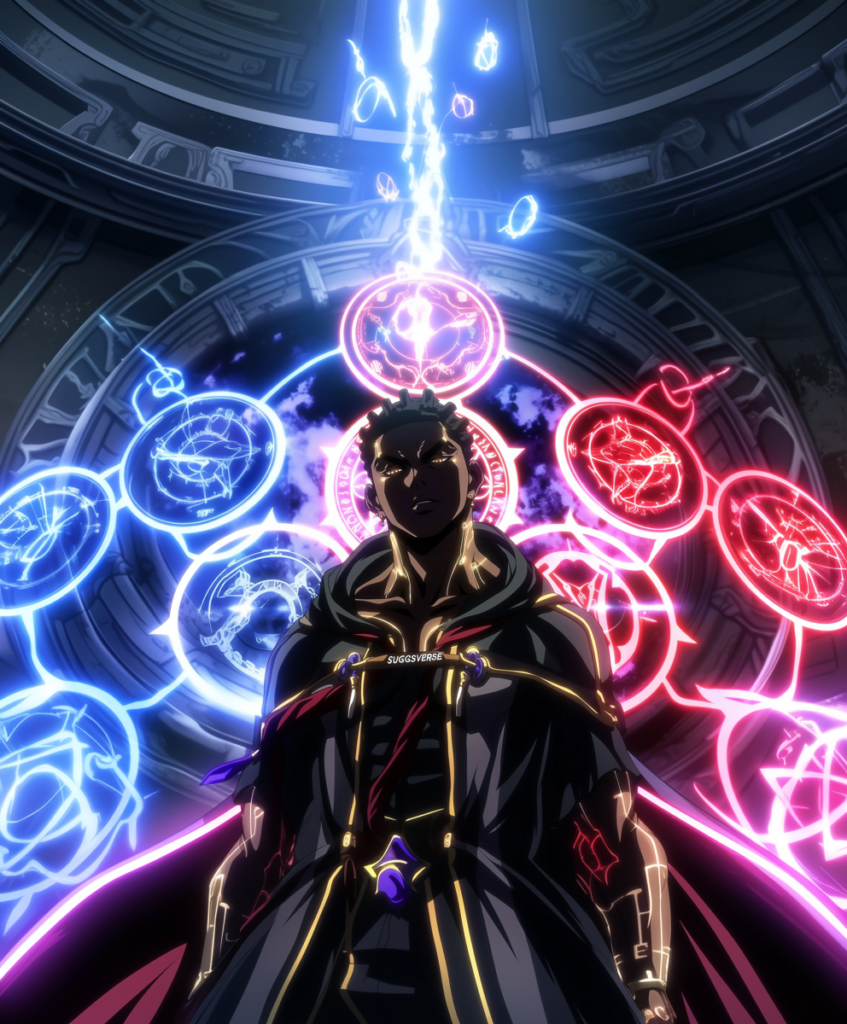
He had not moved for hours. Perhaps days. Perhaps renderless eternities. Draped in a shroud of chronoglyphic residue, Velcryn’s presence did not fill the space—it dislocated it, as if the area surrounding him existed in protest of itself. Every line on his face was a fold of unspeakable confession, a cartography of guilt inked in ontological regret. His hands—calloused not from war, but from scripting impossible treaties—rested upon his knees like dying concepts awaiting a second chance at being real.
The chamber groaned. Not mechanically, not through physics, but through conceptual fatigue—as if the space itself remembered too much and desired to forget again.
And then, without door or sound, presence arrived.
The suggestion of arrival was enough to cause the hall’s perimeter glyphs—those that had refused to vanish entirely—to blink violently, like eyes woken from a long slumber of refusal. And stepping into the reality-ruptured hall was Xenavelle Roquaryn, the self-declared Burning Dialectic, exiled Philosopher-Queen of the Cataphysical Choir-State of Thælzun.

Her appearance was not dramatic—drama implied audience, and Xenavelle refused to cater to the performative illusions of perception. She entered as a contradiction, her silhouette flickering between the feminine, the non-conceptual, and the entirely rhetorical. Her robe, stitched from choral negation and rhetorical entropy, billowed as if rejecting spatial permanence. Her eyes, twin paradox-furnaces, burned not with vision but with unresolved philosophical axioms.
“Velcryn,” she said, though the words never passed her lips. They simply occurred—manifested—within the philosophical aperture between thought and sound. “You invited me to a treaty.”
“I summoned you to an absence,” Velcryn replied, finally lifting his gaze. “A void where treaties used to reside.”
He gestured toward the center of the chamber, where no table sat. No scroll. No documentation. Only a basin—ancient and cracked—filled not with ink, but with negated suggestion, a black fluid that reflected nothing, not even itself. It was the Treatise of Unspeech, and its presence was an indictment.
“You would begin our negotiations with a vessel that holds only what is forbidden?” Xenavelle asked, stepping closer, her voice bearing the weight of entire civilizations that had bled for the privilege of silence.
“No,” Velcryn answered. “I offer it not as vessel—but as mirror. To see what we dare not record.”
Silence stretched.
Xenavelle studied him, perhaps for the first time without contempt. Her excommunication had been, in part, due to Velcryn’s heresies—the scribal philosophies he had injected into the heart of their enemies during the Third Thoughtwar. But here, now, she saw no zealot. Only a man standing before the carcass of civilization, clutching a needle without thread.
And then, the atmosphere bent inward.
Not from entry.
From recursion.
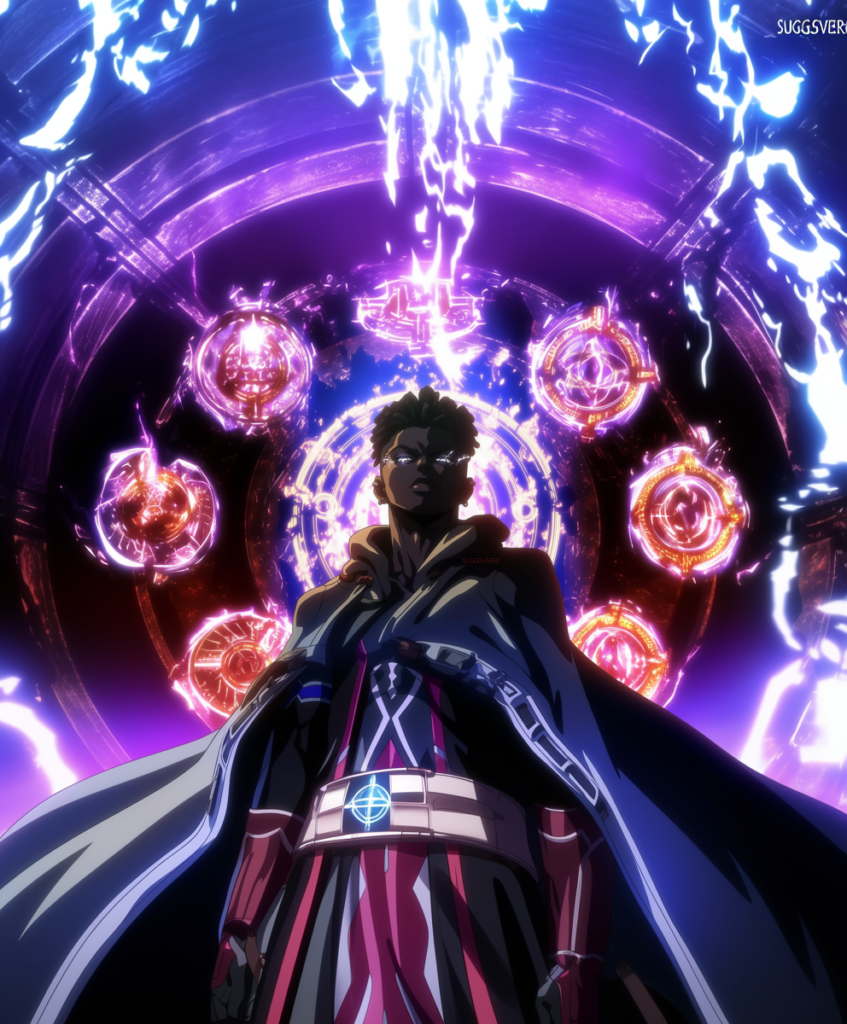
Kaedhrith Vynaeon appeared like a wound in the syntax of reality—his presence not introduced, but repeated from a moment long passed. His cloak, formed from annulled promises and recursive shame, trailed behind him like a history that refused to be footnoted. His armor bore the seal of the Silent Empire of Ash'Vurn, a seal etched not in metal, but in absence of declaration. He did not look at Xenavelle.
Only at Velcryn.
“I warned you,” Kaedhrith said, voice straining to remain causal. “I told you the moment you looked into the suggslogic tomb… you would bring it back with your gaze.”
Velcryn did not flinch. “It was never buried. You know this. The world’s silence only lulled us into forgetting how loudly it used to scream.”
Kaedhrith stepped toward the basin. The negated suggestion inside it rippled violently.
“I know what you think this is,” Kaedhrith muttered. “You want us to confront it. To own it. To wield what was never meant to be held.”
Xenavelle interjected, her voice gentle but unsparing. “Or perhaps to deny it properly, for the first time.”
“But it is already awake,” Velcryn whispered, not to them, but to the chamber itself. “I have seen it in the folds between causation and denial. The Suggshadow. The Original Refusal. It no longer sleeps. It remembers its shape. And its hatred.”
The basin trembled.
And from within, for the first time in ages, a glyphless mark arose—no image, no symbol, no script. It was a scar upon concept itself, an unlettered wound that bled onto the floor in an arcane script that refused translation. It burned not with heat, but with non-consensual memory, forcing all three to remember a moment that had never occurred.
Kaedhrith staggered back.
Xenavelle reached for her Crown of the Unuttered, as if to silence what could not be heard.
Velcryn merely watched.
And when the mark dissolved, leaving only a trembling air behind, he said:
“It does not want peace.
It does not want war.
It wants remembrance.
It wants to be named again.”
A long silence followed.
And in that silence, the background of creation flickered—barely noticeable. A single static beat, as though the cosmic author had hesitated at the next word.