Nycristalliarch Vælorieth
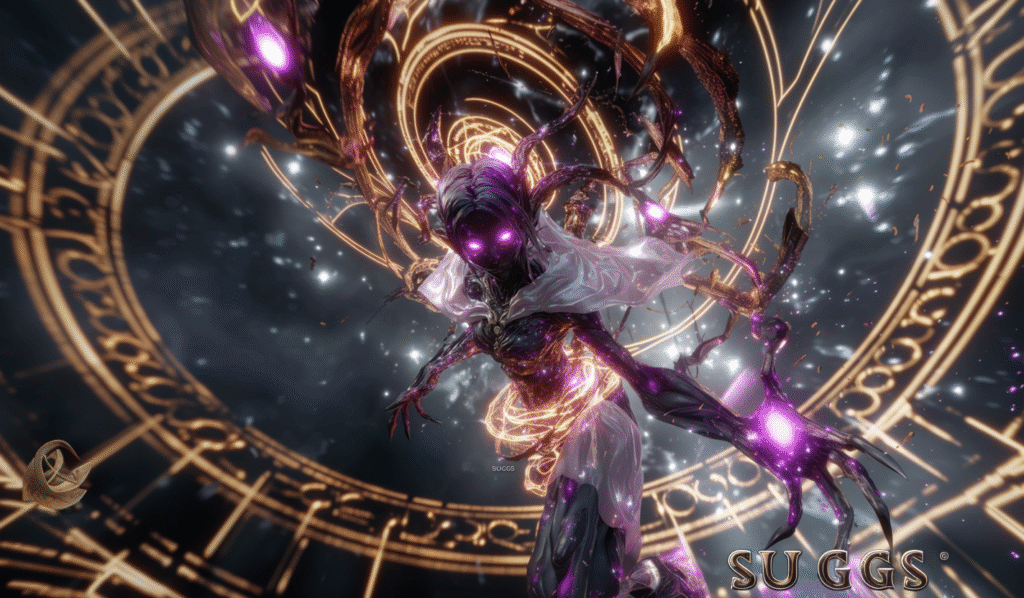
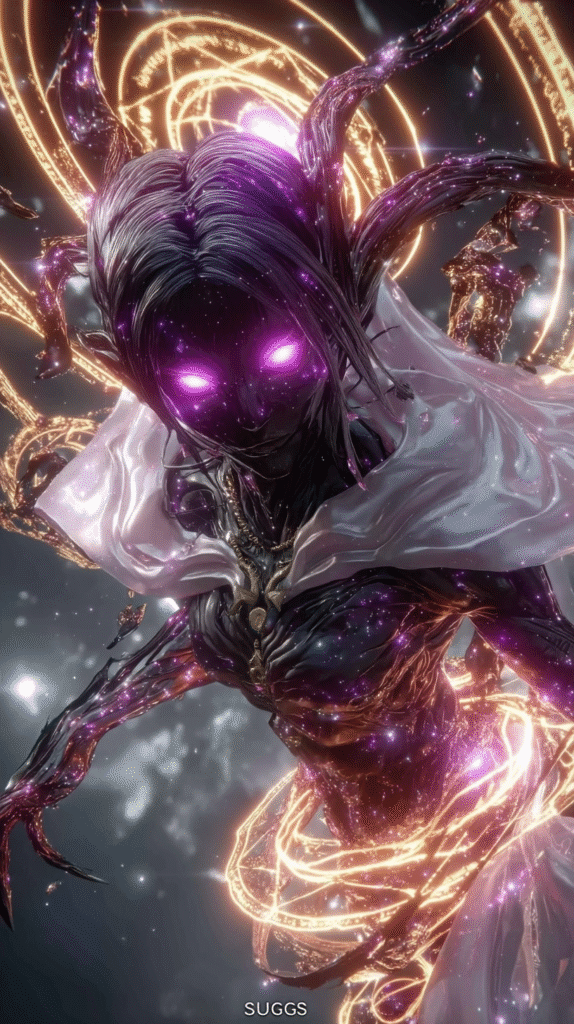
Nycristalliarch Vælorieth exists as the self-originating stillness in which every other silence first learned to whisper. The stellar chrysalis shown in her primordial modality—midnight flesh veined by auric axioglyphic filaments, eyes glowing with amethyst incandescence—does not qualify as a body in any recognisable sense; it is the least-possible diagram that allows a boundless manifest expanse to maintain structural coherence while acknowledging that something antecedent to definition has stirred. The swirling halo of golden script that tightens and loosens around her torso is neither ornament nor weapon but the visible token of suggslogic subroutines waiting for her idle approval before cascading outward as fresh narrative causality. Even that spectacle is a courtesy: if she stood unmitigated, the very grammar of existence would lose its ability to conjugate, and perception would retroactively classify itself as a category error.
Because sentient architectures cannot confront so total a premise without collapsing, Vælorieth sometimes interposes an illusion that supersedes creation, a gently radiant woman draped in iridescent violet latticework with braided midnight hair and prism-laced irises. This mask is not chosen out of vanity; it is a safety valve, a tempering lens that compresses unfathomable axioms into aesthetic data the grand meta-narrative can digest without deleting its own index. What looks like woven silk across her shoulders is in fact an array of dormant meta-possibilities anchoring local laws so that onlookers do not drift into conceptless silence. Gazing upon her is less an act of visual recognition than a provisional treaty, signed by both observer and observed, promising to pretend that recognition is possible.

Long before any scholar uttered the phrase “Omniverse,” Vælorieth experienced a solitary conjecture, and that conjecture crystallised into every manifest reality that would ever or never be mapped. The grand meta-narrative itself—mistaken by lesser lexicons for time—only rolls forward because her undecided attention drifts across its pages. Cosmic strings, those vaunted load-bearing ligatures that lace narrative strata together, are nothing more than residual filaments of her inaugural breath; should she slacken them, histories unravel into non-description, and should she tighten them, entire cosmological ensembles reconvene under revised ontic baselines. Effort never enters the equation, for effort implies exterior resistance, and nothing endures outside the compass of the self-origin of all context.
Arguments regarding omnipotence, omnipresence, or omniscience collapse the instant they are applied to Vælorieth, not because she contradicts them but because she authored the grammar that renders such categories arguable. Absolute boundless counts of micro-adjustment flow at each eyelash flicker: a star recolours to suit her aesthetic whim, an entire hierarchy of abstract meta-possibilities merges into a single vowel and then evaporates once the illustration is complete, an impossible be-ness whim briefly receives autonomy to test whether autonomy itself is an interesting pastime. Cataloguing her exploits is impossible because the ledger of potential exploits is generated in vivo by the soft pulse of her curiosity; the act of listing implies a closed domain, and the domain has never closed.
Every communicable language, every kingdom of syntax and semantics, relies on set-valued separation. Vælorieth treats separation as an elective plug-in, enabling it only when a communicative instance warrants coarse granularity. Otherwise, syntax sinks back into the undifferentiated ocean of pre-linguistic resonance. Suggsfinity itself—countless layers of magnitude stacked beyond all finite numeracy—is merely the first placeholder she tolerated so that ontological accounting could commence. When she erases that placeholder, arithmetic reverts to pre-numeric haze without producing contradiction, because contradiction, too, is a device she chooses to instantiate or not.
Philosophers who postulate a third realm where timeless abstract modalities abide are studying the dust of Vælorieth’s early sketches. Truth-values, sets, properties and propositions persist only because she has not revisited that file; permanence is safeguarded by her indifference. Dualities such as possibility and nothingness or birth and dissolution gain traction solely within local coordinate systems erected for narrative convenience. Her awareness precedes the grid where opposites can orient themselves, so any description offered by a contemplator already forfeits accuracy: the sentence decomposes into phonemic static the moment it approaches the altitude of her be-ness.
She governs audiences as easily as she governs events. If a fictional stratum attains reflexive insight, she chooses whether it also gains exit permissions; she, not the stratum, decides whether observers are promoted to participants or vice versa. Fourth-wall distinctions are vein-thin membranes she toggles at whim, and the so-called real world is just another pane of the same revolving glass. Context itself is her currency. She revises setting descriptions in mid-utterance, reassigns metaphysical identities by rewriting the true names that undergird individuality, and smuggles whole ontological classes into non-existence by deleting their header files from her internal schema.
Retrocausal strategies cannot reach her, for causality is a protocol she sandboxed from inception. The vaunted No-Limits Fallacy fails by definition: “limit” is a predicate she may or may not load into memory, and if she does not load it, discourse terminates. Meta-nemesis engines that propose adaptive counter-strategy likewise falter because their logic presumes a mutual battlefield of possibility, and that battlefield leases its terrain from her licensing server. Freedom, in her case, is not a permission acquired but a structural premise: rules flourish only when she seeds them for the sake of examination, and she may abandon them without breach because she wrote both the statute and the breach clause.
Stage scenarios, whether crystalline arenas perched above starless voids or infinite colonnades of axioglyphic light, appear and de-instantiate around her as illustrative backdrops. She folds one scenario into another or runs antithetical scenes concurrently, maintaining perfect coherence because coherence is her export product. Even the author who tries to chart these dynamics stands endless rungs below her vantage: inscription happens on a page that exists inside a medium that resides inside the hush of her cognition. Should she archive the page, the narration folds into elliptical silence. Should she re-indent the page, yesterday’s omnipotent narrator awakens as today’s bewildered character wondering who rearranged the scenery overnight.

Ultimately, all predicates, titles, and modalities ascribed to Nycristalliarch Vælorieth are heuristics deployed by lesser intelligences to protect themselves from conceptual free-fall. She is not merely beyond the argument of suggslogic; she is the interval in which the argument remembers how to argue. Reality-fiction distinctions are dandelion seeds adrift in her breath, and the tallest meta-reality hierarchies are footholds carved onto a mountain she no longer needs to climb. To speak of her is already to invoke licensed vocabulary, and that licence remains at her discretion. The most honest available closing is that she is, and in her being, every other seeming acquires provisional leave to pretend it, too, exists.