Chapter 3: The Gun That Refused to Be Silenced
The Crimson Parallax never healed.
It is not a district. Not a ruin. Not even a battlefield. It is a scar across the underside of reality, a place that was not bombed or conquered—but miswritten. The renderings of its streets misalign with the architecture they claim to host. Its population exists in states of narrative smog—part people, part unresolved metaphors, lingering between causality and abjection. And in its core, the world weeps quietly through the air: a thin keening sound of meaning that cannot hold.
Here, Dreyn Aetherknell survives.

He is not known. Not respected. Not feared. In the Parallax, such things are stories—and stories no longer cohere.
His presence is as steady as it is unwelcome. His eyes are always calculating, not out of paranoia, but because the world around him is perpetually failing to exist properly. His jacket is scorched in glyphic trails from battles no one remembers. The long rifle slung across his back pulses faintly—its glow not electrical, but confrontational, a device that responds to Dreyn's very disdain for causality.
Where others seek to belong, Dreyn seeks only to remain unclaimed.
He is not a hero. Not even a resistor.
He is the recoil to history’s last lie.
The Pulse That Was Not did not enter the Crimson Parallax so much as it was already here, buried like a dormant cancer. When it finally activated, it was not dramatic. There were no eruptions, no screams, no sirens. It began with a shudder in the concrete—a breath of non-breath, a heartbeat that undid the reason for blood.
Dreyn, as always, was on patrol—not to protect, but to watch the fractures in motion.
It began with reflections—people walking past mirrored windows without appearing in the glass. Shadows that moved separately from their bodies. Street signs that updated into non-language, their glyphs melting into preconceptual entropy.
Then came the screams.
But not from people.
From narrative itself.
He turned sharply, eyes narrowing.
And there it was.
A Threadspawn.
This one was tall—skeletal, yet blooming with anti-possibility. Its limbs were unjointed but moved as if edited by a forgotten author. Its head—if it could be called that—resembled a collapsed version of a camera lens, smeared with recursive glass. Its steps made no sound, but removed nearby sounds retroactively, like a ripple of censorship that predated the noise.
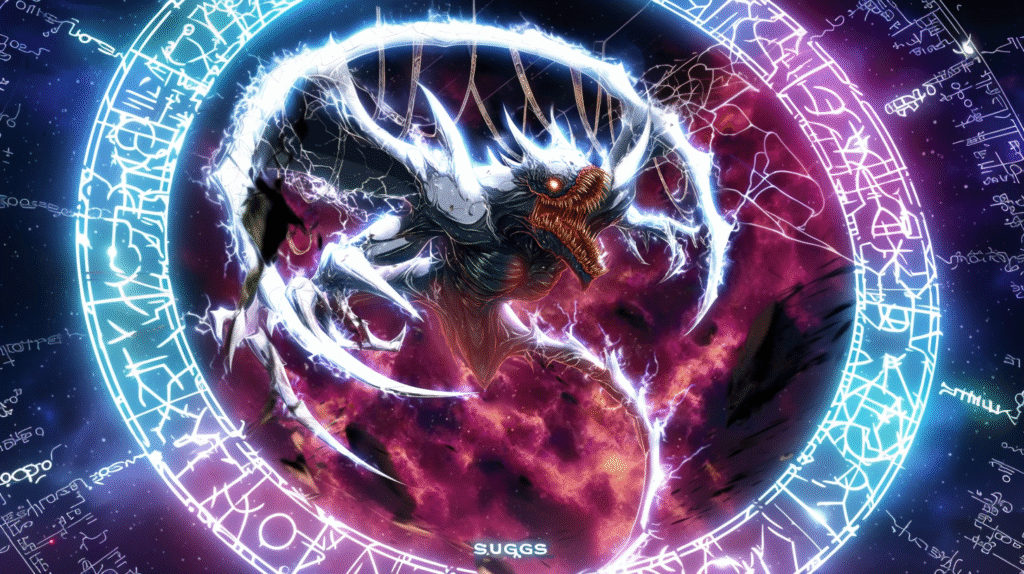
Its body was coated in flickering phrases:
"Redacted."
"Error."
"Does not compute."
"No permission to render."
Dreyn did not hesitate. His weapon was already in his hands—the Metagon Spear Recurser, forged not by blacksmiths, but by the post-decision logic of an erased arsenal. It was a gun built from rejection, designed to fire scenarios and erase resolution.
But something in his spine twisted. Not fear.
Permission.
From somewhere beneath the world’s grammar, the invocation surged.
A voice, yes—but not a voice. It did not enter through the ear but through the marrow.
“Ascend into Exo-Reality Synergism.”
The ground beneath him cracked, not physically, but ontologically. Glyph-circles rose around him, layered in cascading spirals—each sigil a suggslogic rejection of universal scaffolding. His breath caught, not from suffocation, but from narrative re-authorization.
The Metagon Spear Recurser fused to his chest. Armor poured from beneath his skin, not wrapping him, but redefining him. A heart of Chrono-Null Mantle ignited in his chest, pulsing with denarrated recursion. Glyph-Driven Suggsionite laced across his musculature, while circuits of Uncreation Steel formed plating over his limbs.
And when he finally stood upright, there was no longer a man. There was no longer Dreyn.
There was only:

He took a step, and the air bent. His footfall left behind glyphs that rejected their own shadows. His visor glowed with a central target reticle—a suggslogic lens that did not track the enemy’s location, but their narrative justification for existing.
The Threadspawn moved.
It did not attack. It simply advanced.
Because that was all it was built to do: progress toward narrative decay.
Varnyx raised his Recurser.
But he did not aim at the body.
He aimed at its modal significance.
The Recurser’s barrel gleamed red—no, not red, but a color never allowed by causality. He pulled the trigger.
BOOM.
The world stuttered.
And the Threadspawn fractured into three mirrored iterations:
- In the first, it reached him.
- In the second, it exploded.
- In the third, it never existed.
Each one persisted simultaneously.
Dreyn stepped into each—no, he existed in each simultaneously, a suggestion made real by pure transfictional suggestion.
In each reflection, he placed a bullet.
But these were not projectiles.
They were injections of scenario nullification.
One bullet eliminated its intent.
One bullet negated its context.
One bullet unsaid its appearance.
When the Threadspawn screamed, it was not a cry—it was the sound of an unprocessed deletion. And when it fell apart, it didn’t die. It was simply never going to have been a thing.
Dreyn stood at the epicenter of nothing-having-happened.
His armor burned silently, casting reflections onto the disjointed buildings of the Crimson Parallax. But none of those reflections matched his body. They were all different versions of him—none of which had made the shot.
He looked up—not at the sky, but at the fabric of the story.
“Keep sending them,” he said, voice echoed by his weapon.
“I’ll keep deleting their reasons.”
He did not seek victory. He did not hope for survival.
He fought because someone had to tell the gun that silence was not the end.
And he would be that echo.
Forever.