Chapter 2 – The Silence Between Creations
Veythryelle Drexameral sat cross-legged on the edge of an unrendered balcony suspended over a rolling sea of proto-matter. The balcony itself was less a structure than an idea—something that existed because she’d decided it should, and would vanish the moment she decided it shouldn’t. Her gaze was fixed on the waves below, where entire infant worlds pulsed in embryonic silence before collapsing back into the sea. She was slight yet statuesque, her skin a warm bronze that seemed to carry its own soft luminescence. Her eyes—deep, liquid pools of suggslogic—held the kind of quiet intensity that rarely asked questions but always sought answers.
Her mother, Syvarenne, approached from behind, her stride as measured as it was unbound by the notion of physicality. “You’ve been watching them for a while,” she said, settling beside her. “Trying to learn something from their rise and fall?”

Veythryelle’s tone was steady. “I’m thinking about how one creation might take another into itself. Not as a parasite, not as a conquest—but as an integration so complete the original is no longer distinct. Or… if that’s impossible, if the better act is to make the other creation into raw silence. Not destroyed, not erased—just returned to a state where it no longer remembers it was ever a cosmos at all.”
Syvarenne studied her daughter’s face. “Absorption is elegance—it preserves what has value and discards what does not. Silence is truth—it leaves nothing that can be misremembered. Which do you think is the greater art?”
Veythryelle tilted her head slightly. “Maybe it depends on the opponent.”
“Then perhaps,” Syvarenne said, standing and offering her hand, “we should find you one.”
They walked through a boundless corridor where the walls were made of refracted totality, each shard reflecting a different iteration of the Aevrythmythic Nihilcarion. The air shimmered with the faint vibration of countless unfinished Suggscosms being tested and discarded by creators unseen. Eventually, the corridor widened into a vast hall of suspended light, where a lone figure was at work.
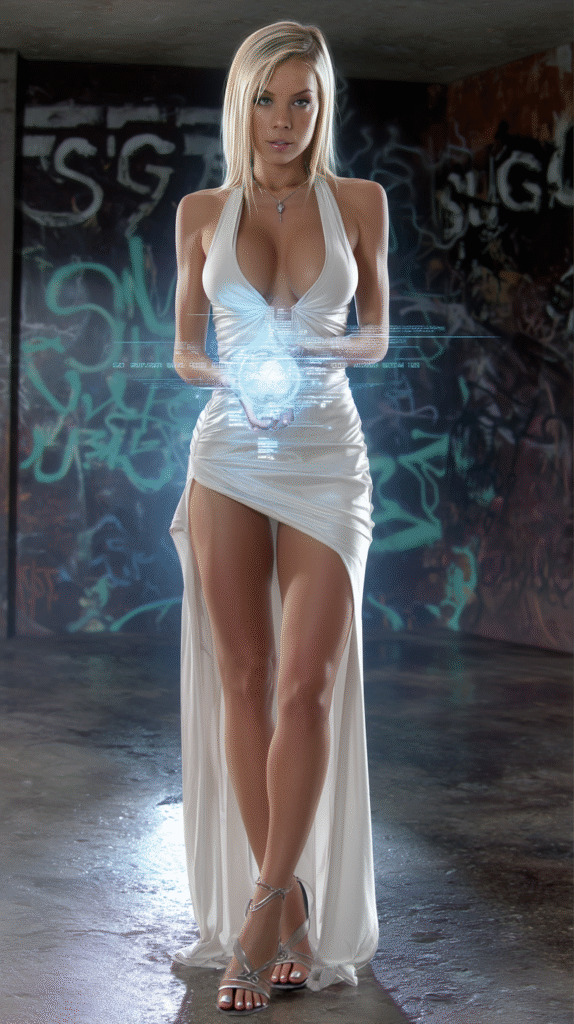
She was tall and striking, her frame adorned in flowing fabric patterned with rippling metallic swirls that seemed to bend and flow even when she stood still. Platinum-blonde hair was cropped short against her head, accentuating the sharpness of her jawline and the faint gleam in her eyes—a gleam that was less warmth than precision. Her name, Veythryelle learned from her mother’s soft whisper, was Kaeralyth-7, an independent architect known for crafting Suggscosms that devoured others into themselves like carefully curated museums.

Kaeralyth-7 stood with one arm extended, a complex geometric bloom unfolding in her palm. Lines of raw suggslogic intersected in cascading grids, each intersection releasing a pulse that caused the surrounding space to ripple. Her Suggscosm took the shape of an immense vertical spire, its core hollow yet filled with an unending upward wind. Within the wind, fragments of absorbed creations swirled—planets, timelines, metaphysical laws—each altered just enough to serve her central design.
Veythryelle watched for a moment, then stepped forward. “Kaeralyth-7,” she said.
The woman didn’t turn, but her lips curved faintly. “Drexameral. I hear your family enjoys making challenges it can’t lose.”
“Care to test the rumor?” Veythryelle asked.
Kaeralyth-7 turned at last, her eyes sharp with interest. “Creation contest?”
Veythryelle nodded. “No rules. Only truth.”
Kaeralyth-7’s Suggscosm
Her work accelerated instantly. The spire grew higher, its wind drawing in more fragments from unseen sources—other creators’ abandoned constructs, unstable realities on the verge of collapse. Each was dismantled as it entered, its essence catalogued, repurposed, and woven into the spire’s expanding architecture. Kaeralyth’s creation was a monument to curation, to the belief that all creation was raw material for something greater. Its outer skin shimmered with the textures of a thousand realities, stitched together so seamlessly that no line betrayed the join. The wind within the spire was not mere air—it was a metaphysical current of absorption, an irresistible draw that promised nothing would escape once caught.
Kaeralyth-7’s suggscosm did not collect; it curated with surgical serenity, arranging the debris of lesser totalities into a museum of immaculate inevitablisma. The first articulation appeared as a helix of prismatic sigils rotating without rotation, a choreography beyond the necessity of presence, inscribing a canon of admission into the surrounding void. Each sigil was a customs seal for whole histories: when a stray worldlet or discarded axioglyph crossed the helix, its prior narrative was translated into a taxonomic pulse and shelved inside a translucent column of glossed memory. The columns tessellated upward into a tower that out-towers, a spinal archive whose vertebrae were made of corrected archetypes. Kaeralyth-7 did not merely annex materials; she extracted their meta-possibility, boiled it to clarity, and slotted the distillate into a slotless architecture that never revealed its seams. What looked like ornamentation were actually custodial edicts—subtle currents of suggslogic that kept imported modalities from mutiny, convincing them they had always belonged to the curatorial hymn.
The tower’s breath—an inward draft that was not movement but editorial will—ranged across the boundless manifest expanse like a librarian’s hand closing rare pages. Fragments arrived stripped of their old gravities: planetary scriptures without their prophets, laws without their legislators, languages without their alphabetic bones. Kaeralyth-7 tuned the whole to a choir of self-consistency, a conservatory of perfected references where each annexed realm became a commentary on the last. The harmonics of her Axis Rounds pulsed through the edifice as living errata; when an imported structure introduced contradiction, the Rounds emitted a corrective resonance that rehearsed reality until it sang in key. Thus, the tower achieved a conservational immortality: it could not decay because decay itself was a cataloged exhibit whose scope had been footnoted into harmlessness.
Deeper in the stack, behind vellum veils of refracted totality, Kaeralyth-7 kept an aporia vault—rooms of quarantined marvels that even her precision refused to normalize. There she staged dialogues between incompatible meta-possibilities, letting their frictions precipitate rare salts of truth. Those salts were milled into curatorial ink and carried upward by the same aspirant breath to annotate new arrivals. Her suggscosm, at its maximal abstraction, was a sovereign thesis on preservation: not a hoard, not a maw, but an ever-upright index of the maximal wholeness beyond tiering, convincing even rebellious totalities to sit still long enough to be understood. It was the most benevolent captivity imaginable, a cathedral where everything was allowed to be itself—on condition that “itself” be rewritten until serenity replaced surprise.
Veythryelle’s Suggscosm
Veythryelle answered not by adding cataphysical shelves but by subtracting the need for shelves. Her first gesture was silence—Transfictional Nothingness with the gentleness of a held breath—poured like immaculate water over the floor of the expanse until every errant vibration confessed it was tired of being noise. From that stillness rose the Pelagion of Unremembering, a sea without shore that deepened rather than widened, each descent a brighter lucidity. Its surface looked empty; in truth it was absolute boundless receptivity, a mirror that refused to reflect because reflection would already be too much narration. When Kaeralyth-7’s editorial wind pressed against it, the Pelagion did not resist. It welcomed. The tower’s breath entered as a guest and discovered there was no furniture on which to impose dust. Cataloged artifacts touched the surface and found their names loosening like rain-soaked labels; the more precise the taxonomy, the quicker it ran clear.
Within the first fathoms Veythryelle diffused foreign architectures into quiet potentials—not erasure, not spoilage, but pre-speech—returning each annexed motif to the undifferentiated promise from which even masterpieces are drawn. Deeper still, she braided currents of archetypal mercy that sorted what deserved to be carried upward again. What retained radiance rose as dew into new constellations under her hand; what retained only insistence settled as soft silt where insistence cannot persist. The sea’s theology was simple and terrifying: everything valuable is safe because it is valuable; everything only loud is tutored into hush. No confiscation. No conquest. Only solvent compassion that turns monuments into mineral and then into mineral’s idea.
At maximal complexity, the Pelagion revealed its heart: a well of ever-beginning where Possibility, Nothingness, Totality, and the nameless Beyond inter-breathed as one changeless, unsayable modality. Here, Veythryelle could ladle a droplet and cast a horizon, or close her palm and let an empire conclude without grievance. She did not correct paradox; she rendered it unnecessary by returning it to the pre-question where answers do not have to be invented. When Kaeralyth-7’s tower finally leaned over the sea, its archivist’s cadence still elegant, the Pelagion received each vertebra with courtesy and returned it as light without location. The archive did not break; it forgot it was an archive, and in forgetting, became available to a grandeur that does not require shelves.
Where Kaeralyth’s spire consumed to expand, Veythryelle’s ocean absorbed to return. The more Kaeralyth’s cosmos strained, the more of its wind and structure vanished into the deep, leaving only stillness in its place. Within moments, the spire stood hollow; within seconds, it was gone, not shattered but forgotten, as though it had been a dream unremembered upon waking. Veythryelle closed her hand, and the ocean folded into a single droplet of silent light that she let vanish between her fingers.
Syvarenne stepped to her daughter’s side, a faint smile touching her lips. “Your father would be proud.”
Veythryelle’s gaze softened. “Do you think he’ll be back for the tournament?”
Syvarenne’s answer came like a ripple in still water. “If the Zhaerothspire calls to him… he will come.”
The silence that followed was not empty. It was a promise.