Chapter 13 — The Critique That Burns Without Wounding
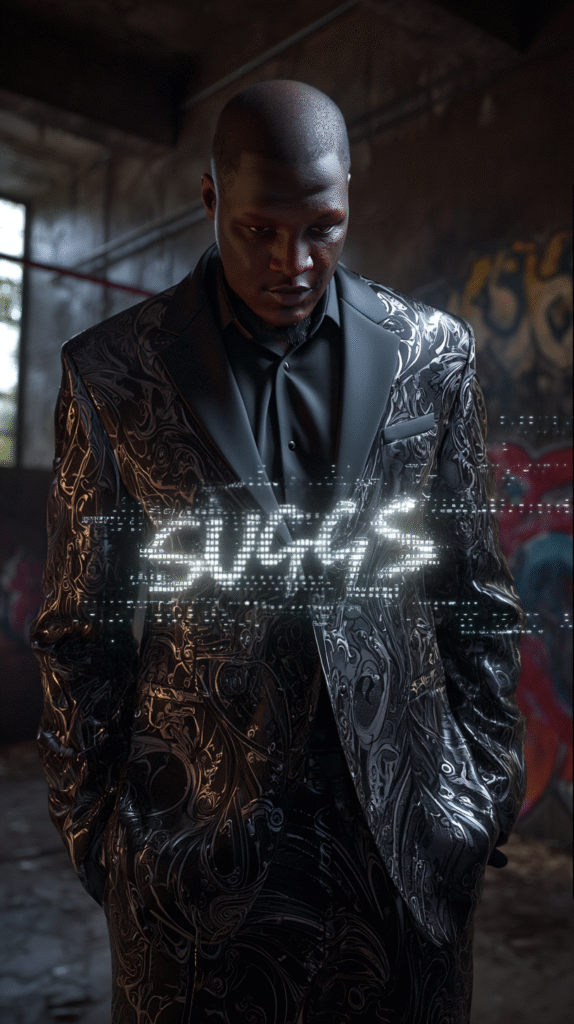
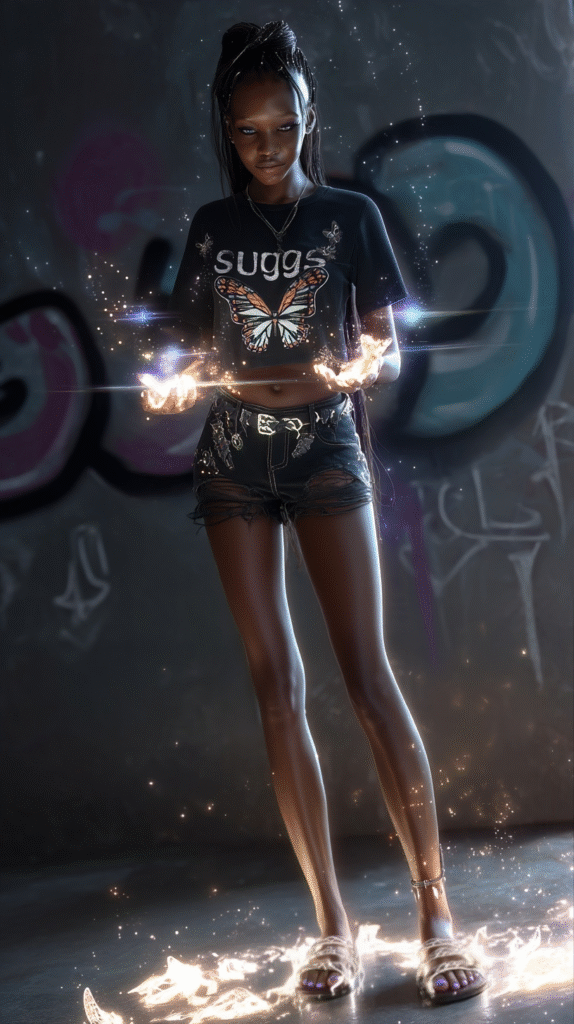
The city had not yet learned how to breathe again. After Ømnivra-Kaelis//Serraphryct had been swept into the polite abyss of irrelevance by Dravanyth Kaelhorne Drexameral, the streets remained in a hesitant composure, as though fearing to break into casual rhythm too quickly. Neon’s glow felt self-conscious, stone facades pretended at solidity, and the air moved as if whispering apologies to itself.
Father and daughter walked through this landscape as if they were walking through the margin between two truths—parallel, present, yet never the same. Dravanyth’s stride was precise without urgency; Veythryelle’s was lighter, yet deliberate, each step still ringing faintly from the battle that had ended only moments ago.
“You felt it, didn’t you?” he asked without looking at her.
Veythryelle’s gaze traced the wavering edges of a signboard that kept forgetting its own letters. “Felt what?”
“That your Suggscosm is still a scaffold, not a citadel.” His tone was surgical, a blade that cut with the intent to excise, not to maim. “It moves, yes. It unweaves and rewrites. But it behaves too much like a mannerism. A well-practiced trick, rather than an inevitable condition of existence.”
Her jaw stiffened, not out of defiance, but because she already knew it. “It’s mine,” she said simply.
“That is not a defense. Possession is a consolation for those who cannot transform. If it is yours, it should not be recognizable. It should not be nameable. Your enemies should enter it and forget they were ever outside. They should forget that outside exists.”
She turned her head toward him, studying his profile. “And yours?”
Dravanyth’s eyes didn’t shift. “Mine is not an ‘it.’”
The remark landed not as arrogance but as anatomy—a statement of fact about organs unseen. The silence between them carried its own texture. Somewhere overhead, the clouds fractured into motes of static, the sky momentarily reconfiguring into a lattice of undecided shapes before folding itself back into anonymity.
They passed a row of buildings whose windows refracted wrong—each pane showing not the street but moments Veythryelle had never lived, versions of her that had taken paths she had never chosen. One window showed her walking away from Dravanyth; another, fighting him; another, never having met him at all.
She paused at the one where she stood triumphant over a battlefield of collapsed structures, her hyperlattice expanded into something vast and unknowable. The vision pulled at her.
“That’s closer,” Dravanyth said, following her gaze. “But still flawed. You see the size and think it matters. You see the intricacy and think it protects you. These are decorations. A Suggscosm that needs to be admired is already compromised.”
She looked at him. “Then what does it need to be?”
“Not a place,” he said. “Not a design. It must be an inevitability. An environment where all possibilities and refusals are already spent before they are even considered. Not an arena, but the ending and beginning of arenas. A total circumstance that cannot be trespassed because it is the only circumstance.”
Veythryelle’s breath was quiet but uneven. “And how do you—”
“You stop pretending to hold it,” Dravanyth interrupted. “Let it exist without permission. Let it predate your name.”
They continued walking. The streets shifted in response to their conversation—the ground occasionally fracturing into patterns only to stitch themselves with threads of unlight, storefronts receding into tunnels of contradictory depth, passersby flickering between shapes as if unwilling to settle on which self they wore in this reality.
Veythryelle closed her eyes for three steps, trying to feel what he meant. When she opened them, her Suggscosm was already responding—edges softening into gradients that had no limit, rules shedding themselves like old skin, presence merging with the unnameable until there was no anchor to measure it by. The air around her hummed in a frequency the city didn’t understand, and the world leaned slightly away, as though giving her room to grow.
Dravanyth nodded once—not approval, but acknowledgment. “Better. But do not mistake emergence for completion. Growth must also be subtraction. What you build, you must also erase without resistance. If your Suggscosm cannot dismantle itself at will, it is not alive. It is a cage—an ornate one, but a cage nonetheless.”
She let the words sink, the weight of them both oppressive and liberating. The hum deepened, the lattice folding and unfolding in a cycle that no longer cared for observers. For the first time, her creation felt… not bigger, but prior.
They turned down a narrow, lightless street. The walls on either side were too close, as if the manifest expanse had decided to test their proximity. Every footstep seemed to erase part of the path behind them.
At the end of the street, a shadow stepped forward—not a thing emerging from darkness, but a darkness that had decided to shape itself into a thing. The figure’s outline was certain, but its details refused to settle—except for the eyes, which mirrored Dravanyth’s perfectly.
“Father,” the voice said, neither cold nor warm, but inevitable.
Dravanyth’s steps slowed, but his posture remained unaltered. Veythryelle looked from one to the other, the hum of her newly shifting Suggscosm pausing, waiting.
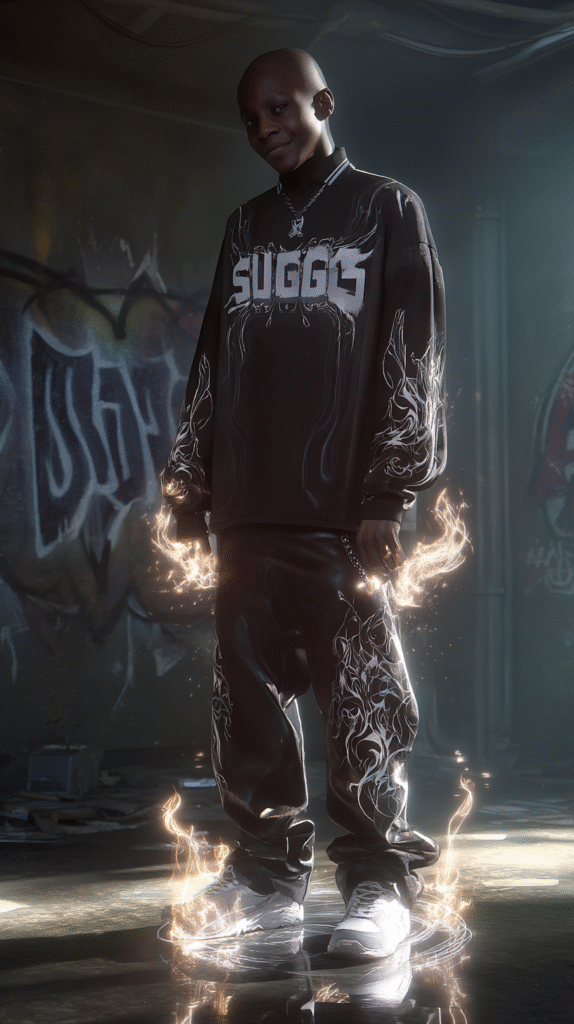
“Son,” Dravanyth replied.
The air contracted around them, preparing for something that would not be mistaken for a reunion.