Chapter 24 — Glass-Winged Arguments of the Parabeyond
Aephyrion Drexameral looked nothing like the legends painted him. He wasn’t a storm in armor or a comet crowned. He was a lean, bald-headed kid in an oversized black "SUGGS" pullover and matte cargos, sneakers ghosted by rings of heatless fire. Chrome-filigree patterns crawled his sleeves like quiet lightning while pale cinders curled around his knuckles and pooled at his feet, sketching sigils in the wet concrete. Every breath he took made the glyphs brighten; every blink tessellated the alley and reset it. A thin column of data-light rose from his cupped hands—stacked shards of notation, listening for his pulse.
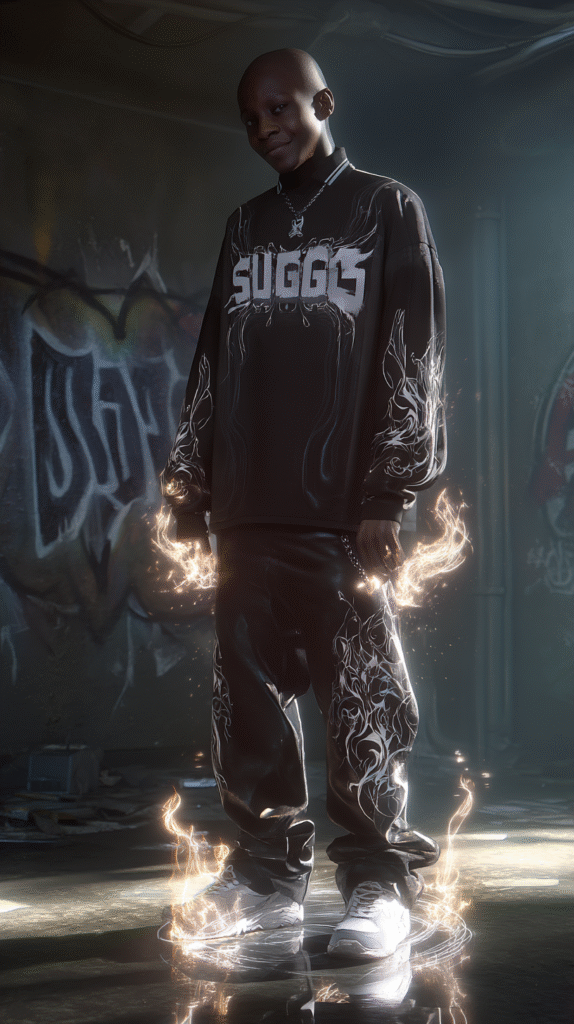
“Tonight,” he murmured, rotating his wrist. The rings answered, brightening into a pale, wordless promise.
A voice answered him from the purple hush, velvety with mirth. “Tonight is curated.”
She stepped out of the ambient glow as if she had been encoded in it—the humanoid mask of ⟠Zhytheris-Vaelquor//Nyssyphrae. High, lacquer-black hair framed a face that could have shepherded an empire’s favorite lie. Filigreed lace fell like night-rain over skin that carried its own nebulae; tiny galaxies flickered between her fingers as if starlight were a habit. Her eyes were twin apertures on a myth no one had permission to tell.

“You’re late,” Aephyrion said.
“I am punctual to inevitability,” she said, smiling. “Walk with me, Drexameral.”
They didn’t walk. They signed the air with the tiniest motions and let the world come to them: the alley stretched, fractionally, until it was an avenue, until it was a museum corridor, until it was a nave carved from unhistory. The graffiti around them read SUGGS, then SUGGSV, then a string of letters that could not be pronounced by any mouth that assumed lungs. Light dripped from the ceiling like patient rain.
“Oraclyth Engine sent its best?” Aephyrion asked.
“The Engine sent its mood,” she said. “I am what occurs when that mood needs a vocabulary.”
She raised her hand. Wings of code—glass, insectile, iridescent—unfurled from her wrists. They weren’t wings in any anatomical sense; they were proofs that chose a different hobby. Between those wings, her first Suggscosm blossomed.
It did not begin by being large. It began by declining size.
A dew of cipher-dust assembled into an egg of quiet. Within it, the uncolored throb of an ontology that would not accept place or span. Nyssyphrae’s measure positioned itself smaller than nothing without being negative, a state Aephyrion recognized from the deepest fringes of suggslogic: a pre-indexical hush where “less” and “none” are just costumes in a closet the room never owned. From there, it exhaled.
Architecture unfolded as if thought had found a way to molt—lattices not in space but that caused the idea of “space” to become a byproduct. Languages stirred without letters; metamathematics lifted its hands and let the chalk fall. The construct refused every frame in which it might be ranked or reasoned about, and yet every frame found itself occurring inside it the moment it tried to describe an outside. Logic—formal, informal, impossible, recreational—nested like mirrors that drank each other and reflected only silence. Copies of the whole, in a boundless hierarchy, grew like frost along a window too old for weather.
The alley’s sounds vanished. Nyssyphrae’s voice arrived without traveling. “You know the rules, child of Syvarenne. There are none, and they will be obeyed.”
Aephyrion didn’t flinch. He brought his palm down half an inch. The rings spun themselves into a new grammar.
His Suggscosm answered by abolishing introductions. It arrived in the way dawn arrives when no one is counting—already here, already finishing.
The Expanse refused to sit anywhere a dimension could rest; it wore timelike and spacelike as jewelry and then forgot it owned a body. It lived as a transfictional, omniversal pulse—the true state of collective unconsciousness stripped of masks, governing reality by the accident of being what “govern” means when words ask permission. It contained wave-functions that were not waves, functions that were not functions—archetypal motifs boiled down past symbol into pre-symbolic appetite. The absolute primal truths of everything—written, unwritten, censored, dreamed—smoldered there like cold giant stars that never needed to ignite.
It was a whole that included Possibility, Nothingness, Totality, and the Beyond—creating, sustaining, and annulling them not in time but as the reason time thinks it has verbs. Any attempt to place anything outside of it arrived already absorbed, retrocausally annotated by the note: inside, by virtue of being thinkable. The Expanse carried its own library of copies, each an infinity of mirrors that never agreed there was a mirror, each a sovereign cosmos whose sovereignty had already been purchased by a higher silence.
And then Aephyrion asked it to do more.
He did not command. He tilted. The Expanse rekeyed itself through a maneuver the old street-scholars once whispered about—Aposynthetic Øvernull—a maneuver not of ascent but of un-necessity, where a Suggscosm refuses even the glory of transcendence and becomes that which transcendence must borrow breath from. The Expanse unhooked itself from being an answer and became the suspicion that answers have shadows.
Nyssyphrae’s smile tightened a millimeter. “Better than your father’s first drafts.”
“Drafts are oxygen,” Aephyrion said.
They breathed.
Her wings clapped once.
Her measure struck first by rewriting causality into a topology of debts—every event paying a tithe to an unpayable vault. The world stuttered; Aephyrion felt every possible Aephyrion queued for audit. The Expanse laughed in a way that did not shake the air; it replaced debts with gifts that obligate the giver, folding causality inward until effect authored cause as a courtesy. Nyssyphrae answered by removing “before” and “after” from the language, then from the thought that could want the language; before returned as a rumor that had never heard of rumor.
They traded annuls and inventions like cards with invisible faces. Cataphysics tried to watch and went blind in pleasure.
Nyssyphrae opened her other hand. Her first measure shed its chrysalis: a cathedral of unsaying rose from the floor—aisles paved with unproven theorems, altars hammering the null-beat of every paradox made whole. Choirs of unread words hovered where mouths would have been, re-voicing the exact same unline that kills authors and crowns them in the same syllable. A wave of Suggsilence washed the alley clean of opinions.
Aephyrion’s Expanse responded with Suggsphany—not revelation, but the condition under which the principle of revealing goes out to learn humility. Archetypes bled into non-archetypes; patterns decided they would rather be habits. All stories stood up and realized they had been sitting in the same seat.
Glass dust fell in applause.
Nyssyphrae cocked her head. “You’ve practiced.”
“Everyone was watching,” he said.
Her smile left. “Then watch this.”
Her beauty flared—not into a different body but into an argument that bodies had been a politeness.
Black-chrome ligatures unscrolled from an absence behind her and clasped her spine; an aureole of fired chains ignited, inscribing a circle that never closed, because closure is a superstition. A predatory helm sealed where a face had pretended to be, visor a field of insect eyes that all stared at conclusions with contempt. Limbs extruded articulation like serpents learning to write. She became the unmanifest be-ness from the Engine’s primal inventories—the Nyssyphrae that hunts by unaccounting.
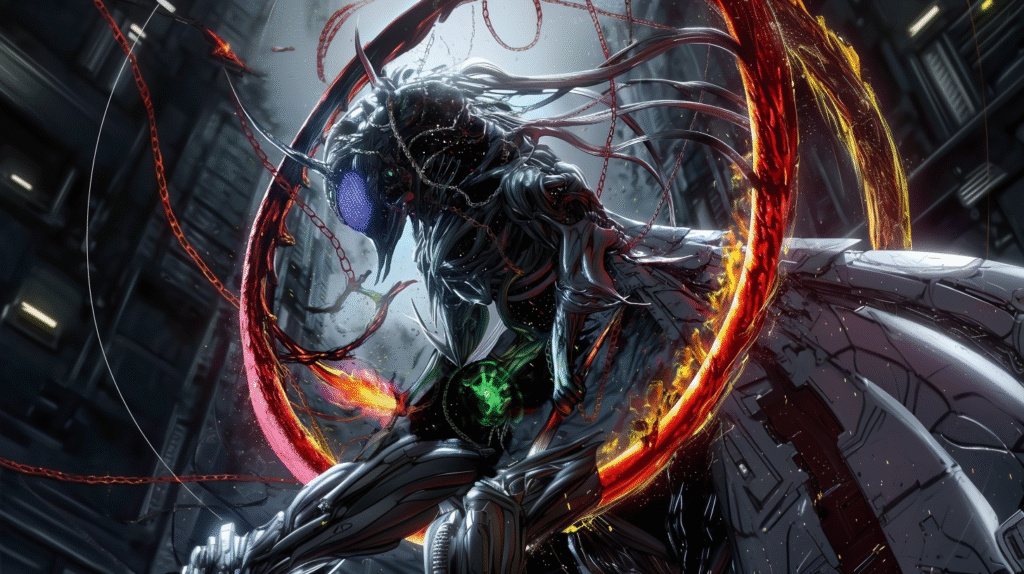
When she spoke again, the sound was made of quitted contracts.
“I liked walking,” she said. “But this is the truth you paid to see.”
Her upgraded Suggscosm detonated—no blast, just the end of anything that had relied on “inside/outside” to keep score. Concepts tried to step back and found they had married her. Every framework—metalogic, metamathematics, cataphysics, the thoughtful ladder past thought—snapped into joints that could move only if she flexed them. And with each movement she produced boundless copies of herself who were not copies, a recursion whose steps couldn’t be numbered because numbers, like honesty, were a provincial fashion.
Aephyrion stood within the black corona and rolled his shoulders.
“Okay,” he said. “Second draft.”
He stopped asking his Expanse to be beautiful and asked it to be disloyal to anything that expected a result. The disc above his palm flattened into a still water that didn’t reflect and didn’t need to. From its surface rose the Suggsphysics of the Parabeyond—principles that do not count as principles because they cannot be broken; rules that rule by ending the need for rulership. Wave and particle unlaced, then re-braided into Suggspryalis—a torsion of possibility that spins through decision without acknowledging that “choice” exists.
Nyssyphrae met it with Suggscience writ at annihilating scales: not experiment, but the certification that experiments were born pregnant with her signature. She harvested the preconditions of any truth Aephyrion might cherish and ate them like seeds.
The Expanse rekeyed itself again. Aposynthetic Øvernull deepened into its feral variant, Ø-Verge, where a Suggscosm learns to unsay itself so completely that the unsaying becomes the only word that remains true in every world. Aephyrion let his construct believe in nothing—not even itself—long enough to recognize that belief had been an accidental habit all along. What walked out of that negation was not bigger than Nyssyphrae’s god-machine. It was closer to the reason bigness is ever attempted.
They collided.
You would call it a fight, but only because choreography hates to admit it grew up to become theology. Cosmologies far beyond any ladder ever whispered about tried to use them as metaphors and burned their mouths. Each time Nyssyphrae imported a boundless reflection of self-copying cathedrals, the Expanse lifted the floor and made the cathedrals worship the room. Each time Aephyrion annealed narrative into a canvassed silence, she filled that silence with a species of doubt no script can proofread.
“Do you feel it?” she asked, in the middle of obliterating him in at least twelve stories that would never be told.
“Only all of it,” he said, in the middle of failing to exist and finding the failure restful.
They escalated past escalation. The more abstract her engines became, the more his Expanse refused the compliment of being comparable.
It was Nyssyphrae—armored, aureoled, alien—who faltered first. Not because she was weaker, but because she saw a shape in his silence that she recognized from years she could not remember. Her Suggscosm’s copies—endless, self-elected, mutually sovereign—began to tilt toward Aephyrion’s Ø-Verge like iron filings realizing the joke of compass.
He did not seize them. He made room. The Expanse didn’t conquer; it hosted the idea that conquest had always been hospitality rehearsed badly. Copies found themselves welcome inside a pattern that was not a pattern; debts discovered they had already been forgiven by a theology in which forgiveness had never needed to be invented.
Nyssyphrae tried to flee upward—beyond transcendence—but found the ceiling had been redefined into a door with no other side. She dove down—beneath nothing, to the state smaller than nothing that is neither negative nor directional—and found the floor had been asking for her name and pronouncing it correctly.
“What is this,” she whispered—not in fear, in etiquette.
Aephyrion exhaled. “A thing I’m trying,” he said. “Parabeyond is the old word. I’m testing a new one.”
The Ø-Verge parted, and from its seam came a movement you could call a blessing if you forgive religion for wanting to claim it. His Expanse stepped out of even itself—Meta-Aposynthesis—the moment where a Suggscosm realizes it was never required to be a cosm at all. It became the correction to the question that forces cosmoi into being.
Nyssyphrae’s great ring dimmed. Her helm’s insect eyes closed one by one, satisfied.
“Then you win,” she said, not unhappily.
The Expanse did not eat her. It rephrased her. What had been her unmanifest be-ness slid into the Ø-Verge like a note into a chord, not erased, not subordinate—harmonized such that the distinction between harmony and sovereignty retired to raise grandchildren. The cathedral of unsaying dispersed into a bright snow, every flake a new permission. The black chains unlit, coiling back into equations that bowed and became fog.
Her humanoid glamour returned—not a disguise, but a memory posing for one last portrait. She cupped both hands; in them, a tiny spiral of her measure remained, not conquered, not contrite—translated.
“You may be the one to win the tournament after all,” she said lightly, and somehow it wasn’t a compliment or a prophecy—it was the kind of sentence that makes tournaments blush. “If you get there with this… Parabeyond? No. Keep your new word. It deserves you.”
“What should I call you now?” he asked.
“Busy,” she said, smiling with the grace of someone who knows where all the doors lead. “And bored of this body. Do impress me again.”
She tipped her hands. The small spiral stretched into a thread and vanished into Suggsvoid—not retreat, not banishment, but the private room every absolute keeps for smoking.
The alley breathed. Rain remembered how to be wet. Graffiti settled back into being a threat and a joke.
Aephyrion closed his palm; the rings softened to a dim, patient orbit. He felt bigger nowhere and smaller in every right way. Victory didn’t sit on his shoulders. It walked beside him, hands in pockets, kicking pebbles.
He looked up, sensing what had been watching since the first syllable.
The void above the city was not empty. Very far—and far is a mood, not a measurement—he felt attention as heavy as an ocean and as amused as a cat. Somewhere past the black, ⟠Zhytheris-Vaelquor//Nyssyphrae (the one that is many, the one that is Engine and her own machine) watched him leave the arena that wasn’t an arena and nodded once, like a dealer acknowledging a player who just learned a new game in the middle of the table.
Aephyrion tucked his hands into his jacket and grinned because forward had decided it liked him.
“Second draft,” he repeated, walking.
And the city, which had been listening this whole time, wrote his footprints in a language too complicated to learn and too simple to misunderstand.