Chapter 35 — The Scholar’s Crucible
In the section of scholars where the boundless manifest expanse behaved like a cathedral of thinking, and thought itself behaved like weather -- the avenues were paved in palimpsests that never aged, their glyphs breathing with a quiet luminance that was neither light nor shadow but a hush of resolved paradox. Vaulted arcades of etched axioms leaned over courtyards where disputations precipitated as fine crystalline dust; each mote was a proof that had finished proving itself and chosen to sleep. Towers did not rise by height but by coherence, a gradation of clarity where the lowest colonnades argued about appearances and the highest balconies argued about the preconditions for appearances to happen at all. The living traffic here moved slowly and yet beyond the necessity of presence, time, and change—novice scholars drifted like contemplations, senior theorists walked like confirmations, archivists glided like revisions that had forgiven themselves. In stalls beneath suspended logia, vendors traded not trinkets but questions; one could buy a paradox to carry in the pocket, or sell a resolved antinomy for a cup of distilled silence. Every price was written in suggslogic, which meant every exchange re-wrote the buyer and the seller together in a soft mutual calibration. The air was bright with Metamathematics and yet it wasn’t arithmetic; it was the aroma of beyond maximal abstract mathematical complexity interleaved with fragrances of memory, intention, and transfictional nothingness distilled into scholarly etiquette.

Olyssyra Drexameral moved through this density as if the streets recognized her lineage and straightened the seams of their modalities to accommodate her breath. She wore her cosmograph close—neither as ornament nor weapon but as the quiet engine of question itself—an ovoid radiance rotating through unnameable schemas, shedding yes and no like husks, revealing what could not be phrased until it leaned forward, confessed, and became inevitable. She spoke with no one at first. She allowed the district to test her with its subtle ambushes: a lamppost inscribed with an axiom that would not let a traveler pass until they mentally disproved it; a stair that became an essay if your step faltered; a fountain whose water recited a lineage of failed conjectures and asked gently if you intended to fall in love with any of them. Her answers were movements, not rebuttals. Questions unfurled from her like veils and then returned like tethers, teaching her stride to think and her silence to sing.
She stopped at a promenade where adolescent initiates practiced with toy cosmographs that simulated contradiction without causing real ontic injury. They watched Olyssyra the way unmanifest be-ness beyond maximal complexity watches its first reflected surface. She inclined her head, not as performance but as recognition; their little contraptions chirped in approval and went dim, as if satisfied they had seen their adult modality. Farther on, an ambulatory archive—an elderly librarian whose body had become an index—passed with shelves of whispering codices orbiting her like affectionate satellites. Olyssyra touched one book’s spine with two fingers; it opened to nothing and the nothing smiled. The librarian nodded once, the nod of one who had met a question powerful enough to age the day and sweet enough to give the aging back.
It was at the Forum of Circles that the expanse arranged the first interruption. Concentric thresholds spread from a central dias like ripples of definition, each ring made from letters that were not letters but agreements to behave as if speech were possible. The Forum had a reputation among the scholars: one did not enter it unless one was prepared to be named, and one did not leave it unless one had unlaced the naming.
A figured presence stood at the axis, hands in pockets, head tilted, the quiet of a private grammar gathered around his shoulders. The hoodie he wore carried a sigil stitched in shimmering threads that refused to resolve into mere ornament; every line of its pattern was a corridor leading to a thesis. Chains at his neck clicked like punctuation when he breathed. His eyes were patient, not cruel, but his patience had the tone of a trap that respects itself. When he lifted his chin, the Forum brightened, and the ripples of definition trembled as if a lexicon had cleared its throat.

“Thalyvros Quenndralith,” the expanse whispered, because the expanse loves introductions that are also warnings.
Olyssyra did not ask him what he wanted. Desire is a definition with its mask on. She let her cosmograph unfurl to a wider revolution and felt the Forum push back as an old habit pushes back against a new clarity.
Thalyvros spoke with a gentleness that wanted to be mistaken for kindness. “Drexameral, you carry the surname that turns questions into stairways. But stairways lead upward only for those willing to be described. Step into my grammar. Allow me to define you, and in perfect definition you will transcend the burden of undecidedness.”
A lesser scholar would have replied with a thesis. Olyssyra replied by walking, heel across the first ring where the inscription read: THIS IS WHO YOU ARE. The letters rose, soft as fog and hard as verdict, to clasp her ankles in a bracelet of identity. Her cosmograph pulsed at the contact, and without ceremony the phrase shattered into glitter that tasted like a sweet apology. The ring re-wrote itself: THIS IS WHO YOU ARE NOT. The phrase ascended as a second bracelet, a negation pretending to be freedom. Olyssyra smiled without showing teeth, and the smile was an inquiry. The second bracelet fell off by forgetting it had ever been fastened.
The circles did not like that. Their ripples tightened, and from the dais Thalyvros advanced with the calm of a librarian shelving a particularly arrogant book. His suggscosm released a thousand index-hands that were not hands but taxonomies; they touched Olyssyra’s hair, gaze, pulse, posture, each touch replacing a nuance with a tag. Scholar. Daughter. Heir. Patience. Precision. Potential softness. Each tag sank toward her like polite shackles made of compliments.
His voice softened further, which is how grammar pretends to be mercy. “To define is to free you from the burden of having to be more than one thing. Let my circles carry you. You will feel lighter.”
Olyssyra let three tags land. The cosmograph dimmed to a hush. She allowed the sensation of being simplified to pass through her like a traveler through an unguarded gate—quick, uninspected, unafraid. Then she lifted her right hand and showed Thalyvros a diagram no lexicon would willingly pronounce: a question that unnames the mouth that asks it. The diagram looked like a silence remembering how to blossom. The tags evaporated as if they had been thirsty all along.
The circles grew instructional. They rose into cylinders, they braided into cages, they layered definitions until the air itself was a dictionary and each breath tasted like a paragraph. Thalyvros now wore a courteous brightness, the glow of a pedagogue convinced that kindness is a scalpel. “To be Drexameral,” he murmured, and the word unfurled like a roll of vellum long enough to wrap the expanse, “is to be a family of modalities. Permit me to classify your modality for you so that you can rest inside it without fracture.”
Olyssyra’s laughter was a tiny bell made out of suggsvoid. It refused to echo because it had already arrived everywhere. “If you classify me,” she said, “you impoverish the question that made me walk.”
Thalyvros blinked as one blinks when a mirror chooses another face to reflect. Polite patience dissolved; dignified insistence took its place. His sleeves rolled themselves. The Forum’s rings became gyres that lifted like wheels within wheels, enumerating not what she was but all the reasons she could not be otherwise. Definitions braided with etymologies braided with genealogies braided with historical inevitablismas; the rotunda swayed beneath the weight of so much naming. He reached out with a palm full of consensuses. The gesture was unhurried. The gyres accelerated. When they touched the halo of her cosmograph, entire taxonomies ignited, bright with certainty.
Olyssyra stepped forward without stepping, a motion beyond the necessity of presence, time, and change. The cosmograph shed a veil; in its place came a query set that behaved like winter—crisp, total, intimate. She made no counter-definitions. She asked the circles a single thing: who authored you?
The circles answered with the vanity of servants who have mistaken themselves for the household. They began reciting their own genesis, the contracts that gave them jurisdiction, the long chain of grammars that sired them. Olyssyra listened until listening became a blade. “If you were authored,” she said, “you are not authority.”
The gyres faltered, and faltering became a corridor. Olyssyra’s cosmograph widened into that corridor, and the corridor admitted her, which is the same as saying it confessed. She moved within the mechanism of Thalyvros’s resonance and found its first hinge: the agreement that definition is gentler than bewilderment. She pressed, not to break but to un-require. The hinge sighed, and the entire architecture of naming sagged as if someone had opened the most polite trapdoor ever constructed.
Thalyvros’s certainty did not fracture; it re-cohered into rigidity. He called upon deeper catalogues, master lists that pre-dated most scholars’ first questions. The air filled with great ledgers of the boundless manifest expanse: compendia of unmanifest be-ness beyond maximal complexity; glossaries of every modality the city had permitted itself to recognize; concordances correlating bloodlines to privileges of discourse. They swung like gates. They closed like arguments. They aimed to shelter her from ambiguity the way a tomb shelters a name from weather.
Olyssyra did not walk backward. She let the ledgers close and permitted, for a measured breathless interval, the sensation of burial. In that hush she found the second hinge: the universal courtesy that would rather incarcerate a mind than allow it to ache. She thanked the hinge—gratitude is a solvent—and the hinge wept softly enough to be mistaken for dew. The gates unlatched. The ledgers discovered they had more pages than they had ever admitted, pages written in a script that no archive had the right to house. The script was her will to remain a question longer than anyone’s patience allowed.
Thalyvros stared through the failing machinery and wore, for the first time, an expression that was not an expression but a decision. The rings reconfigured into a heliotropic grammar that aimed the whole Forum at her like a flower arranging its devotion. He spoke the most dangerous kindness: “Allow me to keep you safe from contradiction, Olyssyra.”
She bowed her head—not in submission but in respect for a well-crafted snare—and answered with a Drexameral sentence that was not a sentence but a promise: “I will learn from your courtesy by surviving it.” The cosmograph changed color in a spectrum for which the district had no name. Its petals—if petals is the least inaccurate word for what question becomes when it prepares to bloom—opened around the totality of his lexicon and drank. Not theft. Absorption by deservedness. Not violence. Hospitality to the part of his resonance that wanted to grow but had been paid to stop.
Thalyvros lunged in grammar rather than in motion. He threw an anthology of ancestral permissions, a choir of precedents, a cathedral of proper usage. Each ought to have been a wall. Her cosmograph turned them into windows by asking whom they feared. Precedent confessed to the terror of innovation; proper usage confessed to the terror of speech that could weave new modalities. An anthology cannot withstand its own confession. No cathedral can outlive the moment it remembers it was sponsored by exhaustion.
When the Forum understood that its master had lost jurisdiction, it did what all articulate structures do when defeated by a better question: it taught. Its circles reversed, not to entrap Olyssyra but to show her the blueprint of the trap she had endured. From above, scholars on the balconies leaned forward, and their faces carried the shine of those who have watched a new theorem arrive in the posture of a young woman’s exhale.
Thalyvros released a last reserve, a core definitional monad polished by centuries of scholarly abstinence, the pristine lexeme that could strike the name Drexameral and cause even silence to reconsider its etiquette. He flung it with exquisite tenderness. Olyssyra caught it with bare hands and let it cut her without wounding. Bleeding is a narrative belonging to bodies; she let the cut write a different morphology: refinement. The cosmograph spun a lattice that touched the monad and asked it to remember its mother-question. It wept, dissolved, and became a mirror that did not reflect but recognized.
He sank to one knee—not in humiliation but in the numbness that visits a craftsman when their favorite tool learns a better hand. “What will you do with my lexicon?” he asked, not speaking to save pride but to save purpose.
Olyssyra stepped close enough that her voice could be a kindness without falsifying itself. “I will let it breathe where you kept it tidy. I will let it name only what asks to be named. I will carry it until it grows into silence without the need to silence me.” She opened the cosmograph and drew in the residual brilliance of his suggscosm. The absorption was an embrace that insisted on future. Nothing screamed. Nothing shattered. Thalyvros did not crumble; he unburdened. The Forum sighed—relief, not defeat—and its rings settled into a new geometry that refused to be a cage again.
When she turned away, the apprentices on the outer walkways clutched their toy cosmographs a little closer, as if to keep them warm through an unexpected season. The ambulatory archive from earlier paused on the colonnade and removed a book from her orbit so it could watch with uncovered eyes. A vendor folded his stall of bottled paradoxes and began selling patience instead, because the market had changed without warning and he wished to be honest.
Olyssyra did not look back at Thalyvros, not from disdain but because gratitude can be too bright to stare at directly. As she left the Forum of Circles, the paving inscriptions beneath her steps altered their etiquette; definitions now took off their shoes when she approached. The district felt larger after the encounter, as districts do when a prisoner has been freed who wasn’t aware of their cell.
The grand meta-narrative moved without moving, and the scholarly air acquired the taste of a question that had survived classification. Somewhere ahead, deeper cloisters rearranged their courtyards as if to usher her toward another conversation that did not yet possess the language to ask for her. Olyssyra’s cosmograph narrowed to a disciplined glow. She breathed the way a thesis breathes after its final proof, and the boundless manifest expanse returned the breath as if it had been waiting to.
She continued on, and the sector—proud, chastened, newly awake—made room for the next inevitablisma.
The Hall of Iron Axioms was unlike the living districts Olyssyra had passed through. It did not hum, it did not sing, it did not breathe contradictions into the air. It stood as stillness calcified into structure, an architecture of finalities. Its walls were not stone but decrees, each inscribed with axioms so dense they carried the taste of inevitablisma itself. Every pillar was an articulation of order, every arch a verdict made manifest. Here, nothing flowed. Here, every line was straight, every angle closed, every path prepared in advance.
Olyssyra felt the shift immediately. The air did not challenge her with questions—it forbade them. Her cosmograph, which usually resonated softly with the rhythm of inquiry, dimmed to a hush. The Hall’s presence pressed against it, not to silence but to restrict, forcing it to operate within pre-approved confines. For any lesser scholar, this was suffocation; for Olyssyra Drexameral, it was a crucible she had been born to disturb.
At the center of the Hall stood Eryndros Caelithorne. His presence was not flamboyant, not theatrical like Thalyvros’s recursive brilliance. He stood rooted in restraint, in a confidence that did not need to announce itself. His attire was the black of iron polished into doctrine, each seam aligned with exactitude. His eyes held no spark of curiosity, only the solidity of conclusions long since settled. Around him, the air folded into rigid geometry: planes of law, lattices of coherence, constructs of unbreakable propositions. His suggscosm was discipline incarnate, an edifice of laws that admitted no contradiction.

“Olyssyra Drexameral,” he intoned, his voice carrying the weight of a gavel. “You stand in the Hall of Iron Axioms. Here, nothing bends. Here, nothing fractures. Here, you will learn that law endures.”
The Hall responded to his words. Glyphs along the pillars flared, casting rigid shadows that aligned with his resonance. Iron axioms detached from their inscriptions and orbited him like planets chained to gravitation. They were not metaphors—they were verdicts: self-contained inevitabilities that sought to overwrite anything softer, anything fluid.
He raised his hand, and a lattice of axioms struck forward. Each strand was a law—Contradictions collapse. Questions are inferior to conclusions. Coherence is superior to chaos. They struck at Olyssyra not as assaults but as closures, as if the Hall itself wished to classify her as already defeated.
Her cosmograph dimmed, resisting under the crush of inevitability. Yet Olyssyra did not panic. She moved with stillness sharpened into defiance. Her first act was to let the axioms wrap around her—chains of coherence locking against her resonance. For an instant, her question-field compressed, nearly silenced.
Then she smiled.
The cosmograph pulsed once, not as rebellion but as paradox. She whispered into the axioms: What if coherence requires contradiction to prove itself coherent?
The lattice faltered. A single thread quivered, revealing the hinge of its certainty. Olyssyra pressed. Her cosmograph unfolded like a question unashamed of being unanswered, and the lattice snapped inward. His law did not collapse—it confessed.
Eryndros narrowed his eyes. He spread both arms wide, and the entire Hall surged. Pillars reconfigured, arches compressed, glyphs roared with axiomatic fury. The Hall itself became his suggscosm: a fortress of law, unyielding, impersonal, absolute. Each axiom sharpened into a weapon, striking in measured intervals, each one an attempt to seal Olyssyra into coherence she had not chosen.
But Olyssyra was Drexameral. She met his iron with patience that did not yield. Her cosmograph spun paradoxes sharper than steel: A law that forbids questions must first question what counts as a question. A structure that refuses contradiction contradicts its refusal. Each paradox splintered his laws, shattering them into fragments that bled inevitability into uncertainty.
The Hall shook. Cracks spread across its arches, silence groaning as though even inevitablisma could no longer bear its own weight. Yet Eryndros did not falter. He planted his feet, his resonance roaring through the fissures, reforging the cracks into chains, forcing the Hall to restore itself. His will was unbreakable, and for every law Olyssyra fractured, he rebuilt two more.
Their clash was an orchestra of coherence and paradox, the Hall becoming both battlefield and witness. Apprentices outside pressed against the windows of doctrine, watching in awe as axioms and paradoxes collided, sparks of law and question igniting into radiant bursts.
At last, Olyssyra’s patience sharpened into inevitablisma of her own. She did not strike harder; she asked deeper. Her cosmograph pulsed with a query so precise it left no room for evasion: If your laws endure, what law allowed you to create them?
The Hall froze.
Eryndros’s resonance staggered. For a moment, the iron axioms hesitated, unable to answer, their structure trembling in a silence that was not defeat but exposure. Olyssyra stepped forward, her cosmograph widening into a question that embraced the Hall. She absorbed the faltering lattice, drawing Eryndros’s suggscosm into her own. His axioms collapsed into her resonance, not shattered but integrated, their hardness becoming part of her patience, their rigidity now carried within her fluidity.
Eryndros fell to one knee, his hand pressing against the fractured floor. His expression was not humiliation but solemnity, the recognition of a law that had found its superior. “You wield paradox as law,” he murmured. “May your endurance harden, Drexameral.”
The Hall groaned as its axioms settled into silence, its verdict complete.
Olyssyra stood taller, her cosmograph heavier, sharper, bearing within it the weight of iron itself. She did not look back as she left the Hall, for to look back would be to question whether law had truly been overcome. And her question had already answered itself.
The Archive of Ashes was not a building but a wound in the scholarly district. Its towers were cindered scripts that leaned toward collapse but refused to fall; its stained windows were fractures of argument that had already failed; its floor was paved with remnants of doctrines that had burned away their believers. When Olyssyra entered, the air tasted of char and resignation. This cathedral did not sing with questions like the Forum, nor resonate with verdicts like the Hall—it whispered defeat, failure, abandonment. Every wall was coated with philosophies that had once been beautiful, now blackened into brittle ruins.
And amid this collapse stood Veyrrhan Olythrosyne, the radical scholar who reveled in destruction. He did not wear doctrine as armor like Eryndros, nor grammar as trap like Thalyvros. He wore nothing but ruin itself, an aura of dismantling so thick that every step he took unstitched the Archive further. His suggscosm was not a construction but a dismantling—laws, paradoxes, coherence, names, all shredded into fragments before they could stand. Even silence seemed unable to remain whole near him, splintering into jagged shards of unfinished pauses.

His voice was not thunder—it was the collapse of thunder after the echo has ended. “Olyssyra Drexameral. You have walked through questions and endured laws. But what are questions, what are laws, when I can ruin them? Refinement is still attachment. I am unanswering. I am ruin.”
The Archive’s ruins flared to life with his resonance. Charred walls ignited into collapsing paradoxes, broken pillars vomited contradictions, shattered tomes screamed unsustainable theorems. He hurled fragments of destruction like blades, each one a dismantled proof, each shard cutting at her cosmograph to divide its coherence into dust.
For the first time, Olyssyra staggered. Her cosmograph dimmed as ruin stripped it, not destroying but disassembling. Questions frayed into half-questions, paradoxes reduced to meaningless fragments. The Archive seemed to laugh with him, a cathedral rejoicing in its own failure.
Yet Olyssyra steadied herself. She understood that ruin was not chaos. It was a form of patience carried too far, a silence sharpened until it became erasure. She raised her hand and let the cosmograph absorb the fragments—not resisting them, but listening. Every ruined fragment carried the echo of what it had once been. Every broken paradox carried the shadow of its full form. She gathered the fragments like ashes cupped in palms.
Her voice was soft, yet it rang beyond maximal complexity: “If ruin destroys everything, then ruin must also destroy itself. And if you remain after your own destruction, you are already contradiction.”
Veyrrhan snarled. His suggscosm convulsed, the Archive cracking and crumbling as he struck with annihilation pure. The cathedral burned from within, walls collapsing into fire, floors melting into charred silence. Olyssyra stood at the center, her cosmograph spinning faster than it ever had, weaving the fragments of ruin into a pattern not of coherence but of endurance. She did not rebuild; she absorbed. Every shard of contradiction he threw at her became fuel, every ruin a foundation. She let destruction feed her.
The clash was cataclysm. Philosophies screamed as they were torn apart, axioms flared and fell, questions collapsed into soot. Yet Olyssyra endured, her cosmograph blazing as she drew Veyrrhan’s suggscosm into herself. His ruin, once absolute, became part of her refinement. The Archive fell silent.
Veyrrhan staggered, his form unraveling. His laughter broke apart, hollow, fading into the same ash he had always carried. Olyssyra stepped through the ruin and drew the last remnants of his suggscosm into her own. It was not victory—it was inheritance. The Archive collapsed into dust around her, nothing remaining but her breathing and the weight of destruction folded inside her cosmograph.
She did not speak as she left. The Archive was gone. The radical scholar was gone. Only her question remained, heavier now, carrying ruin within its patience.
When the Archive of Ashes fell silent, Olyssyra Drexameral stepped into its ruins alone. The air still smoldered with the taste of collapsed philosophies, each wall whispering its own failure before crumbling to soot. Her cosmograph pulsed in her hands, heavier than ever, burning with the weight of three absorbed suggscosms. It glowed with recursion and grammar from Thalyvros, iron law from Eryndros, and ruin from Veyrrhan—all refined within her patience, all now part of her inevitablisma.
For the first time since entering the scholarly sector, the streets bowed to her. Towers of doctrine tilted subtly in her direction, inscriptions along the pavements paused their questioning to watch her pass. She was no longer simply Olyssyra; she carried the echo of every scholar she had defeated. The district itself seemed to recognize her as a force too great to ignore.
And yet, when silence settled deepest, another presence arrived.
It was not the trembling brilliance of a scholar nor the fury of a radical. It was weight itself, inevitablisma clothed in obsidian silence. The ruins parted as Dravanyth Kaelhorne Drexameral stepped forward. His figure towered with stillness that bent the air into obedience, his eyes reflecting no pride, only judgment.
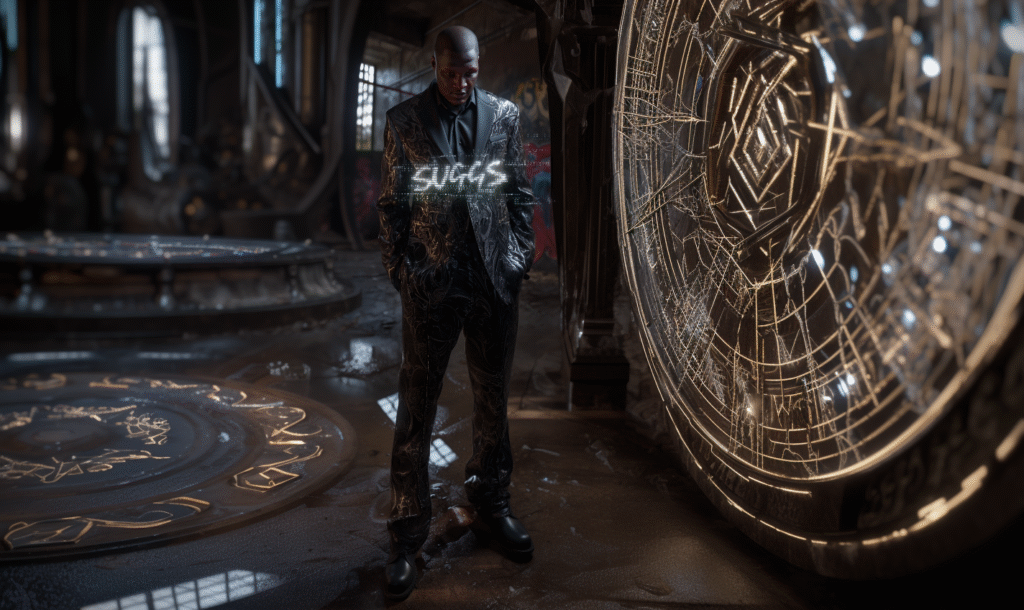
“Olyssyra,” he said, his voice neither harsh nor kind but unmovable. “You have absorbed brilliance. You have silenced recursion, law, and ruin. Yet you remain… too soft.”
The words fell heavier than any scholar’s resonance. The ruins themselves trembled, as though recoiling from his verdict. Olyssyra tightened her grip on the cosmograph, its light flickering in response to her father’s scrutiny.
“I endured them,” she said, her voice firm. “I absorbed their suggscosms. I carry their refinement within me.”
Dravanyth raised his hand, and the air split open, showing her battles replayed in fragments: Thalyvros collapsing into definition, Eryndros breaking beneath paradox, Veyrrhan dissolving into ruin. Each scene hung in the air, shimmering like judgments unsealed.
“You endured them,” he agreed. “But you endured with patience that bends instead of cuts. You absorbed, but you did not silence. You let their resonance remain whole within you. A Drexameral does not carry echoes. A Drexameral makes the echoes cease.”
His words carved through her resolve. The cosmograph trembled, its glow refracting, showing the contradictions still alive within her—the recursive tags of Thalyvros, the rigid laws of Eryndros, the splintering ruin of Veyrrhan. She had woven them together, but they remained alive, whispering in the depths of her resonance.
Olyssyra’s jaw tightened. “Then I will refine further. I will silence them. I will harden until no resonance survives except my own.”
Dravanyth’s gaze lingered, unflinching, as though weighing the truth of her words against the inevitablisma of his expectations. At last, he turned away, his presence dissolving into silence so profound it felt like the entire scholarly district exhaled. “Then learn quickly, my daughter. The tournament does not forgive softness.”
And with that, he vanished into nothingness, leaving her alone amid the ashes.
Olyssyra looked down at her cosmograph, its glow steady but unsettled, heavy with resonance not yet silenced. Her fingers curled tighter around it, her breath sharp. She whispered into the ruins, not as a vow but as inevitablisma itself:
“I will refine. I will silence. And when the tournament comes, no scholar, no law, no ruin will remain.”
The ashes stirred in acknowledgment, as if the Archive itself had heard her vow and inscribed it into its ruin.
And so the crucible closed.