
Interlude II — When the City Breathes Between Them
For once, Baltimore was quiet.
Not safe. Not healed. Not merciful.
Just quiet in the way a warzone becomes quiet when even the violence has to inhale—quiet like the city had grown tired of making noise and decided, for a fragile beat, to let the silence carry the weight instead.
The bedroom held that hush the way a church holds incense. The air was cool, tinted by a hard blue glow pushing in through a window that didn’t fully shut, streetlight spill and distant signage bleeding into the room like an unwanted confession. The walls looked older than they should’ve, like they’d watched too many arguments, too many departures, too many bodies trying to forget the city by holding each other. Even the sheets felt like they’d learned how to keep secrets.
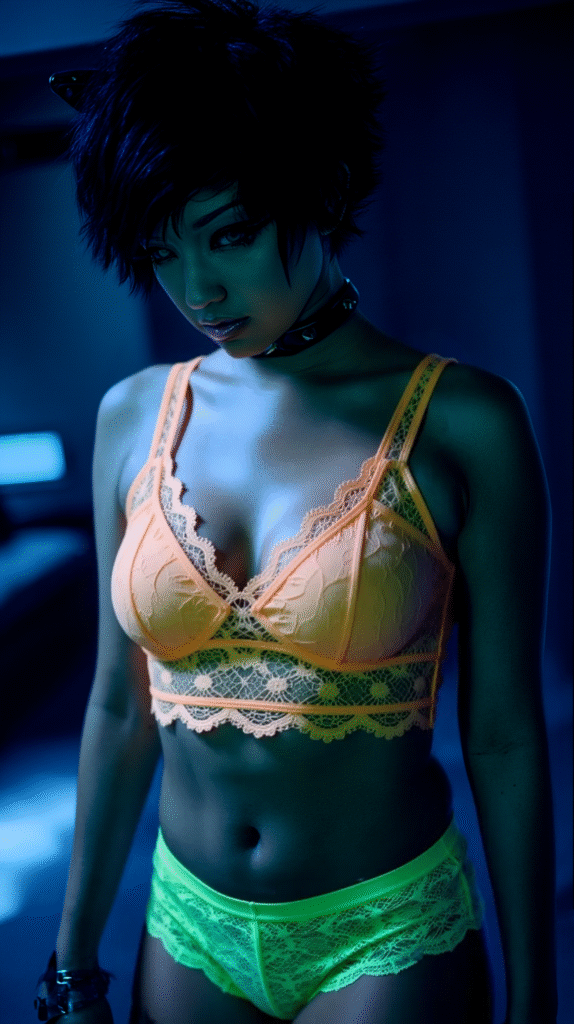
Seren Splinteredcrown lay half-covered beneath the warmth, breathing fast, not from panic, not from fear, but from the aftershock of closeness—the kind that makes the body forget its armor for a second and then remember it all at once. The cold neon edge of the window traced her shoulders, the soft line of her stomach, the subtle tension still living in her ribs like the last note of a song that won’t resolve. Her hair was short and wind-tossed, sweat-damp at the edges, clinging in uneven strands to her forehead in a way that made her look less like an assassin and more like a woman who had been allowed to be human for a moment longer than usual.
Her lingerie was still on—delicate lace that shouldn’t have survived her life, a bralette with scalloped trim and fine mesh stitching that framed her chest without trying to tame it, and matching lace briefs sitting bright against her hips like something defiant and unbothered by the darkness outside. A leather choker hugged her throat with a sleek, studded edge that read like both ornament and warning. One wrist still wore a dark cuff, the buckle glinting when she shifted, like a small, private piece of restraint she didn’t mind choosing.
On the nightstand, her mask rested where she’d dropped it—hard-edged, familiar, the face she wore when she needed the world to stop thinking she was soft. Beside it lay her blade, placed with that unconscious precision she never turned off. Even in a bed that wasn’t hers, even in quiet, she arranged her danger within reach.
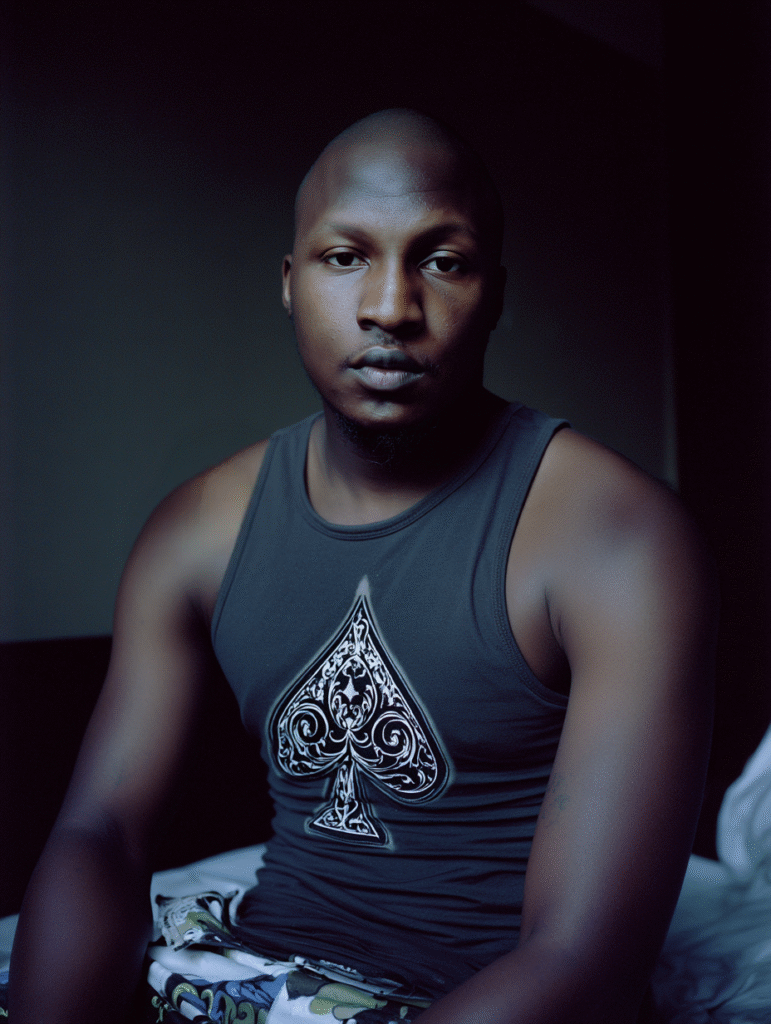
Across the mattress, Draven Endwriting sat with his back against the headboard, posture relaxed in a way that wasn’t truly relaxation—more like a soldier letting his shoulders drop without setting the rifle down. His tank top clung to him, damp with leftover heat, the ace symbol on the chest stark and simple like a card turned face-up in a city that loved gambles. His shorts were patterned, casual in the way a man gets when he’s not trying to be seen, when he’s just trying to exist. One forearm rested on his thigh; the other hand stayed close, not hovering over a weapon, not tense—just present, like he was making sure this pocket of the world didn’t dissolve while he blinked.
He stared at the ceiling as if it contained answers, or at least contained something that couldn’t lie to him.
Seren watched him the way she watched exits. The slope of his shoulder. The pulse at his neck. The controlled stillness of him—the way he could look calm while carrying an entire city’s worth of contingency plans behind his eyes. She hated how much that steadiness did something to her. She hated the part of herself that wanted to lean into it and never move again.
“You stayed,” she whispered, voice small enough that it didn’t challenge the room.
Draven’s gaze lowered to her. There was no performance in it. No charm, no manipulation. Just a quiet intensity that didn’t ask to be forgiven for existing.
“You asked,” he said.
That was the thing about him that kept catching her off guard. He didn’t decorate his truth. He didn’t turn it into a story he could sell. He just set it down between them and waited to see whether it would be held or thrown back.
Seren exhaled through the last of her tension and rolled onto her stomach, her cheek resting against his thigh, cum still dripping like a river from her pussy and booty. Draven brushed a hand along her back, slow, absent-minded, intimate. The touch grounded her more than she wanted to admit. The contact made her chest loosen in a way she didn’t like acknowledging. It was too simple. Too human. Too much like a home she didn’t believe she deserved.
Draven’s hand found her back, slow and absent-minded, the touch intimate without making a point of it. His palm moved like he already knew where her tension lived, his thumb drawing small circles along her spine as if he could erase the world by friction alone.
For a moment—one fragile, stolen moment—Seren wasn’t a blade with a heartbeat. She wasn’t a survivor built out of void-scar tissue and bad lessons. She wasn’t a hunted soul moving through Baltimore like a rumor.
She was just a woman who had let someone close and hadn’t been punished for it yet.
Her phone buzzed once.
Draven’s buzzed again, and again, and again—like his life refused to stop needing him just because he’d dared to be in a bed.
He let out a tired sound that wasn’t quite a sigh, picked up the phone, and the blue glow lit his face from below, carving him into something half-real, half-shadow.
Seren lifted her head a little, eyes narrowing. “You got a whole clan checking in?”
Draven’s mouth twitched—almost a smirk, but too worn down to fully commit. He tilted the screen just enough that she could see without him offering it like an invitation.
Nyra: Dad can you sign my permission slip? I forgot it on the counter… again.
Liora: What’s the pickup for practice?
Eira: I know you’re asleep but I lost my history packet. Do you have a picture of it?
He answered with one hand—short, efficient messages—while the other stayed on Seren’s lower back like a promise he didn’t say out loud. Even when he was “elsewhere,” part of him refused to leave her body untouched, as if contact was a tether and he didn’t trust the city not to yank her away if he let go.
Seren watched him with that unreadable softness that wasn’t new, just newly visible in the quiet. The sight hit her in a place behind her ribs, the place where guilt lived and tried to masquerade as logic.
“You’re a good father,” she murmured, the words slipping out before she could make them sharper.
Draven shrugged, but the shrug didn’t dismiss it. It was more like he didn’t know what to do with praise—like it was a language he could read but never speak fluently. “Trying.”
“That’s more than most,” Seren said, and meant it in a way that was both blessing and condemnation. Baltimore made sure you learned the difference early.
His eyes stayed on her a second longer than necessary, as if he was checking her for cracks she hadn’t admitted were there.
“You okay?” he asked.
Her breath caught—not because she didn’t have an answer, but because the question made her aware of how many answers she could give, and how none of them would be fully true.
“Define okay,” she said, voice low, almost amused, almost bitter.
He set the phone aside like he was choosing her over the noise, and he slid down the bed to lie beside her. When he pulled her into his chest, it wasn’t possessive. It wasn’t a claim. It was a shelter—quiet, firm, and unromantic in the best way. Seren sank into him slowly, like her body had been waiting for permission to collapse.
There are silences that punish you. There are silences that heal you. There are silences that simply hold you long enough to remember you’re still alive.
This one held them.
Seren listened to Draven breathe, felt the subtle rise and fall of him, felt how steady it stayed even when the world outside refused steadiness. And being held by Draven felt like...
She pressed her face into Draven’s chest as if hiding her thoughts would make them less true.
After a long stretch of quiet, she spoke anyway, because she trusted him just enough to risk it. “Baltimore’s… splitting.”
Draven’s fingers brushed the side of her neck, a small grounding touch. “Not literally,” he said, not correcting her, just meeting her where she stood.
“Not yet,” Seren whispered. “But every cycle it feels like the city is cracking from the inside. Like the streets are remembering something they shouldn’t be able to remember.”
His hand stilled for a moment, then resumed, slower. “You think it’s just Baltimore?”
Seren’s jaw tightened, and she shifted so she could see his face. “No. That’s the problem. It’s not contained. China’s folding under a wave of hauntings nobody’s allowed to report. Antarctica lost a research station between two logged readings—like it stepped out of the world without moving. And Maryland’s transhierarchical rifts are getting hungry.”
She hated how calm she sounded saying it. She hated how the apocalypse always arrived wearing the mask of “updates.”
Draven listened without interrupting. That was one of his most dangerous traits: he didn’t waste breath reacting. He stored information like ammo.
“They’re tearing at reality everywhere,” Seren continued, voice sharpening, the exhaustion under it turning brittle. “Not just here. But here… here it’s personal. Baltimore doesn’t just suffer it. Baltimore feeds it. Baltimore echoes it.”
Draven’s arms tightened around her—not to stop her, not to silence her, but to hold the fact that she was saying it at all.
“What about your new team?” he asked, quiet.
Seren hesitated, and that hesitation said more than her words ever could. “They’re strong,” she admitted. “Addison, Mindini, Natla, Sagrias… each one of them is terrifying in their own way. They handle field runs. They keep the Advocates from surfacing where civilians have to see it. They move fast, they hit hard, they improvise like they were born in crisis.”
“That’s good,” Draven said, but his tone wasn’t celebratory. It was measured. He didn’t believe good news meant safety.
“It’s not enough,” Seren breathed.
She lifted her head fully now, eyes glossy—not with tears, but with that harsh, overstretched fatigue you get when you’ve carried too much for too long and your body starts asking for payment. “We’re putting bandages on Big Bang wounds,” she said, voice tightening around the sentence. “And the world is bleeding out faster than we can patch it.”
Draven brushed a kiss against her cheek—slow, deliberate, not sexual, not a distraction, just a statement that she wasn’t alone inside the horror. Then he kissed her jaw. Then the edge of her throat where the choker sat like a ring of chosen danger. His voice came muffled against her skin.
“We keep trying,” he murmured. “That’s the job. That’s the only honest answer.”
Seren shivered—not just at the warmth of his mouth, but at the way he always made endurance sound like a principle instead of a punishment.
“You make it sound simple,” she said.
“It’s not simple,” he replied, and his hand moved down her back like he was tracing a map he refused to lose. “But it’s us.”
The word landed heavier than it should have.
Seren’s laugh came out quiet and breathy, but her eyes didn’t match it. “Us,” she repeated, like she was tasting it, like she was deciding whether it was medicine or poison. “Don’t say that like this isn’t just—”
Draven kissed her again, deeper, and the kiss cut off the sentence before it could turn into a shield. When he pulled back, his forehead hovered close to hers, their breathing mingling.
“Seren,” he said softly, and her name in his mouth wasn’t a command. It was a recognition. “If this was just anything, we wouldn’t be here.”
For a second, something naked flashed across her face—surprise, relief, fear, all braided together. Then she covered it the way she always did, with a smirk, with heat, with motion.
“So,” she breathed, sliding her leg over his hip, the lace of her briefs brushing his thigh like a dare. “You trying to go for round twenty?”
Draven’s laugh was low, the sound of a man who didn’t often get to laugh in rooms like this. “Bold of you to assume I’m not already recovering.”
Seren leaned in—mouth parting, eyes half-lidded, her fingers finding the edge of his tank top like she was about to pull him back into the only softness the city ever allowed her—
—and the world broke.
Not in a dramatic way at first. Not with sirens. Not with screams.
The light went wrong.
The blue glow from the window shifted into something bruised and violet, as if the sky had decided to rot instead of brighten. The air pressure changed, subtle but immediate, like the room had gained weight. The mattress creaked under them with no movement. Somewhere outside, glass trembled in its frame, not from wind, not from passing trucks—something deeper, something that didn’t care about infrastructure.
Seren froze, her body snapping from intimacy to readiness so fast it was almost cruel. Draven’s hand moved without thought toward the nightstand—toward the weapon he never let out of reach, toward the part of himself the city demanded.
Then the birds came.
Thousands of dead birds surged upward in reverse rain, bodies limp, wings slack, rising against the ruined sky as if gravity had decided to argue with itself. Feathers drifted like ash in a direction that made no sense, and the sight hit the street with a kind of sacrilege—nature turned inside out, death refusing to stay down.
A low groan rolled through the block, not quite sound, not quite vibration, like the city’s bones were shifting.
Then the street cracked open.
Not a pothole. Not a sinkhole. A clean, splitting seam that spread like a wound, and from it rose a plume of dark force—thick, grieving, cold—erupting upward like a volcano made of shadow and memory.
But above that—higher than the birds, higher than the broken light—another presence descended.
They looked almost beautiful at first: Celestial Orbs, perfect spheres hanging in the wounded sky like polished planets someone had lowered too close. They didn’t glow like salvation. They glowed like appetite—smooth, steady radiance with no mercy in it, as if light itself had learned how to hunt.
The air in the room grew heavier.
Not metaphorically. Not poetically. The weight pressed into Seren’s ribs, into Draven’s shoulders, into the bedframe, into the building’s foundation like an invisible hand testing how easily the world could be crushed. Somewhere in the distance, a siren started and then warped, the pitch bending as if even sound was being pulled sideways.
The Orbs didn’t just arrive.
They harvested.
Seren felt it before she understood it: matter tugging at itself, tiny objects in the room subtly shifting—dust lifting, a loose thread on the sheet rising as if drawn by a magnet. Outside, street trash skittered. Loose papers peeled off windshields. A street sign shuddered, bolts squealing. The Orbs weren’t “pulling” like gravity the way people understood gravity. They were imposing a deeper claim, as if they were rewriting what it meant for things to belong where they were.
And beneath it all, there was an echo.
A sensation like something familiar pressing its signature through a different shape. Seren’s stomach tightened, her mind snapping back to the earlier horror—the octahedron’s silence, the way the world had felt inverted in its presence, the way perception had become unreliable, cruel, impossible to “think through.”
This was related.
Not the same.
Heavier.
Draven sat up fully, movements sharp and clean, the warmth between them evaporating into readiness without a word. His gaze cut to the window, reading the sky the way he read crime scenes—pattern, motive, consequence. Seren reached for her mask and blade with muscle memory so practiced it didn’t feel like motion, it felt like identity.
Another day in Baltimore.
Seren exhaled sharply, the sound half laugh, half curse. “Guess the city couldn’t let us have one more breath.”
Draven leaned down and kissed her once—slow, grounding, an anchor pressed into her mouth like a quiet promise that whatever came next, they would move through it together even if they refused to name what “together” meant.
Then he sat back, eyes already distant, already calculating. “Suit up.”
Seren nodded, sliding the mask on, the familiar hard edge settling over her features like armor reattached. She gathered her clothes with the efficiency of someone who’d been forced to dress for war too many times. The lace and warmth and softness were shoved aside, not because she didn’t want them, but because Baltimore punished want.
They were out of the bed and armed within seconds, bodies moving in practiced synchronization without needing to narrate it.
Seren glanced back once—just once—at the sheets, the warmth they’d made, the imprint of a moment that could’ve become something more if the city hadn’t always demanded payment. For a flicker, she felt the grief of it—small, sharp, personal grief—because she knew these pockets of quiet were the rarest resource in her life.
Then she looked at Draven.
He stood near the edge of the room, tank top clinging, weapon in hand, expression carved into that cold tactician stillness he wore like a second skin. But his eyes found hers, and in that brief connection she felt what he never said out loud: the fact that he chose to come back, again and again, into the breaking heart of this place.
“You coming with me?” she asked, even though she already knew the answer.
Draven’s mouth tilted—barely. The smallest smirk. The closest he ever got to comfort without admitting he was offering it.
And together they stepped into the wrong-colored light, into the street’s new wound, into the upward-falling birds and the descending spheres that made the whole block feel like it was being pressed into dust.
Baltimore didn’t allow anything.
So they took what they could, when they could, and they walked into the city’s next scream like it was routine—like it was war—like it was the only kind of morning Baltimore ever truly gave.