
No Horizon III: The Children the County Wouldn’t Count
Northern Virginia wore its wealth like armor, and on most nights it worked. The streets were wider than they needed to be. The lawns were clipped into obedient geometry. The shopping centers glowed with soft, corporate light that made everything look safe from a distance, even the shadows that shouldn’t have been there. People here talked about danger the way they talked about weather—something that happened elsewhere, something that didn’t belong in their zip code, something that could be solved with a complaint, a meeting, or an election. Ronan Eclipsedword understood that kind of denial intimately, because it was the same denial he packaged and sold, only dressed up in better language.

Over three thousand children were missing, and the county was still pretending it was a statistical glitch.
The police gave statements about “runaways,” about “custody disputes,” about “unverified reports,” and they spoke with the careful tone of people who had already decided the problem wasn’t real enough to damage their careers. Parents were told to wait. Communities were told not to panic. The local news ran small segments at odd hours, tucked between traffic updates and weather. A few faces appeared on posters, then disappeared under newer posters, then disappeared entirely. The disappearances didn’t create a city-wide scream the way they should have, because Northern Virginia didn’t scream. It negotiated. It buried. It reclassified.
Seren Splinteredcrown was the one who placed the case in Ronan’s hands, not because she trusted the system to do anything, but because she knew the system wouldn’t. She gave him the bare facts, the rough geography, the one detail that made her voice go still when she told him: the missing weren’t concentrated in one neighborhood. They were scattered with intention, plucked from different districts, different incomes, different races, different routines, as if the predator didn’t care about social patterns, only about volume. That kind of indiscriminate selection wasn’t human. That kind of hunger belonged to something that had never needed to pretend it was civilized.
Ronan took the case the way he took most things—quietly, like it was already his responsibility, like refusing would have been a childish fantasy. But when he hung up, he didn’t move for a moment. He stood in the doorway of his apartment with the phone still in his hand, staring out at Baltimore’s night as if he could see Northern Virginia through it. He’d grown used to the city’s supernatural violence. It was honest in a grim way. It bled openly. It howled. It admitted what it was. Northern Virginia was different. It was a place where horror could feed for months without anyone admitting it existed, because everyone’s first instinct was to protect the illusion of normal.
That was why the wyvrens were thriving.
Eclipse watched him pack without asking too many questions, because she’d learned what it meant when Ronan moved with that particular precision. He wasn’t just preparing for work. He was turning himself into procedure. Hoodie folded. Gloves checked. Dice pocketed. Sigil chalk tucked away. A small case of medical instruments that weren’t strictly medical anymore but still carried the logic of medicine. He kept his emotions where he kept everything else: contained, categorized, ready to be deployed but never allowed to spill.
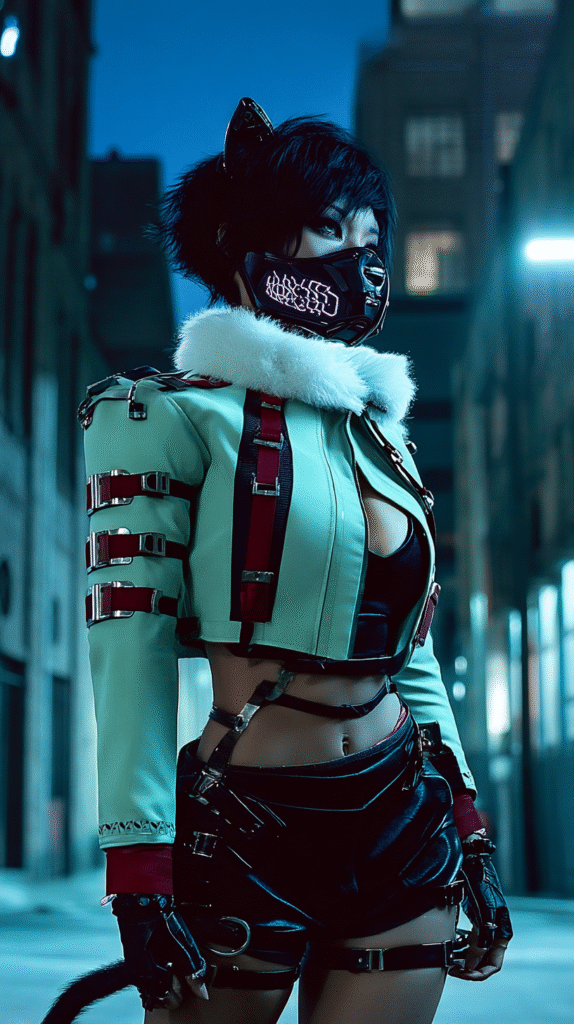
Eclipse leaned on the counter, arms folded loosely, her gaze steady. Even indoors, she carried that same composed athletic presence, the quiet confidence of someone who didn’t need permission to take up space. She watched Ronan like she was reading him through layers he didn’t let anyone else see, and when she spoke, her voice was light enough to be teasing but weighted enough to land.

“You’re going to a place that thinks it’s above consequences,” she said.
“It’s a place that thinks consequences have to RSVP,” Ronan replied, and there was a dryness to it that would have sounded like humor to anyone who didn’t know him.
Eclipse smiled in that way she had, the smile that didn’t soften her intelligence, only sharpened it. “And you,” she said, “are going to be annoying about it the entire render.”
Ronan zipped his bag. “I’m always annoying.”
“That’s not true,” Eclipse said, stepping closer. “Sometimes you’re insufferable.”
He looked at her then, and the edge of his posture eased by a fraction. Eclipse’s laughter came easy, and it always did something to the air around Ronan, as if sound itself remembered it could be kind. She reached up, adjusted the front of his hoodie like she was straightening a stubborn child, and kissed him once—brief, sure, affectionate without being fragile.
“Bring your soldiers back,” she said quietly, and the softness in her voice made it feel like a request she knew she couldn’t enforce but still had to make.
Ronan didn’t promise. Promises were cheap. He only nodded, and Eclipse accepted that nod the way she accepted most things about him: with affection and a realism that could survive disappointment.
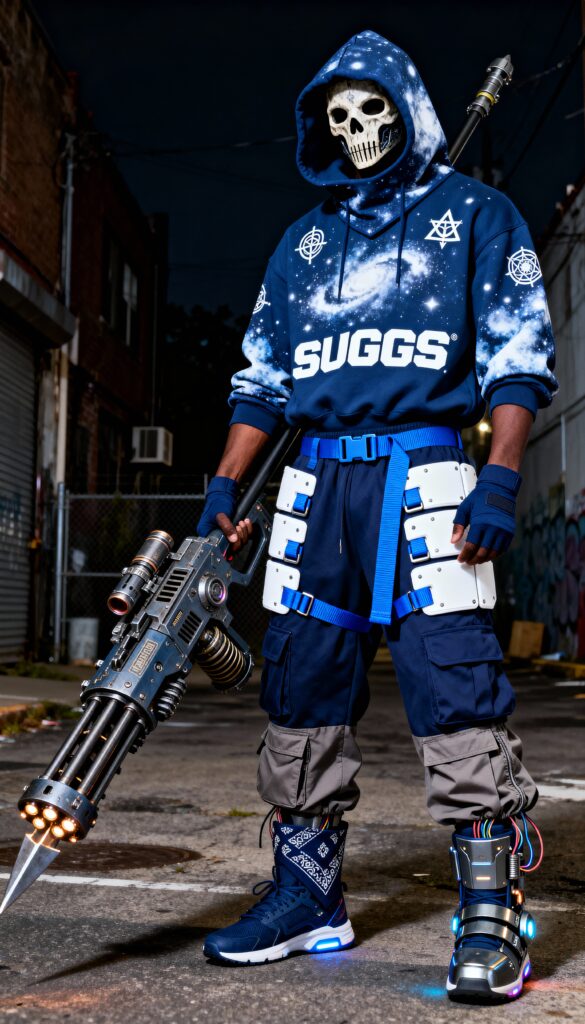
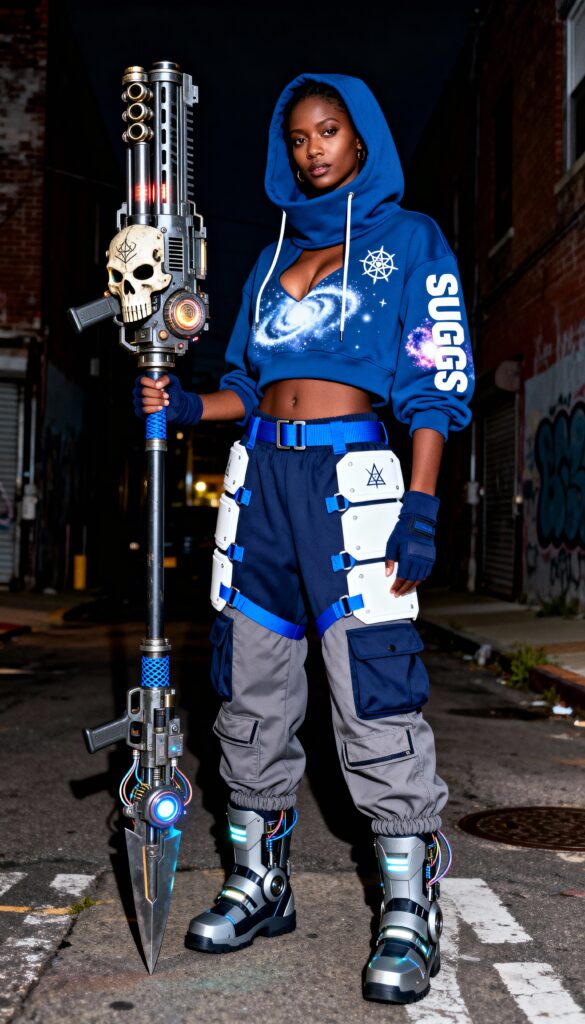
Two of his soldiers met him near the line, not far from where the landscape stopped looking like city and started looking like polished sprawl. They were hard to miss even in the dark, because they carried an intentional wrongness into any environment. Deep-blue hooded tops with cosmic prints and sharp sigils. Tactical streetwear pants strapped with rigid white armor plates bolted along the thighs and hips. Gloves, reinforced at the knuckles. Heavy boots with luminous accents and small exposed cables that pulsed faintly, as if their gear needed constant reminders to remain stable in a world that was increasingly refusing its own rules.
One wore a skull-like mask under his hood, the hollow sockets giving him the presence of a walking warning. He carried a heavy rotary-barrel cannon with a bright lens-like emitter at the front, the weapon balanced with the ease of practice. The other wore a similar mask and carried a siege-staff weapon—part gun, part polearm—its long frame wrapped in cables and circuitry, a cluster of circular chambers along the top glowing with a heated, contained light. Both weapons looked like something engineered by a world that no longer believed in clean categories.
Ronan greeted them with a nod that said everything he needed it to. They didn’t speak much. Soldiers like these weren’t paid to emote. They were paid to move, to contain, to die quietly if required. Ronan didn’t pretend he was their friend. He was their employer, their leader, their gravity. They followed because his kingdom of ignorance kept the streets stable, and stability was the only currency more valuable than money.
They drove deeper into Northern Virginia, and the world grew brighter in artificial ways. Streetlights too clean. Neighborhoods too symmetrical. Cameras on poles like silent witnesses that never testified. Yet as Ronan watched, he saw the seams. He saw the subtle inconsistencies that told him the area had been feeding something. A cul-de-sac where the houses looked fine but the shadows between them were slightly deeper than they should be. A playground whose metal slide reflected light in a way that suggested the air above it was being subtly warped. A wooded strip between developments where the trees seemed to lean inward, as if listening.
The first report they followed came from a parent group in a community center, the kind of building meant to feel safe by design. The people inside weren’t hardened. They weren’t street. They were suburban parents with tired eyes and tight mouths, clinging to decorum because decorum was the last tool they had. A woman approached Ronan with her hands shaking slightly and a folder of printed emails and missing posters clutched in her grip like scripture.
“They won’t listen,” she said, voice cracking. “They keep telling me she probably ran away. My daughter was nine. She didn’t run away. She was scared of crossing the street by herself. She—” Her breath hitched, and the words tangled. “We have cameras. We have footage. We have—” She swallowed, forcing herself into calm. “We have nothing. The footage glitches. It cuts out. Always around the same hour. They say it’s a system error.”
Ronan took the folder without comment and scanned it quickly, his eyes moving in that old surgical way—fast, precise, absorbing patterns rather than details. He didn’t need the county’s files. Counties were cowards. He needed the absence, the negative space, the repeated glitch. He asked for the location of the most recent abduction, and when they gave it, he felt the faint tug in his awareness immediately, the way a wound calls to the hand that knows how to stitch.
They went at night because predators loved darkness and because denial was easier to kill when it had nowhere to hide. Ronan led his two soldiers through a neighborhood that looked designed for comfort, past parked cars that cost more than most people’s rent, past front porches decorated for seasons that hadn’t arrived yet. The air was cold and still, and the quiet was too perfect. No dogs barking. No distant traffic. No normal background noise. It felt like the neighborhood was holding its breath.
Ronan stopped near a small patch of woods behind a row of homes. The trees weren’t thick. This wasn’t wilderness. It was just enough nature to make the residents feel like they lived near something alive. Ronan looked at the treeline, and his awareness brushed against something there—an old smell, faint but real, like scorched bone and damp ash. He heard a flutter, like leathery wings moving somewhere above the canopy, too slow to be a bird, too heavy to be anything that belonged.
His soldier with the siege-staff weapon anchored the blade tip lightly into the ground, ready to deploy fields if needed. The other shifted his rotary cannon upward, scanning. Their skull masks turned, hollow sockets directed at darkness. They didn’t fear it. They respected it.
Ronan pulled the nebula dice from his pocket and rolled them once onto the pavement.
They bounced softly and landed, the cosmic swirls catching the streetlight. Ignorance spread outward in a subtle wave, dulling the edge of recognition in the nearby houses. People inside might wake briefly, feel uneasy, then roll over, convinced they were imagining things. That was the mercy Ronan sold. That was the vice he administered. It kept the neighborhood from panicking, and panic would have drawn the wyvrens closer the way blood draws sharks.
Something moved above them.
Ronan looked up, and for a moment he saw it only as distortion, a ripple in the air as if the sky itself was folding. Then a fragment of the creature pressed into visibility, not because it wanted to be seen, but because the world couldn’t fully hold back what was forcing itself through. The wyvren’s “body” was not the whole thing. It was a partial manifestation, a portion of a greater presence that existed outside the simple physical universe, pressing a fragment into this neighborhood like a finger pressing through thin fabric. The visible portion was massive, its wings spanning far wider than any creature should have been able to carry, its outline shimmering at the edges as if reality struggled to render it correctly. Its eyes were not eyes in any comforting way; they were points of cold attention, and that attention had weight.
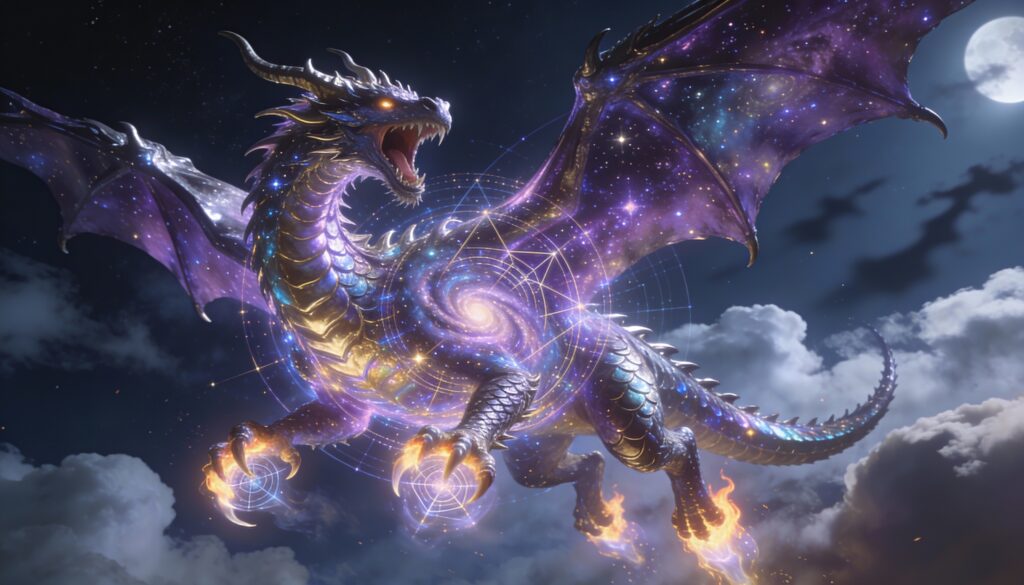
The air around it changed. Not with wind, but with pressure. A gravitational field rolled outward, subtle at first, like a heavy blanket dropped over the street. Ronan felt it in his joints. His soldiers’ boots sank slightly into the pavement. Loose leaves lifted and then hovered, pinned in place. The streetlight halos smeared into elongated arcs.
Then the field intensified.
The world’s render-rate slowed around the wyvren, turning motion into struggle. Ronan watched one of his soldiers take a step and saw the step drag, the body forced into incremental movement as if time itself had become thick. The soldier’s weapon dipped under invisible weight. The wyvren descended slowly, not flapping like a bird, but pressing down as if gravity was its servant.
A second wyvren fragment appeared farther down the street, near a backyard swing set. Its presence made the swing chains tremble, and the metal of the frame warped slightly, as if the concept of rigidity was being argued with. The swing seat rose an inch off the ground and hung there, pinned by field pressure, a child’s toy caught in a physics it never consented to.

Ronan did not waste energy firing at the wyvren’s body the way an ordinary fighter might. He understood already what this was. The creature wasn’t in full. It was a fragment. A partial intrusion. Physical harm would be meaningless, and energy-based attacks would be swallowed the way water swallows a stone.
But chaotic spirits were here too—drawn by the distortion, clustering at the edges of the slowed field. They slithered between shadows like parasites, mouths opening in silent laughter, trying to feed on fear, trying to drag anything living toward the wyvrens’ attention.
Ronan moved first.
His magic snapped into place as procedure. A sterile field flared around him, a translucent circle of sigils that gave the street a brief moment of normal presentation inside its boundary. In that bubble, motion became possible again. His soldiers regained speed. Their weapons lifted. Their bodies shook off the crushing slowness enough to act.
The wyvren’s attention shifted, and the pressure increased at the edges of Ronan’s field, testing it.
Ronan’s soldier with the rotary cannon opened fire at the chaotic spirits first, because spirits could be killed, and killing them was the only way to keep the battlefield from becoming a feeding frenzy. The cannon’s bursts shredded spirit bodies into dissolving static, their protective distortions collapsing under sustained force. The other soldier fired his siege-staff weapon, not at the wyvren, but into the air around it, emitting pulses designed to disrupt whatever resonance allowed spirits to cling to the distortion.
Ronan advanced toward the nearest wyvren, stepping through the slowed field by cheating—finding the least resistant lines through pressure, moving like a surgeon’s hands through tissue, never wasting motion. He raised his hand and carved a binding sigil into the air, aiming not at the creature’s body but at the local conditions holding its fragment stable. The sigil latched onto the shimmering edges, and the wyvren’s outline flickered, its form momentarily destabilized.
The creature reacted with a sound that didn’t travel like sound. It was a vibration in the bones. A pressure in the teeth. The gravitational field surged, and the street cracked under it.
Ronan rolled the dice again, tightening the ignorance wave into a sharper radius, keeping the houses blind, keeping the witnesses asleep, keeping the neighborhood from becoming a chorus of screaming recognition. The dice were doing their work, but the wyvrens weren’t interested in adults. Adults were noise. Adults were weight. Adults were collateral. The wyvrens were here for children, and Ronan could feel that hunger in the way the fragments oriented toward backyards, toward second-floor windows, toward places where small bodies slept unaware.
A shriek cut through the night, and Ronan’s head snapped toward it—not a scream from an adult, but the thin, raw scream of a child, instantly muffled by the slow field as if the sound itself couldn’t escape fast enough to become real. Ronan’s heart didn’t lurch. He didn’t allow himself that. He simply moved.
He found the child at the edge of the woods, a boy no older than ten, frozen mid-step as the slowed distortion field pinned him. His eyes were wide, tears suspended on his lashes because even crying had become difficult. Above him, a wyvren fragment lowered its talons—not talons exactly, but gravitational focal points that would latch onto the child’s existence and lift him like a prize.
Ronan didn’t swing his spear at the fragment. That wasn’t the point. He drew the blade anyway because it was a declaration, and the air around the spear became cleaner, more defined, as if the world remembered how to behave near something that didn’t argue with its own authority. The weapon’s cold cosmic radiance cut through the smeared light.
Ronan struck the space between the talons and the boy, not aiming to sever flesh, but to sever defense, to erase resistance in the only way his blade knew how—multiplying conceptual defenses by a factor of zero by targeting reality–fiction distinctions across boundless pataphysical layers. The wyvren’s “grip” failed, not because Ronan overpowered it, but because its claim to defense was reduced to nothing. For a moment, the boy dropped, gravity reasserting itself without the wyvren’s control.
Ronan grabbed the child by the hoodie and yanked him into the sterile field corridor where motion was possible. The boy stumbled, sobbing, and Ronan shoved him toward his soldiers without tenderness. Tenderness was a luxury. Survival was the task.
“Get him out,” Ronan ordered.
His soldier with the siege-staff weapon moved, scooping the child up and sprinting toward the nearest house, likely to leave him on a porch and vanish before anyone woke. The soldier didn’t argue. He moved like a man who understood his job was to be a moment of safety inside a night that had none.
The wyvren fragment recoiled and then surged again, pressure intensifying. Its field pushed back against Ronan’s sterile circle, compressing the space, testing the seams. Ronan felt the field’s weight in his ribs, the way it tried to turn breath into effort. He held the circle anyway, carving additional sigils, reinforcing the boundary, not because he believed he could win, but because he had decided he would not let this creature take another child without paying something for it.
More fragments appeared.
Two, then three, then four, hovering over the neighborhood like an invasion of wrongness. Their visible bodies shimmered at the edges, implying a greater size pressing beyond what the world could render. They weren’t fully present, but the pressure they emitted was enough to bend reality around them, to warp matter, to slow witnesses into helpless observation. They moved toward the woods, toward the backyards, toward the places where children were easiest to lift.
Ronan’s soldiers fought with everything they had, firing into spirit clusters, anchoring weapons into pavement, emitting pulses that disrupted the spirits’ ability to feed. They were good. They were trained. They were loyal in the way employees can be loyal when they believe their boss’s lies are at least useful.
It didn’t matter.
One soldier—rotary cannon—stepped too close to a wyvren’s gravitational focal zone, and the field tightened around him like a fist. Ronan watched the soldier’s movement slow, watched his wide stance become a trembling struggle, watched the cannon dip as if the metal itself was suddenly heavy enough to break bone. The soldier tried to retreat, but his step became a crawl. The skull mask turned slightly toward Ronan, hollow sockets offering a silent look that wasn’t fear so much as recognition: this is the part where the world proves it doesn’t care.
Ronan moved to carve a corridor, but the wyvren’s field surged faster than his hands could stitch. The soldier’s body compressed, armor plates snapping, manifest matter folding inward until the soldier became less and less volume, less and less argument, less and less presence. The death was quiet, brutal, and clinical. A reduction rather than an explosion. A man erased by pressure.
Ronan didn’t flinch. His face stayed calm because calm was what kept him functional. But something in his chest tightened, a pressure of a different kind, and he hated it because it felt like meaning.
The second soldier—siege-staff—held the line longer, anchoring the weapon into the street, its glowing chambers pulsing with contained force. He emitted fields that repelled spirits, he dragged two more children out from behind a fence where they’d been pinned by slowed distortion, he shoved them toward a safe corridor where Ronan’s dice kept the neighborhood asleep. He fought like a man trying to justify his own existence by being useful.
A wyvren fragment descended on him anyway.
The creature’s attention wasn’t emotional. It didn’t hate him. It didn’t respect him. It simply calculated that he was in the way. The gravitational field spiked, and the soldier’s weapon bent. The blade tip anchored in pavement snapped free as the street itself warped. The soldier’s knees buckled, not from exhaustion, but from physics rewriting itself around him. Ronan saw the soldier’s gloved hands clamp onto the staff, saw the cables along his boots pulse brighter, saw the body fight against slowed presentation as if sheer will could restore normal motion.
It couldn’t.
The wyvren’s focal pressure tightened, and the soldier folded inward, armor plates cracking, breath crushed out of him in silence because sound couldn’t move fast enough. The siege-staff weapon clattered to the ground, still glowing faintly, still pulsing as if it didn’t understand the body that held it was gone.
Ronan stood alone.
The neighborhood remained asleep because his dice kept ignorance flowing like a quiet drug through the air, but the street itself was now a battlefield littered with warped matter and dissolving spirits. The wyvrens hovered above, fragments of something far larger, their full presence implied in the way the sky seemed to bow around them.
Ronan looked up at them and felt, for the first time on this case, a sharper kind of anger. Not rage. Not vengeance. Something colder and more surgical. Anger as diagnosis. Anger as decision.
He raised his spear and carved again, not at flesh, not at wing, but at the conceptual scaffolding that allowed these fragments to behave like predators. He multiplied their defenses by zero in the narrow ways his weapon permitted, severing their local claims to stability. The nearest wyvren flickered, its outline destabilizing. The gravitational field stuttered. For a heartbeat, the render distortion loosened, and the street inhaled as if it could move again.
Ronan used that moment to act, because moments were all anyone ever got.
He rolled the dice one more time, not outward to numb civilians, but inward to compress ignorance into a sharp wedge. Then he drove that wedge into the wyvren’s anchor point, not by brute force, but by making the local reality forget how to host it. He treated the fragment like an infection and the neighborhood like tissue that needed excision.
The wyvren’s form shuddered and tore upward, withdrawing not because it was defeated, but because the local conditions had become inhospitable for its fragment. The sky rippled. The pressure eased. The streetlights flickered back into something closer to normal.
The other fragments followed, retracting in staggered pulses, not fleeing, only relocating, as if Northern Virginia was riddled with enough wounds that they could simply feed elsewhere.
When the last fragment withdrew, the street sagged into uneasy quiet. Spirits dissolved back into shadows. The warped metal of a nearby fence groaned as it remembered it was supposed to be rigid.
Ronan stood in the aftermath and looked at the two corpses that weren’t really corpses so much as compressed remnants of men who had been reduced by impossible physics. He didn’t kneel. He didn’t pray. He didn’t speak their names. He held that cold calm because that was the cost of being the kind of man who could keep moving.
He turned toward the woods and listened.
Somewhere deeper within the trees, something still moved. A lingering vibration. A faint tug in the air, like a door that hadn’t fully closed. The wyvrens had withdrawn, but the hunting ground remained, and Ronan understood the shape of the truth now: this wasn’t one predator. This was a system. A pipeline. An abducting mechanism feeding on the county’s denial.
Over three thousand children were missing, and the night had just proven why the county could afford to pretend it wasn’t happening. Because the moment a system admitted the truth, it would have to admit it couldn’t control it.
Ronan slipped the dice back into his pocket, the nebula cubes warm from his palm. He looked back toward the sleeping houses, toward the quiet windows where children still breathed unaware, and he felt the faintest flicker of something like protective instinct, something he would never call kindness but which still guided his hands when it mattered.

He picked up the siege-staff weapon from the pavement and stared at its pulsing lights for a moment, as if he expected the machine to accuse him. Then he set it down gently, almost respectfully, because respect was the only mourning he could afford.
Ronan turned and walked deeper into Northern Virginia’s darkness, leaving the street behind, leaving the compressed remains of his soldiers behind, leaving the county’s denial intact because breaking it tonight would only make the feeding worse.
He had the case now. He had the pattern. He had the scent.
And he would keep cutting into this horror until the pipeline bled itself dry, even if the cost was paid in the kind of deaths nobody would ever count on an official report.
Because some worlds did not protect their children.
So Ronan did it instead.