
INTERLUDE III — The Weight of Fire
The street was empty in the way only Baltimore streets ever were at night—not peaceful, not quiet, just temporarily holding its breath. Lucraen Hollowpage stood alone in the middle of the intersection, sodium streetlights flickering overhead, rowhouses leaning inward like tired witnesses. The city watched him the way it always did: suspicious, exhausted, ready to turn on him the moment he slipped.
In his hands rested the future of his work—and maybe the end of it.
The bazooka no longer looked like something cobbled together in basements and abandoned churches. It had grown. Not sleeker. Not prettier. Heavier. Denser. Brutal in a way that suggested permanence. The barrel assembly had been replaced with a rotating multi-chamber system, reinforced with blackened steel bands etched with sigils so small they looked like machining marks unless you knew what you were looking for. Power conduits ran along its spine, faintly glowing, pulsing slow and steady like a heartbeat that didn’t belong to him.
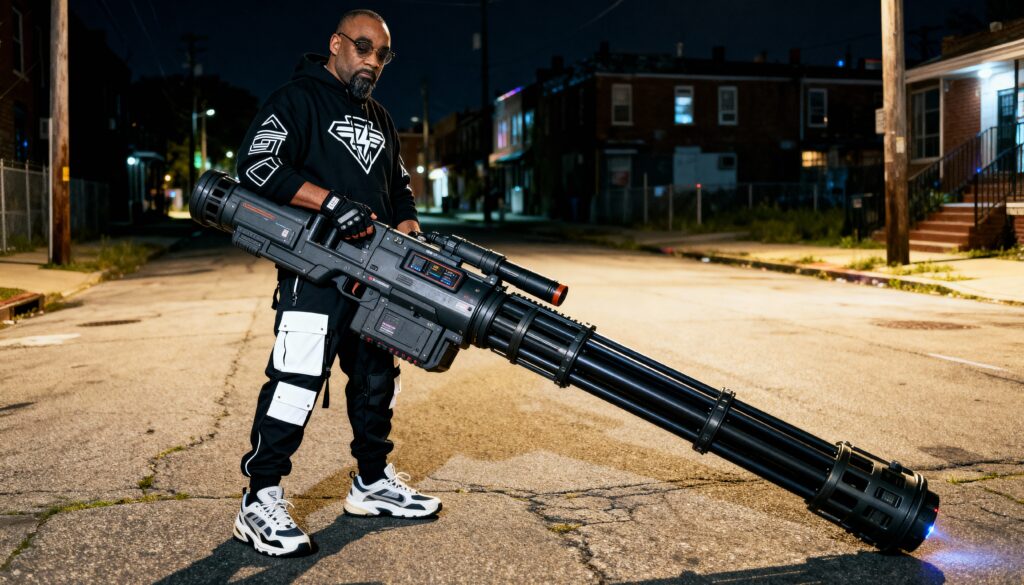
Lucraen shifted his grip, feeling the weight pull at his shoulders.
It was honest weight.
The kind that didn’t lie to you.
“This thing’s gonna put me in the ground,” he muttered.
The weapon did not disagree.
He had built it over three nights. No sleep. No music. Just coffee, painkillers, chalk dust, and memory. He scavenged parts from dead tech left behind by worse people—things Seren told him not to touch, things Ronan had once called bad ideas waiting to hatch. Draven had only looked at the pile and said nothing, which somehow felt like permission.
The cubes stayed in his pocket the whole time. He didn’t touch them. Didn’t want to know what would happen if he did.
The city didn’t give him time to admire his work.
The scream came from three blocks east—high, wet, and wrong. Not human. Not fully not-human either. The sound scraped along brick and glass, vibrating windows, setting off car alarms that died as quickly as they started.
Lucraen exhaled, shouldered the weapon, and started walking.
The first scene was a convenience store that no longer knew it was a store. The doors had been twisted inward like soft metal, shelves fused together in spirals, the air thick with the smell of ozone and spoiled food. A man lay unconscious behind the counter, alive but shaking, whispering the same sentence over and over again.
“It asked me to remember something I never lived.”
Lucraen didn’t touch him. He marked the floor with a containment sigil, whispered a ward under his breath, and kept moving.
Outside, the night was wrong in subtle ways. Shadows lagged half a second behind their owners. Reflections in car windows blinked when the people they belonged to didn’t. Dogs howled from inside houses and refused to stop.
This wasn’t an invasion.
It was a bleed.
The Church’s work—whatever Saint Meridian had torn open—wasn’t marching. It was leaking. Reality wasn’t being attacked. It was being misremembered.
Lucraen turned down an alley and almost ran straight into the first thing that wanted him dead.
It unfolded from the darkness like a bad thought—tall, jointed backward, skin stretched thin over something that pulsed and crawled beneath it. Its head was wrong, face split into too many vertical seams, each one opening and closing as if tasting the air.
Lucraen raised the weapon without hesitation.
The thing lunged.
He fired.
The upgraded weapon didn’t roar.
It thundered.
A rotating chamber spun, sigils flaring in sequence, and a compressed blast of white-black force tore through the alley like a wrecking ball made of scripture and spite. The creature didn’t explode. It didn’t disintegrate.
It failed.
Its body unraveled mid-motion, joints forgetting what they were supposed to do, flesh peeling into ash that evaporated before it hit the ground. The alley went silent again, save for the ringing in Lucraen’s ears.
He lowered the weapon slowly.
“…Okay,” he said quietly. “That works.”
Something shifted deeper in the city.
Lucraen didn’t call anyone. Not Draven. Not Seren. Not Ronan. He had a feeling—deep, unpleasant, and familiar—that if he did, they’d split up. And tonight felt like a night that punished people for being alone.
The next disturbance hit near the harbor.
The water wasn’t moving.
That was the first sign something was wrong. The harbor was never still—not with tides, not with trash, not with the city constantly dumping itself into it. But tonight, the surface lay flat as glass, reflecting the sky with uncomfortable clarity.
Lucraen stepped onto the pier, boots echoing.
The reflection blinked.
He froze.
The water’s surface rippled once, then bulged upward like something pressing from beneath. A shape emerged—not climbing out, not swimming, but being recalled into the world. It looked like a man made of drowned memories, body sagging and bloated in places, hollowed out in others. Seaweed and black water dripped from its mouth as it breathed for the first time in years.
Lucraen felt the cubes vibrate faintly in his pocket.
He ignored them.
“Don’t,” he said to the thing. “I’ve had a long week.”
The drowned thing opened its mouth.
The harbor screamed.
Lucraen fired again. The blast struck the pier just short of the creature, the force bending space enough to fling it backward into the water. The surface closed around it, sealing like a wound pretending it never existed.
The water began to move again.
Lucraen leaned on the weapon, breathing hard.
This was too much. Too fast. Too widespread. Maryland wasn’t under attack—it was being stress-tested.
And something was watching to see what broke first.
By the time Lucraen reached home, dawn was threatening the edges of the sky. His arms ached. His vision swam. The weapon felt heavier now, like it was learning him, mapping how much it could take.
He set it down carefully and slumped into a chair.
That’s when he noticed the blood.
Not from a wound.
From his nose.
He wiped it away with the back of his hand and stared at the smear.
“Cost of doing business,” he muttered.
The cubes were warm now. Not hot. Just… present.
Lucraen didn’t touch them.
Tess was asleep in the bedroom. He didn’t wake her. Didn’t want to see the worry on her face, the quiet calculation she did every time he came home breathing.
Instead, he sat there until the sun came up, listening to the city reassemble itself around him—sirens, buses, voices, life pretending nothing had happened.
But Lucraen knew better.
The shadows were deeper now.
The nights louder.
The monsters less patient.
And somewhere, beyond the limits of his sight and faith and weaponry, something was learning how much fire it took to stop him.