
ECLIPSE VI — Hollow
Lucraen Hollowpage didn’t quit the work. He just stopped answering it for a stretch, the way a man stops listening to a ringing phone when he realizes it’s only ringing because someone wants to pull him back into the same bad pattern. The city never thanked him for anything. The Church never stopped being a Church. Maryland never got cleaner. But for a small run of days that felt stolen from some kinder world, he let the streetlights flicker without treating every flicker like a warning, and he let his own front door click shut behind him without thinking about whether it would be the last normal sound he heard.
He sat at the table with the bills spread out like accusations and tried to be a regular husband for long enough to remember what that even meant. The numbers were still ugly. The margins were still thin. The work still didn’t pay the way it should, not for what it asked of him, not for what it took out of his body. The difference was Tess moving through the apartment as if she’d decided she wouldn’t let the darkness have every room. She’d come home carrying the fatigue of social work like a second coat, and she’d take it off by force, by will, by sheer stubborn love. Sometimes she did it with quiet, sometimes with attitude, sometimes with jokes that cut sharp enough to draw a real smile out of him.
“You’re staring at them like they’re gonna jump up and bite you,” she said, leaning over his shoulder, close enough that he could feel the warmth of her presence before he fully registered her words. “If you wanna fight paper, baby, at least let me get my shoes on so I can watch.”
Lucraen pinched the bridge of his nose. “These ain’t paper. These are… consequences.”
Tess made a sound that was half laugh, half scoff. She slid into the chair across from him and reached for one of the envelopes like she had a personal vendetta against it. “You always talk like you’re the only person carrying something,” she said. “But let me tell you something, Lucraen. When you walk out that door, I carry it too. So if you’re gonna sit here and brood, at least share the burden like a married man.”

He looked up at her, and there it was—the thing he loved and feared in equal measure. Tess didn’t soften the world to survive it. She sharpened herself until she could cut through it. She had a face that could look playful one second and deadly serious the next, eyes that never stayed fooled for long, and a mouth that had always been willing to say the difficult thing before the difficult thing rotted in silence. The apartment lights caught the clean lines of her posture as she leaned forward, elbows on the table, daring him to pretend.
He didn’t answer right away. He learned long ago that Tess didn’t need words to know the truth. She needed the truth to be treated with respect.
“I’m taking a break,” he said finally.
Tess blinked like she didn’t believe him at first, then the disbelief melted into something warmer, almost startled. “A break,” she repeated, tasting it. “From what? From the monsters? From your little midnight errands? From making me sleep with one ear open?”
“A break,” he said again, firmer. “From all of it. I’m still me. I’m still here. I’m just not going out there for a bit.”
She sat back slowly, letting that sink in like her body needed proof before her mind would accept it. “Say that again,” she said, softer now.
“I’m not going out there for a bit,” Lucraen repeated.
Tess held his gaze, searching for the lie, then finding the decision. Her shoulders dropped. The tension in her jaw loosened. She exhaled like she’d been holding her breath since the first night she realized her husband wasn’t just street-smart, he was street-haunted.
“Okay,” she said. “Okay. Then we’re gonna do something wild.”
Lucraen’s brow lifted. “Like what?”
Tess smiled, and it was the kind of smile that made him remember the version of her that existed before case files and trauma calls and the cruel ritual of being the person who walks into other people’s pain and tries to map it. “We’re gonna have a week,” she said. “A real one. We’re gonna act like we’re allowed to enjoy each other. We’re gonna eat good. We’re gonna go outside. We’re gonna laugh. And if you get that look in your eyes like you’re about to run back into the dark, I’m gonna smack you with a frying pan.”
Lucraen snorted despite himself. “You’d miss.”
Tess leaned forward again, voice dropping into that intimate register she used when she meant it. “Try me.”
That night, she didn’t let him stay stuck at the table. She dragged him into the kitchen and gave him a job like he was a normal man with normal hands. She handed him a cutting board and pointed. He watched her move through the space with wet hair still clinging to her shoulders from a shower, wearing a cropped top that made the domestic light look indecent, denim shorts that had no business existing in a room full of knives, and an expression that said she was daring the world to interrupt her peace. Tess cooked like someone who’d learned that comfort was a weapon. She seasoned everything like she wanted the food to punch back at the despair.
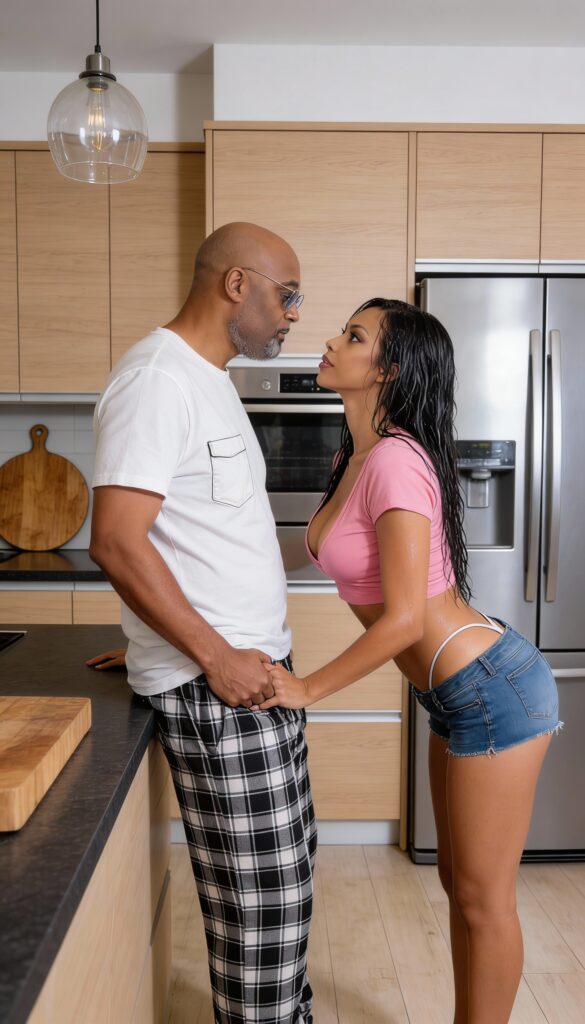
“You know Seren called me,” she said, casual, like she was talking about the weather.
Lucraen’s knife paused mid-slice. “Seren.”
“Mm-hm,” Tess said, flipping something in the pan with the confidence of a woman who’d survived worse than grease. “She checked on me.”
Lucraen’s eyes narrowed slightly. “Why?”
Tess shot him a look. “Because she’s not heartless. And because she knows what you do means somebody loves you enough to worry.” She plated the food, then leaned back against the counter, arms folding. “She told me things, Luc.”
He kept his voice neutral. “What things?”
Tess’s gaze drifted, not away from him, but through him—through the apartment walls, through Maryland, through all the places she’d had to stand in the aftermath and pretend her heart didn’t crack a little every time. “She told me about places you’ve been,” she said. “About what it looks like when you don’t show up. About what happens when people like you stop doing what you do.”
Lucraen swallowed, slow.
Tess continued, words measured now, careful. “I see the dark every day, Lucraen. Different kind than yours, but it’s still dark. I see it in kids who don’t flinch anymore when adults raise their voices. I see it in women who apologize for being bruised. I see it in men who don’t even pretend they want to get better. And then I come home, and you’re cleaning blood off your hands like it’s just another chore, like it doesn’t cost anything.” She stepped closer. “Seren told me the world’s better because you exist in it. She said you don’t brag. You don’t even talk about it. You just… do it.”
Lucraen felt his throat tighten, and he hated it, because he didn’t like emotions getting loud. He was used to dread. He was used to anger. He was used to calculating fear. Love was the one thing that still had the power to make him reckless.
Tess touched his chest with two fingers, not pushing, just claiming his attention. “So I’m not here to fight you,” she said. “I’m here to support you. But I need you to be smart. I need you to be safe. I need you to come back.” Her mouth twisted into a half-smirk, that familiar sharpness returning. “And I need you to stop acting like you’re the only one allowed to have an opinion about whether you live.”
Lucraen stared at her for a long beat, then nodded once. “Fair.”
Tess’s eyes softened. “Good. Now eat. And don’t you dare say the food’s too salty. I will file paperwork on you.”
They went out midweek like the world hadn’t tried to ruin them. Tess chose the place. Warm lighting, leather booths, that soft hum of conversations from other tables that made the room feel like a shelter. She wore a light blue dress that sat clean against her body, simple but impossible, like she’d decided elegance was a form of defiance. Lucraen wore black like he always did, but for once it didn’t look like armor. It just looked like him.
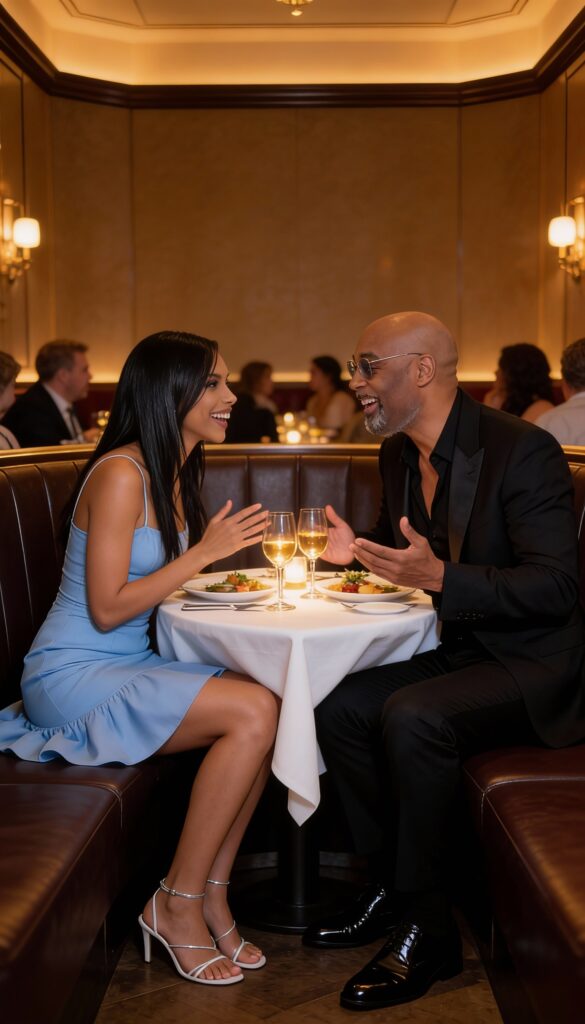
They ordered, they drank, they laughed—real laughter, the kind that surprises you when it escapes, like you forgot you still had it. Tess leaned across the table, hands animated as she told him about a coworker who’d tried to explain “street” to her like she hadn’t been living next to it her whole life. Lucraen listened with that quiet focus he gave to danger, except this was joy, and the intensity of his attention made it feel sacred.
“You know you scare people,” Tess said suddenly, grinning.
Lucraen’s eyebrow lifted. “Me?”
“Yes, you,” Tess said, pointing her fork at him like it was evidence. “You sit there looking like you’re about to interrogate the whole room. The waiter thought you were a cop. The couple behind you keeps glancing at you like you’re gonna pull out a weapon.”
Lucraen didn’t smile, not fully, but his eyes warmed. “Good.”
Tess laughed. “That’s the problem. You like it.”
Lucraen’s gaze drifted to her mouth for a second, then back to her eyes. “I like you.”
Tess’s grin faltered into something softer, something that carried weight. “I like you too,” she said, quieter. “That’s why I talk the way I do. That’s why I get mad. That’s why I don’t let you drift off into your own head. Because I’m… in love with you, Luc. Like, embarrassingly. Stupidly. Deep.”
Lucraen felt that land in his chest like a blow. He didn’t flinch. He let it hit.
“I know,” he said, voice low.
Tess narrowed her eyes. “You better.”
They went shopping later, like a normal couple pretending their lives weren’t wired to explode. A mall full of noise and neon and people who didn’t look over their shoulders for shadows that moved wrong. Tess walked beside him with bags in hand, dressed sharp, a white top cut with a clean line at the chest and a black skirt that made her look like she belonged on the cover of something expensive. Lucraen moved through the crowd with his hands in his pockets, watchful but not hunting, a blue track jacket over a dark shirt, the whole look saying he could blend if he wanted to, but he didn’t feel like it.

“You’re judging everybody,” Tess teased, leaning into him.
“I’m observing,” Lucraen corrected.
Tess rolled her eyes. “Same thing.”
They bought things they didn’t need. They ate pretzels. Tess made him take a picture with her because she said she wanted proof that he could exist in daylight without a demon trying to cash in a debt. He didn’t argue. Not much.
That night, they went home and turned the world down. Tess sprawled across the couch in an oversized sweater, remote in one hand, popcorn in a bowl beside her like she’d declared war on seriousness. Lucraen sat near her, closer than he usually allowed himself when he was tense, and she put her legs across his lap like it was the most natural thing in the world. He massaged her foot absentmindedly, his hands doing what his mind didn’t know how to do: care without calculating.
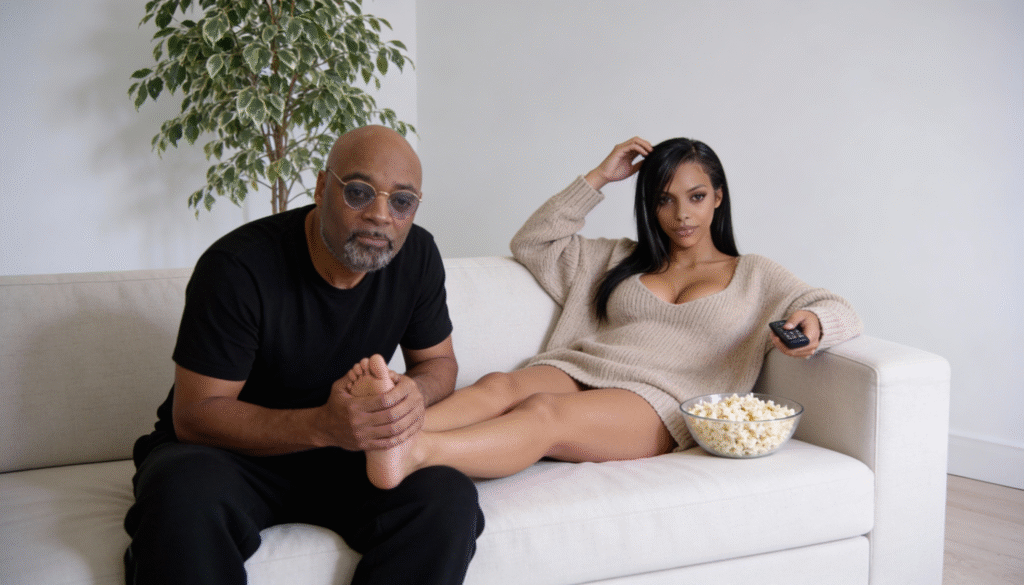
“You’re good at this,” Tess murmured, eyes half on the screen, half on him.
“At what?”
“At being mine,” she said, simple.
Lucraen’s fingers paused, then resumed, slower. “Don’t get used to it,” he said, but his voice didn’t carry the bite.
Tess smiled like she’d won anyway. “I’m already used to it.”
Later, when the apartment went quiet and the lights went low, Tess climbed into bed like she was stepping into sanctuary. Candles flickered soft against the wall, the shadows gentle for once. She lay close to him, dressed in gold-toned lace that caught the dim light and made her look like something precious, something that didn’t belong in a city like theirs. Lucraen turned toward her and felt something in him unclench, like his body had been waiting for permission to stop bracing.
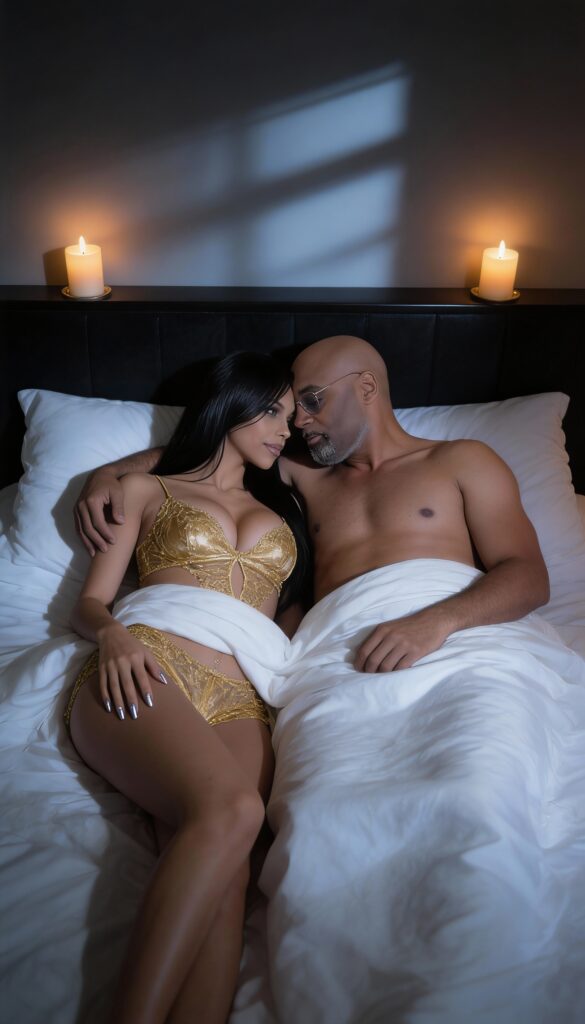
Tess touched his face. “You’re here,” she said.
Lucraen exhaled. “I’m here.”
Tess’s forehead rested against his. “I don’t want you to stop being who you are,” she whispered. “I just want you to come back to me after.”
Lucraen’s arm slid around her, pulling her close, and he didn’t let himself speak the fear that lived under his ribs, the fear that one night his luck would run out and he’d leave her alone with bills and grief and the memory of his shape in the bed. Instead, he pressed his mouth to her temple, then her cheek, and held her like holding her could rewrite the city.
“You got me,” he said.
Tess’s breath shuddered, not sad, just real. “I know,” she said. “That’s why I’m scared.”
He didn’t answer with promises. He answered with presence, with the kind of stillness that meant he was listening all the way down.
When the week ended, it didn’t end with a bang. It ended with reality reminding them that peace was borrowed.
Lucraen stood in the kitchen again, alone for a moment, and looked at the small cosmic cubes—dice-sized, heavy in the palm, cold like a secret. He didn’t roll them. He didn’t test them. He simply stared, remembering the Antithesis of Paradise, remembering the laugh that had split that unmanifest expanse, remembering the way the warning had been delivered like a joke meant for someone else. He’d told no one. He still wouldn’t. Some warnings were poison if spoken out loud.
He set the cubes down. Carefully. Like they might hear.
Then the world elsewhere decided to stop pretending.
Mira Calder met Draven under a sky that looked normal until you stared too long. Baltimore had a way of hiding cosmic horror behind streetlights and block parties, behind boarded windows and police tape, behind the daily noise of survival. The alley they stood in was wet with old rain and newer rot, brick walls tagged with names that had outlived the people who wrote them. Draven stood still, his posture calm in the way that made him feel more dangerous than movement. He wore a black hoodie marked with stark symbols, gloves fitted tight, tactical pants heavy with straps and pockets, boots planted like the ground needed his permission to exist. In his hand was his blade—rune-etched, blue-white luminescent, breathing cold mist that made the air around it look brittle.
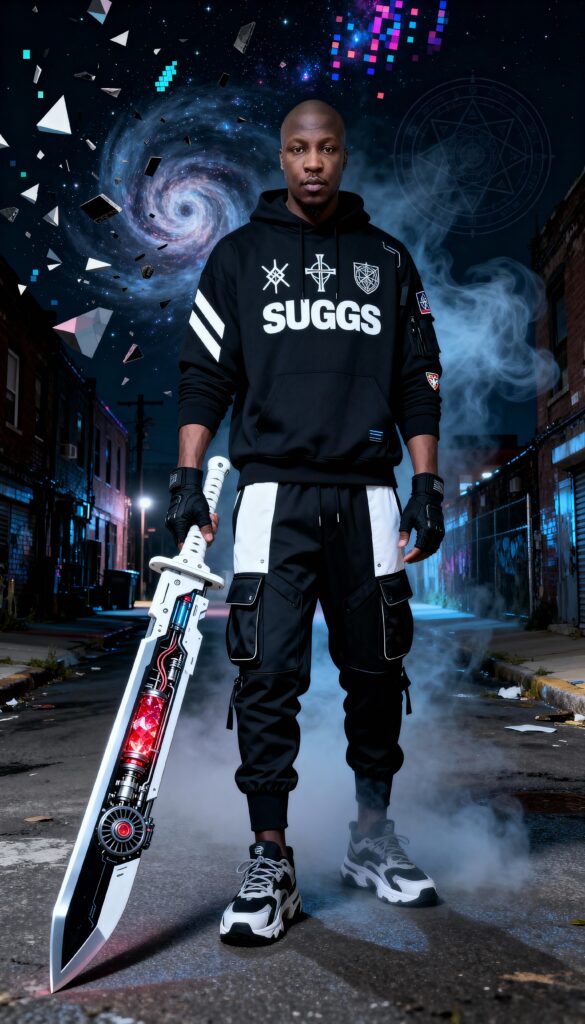

Mira arrived like she always did: too bold for her own safety, too alive for the darkness to fully swallow. She wore a red jacket with a shearling collar over a black dress slit high, boots laced and heeled like she’d decided danger should at least be aesthetic. She lifted her hand and a constellation of holographic galaxies spiraled above her palm, flickering in blues and violets, a miniature cosmos pretending it was just a trick of light.
“You look like you didn’t sleep,” Mira said, trying for casual.
Draven’s eyes flicked toward her, then back to the sky. “I slept.”
Mira’s lips twitched. “You always say that like it means something.”
Draven didn’t respond. He didn’t need to. The air was already changing.
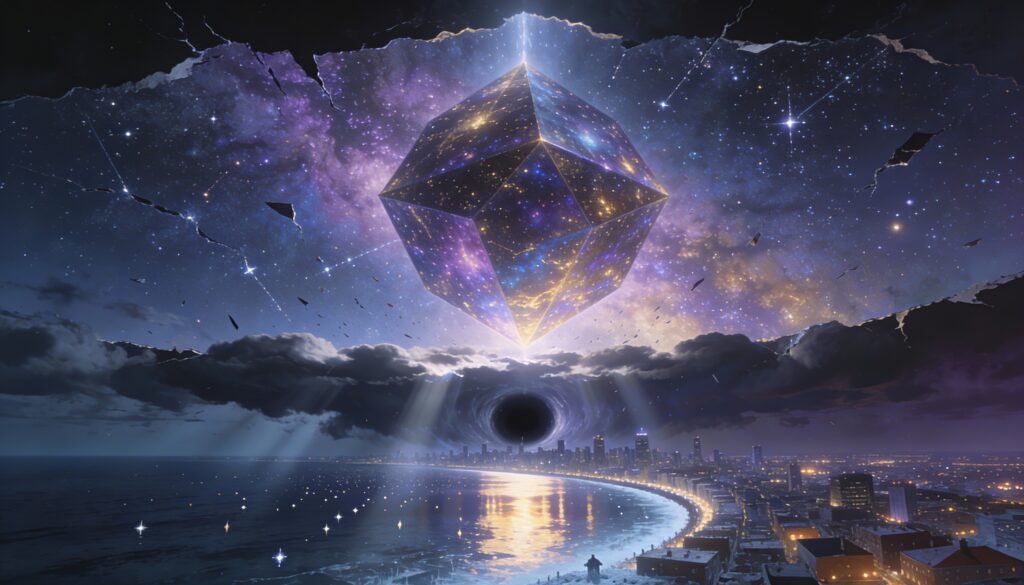
High above the city, the cosmic octahedron ruptured into view like a thought too large for the mind of the world. It wasn’t a ship. It wasn’t a star. It was geometry turned into a wound. The surface shimmered with nebulae and starfields, as if its skin was a window into some boundless manifest expanse that had never agreed to be separate from Earth. Cracks spidered around it, not in the air—through the very notion of the sky being intact. Light bent wrong. Sound arrived late. The edges of buildings blurred as if reality was deciding whether to keep them.
Mira swallowed, her throat tightening. “That’s… not a normal one.”
Draven’s grip adjusted on the blade. He didn’t say what he was seeing, but his mind was already moving through it, cold and methodical, the way it always did. He didn’t need to declare his competence out loud. He wore it in the way he stood.
The octahedron pulsed, and the world answered by shuddering through layers of beyond-dimensional reality like a nervous system having a seizure. Not just Baltimore. The entire planet felt it, a deep tremor that made birds explode out of trees and made people on distant streets stop mid-sentence because they suddenly didn’t trust their own memories. Possibility began to stutter, not collapse, not end—just slip, as if it could no longer hold its own shape.
The octahedron pulsed, and then it went silent.
Not the absence of sound—the cancellation of it. A silence so absolute it propagated outward as an influence, spreading across infinite reality–fiction layers like a thought that refused to be interpreted. Confusion didn’t arrive as panic or noise; it arrived as misalignment. Meaning slipped first. Cause and effect lost their agreement. Across the planet, conversations ended not because people were interrupted, but because language briefly forgot what it was supposed to point to. Birds fell from trees mid-flight, not dead, just inverted—wings flailing upward into gravity that no longer recognized them. Somewhere, oceans hesitated, unsure which direction to fall.
The world inverted.
Up and down reversed, but not cleanly. Left and right traded places in a way that made the body rebel against its own instincts. Forward folded backward into itself. This was not disorientation—it was weaponized inversion. Eyesight betrayed its owners. Incoming attacks arrived from directions that no longer existed. Wounds appeared on the opposite side of the body from where impact should have occurred, injuries blooming where nothing had touched. The mind tried to compensate, tried to process the reversal, but cognition collapsed under the load. No amount of mental calculation could counter it, because the inversion wasn’t happening to perception—it was happening to the framework that made perception possible.
Within the radius of that silence, every enemy was inverted at the level of awareness itself.
Thoughts arrived backward. Reactions preceded stimuli. Intent lagged behind consequence. The octahedron’s otherness did not merely confuse—it redefined orientation. To stand against it was to fight while upside down inside your own body, inside your own expectations, inside your own understanding of where you were and what you were facing. The silence turned opponents against the reliability of their senses, sealing them inside a version of reality where trust in direction, damage, and defense no longer existed.
And the silence did more than invert—it fused.
The otherness of the octahedron bled into its surroundings, merging with everything it touched. Streets, air, light, void—none were exempt. Even the foundation of creation bent inward, absorbed into its presence. The silence entwined itself with the grand principle of creation itself, binding nothingness, possibility, and totality into a single extension of its will. They were no longer independent states; they became functions of the silence. Through this fusion, the octahedron perceived everything within its domain—living and nonliving, organic and inorganic—not as separate entities, but as variations of position within its awareness.
Space itself became pliable under that dominion. Silence echoed—not acoustically, but existentially—sealing victims’ possibility inside the boundaries of its presence. Within that enclosure, escape was not denied by force, but by relevance. Possibility resonated one way and became suppression. Nothingness resonated another and became erasure. Totality resonated a third and became containment. The silence adapted, reshaping itself to counter the defining characteristics of whatever opposed it, a living inversion engine that learned by existing.
Above it all, reality began to fail structurally.
The eleven dimensions of reality convulsed, layers peeling and buckling as if their connections had been loosened by an unseen hand. Beyond them, twenty-three higher dimensions fractured outright—not destabilized, not damaged, but destroyed, collapsing into unusable remnants that could no longer support continuity. The sky did not crack; it forgot how to stay intact. The planet groaned under stresses it had never evolved to recognize, as if the universe itself were recoiling from something it had no context to survive.
And still—no sound.
Just silence.
A silence that did not wait to be understood.
A silence that had already decided what everything meant.
Beyond accelerating tachyon speed, a beam of dark energy sliced downward, silent at first, then roaring as it tore through the air. Mira moved on instinct, rolling behind a parked car that immediately crumpled from the proximity of the strike. The beam didn’t simply burn. It tried to subtract. The asphalt around it rippled like liquid, then hardened wrong, like the street had forgotten its purpose.
Draven moved without looking dramatic. His body shifted, precise, minimal. He didn’t leap. He didn’t show off. He just wasn’t where death aimed.
Another blast came—this one not a beam but a swelling pressure that made Mira’s teeth ache. The air thickened like a hand closing around the city. Mira felt her thoughts flicker, like something was trying to deconstruct the sequence of her existence, to pull her apart not physically, but narratively.
She clenched her jaw and forced her mind into focus. “Draven!”
He didn’t answer with a shout. He answered with action. The blade in his hand flared cold, the mist sharpening into a thin halo of blue-white light. He stepped forward, toward the impossible, toward the octahedron that was shaking the world’s framework, and Mira felt that familiar terror and awe that came whenever she fought beside him. Draven didn’t fight like a man trying to win. He fought like a man correcting an error.
Mira rose from behind cover and lifted both hands. Her galaxies expanded into a lattice of shimmering symbols that spun around her wrists like bracelets made of starlight. She didn’t try to overpower the octahedron. She didn’t have to. Her job was support, interference, disruption—making openings where none should exist. She sent a spiral of luminous distortion upward, and the next beam meant for Draven curved slightly, just enough to miss him by a breath.
Draven’s eyes never left the target. Internally, he mapped the octahedron’s rhythm, the pulse between ruptures, the way its geometry shifted like it was trying to decide which world it belonged in. He saw the problem the way a surgeon sees a tumor: not with fear, but with clarity. The blade’s rune-etchings brightened as if responding to his certainty.
He ran—not fast in the childish way people brag about, but with that beyond conceptual tachyon velocity, the kind of movement that made his body look like it belonged in the space between moments, where consequence hadn’t caught up yet. The ground under him cracked from stray pressure waves. Cars flipped. Glass shattered in a rain of glittering fragments. Mira kept pace at a distance, dodging blasts, forcing her breathing steady as antimatter gates began to bloom in the air—black, oval wounds that bent light and tried to swallow the world whole. They weren’t merely gravitational. They were conceptual. They didn’t just pull matter. They pulled meaning.
Mira flung a sequence of sigils into one gate and it hesitated, wobbling like a mouth unsure whether to bite. She didn’t celebrate. She immediately moved to the next, because hesitation was the only mercy the universe ever offered, and it never lasted.
Draven reached the point beneath the octahedron where the air felt thin and wrong. Above him, the shape rotated, starfields sliding across its faces, the cracks around it widening. It tried to reassert itself, to anchor into Earth’s reality like a parasite pushing roots into soil.
Draven lifted his blade.
For a brief breath, the city went quiet, not because sound stopped, but because everything else recognized something decisive was about to happen. Mira felt her skin prickle. She didn’t look away. She couldn’t.
Draven swung.
The blade did not simply cut matter. It cut through the argument that the octahedron was allowed to exist here. The strike carved a line through the air that looked like frost splitting glass, and where that line touched the octahedron, the geometry screamed without sound. The cut didn’t destroy it instantly. It did something worse to it. It forced the octahedron to confront its own contradiction—existing and not existing in the same place, demanding the world accept it while its very presence destabilized the world’s ability to accept anything.
A second strike followed, not dramatic, not flamboyant, just inevitable. The rune-etched blade exhaled a colder mist, and the cut widened, slicing through the octahedron’s conceptual existence and its conceptual nonexistence, splitting the thing’s claim to reality into fragments too incompatible to remain unified.
Mira’s knees buckled as the backlash rolled across the city. She caught herself on a wall, breathing hard, eyes watering, heart pounding like it was trying to escape her ribs. Above them, the octahedron fractured into shimmering shards that looked like pieces of the night sky being shattered and dismissed. The antimatter gates collapsed, imploding into nothing. The beams ceased. The pressure released.
The sky resealed itself with a sickening smoothness, like a wound that didn’t want witnesses.
For a moment, everything held still.
Then Baltimore resumed. Sirens in the distance. A dog barking. Someone shouting from a window. The normal noise of a city too stubborn to die.
Mira laughed once, breathless, the sound half relief and half disbelief. She pushed off the wall and stumbled toward Draven as he lowered his blade, shoulders rising and falling in controlled breaths. His expression didn’t change much. It rarely did. He looked like a man who’d just finished a job.
Mira stopped in front of him, close enough to feel the cold mist coming off his weapon. She swallowed, suddenly aware of her own heartbeat, suddenly aware of how often she’d imagined this moment going differently. “So,” she said, trying to sound casual and failing, “you free tonight?”
Draven’s gaze moved to her, steady, unreadable. He didn’t mock her. He didn’t soften for her. He simply regarded her with the same calm he gave to everything, like emotion was something he acknowledged privately and managed responsibly.
Mira pushed through anyway. “I’m serious,” she said. “Not like… a joke. Not like I’m trying to be cute. I’m asking. A date. Just—me and you. Food. Somewhere that doesn’t feel like the end of the world.”
Draven was silent long enough that Mira’s confidence started to wobble.
Then he spoke, voice low. “No.”
Mira blinked, forcing a smile that didn’t quite land. “No?”
Draven’s eyes stayed on hers. “Not like that.”
Something in Mira’s chest tightened. She nodded slowly, as if she’d expected it, as if she’d prepared for it, but preparation didn’t stop it from hurting.
Draven continued, not cruel, just honest. “You did good work tonight.”
Mira laughed again, smaller this time. “That’s a nice way to say thanks.”
Draven didn’t smile, but there was a faint shift in his eyes, a subtle warmth that didn’t become permission. “It’s the truth.”
Mira held his gaze for another beat, then stepped back, choosing pride over collapse. “Yeah,” she said. “Just another day in Baltimore.”
Draven turned slightly, attention already moving back to the city, to the next threat, to the endless work. He didn’t watch her leave. He didn’t have to. He trusted that she would.
Mira walked away with her galaxies flickering dim around her fingers, swallowing disappointment like it was just another thing she had to be good at surviving.
Back in his apartment, Lucraen stood at the table again, the cubes in front of him like a dare. Tess was in the other room, humming softly as she moved through their space, trying to keep the atmosphere light because she knew his mind liked to drift toward the dark when it wasn’t occupied. Lucraen picked up the cubes, stared at them, and for the first time in days, he felt that old pull—the call of the work, the lure of purpose, the addiction of being needed.
He thought of Tess’s hands on his chest. He thought of her voice saying she didn’t want him to stop being who he was, she just wanted him to come back. He thought of Seren’s quiet respect. He thought of Draven cutting an impossible geometry out of the sky like it was a nuisance.
Lucraen looked down at the cubes.
Then he did something simple.
He threw them away.
Not dramatically. Not ceremoniously. He walked to the trash, dropped them in, and let the lid close with a soft, final sound that made his chest feel oddly lighter. He knew they weren’t really gone. He knew nothing that strange ever stayed discarded. But the gesture mattered. It was him declaring that he would not be ruled by fear disguised as prophecy.
He returned to the window.
Outside, the sky had a thin, almost invisible fracture line—so faint a normal person would miss it, so subtle it could be mistaken for a cloud, but Lucraen saw it for what it was. The world had been touched. The world had been warned. The world would not end today, not tomorrow, not soon, but it had been reminded that it could be broken.
Lucraen rested his hand against the glass, and instead of dread, a smile tugged at his mouth.
Not because he was happy the sky was cracked.
Because he was still here to see it.
Because he still had someone in the other room who wanted him alive.
Because even if God was silent, even if the universe laughed, even if the Church kept spreading its sickness through Maryland like mold in drywall—Lucraen Hollowpage had decided his faith didn’t need to be proven by miracles. It only needed to be strong enough to make him stand back up.
Behind him, Tess called out from the kitchen, voice warm. “You want tea or you wanna pretend you’re too tough for that too?”
Lucraen didn’t turn around right away. He stared at the fractured sky a moment longer, smiling like a man who’d accepted the cost and chosen the work anyway.
Then he answered, voice calm, steady, humble.
“Make it sweet,” he said. “We got a lot of night ahead of us.”