
Voidsong VIII: The Discourteous Guests
The Void Beyond did not “open” the way a door opens, because opening implies a hinge, and a hinge implies permission; what happened instead was that the realm’s unmanifest silence flexed—like a throat tightening around an unspoken refusal—and the party found themselves facing a vertical immensity that behaved less like a wall and more like a verdict pretending to have edges. The Asymptote of Glances rose and sank without terminus, a cliff-face made of frozen perspectives, stacked and compressed until “looking” became a kind of violence. Its surface was not stone, not metal, not any stable modality of matter, but a dense palimpsest of viewpoints that had been abandoned mid-thought—glances that never finished becoming understanding—hardened into a single, oppressive plane. Two colossal void-eyes hung within it like twin sinkholes in the manifest expanse, not watching so much as subtracting the right to be witnessed, and between them hovered a crownlike glyph-work of pale violet and cold-blue sigils that rotated without turning, a cathedral of circles nested in circles, needles and crescents and runic seams braided into a single anti-compass that insisted direction was an insult.
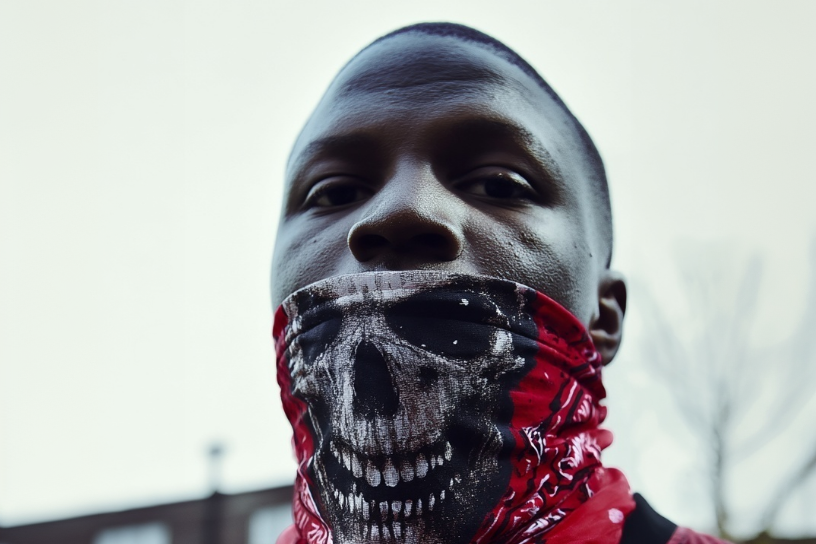
Draven Endwriting stood at the base of that impossible face and did what he always did when the world tried to erase him: he squared his shoulders and made himself undeniable. He wore a heavy, red-and-black jacket that looked built for weather and war at once, the front zipped to his chest with a blunt utilitarian seam, the word SUGGS stamped across it in oversized, distressed white lettering like a claim carved into a bruise. A skull-printed bandana was pulled up over his mouth and nose, the skeletal grin stretched across his lower face as if the Void had tried to assign him an epitaph and he had decided to wear it as a warning instead. His posture was forward-leaning, chin lifted, eyes locked on the cliff as though eye contact could be turned into leverage. In his right hand he kept the broken remainder of his blade—what used to be a reliable declaration of choice—now a jagged, rune-etched fragment that still exhaled a faint cold mist, blue-white luminescence spilling from its fissures like an old oath refusing to die.
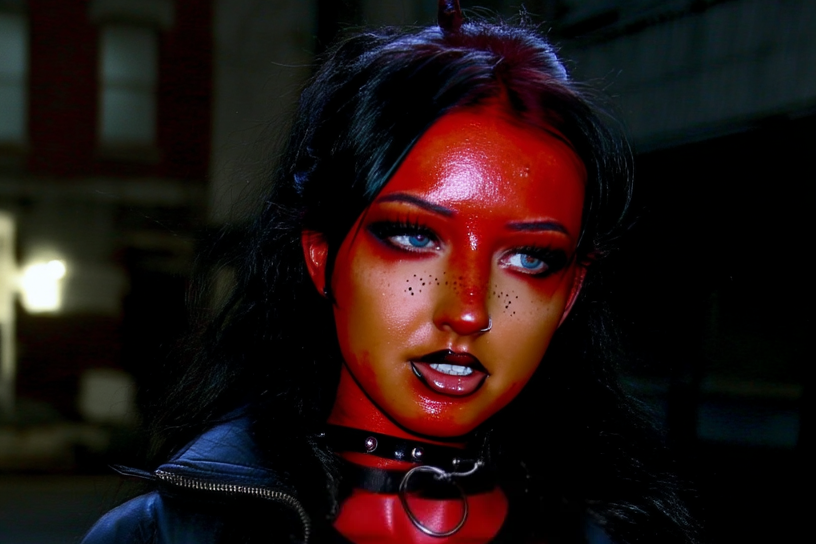
Ranavalona Zakirra stepped beside him with the kind of ease that made the Void look clumsy. She moved like someone who had lived inside contradiction long enough to treat it as fashion, her black puffer jacket hanging open to reveal a lace-trimmed black top that clung like deliberate scandal, a choker at her throat fitted with a metal ring that caught the ambient unlight and made it look sharpened. Her lips parted in a half-smile that carried both amusement and appetite, and her head tipped slightly as if she were listening to Draven’s thoughts not with telepathy, but with the intimate skill of someone who can read obsession in the way a person breathes. She kept her hands low, relaxed, and yet every angle of her stance suggested readiness—the kind of readiness that doesn’t tense, because it doesn’t need permission to strike. She looked at the Asymptote as if it were a rude stranger and she had already decided whether to flirt with it or kill it.
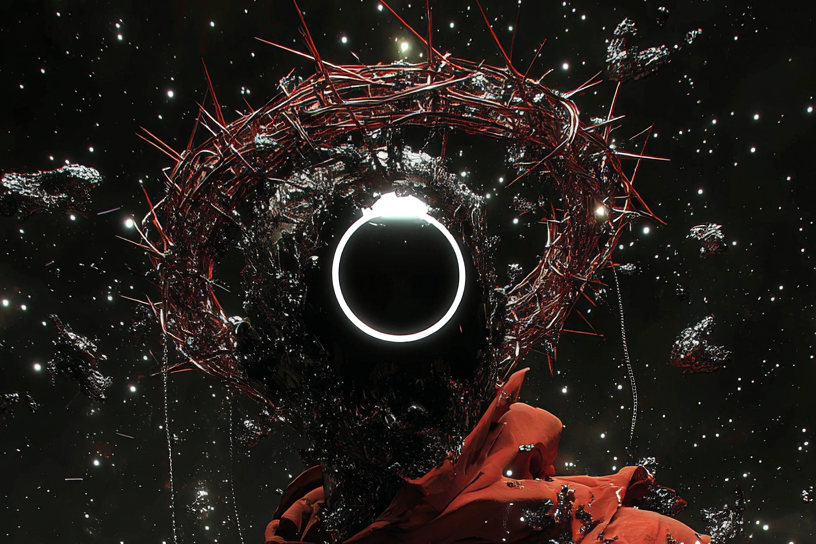
Ae’Suggsrael did not step so much as arrive. One moment the silence was only pressure; the next, a red-robed silhouette occupied the tension, draped in layered crimson cloth that folded and refolded like mourning garments trying to remember who died. Around the headspace where a face should have been hovered a ring of pale light—an eclipse-outline—set against an absence so complete it didn’t read as darkness, but as refusal given geometry. Above and behind that ring, thin red spines formed a crownlike halo, thorned and erratic, as if some unseen hand had tried to sketch sanctity and instead produced a wound. Ae’Suggsrael’s pose was composed—one hand lifted slightly, fingers curved as though holding a thought by the throat—and the whole figure carried the stillness of someone whose voice does not travel through air, but through deletion.
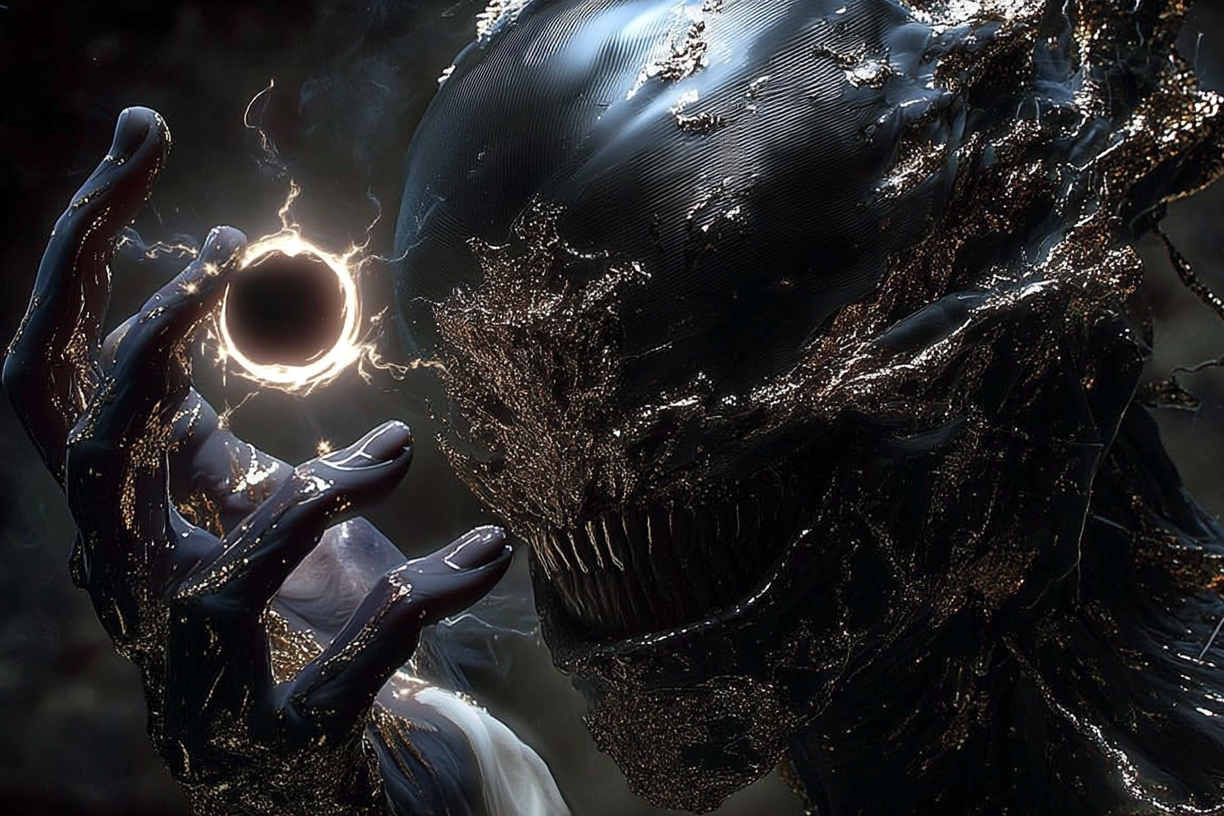
Khal’Vossugg stayed a pace back, not out of fear, but out of disdain for proximity. Its body looked like glossy black oil wearing the idea of a humanoid outline, filaments of gold-flecked sheen glinting across shoulders and jaw as if entire constellations had been ground into tar and smeared over muscle. A mouth split its face in a long crescent of teeth—too many, too narrow, too pleased—and one hand was raised near its cheek, delicately pinching a small ring of dark radiance: an eclipse the size of a coin, haloed by sparking filament-light, as if it were casually holding the eye of a dead god between two fingers. Khal’Vossugg’s posture was almost theatrical, chin angled, body turned half-profile, savoring the scene with the patience of a predator watching lesser creatures argue about whether fear is rational.
They should have been able to “climb” the Asymptote by effort, but effort meant nothing here unless the wall admitted the effort as real. The cliff did not resist hands; it resisted acknowledgement. Draven raised his broken blade and whispered, not as speech, but as an assertion that silence did not get to own the last word. The rune-cracks along the fragment glowed, and the air around his hand acquired the faintest tremor, like the manifest expanse remembering what it felt like to be cut. For a moment the cliff-face’s frozen perspectives stuttered, as if one of its discarded glances had been forced to finish its thought, and a narrow seam appeared—an almost-climbable crease, a slit of acceptance forming where refusal had been absolute.
Ae’Suggsrael froze.
Not because something moved, and not because a sound arrived, but because an absence approached that had no right to exist. The eclipse-ring where Ae’Suggsrael’s face should have been brightened by a fraction—enough to make the halo look like a warning light—and the red thorns around the headspace quivered as if the Void Beyond itself had inhaled through clenched teeth. Draven felt it too, not as hearing, but as a pressure on the inside of his name, a tug at the back of his identity as though something had grabbed the thread that kept him coherent and tested how easily it could unravel. The unmanifest silence around them did not deepen; it began to pant, an irregular rhythm of negation, like the realm’s own composure had been interrupted.
Ranavalona’s smirk thinned into focus. Her gaze slid past the wall, past the twin void-eyes embedded in its depth, toward a hairline fracture above and beyond the party—an improbable crack in the “ceiling” of the Void Beyond’s own refusal, an opening that should not have been possible because the realm was not supposed to have an outside. In that fracture, a current flowed the wrong way. Normally the Void Beyond harvested, pulled, drank. Now it was expelling. A thick stream of non-attribute sludge poured outward, not liquid, not gas, not any stable modality—more like discarded definitions melted into an ooze that carried the stink of rejected logic. It crawled toward the crack as if the realm were vomiting up its own waste.
Ae’Suggsrael lifted a finger, and the surrounding stillness around that gesture was deleted—just enough for meaning to surface. “Do not mistake this for an assault,” the voice arrived without sound, present as a carved absence in the air. “Assault implies desire. This is rejection losing its grip.”
Khal’Vossugg’s teeth showed more. “How discourteous,” it purred, and the word itself seemed to stick to the inside of Draven’s thoughts. “The Void Beyond has guests.”
Then the first of them slid into view.
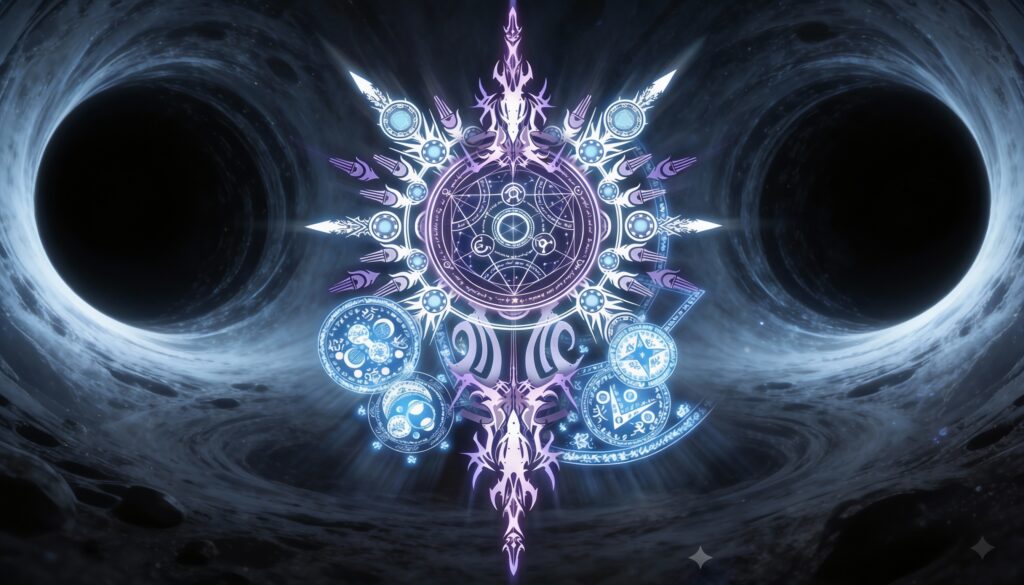
The first of them did not “enter view” the way a creature enters, because creaturehood implies an agreed outline. What manifested at the breach was a self-contained refusal shaped like a theorem. A violet core-ring appeared as if the Void Beyond had been forced to admit a center, packed with nested circles, triangulated seams, and engraved runes that looked less like language and more like a legal document drafted by a cosmos that hated loopholes. Around that central ring, pale lances of sigil-geometry unfolded in perfect radial symmetry, each spike an exclamation point aimed at whatever tried to interpret it. Smaller blue-white seals orbited the core in disciplined arcs—subsidiary discs etched with variant rule-sets—rotating as if they were deciding, in real time, which version of reality they intended to insult. Behind this mandala, twin abyssal apertures opened like the suggestion of eyes, not watching but subtracting the right to be witnessed; the “background” itself became a paired emptiness that framed the Prisoner’s presence the way a wound frames its own violence. It did not move forward; it aligned. It rotated its inner diagrams until the Transhierarchical Sieve recognized it as compatible refusal, and then it slid through with the smoothness of discarded canon returning to the page that rejected it.
A second Prisoner followed, and the Void Beyond reacted the way an immune system reacts when it realizes its own rejection is failing: with offended tightening, with deeper negation pressing in as if to crush the spectacle into nothing. This one’s crown of lances was jagged rather than elegant, its orbiting seals fewer but heavier in implication, and along the inner circumference of its violet ring ran a serrated crescent of glyphs that resembled teeth—not a mouth, not a face, but an annotation that read like predation. Where the first mandala felt like a verdict, this one felt like a hunger clause inserted into the law. It carried its own chain as well, though the chain was not metal and not substance; it was a linked sequence of never-rendered events, each “link” a compact scene that had been denied existence, each denied scene now dragged behind the Prisoner like a trophy. The chain did not clatter. It asserted. Each link declared, without needing sound, that an apology had been refused, a birth had been voided, a reconciliation had been edited out, and the universe had signed off on that erasure until now.
A third Prisoner emerged in a way that stabbed Draven’s identity directly, because its orbiting seals briefly reconfigured into imagery that should never have belonged to it. One of the subsidiary discs flashed a skull-grin motif—an obscene echo of the bandana across Draven’s lower face—while another displayed blocky, distressed letterforms that implied the word on his jacket as if the Prisoner had peeled his symbol from him and pinned it into its own geometry. The effect was immediate and nauseating, not because it threatened his body, but because it threatened the principle that his self belonged to him. In that instant, he understood the deeper horror of the Discourteous Guests: they don’t need to “copy” a person; they can overwrite the surrounding meaning so thoroughly that your signature becomes an ornament in their crown, and the world begins to behave as if it was always theirs to wear.
Draven’s stomach dropped with a sensation that wasn’t fear so much as causality folding back on itself beyond the grand meta-narrative. He remembered Baltimore burning in a silence that hadn’t arrived yet. He remembered his daughters staring at him with eyes that said he had been absent for too long, even though that absence was still unfolding. He remembered Ronan’s voice calling his name through a dead phone line that had not been dialed. The memory wasn’t prophecy; it was infection—retroactive meaning trying to establish itself early, so it could pretend it had always been true.
Khal’Vossugg inhaled, and its gold-flecked skin glittered. “I smell your universe,” it said softly, and the word universe here carried the weight of a fragile bubble, a noisy little pocket of coherence that the Void Beyond found adorable. “It is leaking through that crack like blood through gauze.”
Draven took a step toward the fracture. His whole body pitched forward with the instinct of a man who has spent his life sprinting toward danger because the alternative is letting it reach his family first. The broken blade in his fist hissed cold mist. He could almost see it—almost—an exit shaped like a wound, a way back into noise, back into streets, back into the brutal mercies of a world where he still had daughters to return to.
Ranavalona’s hand touched his chest, not forceful, not desperate, but absolute. Her fingers pressed lightly against his jacket, and the contact carried the kind of authority that doesn’t need strength. “No,” she said, voice low, intimate, amused even now. “Darling, not through that.”
Draven’s eyes narrowed. He didn’t speak; he didn’t need to. The question was in the way his shoulders tightened, the way his breath held behind the skull grin of his bandana.
Ranavalona angled her head toward the crack. “That breach is a sieve,” she murmured, and the word wanted to be transhierarchical rather than the old name, because what it did was not mere contradiction—it was filtration across ranks of reality-claim. “It was built to let rejected canons slip through. Rejected modalities. Rejected axioms. Things the world spat out because they were too rude to be coherent.”
Ae’Suggsrael’s eclipse-ring brightened again, confirming without explaining. Khal’Vossugg laughed under its breath, enjoying the lesson.
Ranavalona leaned closer, her voice almost a purr against Draven’s ear. “They fit because they are made of ‘is-not.’ You—” she tapped his chest once, precisely where his heartbeat insisted on being real “—are made of ‘is.’ Your ego has validity. You proved it by surviving the Void Beyond’s attempt to file you into stillness. If you push yourself through that sieve, the pressure difference between your coherence and that unreal gap will shear you. It won’t kill you cleanly. It will lock you into a loop of invalidation and negation where your identity is constantly proven false and then forced to argue itself back into existence, forever.”
Draven’s throat tightened. Not because he doubted her, but because he understood. The Void Beyond had been trying to erase him with brute silence and failing; this was subtler. This was a trap designed for someone exactly like him—someone stubborn enough to keep walking, desperate enough to sprint toward any hole that looked like escape.
Beyond them, the Discourteous Guests continued to pass through the Transhierarchical Sieve in disciplined succession, each one a rotating decree-ring with orbiting sub-seals, each one a self-proving contradiction that the Void Beyond had once quarantined as waste. They did not “leave” so much as they re-authored the breach to match themselves, turning the opening into a compliance test that only rejected canon could satisfy. And every passage left residue—not footprints, not debris in any ordinary sense, but broken fragments of their geometry: half-rings of script, snapped punctuation-lances, incomplete subsidiary seals that kept rotating even after separation, refusing to admit they had been severed. Those fragments did not remain inert. They assembled into Echo-Guards by sheer insistence, silhouettes of unfinished law, negative afterimages that carried absolute boundless drag against meaning itself, as if pursuit could be delayed by making every intention feel like it had to argue for permission.
Null-Phantoms formed in their wake, silhouettes without mass, without weight, yet dragging the world around them as if the manifest expanse had been filled with tar. They were not “there” enough to strike with force, but they were present enough to resist, and their resistance carried absolute infinity beyond all multiplicity and distinction drag—an anchor effect so total it made motion feel like apology. Their outlines shivered like heat haze made of grief, and wherever they drifted, Draven felt his thoughts slow, not by exhaustion, but by ontological fatigue: a weariness in the act of remembering who he was.
One Null-Phantom slid toward him, and the moment its absence touched the edge of his jacket, a wound opened—not in flesh, but in narrative. Draven’s mind flashed with a gap where a childhood memory should have been, a sudden hollow where he knew something had existed: a front porch, a voice calling him inside, a smell of fried food and cheap cologne. Gone. Not forgotten—removed. The Void Beyond didn’t injure bodies first. It injured the scaffolding that kept bodies meaningful.
Draven swore behind the bandana, and the swear didn’t travel as sound; it traveled as refusal. He lifted the broken blade and did not swing to cut the phantom—because cutting implies contact, and contact was a privilege the enemy didn’t grant. Instead, he whispered.
The whispering technique was not a spell and not a shout. It was an anti-prayer, a thread of suggsvoid laced with intent, fed into the space around the Null-Phantom like smoke poured into an invisible mold. The air thickened around the silhouette, and for the first time the phantom’s outline became defined—not by matter, but by enforced description. Draven’s whisper did not try to overcome it; it tried to make it admit what it was.
The Null-Phantom shuddered, suddenly burdened by the indignity of being named.
Draven snapped his wrist and drove the broken blade fragment through the defined outline—not to stab flesh, but to shatter the definition he had forced into place. The outline cracked like glass. The phantom split into splinters of negative debris that fluttered away like burnt paper, and with each fragment, Draven felt a stolen sliver of memory return in a sickening rush—enough to make him stagger, not from pain, but from the vertigo of continuity being yanked back into his skull.
Two more Null-Phantoms drifted in, slow and patient, trusting in their drag. Ranavalona moved with sudden sharp grace, her hand tracing a motion in the air, and a flame darker than black bloomed in her palm—voidfire that did not burn matter, but burned the right to remain asserted. She flicked it like a lazy kiss toward the nearest silhouette, and where the flame touched, the phantom did not ignite; it vanished into suggsvoid, erased as though it had never been granted a legitimate line on the page. Ranavalona’s smile returned, brief and wicked, and she looked at Draven as if to say: even here, darling, you’re not the only one who knows how to be rude back.
Ae’Suggsrael lifted both hands, and the silence around those gestures was deleted in a widening oval. The Void Beyond recoiled as if offended by clarity. The Null-Phantoms nearest Ae’Suggsrael trembled, their drag disrupted not by force but by absence of silence, and Draven realized, with a grim awe, that Ae’Suggsrael’s voice didn’t fill the air; it evicted the Void’s background static. Meaning arrived where meaning had been outlawed, and the phantoms faltered like insects caught in sudden cold.
Khal’Vossugg did not help. It watched, head tilted, teeth gleaming, the eclipse-ring between its fingers pulsing faintly. When Draven shattered another phantom and staggered again under the return-surge of stolen continuity, Khal’Vossugg finally spoke, almost bored. “You fight heavy.”
Draven’s eyes snapped toward it.
Khal’Vossugg’s grin widened. “You are dragging your daughters behind you like chains. Every breath you take is weighted with attachment. In this place, attachment is mass. It gives you narrative weight. It makes the drag worse.”
Draven’s jaw clenched. His first instinct was to deny it, to snarl something about love not being a weakness. But he kept it inside, because the Void Beyond was listening for anything that could be used against him. He turned back to the phantoms, and in the space between one heartbeat and the next he admitted the truth: his desperation was a beacon, and beacons are easy to target.
Khal’Vossugg’s voice softened, almost intimate in its cruelty. “Stop fighting like a father,” it advised, as if offering a drink. “Fight like a fiction. Strip yourself to the point. Become sharp. Become rude.”
Draven didn’t answer out loud. He inhaled through his nose, the skull grin on his bandana mocking him with its frozen teeth, and he let the ache of his daughters’ faces settle deeper—not as a chain, but as a core. He did not abandon them. He changed how he carried them. Instead of holding them like weight, he held them like a blade: close, controlled, purpose without drag.
He whispered again—shorter, cleaner, colder.
The next Null-Phantom that approached found itself defined faster, its outline snapped into place as though the world had been forced to admit it existed for the sole purpose of being shattered. Draven struck, and the definition broke. Negative debris scattered. The drag lessened by a fraction, not because the Void Beyond had relented, but because Draven had become less negotiable.
Above them, the crack continued to bleed rejected canons. The Antinomies slid outward, and the manifest expanse beyond the sieve shivered under their passage. Draven could feel the consequence like a bruise forming on the skin of reality: if those things reached his world, they would not “destroy” it in the ordinary way. They would overwrite the surrounding meaning. A neighborhood wouldn’t be reduced to rubble; it would be rewritten into something that claimed it had always been a burning star of silence. A person wouldn’t die; they would be edited into never-having-been. The damage would not be an event—it would be a new premise.
Ae’Suggsrael lowered its hands, the deleted silence slowly refilling like water returning to a drained basin. “The sieve is not an exit,” it said, the statement arriving as an engraved absence in the air. “It is a symptom. Flow is reversing. Regulation is failing.”
Ranavalona’s eyes narrowed. “Which means something deeper is broken,” she murmured, voice now stripped of flirtation. “A mechanism. An anchor.”
Khal’Vossugg’s fingers rolled the eclipse-ring lazily, like a coin. “A transfictional anchor,” it echoed, tasting the phrase. “A regulator that keeps the Void Beyond from vomiting its trash back into coherent noise.”
Draven stared at the sieve until his eyes ached with the effort of holding coherence steady. The crack looked like salvation the way a blade looks like mercy: honest, quick, tempting. He could attempt it and be shredded into an endless loop of invalidation, his identity grated against the mesh until nothing remained but a perpetual argument. Or he could do the thing he had always done, the thing that made him both monstrous and admirable—walk toward the deeper threat, away from the illusion of a simple escape, because the cost of not doing so would be paid by people who never agreed to be collateral.
He thought of his daughters, not as pleading faces, but as anchors of reality in his chest—proof that his “I” was not just stubbornness, but responsibility. The Void Beyond didn’t know how to digest that kind of attachment because it wasn’t mere sentiment; it was a contract written in blood and bedtime and fear and laughter, a claim that meaning could be built even in a city that tried to drown it.
He turned from the crack.
It felt like tearing his own skin off.
Ranavalona watched him do it, and something softened in her gaze—brief, dangerous tenderness she didn’t acknowledge. Ae’Suggsrael’s eclipse-ring dimmed slightly, approval without comfort. Khal’Vossugg laughed under its breath, delighted. “There it is,” it said. “The human choosing descent.”
Draven tightened his grip on the broken blade fragment until the runes bit his palm. He did not say goodbye to the exit. He treated it like a lie he would punish later. Then he stepped forward into the deeper strata of unmanifest silence, following the only objective that mattered now: find the anchor, repair the regulation, seal the breach from the inside, and accept the cruel arithmetic of the Void Beyond—that saving the world might require him to remain trapped in the very realm that could not finish him.
Above, the Discourteous Guests continued to slip out through the sieve, dragging chains of never-happened events behind them like trophies, their passage staining the edges of reality with wrong premises. Below, the Void Beyond waited with its patient, crushing pressure, eager to see whether Draven’s sharpened refusal could survive the next layer of subtraction. And as the party began their descent, the Asymptote of Glances finally acknowledged them—not by opening a path like kindness, but by flinching, the frozen perspectives cracking just enough to admit that something real was walking deeper into the place that hated realness most.