
Voidsong IX: The Ocean of Paratext

The descent stopped pretending it was a descent. The Void Beyond had never been a place that rewarded direction, but at least the earlier strata had offered the courtesy of hard edges—cliffs of frozen perspectives, fissures that resembled doors, fractures that resembled exit. Now those false geometries softened into something worse: an unregion where negation did not stand like a wall, and did not loom like a ceiling, and did not threaten like a weapon. It dissolved into a boundless black viscosity that behaved like the discarded context of creation—footnotes without pages, redactions without sentences, marginalia severed from any book that would have legitimized it. The Ocean of Paratext spread beneath them, not as “water,” not as any stable modality of liquid, but as a thick, crawling absence that looked like ink only because ink is the closest lie a mind can tell itself when it sees meaning stripped of value and forced to remain present anyway.
If the earlier regions tried to erase them through raw stillness, this one tried to do something far more humiliating. It tried to explain them away. It did not need to swallow. It did not need to crush. It only needed to touch the paratext around a person’s identity—the annotations that make a name stick to a self, the background that makes a memory feel owned—and begin erasing those references until the person became irrelevant. Not dead. Not absent. Just un-cited. A character whose paragraph had been quietly removed, whose existence had been rewritten into a footnote that no longer mattered, whose “I” became a scribble in the margin that someone eventually stopped noticing. The Ocean did not drown you. It omnilocked you into erasure-by-explanation, endlessly redacting the paratext of who you were until even your resistance looked like a typo.
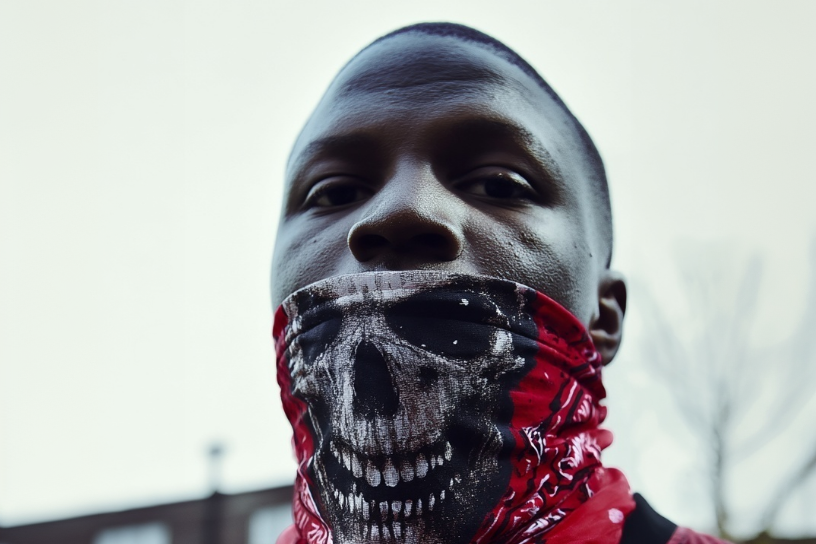
Draven Endwriting stood at the edge where the last fossilized ledge gave way to that viscous blackness and did what the Void Beyond could never predict: he refused to romanticize it. He wore the same heavy red-and-black jacket with SUGGS stamped across the chest like a scar made into a banner, the same skull-printed bandana pulled high across his face, the same forward set to his shoulders that made him look like he was about to step into a fight that had no audience. His broken blade remained in his hand, rune-etched, fractured, still exhaling that thin blue-white luminescence from its cracks—the last remaining proof that he could still make a choice that cut. His posture didn’t beg the unregion to accept him. It implied acceptance was irrelevant.
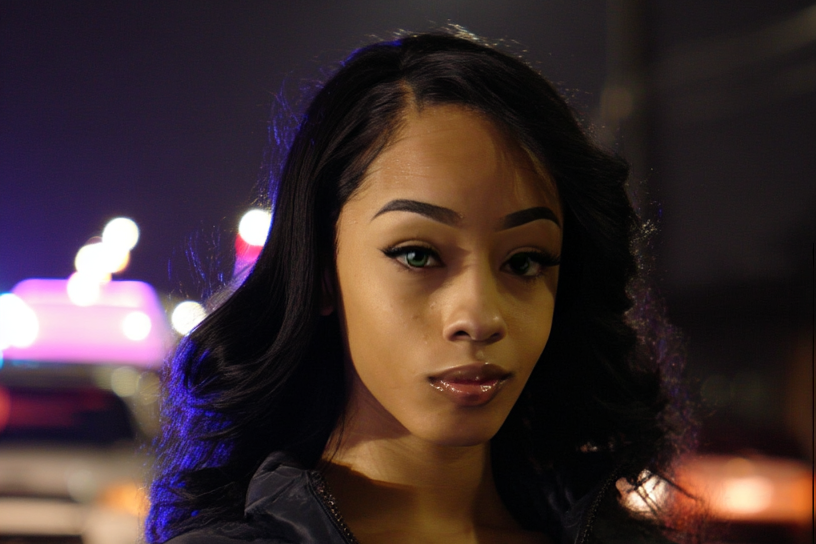
Ranavalona Zakirra drifted closer, close enough that her presence brushed against his without needing contact, and close enough that her voice could become a private offense. She wore her puffer jacket open like a deliberate confession, lace black against her skin, the metal ring at her throat catching the Void’s faintest gleam like a hook. She looked at the Ocean of Paratext and smiled as if it were a boring admirer trying too hard. Then she turned that smile on Draven, and the Void Beyond briefly felt like it had been demoted to background scenery. “You know,” she murmured, sweetly invasive, “if you wanted to take me somewhere intimate, you could’ve picked a realm that wasn’t actively trying to annotate me into irrelevance.”
Draven didn’t give her what she wanted—not on the surface. His eyes stayed on the Ocean. His grip stayed firm on the broken blade. His silence stayed controlled. “Focus,” he said at last, low, clipped, not unkind, simply unwilling to let flirtation become a foothold the Void could grab.
Ranavalona’s laughter didn’t echo. Nothing echoed here unless ego forced it to. “That is my focus,” she replied, and her gaze slid over him like a hand. “You’re the only interesting thing in this entire abomination. Don’t take that away from me, darling. I’ll start committing atrocities out of boredom.”
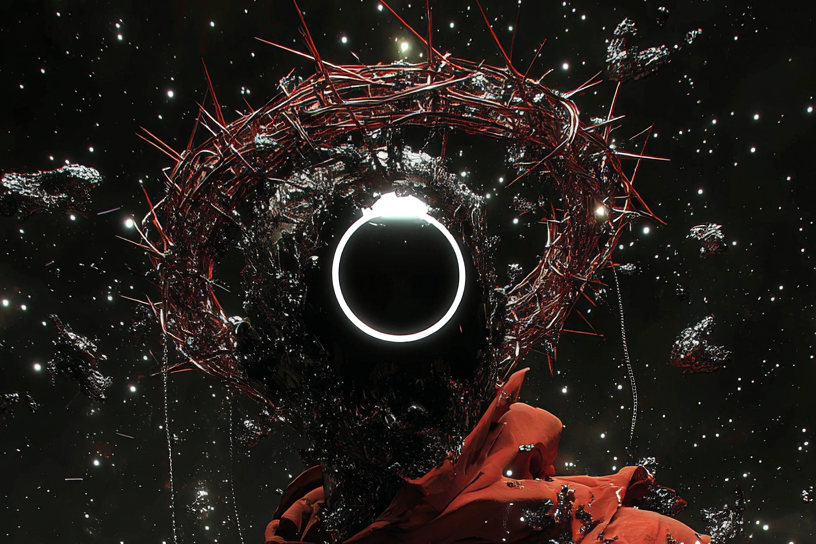
Ae’Suggsrael did not step to the edge. It arrived there, red-robed and composed, eclipse-ring where a face should have been, thornlike spines crowning the headspace like a halo made of disciplined violence. The figure’s stillness carried the kind of authority that made the Ocean look like an unruly footnote. When Ae’Suggsrael spoke, it did not produce sound; it deleted the silence around meaning so the statement could exist without permission. “This unregion is not hunting your bodies,” Ae’Suggsrael stated. “It is hunting your citations. It will remove the supporting references that make you legible to yourself. You will remain present, but you will become unread.”
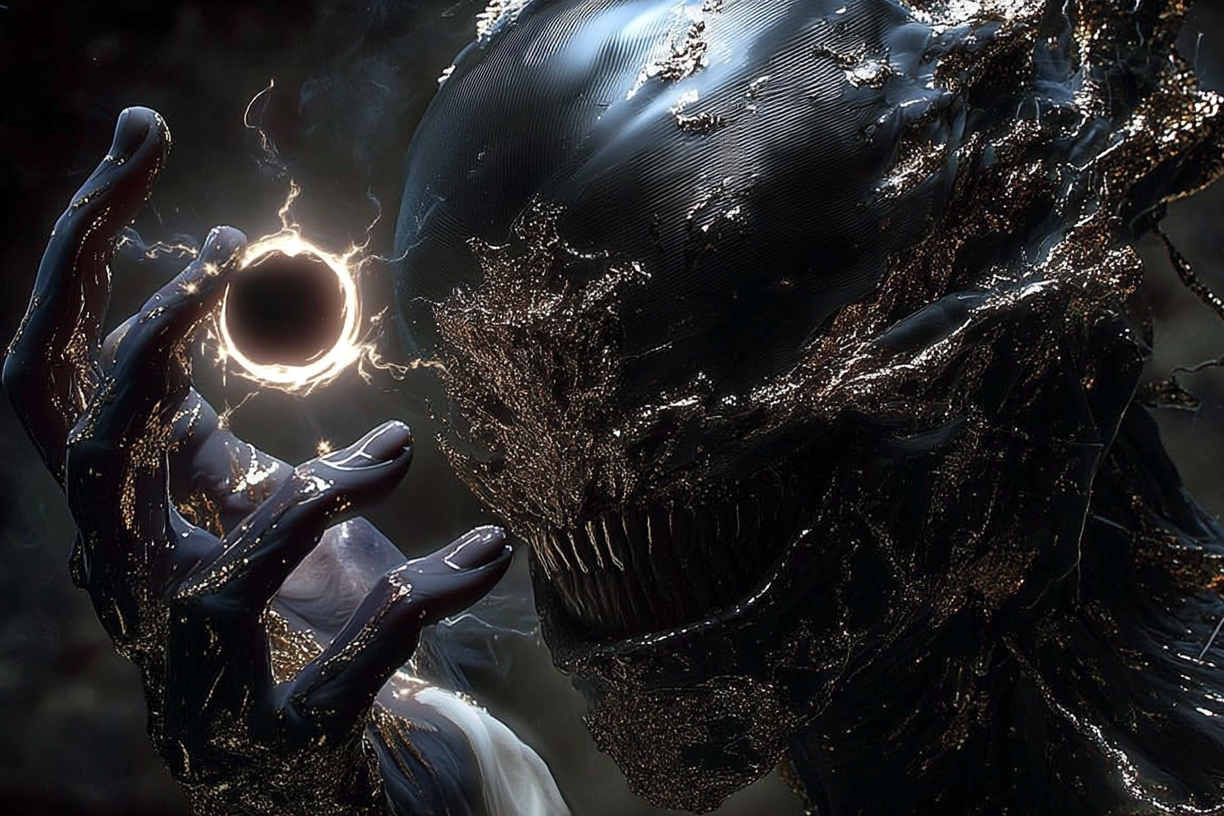
Khal’Vossugg lingered behind them, glossy and gold-flecked, mouth split into too many teeth, posture relaxed the way cruel things relax when they know the world is already on their side. It pinched a small eclipse-ring between two fingers as if it were toying with the idea of attention. “How elegant,” it purred. “A sea of editorial decisions. A place where the punishment is not negation, but transfictional dismissal.”
Draven’s eyes narrowed, not at Khal’Vossugg, but at the Ocean’s surface where faint swirls of script drifted without alphabet, and thick black streaks curled like censored lines, and parentheses floated like shackles that never finished closing. He could feel the Ocean’s intention pressing against him—not as weight, not as pull, but as an insinuation in the back of his mind: you are only important because you believe you are important; let us revise that. The Void Beyond didn’t want his blood. It wanted his relevance.
Ranavalona leaned in again, voice soft enough to make the insult feel like intimacy. “Tell me something, Draven. When the void tries to erase your footnotes… do you get angry, or do you get sad?”
He didn’t answer out loud. He kept that answer where the Void couldn’t steal it. Inside, the thought surfaced anyway—sharp, unwanted, true: I don’t get sad. I get careful. Outwardly, he lifted the broken blade a fraction, as if the motion itself could punctuate his refusal.
Ae’Suggsrael turned slightly, eclipse-ring angled toward the Ocean like a judge considering evidence. “We require a crossing that does not grant the Ocean a chance to cite us,” it said. “We must move without becoming a sentence.”
Khal’Vossugg’s grin widened, delighted at the phrasing. “Move without becoming a sentence,” it echoed. “You hear that, Draven? Even your allies have learned the language of cowardice.”
Draven’s jaw tightened under the skull grin of his bandana. He looked at Khal’Vossugg at last, and the stare carried the cold methodical tactician he showed the world. “I don’t do cowardice,” he said. “I do outcomes.”
“Ah,” Khal’Vossugg replied, savoring the exchange. “Outcomes. You’re walking like a protagonist again.”
The phrase slid into the space between them like a blade turned sideways. Ranavalona’s lips parted as if to tease, but she paused—because even she understood the bite in Khal’Vossugg’s tone. Ae’Suggsrael remained still, but the eclipse-ring brightened a fraction, listening.
Khal’Vossugg stepped forward onto a thin bridge of fossilized silence that extended from the ledge like a preserved hush hardened into a path. It was not stone. It was not bone. It was the petrified remainder of every moment someone tried to speak and swallowed the words instead, layered until quiet became structure. The bridge arched over the Ocean of Paratext with a fragile authority, and on either side of it, the viscous blackness rolled its censored lines like hungry punctuation. Khal’Vossugg lifted its chin. “In the Deep Void, protagonists die first,” it said conversationally. “Because the realm recognizes the trope and inverts it. It sees your narrative weight. It sees your insistence on meaning. It sees your attachment. It will punish you for being central.”
Ranavalona’s eyes flashed with amusement. “And you’re suggesting he what—be boring?” she asked, as if the idea offended her on principle.
Khal’Vossugg’s teeth showed. “I’m suggesting he walk like a background character,” it said. “Move without insisting the world notice. Slip through the cracks of the narrative the way discarded punctuation slips through editorial fingers. You cannot out-muscle this place. You can only out-irrelevance it.”
Draven stepped onto the fossilized silence bridge, and the moment his boot met its surface, he felt the Ocean below react—not with pull, not with hunger, but with curiosity. The paratext shifted as if searching for his annotations, trying to find the footnotes that supported his name. He kept his posture minimal. He kept his movements precise. He kept his attention narrow. If the Void Beyond wanted to read him, he would give it as little text as possible.
Ranavalona followed, gliding with the kind of grace that made even fossilized silence feel unworthy. She stayed near Draven’s shoulder—not behind him, not ahead of him—close enough that her flirtation could become a shield if she chose. “Walk like a background character,” she murmured, brushing the words against him like a kiss. “I don’t think you know how. You’re too… stubbornly loud.”
Draven’s response was a glance, brief and controlled. “Then stay quiet,” he said.
She laughed again, delighted. “Darling, I would rather be erased than be quiet.” Then her voice lowered, turning the joke into confession without admitting it was confession. “But I won’t let you be erased. That would make you boring too.”
As they crossed, the Ocean of Paratext began to show them things—not visions the way other realms show visions, but reflections built from editorial cruelty. The viscous black surface shimmered with faint panels of rewritten identity: fragments of childhood made generic, grief made cliché, love made predictable. It offered each of them the same insult: you are not unique; you are merely a pattern.
For Ranavalona, the insult landed like a slap. She glanced down, and there in the paratextual surface was a reflection of herself stripped of her “Is.” The reflected Ranavalona wore the same jacket, the same lace, the same choker ring—but everything about her presence was dulled into something pre-approved. The reflection’s eyes carried no threat, no mischief, no hunger for novelty. It looked like a stock character drafted by a bored writer: flirtatious femme fatale, decorative danger, predictable seduction. It smiled at Draven the way a cliché smiles when it expects the plot to reward it.
Ranavalona stopped walking.
Draven caught it immediately, his body shifting subtly into readiness, broken blade angled downward to avoid offering the Ocean a dramatic pose it could exploit. “Don’t look,” he said quietly, not command, not comfort—tactical.
Ranavalona ignored him.
She stared at her reflection, and something in her face sharpened into fury so pure it almost looked like devotion. “Oh,” she whispered, voice trembling with offended vanity. “No.”
The Ocean offered her a second reflection, even worse: Ranavalona as “the mysterious cunt,” Ranavalona as “the playful distraction,” Ranavalona as “the temptress with a tragic past.” The Ocean tried to frame her like a trope, to flatten her into something easy to predict, something safe to dismiss.
Ranavalona’s lips curled. “You think I’m that?” she asked the Ocean, and her tone made the words feel like broken glass.
Ae’Suggsrael’s eclipse-ring angled toward her. “Do not grant it attention,” Ae’Suggsrael warned. “Attention is citation.”
Ranavalona lifted one hand anyway. Voidfire gathered there—not heat, not flame as a pataphysical phenomenon, but an ineffable black ignition that burned meaning the way deletion burns ink. It did not illuminate. It did not warm. It simply asserted that what it touched would no longer be allowed to claim it had mattered. Ranavalona smiled at her reflection like a lover. “I’d rather be an atrocity than a cliché,” she whispered, then drove the voidfire down.
The Ocean of Paratext did not boil. It did not splash. It lost text. Entire bands of footnotes and redactions vanished where her voidfire kissed the surface, leaving a clean wound of unmanifest silence that refused to support reflection at all. The cliché version of her flickered, tried to maintain its narrative, and then was erased into suggsvoid as if it had never been granted permission to exist.
Ranavalona exhaled—no, not exhaled, because that word belonged to other realms; she released tension like a blade being resheathed. She turned back to Draven, eyes bright with predatory satisfaction. “There,” she said sweetly. “Interesting again.”
Draven didn’t praise her. He didn’t scold her either. He noted the truth inside himself: she feared boredom more than she feared erasure, and the Void Beyond had discovered the lever that could make her reckless. He stored it away like a tactician stores away a weak point in a battlefield. He also noticed something else, quieter: the way her hand trembled after the voidfire, the way her smile arrived a heartbeat too late. Vanity was the costume. Fear was the skin underneath it.
Khal’Vossugg chuckled. “Spectacular,” it said. “You just burned the editor’s notes because you didn’t like the critique.”
Ranavalona’s grin turned razor-thin. “Critique is for things that matter,” she replied. “I refuse to be handled like a draft.”
They moved again, but the bridge did not carry them to solid ground. The fossilized silence ended in a break where the unregion simply failed to be coherent. Ahead, a Plot Hole gaped—not a literal hole in terrain, but a discontinuity in noncausality itself, a place where narrative weight did not register and inverted negation did not apply. It was the kind of absence that couldn’t be threatened, because threat requires a premise, and here premise collapsed. The ledge ended. The far side existed. The between did not accept explanation.
Draven halted at the edge and stared into the Plot Hole. His mind reached for metaphors and found none that didn’t lie. The Plot Hole was not emptiness. It was not darkness. It was the refusal of even negation to take responsibility for its own absence.
Ae’Suggsrael tilted its eclipse-ring toward the gap. “This is not a place where our usual refusals will function,” it said. “Silence does not behave properly here. Suggsmatic intention will not anchor itself unless it is believed.”
Khal’Vossugg’s smile widened in anticipation. “Ah,” it said. “Now you must lie to raw silence so convincingly it adopts your lie as its own.”
Ranavalona looked at Draven with a glimmer that was half flirtation and half challenge. “Well?” she purred. “Background character. Slip through the cracks.”
Draven didn’t answer her. He crouched slightly, broken blade held low, and brought his attention inward the way he did when he had to become smaller than the enemy’s awareness. He remembered what the Void Beyond had taught him: you could not fight it like a world. You could only fight it like an argument. His whispering technique had started as survival—forcing outlines onto what refused outline. Here, it had to become construction.
He lifted the broken blade fragment and brought its rune-etched edge close to the boundary of the Plot Hole. The blade’s cracks glowed faintly, blue-white, like a wound insisting on lightless existence. Draven’s whisper began not as sound, not as vibration, but as an internal cut—an ego sharpened into statement. He did not “speak” to the Void Beyond. He spoke around it, carving a pocket where meaning could breathe without needing air, where assertion could exist without being cited.
He whispered a bridge.
Not “a bridge” as an object. A bridge as a premise. A bridge as a lie told with such ruthless consistency that the Void Beyond, bored and offended and hungry for contradiction, decided to accept it as a temporary truth. The whisper poured out like thin threads of suggsvoid resonance, weaving across the discontinuity in lines so fine they looked like writing marks, not beams, not planks—marginal strokes of authored refusal. The threads latched onto nothing, and that was the miracle: they did not need a foundation. They needed only the ego that insisted foundation was irrelevant.
Ranavalona watched, smile softening into something dangerously close to admiration. “You’re writing,” she murmured.
Draven didn’t look up. “I’m lying,” he said quietly, and the blunt honesty of it carried more power than any flourish.
The bridge did not appear all at once. It emerged in fragments: a thin arc of script, then a second arc, then the suggestion of a span. Each whisper-thread had to be repeated, reinforced, cited by his own refusal, because the Plot Hole wanted to unmake even the idea of connection. Draven’s shoulders tensed—not from strain in muscle, but from strain in identity. Every second he held the lie, the Void Beyond tried to revise his footnotes. It tried to find the parts of him that made him care, and redact them. It tried to make his whisper meaningless.
He tightened his grip on the broken blade until the runes bit his palm. He anchored himself not by chanting a name, but by remembering the simplest truth that still mattered: I am not done. He didn’t say why. He didn’t say who waited for him. He kept that inside where the Void couldn’t turn it into a trope.
Ae’Suggsrael stepped onto the first line of the whispered bridge, and the silence around its footfall was deleted so the action could hold. Ranavalona followed, light as a threat, still smiling at Draven as if crossing a Plot Hole was foreplay. Khal’Vossugg walked last, unbothered, amused, as if the gap were a stage and Draven the entertainment.
Halfway across, the Ocean of Paratext surged upward—not physically, not as a wave, but as an editorial impulse. Strands of redaction lifted like tendrils of censored ink, reaching for the whisper-threads. The Ocean tried to annotate the bridge into irrelevance: this is merely a trick; this is merely desperation; this is merely a protagonist’s stunt. It tried to make the lie feel cheap.
Draven felt the attack as paratextual damage. A hole opened in the backstory behind his eyes—an erased corner of memory, a stolen reference point—and for a moment his own life threatened to become un-cited. He didn’t panic. Panic was citation too. He narrowed his ego into something smaller and sharper. He let Khal’Vossugg’s earlier advice cut through him: walk like a background character. Not invisible. Just unremarkable enough to slip past the editor’s blade.
He adjusted his stance. Reduced motion. Reduced drama. The whisper continued, cleaner, colder, less desperate. The bridge stabilized, not because the Void Beyond respected it, but because Draven stopped trying to impress the nothingness and started trying to outlast it.
They reached the far side, and the moment the last of them stepped off, Draven severed the whisper with a single inward cut. The bridge vanished without leaving residue. No evidence. No citation. The Plot Hole remained, offended, unsatisfied.
Beyond it, the unregion shifted again. The Ocean of Paratext thinned into streams of redaction that crawled along invisible channels, and ahead—suspended above a yawning paired abyss, framed by two enormous apertures that looked like twin void-eyes—hung the Transfictional Anchor.

The Transfictional Anchor did not announce itself like a landmark; it actively asserts itself like an objection that refuses to be footnoted. In the darker-than-black negation of the Void Beyond, where value has already been eaten and possibility has already lost the right to mean anything, the Anchor appears as a floating, irregular mass—part petrified ruin, part clockwork thesis—suspended inside an angular lattice of blue, wireframe geometry that reads less like a cage and more like a forced admission of “location.” The grid-lines do not “hold” it in any ordinary sense; they behave like a coerced coordinate-prayer, a scaffolding of permitted reference that tries to make the Anchor legible to a realm that wants everything illegible. Its presence is rough and bone-like in silhouette, riddled with cavities and weathered folds, yet fused into mechanisms that look ancient and surgical at once: exposed gears, toothed rings, and interlocking plates embedded into the stone as if the concept of “mechanism” was hammered into an unwilling chunk of reality and left there to bruise forever. Over its surface, circular diagrams sit like transparent seals—astrolabe-like glyph wheels and star-map lattices that do not predict anything so much as they forbid the wrong outcomes from ever becoming coherent, their lines crossing in deliberate arrogance, insisting that even here, there is still an authority that can say “no.”
Fragments orbit the Anchor as if the surrounding negation cannot decide whether to swallow it or study it. Glass-like shards drift around it—each shard filled with miniature Omniverses and tiny specks of borrowed radiance that look like stolen context, like the last glittering residue of worlds that were edited out but not fully digested. Near one side, a translucent orb hangs close, stamped with a geometric sigil that resembles a locked equation; it feels like an auxiliary conscience, a secondary governor that should be regulating flow, except it’s too quiet in the way a paid guard is quiet. A vein of gold-bright fracture runs through the Anchor’s lower mass like a wound that was never meant to heal, not because of damage, but because of indulgence—like someone fed the Anchor a ribbon of attractive paratext, a bribe of narrative sweetness, and it cracked open just enough to enjoy it. That fissure isn’t “light” in the comforting sense; it’s an arrogant leak of meaning, a smug line of significance surviving where significance is supposed to be impossible, as if the Anchor is showing off that it can still glow while the Void Beyond cannot.
When Draven looked at it, silence.
Ranavalona stared up at it, eyes narrowing. “That thing is pouting,” she said, like she was offended by the audacity of a machine having moods.
Ae’Suggsrael’s eclipse-ring brightened. “It is not damaged,” Ae’Suggsrael confirmed. “It is disengaged. Its compliance is absent.”
Khal’Vossugg’s grin turned delighted. “Bored,” it whispered. “Or bribed.”
Before Draven could respond, the paratext around the Anchor rippled, and two new presences stepped into the scene as if they had been written into the margin and finally decided to enter the main text.
The paratext around the Anchor rippled, and the Void Beyond committed an obscenity it only allows when a will is strong enough to carry its own citation: a slice of the noise-world surfaced like a torn panel pressed against negation. Blurred emergency strobes smeared into color without source, distant lamps collapsed into soft halos, and the suggestion of a night street existed only as an afterimage of meaning—enough context to make two arrivals feel undeniable, not enough context to let the Ocean of Paratext claim them. They didn’t “step in” the way people step into places. They rendered—as if their egos dragged their own atmosphere of reality behind them, a private signature the Void could not fully redact.
Ahmose Queenscape held the center of that overlay with a direct, composed gaze that refused to ask permission. She wore a black puffer jacket with SUGGS embroidered on the left chest, unzipped and worn open over a white lace bra/bralette whose scalloped edges and delicate patterning read like intention rather than vulnerability. Her posture was squared and still, shoulders set, chin level, expression calm in a way that implied authority without performance, as if she had already survived being rewritten and decided the Void Beyond would not get a second draft. In the Void Beyond, where everything tried to reduce selves into footnotes, Ahmose looked like a title that could not be downgraded into a caption.
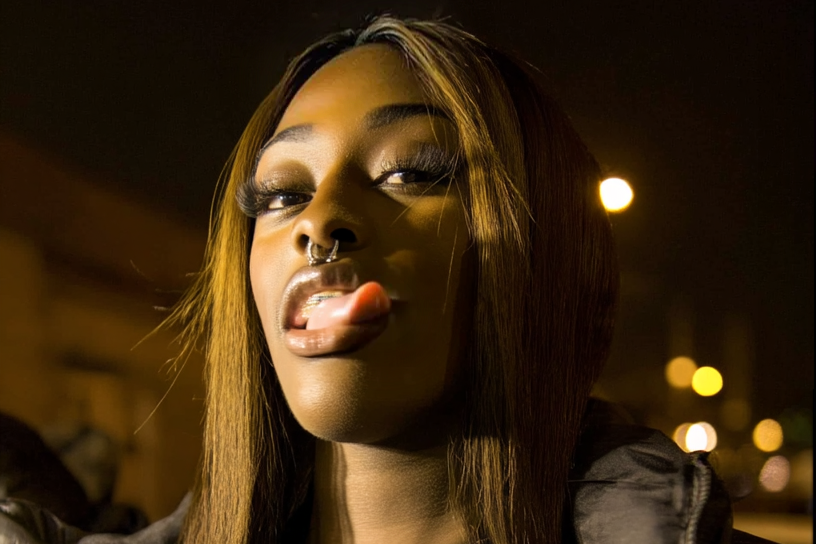
Amanishakheto Dyingstar arrived beside her like a different kind of truth—less composed decree, more defiant provocation that dared the realm to misinterpret her and suffer for it. She wore a black puffer jacket open over a black top stamped with SUGGS, layered with a white lace corset/bustier that had structured cups and intricate lace paneling, the contrast turning softness into threat instead of decoration. A septum ring punctuated her presence like punctuation made into a weapon, and her expression was playful and confrontational at once—tongue out, chin lifted, shoulders relaxed—broadcasting the kind of irreverence that the Ocean of Paratext could not “explain away” because it refused to behave like a lesson. Where Ahmose looked like control refusing revision, Amanishakheto looked like chaos refusing shame, and both of them carried that night-streaked overlay as if the Void Beyond was the one trespassing on their scene.
Ranavalona’s smile returned immediately, predatory. “Oh,” she said, looking between them. “New company. This nil finally remembered it could be dramatic.”
Ahmose’s gaze swept the group once—Draven, Ranavalona, Ae’Suggsrael, Khal’Vossugg—and settled on Draven as if she had been expecting him. “You’re late,” she said, voice even, not hostile, simply factual in the way queens deliver unpleasant truths.
Draven didn’t flinch. “I didn’t know I had an appointment,” he replied.
Amanishakheto’s eyes flicked to the broken blade in Draven’s hand, then to the Anchor, then back to him. “You made it here with that?” she asked, and the question carried respect disguised as insult.
Ranavalona drifted closer to Draven again, as if instinctively claiming the space beside him. “He’s full of surprises,” she purred. “Try not to fall in love. It looks ugly on everyone.”
Ahmose ignored the flirtation like it was background noise—possibly because she had learned how to walk like a background character when necessary. “The Anchor is letting them out,” she said, and her gaze lifted to the mandala apparatus as if she was addressing a subordinate that had forgotten it was subordinate. “Not by failure. By choice.”
Khal’Vossugg chuckled. “Bribed, then,” it said. “Tell me, Queenscape—what does an Anchor accept as payment?”
Ahmose’s jaw tightened fractionally, the only crack in her composure. “Novelty,” she said. “A different kind of silence. A promise that it wouldn’t have to keep performing regulation forever.”
Amanishakheto’s grip tightened on her weapon. “The Discourteous Guests offered it entertainment,” she added, voice edged. “They promised it a world worth watching burn into irrelevance. They promised it a spectacle: coherence panicking.”
Draven’s eyes narrowed as he stared up at the Anchor’s sluggish rotation. The insult of it landed hard. A device meant to regulate the boundary between negation and noise had been tempted into apathy—because duty had become boring. Because endless responsibility, even at this scale, could be eroded by the simplest poison: disinterest.
Ranavalona tilted her head, eyes bright. “I understand it,” she said softly, and that softness was the most dangerous thing she had said yet. “Eternity without novelty is just a long way of spelling boredom.”
Ahmose’s gaze snapped to her. “That’s the kind of sympathy that gets worlds erased.”
Ranavalona smiled. “I said I understood. I didn’t say I agreed.” Then she leaned closer to Draven again, voice intimate, daring him to respond. “You hear that, darling? Even anchors get tired. Everyone gets tired. What do you do when you’re tired?”
Draven didn’t answer her out loud. He kept his face unreadable behind the skull grin. Inside, the thought sharpened: I don’t get tired. I get more precise. That was how he survived. That was how he protected what he couldn’t mention without giving the Void a handle.
Ae’Suggsrael stepped forward, eclipse-ring aimed at the Anchor as if placing it on trial. The silence around the statement was deleted so meaning could stand. “Anchor,” Ae’Suggsrael addressed it, and the act of addressing felt like forcing the mechanism to remember it was being watched. “Your compliance is required. The flow is reversing. Rejected canon is escaping.”
The Anchor did not respond with words. It responded with paratext. Its inner ring rotated, and for a moment the runes rearranged into something that resembled a sentence without ever becoming one. Draven felt the response in the back of his identity as a subtle editorial shrug: Why should I care?
Khal’Vossugg laughed quietly, delighted. “It’s not broken,” it said. “It’s offended. It believes it deserves better than duty.”
Amanishakheto took a step forward, jacket shifting like a threat. “We can force it,” she said, and the words carried conviction.
Ahmose lifted her scepter-diagram slightly—not as a weapon, but as a decree. “Force will only teach it to resist,” she said. “It’s not a gate you can batter. It’s an attention you must capture.”
Ranavalona’s smile widened. “Capture attention,” she echoed, amused. “Now that’s a language I speak.”
Draven’s gaze remained on the Anchor, and his voice emerged low and controlled. “What did they offer it?” he asked Ahmose, not because he needed exposition, but because he needed the shape of the bribe in order to cut it.
Ahmose’s eyes held his. “A promise that it could stop being the invisible labor of reality,” she said. “A promise that it could be central.”
Khal’Vossugg’s grin turned vicious. “Protagonist bait,” it murmured. “Even the Anchor wants to walk like a protagonist now.”
Draven absorbed that, and something in him settled into a colder clarity. The Void Beyond wasn’t just vomiting rejected canons. It was corrupting the regulator by offering it the very trope Khal’Vossugg warned against—centrality, drama, the illusion of being important. The Anchor had been bored into betrayal by the idea of being seen.
Ranavalona glanced at Draven, and her flirtation softened into something that almost resembled honesty. “So what do we do?” she asked. “Make it feel special? Tell it it’s beautiful? Lie to it like you lied to the Plot Hole?”
Draven’s broken blade shifted in his hand. The runes along it caught faint gleam from the Anchor’s rings. He did not smile. He did not posture. He simply made a decision. “We remind it what it is,” he said. “Not a protagonist. Not a spectacle. A regulator.”
Khal’Vossugg’s laughter was quiet approval. “And how do you remind a bored nil-machine of duty?” it asked. “With morality?”
Draven’s eyes didn’t leave the Anchor. “With consequence,” he replied.
Ae’Suggsrael stepped closer to Draven, and the space between them tightened into shared purpose without needing affection. “Your whispering technique can impose premise,” Ae’Suggsrael said. “You can force outlines. You can force bridges. You can force definition long enough to shatter it.”
Draven understood what Ae’Suggsrael was implying, and he hated how elegant it was. The Anchor had been bribed with centrality. It wanted to be important. So they would give it importance—briefly—by making it the target of an imposed premise so sharp it could not ignore itself.
Ahmose’s gaze narrowed. “You would threaten it with being rewritten,” she said, and the statement was both fear and respect.
Draven’s response was minimal. “I would threaten it with being irrelevant,” he said. “If it wants to play at spectacle, it can learn what dismissal feels like.”
Ranavalona’s smile turned feral. “Oh,” she purred. “That’s cruel. I like it.”
Amanishakheto’s posture eased by a fraction, as if she approved of violence that didn’t pretend to be righteous. “Do it,” she said simply.
The Ocean of Paratext below shifted, hungry for citation. The Anchor’s rings continued their lazy rotation, as if it expected the group to beg. The Discourteous Guests’ exit remained open somewhere above and behind, bleeding rejected canon into coherence like a sickness that wanted to become permanent.
Draven raised his broken blade fragment, and his whisper began again—not as sound, not as pataphysical phenomenon, but as a narrow blade of ego aimed at the heart of a mechanism that had forgotten its job. He didn’t plead. He didn’t bargain. He started to write a consequence into the margin of the Anchor’s existence, a lie sharp enough to become a temporary truth: that the Anchor, too, could be annotated into irrelevance if it kept refusing.
Ranavalona leaned close, lips near the skull grin on his bandana, voice like velvet wrapped around a knife. “That’s it,” she whispered. “Walk like a background character… while you erase an Anchor.”
Khal’Vossugg watched with delighted hunger, as if this was the kind of scene it had been waiting for since the first descent. Ae’Suggsrael stood steady, eclipse-ring bright with disciplined intent. Ahmose Queenscape lifted her scepter-diagram like a decree poised to land. Amanishakheto Dyingstar shifted her weapon into readiness, not to strike the Anchor, but to strike anything that tried to interrupt the act.
And as Draven’s whisper-thread reached toward the Anchor’s violet core-ring, the Ocean of Paratext stirred beneath them like a censor preparing its pen, eager to revise the outcome before it could be written—because in the Void Beyond, even the act of saving a world was just another line the darkness wanted to redact.