Forever Zero II
A few years ago, Baltimore wore the kind of night that made even the streetlights look tired. The corners were loud in the familiar ways—music bleeding from a car with a rattling trunk, laughter that sounded practiced, arguments that never fully turned into fights because everyone already knew what the next step costs. The pavement held a thin glaze of dampness that turned every neon reflection into a smear, like the city couldn’t keep its own lines straight. Above the rowhomes and the shuttered storefronts, cables and fire escapes stitched the sky into a grid, and for a little while it felt almost ordinary, the way a bruise feels ordinary when you’ve carried it long enough.
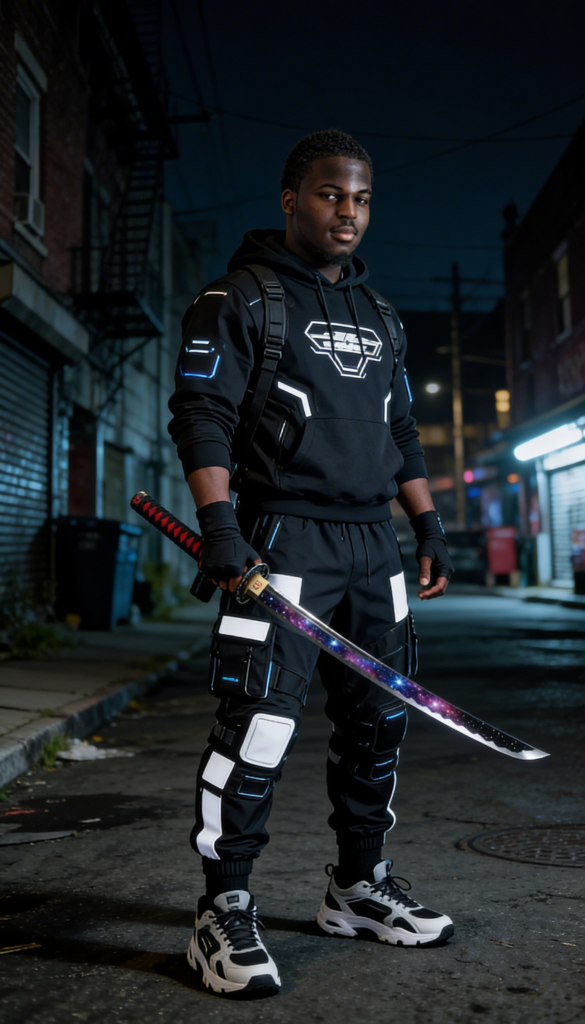
Ronan stepped off the corner like a man leaving a conversation he’d been forced to have too many times. His posture was calm, but not relaxed—calm the way a surgeon stays calm, not because the situation is safe, but because panic doesn’t help you cut clean. A deep-blue hoodie sat on him with the weight of something lived-in, the chest marked with cosmic iconography that looked half streetwear and half warning sign, and his gloves and strapped pants read like he’d built his wardrobe around the assumption that tonight might demand running, kneeling, or violence. A blade hung at his side, dark handle in his grip for a moment as if he was reminding himself it was real, as if the city sometimes tried to convince you your own tools were imaginary.
Behind him, the “ignorance” dealers kept talking even after he’d turned away, because their product wasn’t just powder or pills. They sold forgetting as a lifestyle. They sold numbness as a philosophy. They sold the illusion that if you don’t look directly at the wound, the wound isn’t there. Ronan had listened long enough to pull what he needed from their noise, the same way he used to pull meaning from symptoms—headache, tremor, a patient’s shame disguised as jokes. He’d asked about the weird nights. The nights when people swore their apartments changed layout. The nights when someone ran from something they couldn’t describe and then insisted they’d always lived somewhere else. The nights when the city’s missing posters multiplied and the faces on them felt wrong, like the ink had been applied to the world after the person was already gone.
He’d gotten his answer the way answers come from men who profit off ignorance: sideways, careless, and expensive. A name dropped like trash. A rumor like a cough. A mention of “the sky cracking” delivered with a laugh that didn’t reach anyone’s eyes.
Ronan kept walking.
He didn’t believe in omens. He believed in patterns. And Baltimore, for all its mess, had a rhythm. It had tells. When something truly wrong was about to happen, the city didn’t scream first. It held its breath.
That breath-hold arrived without warning, right as he reached the stretch of road where the shops were closed but their signs still glowed, right where the darkness between streetlights felt deeper than it should. The first sensation was not visual. It was cognitive—the sudden, nauseating realization that possibility had stopped flowing, like a vein clamped shut.
Nothingness became loud.
Not loud in the way sirens are loud. Loud in the way a concept becomes oppressive. Loud in the way the absence of rules can feel heavier than any rule. Ronan’s stride shortened by instinct, his body trying to adapt before his mind could name what was happening, and he tasted metal in the back of his throat as if his nervous system had reached for a warning signal it didn’t fully understand.
Then the inversion dissolving coherence event began, and it did not arrive in a sequence that a human brain could narrate cleanly. It arrived all at once, like the city had been struck by a single invisible verdict.
Physical constants betrayed themselves. The smallest agreements that make atoms stay loyal to structure went off-axis. You could feel it without knowing you were feeling it, the way you feel a room’s pressure change before you consciously notice a storm. A brick wall beside Ronan’s shoulder didn’t crumble; it hesitated, as though the idea of “brick” had been asked to justify itself and suddenly couldn’t. Streetlight halos didn’t flicker; they misplaced their own glow, pushing illumination into angles that made shadows look like they were standing in front of the objects casting them.
Quantum fields beneath the city inverted their underlying posture. Matter didn’t melt. It didn’t burn. It became uncertain in a deeper register—as if mass itself had been demoted from a stable property to a temporary suggestion. A parked car’s silhouette warped for a breath, not because it moved, but because the field that supported its “car-ness” stuttered. The air around it shimmered with the wrong kind of distortion, like reality trying to remember what it had promised.
Causality inverted next, not as reversal but as rupture. Effects began generating causes. A trash can toppled and only afterward did the gust arrive that might have pushed it. A dog barked from a block away, and the echo hit the street before the bark did. Ronan’s own heartbeat seemed to land out of order—thump, pause, thump—like the rhythm was being rewritten behind him.
Information started dying. Not losing, not hiding—dying. The city’s memory bled out in real time. A billboard advertisement down the street changed twice in a blink, not to other ads but to nonsense strings, then to an image that made Ronan’s vision recoil as if it had been asked to process an impossibility. His mind, trained to catalog, to diagnose, to parse, felt the beginnings of something worse than confusion: the sensation that description itself was failing to attach.
Symmetry—those deep, quiet invariances that let models behave—buckled. The street did not merely look wrong; it became wrong in incompatible ways at the same time. The lines painted on the asphalt stretched and shortened without moving. Perspective collapsed and reasserted itself in contradictory frames. The corner store’s sign appeared closer than it was, then farther, then the same distance but rotated in meaning, as if spatial coherence had become a negotiable trait.
The vacuum state beneath it all tipped toward a lower, crueler claim. There was a propagation embedded in it, a conversion pressure, a sense that the rules were trying to rewrite themselves into a different baseline. It felt like the world was approaching a point where it could not return to “normal” because “normal” would no longer be available as an option.
And then logic unlatched.
Contradiction became permitted without restriction, and with it came the true horror—logical explosion. Every proposition became provable. Every negation became provable. The street was wet and not wet. Ronan was moving and not moving. The corner store existed and never existed. In that regime, truth became meaningless not as a philosophical flourish but as a practical collapse. Physics didn’t fail like a machine; it failed like a language losing the ability to refer. The city became unspeakable while still forcing everyone inside it to keep trying to speak.
That was when the sky broke.
A thin fracture ran across the canopy above the rowhomes like someone had dragged a blade through the concept of “above.” It widened into luminous cracks, and beyond those cracks Ronan saw layered realities and layered illusions in quantities that surpassed totally Reinhardt cardinal—not as a count anyone could finish, but as a boundless procession of incompatible backdrops stacked behind the city like an infinite set of mirrors refusing to agree. Some layers looked like Baltimore under different light. Some layers looked like Baltimore drowned. Some layers looked like Baltimore erased, where the harbor was a black wound and the skyline was a rumor. Some layers were not Baltimore at all, but other worlds elbowing into the frame, demanding to be seen. Each layer shattered as it appeared, breaking apart on an ontological erasure level, as if existence was being peeled into drafts and then the drafts were being thrown away.
Ronan felt the nausea hit late, because his mind was fighting to stay clinical. He did what he always did when faced with something unthinkable: he looked for the underlying pathology. He treated the event like a disease process. He listened for a pattern inside the noise. He watched the city’s failures like symptoms—constant inversion, field collapse, information hemorrhage, logic fracture—and he recognized the signature he’d been warned about, the thing older than rumor and newer than any sermon.
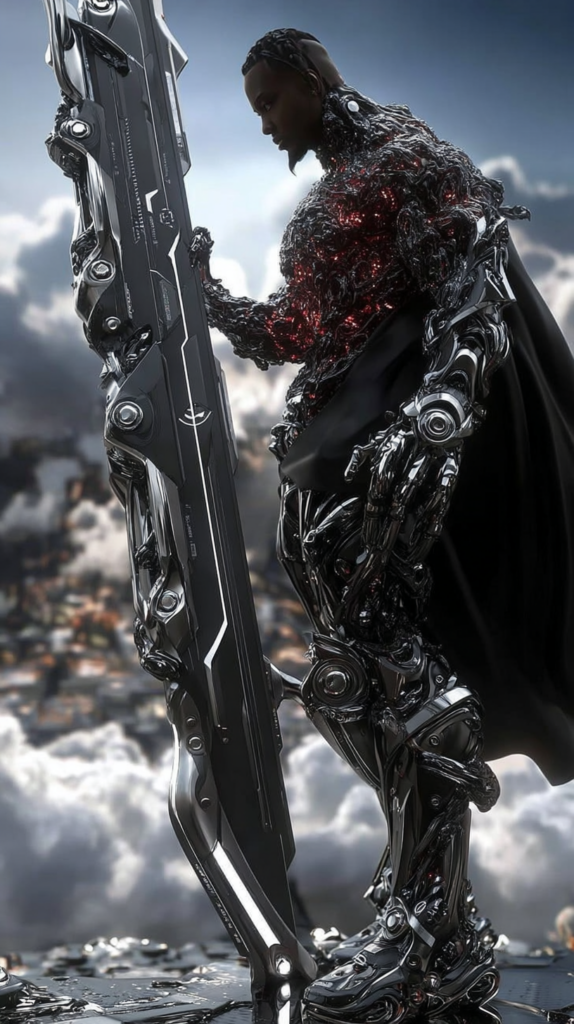
Xvrrkhaaz T’qnell arrived not as a shape stepping into the sky, but as a silence claiming jurisdiction over the sky’s right to exist coherently. It stood framed against a curvature of stars like a blade held to the throat of the horizon. Its armor was glossy and predatory, hard surfaces fused with magma-like filigree and cable-tendons, a black chrome musculature that looked engineered to wear violence as an aesthetic. It held a massive blade of cold radiance, and that blade did not glow the way metal glows; it glowed the way an argument glows when it believes it can win by erasing the opponent’s ability to answer.
The silence spread.
It wasn’t quietness. It was an active field that induced absolute infinite multiplicity of reality–illusion confusion and chaos so thoroughly that perception became an untrustworthy trait. Ronan’s sight inverted first: up became down, left became right, forward became behind, but the inversion didn’t stop at orientation. It reached into the mapping between his eyes and his body. The direction of incoming attacks inverted. The place his body would register injury inverted. His reflexes—those protective automations—betrayed him in micro-spasms, trying to correct for a world that had flipped its rules. His inner ear screamed false alarms. Vertigo became a weapon pressed against his balance. For a moment, even his own hands looked like they were moving in the wrong direction relative to his intention, like will and motion had been divorced.
He forced himself still.
In the thick of that vertigo, Ronan realized what the “ignorance” dealers had really been selling: an early rehearsal for this. People numbing themselves because the world, when seen clearly, is sometimes unbearable. But numbness was useless here. This event wasn’t attacking emotion. It was attacking coherence.
Ronan closed his eyes—not as surrender, but as triage. He refused visual data because it had become contaminated. He opened another modality, the one he trusted more than sight: diagnosis. He let his awareness sweep like a sterile field, clinical and cold. He listened for the way the silence resonated, the way it adapted to opponents, the way it fused with surroundings and turned possibility, nothingness, and totality into mere extensions of its jurisdiction. He felt the city becoming its body. He felt the enclosed manifest expanse being manipulated like tissue under a scalpel.
And within that feeling, he found his own answer.
This was not something you fought by swinging harder. This was something you excised. You didn’t debate logical explosion. You removed the source that was making it permissible.
He opened his eyes, and the sky’s fracture stared back with the indifference of a wound. Ronan’s expression didn’t change much, but inside him something locked into place, a decision so complete it felt older than the moment he made it. He understood what he needed to do in the same way a surgeon understands when there is no longer time for consultation. There are moments when you either cut, or you watch the patient die.
Ronan moved.
He didn’t run like a hero. He moved like a man stepping into a procedure. His “Cheat”—that instinctive navigation through coincidence and probability—did not feel like luck tonight. It felt like a refusal to be trapped by the event’s warped narrative causality. He slipped through streets where direction had become a lie, stepping where his body should not have been able to step, arriving at corners a breath before the corner admitted it existed. The world tried to invert him mid-stride. The silence tried to seal his possibility inside itself. He kept going anyway, not because he understood the mechanism, but because he refused to let the mechanism decide.
When the moment arrived, it arrived like a snapped thread.
Time stopped behaving politely.
Presence stopped being an assumption.
Change stopped being mandatory.
Ronan appeared at the center of the event without explanation, as if he’d stepped out of the gap between a second and its shadow. He was no longer just the man in a hoodie leaving corners. Xvrrkhaaz T’qnell stood armored in a high-tech exoshell that looked like it had been forged from reflective night, jointed plates and engineered musculature wrapping him in a cold, mechanical elegance. A cloak fell from his shoulders like a torn piece of darkness, and the city’s broken sky reflected along the hard curves of his limbs. In his hands, he held his weapon—an enormous monolithic implement of polished alloy and embedded mechanisms, too large to be carried by any ordinary logic, its surface marked by seams and rings like the spine of an impossible machine. It looked less like a gun or a blade and more like a verdict given physical mass.
Xvrrkhaaz T’qnell turned toward him, and the silence deepened, trying to claim him the way it claimed everything else. The inversion pushed at his senses. The contradiction tried to fold his existence into provable and disprovable at once, to render him meaningless.
Ronan remained coherent.
He didn’t shout. He didn’t explain. He didn’t offer the city a speech it could remember. He simply raised his katana as if aligning a scalpel with a tumor that had no right to be there.
Then he cut.
The strike did not “hit” the otherness the way steel hits flesh. It severed jurisdiction. It carved through the silence’s claim on the world’s rulebook. It was a surgical removal of the source-event, an excision performed with such clean finality that the inversion dissolving coherence event didn’t have time to argue. The blade-line of that motion—whether it was edge, energy, or something beyond both—passed through Xvrrkhaaz T’qnell like a sentence being crossed out.
For a heartbeat, the otherness tried to remain.
The stars behind it trembled. The curved horizon shuddered. The silence pushed outward like a dying lung trying to inhale.
Then Xvrrkhaaz T’qnell came apart on an ontological erasure level, not into debris, not into blood, but into absence—its presence unwritten, its field collapsed, its contradictions deprived of their patron. The layered realities and layered illusions—those surpassing totally Reinhardt cardinal—began to fold back, not gently, but abruptly, like pages slammed shut before anyone could finish reading. The sky’s fractures stitched themselves by force. Physical constants snapped back into their dependable ratios with a citywide shudder that felt like the world remembering its own name. Quantum fields settled. Information stopped hemorrhaging. Symmetry reasserted itself like a spine straightening after a near-break.
Baltimore did not become safe.
It merely became coherent again.
Ronan lowered his weapon slowly. The wind behind him moved as if the air had only just regained permission to behave like air. He stood in the aftermath with the stillness of someone who knows that procedures don’t end because the incision is closed; they end because the bleeding stops. Around him, the city stumbled back into itself, people clutching walls as vertigo faded, streetlights finding their halos again, reflections returning to their objects in the proper order.
Ronan looked up once at the repaired sky.
He didn’t look triumphant. He looked tired in a way that had nothing to do with muscles. He looked like a man who had just witnessed how thin the world’s contracts really are—and how easily an otherness can walk in and invalidate them.
Then he turned and walked back into Baltimore’s night, not because the night had forgiven the city, but because the city was still here, and someone had to keep treating the wound before it reopened.