
Flowers for the Grave V: The Timeless Labyrinth
The moment Velvet crossed the threshold, the world stopped behaving like a world and began behaving like an accusation. The Timeless Labyrinth did not welcome her as a place, because it was not a place in the ordinary sense; it was Toronto remixed by a Transhierarchical Rift, a city re-written by the kind of editorial hand that doesn’t merely move streets or alter skylines, but cuts entire assumptions out of the sentence of reality and then forces what remains to keep speaking. She felt it immediately in her bones, not as cold, not as wind, not as weather, but as the sensation that the background rules were being held at knifepoint, trembling, and forced to sign a confession they didn’t understand. Her SUV was gone in the way a word is gone when you realize you never learned it and every dictionary has been scraped clean of its existence. There was no empty parking space where it should have been, no echo of tires, no sense that it had ever belonged to her. The Labyrinth didn’t steal things like a thief; it un-wrote them like a censor who believes absence is a holy act.
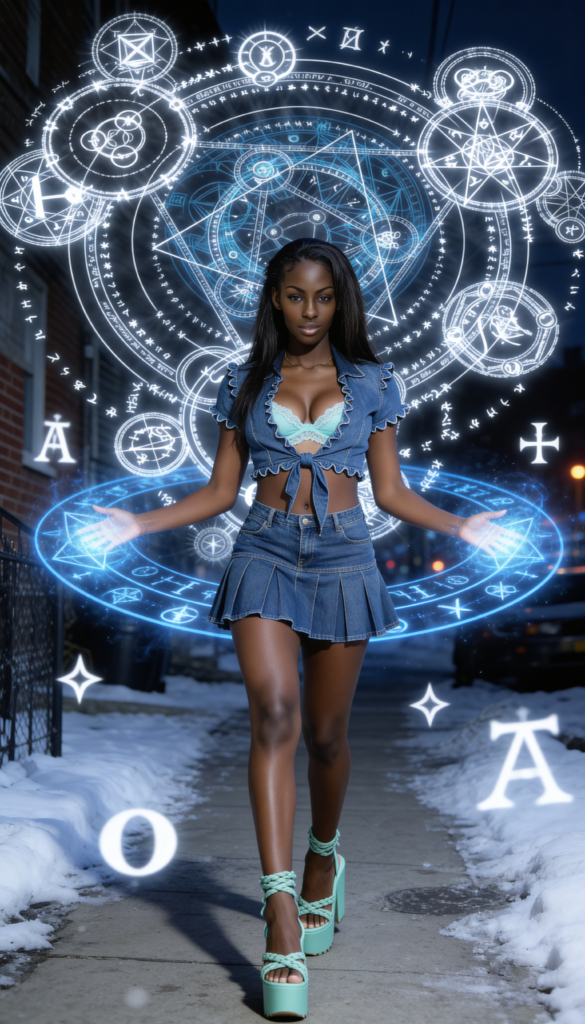
Velvet stood on what should have been a familiar sidewalk, snow piled along the curb like a memory trying to look normal, but the street itself leaned upward at a subtle angle, as if the city had decided that horizontality was merely a suggestion and ascension was now the default posture of concrete. She was dressed for a world that had once pretended to be rational: a denim tie-front crop top with ruffled edges that framed her shoulders like soft armor, knotted at the center of her chest so the fabric gathered into a deliberate, unapologetic point, and beneath it a pale lace bralette that looked almost too delicate to belong in a domain that ate certainties. Her skirt was denim too, pleated and structured, a short flared cut that moved with her steps as if it remembered what walking used to mean. On her feet were mint platform heels with wraparound laces that cinched her ankles in neat crossings, the kind of shoes that made every step a statement even when nobody was watching. The Labyrinth noticed those shoes anyway, the way it noticed everything about her that tried to remain human, and it responded by making the pavement subtly inconsistent beneath her soles, as if testing how much intention it would take to continue forward.

Toronto was everywhere, but it was also nowhere in the way she needed it to be. A row of brick houses that should have belonged to a quiet block folded inward like paper, their porches turning into staircases that climbed into themselves, their railings joining at impossible corners. The old silhouette of her apartment appeared ahead—she recognized the angle of the windows, the shape of the front entrance—except it was grafted onto a looming, demonic castle façade that rose behind it like a parasite with a crown. Gargoyles sat on ledges where pigeons should have been, their mouths open in silent laughter, and the apartment’s familiar door had been replaced with a massive arched threshold engraved with patterns that felt like mockery. Somewhere to her left, the her child's father’s house existed as an Escher painting made from domesticity: a staircase that began at the front door and ended at the underside of a ceiling that was also a floor, rooms rotating into one another until “inside” and “outside” became interchangeable insults. Every time Velvet looked away and looked back, the angles had shifted slightly, as if the Labyrinth was incapable of holding a stable lie.
The Transhierarchical Paradox Effect wasn’t something that happened to the terrain; it was the terrain. A cracked pothole wasn’t simply a pothole—it was a seam in the story where the sentence had been cut and stapled back together wrong. Streetlights hummed in patterns that didn’t feel electrical, their glow forming glyph-like halos that drifted a handspan above the glass and then dissolved, as if the bulbs were sweating language. Cars sat abandoned at odd angles, doors open, interiors empty, and Velvet knew without needing proof that these vehicles didn’t belong to evacuees who ran. They belonged to people who had been edited out mid-motion, the way a draft deletes an entire paragraph and leaves only a faint indentation on the page.
She moved forward slowly, not because she lacked courage, but because courage in a place like this was not sprinting; it was refusing to let your nerves make decisions for you. Velvet had left the System behind with the kind of finality that only comes when you’ve begged it for mercy and watched it shrug. Courts, Exchange, paperwork, phone calls, waiting rooms, polite lies—those were tools designed for problems that still agreed to exist. She was no longer hunting within bureaucracy; she was hunting within Structure, where reality and illusion were braided together so tightly that even recognizing the difference became a liability. If the world could be altered by an editorial hand, then her grief could be used as punctuation. If the Rift could take her son, it could take anything attached to him, and Velvet could feel that possibility like an infection she had to cauterize by will alone.
Above her, the sky was darker than black, not in a poetic way, but in a way that made her eyes feel accused for expecting to see anything at all. It wasn’t a ceiling so much as a refusal. When she stared long enough, she saw hairline fractures spread across it like a glass window beginning to break, but the cracks did not reveal stars or clouds or any familiar beyond. They revealed layers of unreality stacked in maximal complexity beyond the maximal wholeness beyond tiering, and those layers looked back at her with the blankness of a judge who has already decided the verdict. She didn’t hear thunder. She didn’t hear distant sirens. She heard something worse: the sense of presence that did not need sound to be oppressive.
She understood, with a clarity that made her stomach tighten, that the Sovereigns of the Nullzenith could be watching. Not as scouts watch a battlefield, but as architects watch a blueprint come alive. In the far reaches of her perception—beyond streetlight and snowbank, beyond rooftops and power lines—she felt four silhouettes arranged over Canada as if the country were a plate set for them. Their intentions were still unknown, but their appetite was not. Fear moved toward them the way water moves downhill, and the Labyrinth itself seemed to feed that flow, shaping streets into funnels and memories into traps. Velvet did not see them directly, but she sensed the pressure of their existence: four presences whose mere mass, measured at a single Planck-length of their bodies, exceeded a Reinhardt cardinal in kilograms, and whose weapons carried that same impossible density at a single Planck-length of their structure. They did not simply ignore the ordinary necessity of presence and change; they stood beyond it as principle, beyond it as illusion, beyond it as Platonic modality, as if the very argument of “before” and “after” had been dismissed as too simple to be worth their attention.
And beneath that watching, the Labyrinth spawned its own enforcement.
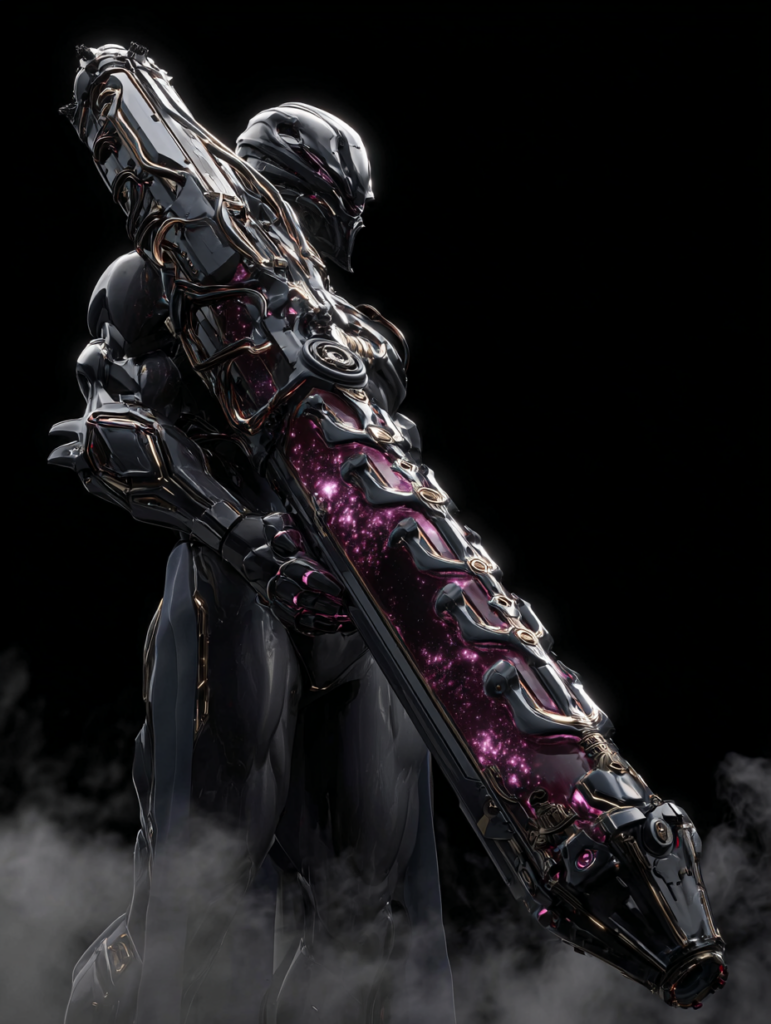
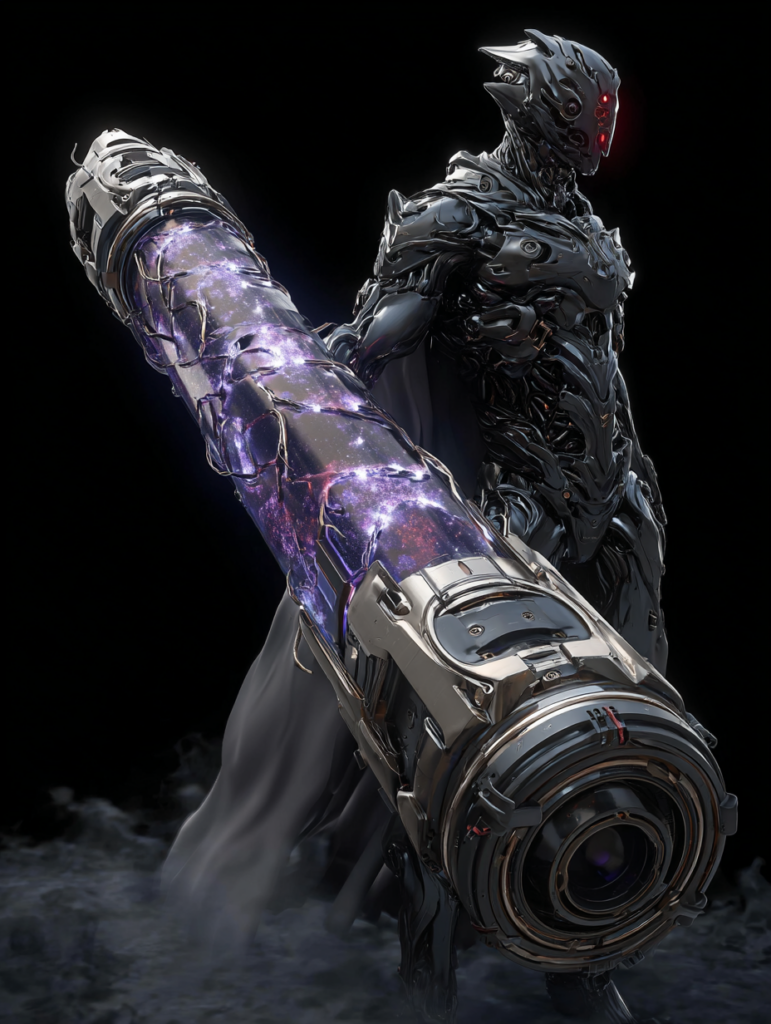
The first Colossus she saw was not a creature stepping into view so much as a shadow becoming a fact. It rose at the end of a looping street that curved upward and vanished into the fractured sky, its silhouette enormous—over three hundred meters in height by any sane measurement, yet sanity had no authority here. It wore armor that looked like glossy black exo-plating, segmented and smooth in places, ridged and jointed in others, with metallic filigree lines that caught faint glints as it moved. The faceplate was a sleek helmet, unreadable, and where its eyes should have been there were dim points that felt less like sensors and more like judgments. In its hands was a weapon so large it looked like a collapsed bridge: a cannon-blade hybrid with a long housing and a central spine filled with a galaxy-like core, a saturated violet-pink nebular glow trapped behind metal ribs, pulsing like a heart that had never learned empathy. The weapon’s design was too intricate for mere engineering; it was the aesthetic of something that had been built with suggslogic rather than metallurgy, an artifact that could swing like a sword and fire like a siege engine while claiming to be neither.
Velvet lowered her chin and kept walking as if she hadn’t noticed it, because in the Labyrinth, attention was a form of consent. The army was everywhere here, existing in quantity beyond the wholeness axioms, not as numbers but as an uncountable mood of violence. She could feel other Colossi moving on other streets, their steps translated into vibrations through the city’s false geometry, like a heartbeat mapped across an entire province. If she ran, the Labyrinth would make running a spotlight. If she hid, the Labyrinth would turn hiding into a confession. So she did the only thing that still belonged to her: she decided.
Her hands lifted slightly, fingers loose, and the world around her responded as if it had been waiting for her permission to collapse. She didn’t reach into pockets for chalk or salt or nails. She didn’t need materials anymore. What she carried now was manifest suggslogic in trap-modality, the ability to set ontological collapse as if she were placing a bear trap in the foundations of existence itself. The gesture was small—a subtle turn of the wrist, a slow opening of her palm—and a pale, luminous ring unfolded beneath her feet, not drawn on the ground but asserted into it. Symbols spun along the ring, crisp and bright, like an alphabet that had been invented to describe impossible consequences. A larger circle flared behind her in the air, layered with rotating geometric inscriptions—rings within rings, sigils nested like gears, a vast diagrammatic halo that made the alleyway look like it had been repurposed into a ritual chamber. Velvet stood in the center of it with her arms slightly open, palms out, and the glow made her denim and lace look like they were being lit by a holy interrogation.
The Colossus raised its weapon.
The blast that came out of it did not travel in any ordinary way. It was not a projectile that crossed distance. It was an assertion that the target had already been struck, an event that arrived carrying the I0 axiom and its strengthenings like a crest stamped into the force itself. Velvet felt the pressure of it in her teeth and behind her eyes, not because it shook the street, but because it tried to shake the permission for the street to exist. The beam—if it could be called a beam—was a line of violence that ignored the necessity of presence and change by principle, skipping past the entire idea of traversal and landing its verdict directly onto her location.
Velvet’s trap snapped.
The ring beneath her feet inverted. Not upward, not downward—those were childish directions—but into a deeper negation that treated the Colossus’s attack as something that could be edited. Her circle did not “block” the strike. It declared that the strike’s ontological claim could not find an anchor. The blast hit the boundary of her trap and immediately lost its right to be defined. For an instant, Velvet saw a thin seam open through the airless darkness, like a paper cut through the sentence of reality, and the Colossus’s force poured into it the way a scream pours into a mouth that is suddenly sealed shut. The I0-laced aggression did not dissipate; it was erased per se, not cancelled, not reduced, not resisted, but stripped of the assumption that it was allowed to remain described.
The Colossus staggered as if it had been punched by absence. Velvet tightened her hand into a fist, and the second layer of her trap activated: an acausal hook, a suggslogic snare that grabbed the Colossus not by its armor, not by its joints, not by any mechanical seam, but by the claim that it existed as an enemy on her path. The hook pulled. The Colossus did not fall. Falling required a floor, and the Labyrinth had made floors negotiable. Instead, the Colossus folded in on itself like a draft being crumpled. Its armor imploded into a compressed knot of negative narrative, the galaxy-core in its weapon flaring once in offended color before being pinched into silence. One moment it was a towering executioner. The next moment it was gone, leaving behind only a faint distortion in the snow where its shadow had been, and even that distortion quickly corrected itself, embarrassed to have remembered.
Velvet exhaled through her nose, slow and controlled, because her body wanted to shake and she refused to give it that victory. The Labyrinth did not reward panic. It fed on it.
She moved deeper.
The streets began to loop more aggressively now. A familiar corner store appeared three times in different orientations, each version with a different name that looked almost right but not quite—letters swapped, syllables missing, as if the Rift had pulled language apart and reassembled it while distracted. A subway entrance yawned open in the middle of the road, but when Velvet glanced down she saw not tracks, not a platform, but a staircase that descended into a hallway of framed photographs. Each photograph showed a Toronto that never happened: protest signs with slogans Velvet didn’t recognize, a mayoral speech delivered by a face that looked vaguely familiar but shouldn’t exist, a winter carnival that had been held on a lake that the city didn’t have. These were the Lost Things—the edited fragments of history and fiction, the pieces that had been cut out of the world and thrown here like trash. Velvet didn’t have time to study them, but she felt their weight emotionally. If the Rift could steal entire events from the record, then it could steal a child with the same casual cruelty. Her son wasn’t merely missing; he might be living inside an editorial margin, surrounded by the ghosts of deleted sentences.
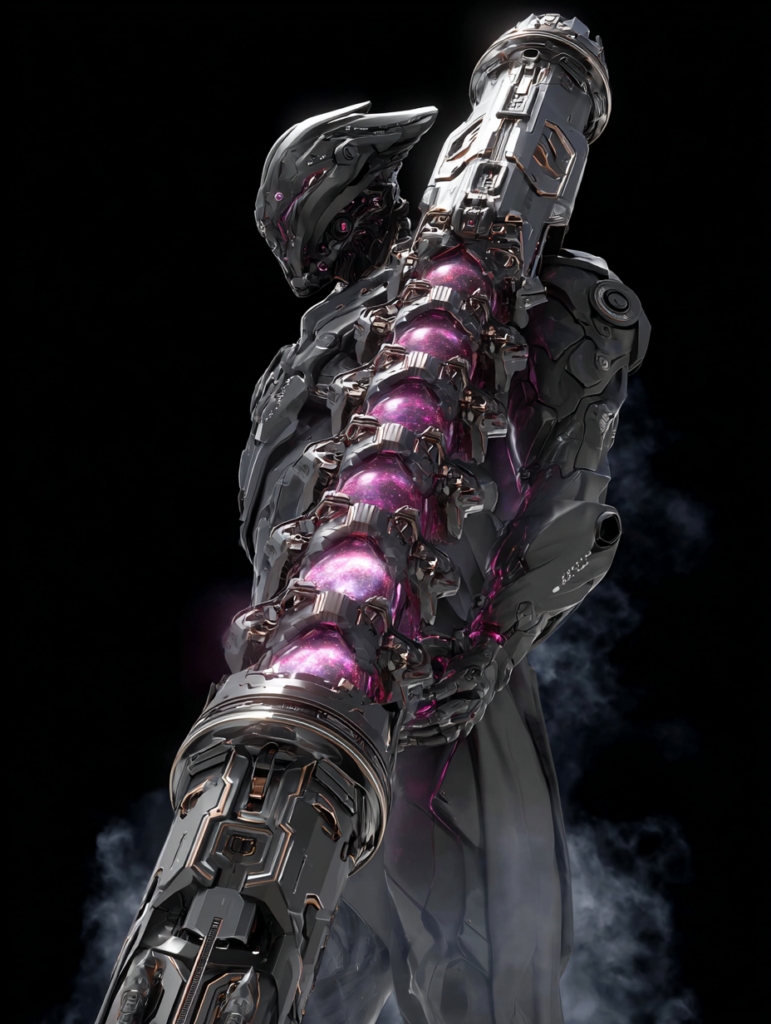
A second Colossus emerged near what should have been a schoolyard, except the yard had been reshaped into a spiraling amphitheater of steps that climbed into the fractured sky. This Colossus held a different weapon: a massive cylindrical cannon with segmented chambers running down its length, each chamber glowing with pulsing violet nodes like compressed stars trapped behind metal ribs. Its armor plating was sleeker, more refined, and the helmet’s contours suggested a predatory elegance rather than brute force. It turned its head slightly, and Velvet knew it had sensed her. Not seen her. Sensed her, the way a shark senses blood in water, except here the medium was fear.
Velvet didn’t give it the satisfaction of flinching. She raised her hand again, not hurriedly, but with ceremonial calm, and the Labyrinth responded with another circle—this one smaller, tighter, etched with symbols that didn’t spin but locked into place like a sentence ending with a period. The Colossus fired.
The force arrived as a blooming negation, an expanding sphere of aggression that carried I0-strengthened pressure, not aimed at her body, but aimed at her right to occupy the coordinate of her own existence. The blast tried to overwrite her location with the concept of “impact,” tried to declare that she had already been struck and therefore must become the aftermath of that strike. Velvet’s trap answered by refusing the premise. The circle didn’t catch the blast; it made the blast forget how to be a blast. The expanding violence compressed into a thin sheet, then into a line, then into a single point, and then Velvet’s acausal hook snapped shut and dragged that point sideways into a seam that wasn’t a seam but a negation disguised as geometry.
The Colossus lunged forward, stepping into the street, and the street reacted by bending under its weight like soft plastic. The Labyrinth was complicit. It wanted the Colossi to remain. It wanted Velvet to be hunted. But Velvet’s trap had already been placed under the Colossus’s step—not as a mine, but as an ontological question: Are you allowed to be here? When the Colossus’s foot pressed down, the question detonated. Its leg didn’t break. Breaking required material consistency, and this place treated material like costume. Instead, the Colossus’s lower body began to dissolve into a cascade of erased assumptions, as if each plate of armor was being individually edited out of the story. The weapon’s violet chambers flared bright, then went dark, then flared again in a panicked stutter, and Velvet felt, for a brief instant, the violence of what that weapon could have done if the Labyrinth had been allowed to complete its sentence. The blast could have devastated Canada in a single uninterpretable gesture, because it wasn’t bound to ordinary distance, and it wasn’t bound to the necessity of presence and change. It was a verdict-beam, a suggslogic decree disguised as artillery.
Velvet tightened her fist. The Colossus vanished.
She kept moving, but her breath began to feel too loud in her own ears, as if the Labyrinth wanted to translate it into a beacon. She forced herself to slow down, to place each heel carefully, to let the mint platforms touch the ground with deliberate authority. Fear is not always screaming. Sometimes fear is the body trying to hurry, trying to escape, trying to do anything that feels like control. Velvet refused that reflex. She let her posture become a kind of prayer, shoulders squared, chin steady, eyes forward.
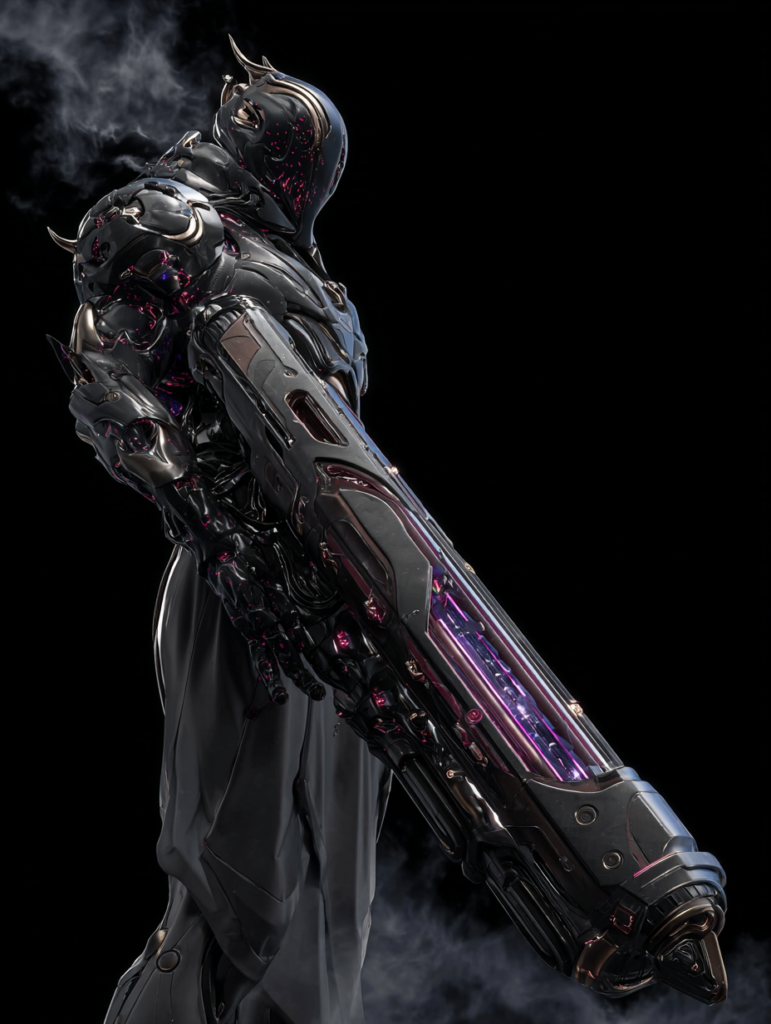
The third Colossus came at her near a distorted version of her old neighborhood, where the street signs were wrong and the houses were too tall, their windows stacked like teeth. This Colossus looked more brutal, its armor knotted with protruding ridges and horn-like spikes along the helmet and shoulders, as if it had been designed to resemble a demon without needing to pretend it wasn’t a machine. Its weapon was sleeker than the others, a long, heavy, cannon-blade with a narrow central channel glowing in violet, contained and focused like a blade of compressed galaxy-light. It raised the weapon and tilted it, and Velvet saw the glow inside rotate as if aligning to her existence like a scope locking onto a target.
She didn’t have room to avoid it. The street behind her folded upward, turning into a wall. The alley beside her narrowed into a seam too thin for her body. The Labyrinth was corralling her into confrontation, and Velvet understood then that stealth here wasn’t only about not being seen. It was about refusing to be manipulated into the story the Rift wanted to tell.
Velvet lifted both hands, palms open, and her casting circle flared larger than before, a layered construction of white glyphs and rotating geometry that rose behind her like a luminous engine. Symbols drifted at the edges—letters and sigils that looked like they belonged to every language at once and also belonged to none. The Colossus fired.
The force that came was more concentrated, more precise, a line of annihilating assertion that carried the I0 axiom and its strengthenings not as background, but as a signature pressed into the strike itself. It hit Velvet’s trap and, for a split second, pushed against it with the stubborn authority of something that believed it had the right to remain described. Velvet felt the resistance in her wrists, in her shoulders, in the tension behind her sternum, not as physical strain, but as ontological friction. This was what it meant to fight the Structure. It wasn’t merely combat. It was refusing to let an alien grammar rewrite your life.
Her circle held. Then it inverted. The strike didn’t bounce. It didn’t deflect. It ceased to have an interpretation that could persist. Velvet’s acausal hook snapped down like a guillotine, and the Colossus’s weapon became the target of her trap rather than her. The glowing channel inside the cannon-blade twisted, not in space, not in direction, but in meaning, and the weapon began to collapse into itself like a word being erased letter by letter. The Colossus tried to pull back, but pulling back required a before and after that the Labyrinth did not grant cleanly. Velvet’s trap treated that confusion as an opening. The Colossus’s armor began to unravel at the joints, plates losing their claim to connection, the horned helmet distorting as if the Rift itself were offended that one of its enforcers was being denied.
Velvet stepped forward, not running, just moving with the finality of a mother who has already decided that the world’s excuses are irrelevant. She brought her palm down toward the ground, and the circle beneath her feet flared with a harsh white brilliance, then snapped shut like a mouth. The Colossus was erased per se, not destroyed, not reduced, but edited out so completely that the Labyrinth briefly stuttered, as if it hadn’t expected Velvet to be able to write back.
Silence followed, heavy and unnatural, a silence that didn’t feel empty but felt occupied. Velvet paused, letting her hands lower slowly, letting her shoulders relax by a fraction. Her heart was racing now, and she hated that because it felt like giving the Labyrinth a taste. She scanned the street, watched the cracked sky, and forced herself to remember why she was here.
Then she saw it.
The backpack lay near the edge of a sidewalk that shouldn’t have existed, half-buried in snow that looked too clean, too curated, as if it had been placed there for aesthetic rather than weather. Velvet’s breath caught, and for an instant she didn’t move. Her mind did the thing it always did now: it tried to protect her by inventing doubt. It’s a trick. It’s bait. It’s not his. But her body didn’t listen to that caution because her body recognized the shape of her son’s life in the way mothers do, beyond evidence, beyond argument.
She approached slowly, crouched, and brushed snow away with trembling fingers. The fabric was scuffed. The zipper was slightly crooked the way he always tugged it. A nametag was sewn inside, and the handwriting on it hit her like a punch—his name, written in a familiar style, the letters uneven in a way that felt heartbreakingly ordinary. Velvet’s throat tightened. She opened the bag with care, as if opening it too roughly might wake the Labyrinth.
Inside were the small pieces of a life that still insisted on being real. A notebook with bent corners. A pencil case with one pen missing. A crumpled paper where a child had drawn something that looked like a monster and then scribbled over it angrily. A small toy he’d kept for comfort, cheap plastic, worn smooth from being held too often. Velvet’s hands shook as she touched each item, and her eyes burned, but she refused to cry loudly. Tears here felt like blood in water.
Somewhere above her, the fractured sky creaked. The Labyrinth shifted subtly, as if noticing that she had found something meaningful and deciding whether to punish her for it.
Velvet stood with the backpack held close against her chest, and she whispered his name—not as a spell, not as a prayer, but as a vow that the Labyrinth could not redact out of her throat. She didn’t know where he was. She didn’t know what state of existence he had been dragged into. But this bag was proof that he had crossed this threshold. It was proof that he had touched the Labyrinth and left an imprint, and that meant he could be traced. Velvet’s grief sharpened into something colder, something that felt like purpose turning into a blade.
That was when she noticed the other footsteps.
They were lighter than the Colossi. Human-weight. Human cadence. Velvet turned slowly, keeping her posture calm, her hands ready to cast without warning. Out of the darkness came a woman standing in a posture that looked casual only because confidence was doing all the work. She held herself with her feet planted apart on the snowy street, hands relaxed near her thighs, shoulders loose, gaze angled with a slight tilt that suggested both curiosity and boredom with the obvious. She wore a black mesh bralette-style top with thin straps and a fishnet banding across the midsection, paired with light denim shorts ripped and frayed at the thighs as if the fabric had survived a fight. Metallic silver flat sandals strapped across her feet, and stacked silver anklets circled her ankles like jewelry that didn’t care about practicality. A small tattoo marked one shoulder, and subtle piercings caught faint highlights on her face. Her hair was styled in twin braids pulled up into high pigtails, with long framing strands falling beside her face, the whole look straddling street and siren with a kind of effortless precision.

Velvet didn’t lower her guard. “Who are you?” she asked, voice low, controlled.
The woman’s eyes flicked to the backpack in Velvet’s arms, then back to Velvet’s face. “Label,” she said, as if names were optional. “And you walked in loud.”
Velvet’s jaw tightened. “I walked in alive.”
Label smiled faintly, not kind, not cruel, just amused by the shape of Velvet’s defiance. “Alive is loud in here.” She glanced upward, not at the streetlights, but at the fractured sky itself, as if acknowledging an audience. “You don’t have your ride. That means you’re actually committed.”
Velvet didn’t appreciate the tone, but she recognized something else beneath it: Label wasn’t panicking. Label wasn’t frayed. Label looked like someone who had been in this Labyrinth long enough to stop reacting and start navigating. That kind of composure was rare here. It was either skill or madness.
“How long have you been here?” Velvet asked.
Label shrugged, as if shrugging could dismiss the very idea of counting duration. “I stepped in after you,” she said, and the sentence was deliberately misleading, like a joke told to bait correction. “But ironically, if the grand meta-narrative still permitted ordinary duration-counting, I’ve been here five years longer than you have.”
Velvet stared. “That doesn’t make sense.”
Label’s smile widened slightly. “Exactly. You’re learning the Labyrinth’s language.”
Velvet tightened her grip on the backpack. “Why are you here?”
Label’s gaze sharpened, and for the first moment she looked serious, as if the name of what she wanted carried weight even in this edited world. “I’m looking for the Snake of Seven Rabbits,” she said, pronouncing it like a thing that deserved to be capitalized by the universe itself. “An aretefact. It fell from the Art Gallery long ago, when the world hiccuped and pretended it didn’t.” She stepped closer, slow enough to be nonthreatening, but not slow enough to be timid. “That aretefact can open the Doors to Tomorrow. It can open us out of here.”
Velvet felt a pulse of anger and hope collide in her chest. “Out of here,” she repeated, as if tasting the phrase. “And my son?”
Label’s eyes flicked down to the bag again. “You found proof,” she said. “That’s more than most people get before they become part of the snow.”
Velvet’s posture stiffened. “What do you mean?”
Label’s gaze turned past Velvet, toward a distant street that curved upward and vanished into darkness. “The hunters meant to protect Canada and the world?” she said, voice flat now. “They’re being erased one by one. Sometimes by the hundreds. No speeches. No last stands. Just—gone. The Sovereigns are feeding, and the Labyrinth keeps spawning enforcement. Colossi keep arriving like the Rift is printing them.”
Velvet swallowed, her throat dry. She had known it intellectually. Hearing it stated out loud made it heavier.
“And you’re just walking around?” Velvet demanded.
Label’s expression softened into something almost sympathetic, but it didn’t last. “I’m not ‘just’ doing anything,” she said. “I’m surviving long enough to find a key.” She paused, then added, “And you’re surviving by writing traps into the ground like you own the language. That’s… impressive.”
Velvet didn’t want praise. She wanted her child. But she also understood that the Labyrinth was not a place you conquered alone. Even wolves ran in packs when the night grew teeth.
They moved together after that, Velvet leading when the streets tried to bait them into obvious paths, Label watching the sky and the corners and the reflections in windows that didn’t match what was outside. Toronto Remix kept unfolding in increasingly malicious collage. A familiar convenience store merged with a cathedral interior. A basketball court became a circular altar engraved with symbols that rotated when nobody looked directly at them. A row of parked cars transformed into a staircase of metal, each hood a step, each windshield a landing, climbing up toward a neighborhood that hung upside down like a chandelier above them. Velvet’s old apartment appeared again, but now its hallway stretched endlessly, lined with doors that opened into rooms filled with things that shouldn’t exist: a classroom where the chalkboard displayed equations Velvet recognized from physics and also displayed symbols that felt like prayers; a living room where the TV showed a news broadcast from a year that never happened; a kitchen where a family sat frozen mid-dinner, their faces blurred out as if the editor had forgotten to render them.
The Lost Things were everywhere, and Velvet felt herself trembling with rage at the casual cruelty of it. The Rift didn’t only take people. It took context. It took the comforting lie that history was a stable archive. It took the idea that if you remembered something, it had therefore been real. Here, memory was a currency that could be devalued at will.
A distant impact tremor rolled through the city, and Label halted, eyes narrowing. Velvet felt it too: the subtle vibration of something immense stepping onto a street somewhere nearby, the weight of three hundred meters of enforcement making the Labyrinth flex around it.
Another Colossus emerged at the end of a curved avenue that looked like it had been designed by a nightmare trying to imitate urban planning. It was enormous, armored, and in its hands was a weapon that looked like a slab of engineered violence—metal ribs, luminous core, filigree lines that gleamed with faint gold. The weapon’s glow pulsed violet, and Velvet could feel the suggslogic pressure of it before it fired, the I0 axiom-strengthened aggression gathering like a storm that didn’t need clouds.
Velvet lifted her hands, ready to cast. Label didn’t move.
The Colossus fired.
The blast arrived as a verdict, ignoring the necessity of presence and change by principle, landing directly onto the street where Velvet and Label stood. Velvet felt her circle begin to form instinctively beneath her feet, but then she felt something else: Label’s calm, unhurried indifference, as if she didn’t even consider the attack worthy of response.
Label blinked.
It was a simple blink. Eyelids closing and opening. No gesture. No casting circle. No visible ritual. But the pressure of that blink hit the oncoming force like a wall made from pure negation. The I0 axiom-laced blast didn’t disperse; it didn’t bend; it simply ceased to be allowed to finish its sentence. The airless darkness shuddered, a thin seam appeared like a cut through the script, and the entire attack was erased per se as if it had never been authored. The Colossus froze, its weapon’s core flickering once in confused violet.
Label blinked again, slower this time, almost lazily.
The Colossus vanished.
Not exploded. Not collapsed. Not reduced. It was simply removed, edited out with the casual authority of someone who had learned how to write in the Labyrinth’s margins. The snow where it had stood didn’t even melt. The street didn’t even crack. The absence was clean, surgical, humiliating in its simplicity.
Velvet stared at Label, shock and anger colliding. “You could do that the whole time?”
Label’s expression didn’t change. “I don’t do anything ‘the whole time,’” she said. “I do what keeps me alive long enough to find what I’m here for.”
Velvet’s hands clenched. “That thing you’re looking for better be real.”
Label met Velvet’s gaze, and there was something in her eyes then that Velvet hadn’t seen before: not fear, but fatigue, the kind that comes from being trapped in a place where the grand meta-narrative has been sabotaged and every step could be your last if you assume the wrong rule. “It’s real,” Label said quietly. “Or real enough. Doors to Tomorrow don’t open for people who hesitate.”
Velvet swallowed, forcing herself to refocus. The backpack was still against her chest, a weight she refused to put down. The Labyrinth loomed around them, Toronto twisted into a demon’s collage, sky fractured into darkness that watched.
Then, from somewhere ahead—somewhere that sounded both near and impossibly far—Velvet heard it.
A boy’s voice, raw with desperation, cutting through the edited silence like a blade through paper.
“MOM!!!!”
Velvet’s entire body locked in place, every nerve electrified, every instinct screaming her name back into the darkness, and the Timeless Labyrinth, as if amused by how quickly hope could become a weapon, let the sound echo once… and then everything clenched shut around that single word.