
ECLIPSE VII — Chapter Red
The directive arrived in the way the truly consequential ones always did, not with fanfare, not with a dramatic knock on the door, but with the quiet finality of a message that assumed compliance because the alternative had already been evaluated and discarded. Fort Worth, Texas, the text read, and beneath it a list of incident identifiers that looked sterile on the screen but carried the stink of human grief once you knew what to listen for. A pattern of missing children whose absences were too clean, too synchronized, too emotionally specific, as if something had learned the exact frequency of innocence and now plucked it from the world like a string. Lucraen Hollowpage stared at the message for a long moment, not because he needed to be convinced, but because he recognized the signature beneath the chaos, the way certain threats didn’t merely harm the body but vandalized the very architecture that held childhood together.
Serinda Walker’s name was appended to the mission brief the way a scalpel is appended to an operating room, as an assumption of necessity, not a suggestion. There was no “partnering,” no “supporting,” no language meant to soften the reality of what it meant for her to accompany him. The system did not send Serinda to be a second set of hands. It sent her as an answer, the kind you deploy when you don’t have the patience to lose.
Lucraen met her outside, where the sky’s brokenness pretended to be normal cloud cover and the street pretended to be only a street. She stood with the kind of posture that made the world around her feel like it had been evaluated and found lacking, and the impression wasn’t theatrical. It was the byproduct of someone who had never needed to perform confidence because she had always possessed it as a default. She wore a fitted white crop top stamped boldly with SUGGS, the graphic crisp like a seal of ownership rather than a logo, and long black arm sleeves traced in pale geometric lines that made her forearms look diagrammed, measured, and already decided. Dark denim shorts sat high on her hips, frayed at the edges with side ties hanging loose like afterthoughts, and her boots were the kind of black lace-up heels that turned a beach walk into a runway without ever losing balance, the open-toe fronts showing composure rather than vulnerability. Her stance implied motion even when she was still, one knee slightly forward, hips angled, shoulders squared, gaze level and unblinking. If Lucraen had to describe her in one honest line, it would have been this: she looked like someone who would rather win than be liked, and she had never once confused those two goals.
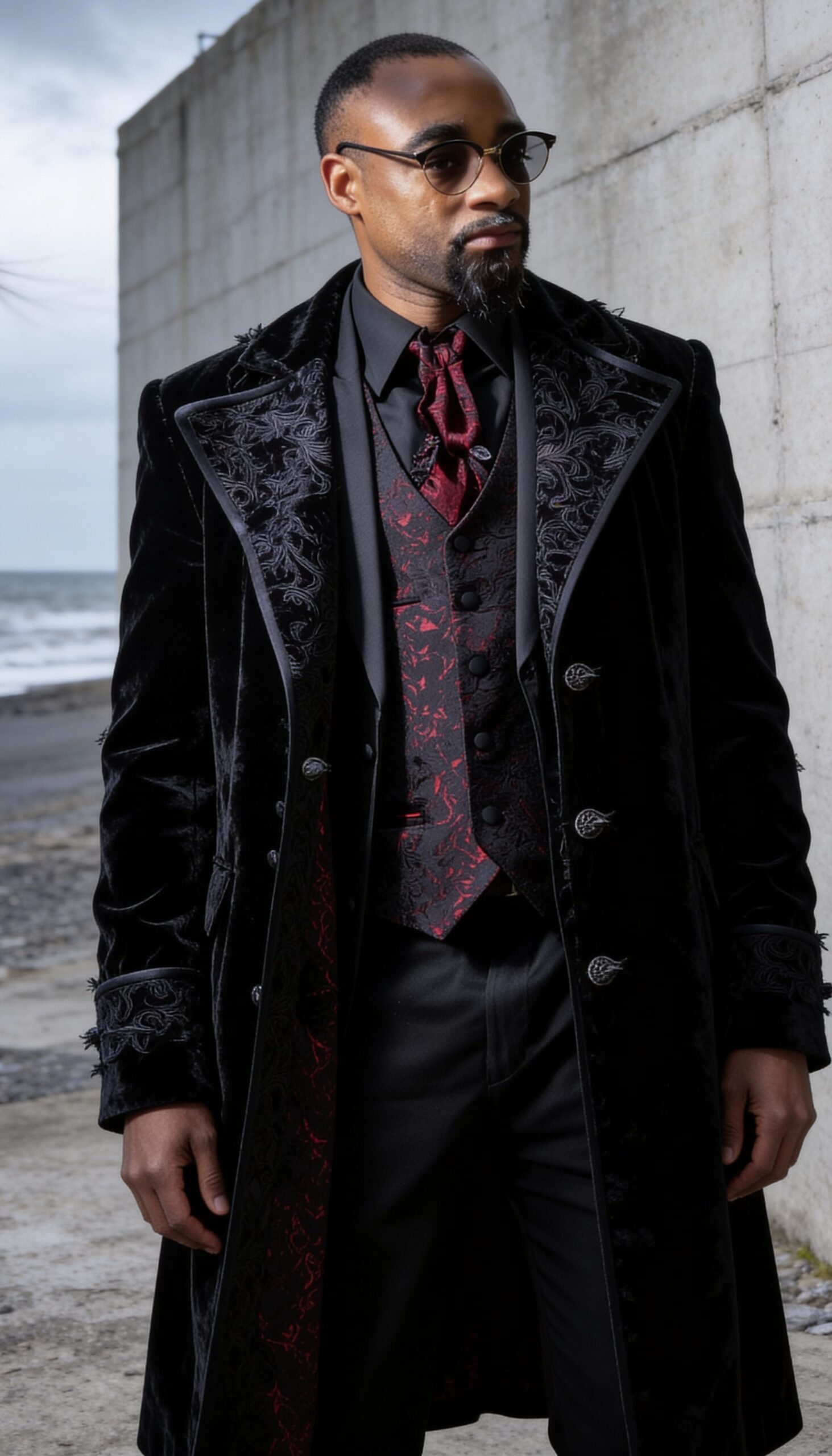

“Fort Worth,” Lucraen said, not as a greeting, but as an agreed-upon premise.
Serinda’s eyes tracked him once, not with curiosity, but with assessment. He wore his black coat like a judge wears authority, velvet-dark and heavy with embroidered patterning along the lapels, the kind of detailing that looked ornamental until you realized it was less decoration than a signature of craftsmanship meant for violence. Beneath it, he was dressed in layered formal black, a collared shirt and a waistcoat that carried blood-deep red patterning, a knotted tie in the same shade like a deliberate wound against the monochrome. He looked like a man who had made a truce with elegance because brutality alone wasn’t precise enough. He stood with his shoulders slightly angled toward the street as if he never fully turned his back on anything, and his expression carried that familiar restraint, the kind that suggested he could contain a storm in his chest without letting a single drop touch his face.
“You read the brief,” Serinda said. Her voice was even and low, lacking warmth in a way that didn’t feel cruel, only efficient. “Three primary predation modalities. One ancient. One witch-adjacent. One distributed.”
Lucraen didn’t miss the way she spoke about them as if they were mechanisms rather than nightmares, and he understood immediately what the chapter was going to demand of him. Serinda wasn’t here to empathize. She was here to dismantle.
They drove, and the miles between Baltimore and Texas became a long corridor of thought, the kind where you can’t distract yourself because the road itself is a metronome for memory. Lucraen listened more than he spoke. Serinda didn’t fill silence with small talk. She filled it with clarifying questions that felt less like conversation and more like interrogation of the problem. She wanted to know how the children vanished, what emotional conditions were present beforehand, whether the parents reported odd dreams, whether the houses had attic access, whether the basements had old crawlspaces, whether phones had suffered unexplained battery drains or phantom notifications that did not originate from any known app. She treated the world like a system that could be reverse engineered, and the part of Lucraen that still believed in gentleness flinched at her coldness even as the part of him that had survived Baltimore recognized her as a necessary kind of monstrous competence.
“You work like Mira,” Lucraen said after a long stretch of highway.
Serinda’s mouth barely shifted, not quite a smile, more like an acknowledgment that the comparison was irrelevant. “Mira is emotionally porous,” she replied. “She leaks motivation. That makes her predictable to anyone patient enough to watch.”
“You think I’m predictable,” Lucraen said.
“I think you’re principled,” Serinda corrected. “And principles are a map.”
The words hit clean, not because they were insulting, but because they were accurate in a way that didn’t allow argument. Serinda wasn’t trying to dominate him. She was defining the battlefield.
Fort Worth greeted them with a bright sky and a suburban calm that felt obscene once you knew what was being taken. Rows of houses with trimmed lawns, the kind where parents believed the world still obeyed rules, the kind where people assumed danger had to look like danger to be real. The first incident site was unremarkable from the street, which was the first warning. Predators that can operate in daylight do not require theatrics. They require access.
Lucraen’s phone buzzed again as they pulled into a lot outside a nondescript office building that had been repurposed into a temporary operations hub. The message wasn’t from the mission chain. It was from Draven.
It’s done. Your access is restored. Go see him.
Lucraen’s hand tightened around the phone without him meaning to. He stared at the screen until the words stopped looking like text and started looking like permission, a concept he didn’t fully trust because it always came with hidden price tags. The restraining order had been the most humiliating kind of captivity because it didn’t imprison the body, it imprisoned the right to be a father. He had lived in that cage for too long, texting his son in secret like a criminal just to maintain a thread of love. Draven had cut the cage open as casually as he did everything else, using connections that operated in rooms Lucraen would never be invited into, and now the question wasn’t whether he could see his son but whether he could survive what that reunion would tear open in him.
“I’m taking a detour,” Lucraen said.
Serinda didn’t ask why. She didn’t tease out the emotional implication. She simply looked at him as if detours were liabilities that needed to be priced.
“My son,” Lucraen added, as if naming it made it defensible.
Serinda’s gaze remained level. “Do it fast,” she said. “This city is bleeding children.”
They found Meriluke Lionheart’s house at the edge of a neighborhood that looked like money had been poured into it as an apology for existence. The home itself was grand in a way that felt aggressively curated: stone façade, brickwork, tall windows catching warm light, a driveway wide enough to feel like a stage. A pool gleamed off to the side like a luxury unrelated to morality. The scene might have felt aspirational if Lucraen hadn’t known the ugliness that lived behind the front door. Parked in the driveway like a trophy was Lucraen’s old car, sleek and expensive, the kind of vehicle that carried the ghost of his former life, the life Meriluke had won in the divorce not because she needed it but because she needed him to see she could take it. The car sat angled as if intentionally displayed, black paint reflecting the house’s golden glow, a silent taunt.

Serinda remained in Lucraen’s passenger seat when he killed the engine. She watched the property the way a professional watches a crime scene, noting entry points, lines of sight, distances to cover, the angle of windows. She was not here for family. She was here for threat mitigation, and the fact that she waited without complaint did not make her kind. It made her controlled.
Lucraen stepped out and walked toward the door with the weight of a man who had fought entities that devoured innocence but still feared the sound of a woman’s voice raised in rage. He knocked once, firm, not pleading, not apologetic. He could feel the old dynamics trying to reassert themselves, the impulse to shrink, to negotiate, to accept punishment as penance. He shoved that impulse down with the same discipline he used to aim his weapon.
The door opened.
Meriluke Lionheart filled the doorway like accusation made flesh. She wore a blue-and-black striped short-sleeve hoodie cropped high, zipped partway, and matching shorts that hugged her in a way that would have looked playful in a different life, but her expression was pure hostility, her posture angled forward like she had been waiting for the chance to unleash what she’d been storing. One hip cocked, one knee bent, bare feet in dark flip-flops like she didn’t need to dress for anyone, like her comfort was the only law. Her hair fell long and sleek, framing a face whose beauty had not softened her bitterness, and her eyes held that particular sharpness of someone who has turned resentment into identity.

“What,” she said, loud, not as a question, as a weapon.
Lucraen kept his voice calm. “I’m here to see Sterne.”
Meriluke’s laugh was a bark. “You don’t just show up here.”
“I can,” Lucraen replied. “I have the right now.”
Her eyes narrowed. “Oh, so now you got rights.”
“I handled it,” Lucraen said, and he watched the way his tone landed like poison, because Meriluke understood what his tone represented: influence that couldn’t be bullied.
Meriluke leaned into the doorway like she could block the entire universe with her body. “You want to play that game?” she snapped. “You step one foot in my house, I’ll file again. I’ll get another restraining order and I’ll make sure the court bleeds you.”
Lucraen swallowed. “I’m not here to fight you. I’m here for my son.”
“You don’t get to come in here and pretend you’re father of the year,” she spat, voice rising. “You don’t get to show up with your spooky coat and your little magic friends and act like you didn’t leave me holding everything.”
“I didn’t leave him,” Lucraen said, and for the first time his calm thinned enough to show the steel underneath. “I’ve been texting him. You couldn’t stop that. You could only pretend you did.”
The air sharpened.
A shadow moved behind Meriluke, and then Sterne Hollowpage stepped into view like a secret finally allowed to be seen. He was fifteen, standing tall and straight in a sleek, modern hallway lit by warm vertical strips of light that framed him like a portrait. He wore a black hoodie with SUGGS printed across the chest, black cargo pants with oversized pockets, and black-and-red high-top sneakers with bold branding around the ankle straps. His stance was hesitant but proud, hands relaxed at his sides, chin slightly lifted. His face held the calm of someone who had learned to survive conflict by not feeding it, but the moment his eyes met Lucraen’s, that calm cracked just enough to reveal relief.

“Dad,” Sterne said, the word soft but solid, as if he’d been practicing it alone to make sure it didn’t feel foreign.
Lucraen’s chest tightened so hard it felt like a physical injury. He stepped forward one pace, then stopped, because the doorway was still Meriluke’s territory and he refused to make Sterne watch another legal boundary become a battlefield. “Hey,” Lucraen said, and his voice almost failed him on the simplicity of it. “You got taller.”
Sterne’s mouth twitched into a restrained smile. “You too,” he joked, and the joke was bad on purpose, a way to make the moment survivable.
Meriluke snapped her head toward her son. “Go to your room.”
“No,” Sterne said, and the single syllable carried more courage than most adults ever summoned. “He’s allowed to see me.”
Meriluke’s face twisted. “You’re a child. You don’t get to decide—”
“I’m not a child,” Sterne replied, still calm, still controlled, but his hands curled slightly at his sides. “And you know we’ve been talking.”
The silence that followed was thick with exposed truth. Meriluke’s eyes went wide with rage, not because she didn’t know, but because it had been confirmed in front of her, and confirmation is humiliation when you’re addicted to control.
“You’ve been texting him behind my back?” she shouted.
Sterne flinched.
Lucraen stepped forward, and his voice dropped into something dangerous. “Don’t you put that on him.”
Meriluke’s laugh turned shrill. “Oh, now you want to protect him? You want to be the hero? You think because you waved your little connections around that you can walk in here like you’re entitled?”
“I am entitled,” Lucraen said, and he hated himself for how the word tasted, hated how legal language infected love. “He’s my son.”
Meriluke jabbed a finger toward him. “Try me. I’ll raise child support to twenty-five thousand a month. Twenty-five. I’ll make it hurt. And I’ll make sure he knows it’s your fault.”
Sterne’s face drained of color. The sentence landed on him like a slap. Not the money, not the number, but the idea that love could be billed, that he could be used as a lever. He turned without another word, moving out of the doorway, and the sound of his footsteps retreating down the hall was the sound of a boy being forced into adulthood by someone else’s rage.
“Sterne,” Lucraen said, stepping forward, but Meriluke moved to block him again, eyes bright with triumph and fury.
“You don’t chase him in my house,” she hissed.
Lucraen’s hands clenched, then released. He looked at Meriluke the way you look at a fire you can’t afford to fight because the smoke would choke the child you’re trying to save. “This isn’t over,” he said quietly.
Meriluke leaned closer, voice dripping venom. “It never is.”
Lucraen walked back to the car with something cold behind his ribs. Serinda watched him approach without sympathy on her face, but her posture had shifted, her attention angled down the street like she’d already begun tracking the ripple effects of the argument. When he slid into the driver’s seat, she didn’t ask what happened. She didn’t need the details. She recognized the aftermath in the way his breath had changed.
“He ran,” Serinda said, not as assumption, as certainty.
Lucraen’s eyes stayed forward. “Yeah.”
Serinda’s gaze flicked to the neighborhood. “He didn’t go far. He went somewhere he believes you can’t reach. That’s what children do when adults turn love into a courtroom.”
Lucraen started the engine. “Help me find him.”
Serinda didn’t nod. She didn’t reassure. She simply pulled up a local map, fingers moving fast, and began to work the problem the way she worked everything: as a system. She watched the likely routes a fifteen-year-old would take, filtered by what he would avoid, cross-referenced with where someone in pain might go to feel invisible. She didn’t care about ethics; she cared about outcomes. And for the first time since meeting her, Lucraen felt gratitude for that ruthlessness.
They found Sterne near a concrete seawall that cut the beach into an austere corridor, the gray slab rising behind him like a prison made of geometry. The ocean rolled beyond, and the sky was a dull sheet of overcast that made everything feel flattened, as if the world itself had been put in quarantine. Sterne stood alone at the edge of wet sand, shoulders tight, hands stuffed in his hoodie pocket, looking out at the water like it could answer questions adults refused to.
Lucraen parked and stepped out slowly, careful not to spook him. Serinda remained in the car, as promised, not because she respected privacy, but because she understood leverage. A father-and-son reunion was volatile. Serinda preferred volatility at a distance she could control.
“Sterne,” Lucraen called.
His son turned, and the expression on his face was a storm held behind glass: hurt, anger, relief, exhaustion, all layered. He didn’t run again. That alone felt like mercy.
“I’m sorry,” Lucraen said immediately, because anything else would have been cowardice. “I’m sorry you had to hear that.”
Sterne’s jaw flexed. “She does that,” he muttered. “She uses… stuff. Like it’s a weapon.”
Lucraen nodded once. “I know.”
Sterne’s eyes narrowed. “Then why do you keep coming back?”
Lucraen stepped closer until the wind off the water filled the space between them, until Sterne could see his face clearly, could see the sincerity without needing words. “Because you’re my boy,” Lucraen said, voice low. “Not like property. Like… like part of my responsibility. Like part of what makes me real.”
Sterne’s shoulders sagged slightly, the tension loosening just enough to reveal the boy underneath. “We’ve been texting,” he said, as if needing to confirm it wasn’t a dream. “I didn’t tell her. I didn’t want her to—”
“Punish you,” Lucraen finished. “I know.”
Sterne looked away. “She acts like you’re dangerous.”
Lucraen’s mouth tightened. “Sometimes I am. But not to you.”
A silence settled, and in that silence the world shifted.
At first it was a vibration underfoot, so subtle it could be mistaken for distant construction. Then it sharpened into something else entirely, a pressure that made the air feel thick, as if the atmosphere had become syrup. The ocean’s motion faltered, not stopping, but moving with a strange reluctance. Sterne’s eyes widened, his body freezing, and Lucraen recognized the signature instantly: a distortion of render itself, a field that didn’t merely slow movement but attacked the very continuity of change, forcing witnesses into a kind of paralyzed observation where the body knew it should run but could not convince reality to allow it.
He turned.
The thing rising beyond the seawall was not a monster in the way humans tell stories about monsters. It was a colossai entity, a presence that stood three hundred meters tall and carried a mass that made the ground register it like a new law. It did not fully occupy the manifest expanse; it projected into it like a partial thought forcing itself through a narrow mind. Its true state was not contained here, not constrained by the usual boundaries that keep entities honest. What they saw was an excerpt, a fraction, a sliver of something unbound, and even that fraction was enough to make the world behave like it was afraid.

It had multiple arms, elongated and crowned with claw-like extensions that looked less like biology and more like the ends of broken universes. Its torso was wrapped in dark, ridged material like petrified bark, but beneath that bark the surface glittered with starfields, as if the night sky had been trapped inside its flesh. Where a face should have been, there was an abyssal hood of texture, and within it a single radiant point like a distant star, glaring outward with an intelligence that did not need eyes to see. The air around it shimmered, not with heat, not with dust, but with the visible strain of reality attempting to reconcile the entity’s presence with rules that were never meant to include it.
Sterne tried to speak, but his mouth barely moved. Lucraen felt his own breath become labor, as if each inhale had to negotiate with the distortion field. The colossai entity’s epiphenomenal breath did not arrive like wind. It arrived like a premise, a statement that nature’s strongest weapon was not storm or fire but the capacity to rewrite what matter believed it was allowed to be. Lucraen’s mind, trained to analyze under pressure, registered the terror in technical terms because technicality was sometimes the only way to keep panic from eating you alive.
He knew what the brief had said. Each cell of the entity contained eruptions equivalent to genuine gamma-ray burst phenomena, on the order of at least twelve KiloFoe of energy per cellular event, and that wasn’t poetry. That was physics made grotesque. If such eruptions were allowed to couple coherently to the local environment, the consequences wouldn’t be “damage.” They would be conversion, restructuring, erasure masquerading as natural catastrophe. Its roar wasn’t mere sound; it was resonance, capable of subatomic crushing, meaning it could attack the integrity of matter at the scale where the world’s stability is negotiated. And then there was the most obscene expression of it: the plasma shockwave generated by singing its silence, a contradiction made into a weapon, a field effect that targeted constituent particles of matter across a range of six hundred meters, not caring what shape those particles had agreed to take.
The attack potency, Lucraen reminded himself with a kind of grim clarity, was defined by the energy output of a single strike, not by the area of effect. There was no sugar coating that. It was not “big because it hits far.” It was catastrophic because each discrete expression was quantified at a minimum of 2.825 QuettaexaFoe, corresponding to 6.752×10^82 tonnes of energy-equivalent scale, corresponding to 2.825×10^92 joules. Those numbers weren’t there to impress. They were there to describe the floor of the threat’s output, the baseline of what it considered casual.
Lucraen tried to move and felt his body argue with itself. The distortion field made thought heavy. It made intention sluggish. It made the simplest act—stepping forward—feel like pushing a mountain with a fingertip.
Serinda opened the car door.
She stepped out as if the distortion did not apply to her.
Not because she was immune in a comforting way, but because she was operating through a modality that treated the field as negotiable. She walked toward the beach with the same calm she’d had on the highway, boots biting into sand with precise footfalls, posture straight, head level, eyes unwavering. Her outfit looked almost absurdly clean against the gray ocean and the looming horror: the white SUGGS crop top stark against the dull sky, the black patterned sleeves cutting geometric lines down her arms, the distressed black shorts with dangling ties moving lightly with her steps, and those lace-up heeled boots turning the sand into a stage she owned. She didn’t rush to protect Sterne. She didn’t shout warnings. She didn’t announce heroism. She treated the entity like a math problem she was about to solve.
Lucraen felt a cold realization: Serinda was not motivated by fear, and she was not motivated by compassion. She was motivated by control.
The colossai entity shifted, and the air stiffened. Its arms lifted, claws curling as if gathering the manifest expanse itself into a grip. The radiant point in its hood-face brightened, a star intensifying, and the world’s pressure deepened, pinning Sterne’s body into immobility. Sterne’s eyes were wide, mouth parted, trapped in a witness-state, and Lucraen’s fury rose, sharp and helpless, because nothing enrages a father like being forced to watch.
Serinda raised both hands.
Not dramatically, not in prayer, not in desperation. Her arms extended outward with measured symmetry, palms open, fingers slightly spread, as though she was aligning invisible instruments. And then, behind her, a luminous circular architecture unfolded into being—an intricate sigil-plane of pale blue light, layered with rotating rings, markings, and interlocking glyphic structures that looked like a fusion of arcane diagram and engineering schematic. The circle hovered at her back like a halo designed by someone who hated gods, and it spun with silent intent.

Black Collapsed Ontology did not look like darkness. It looked like the failure of definition.
The air around Serinda subtly lost its certainty, as if reality hesitated to commit to what it was in her vicinity. The glow of the circle remained blue, but beneath it there was a deeper null-quality, a pressure that suggested she was not summoning force so much as summoning subtraction, an erasing logic that could unwrite the relationship between an entity and the world that hosted it.
She spoke once, and the words were not audible, not because she whispered, but because the concept of sound did not deserve to carry what she was doing. Her eyes remained fixed on the colossai entity as if she could see the seams where its projection met the manifest expanse, as if she could see the exact points where it was anchored.
Then she closed her fingers gently, like a woman pinching out a candle.
The colossai entity did not explode. It did not fall. It did not roar in defeat. It simply lost the right to be present. Its projected portions stuttered, the starfields inside its limbs flickering like a corrupted image, the radiant point in its hood-face dimming as if the very act of being observed had been revoked. The distortion field collapsed, and render surged back into the world, snapping muscles and breath and motion into normal continuity so abruptly that Sterne stumbled forward, catching himself, blinking like someone waking from anesthesia.
Serinda’s circle faded. The air re-solidified. The ocean resumed its indifference.
The entity was gone, not slain, not destroyed in a way that left remnants, but erased, negated, removed from the argument of existence as if it had never successfully completed the act of arriving.
Lucraen stared at Serinda, and for the first time he felt something close to unease that had nothing to do with the monster. The ease with which she had done it was not comforting. It was instructional. It said: there are people in this war who do not struggle. They simply decide.
Serinda glanced toward him, then toward Sterne. Her expression did not soften. “We’re leaving,” she said, as if this had been an inconvenience.
Sterne looked at her with stunned awe, then at his father. “Who is that,” he breathed.
Lucraen put a hand on Sterne’s shoulder, steadying him. “Someone on our side,” he said, and even as he said it he understood the difference between “on our side” and “for us.”
They walked a short distance away from the water, to a place where the concrete wall blocked the wind. Sterne’s breathing was fast, his hands shaking slightly as adrenaline finally found permission to move through him. Lucraen crouched in front of him, meeting his eyes, making sure his son felt seen, not just saved.
“I’m sorry you saw that,” Lucraen said.
Sterne’s mouth twitched. “I’ve seen worse in my head,” he admitted, and the honesty in the sentence cut deeper than fear. “When she’s yelling.”
Lucraen’s face tightened. He nodded slowly. “That’s real too,” he said. “And it matters.”
Sterne swallowed. “Are you… are you always doing this?”
Lucraen hesitated, because lying would be cruelty and truth would be heavy. “Yeah,” he said. “But not because I want to. Because someone has to.”
Sterne looked down, then back up. “I want to come with you.”
Lucraen’s chest tightened again, not with fear this time, but with the ache of hearing your child ask to step into your hell because home has become its own version of one. “No,” Lucraen said instinctively, and the word came out too fast.
Sterne didn’t flinch. “You can’t tell me I’m safe there,” he said. “Not after that. Not after… her.”
Lucraen’s jaw flexed. He looked over at Serinda, who stood a few paces away, watching the perimeter with the calm of someone who never fully relaxes because relaxation is a luxury for people who can afford surprise. She didn’t interject. She didn’t advise. She waited to see what decision Lucraen would make, because she understood that this was the real mission now, the one no brief could contain.
Lucraen turned back to Sterne. “If you come with me,” he said carefully, “you don’t get to pretend. You don’t get to half-believe. You’ll see things that don’t care about your feelings. You’ll see predators that specifically target children because children are easier to shape. You’ll see ugliness that doesn’t even have the decency to look like ugliness.”
Sterne’s eyes stayed steady. “I already live with something that targets children,” he said quietly. “It just wears a mom’s face.”
Lucraen closed his eyes briefly, then opened them. He placed both hands on Sterne’s shoulders, firm, anchoring. “Then you stay close,” he said. “You listen. You don’t wander. And when I tell you to move, you move.”
Sterne nodded once, fast. Relief and excitement and fear all tangled together.
Serinda finally spoke, voice flat. “He’ll be useful,” she said, as if that was the only supportive frame she trusted. “Children draw predators. If he’s with us, the threats come to us instead of to strangers.”
Lucraen stared at her. “That’s your justification?”
Serinda’s eyes remained cold. “It’s the only one that matters in the field.”
Sterne glanced between them, and something in his expression changed, a subtle dawning: his father’s world was full of allies who were not gentle. Lucraen recognized the moment and filed it away as another wound the chapter would leave behind.
They didn’t return to Meriluke’s house. Lucraen made that choice without ceremony. He did not owe Meriluke another confrontation today. He owed Sterne protection. And protection sometimes looked like removal.
The hunts began immediately, because Fort Worth didn’t pause for fatherhood.
The first target was the ancient creature that fed on innocence and could turn invisible and immaterial, slipping through walls the way guilt slips through families. The incident map pointed them toward a residential block where children had complained of “a man” watching them from corners that held no one, a presence that made their toys feel heavy, a sensation of being observed even in closets with doors shut. Lucraen walked the perimeter of the house while Serinda sat in the driveway, watching the windows as if she could see through them by sheer contempt. Sterne stayed between them, close enough to touch Lucraen’s coat hem, eyes wide but focused.
Inside the house, the air felt wrong in the way it always did when a predator had established territory, not colder, not darker, just subtly more confident. Lucraen moved room to room, listening to the quiet in the walls. The creature’s invisibility wasn’t merely optical; it was a refusal to be registered as matter. It could become immaterial, pass through objects, hide in the gap between attention and perception. It fed on innocence the way mold feeds on dampness, slowly, patiently, leaving children exhausted, hollow-eyed, irritable in ways parents misread as “phases.”
Lucraen didn’t chase it like prey. He baited it with absence, standing still in the center of a child’s room, letting his presence become a kind of mirror, letting the creature’s hunger miscalculate. When it moved, Lucraen felt it as a pressure shift, a faint tug in the room’s geometry. He snapped his hand up and traced a short, precise seal in the air, not shouting, not dramatizing, simply evicting the creature’s right to remain intangible. The entity shrieked without sound, becoming briefly visible as a twisted silhouette wrapped around itself like shame.
Serinda stepped through the doorway at that exact moment, hands already lifted, eyes indifferent. She didn’t ask if Lucraen wanted to interrogate it. She didn’t ask if it could be contained. She didn’t care what it had been. She cared what it was doing.
A thin, black cut of negation passed through the air like a line being drawn on paper.
The creature was erased mid-coil, reduced to a moment of absence that closed behind itself. The room’s pressure eased. The child’s toys looked like toys again.
Sterne stared. Lucraen felt anger flare, not at Serinda’s efficiency, but at the casualness with which she removed threats without allowing their ugliness to be named. Part of him wanted to understand. Serinda had no patience for understanding.
The second hunt took them to the witch-like predator, the one feeding on children’s life force in a manner that made hospitals useless because it didn’t present as disease. The reports spoke of kids becoming pale, fatigued, eyes dull, bodies thinning even as bloodwork returned “normal.” The creature did not drain blood. It drained vitality, the subtle metabolic music that makes a child’s laugh feel effortless. It nested in places where adults did not look closely: old playhouses, disused sheds, the shadowed cavity beneath a staircase. It wore charm and curse together, like a lullaby with a blade in it.
Lucraen found its trail in a backyard where the grass grew in a circle too perfect to be natural. The air there tasted faintly sweet, like fruit beginning to rot. Sterne hovered near the fence, watching, trying to be brave, trying not to be a burden. Serinda walked straight into the circle, boots compressing the grass without hesitation, eyes scanning the ground for sigils like she was reading someone’s handwriting.
“She’s close,” Lucraen murmured.
Serinda’s gaze remained fixed. “Of course she is. Predators don’t leave the pantry.”
The witch-thing emerged as a figure shaped like a woman’s outline but wrong in the details, joints bending too smoothly, hair drifting as if underwater, eyes reflecting nothing. It spoke in a voice that sounded kind until you listened to the hunger behind it, offering bargains, offering relief, offering parents “solutions” they didn’t realize were payment plans.
Lucraen stepped forward to engage, because sometimes you needed to pull a predator’s attention toward the adult who could withstand it. But Serinda cut in, not physically, but psychologically. She tilted her head slightly and smiled with no warmth.
“You’re not clever,” Serinda said. “You’re just early.”
The witch-thing’s expression faltered, offended.
Serinda continued, voice calm. “You feed because you don’t know how to exist without taking. That’s not power. That’s dependency.”
The creature hissed and lunged—not at Serinda, but at Sterne, because predators are always opportunists, always drawn to the child in the scene like a magnet. Lucraen moved instantly, coat flaring as he stepped between, but the witch-thing’s reach was not purely physical. It was a siphon, a hook for vitality.
Serinda’s hand snapped outward, and the air folded.
Black Collapsed Ontology didn’t merely erase the creature’s body. It collapsed the predatory relationship itself, severing the linkage between hunter and prey so completely that the witch-thing’s hunger had nowhere to attach. The entity recoiled, not in pain, but in confusion, as if its fundamental modality had been invalidated. Serinda closed her fist.
The witch-thing was negated, not leaving ash, not leaving smoke, leaving only the sense that something had been removed from the rules.
Sterne exhaled shakily, and Lucraen felt a strange, grim gratitude. Serinda had saved his son without even considering the emotional meaning of the act. That was her paradox: she could be indispensable and still feel dangerous to stand beside.
The third hunt was the worst because it wasn’t one creature. It was many, distributed across modern life like rot in the plumbing. Ineffable predators that lurked in basements, attics, and phones, feeding on children through the most intimate channels: screens, whispers, notifications, reflections in dark glass. They didn’t need to snatch bodies. They could gnaw at attention until a child became hollow, compulsive, anxious, unable to sleep because the room felt watched even when alone. These were not demons in the cinematic sense. They were infestations of the everyday, parasitic modalities that made a home feel unsafe without giving adults a clear villain to hate.
They moved through a sequence of houses with the same pattern: a basement corner that felt too quiet, an attic hatch that seemed to breathe, a phone that displayed messages that weren’t sent by anyone human, a child who stared at a blank screen like it was a portal. Lucraen handled some of these with painstaking ritual, sealing thresholds, rewriting the room’s acoustic geometry the way Ardine would have, forcing the infestations to reveal themselves by denying them concealment. Serinda handled others with surgical cruelty, walking into a child’s bedroom, plucking the phone from the nightstand, and crushing the infestation’s tether with a single ontological cut that left the device intact but cleansed, as if she had removed a virus by erasing the concept of infection itself.
At one point, in a dim attic filled with cardboard and old holiday decorations, Sterne pointed shakily at a corner where darkness pooled unnaturally, where the air seemed to swallow sound. “There,” he whispered.
Lucraen looked, and he felt it too: an ineffable thing crouched between insulation and shadow, feeding on the child’s fear of the dark itself, turning that fear into calories. Lucraen stepped forward, ready to draw it out.
Serinda caught his sleeve with two fingers, stopping him like he was a tool she was repositioning. She didn’t look at him. She looked at Sterne.
“Tell it you see it,” Serinda said.
Sterne blinked. “What?”
“Say it,” Serinda repeated, colder. “Predators like that live on the belief that they’re unnameable.”
Lucraen’s stomach tightened, but he understood. It wasn’t kindness. It was psychological warfare.
Sterne swallowed. His voice shook. “I see you,” he said, louder than he meant. “I know you’re there.”
The darkness rippled, offended, as if being acknowledged was an injury.
Serinda moved her hand once, minimal, and the corner of shadow simply ceased to be a viable hiding place. The infestation’s anchor was erased. The attic’s air relaxed, returning to normal stale dust and cardboard smell.
Sterne stared at Serinda, and for the first time his expression held something like awe mixed with caution. He was learning that strength could be cold and still be protective, that some guardians didn’t comfort you—they armed you.
When the day finally slowed enough for them to breathe, they sat in the car near an empty lot while Fort Worth’s sky dimmed into evening. Sterne leaned back, exhausted, eyes heavy, but his posture carried a strange new steadiness, like someone who had survived a private apocalypse and come out with a spine he didn’t know he had.
Lucraen watched him quietly, the way fathers do when they’re trying to memorize their children because they’ve learned how quickly life can alter the surface of a face. He thought of Meriluke, of her threats, of the way she had turned the language of support into a noose. He thought of the colossai entity and the way the world had tried to freeze them into helpless witnesses. He thought of Serinda’s hand closing like a candle snuff and removing an entire catastrophe with a gesture.
He realized something ugly and simple: if he returned Sterne to that house tonight, he would be delivering his son back into a different kind of predation, one that couldn’t be erased with ontology because it lived inside law and resentment and the social permission granted to bitterness.
“I’m taking him with me,” Lucraen said.
Serinda glanced at him from the passenger seat. Her expression didn’t change. “Good,” she replied.
Lucraen turned toward her. “That’s all you have to say?”
Serinda’s eyes narrowed slightly, as if he’d asked a meaningless question. “He’s already in it,” she said. “You don’t protect someone by pretending they aren’t. You protect them by placing them where the least damage can reach them.”
Sterne looked between them, quiet.
Lucraen reached over and squeezed his son’s shoulder once, firm. “Baltimore isn’t gentle,” he warned.
Sterne’s mouth twitched. “Neither is here,” he said, and for the first time the sentence sounded like he believed he could survive it.
Lucraen stared forward through the windshield, watching the road ahead become a dark ribbon, feeling the weight of the decision settle into him like armor. He wasn’t just bringing his son into his war. He was acknowledging that the war had already come for his son, and the only choice left was where Sterne would stand when it did.
Serinda leaned back in her seat, calm again, as if everything that had happened—colossai erasure, predatory hunts, family fracture—had been nothing more than an efficient day’s work. Lucraen didn’t know whether to resent her for that or to envy her.
As they pulled onto the road out of Fort Worth, Sterne sat in the back seat, hoodie hood down, eyes open, watching the world pass by with the alertness of someone who had stopped assuming the world was safe. Lucraen drove with both hands steady on the wheel, and in his mind he could already feel the next render approaching, the Church growing, the sky breaking, the children vanishing, the predators adapting, the city calling.
He did not know what Baltimore would do to Sterne.
But he knew what Meriluke’s house already had.
And that was enough.
The highway swallowed them, and behind them Fort Worth’s quiet neighborhoods remained lit and manicured and unaware of how close they had been to losing their children to things that fed on innocence like it was a resource. Ahead of them, the work waited—unending, unglamorous, necessary—and beside Lucraen sat Serinda Walker, quiet confidence wrapped around cruelty like a coat, the kind of ally who would win any battle and leave you wondering what it cost your soul to stand near her.
Lucraen kept driving anyway, because in the world he lived in, victories were rarely clean, and protection was rarely gentle, and fatherhood was sometimes nothing more than making the least-damaging choice in a universe that didn’t offer good ones.
Meriluke’s call hit Lucraen’s phone like a thrown object, vibrating hard enough to feel accusatory in his palm. The screen lit with her name, and for a moment he just watched it ring, letting the sound exist, letting it announce itself into the cabin without granting it immediate authority. Sterne was in the back seat, quiet, shoulders tucked into his hoodie, eyes forward as if the road itself had become something he could trust more than any house. Serinda sat in the passenger seat with her chin slightly lifted, gaze steady on the highway, posture calm in that unnerving way she carried—like nothing that happened inside a human heart deserved to interrupt the logistics of movement.
Luc answered without putting it on speaker, not because he was hiding it, but because he refused to turn his son’s pain into a public spectacle.
Meriluke’s voice detonated instantly, loud enough that the phone’s tiny speaker sounded like it might crack under the force of her rage. She didn’t say hello. She didn’t ask a question. She arrived already mid-sentence, as if she’d been screaming at him in her head for hours and now the call had simply unmuted her.
“You think you’re slick?” she snarled, each word sharp with spit and resentment. “You think you can show up here and start drama and then just dip? You got my son in here acting different, talking back to me, thinking he got options—because you wanna play daddy for five minutes?”
Lucraen kept his eyes on the road. His voice stayed even. “I’m not playing anything.”
“Oh, shut up,” she snapped, the sound of something slamming in the background—maybe a cabinet door, maybe her fist against a wall, maybe just the need to make noise because silence would force her to hear herself. “Sterne is gone. He ran off. He’s not answering his phone. He’s not in his room. You came here, you stirred up your little mess, and now my son is missing.”
Lucraen’s mouth tightened, but he didn’t correct her. Not yet. Not at all.
Meriluke kept going, her anger accelerating as if fury itself was a vehicle she knew how to drive. “If anything happened to him, I swear to God, Lucraen, I will ruin you. Do you hear me? I will tear your life apart piece by piece. I’ll get another restraining order so fast your head will spin. I’ll have you dragged into court like a dog. I’ll have your money. I’ll have your name. I’ll have your little reputation. I’ll call everybody you think you got in your corner and I’ll make sure they see what you really are.”
Lucraen’s grip on the wheel stayed steady. His face didn’t change.
Meriluke’s breathing was audible now, harsh and fast, the sound of someone who didn’t know how to be afraid without turning it into violence. “And don’t think that little win means anything,” she spat. “I don’t care who you know. I don’t care who you’re hiding behind. I’ll call the cops. I’ll call CPS. I’ll call the courts. I’ll call the news. I’ll tell them you’re unstable. I’ll tell them you’re dangerous. I’ll tell them you’re stalking us. I’ll make them believe it. You hear me? I’ll make them believe it.”
Serinda’s eyes flicked toward Lucraen for half a second, then back to the road, expression unchanged, as if she were listening to weather.
Meriluke’s voice rose again, pitch sharpening into something almost frantic. “You think you can take my child from me? You think you can just come in my house like you own something? Sterne is mine. Mine. And if he’s hurt, if he’s scared, if he’s—if he’s out there because of you—Lucraen, I will bury you. I will destroy you. I will make you pay every month until you choke on it. Twenty-five thousand? That was just the start. I’ll make it fifty. I’ll make it whatever I want. I’ll have you working just to bleed. I will break you.”
Lucraen listened, and something quiet in him unclenched. The more she screamed, the more he could hear the truth under it, not the truth she meant to confess, but the truth she couldn’t hide: she was terrified, and she didn’t know how to hold terror without turning it into a weapon.
He could have ended it with one sentence. He could have said Sterne is safe. He could have said he’s with me. He could have cut her fury off at the knees and watched her collapse into a different kind of noise. But Lucraen understood something now that he hadn’t understood before. There was a kind of power in refusing to participate. There was a kind of protection in not giving an enemy the information they could weaponize next.
Meriluke’s voice cracked, then surged again, trying to drown her own fear. “Answer me! Where is he? You better tell me where my son is, Lucraen! You better—”
Lucraen exhaled slowly, a calm breath that felt almost indulgent.
Then, without saying a word, he ended the call.
The cabin of the car returned to its own quiet, the highway hum smoothing back into place like a blanket. Lucraen set the phone face-down in the console as if it were nothing more than a tool he didn’t need at the moment. His eyes stayed on the road. The corners of his mouth lifted—not into a grin, not into arrogance, but into something smaller, something private: the faint, satisfied smile of a man who had finally learned that he didn’t have to answer cruelty with explanation.
Serinda didn’t look surprised. She didn’t ask if he was going to call back. She only murmured, almost absentmindedly, “That’s the correct response,” like she was confirming a calculation.
In the back seat, Sterne sat silent for a beat, then let out a breath he didn’t seem to realize he’d been holding. Lucraen caught his eyes in the rearview mirror. No apology. No speech. Just a look that said: I’m driving. You’re here. You’re safe.
And Lucraen kept that faint smile as the miles carried them away, because for once, someone else’s rage wasn’t steering his life.