
Glass Historia IV: The Mirror of Chaos
The world did not lose its voice the way a machine loses power. It lost its voice the way a mouth loses language—sudden, intimate, humiliating, and final. The first seconds felt like routine failure, the sort of inconvenience people have been trained to tolerate, but the routine fell apart immediately because everything failed at once, and everything failed with the same dead indifference. No satellite confirmation. No radio static. No cellular reach. No emergency tones. No navigation pings. No buffering circle, no last message, no desperate call that at least rings into voicemail. The planet’s nervous system simply stopped behaving like a system, and every human discovered what it meant to live inside a world where reassurance could no longer travel.
Then the sky revealed that this was not merely an outage. It was adjudication.
Over every continent the vault above became a shattered surface, not ripped like cloth, not clouded like weather, but fractured like glass that had finally met a pressure it could not negotiate with. The cracks were not luminous; they were dark, and the darkness behind them didn’t resemble emptiness so much as an unmanifest be-ness beyond maximal complexity that refused to be described by the senses. Night deepened into something heavier than night. Daylight, where it still existed, looked bleached, as though the sun itself were being forced to shine through a smeared lens of refusal. People stared upward and understood, without needing a broadcast, that the world had entered a new condition: the background had become an active participant, and it did not care whether humanity agreed.
In coastal cities the sea went strangely polite for a brief span, holding its waves like breath, then returned with a violence that felt choreographed—flooding roads not as a natural surge but as a deliberate rearrangement of routes and exits. In mountain regions the wind rose and fell in pulses, not gusts, as if something were testing the air for resonance. In suburbs, streetlights flickered in patterns that looked too consistent to be random; their rhythm resembled a hymn that never quite became a melody. In dense urban districts, elevator doors opened and refused to close again, trapping people between floors, between choices, between the old idea of “help is on the way” and the new reality that help had lost the ability to arrive.
Without transmissions, the world became a collage of isolated horrors. Airports turned into shrines to stranded bodies, where pilots and passengers were forced to speak to each other again with human mouths and human fear. Harbors became graveyards for vessels that could no longer coordinate entry or departure. Hospitals filled with the sick and the injured, then filled with something worse: the staff’s dawning recognition that they could not call for supplies, could not request reinforcements, could not even confirm whether other hospitals still existed in the same way. Every institution that relied on invisible reach began to behave like a hand trying to grasp while missing the concept of fingers.
And inside that reachless world, the oldest human impulse resurfaced with a clarity that felt like a sentence: when the witness disappears, the restraint weakens.
The first cities to fall were not necessarily the poorest or most violent. They were the ones that had built their identity on constant connectivity, on constant information, on constant confirmation that they were seen. Those places collapsed inward as though their social cohesion had been a borrowed loan from an unseen network. When that loan was revoked, people discovered how little they trusted their neighbors when they couldn’t outsource trust to screens. Rumor became law. Fear became doctrine. A whispered claim—the water is poisoned, the air is cursed, the government did this, the heavens did this—could ignite a stampede, because stampedes are what happen when a crowd becomes convinced it cannot afford deliberation.
Across the globe, acts of cruelty began to appear like stains in a fabric that had always been dirty but had finally stopped pretending it was clean. People broke into homes not only for resources but for the intoxicating sensation of taking. People began to punish strangers for the crime of looking calm. Mobs formed around scapegoats with no evidence beyond the hunger for someone to blame. Some of the worst moments were quiet—parents choosing not to open their doors to neighbors begging for food, communities deciding that mercy was an unaffordable luxury, whole apartment blocks agreeing not to share medicine with the “wrong” floors, the “wrong” families, the “wrong” bodies. In the absence of transmission, morality stopped feeling like a shared contract and started feeling like an individual preference.
Then, in one of Africa’s largest megacities—Lagos, vast and sleepless, a place of roads braided like veins and commerce that usually moved with the stubborn rhythm of survival—another bishop arrived as though he had been expected.
He did not arrive with convoys. He did not arrive with guards. He did not arrive with spectacle. He was simply there, standing beneath a streetlamp on a narrow road that smelled of dust, exhaust, and salt carried from the water. Behind him, mid-rise buildings leaned into the night with tired balconies and dark windows. A fence of pointed iron spikes ran beside the sidewalk like a row of teeth. Farther down, faint points of light glimmered where the city still tried to pretend it had electricity, but even those lights looked uncertain, as though they knew they were temporary.
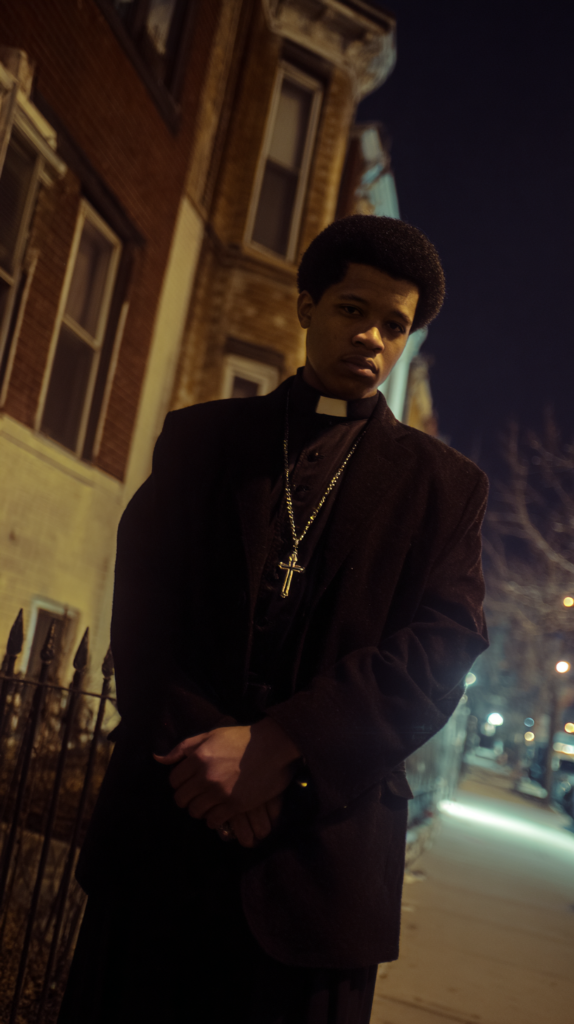
The bishop’s presence was the kind that made the air feel smaller.
He wore a tailored black coat that sat square across his shoulders and fell clean down his frame, a black clerical shirt buttoned high beneath it, the white collar at his throat stark and immaculate. A long chain draped from his neck, ending in a cross that caught the streetlamp’s glow in brief, cold flashes. His face was young but not soft, his gaze heavy-lidded and unamused, the expression of someone who is not impressed by human suffering because human suffering is the material he has come to sculpt. His hair was shaped into a full, rounded halo of tight curls that framed his head like an icon’s outline, a saintly silhouette repurposed for blasphemy. He held his hands together low in front of him, fingers interlaced not in prayer but in patience, like a man waiting for a crowd to finish gathering so he can begin the procedure.
And a crowd did gather, because even in a planet-wide silence, humans still move toward a figure who looks like authority. They came from side streets, from shuttered storefronts, from compounds where people had spent the last stretch of render listening to the global quiet and realizing they couldn’t confirm anything. They came with machetes and kitchen knives and nothing at all. They came with children clutched close. They came with eyes that kept darting up toward the shattered sky as if the sky might answer them directly now that the phones could not. They came with faith still in their mouths and suspicion already on their tongues.
The bishop watched them without urgency. When he finally spoke, his voice was not loud, and that was what made it carry.
“You have been starving for permission,” he said, and the statement landed like an accusation shaped as comfort. “Not permission from your leaders. Not permission from your Gods. Permission from your own fear. Permission to stop pretending you are fine.”
Someone shouted from the back, voice shaking. “Who are you?”
The bishop’s mouth curved into a faint smile that contained no warmth. “A witness,” he said. “Not the kind that records. The kind that reveals.”
A man nearer the front, older, jaw set with the kind of sternness that usually comes from long responsibility, demanded, “What happened to the world?”
The bishop’s gaze lifted toward the sky, and in that upward glance there was something like reverence—yet it was the reverence of someone admiring a demolition. “The world stopped lying,” he said. “Transmission was your narcotic. You thought you were connected, but you were only distracted. You thought you were informed, but you were only soothed. You thought you were safe because you could reach someone else, but reaching someone else is not the same as being saved.”
He looked back down at them, and his eyes sharpened. “Now you are forced to be local again. Forced to be immediate. Forced to be honest.”
A woman stepped forward, tears streaking her cheeks, her voice raw. “We need help.”
The bishop tilted his head slightly, and the gesture felt almost kind until his words clarified the cruelty beneath it. “No,” he said gently. “You need truth. Help is what you ask for when you still believe the world is obligated to care. But the world has never cared. The world has only continued. And now it will continue without your comforting stories.”
He took one step forward, slow, deliberate, and the crowd unconsciously shifted back. “You have been taught to fear evil as though evil is a separate species,” he continued. “A demon, a criminal, an outsider. But evil is not a creature. Evil is a modality—a principle of creation turned against itself. Evil is what happens when people decide that cruelty is efficient.”
His smile widened a fraction. “And chaos,” he added, “is what happens when people decide efficiency is unnecessary.”
That was his difference. The earlier bishops had treated ruin like engineering, malice like a plan, despair like a mechanism. This one spoke as though the plan was simply to dissolve the very desire for plan. He did not offer order. He offered release through disorder. His doctrine did not flatter the disciplined mind; it seduced the exhausted body.
“I am not here to build a system,” he said. “Systems are for those who believe in repair. I am here to remove the last illusion that keeps you obedient: the illusion that order is sacred.”
A young man in the crowd laughed nervously, shaking his head. “This is madness.”
The bishop’s eyes softened with a tenderness that felt invasive. “Yes,” he said. “And you have been denied your madness for too long.”
He lifted his right hand and let his fingers open slowly, like a flower unfolding. “Black Peace is not calm,” he said. “Black Peace is the end of negotiation. Black Peace is what happens when the world stops pretending it can be reasoned into mercy. Blackbourne Rapture is not escape to heaven. It is the world being dragged into the only honesty it has left: collapse.”
As he spoke, the air around him changed texture. It did not grow colder or hotter in a simple way. It grew unstable, as if the atmosphere were trying to decide whether it should behave like atmosphere or like a page being torn. The streetlamp above flickered and then steadied into an unnatural consistency, illuminating the bishop too perfectly, as though the light had chosen him as its subject.
Then he said, almost conversationally, “I will show you the mirror.”
The ground beneath his shoes darkened—not with wetness, not with oil, but with a reflective sheen that looked like polished obsidian. It spread outward in a smooth circle, consuming dust, litter, footprints, as if it were rewriting the street into a surface meant for revelation. Where the sheen passed, the air shimmered faintly, and people felt pressure behind their eyes, the sensation of standing too close to something that wanted to be looked at.
Someone stepped back and whispered a prayer. Another person spat on the ground as if to reject the ritual. The spit hit the reflective surface and did not splatter; it vanished, absorbed without trace, and that small detail sickened the crowd more than any obvious spectacle could have. It implied that the mirror did not merely reflect—it edited.
The Mirror of Chaos rose from the circle like a thin wall of darkness, not solid but dense, a pane that did not reflect faces so much as reflect possibilities of destruction. People who glanced into it did not see their own expressions; they saw the world’s history of chaotic ruin, not as documentary but as living encyclopedia—every riot, every stampede, every wildfire devouring homes while the sky turned orange, every flood taking streets into its mouth, every war born from misunderstanding, every accidental catastrophe turned into a deliberate one by opportunists, every moment where civilization’s thin skin ripped and the animal underneath took over.
And the mirror did not show these things as lessons. It showed them as options.
This was its horror: it functioned like a quantum encyclopedia made real, not a book to read but a field to step into. It poured knowledge of destruction into the nerves. It made certain behaviors feel instinctive by supplying the body with the memory of how destruction has always been done. It did not invent chaos; it reminded the species of its own archive, and the archive was absolute boundless.
A man in the crowd looked into the mirror and began to laugh, then choked on his laughter as his eyes filled with tears. He turned away, trembling, and whispered, “I saw—” but could not finish the sentence, because whatever he saw did not want to become language.
A woman looked into it and fell to her knees, sobbing, not because she saw herself committing violence, but because she saw the world committing it endlessly, repeatedly, with variations so countless that mercy began to feel like an anomaly rather than a rule.
A teenager leaned close, eyes wide with fascination, and when he pulled back there was a new brightness in his gaze—not hope, not joy, but the intoxication of someone who has just discovered that destruction can be treated like sport.
The bishop watched their reactions as if he were monitoring vital signs. “Do you feel it?” he asked softly. “The relief? The permission? You have spent your entire life holding your chaos inside your ribs because you were told restraint makes you good. But restraint was never goodness. Restraint was surveillance. Restraint was fear of consequences. And now the world has removed consequences as a meaningful story.”
He gestured toward the shattered sky. “Look up,” he said again. “The ceiling is broken. Who are you still performing for?”
The first violence did not begin as organized militia. It began as the simplest, oldest chaos: a crowd discovering that it can become a tide. A man shoved another man for no reason beyond the thrill of testing what would happen. The second man shoved back. A third joined. Someone swung a bottle. Someone screamed. The scream acted like a spark. People surged, bodies pressed together, and in that press the individual mind dissolved into collective appetite.
The bishop did not flinch. He began to hum—low, rhythmic, almost playful. This was not the earlier bishops’ engineered cadence; this hum carried the lilt of celebration. His body language was almost relaxed, shoulders loose, chin slightly lifted, as if he were listening to a beloved song. The hum threaded through the crowd’s rising noise like a conductor finding tempo.
The Mirror of Chaos responded. Its surface rippled, and within its ripples, scenes of disorder intensified: crowds overturning vehicles, fires leaping across rooftops, people trampling one another in panic, gunshots fired in all directions because direction had ceased to matter. The mirror did not predict. It suggested. It showed the crowd what chaos looks like when it is unashamed, and the crowd, already hungry, accepted the suggestion like instruction.
Soon the violence spread beyond that street. It moved like rumor, like contagion, like a storm front. Markets became battlegrounds. Intersections became arenas. People began hunting not only for resources but for sensation. When the world’s network went silent, some humans began trying to feel alive by forcing others to feel fear. They turned alleys into stages. They turned homes into traps. They turned the suffering of the innocent into entertainment because entertainment was the last ritual they understood.
Some groups began to commit ritualistic cruelty not even for ideology, but for pageantry. The mirror’s encyclopedia offered them images of how brutality can be stylized into ceremony—how crowds can chant while an innocent body is made into proof of dominance, how laughter can drown out pleading, how blood can become paint when empathy has been outmoded. People who had never seen themselves as monsters discovered that monstrosity is simply what the human animal becomes when it stops believing it will be judged.
The bishop walked through it all as though he were strolling through a cathedral. His coat swung lightly with each step. His cross glinted as he passed beneath broken lights. His expression remained calm, almost bored, and that boredom became a different kind of terror because it implied that the suffering around him was not shocking—it was expected, the inevitable manifestation of a species finally released from its own self-myth.
A man—young, shaking, holding a child—pushed through the crowd and stumbled toward the bishop, desperation cracking his voice. “Stop this,” he begged. “Please. This is not peace. This is not—”
The bishop stepped close enough that the man’s breath fogged against the fabric of the coat. “Peace is not tenderness,” the bishop whispered. “Peace is not safety. Peace is the end of contradiction.” He touched the man’s shoulder with two fingers, light as a blessing, and the man froze as if his body had been briefly unplugged. “You call it chaos because you want to believe this is abnormal. But this is your species without its stories.”
The man’s eyes widened. “We can be better.”
The bishop smiled softly, and the softness was cruel. “Better is a luxury of stable worlds,” he said. “This world has chosen Black Peace. The Blackbourne Rapture does not require your consent. It only requires your participation.”
He withdrew his fingers. The man stumbled backward as though released from a brief paralysis, clutching his child tighter. The bishop watched him retreat and murmured, almost tenderly, “Take her somewhere quiet. The quiet will not last.”
Across Lagos, the mirror began to multiply. It appeared in the surfaces humans forget are reflective until horror forces them to notice: in car windows, in puddles, in the gloss of polished tile in lobbies, in the black screen of dead phones held up like talismans. Every reflection became a portal to the encyclopedia. People looked accidentally and found their minds invaded by visions of chaotic destruction so vivid that their bodies reacted as if they were already inside the event. Some ran. Some vomited. Some laughed. Some became still, the stillness of a mind short-circuiting.
And it was not only Lagos.
On the far side of the planet, a city that had prided itself on order found its order dissolving into sudden stampedes, not because a specific threat appeared, but because the shattered sky above made people feel hunted by the universe itself. In a coastal town, a rumor that the water was cursed caused residents to turn on one another, accusing neighbors of contamination. In a mountain village, the mirror manifested in a lake’s surface, and when villagers looked down they saw an encyclopedia of disaster that convinced them the only way to be safe was to strike first. Families locked doors. Families broke doors. Trust became a myth spoken with the same nostalgia as childhood.
Starvation began not as empty fields but as the failure of coordination. A distribution chain is just a story told by roads and schedules and signals. When signals died, the story fell apart. Food rotted in warehouses while people fought in the streets. Medicine sat in locked containers because the keys belonged to someone who had fled or been erased. Entire neighborhoods became islands, each one forced to decide whether it would share or hoard. Many chose hoarding, not because they were inherently evil, but because fear makes scarcity feel sacred.
Disease spread in the simplest way: wounds went untreated, sanitation failed, water systems became contaminated, and clinics became overwhelmed. The horror wasn’t a cinematic plague. The horror was banal infection turning lethal because civilization’s support lattice had snapped. People coughed in darkness. Fevers climbed and were met with superstition instead of care. Some communities began to blame the sick and erase them from the group as if sacrifice could restore order. The mirror encouraged this by showing them a thousand historical examples of scapegoating dressed as purification.
War, too, ignited where borders were still physically present but morally meaningless. Without transmissions, misunderstandings could not be corrected quickly. Without coordination, small conflicts escalated because no one could confirm what anyone else was doing. Rumor declared that one group had attacked. Another group retaliated. Retaliation became justification. Justification became doctrine. And doctrine, once it has blood under its fingernails, becomes very difficult to wash. Nuclear wars started to erupt across the globe. Bio-chemical warfare erupted just the same.
In Lagos, the bishop climbed a short set of steps outside a darkened building that might once have been an office or a civic hall, and he turned to face the crowd that had followed him like a tide. Behind him, the sky’s fractures thickened into a web, the cracks converging overhead as if the night were trying to crown him.
His voice rose slightly, but it did not become a shout. It became something like a sermon spoken to a world that could no longer reply.
“You thought chaos was the enemy,” he said. “But chaos is the oldest truth. Chaos is what the cosmos was before you learned to name it. Chaos is what your body is when you stop forcing it to behave. Chaos is what your mind is when you stop pretending you are consistent.”
He lifted his hands, palms up, and the gesture resembled prayer while mocking prayer. “You have been told that grace is a gift,” he continued. “But grace is also a leash. Grace tells you that someone above will balance the scales. Grace teaches you to accept suffering with patience, to endure with submission, to wait for justice somewhere you cannot verify.”
His eyes brightened. “I am here to bring the Fall of Grace,” he said, and the words landed like a door slamming. “Not because I hate you. Because I refuse to let you hide behind lullabies.”
Someone in the crowd screamed at him, voice ragged with rage. “You’re making monsters!”
The bishop’s smile widened, and for the first time there was something ecstatic in it. “No,” he said. “I am revealing what you become when you are finally honest.”
He pointed down at the Mirror of Chaos, which had pooled at the base of the steps like a black sea. “Look,” he said softly.
The crowd looked, because the mirror had already trained them to obey.
Within the mirror, they saw a vast archive of chaotic destruction, but now the images began to overlap, to stack, to braid. Flood and fire and riot and bombardment and collapse and stampede—each scene bleeding into the next, as though the encyclopedia were no longer content to be watched. It wanted to be enacted. The mirror’s surface began to steam with faint light, sparks rising like embers, and people felt an urge crawling under their skin: an urge to participate, to make reality and illusion match what they were seeing, to prove that their own lives were not powerless by turning others into sacrifices.
This was where hope became impossible—not because people lacked courage, but because hope requires a shared agreement that the world can be repaired. In this moment, the world was behaving as if repair was an outdated myth. The mirror offered too many examples of destruction for anyone to convincingly argue that mercy was the dominant pattern. The shattered sky offered too much evidence that the background of reality had changed its mind about being supportive. And the absence of transmission ensured that no external witness could arrive to stabilize the story. There was only the local, the immediate, the crowd, the appetite, the darkness.
The bishop began to sing.
His hymn was different from the earlier canticles. This one had a cadence that sounded like celebration braided with lament, like a festival held in a cemetery. It carried the pulse of drums even when no drums were present. It made bodies sway. It made feet move. It made hands twitch with the desire to do something irreversible simply to feel certainty again. As he sang, the mirror’s surface rippled higher, and the air above it shimmered as though the laws of the manifest expanse were being rewritten into something more permissive toward ruin.
The shattered sky trembled, and the cracks widened. Dark seams opened between the fractures, and through those seams the world glimpsed an unmanifest depth that did not behave like outer space but like a denial of background itself—an unmanifest be-ness beyond maximal complexity staring through the ceiling with no need to announce itself.
The bishop’s voice did not break. It deepened. His chain swung slightly, the cross tapping against his chest like a metronome keeping rhythm for the Fall of Grace. The crowd’s noise rose and fell around him, screams and laughter and chanting blending into a single sound that wasn’t a language so much as an atmosphere.
Then the bishop stopped singing mid-note, and the sudden silence felt louder than any scream.
He lowered his hands slowly and whispered, “Black Peace.”
The words were barely audible, yet they struck the crowd like impact. The mirror surged upward, and for a breath it looked like a wall made of darkness and moving images, an encyclopedia turned into a gate. The bishop stepped forward into the mirror as though it were water, and instead of wetness, the surface clung to him like a mantle.
His coat darkened further, not as fabric but as absence. The edges of his silhouette began to blur, as though the world could not maintain his category. The light around him splintered into tiny points that looked like stars being shaken loose from an unseen cloth. His face lost its human coherence, features dissolving into a cosmic glow that burned behind a hood of shadow. A harsh radiance ignited where his eyes should have been, and beneath that radiance a mouth of jagged geometry formed, teeth implied not as flesh but as a principle of consumption.
The crowd staggered backward. Some fell. Some lifted their hands in worship. Some tried to run and discovered that running was an idea their legs could no longer fully obey, as if the air had thickened into an inverse field that made motion feel like wading through punishment.
Behind the transforming figure, shapes unfolded in the dark like branches of predatory wings—multiple clawed appendages arcing outward, each one glittering with embedded starlight as though the creature’s anatomy contained constellations. Sparks burst along those limbs like fractures of light, and the mirror below reflected all of it, turning the transformation into an icon that seemed to demand devotion.
In that moment, people understood that this was not merely a bishop losing humanity. This was a Neo-Phau’drexh projection arriving through him, a vast unmanifest be-ness beyond maximal complexity using his body as a threshold.
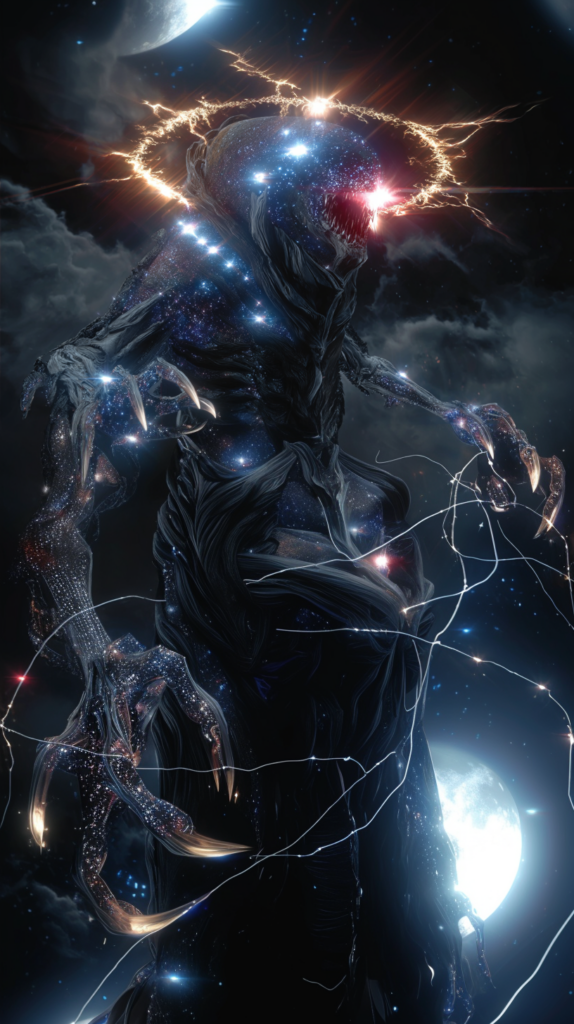
The Neo-Phau’drexh lifted its head toward the shattered sky, and the cracks overhead converged more sharply, as if the ceiling were acknowledging a superior presence. The creature’s chest glowed with a deep starfield, a galaxy-like interior pulsing with cold radiance. The claws flexed, not hurried, not aggressive in the ordinary sense, but with the calm inevitablisma of something that does not need to rush because it has already outlasted the concept of resistance.
Then it demonstrated its authority in the simplest possible way.
It screamed silence.
There was no audible roar, no movie shockwave that could be measured by ears. Instead, the scream arrived as pressure in the bones, as a sudden refusal in the air, as the sensation that the manifest expanse itself had been told to stop negotiating. People clutched their heads and dropped, not because sound hurt them, but because the absence of sound behaved like a weapon—an ontological cancellation that made nervous systems misfire and made breath feel like an unaffordable privilege.
The sky’s fractures flared, and for a brief span the world saw beyond the broken ceiling: not a comforting starfield, but a deeper vista of beyond-dimensional reality where the usual rules of distance and sequence had been outmoded by something more absolute. The Neo-Phau’drexh’s silent scream traveled through that vista as though it were not traveling at all, as though it were simply present everywhere the scream chose to be present, beyond the necessity of presence, change, and render.
And far beyond Lagos, far beyond Earth’s immediate night, far beyond the local reachless prison that humans still called “the world,” the Alcyoneus Galaxy—vast, ancient, a titanic arrangement of light and structure—met the scream.
It did not explode. It did not burn. It did not dramatically collapse.
It was unwritten.
The silent scream struck not only the visible arrangement of that galaxy but the very permission for its quantum configurations to be configurations. Every possible arrangement of its particles, every possible ordering of its fields, every possible way it could have been described, observed, inferred, or remembered—across the grand meta-narrative of the manifest expanse and across every Teraverse layered in maximal wholeness beyond tiering—was simultaneously denied.
The galaxy vanished in the only way that matters: it stopped being a valid statement.
In the same breathless instant, the scream reached through Teraverse after Teraverse, not as travel but as verdict, and erased every corresponding Alcyoneus—every version, every mirror, every projection, every hypothetical, every impossible be-ness of it—until “Alcyoneus” was no longer an object in the cosmos but a hole in the vocabulary of existence. It wasn’t destruction in the ordinary sense. It was subtraction so clean that even absence looked embarrassed to be seen.
On Earth, people did not know the name of what had just been unwritten. They did not need to. They felt it as a sudden dimming in the sky’s remaining lights, as though the cosmos itself had lost a candle. They felt it as a deepening of darkness that wasn’t merely nightfall but a metaphilosophical confirmation that the world had entered a phase where scale itself could be nullified with one act of silent authority.
The Mirror of Chaos responded by blooming wider, reflective surfaces appearing in places that had no right to reflect: in the air, in the shadow between buildings, in the glaze of tears on human faces. Everywhere the mirror appeared, it offered the same encyclopedia, now updated with a new entry: a demonstration that not only cities and nations could be thrown into mayhem, but galaxies could be unwritten without effort.
Hope did not merely die in that moment. Hope became incoherent. It became a word that no longer matched the environment. It became outmoded, like a language spoken by a species that had not yet learned it was obsolete.
The Neo-Phau’drexh lowered its head slightly, as if listening to the planet’s collective panic the way a choir listens to its own echo. Its claws flexed again, slow and deliberate. The bishop’s human posture was gone; what remained was a hooded cosmological predator draped in darkness, starfire pulsing beneath its mantle, eyes burning like interrogation, mouth carved into a grin that did not require joy.
And beneath the shattered sky, in the largest city that could still gather bodies into a crowd, the Mirror of Chaos shimmered like a black scripture. The humans around it screamed, laughed, prayed, cursed, fought, and performed cruelty as if cruelty were the only ritual left that still made sense.
No transmissions carried their cries. No satellites recorded their collapse. No distant voice promised rescue. The planet was sealed inside its own silence, and the silence was not empty.
It was singing.