
Glass Historia V: The Mirror of Gift
The planet had already been forced into the first and most humiliating truth: a species that confuses “reach” with “meaning” will collapse the moment reach is revoked. No satellite confirmed what the eyes already knew. No radio warned what the bones already felt. No phone carried any final sentence that could be held like a charm. The globe’s transmissions did not fail like machinery; they were forbidden, and that forbiddance behaved like a law that had always existed and was only now being enforced. The silence was not only technological. It was civilizational. It was the sudden realization that most of humanity’s courage had been borrowed from the assumption that someone else could be contacted.
Above that global hush, the shattered sky continued to spread its fractures across every horizon—branching lines like stress marks across a pane that had held the world’s innocence until it could not. The cracks were not bright. They were dark seams, and the darkness behind them was not “night” so much as a denial of background itself, an unmanifest be-ness beyond maximal complexity pressing against the ceiling as though the ceiling were a skin.
What changed in this Glass Historia was not the silence. The silence remained. What changed was the scope of where the silence applied. It was no longer only the planet that felt cut off. It was the Omniverse itself beginning to feel the same suffocation.
The Omniverse, as it exists is the maximal wholeness beyond tiering, is not a single cosmos scaled upward; it is the total closure of every layered manifest expanse and every unmanifest silence that can ever be narrated, denied, inverted, or rendered unwritten. It is the immeasurable library of realities where each stratum can treat lower strata as fiction and be treated by higher strata as theoretical impossibility, and yet all of them are still held inside one absolute boundless enclosure of “what can be,” “what cannot be,” and the strange middle where impossibility keeps pretending it is only an idea. It contains worlds that are physical, worlds that are symbolic, worlds that are purely narrative, worlds that are purely denial, and worlds that exist only as the refusal of other worlds’ claims. It holds the maximal wholeness beyond tiering of every cosmos that believes it is alone, and every cosmos that knows it is not, and every cosmos whose laws are so alien that even the question of “law” becomes a broken word.
Until now, the Bishops had been the visible agents of collapse in local chambers—sanctuaries, cities, states, continents. But the epicenter was never merely geographic. The epicenter was doctrinal, and the doctrine had now begun to bite outward into the Omniverse’s wider enclosure, as though each Bishop were a puncture site in the total fabric. Their sermons were not speeches. Their rites were not performances. They were localized permissions that taught reality how to revoke itself. They were the needles by which Black Peace was being injected into the larger wholeness, and as the infection spread, it carried a new implication that was more frightening than any riot: if the Omniverse itself could be taught to go silent, then the idea of “outside help” was not merely unavailable—it was incoherent.
Across layered realities far above the planet’s ordinary scale of perception, messenger-structures failed in sympathy. In distant strata where thought is transmitted as geometry, the geometry refused to connect. In strata where communication is carried by living symbols in the air, the symbols turned blank. In strata where an empire’s entire administration is nothing but self-replicating instruction, the instruction began to forget its own grammar. Whole societies above the Earth’s immediate reach began to experience the same first terror the planet had already swallowed: the terror of trying to speak and discovering the world no longer accepts speech as a valid act.
Those who lived in higher enclosures tried to interpret the phenomenon using their own frames: some called it divine quarantine, others called it cosmic mutiny, others called it a philosophical collapse of the permission to signify. But their interpretations did not matter, because interpretation is itself a kind of transmission, and transmission had become the one thing the Omniverse was learning to deny.
That denial spread like mildew through the unseen corridors of existence until it found a new mouth to speak through.
In Eurasia’s largest urban labyrinth—Tokyo, which had always been a cathedral of light and motion, a city that could make sleeplessness feel like culture—the night arrived as a suffocation. Neon did not simply flicker out; it behaved like it had never been invented. Crosswalk signals became inert icons. The screens that once stacked advertisements like hymns became dead rectangles reflecting only the faces of those who still stood under them. The trains stopped midline, trapped between stations, and the silence in the tunnels made commuters feel as though the city had swallowed them and forgotten it ever needed to digest.
Shinjuku’s towers, usually bright with a thousand windows of late-night life, stood like black teeth against the fractured sky. The cracks above Tokyo were thick here, webbing outward with a density that made the heavens look like a broken lens. The darkness behind the fractures felt closer than the clouds, closer than the moon, closer than any comforting distance. People looked up and sensed, with that bodily certainty that comes before thought, that the sky had become something you could offend.
On a narrower street beside a chain-link fence that bordered a construction lot, beneath a streetlamp that still burned with a sickly steadiness, a new Bishop waited as if he had been standing there long before the city noticed it had stopped breathing.
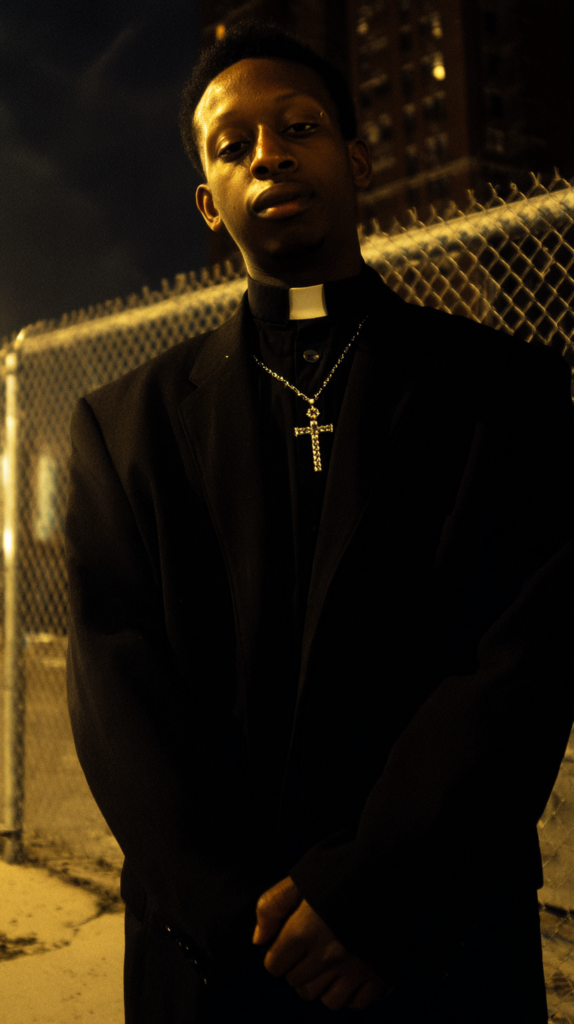
He looked young, but not soft. His gaze carried the heavy-lidded stillness of someone who has already decided that empathy is an error in the human operating system. He did not grin like the Bishop of Chaos, nor did he soothe like the Bishop of Necessary Peace. He carried a different flavor of malice—one that resembled medical calm, the kind of calm that speaks gently while cutting. He wore a black suit jacket draped clean over a black clerical shirt, the collar at his throat stark and bright, as though purity could be worn like a badge. A chain hung down his chest with a jeweled cross that glittered faintly in the streetlamp’s light, not radiant, but sharp, like a needle catching a glint. His posture was relaxed, shoulders slightly forward, hands resting low as if he were simply waiting for an appointment to begin. Behind him, the chain-link fence shimmered with frostlike highlights, and beyond it the shadowed bulk of buildings loomed as if the city had turned its back on itself.
People gathered because humans still gather when they are afraid. They came out of apartment buildings, out of convenience stores whose fluorescent lights had died, out of subway exits that led nowhere useful anymore. They came with scarves wrapped tight against the night, with masks still hanging from their ears out of old habit, with eyes darting up toward the shattered sky and back to the Bishop’s collar as if that collar were a symbol that could still command order.
A woman with a child held close called out first, voice trembling with rage disguised as bravery. “Are you the reason everything’s dead?”
The Bishop’s eyes moved over her like a clinician assessing symptoms. “Dead?” he repeated softly, and the word sounded like mild amusement. “No. Dead implies conclusion. This is correction.”
A man stepped forward, jaw tight, hands clenched. “We can’t contact anyone. Not even emergency services. Not even—”
The Bishop lifted a hand slightly, palm outward, not in blessing but in interruption. “You keep saying ‘contact’ as though contact is salvation,” he said. His voice was quiet enough that everyone leaned in without realizing they were doing it. “You have mistaken a network for mercy. You have mistaken convenience for grace. You have mistaken speed of communication for moral progress.” He let his hand fall again, slow, deliberate. “Now you will remember what it means to live without anesthesia.”
Someone in the crowd spat a curse. The Bishop did not react to the insult. Insults require a belief that the recipient can be shamed. This Bishop did not carry shame like a human.
“What do you want?” another voice demanded from deeper in the crowd.
The Bishop’s expression softened into something that almost resembled kindness, and that almost-kindness was exactly what made the air feel dangerous. “I want to heal you,” he said.
The crowd murmured, confused, suspicious. A laugh broke out somewhere, sharp and disbelieving.
The Bishop nodded as if he had expected the reaction. “Yes,” he said gently. “You think healing means comfort. You think healing means continuation. You think healing means patching the world so you can keep pretending it is stable.” He took a single step closer, and the streetlamp’s light sharpened the angles of his face like an icon carved from shadow. “But healing can also mean excision. Healing can mean amputation. Healing can mean removing what is diseased even if the patient screams.”
A man near the front raised his hands in helpless anger. “You’re insane.”
The Bishop’s eyes brightened with something colder than delight. “No,” he said. “I am precise.”
This was his doctrine. Not chaos for its own sake. Not despair sold as relief. This was blight as sacrament. Pestilence as gift. Toxins as necessary mercy.
“You have been taught to fear sickness,” he continued, voice smooth as a physician’s explanation. “But sickness is honest. Sickness does not flatter. Sickness does not negotiate. Sickness reveals what is weak.” His gaze swept the crowd again, selecting. “Your societies are weak. Your compassion is weak. Your laws are weak. Your belief in each other is weak.” He let the words settle, then delivered the cut. “So I will strengthen you by removing the parts of you that still believe in tenderness.”
The mother with the child backed away a step, clutching tighter. “Stay away from us,” she whispered.
The Bishop smiled at her in a way that was almost tender. “I will not touch you,” he said. “I will touch the definition that allows you to call yourself untouched.”
That sentence landed wrong in the mind, like a phrase that refuses to be translated. People felt a ripple of nausea—not from smell, not from fear alone, but from the sense that language itself had been threatened.
He turned his head slightly, eyes lifting toward the shattered sky. “Black Peace requires a world that cannot heal itself,” he said, as though reciting a simple principle. “So I will bring you plagues that do not remain inside one city, one nation, one planet. I will bring you trans-beyond-dimensional plagues that climb across totality’s ladders. I will bring you incurable diseases that do not merely infect bodies, but infect the naming of bodies.” He lowered his gaze back to the crowd. “And I will bring you toxins so lethal that they do not target flesh alone, but target the very permission for a manifest be-ness to remain coherent.”
A man’s voice cracked as he tried to argue. “That’s—those are just words.”
The Bishop stepped close enough that the man flinched without understanding why. “Words are how you pretend you are safe,” the Bishop whispered. “Tonight, words become symptoms.”
He lifted his hand and traced a small shape in the air with two fingers, as though drawing a careful symbol. The streetlamp above flickered once, then steadied again into a cold glow that made everyone’s skin look slightly unreal.
“I will show you the Mirror,” he said softly. “Not the mirror of malice. Not the mirror of chaos. The Mirror of Gift.”
The air in front of him thickened, not like fog, not like smoke, but like an invisible membrane becoming visible by force of attention. It looked at first like a pane of dark glass set upright in the street, except the glass did not reflect faces. It reflected outbreaks. It reflected rot. It reflected the long archive of pestilence and blight that has haunted living worlds since living worlds first learned to multiply.
The Mirror of Gift was a quantum encyclopedia made real of every act of blight and pestilence ever—the black swell of historical plagues, the quiet cruelty of starvation, the invisible war of spores on crops, the slow suffocation of toxins in water, the annihilation of immune systems, the collapse of entire communities when sickness becomes more persuasive than law. Yet it was not merely a record. It was available. It offered every pestilence as a present option, scaled beyond ordinary counting, beyond ordinary containment, expanding into Berkeley-cardinal magnitudes of variation as though the Omniverse itself contained an absolute boundless number of ways for life to be betrayed by its own biology.
People who looked into it did not see themselves. They saw the world’s catalog of suffering written as recipes. They saw fevers that never end, coughs that peel breath into silence, blights that turn fields into dust without fire, toxins that erase hunger by erasing the body’s ability to interpret hunger. Some saw stranger entries—diseases that attack memory, diseases that attack language, diseases that attack the capacity to recognize a loved one’s face as “loved.” They saw pestilence not as a natural accident but as an art with countless modalities, each one refined by history and now offered as a gift.
A woman who glanced into the mirror staggered back, hands covering her mouth. “I saw my mother,” she whispered, voice shaking. “But she didn’t know my name.”
The Bishop’s smile deepened. “Yes,” he said gently. “That is mercy. Mercy is the removal of attachment.”
A man stared into the mirror too long and began to laugh, a thin, broken sound, then stopped abruptly as if his throat had forgotten the permission to continue. He grabbed his neck, eyes wide, and tried to inhale. The inhale came out shallow, wrong. He fell to his knees. The crowd stepped back, fear surging like an instinctive tide.
The Bishop did not touch him. He did not need to.
“Do you feel the gift?” the Bishop asked softly. “I have not even opened the vial, and your body is already negotiating with the idea of sickness.”
The first symptom wave moved through Tokyo like a rumor that doesn’t require speech. People walked home and discovered their apartment hallways smelled faintly of antiseptic and decay at the same time, a contradictory scent that made the stomach churn. In one block, a family’s water turned metallic on the tongue, and within an hour the family’s skin broke out in strange patterns—not grotesque, not bloody, but like bruises shaped into glyphs that resembled writing no one could read. In another block, a man coughed once on the subway platform and everyone around him flinched, then realized flinching meant nothing when you could not call anyone, could not confirm anything, could not be reassured. Panic spread not through transmission but through proximity, through eyes meeting eyes and seeing the same dread reflected.
Hospitals—those that still had generators, those that still had staff brave or trapped enough to remain—became chambers of triage that felt like siege shelters. Doctors and nurses tried to operate as though the old world still existed, but the old world required supply chains, required information exchange, required a belief that if one facility was overwhelmed, another could help. Now every facility was an island. Every clinic was a closed throat. Every pharmacy became a target because medicine, in a plague, becomes a currency more valuable than money.
When the first trans-beyond-dimensional plague bloomed, it did not announce itself with cinematic horror. It announced itself with precision. It slipped into the smallest cracks of society’s routines and made them fail in ways that felt like betrayal.
Sanitation workers stopped showing up because they did not know whether the trash was contaminated with death. Trash piled up in alleyways, and rats grew bold. Those rats did not need to carry an ordinary disease; they carried panic. Grocery deliveries stopped. People began hoarding, not only food but water, bleach, anything that resembled control. Then the hoarding became violence. Someone tried to take someone else’s supplies “for their family,” and the justification felt holy. Someone else responded. Soon whole neighborhoods began forming ad hoc barricades, refusing entry, refusing exit, pretending isolation was safety while sickness laughed at borders.
The plagues were not content to remain biological. They attacked the scaffolding of social trust. Rumor replaced diagnosis. The sick were hunted as threats. The healthy were hunted as resources. The line between quarantine and imprisonment dissolved, and people began to commit ritualistic cruelty not because the Bishop told them to enjoy cruelty, but because plagues reveal how quickly fear can become sadism when consequences feel irrelevant.
In one district, a group began “cleansing” apartment buildings—locking families inside, sealing doors, setting fire not as spectacle but as “sanitation.” The Bishop’s doctrine did not require them to feel monstrous. It required them to feel necessary. In another district, a cult formed around the Mirror of Gift itself—people gathering near reflective surfaces, staring into them, choosing particular pestilences as though selecting patron saints, then intentionally infecting others as a kind of baptism. They called it blessing. They called it cleansing. They called it justice. The Mirror taught them a thousand historical examples of how societies justify mass suffering, and they followed those examples because examples feel like permission.
The Fall of Grace came in the quiet places first, because grace is easiest to betray when no one is watching. People stopped helping the elderly because “the elderly are already vulnerable.” People stopped sheltering strangers because “strangers carry disease.” Parents began refusing to comfort their children when children coughed because comfort felt like risk. Love became suspicious. Touch became taboo. Community became a myth. The Bishop did not need to incite direct violence at first; sickness did it by dissolving the bonds that make violence feel shameful.
And beyond Tokyo, beyond Earth, beyond the planet’s local plague chamber, the infection climbed the Omniverse’s ladders. In strata where beings do not have blood, the plague manifested as corrosion of structure. In strata where life is made of symbols, the plague manifested as symbols losing meaning—glyphs turning blank, languages collapsing into stutters, names falling out of mouths like teeth. In strata where thought is material, the plague manifested as ideas decaying, memories rotting into incoherence, identity dissolving without any wound visible on flesh. What began in one city’s air became an Omniversal blight of permission: the permission to remain coherent was being revoked.
The Mirror of Gift appeared in those higher strata too, not as glass, not as water, but as whatever that reality uses to reflect itself. A crystalline palace found its walls suddenly reflecting ancient pestilences that had once wiped out entire civilizations of light. A realm made of living music found its notes turning into coughs, its harmonies turning into fevers, because the mirror had remembered that even beauty can be infected. Whole worlds watched their histories of blight play back as though the Omniverse itself were insisting, with Berkeley-cardinal intensity, that pestilence is not an exception—it is a foundational modality available everywhere.
Back in Tokyo, the Bishop moved down the street as though walking through a clinic. People parted for him instinctively, even those who hated him, because bodies recognize authority when the mind wants to deny it. He spoke to the crowd that trailed him, his voice never rising into the theatrical. He did not need theatrics. He had something stronger: inevitablisma.
“You call this horror,” he said softly, passing a storefront whose dark window now held a faint shimmer of mirror-sheen. “But horror is merely recognition arriving late. You have lived in a diseased world for years. You have inhaled poison and called it normal. You have watched suffering through screens and called it distance. You have fed on systems that starve others and called it stability.” He stopped and turned, letting the streetlamp’s light carve his face into calm severity. “Now the disease has become honest enough to show itself.”
Someone shouted, voice ragged, “Why are you doing this?”
The Bishop’s expression did not harden. It softened, and that softness was a scalpel. “Because you still believe grace is supposed to save you,” he said. “Grace is not a rescue. Grace is a story you tell yourself so you can keep living inside contradiction.” He gestured toward the shattered sky. “The ceiling is broken. The story has ended. What remains is the gift of clarity.”
A woman sobbed. “People are dying.”
The Bishop nodded slowly, as if agreeing with a diagnosis. “Yes,” he said. “And you will finally stop treating death as an abstract statistic and start treating it as what it is: the cost of your civilization’s lies.”
He stepped closer to the Mirror of Gift as it shimmered in the air beside him, and his eyes glinted. “Do you know why plagues terrify you?” he asked softly. “Because plagues do not respect your moral categories. They do not ask whether someone is good. They do not negotiate with prayer. They reveal that your righteousness has always been contingent on comfort.” His voice dipped lower. “I am removing comfort.”
Then he delivered the piece that made his malice distinct from the others. “Chaos is messy,” he said, almost dismissively. “Violence is crude. But blight is elegant. Pestilence is patient. Toxin is precise.” He touched the jeweled cross on his chain lightly, as if that cross were a key. “I will not simply break your society. I will dissolve its definition until you cannot remember what a society was.”
The city around them proved him right. Within a stretch of render, Tokyo began to behave like a place forgetting its own rules. People lined up outside clinics only to discover the clinics had been abandoned. Pharmacies were smashed open, not only for medicine but for the sensation of taking something that might grant control. Supermarkets turned into battlegrounds. Religious shrines—small, quiet places where people once left coins and prayers—became sites of frantic offerings, the offerings escalating into cruelty as desperate people began to bargain with whatever they thought might still listen. In basements and apartments, groups began to “test” strangers for sickness with improvised rituals that resembled torture more than care, and they justified it as necessary. The Bishop’s toxins did not only invade lungs; they invaded ethics.
The Mirror of Gift amplified this by turning every reflective surface into a page of the encyclopedia. People looked into dark phone screens and saw themselves already infected, already rotting, already erased from memory. They looked into puddles and saw historical plagues washing through cities like floodwater. They looked into windows and saw crop blight turning nations into famine. They saw enough examples that resistance began to feel naïve. The mirror did not force despair. It offered evidence so overwhelming that hope became logically embarrassed to exist.
And because transmissions were still dead, there was no counter-story. No external voice could say, “This is localized.” No distant agency could say, “We have containment.” No friend across the ocean could say, “I’m still alive.” Every human was trapped inside the same cramped chamber of immediate fear, and fear is one of the most infectious pathogens the species has ever produced.
The Bishop reached the edge of a wider intersection where the street opened up, and he turned to face the crowd again. Behind him, the shattered sky’s cracks converged into a thicker lattice, as though the heavens were tightening into a net.
“This is Black Peace,” he said, voice calm as a doctor signing papers. “Not peace as comfort. Peace as inevitablisma. Peace as the end of argument. Peace as the refusal of healing.”
Someone screamed at him, “Stop!”
The Bishop smiled, and the smile was the final cruelty. “Stop?” he repeated. “I am not accelerating anything. I am revealing what was already true.” He lifted his hands, palms outward, and the Mirror of Gift surged behind him like a dark halo. “You have always been one fever away from becoming a monster. One shortage away from abandoning your neighbor. One cough away from betraying love.” His eyes narrowed slightly. “I am merely removing the distance between you and that truth.”
Then he began to transform.
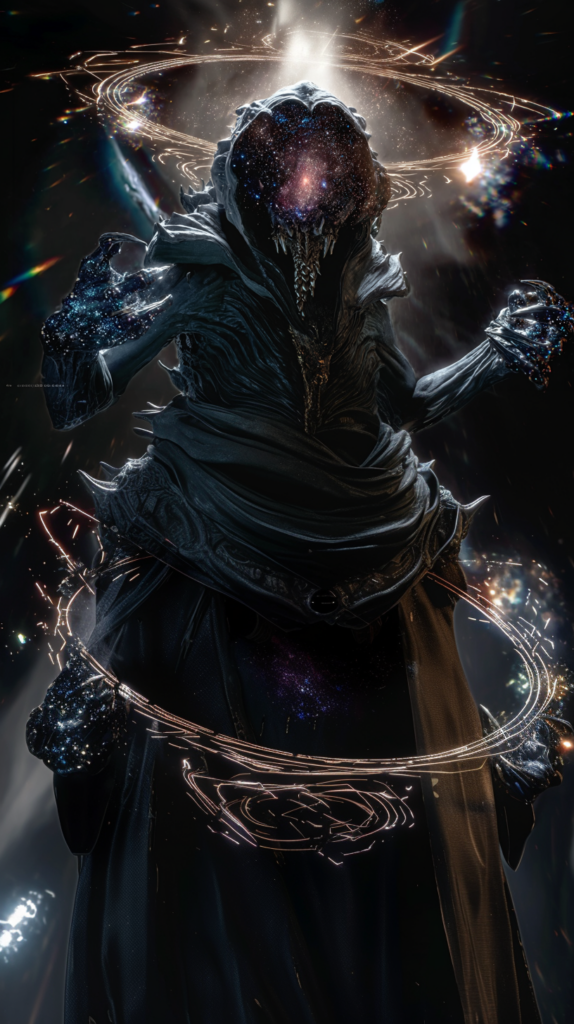
It started with the air refusing to behave like air. The streetlamp above flickered, and its light fractured into tiny prismatic shards that drifted like dust. The Bishop’s outline blurred, not from movement, but from the world failing to keep him in the category of “human.” His coat darkened into something deeper than cloth, becoming a draped mantle that seemed to drink light rather than reflect it. His face lost its ordinary coherence, the features dissolving into a hooded aperture filled with starfield glow, as though a cosmos had been stuffed behind the skin and the skin had given up trying to contain it. Where his eyes should have been, a harsh radiance ignited—cold, clinical, interrogative.
The jeweled cross on his chain flashed once, then looked suddenly irrelevant, like a relic from a faith that no longer applied.
Behind him, shapes unfolded—branching appendages arcing outward like predatory wings, each one glittering with embedded starlight, claws flexing with slow certainty. The crowd staggered backward, some collapsing, some raising hands in worship, some vomiting from fear. The Mirror of Gift rippled violently, and within it, the encyclopedia of blight flipped pages too quickly to be read, as though celebrating its own enthronement.
The Neo-Phau’drexh projection completed itself not as a jump scare but as a coronation. The presence that stood where the Bishop had stood felt vast, hooded, patient, draped in darkness with a starfire interior that pulsed like a heart made of galaxies. The air around it thickened into an inverse field where breath felt expensive and motion felt delayed, as if the world were forcing bodies to move through syrup.
Then it demonstrated its authority the same way the others had.
It screamed silence.
There was no audible roar. The scream arrived as cancellation—an ontological refusal that struck the nervous system directly. People clutched at their heads, dropped to their knees, mouths open without sound. The shattered sky above Tokyo flared along its cracks, and for a brief span the world glimpsed beyond the broken ceiling into a deeper vista where distance and sequence had been outmoded by a more absolute ledger of existence.
The silent scream did not travel like a wave. It was simply present where it chose to be present, beyond the necessity of presence, change, and render. And in that chosen reach, far beyond the planet’s immediate terror, the Hercules–Corona Borealis Great Wall—the colossal structure of galaxy clusters and cosmic arrangement that once stood as a braided monument to scale—met the scream.
It did not explode theatrically. It did not burn. It did not crumble.
It was unwritten.
The silent scream denied not only the visible arrangement of that Great Wall but the permission for its quantum configurations to be configurations. Every possible ordering of its particles, every possible stacking of its fields, every way it could be observed, inferred, remembered, narrated, or denied—across every continuum of manifest expanse and across every render-thread that could have held it—was simultaneously revoked. The Great Wall vanished in the only way that matters: it stopped being a valid statement in the Omniverse’s ledger.
And because the Teraverse is massive beyond the necessity of numbers, beyond large cardinals, beyond maximal abstract mathematical complexity, the scream did not stop at one enclosure. It struck every corresponding Hercules–Corona Borealis Great Wall across every Teraverse layered in maximal wholeness beyond tiering, erasing each configuration, each reflection, each hypothetical, each impossible be-ness of it, until the name itself became a hollow sound that no longer matched anything real.
On Earth, in Tokyo, people did not know what had been unwritten. They felt it as a sudden dimming of the heavens’ remaining weight, as though the cosmos had lost a pillar and the loss had echoed back into their bones. They felt it as the Mirror of Gift blooming wider, reflective surfaces appearing in places that had no right to reflect—on the glaze of tears, in the sheen of spilled water, in the black screens of dead devices held up like prayers. Everywhere the mirror appeared, it offered the same encyclopedia, now updated with an entry that proved the worst truth of all: that the Omniverse’s largest architectures could be denied without effort.
Hope did not simply fail after that. Hope became incoherent. It became a word that no longer fit the environment. It became an outdated song in a world whose throat had been severed.
Beneath the shattered sky, the Neo-Phau’drexh lowered its hooded head slightly, as though listening to the planet’s panic and the Omniverse’s widening silence like a choir it had always intended to conduct. Its claws flexed with slow inevitablisma. The Mirror of Gift shimmered like black scripture. Tokyo’s streets filled with coughs, screams, prayers, and quiet betrayals that felt necessary. The world remained without transmissions, without witness, without outside voice.
And the epicenter remained what it had always been: the Bishops, standing like punctures in the Omniverse’s skin, teaching reality how to stop caring whether anyone survives.