
Penultimate Truth II — The Shadows They Cut Away
Before Adelaide understood that it had been selected, the pressure had already begun.
It began in the places that could not easily defend themselves against contradiction. In reflections. In peripheral vision. In the private confidence of walls. A woman in North Adelaide looked into her bathroom mirror and saw herself blink half a second too late. A tram window in Glenelg briefly reflected an empty city instead of the passengers seated inside it. In the western industrial districts, security footage showed forklifts moving through a warehouse that no longer existed in the present arrangement of the building. Dogs started growling at corners where nothing stood. Children woke from sleep and asked their parents why the sky sounded far away.
The cause of it stood beyond the right of human naming.
Those who would later try to catalog the event, those frightened scholars and occult archivists who still believed terminology could fence horror into manageable intellectual parcels, would settle on a temporary designation: Fractiflux. The word was useful only in the way a chalk mark on a coffin lid was useful. It did not describe them. It did not contain them. It merely gave panicked minds a shape to point at while the world around them began to shear apart.
Names, terms, and essence did not apply to those prisoners of the void.
They stood outside the ordinary architecture of becoming. The grand principles by which lesser realities organized themselves—nothingness, possibility, totality, the whole debate of whether anything could be or fail to be at all—lay beneath them like the discarded scaffolding of an abandoned project. They remained in the silence prior to such principles and in the silence after them, detached from both, untouched by the need to participate in either. To say they existed was already to lower them into a grammar that did not deserve them. To say they did not exist was equally crude. They were not paradoxes. They were not absences. They were prisoners whose captivity had not made them small, only patient.
In their partial projections into this world, each one stood nine feet tall and carried a localized mass of nine hundred thousand tons, a burden that local matter could not truly support and so was forced to negotiate around. Each one existed outside the normal eleven dimensions and extended only a sliver of itself into physical locality, while its true modality remained unbound, effectively without measure, vast beyond any sane geometry. In every cell of each projected body there were eruptions equivalent to real gamma ray bursts nested in the pulsars of supermassive black holes, every cellular convulsion producing at least twenty-four KiloFoe. Their bodies generated a minimum condensed expression of 9.825 × 10^92 joules. Around them spread a temporal distortion field so dense and so sovereign that render itself slowed near them; victims and witnesses alike found movement lagging into paralysis, thought thickening, panic suspended long enough to become its own torture.
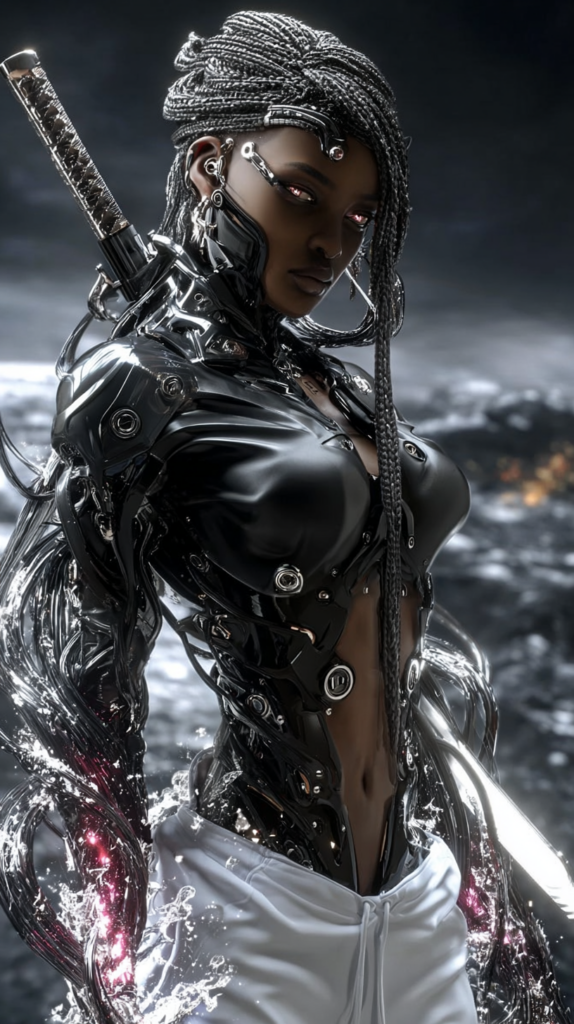
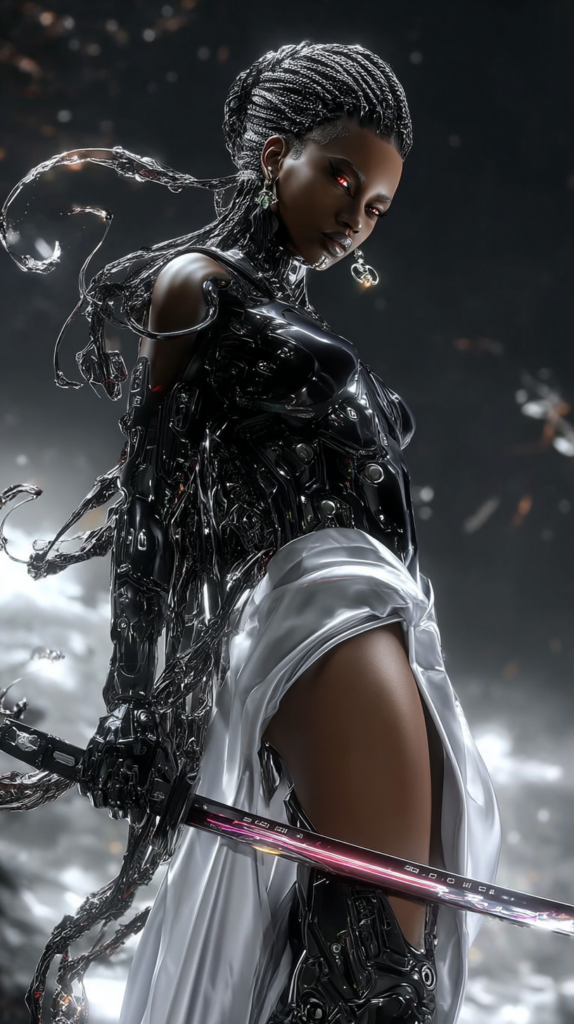
And yet those terrifying metrics were not the deepest injury they inflicted.
Their true offense was ontological. They did not merely arrive in reality. They loosened the adhesion between reality and illusion and let both begin to slide out of alignment.
Two of them now stood upon Australia.
One occupied a ley line running beneath stone, fault memory, and buried colonial blood beneath the red interior, where ancient land and newer violence still hated one another enough to sing under the soil. The other had projected near the southern chain that fed through Adelaide and farther across waters and old fractures, in a line forgotten by civic planning but not by the deeper geometry of the world. They did not stand randomly. They had calculations. They had discipline. They had been erasing too long to be careless.
This reality, the one inhabited by Adelaide’s breathing streets and warm kitchens and secret wars, functioned as a singularity. Every other quantum configuration branching from it was not an independent equal but a reflection or shadow cast by this source-instance, a consequence-image, a dependent ghost. By standing at the source and cutting with enough precision, the Fractiflux could strike the shadows without immediately damaging the object that cast them. One could erase the reflected steps without burning the stairwell itself. That was the method. That was the cruelty.
They were searching for ♠The Art Gallery♠.
Not a museum in the human sense, not a civic building with curated walls and wine at the opening reception, but a hidden superordinate locus beyond reflected realities, a chamber of holding, arrangement, and impossible custody. ♠The Art Gallery♠ existed behind too many wrong turns of creation for direct assault to work. ♠The Art Gallery♠ Guards watched for catastrophic disclosures. ♠The Art Gallery♠ itself carried its own obscure defensive awareness. If the prisoners simply shattered this source-reality, they would expose themselves to both. So they hid instead.
The ley lines mattered because specific geographies blurred them from the attention of the Guards. While rooted in those singular nodal lines, the Fractiflux could remain partially concealed, their erasures masked by the local noise of a world already full of war, delusion, grief, and metaphysical injury. They could stand in the hidden place and cut away every other quantum configuration that did not produce the path they wanted. They were clearing the forest to find the cabin. Removing every false stair until only the true route to ♠The Art Gallery♠ remained.
This reality was breaking under the process. They knew it. They accepted it. By their calculations, the source-instance would remain functional long enough for the search to finish. By the time the singularity fully collapsed, ♠The Art Gallery♠ should already have been found.
So they cut.
In the inward red of the continent, one Fractiflux raised an arm whose chrome-black structure never quite held still, its surfaces part machine, part anatomical blasphemy, part liquid hardening into decisions that should not exist. The blade extending from that arm was not forged metal so much as negation given edge. When it moved, distance along with sequence split open around it.
The strike did not land on Australia.
It landed on the reflected Australías.
Whole branching worlds where a different storm had reached Brisbane first, where Canberra had burned before Perth, where Adelaide had never been settled, where oceans cut differently at the continental skin, where bloodlines rearranged history by millimeters and therefore by civilizations—all of those shadow-configurations vanished under that one terrible incision. In those erased reflections, cities died without noise because noise had already been retracted. Billions of possible lives were not ended so much as removed from the permission to have ever formed.
The source-instance remained.
For now.
In South Australia, people only felt the consequence as a pressure headache, a sudden blood taste in the mouth, a school clock that skipped backward and then gave up, a skyline that appeared double and then single again.
The second Fractiflux did not strike immediately. It listened.
That was what terrified the few occult systems still sensitive enough to notice it. It was listening through the breaking of illusion. Every time reality and its reflections slipped against one another, every time a false street overlaid the true street, every time a person saw the wrong moon or the wrong death in the wrong window, that prisoner learned a little more about the remaining routes. A city that could no longer keep its surfaces honest was a city already giving away its secrets.
Across Australia, distortions multiplied. Highways seemed to continue into suburbs that had never been built. Satellite feeds showed weather systems rotating in reverse. In one hospital outside Melbourne, a patient flatlined in one reflected configuration while surviving in this one, and the operating room briefly heard both outcomes at once. On the Nullarbor, truckers reported a horizon bending inward as if the earth had been turned into glass and some larger hand was leaning over to inspect it. On the coasts, waves arrived with the wrong intervals, like water itself had lost confidence in which version of the shore it was meant to obey.

Adelaide received the damage more intimately.
The city had always been good at hiding rot beneath culture. The Fractiflux turned that talent against it. Old terraces showed their reflected fires in windows before the flames actually appeared. Cathedral stone whispered in obsolete liturgies. Graffiti peeled itself from concrete and hovered for seconds before falling as dust. Bar patrons stared at the same television and watched different broadcasts. In the East End, a woman crossed a street and for three heartbeats could see, superimposed over traffic, a version of that same street already abandoned and drowned in black glass silence.
Reality and illusion were not simply separating. They were accusing one another.
Morning came anyway, because local life still insisted on its rituals even while the foundations beneath those rituals were splitting.
In Excella Angelicus’s house, the warm normalcy of domestic light held longer than it should have.
The kitchen smelled of fruit, toasted grain, and coffee. White cabinetry reflected soft gold from the recessed lights. The stone columns in the open-plan living space caught the brightness of a clean Adelaide morning as if the previous night had been a bad story and not a real wound cut into the city. Yet even here, the sense of strain had begun to seep through. The windows held their view a fraction too carefully. The silence between appliance hums felt watched.
Dandemægus Auspiciouscrown was back on his feet.

It should not have been possible, not after the condition Excella had found him in, not after the neurological fracture she had brushed against inside his mind, not after the way he had been fading in and out of coherence in the lane. Yet there he was in the living room in a white tank and white sweatpants, body stretched out over the tile in a line of perfect control, lowering into push-ups with the measured intensity of someone who no longer trusted stillness. The movement was not vanity. It was calibration. He was testing whether his body still belonged to him.
Excella sat on the couch in an oversized SUGGS jersey, one leg tucked beneath her, watching him over the rim of her coffee mug with the kind of expression she would have denied if asked directly. Not soft exactly. Excella’s warmth was never that defenseless. It was attentive, amused, a little disbelieving, and more invested than she intended to be.
He dropped, rose, dropped again.
Not a tremor in the shoulders. Not a falter in the breath. The bruising from last night still mapped faintly across him, but his recovery had already moved beyond what ordinary biology should have tolerated. He was still fragmented in quieter ways, though. She could tell. Sometimes his gaze unfixed for a second too long. Sometimes he would stop in the middle of reaching for a glass and look at his own hand as though expecting it to remember something before he did. Once, earlier that morning, he had turned toward the window with a violence that did not belong to domestic morning at all, as if he had heard something calling from very far away.
“You know,” Excella said at last, “most men trying to impress a woman go with conversation first. This whole mysterious amnesiac athletic phenomenon thing is a very aggressive opening strategy.”
He pushed up, held there, then slowly stood. Sweat barely marked him. He turned toward her with that same guarded, half-distant look that always made it seem like part of him was listening to a place beyond the room.
“I wasn’t trying to impress you.”
“No?” She tipped her head. “That’s tragic. You’re accidentally excellent at it.”
He almost smiled. There they were again, the dimples, brief and dangerous in how quickly they changed the severity of his face. Excella hated how much that did for her.
She had been divorced for five years. No children. No boyfriend. No secret lover tucked discreetly into the neat margins of her life. Her marriage had ended not in operatic betrayal but in something colder and more insulting: gradual starvation. A man who had wanted her brightness until he realized brightness reached into locked drawers and would not politely leave his fear untouched. Since then she had lived well, worked hard, laughed hard, touched lives, broken stagnation wherever she found it, and refused to let loneliness make a performance out of itself. But this was different. She had never brought home a stranger from a lane. She had never felt herself pulled toward a man because she had seen, in the raw ruin of his mind, an impossible depth of suffering and still found at the center of it a clean intention. She had never watched someone who could barely maintain his own reality see a world-ending threat, assess it in an instant, and erase it without hesitation.
And yes, he was handsome. Obscenely so, especially when he was not trying.
She stood and moved to the kitchen before her thoughts could embarrass her.
“Sit,” she called over one shoulder. “Or don’t. Hover broodily if you must. But I’m making you food and I’m choosing to interpret that as medical authority.”
He followed more quietly than a larger man should have, then stopped near the island and watched her work.
Excella moved through the kitchen with the natural command of someone who liked taking care of things and hated making a ceremony out of it. She assembled a thick smoothie bowl dense with fruit, protein, seeds, banana, coconut, granola, honey, things chosen not merely to feed him but to coax a body back into a tolerable relationship with matter. The SUGGS jersey fell loose across her frame. Her hair, vivid even in daylight, slanted over one shoulder as she leaned over the counter. There was something almost indecently gentle about the scene, which only made the fractured unreality pressing against the windows feel worse.

Her phone buzzed.
She wiped her hand, picked it up, and frowned.
The message had come from an unknown number. No greeting, no identifying mark, just a clipped line and an attached image file she did not open immediately.
Baltimore incident confirmed. One of the Deerstalkers was pulled into the Void Beyond.
That made her still.
The Deerstalkers were infamous even across oceans. Not celebrities. Something worse. Their reputation traveled through occult security circles, black-market miracle networks, counterinsurgency archives, city-myth clusters, whispered institutional reports from people who had survived them badly. Predators of predators. The kind of operating force that turned urban legend into a tactical category. A Deerstalker being stopped at all was one kind of alarming. A Deerstalker being pulled into the Void Beyond was another order entirely.
Excella read the line twice.
“Problem?” Dandemægus asked.
She looked up. “Maybe. Maybe not. Depends whether someone’s lying, bragging, or catastrophically informed.”
He said nothing, so she continued, partly because she was thinking aloud now. “The Deerstalkers don’t just vanish. Not like that. Nothingness isn’t the sort of thing that should stop one of them unless something else was involved. Something with intention. Something more specific than raw absence.”
His expression shifted at the phrase Void Beyond. Not recognition exactly. More like pain looking up from under the floorboards.
Excella noticed and deliberately chose not to press. The compulsion to probe was strong. It always was with her. But she had touched his mind once and understood enough to know that some fractures did not widen gracefully.
She set the bowl in front of him. “Eat first. Apocalypse speculation second.”
He obeyed because hunger, unlike identity, was straightforward.
She leaned against the counter, arms folded, watching him take the first few bites with the polite caution of someone still uncertain how much the world deserved trust. There was a disarming normalcy to it. A strange man in her kitchen. Morning light. White stone counters. Her pulse catching every few seconds when he glanced up. The knowledge that outside, the city might already be beginning to come apart.
Her phone buzzed again.
This message was not from a number so much as from a masked route, routed through layers designed to erase origin. The text was in Sanskrit.
Excella read Sanskrit.
Not because it made her exotic, as one particularly stupid ex-colleague had once implied, but because language had always been part of the work and because there were old streams of command, contract, warning, and ritual that still traveled best through older tongues. She read quickly, eyes narrowing.
A threat is present. It must be extinguished. Location attached. Compensation transferred. Immediate action required.
A second alert appeared before she had fully processed the first. Deposit confirmed. The sum made her exhale once through her nose.
Dandemægus had stopped eating. “What is it?”
“Work,” she said.
His gaze stayed on her.
Now the problem arrived. Excella had not lied to him yet. She did not particularly want to start. But there was a version of herself he had not seen, because last night she had been in rescue mode, domestic mode, the spontaneous humanitarian nuisance version of Excella Angelicus. That was real. It simply was not the whole truth.
“I need to go out,” she said. “Something ugly just got pointed at my morning.”
“You were hired.”
She gave him a slanted smile. “I like that you say that as if it confirms I’m suspicious.”
“It confirms you’re more than you’ve said.”
Excella laughed softly. “So are you, Dandemægus Auspiciouscrown. I just have the social grace not to make it weird before breakfast.”
Then she stepped closer, braced one hand on the counter beside him, and let her voice lower into something warmer. “Stay here. Eat. Don’t open the psychic locks in the west hall closet. Don’t go wandering into reality fractures if one shows up in the garden. I’ll be back.”
Something in his face tightened. “You don’t know what’s out there.”
“No,” she said. “But I know what I’m like when someone sends me coordinates and money with no context, and it turns out they were right to be worried.”
The location took her toward the city’s harsher edge, where industrial yards, abandoned lots, and freight corridors made excellent places for things that did not want ordinary witnesses.
She changed before leaving.
The SUGGS jersey disappeared into the warmth of the house. In its place came the darker modality she reserved for contracts, interventions, and those sections of the world that preferred a blade to a conversation. The dress was black, close-cut, elegant, with pale patterns running across it like a formal garment designed by someone who understood both beauty and killing. High heels clicked sharp and controlled against pavement. In her right hand she carried a sword whose blade glowed with a coiling violet force, not decorative light but condensed rotational violence, as though an entire storm had been persuaded to narrow itself into an edge.
By the time she reached the target zone, the city was already trembling wrong.

Streetlights blinked at noon. A storefront sign showed three names in succession. A flock of birds hung still over an intersection for a fraction too long and then resumed motion all at once. Somewhere nearby, someone screamed. Somewhere else, glass collapsed in a cascade.
Then the Colossai appeared.
It tore into visibility like a siege engine remembering it did not need permission from local reality to manifest. The thing stood vast and armored, a towering biomechanical titan of black-white alloy, ember-lit fissures, and smooth war-faced brutality, its head a polished nightmare with a burning red ocular line. In its grasp was a weapon too large to belong to streets at all, an enormous cannon-blade hybrid layered in gold filigree, white plating, and blue internal radiance, the sort of instrument built not for combat between persons but for the revision of districts.
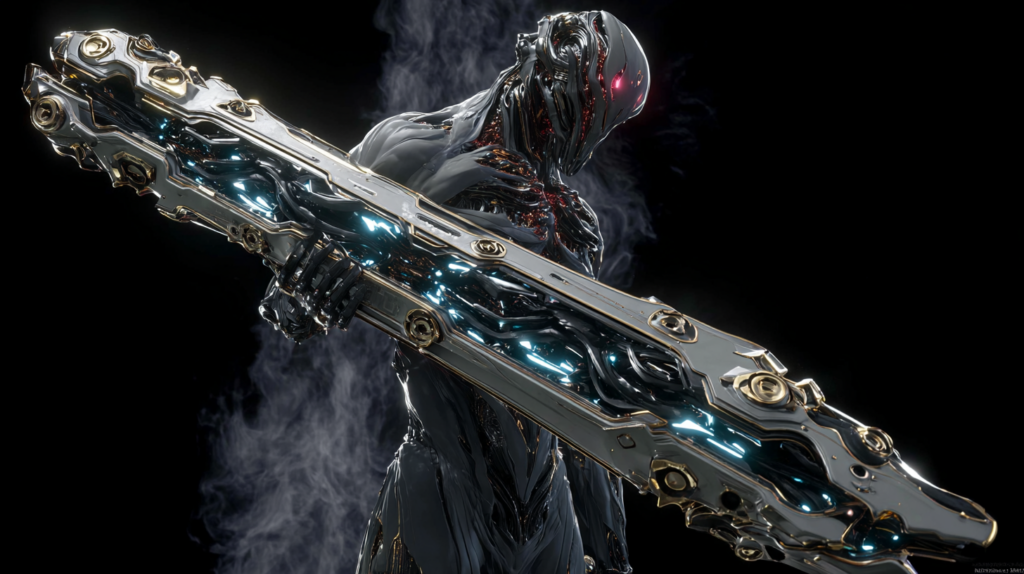
It moved once and a warehouse ceased to be meaningful architecture.
The first sweep of its weapon did not simply destroy the building. It unfolded the structure. Steel beams peeled apart like wet bark. Concrete columns burst into dust before impact fully registered. Forklifts, shipping crates, office glass, paper files, wiring, plaster, mold, rats, old stains in the floor, all of it became particulate weather and then less than weather. The blast kept going, carving through the yard beyond and turning two parked trucks into flaming skeletal outlines in under a second.
The second strike hit farther out.
A row of power poles detonated into showers of sparks and splintered utility lines. Pavement erupted in slabs. A fuel container went up hard enough to turn daylight briefly infernal. People ran, then slowed, then staggered as the local distortion field thickened. This was not a Fractiflux. It did not carry the same cosmological subtlety. But its presence still bent the local rules hard enough to make panic clumsy.
Excella stood in the middle of the road and watched it with flat irritation.
“So that’s what I was paid for,” she said.
The Colossai turned its burning gaze toward her. It saw a woman in heels holding a sword and made the mistake of interpreting elegance as fragility.
Its cannon opened.
Excella moved before the light fully formed.
No thunderous charge. No theatrical scream. She crossed the distance with insulting ease, a black stroke against breaking air, and the beam meant to flatten the block passed harmlessly through the place where she had been standing. By the time the Colossai corrected, she was already under the arc of its weapon. The violet blade in her hand spun once, shedding spirals of luminous force that gnawed through armor not by brute magnitude but by intimate disagreement. Metal parted.
The lower joint of the weapon-arm dropped off.
The Colossai reeled.
Excella landed lightly on shattered concrete, looked up at the gigantic machine-creature, and sighed. “You had one job, which was to intimidate me. And now look at you.”
It swung with its remaining arm.
She stepped inside the swing and cut upward.
The motion was almost lazy. That was the humiliating part. Her blade passed through the torso seam and the internal blue-white energies feeding the Colossai’s core lurched wildly. She turned at the waist, wrist adjusting with dancer precision, and severed the cervical housing before the thing had finished understanding the first wound. The titan’s head rotated free in a spray of sparks and red-lit vapor.
Still it did not fall. Its emergency systems tried to keep it upright, limb actuators spasming, core overloading into a final suicidal discharge.
Excella placed two fingers against the flat of her blade and whispered one brief phrase under her breath.
The violet force around the sword changed color at the center, darkening almost to black, then flared back outward as a tight ring. She slashed once across the Colossai’s chest. Not a large cut. A precise one. The ring entered the opened seam, found the core, and collapsed it inward. The giant went still immediately, then came apart from the inside with a controlled implosion that reduced its remaining bulk to molten fragments and collapsing panels rather than a catastrophic area blast.
Silence hit.
Not the ordinary kind.
Excella felt it before she heard it, if hearing was even the correct verb. The silence arrived from above and behind all things, a pressure older than the ruined industrial lot, older than the city, older than any human confidence that the sky would remain a ceiling instead of becoming an opening. She straightened slowly, the remains of the Colossai burning around her in broken segments of red and white.
The streetlights flickered on in broad day.
A reflection moved across the windows of a nearby building, except there was no corresponding object in the road to cast it.
Then the sky cracked.
Not metaphorically. Not in the poetic sense. The blue above Adelaide, already thinned by the deeper injuries moving through the source-instance, split along pale branching seams like glass under impossible pressure. Through those fractures there was no clean cosmos waiting, no ordinary starfield, no reassuring astronomical depth. There was layered darkness and wrong light and the sensation of multiple unreal distances pressing toward visibility at once. One seam bled a color the human eye refused to keep. Another showed what looked like a city hanging upside down in the wound. A third opened just wide enough for Excella to hear the same vast hush she had touched last night at the edge of Dandemægus’s broken mind.
Around her, reality and illusion separated another inch.
The road under her feet briefly became a different road, wet and abandoned and lined with faceless onlookers that vanished when she blinked. The burning fragments of the Colossai reflected themselves in midair where no glass hung. A billboard at the end of the street showed the correct advertisement, then a funeral announcement, then an empty white panel. Somewhere across the district, alarms began to scream in three different pitches that did not belong to the same city.
Excella looked up into the broken sky and, for the first time that day, did not reach for humor.
The darkness looking back through the fractures was not the darkness of simple disaster. It had intent. Method. It felt like something removing layers around a hidden place.
Her phone vibrated in her hand.
Unknown sender again.
No words this time. Only an image attachment that loaded slowly against the failing signal. When it finished, it showed a fragmentary occult map of Australia overlaid with two pulsing points and a dense web of fault-lines, ley-lines, and impossible geometries converging toward something absent at the center. Underneath the map was a single sentence.
They are not here to rule this reality. They are here to use it.
Excella stared at that line while above her the sky continued its patient failure.
Back at the house, Dandemægus Auspiciouscrown would be waiting, fractured and alert and perhaps already hearing the same silence from inside whatever remained of his lost interior world. The Deerstalker message sat unanswered in her phone. Baltimore had entered her morning. The void had entered her city. Two unnameable prisoners were cutting away reflected worlds to uncover a hidden Gallery. And Adelaide, for all its lovely stone and polite facades and warmly lit kitchens, had just been informed that it was not a destination but a tool.
Excella lowered the phone.
Then she looked once more at the broken sky, at the hairline wounds spreading through daylight, and understood with a clarity that tasted almost like dread that the darkness of this arc would not arrive all at once. It would arrive surgically. By subtraction. By stripping away false versions until only the most dangerous truth remained standing.
She turned and began walking back toward the house, blade still humming violet at her side, heels clicking through dust and broken glass, while overhead Adelaide’s heaven went on cracking open like an eye that had finally decided to look back.