
Penultimate Truth — Theory of Small Light I
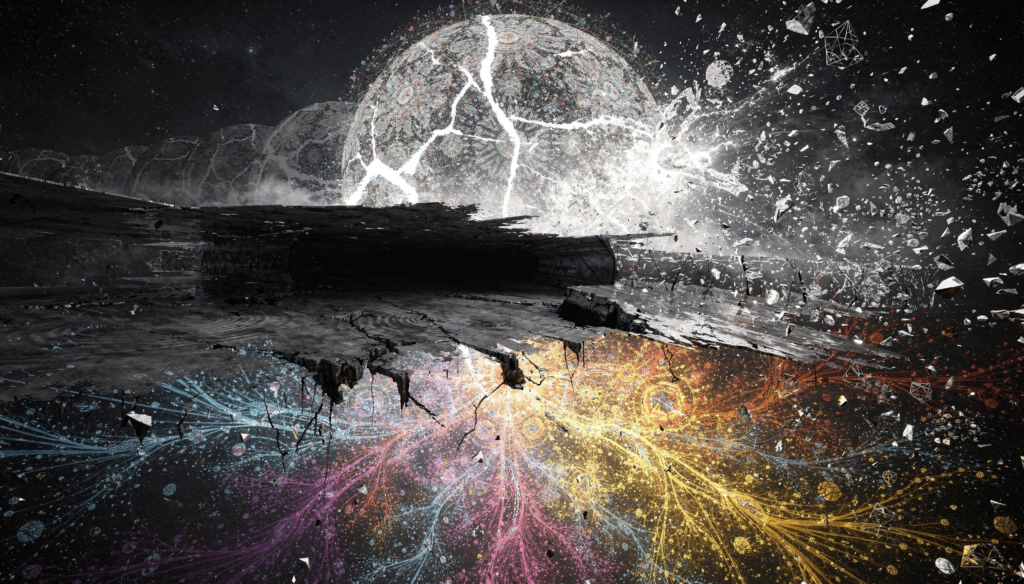
Inside him, the world had not merely broken.
It had been unmade in layers.
The inner world of Dandemægus Auspiciouscrown did not resemble a mind in the ordinary sense, nor even the vast wounded mental cathedrals Excella Angelicus had entered before when touching the fractured psionics of the hunted, the haunted, or the nearly lost. What opened around her when she crossed the threshold of his psyche was something more catastrophic than thought and more intimate than cosmology. It was an entire interior architecture of possibility, nothingness, and totality collapsing at once, each principle once linked to his unmanifest be-ness now shearing away from the others in boundlessly violent fractures. Great horizonless plates of blackened substance drifted in a silence deeper than absence, broken like ancient continents after a primordial war. Above them hung enormous spherical structures, radiant and impossibly intricate, each one webbed with crack-light, each one splitting from within as if some truth too severe for containment had finally reached their core. Below the broken planes, where one expected lesser dark or falling debris, there was instead an abyss of living complexity, a lower ocean of streaming color and luminous script, threads of gold, rose, blue, white, and violet flowing like damaged nervous systems through the background of creation itself.
Names had failed here.
Terms had failed here.
Essence had failed here.
It was not simply that Dandemægus no longer remembered who he had been. The linkage by which a self holds to its naming, the bridge by which a life says I am this, I was this, I continue as this, had been dismantled. The connective tissue between his experiences and the words that should have housed them was gone. The ideas that would have let him gather himself into a coherent pronouncement had been stripped away and scattered through the voidal interior like bones after an explosion. His mind was not suffering ordinary amnesia. His very claim to definable selfhood had been deconstructed at the point where the world meets language.
Excella felt that truth before she could intellectually parse it.

She stood on one of the fractured black plates, her own manifest modality stabilized only because her will was too disciplined to dissolve in a foreign psyche. In this inward realm she appeared as an answer rather than an accident: poised, elegant, a bright white principle of human insistence amid impossible ruin. The pale dress she wore there hugged her frame with clean severity, the pleated hem shifting in the strange atmospheric pull of the broken inner world, and her hair fell in dark violet softness over her shoulders like a deliberate contradiction to all this damage. She did not look like an intruder. She looked like the kind of light that steps into dark places because the dark made the mistake of assuming it would remain unchallenged.
The ground under her feet trembled.
Far away and very near at once, another sphere cracked down its center. White radiance burst from the fissure. A rain of symbolic debris spiraled outward—letters, laws, memories, definitions, glimmering shards of discarded selfhood—before being swallowed by the black gulf beneath the world-plates.
Excella turned.
Someone else was already there.
The girl stood at the edge of a broken ledge as if she had arrived by instinct rather than route, as if blood had drawn her farther than reason could have. She was striking at first glance and then painful at second. Young, but not fragile. Beautiful, but with that beauty sharpened by grief, intelligence, and the habit of standing upright inside emotional weather that would have broken less disciplined souls. Her hair framed her face in dark softness, her expression caught between wonder and alarm, and her eyes held that strange doubled light certain children of impossible men seemed born with—the capacity to love someone fiercely while already understanding the scale of their damage. She was dressed simply, but the simplicity did not diminish her. It made her more real against the psychedelic wound of Dandemægus’s internal ruin.

Eira Endwriting had finally found her way in.
For a suspended measure, neither girl nor woman spoke. The soundlessness here was too large, the broken mind around them too immediate. Excella studied her with the swift, dangerous accuracy that belonged to every part of her. The resemblance was not superficial. It was structural. Not the face exactly, though traces lived there. Not merely the eyes, though those too carried familiar force. It was deeper than that. The emotional geometry. The way she stood as if hurt and resolve had learned to share a spine. The way some interior bond to the mind around them trembled through her without snapping. This was not an interloper. This was kin.
Eira recovered first.
“Who are you?”
She asked it with caution, not childish fear. Her voice did not shake. That told Excella more than the words themselves.
Excella answered just as plainly. “Someone trying to keep this mind from breaking apart completely.”
Eira’s gaze sharpened. “Then you aren’t from here.”
“No,” Excella said. “But neither are you, at least not this way.”
The younger girl looked past Excella, into the split horizons, the collapsing spheres, the rivers of symbolic light beneath the broken plates. She swallowed once. “I thought…” Her voice lowered, not with weakness, but with the shock of a theory failing. “I thought I’d finally found my father inside the Void Beyond.”
Excella held still.
She did not ask your father? in a foolish or theatrical way. She did not make the mistake of sounding surprised. The truth had already struck her the moment she saw the girl. What mattered now was how gently or how intelligently it should be handled.
“You did find him,” Excella said.
Eira’s eyes flicked back to her face so fast it almost looked like pain.
“You know him.”
Excella exhaled softly. “I know the man he is now. Or the man he is trying to remain.”
That answer did not reassure Eira. It unsettled her in a different way, which was fair. She had crossed into a ruined mind in search of her father and instead found a beautiful stranger speaking as if she had already earned nearness to him. There was suspicion in the girl’s face now, but beneath it, something more immediate. Hope at the edge of breaking.
“He isn’t dead,” Eira said.
“No.”
“He isn’t gone.”
“No.”
Eira looked away again, and the force of her relief was so severe it could not fully become visible. She only closed her eyes once, jaw tightening, and when she opened them, her composure had returned in the efficient, practiced way of children who learned too young that if they looked too happy, the world would use the softness against them.
“Then why is this happening?”
Excella turned with her toward the psychic horizon.
All around them, Dandemægus’s interiority kept failing in visible tiers. Possibility streamed out of him in broken currents. Nothingness warped around the fractures but could not fully host them. Totality, whatever internal claim he still had to a complete self, was breaking under pressures older and more violent than memory alone. A vast sphere in the distance split open and released a storm of glowing shards shaped like names that could no longer remain attached to the life they once labeled.
“Because something did not just injure his mind,” Excella said. “Something dismantled its architecture. This isn’t only memory loss. His continuity has been deconstructed.”
Eira watched the falling symbolic ruin with a face that had gone very still. “Can you fix it?”
Excella almost answered I don’t know. She did not. Not because she needed to posture, but because fear would help nothing here.
“I can try,” she said. “And you can help me.”
That made Eira fully face her.
“I think,” Excella continued, “that if we move through this together, we may find where the fractures began. Not the voidal damage alone. The older break. The one everything else widened. If his mind can be rebuilt enough to hold itself again, then maybe he won’t stay trapped in what took him. Maybe he steps fully back.”
Eira searched her, weighing not only her words but the person speaking them. Excella did not flinch from the scrutiny. She rather liked that the girl did not offer trust cheaply. Trust that came too easily rarely mattered.
At last Eira nodded once. “All right.”
“Good.”
“Because I’m not leaving without him.”
It was said so simply, with such total refusal of any alternative, that Excella felt something inside her respond with immediate kinship. Not agreement alone. Recognition. Of course this was his daughter. Of course devotion had arrived like this.
They began to walk.
The ground did not remain stable beneath them. No path in Dandemægus’s mind was truly a path. The black plates drifted, cracked, tilted, and occasionally dissolved at the edges into falling script or vaporized symbolic residue. Some pieces of the interior world floated like broken islands, while others looked more like the cross-sections of ruined thoughts—jagged, hollow, and lined with traces of former meaning. Overhead the spheres continued to fail, each one perhaps a sealed totality of memory, identity, category, or bond, now rupturing under the force of what had happened to him. Underneath it all moved the lower brilliance of the mind’s deeper engine, the streaming colors like naked nerves or broken star-roads, still working, still alive, still trying to keep some core of him in motion.
As they crossed a narrow black causeway suspended above the lower radiance, the first child appeared.
He did not step into being all at once. He resolved.
At first he was a blur in the distance, a small figure moving through the devastated field as if it belonged to him more than to anyone else. Then he clarified into a boy, young enough that his limbs still held a softness not yet disciplined by adolescence, yet already carrying himself with the wary internal gravity of someone who had learned caution before play. He walked alone through the shattering interior, tiny against spheres larger than cities, tiny against the collapse of possibility, nothingness, and totality, and yet somehow also central to it. His little body became the axis of the whole scene the instant Excella saw him.
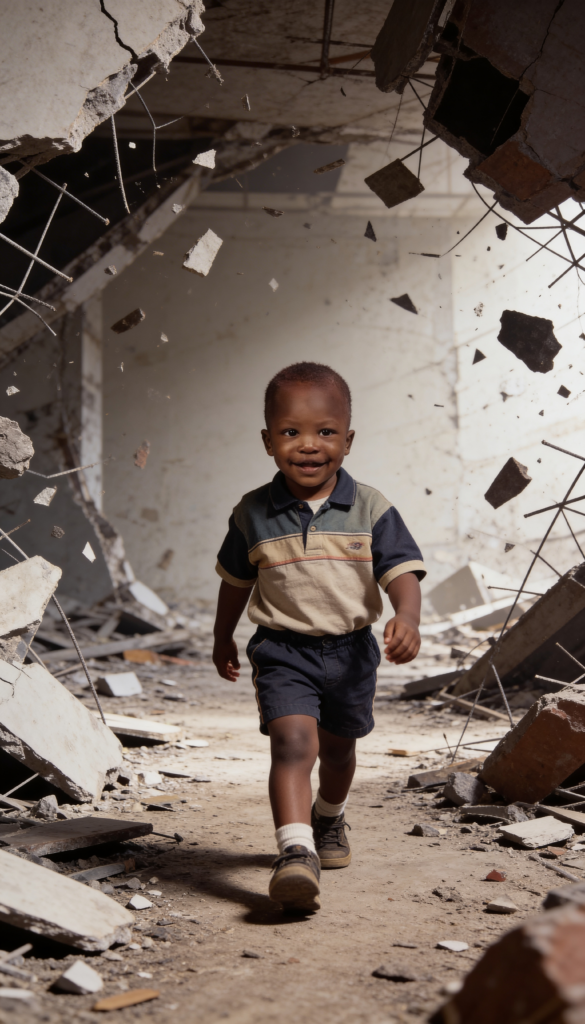
Young Dandemægus.
He moved across a plate broken clean through the middle, stepping as though he had always known how to find footing where others would only see death. The black world cracked around him and the lower colored streams rose in brief luminous reflections against his skin. He did not seem afraid. That was not because he was brave in the sentimental childish sense. It was because fear had already become too normal to be registered theatrically. He had the expression of a child who had lived too long in conditions where terror was part of the weather.
Eira stopped walking.
Excella looked at her and saw something sharpen to pain in the girl’s face.
“You’ve seen this before,” Excella said quietly.
Eira’s eyes remained on the boy. “Pieces.”
“You know what happened to him.”
“I know some of it.” Eira’s jaw tightened. “More than I wanted to.”
The young boy continued forward until the cracked world around him changed.
The broken plates thinned, the cosmic spheres faded to ghosted glass, and suddenly the psychic terrain became city.
Not the clean rational city of urban planning diagrams or official postcards, but the other city, the one trauma remembers because it has no choice. Sidewalk concrete with chewing-gum scars. Alleys rich with wet cardboard smell, exhaust residue, cracked brick, old piss, rusted dumpsters, broken glass, oil rainbows in puddles, and the immense indifference of architecture built for people who had homes. The transition was so absolute that Excella felt the air change in her lungs.
Baltimore.
Not the Baltimore of current maps or present-day skyline logic, but an older rendering carried in a wounded boy’s mind. A Baltimore of heat on brick. A Baltimore of hunger. A Baltimore of sidewalks becoming nurseries because nobody else would open a door.
Deenvylia appeared next.
She came not as a single image but as a body under impossible pressure, assembling in fragments until the reader of the memory could finally bear the full fact of her. She was eleven. That truth struck harder than any decorative description could. Eleven, and already forced into the brutal grammar of motherhood. Her face still carried childness in places no world should have touched, yet exhaustion had laid its claim over all of it. She held the baby close with the clumsy, desperate precision of someone loving hard through panic because she understood, instinctively, that love might be the only intact thing available to her. Her clothes were wrong for the season. Her shoes were wearing down too fast. There was no adult softness protecting her. The city had looked at an eleven-year-old mother and responded with exactly what cities often offer those at the bottom: delay, contempt, predation, cruelty, rape and just enough intermittent mercy to keep the cruelty from being efficiently named.
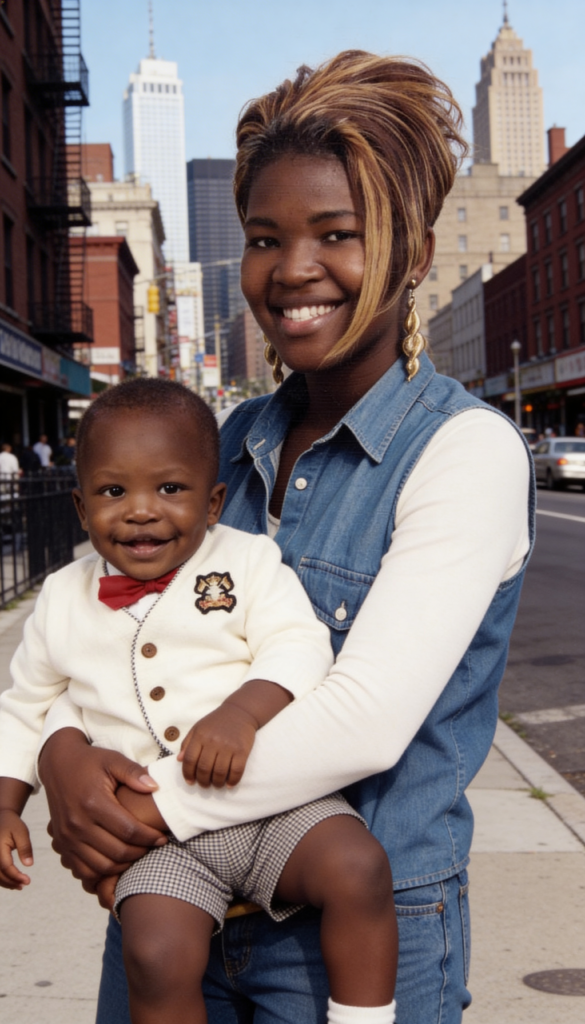
Excella stopped breathing for one long second.
Even prepared by everything she already knew of this world, even armed with all her professional ruthlessness and all her practiced refusal to flinch from ugly truths, this hit differently. Not because she was naïve. Because some horrors remain offensive no matter how much evidence the world piles in front of you. A child with a child. A girl not yet grown into language for her own suffering forced to become shelter for someone else.
The memory widened.
The sidewalk became bed. The alley became home. There were days when Deenvylia sat with the infant held to her chest while traffic passed and people moved around them with the ugly discipline of public indifference. Adults saw them and performed the thousand daily evasions by which societies protect themselves from guilt. Some looked with pity and kept walking. Some looked with judgment and kept walking. Some did not look at all. The baby cried from hunger. Deenvylia learned to rock him while hiding her own shaking. She learned which bodegas might let her warm something without calling the wrong authorities. She learned which church basements offered stale bread without questions and which offered questions without bread. She learned the politics of doorway shade and the difference between dangerous men who were immediate and dangerous men who smiled first.
Young Dandemægus, as the child in the memory, watched from the ground-level of all this.
That mattered. The memory was not simply about what had happened to the mother. It was also about what the child’s mind absorbed before it had language. Hunger as atmosphere. Instability as default. Fear in the caregiver’s eyes. Male laughter arriving from the wrong angle. Sudden tenderness from strangers that never lasted long enough to stabilize anything. The body remembers what the language has not yet built a room for. Dandemægus’s mind, shattered as it was now, had stored those original lessons somewhere beneath the later wars, later magick, later losses. Here, inside the collapse, they rose like foundations exposed after a building falls.
Eira’s voice, when it came, was low and cold. “She should never have had to carry him like that.”
Excella kept her gaze on the unfolding memory. “No.”
“She should never have been allowed near what came next.”
There was something in the way she said it that made Excella turn.
The hatred on Eira’s face was unlike ordinary anger. It was not adolescent resentment. It was not the simple fury of a daughter disliking a grandparent out of inherited grievance. This ran deeper. Older. Cleaner. The grandmother—Deenvylia, by blood—occupied some place in Eira’s moral architecture far beyond dislike. There are hatreds built from misunderstanding. This was not one of them. This was the hatred reserved for someone who had crossed a line so absolutely that forgiveness did not even present itself as a failed option.
Excella did not ask yet.
The memory answered first.
Night in the alley.
An old blanket. A borrowed coat. The boy sleeping against Deenvylia’s body because concrete gives back no warmth unless you steal it from one another. Men approaching. Not monsters in the ceremonial sense. That would have been easier. Just men. The kind societies breed in the corners where poverty, patriarchy, predation, and impunity agree to become practical. Men who looked at an eleven-year-old girl with an infant and saw not tragedy but opportunity. They read need as leverage. They read exhaustion as surrender. They read the absence of witnesses as permission.
Nothing in the memory was graphic. It did not need to be.
It was worse than that. It was comprehensible.
A hand that lingered too long when offering food. A shelter promise that came with conditions Deenvylia was too young to even fully parse before understanding they were wrong. A room for the night that turned into debt. A debt that turned into access. Access that turned into repeated use of her body under the logic of survival. The city around them kept moving. Neon signs hummed. Police cruisers passed and never saw the right thing. Somewhere far away music played from a window. The baby woke and cried while his mother stared at a ceiling she did not own and learned the first adult lesson any civilization ashamed of itself teaches poor girls: that the world often charges them for staying alive.
Excella’s hand closed into a fist.
She did not know she had done it until Eira looked down at it briefly.
“I told you,” Eira said, not cruelly, just with the exhausted certainty of someone who had lived with these truths too long. “You are learning him.”
Excella looked at the child in the memory.
No, she thought. I am learning what the world did to him before he could become anyone else.
That felt more accurate.
The scene shifted again.
The boy had grown a little. Not much. Enough to walk with more confidence. Enough to recognize danger in tones before the words themselves arrived. Enough to understand, dimly, that his mother was suffering and that he could not stop it. There is a particular violence in childhood when one learns that love is helpless in the face of structures too large to break. Young Dandemægus carried that violence quietly. He watched everything. That was one of the first stable traits. He watched the faces of men. He watched the slight changes in his mother’s posture when certain footsteps approached. He watched hunger turn adults into different species of themselves. He watched other children move in packs and learned he was not one of them. He watched people with money pass as if the sidewalk were merely scenery. He watched his mother cry only after she thought he slept.
And because he could not fight, he learned to endure.
That was the other first stable trait.
Excella understood now why his mind’s interior had formed around shattered possibility, nothingness, and totality rather than more conventional psychic symbols. For a child born under those circumstances, the world does not first introduce itself as family, school, name, or belonging. It introduces itself as unstable law. It teaches that every category can break. Safety can break. Trust can break. Home can break. Self can break. If the first cradle of your life is a sidewalk and an alley, then even the idea of a stable totality becomes suspect. You do not simply grow up poor. You grow up watching possibility bargain with brutality while nothingness waits under every open night.
“Did he remember any of this?” Excella asked.
Eira’s answer took a moment. “Not the way you mean.”
“The body?”
“The body. The fractures. The way he loves. The way he overcorrects. The way he cannot walk past hurt and remain whole. All of that comes from somewhere.”
They kept following the young boy.
Sometimes he passed through scenes of external city. Sometimes through more abstract internal ruin. One moment he would be walking down an alley with brick on either side, cold steam rising from vents and broken bottles glittering in trash. The next he would be crossing one of the black cosmic plates again, beneath the splitting spheres, as if the mind itself could no longer fully distinguish between early life and the larger metaphysical catastrophes that followed. It was all one wound now. Street trauma had become cosmological architecture. Personal devastation had become universal symbolism.
Excella began to understand the title without anyone needing to name it.
Small light.
Because that was what remained impossible to extinguish.
Not power. Not grandeur. Not victory. Small light. A little boy continuing to walk. A child-daughter crossing into a broken psyche to rescue the father she refused to abandon. A woman who should by all logic have turned away instead entering deeper into a mind that might swallow her. The larger structures were failing—possibility, nothingness, totality, name, term, essence. Yet still something small and bright remained. Not enough to deny the darkness. Enough to refuse its final authority.
At the edge of another memory field, the young boy stopped.
Ahead of him sat a woman on a curb, older than the eleven-year-old mother but not yet old in the ordinary sense. Deenvylia again, rendered at a later point in the life-wound, walking Baltimore under a sky that seemed incapable of deciding whether it belonged to the physical city or some adjacent phase-space where reality and illusion bled together. Here the streets around her flickered. Storefronts shifted. Familiar urban signage dissolved and returned. People moved through crosswalks while the world behind them phased in and out in strips, brick one second, voidal shadow the next. It looked like Baltimore caught in a failing projection.
Young Dandemægus watched her from farther away.
She did not hold him now. That difference hurt more than the prior scenes.
In this memory, the distance between mother and child had widened into something emotional rather than physical. Not abandonment exactly. Worse. Inconsistency. Instability. The kind of maternal presence that appears, disappears, loves, fails, protects, betrays, and returns with enough sincerity each time to keep the child from fully learning how to hate. Excella could feel Eira beside her growing colder as the scene unfolded. The older daughter knew more about this woman than the current memory would yet reveal.
“You despise her,” Excella said.
Eira did not take her eyes off the shifting Baltimore scene. “That word is too small.”
Excella did not press. Not yet.
Deenvylia walked through the city with the strange float of someone half inside the world and half already missing from it. Traffic moved. Pedestrians crossed. Shop signs buzzed. Yet around her the air kept phasing in and out, as if Baltimore itself could not decide whether to keep her fully rendered. The implication hit hard. This woman was not merely part of the boy’s trauma. She was tied to the larger instability. A node. A wound-carrier. Perhaps even one of the early reasons the later fractures found such purchase in him.

Behind her, the street began to split with lines of white light identical to the cracks racing through the psychic spheres overhead.
The connection was undeniable now.
Dandemægus’s mind had not been shattered only by the Void Beyond. The void had widened what life had already destabilized. The deconstruction of names, terms, and essence had found earlier preparation in a childhood where those things had never been given stable shelter. A boy born without safety. A mother born into violation. A city built from overlapping human and inhuman predation. The later cosmic fracture had entered a psyche whose first lessons were already collapse.
Excella stood with Eira on the edge of the memory and felt the full tragic breadth of it at last.
He had not simply lost himself.
He had been losing the right to simple selfhood in stages since the beginning.
In front of them, Deenvylia Endwriting kept walking through Baltimore as the world phased in and out around her, the city strobing between manifest brick and broken illusion, and somewhere beyond the visible horizon of the mind, another sphere cracked open with the sound of a name almost remembered and then lost again.