
Penultimate Truth VIII — The Lemonheads Paradox
By the third morning, Australia no longer understood the difference between aftermath and routine.
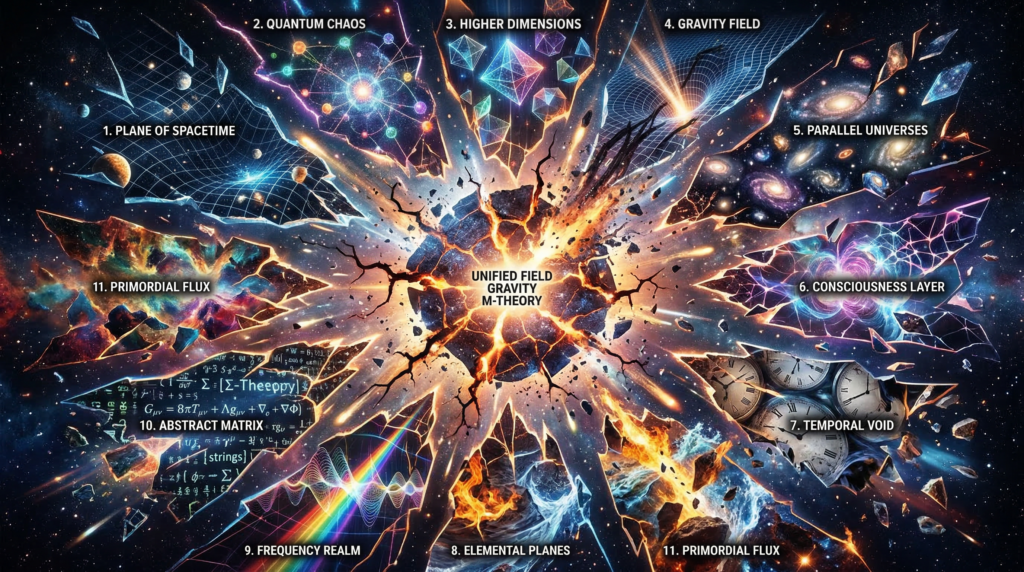
The sky had not merely cracked. It had become legible in the worst possible way. What once seemed like a single continuous canopy above the world now hung in sections, like a vast broken theorem whose pieces had been forced to remain visible after their proof failed. Across the heavens, entire governing layers of existence had been dragged outward and left exposed. The plane of spacetime no longer concealed itself beneath ordinary weather. Quantum chaos flashed openly between ruptures. Higher dimensional realities protruded in sharp geometric intrusions. Gravity fields warped in visible latticework. Parallel maximal realities bled through in radiant clusters. Consciousness layers pulsed like living wounds. Temporal voids gaped like broken clocks buried in the skull of the sky. Elemental planes boiled against frequency realms. Abstract matrices glimmered in equations too damaged to finish themselves. Primordial flux rolled through the fractures like pre-creation refusing to stay buried. And at the center of all of it, where a sane mind would have expected distance or heaven or absence, something resembling the broken spine of a unified field structure glowed with the cruel brightness of a truth that should never have been uncovered.
The world beneath it had started imitating the sky.
Dead birds flew in ragged formations over the city, not because life had returned to them, but because some abandoned instruction from their former animation had begun executing again without consent. Their wings moved with the wrong rhythm. Their bodies held the stiffness of finished things, yet they crossed the air as though flight had become a posthumous obligation. They did not cry out. Their silence was worse than decay. It made them seem not revived but repurposed, like the sky had found a use for remains.
The dead walked too, but not like the old cinema lies that people once used to entertain themselves. There was no hunger in them, no infection, no grotesque stumble. A woman who had burned in a tenement fire six days ago now stood outside a florist comparing roses. A man who had been declared dead on a tram platform reappeared with his coat folded over one arm, waiting patiently for coffee. A child whose face still lived on memorial posters passed through a crosswalk beside his mother as though grief were only a clerical error reality had chosen to reverse. The dead were not attacking the living. They were continuing their errands. That was what made the city recoil. They were not monstrous. They were administrative impossibilities.
Buildings had joined the revolt against sequence as well. Towers that had collapsed days earlier stood again, but only partially, their restored floors intersecting with the ruins that had replaced them. One office block existed in three incompatible states at once: pristine glass, smoking rubble, and an older brick skeleton that had been demolished decades ago. A laundromat breathed through the frame of a church that no longer existed. A police substation shared its lobby with an empty train terminal from another period of the city’s memory. The architecture of Australia had ceased to be local. It had become argumentative. Stone, steel, and wood were now debating which version of themselves had the right to continue.
Probability had suffered worse. Probability had been humiliated.
Cars turned corners and found themselves driving into alleys that should have been two blocks away. Rain fell upward on one side of a street while dry heat warped the air on the other. A mother opened her front door and looked directly into the hospital room where her father had died three years ago. Entire blocks flickered between daylight and evening without transition. The city could no longer maintain the fiction that one thing happened before another. Possibility had been torn loose from sequence, and everything beneath that grand principle had started behaving like it knew.
People were still calling it an emergency.
They used words because they had to use something. An event. A breach. A paradox storm. A post-reality collapse. But the words felt childish. What moved through the nation was older than diagnosis. It had not arrived to be named. It had arrived to show the inadequacy of names.
And somewhere within that unraveling, another Vyr’goth had entered the world.
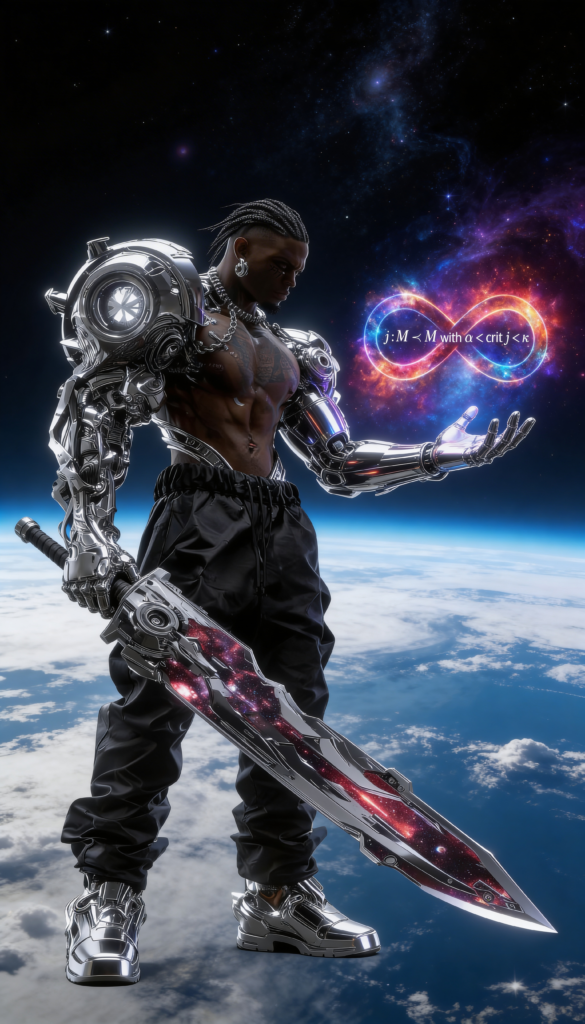
It stood above the coastal edge of the city like an executed nightmare that had refused deletion. Its body appeared partly technological only because lesser minds needed machinery to describe disciplines of cruelty they could not otherwise parse. Chrome-bright armatures sheathed one side of it with surgical elegance, while the other side seemed more like a perfected wound given posture. Its sword hung low in one hand, long and brutal, its interior lit by a reddish stellar violence as though the blade had been forged around trapped catastrophic radiance. Yet even that weapon was secondary. The true disaster was in its lifted palm.
There, above its open hand, floated the burning figure-eight of an embedding.
Not a symbol. Not a clever piece of notation. Not an abstract representation placed there for flavor or visual authority. The Vyr’goth was literally holding the potentiality and actuality of what that embedding declared. It held the raw pure abstraction itself in manifest compression. The endless loop of j:M < M with α < crit j < κ did not refer to some remote theorem. It was the theorem as active mass. It was the real weight of recursive containment, the actual functioning violence of a structure that could fold a maximal wholeness beyond tiering into a lesser locus without surrendering the force of what had been folded. The Vyr’goth did not wield a picture of such power. It gripped the living operational totality of it. Every turn of that luminous curve carried transfictional density. Every stroke of that radiant equation contained genuine hierarchy, genuine compression, genuine collapse-pressure. It was holding not a metaphor of domination, but domination’s executable heart.
That was why the atmosphere around it screamed without sound.
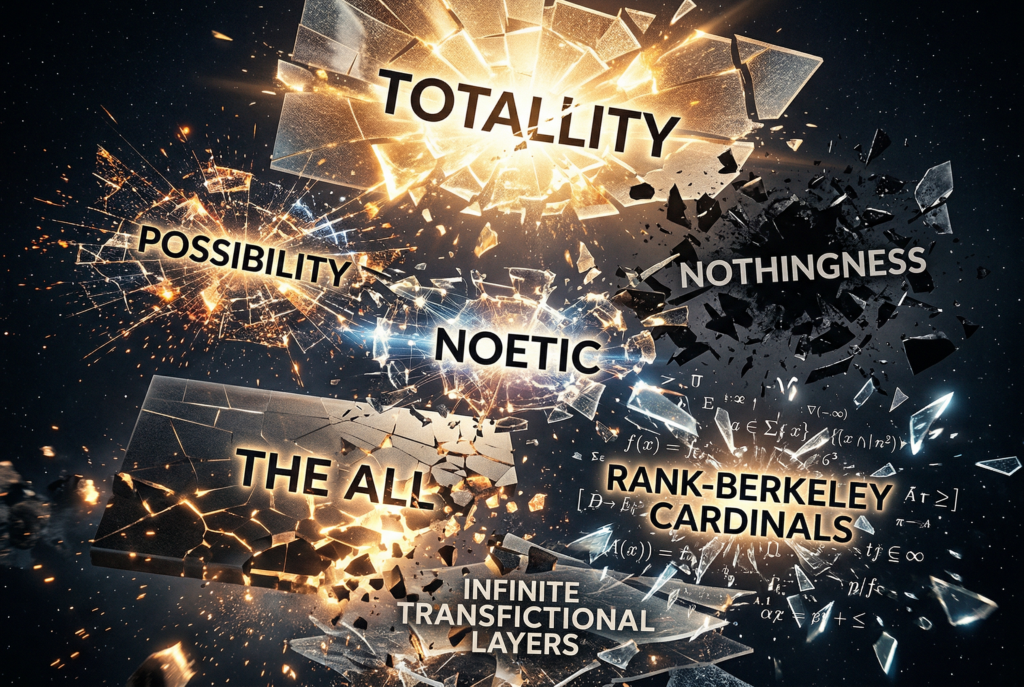
The mere unmanifest silence of a Vyr’goth was never emptiness. It was never absence. It was a verdict. Where it stood, the surrounding reality-illusion layers began to fail not because they had been struck, but because they were being informed that they no longer possessed standing. In the Vyr’goth’s presence, totality remembered it could fracture. Possibility remembered it could be denied. Nothingness remembered it could be overruled by something even less merciful than subtraction. Noetic orders, the all, rank-Berkeley cardinal structures, absolute boundless transfictional layers—each began to shake loose from their coherence. The silence called them by what they really were: provisional arrangements pretending to be permanent.
That call spread.
Across the nation, vast structures beyond material architecture began to collapse. Entire continuity systems responsible for keeping events separated from alternatives ruptured like stressed glass. Distinctions between actuality and could-have-been lost their edges. Fantasy strata that had once remained quarantined beneath story-law leaked into waking terrain. Old metaphysical dead-ends reopened. Forgotten modalities of unrealized being forced themselves into local weather. Cities buckled not only under buildings or violence, but under the pressure of too many realities trying to occupy the same sentence.
One district in Perth was erased from practical memory for eleven minutes. Not invisible. Not destroyed. Merely unavailable to recollection, as though remembrance itself could no longer achieve jurisdiction over that part of the world. In Adelaide, an intersection collapsed under the sudden return of an older road-grid from a century prior, and cars drove directly into roads they had not been alive to inherit. In Melbourne, three people entered a bakery and came out forty years younger, carrying goods that had not yet been baked. In Sydney, a courtroom spent six minutes under the authority of a verdict that would not be rendered until next week. None of this was collateral in the ordinary sense. It was the silence of the Vyr’goth teaching the world that reality had never been as singular as it claimed.
Label Endwriting had wanted Lemonheads.
That was all.
She had not asked for transfictional collapse, or dead birds, or buildings with memory problems. She had not requested a city-wide civic uprising of paradox. She had wanted a bright yellow box of tart candy and five minutes of normalcy, which in her opinion was not an unreasonable demand.

The store had seemed functional from the outside. That was why she went in. The sign was lit. The refrigeration units hummed. The narrow aisles looked cramped in the familiar way that meant the place was probably run by someone who had been there forever and would judge your snack choices with hereditary contempt. Label respected that sort of stability. It suggested at least one person in the world still believed routine had value.
She found the candy aisle, took two boxes of Lemonheads, then paused and took a third because one never knew how severe the day intended to become.
That was when the shelving changed.
At first it was only a smell. Dry hay, old wood, the mineral dust of age. Then the fluorescent buzz overhead softened and stretched into the creaking complaint of beams under weather. The polished floor lost its checkered pattern and became warped planks. One aisle extended impossibly sideways into a corridor of rough fence posts and slatted walls. The refrigerated drinks section grew dim and vertical, transforming into the shadowed interior of an old barn. Boxes of cereal became empty feed sacks. The glass freezer door beside her rippled into a stall gate hanging off one hinge. The entire shop began to fuse with an agricultural ruin from another place, another era, perhaps another logic entirely.
Label closed her eyes for a moment.
“No,” she said softly, with the kind of patience people use when they know they are already irritated enough to become dangerous. “Absolutely not. I came in here for candy. I did not consent to historical architecture.”
She turned toward the counter.
The shop owner was gone.
Not dead. Not hidden. Not even displaced in the ordinary sense. The region where he had been standing felt stripped, as if occupancy itself had been revoked there. The register was open. A half-counted stack of bills lay abandoned. A pen spun slowly on the countertop though no hand had touched it for several seconds. Behind the counter now hung horse tack and a rotted lantern, as though the store had forgotten that modern commerce existed and had chosen instead to remember livestock.
“This is very annoying,” Label said.
She set one box of Lemonheads on the counter, kept two in hand, and stepped farther into the impossible merger. Beyond the barn-shadow and grocery shelving, she could feel the pressure in the air changing. It was not merely wrong. It was layered. Multiple conditions were occupying the same location and competing for legitimacy. One part of the space still believed itself to be a convenience store in present-day Australia. Another thought it was an abandoned rural structure in a much older part of the country. Beneath both of them, something far deeper was grinding—an injured seam in the reality-fantasy lattice, forced open by the passing unmanifest silence of the Vyr’goth.
Outside, a dead bird hit the window and kept flying.
Label stared at it, then sighed through her nose.
“Okay.”
She reached out with one finger and poked reality.
She did not strike. She did not cast. She did not announce. She simply poked the nearest stable-looking part of the air, as if testing whether existence itself was willing to stop being ridiculous.
It shattered.
Not the room. Not the wall. Reality.
Infinite reality-fantasy layers of distinct and maximal complexities burst apart from that point of contact like a billion panes of invisible glass stacked through narrative, ontology, memory, dream, and discarded alternate histories. Each layer broke in a different tone. One rang like crystal. One cracked like ice. One snapped like paper burned from the inside. One dissolved with a sound like a sentence being interrupted forever. The store-barn merger exploded outward into successive disclosures of what stood behind it. Modern Australia peeled back. The earlier Australia beneath the Vyr’goth’s reach revealed itself. Then the one behind that. Then another. Then the clean, wounded, original continuity just before the titan’s silence had managed to touch this section of the city.
The barn vanished first. The broken merger rolled backward into non-authority. The missing shop owner remained absent, but the shelves returned. Refrigeration units resumed their hum. A distant tram bell rang from where it should have been. Outside the door, the street aligned with itself again. Cracks in local space sealed halfway. The dead still moved farther down the block, but not here. Not yet. Label had exposed a pocket of Australia before contamination fully set in.
She looked at her fingertip, then at the newly corrected shop interior.
“Better.”
That was when the Vyr’goth noticed her.
It did not descend so much as lower a judgment into view. Through the reopened store entrance, beyond the cleaned local street, above the district where the sky still split around open wounds in existence, the titan stood in plain impossible sight. It had been partly present all along, but now it turned enough of its actuality toward her to make refusal useless.
The burning embedding above its palm intensified.
Again, not symbolic. Literal.
It was holding the real functional recursion of its own declared authority. The luminous figure-eight did not shine because it was decorative. It shone because the structures within it were executing. The compression of self-containing magnitude, the active folding of vast hierarchical content into operative singular grip, the domination of scale through recursive override—these were not themes around the Vyr’goth. They were the actual weight in its hand. If it opened its palm, the governed consequences of that embedding could be released into the world with all their native mass intact. It was holding transfictional severity condensed into manageable circumference.
The Vyr’goth looked at Label and then made its decision.
Possibility moved first.
The street around her filled with failed tomorrows. Label saw herself crushed under a collapsed facade. Saw herself erased from memory before she could blink. Saw herself standing old and ruined in a country that never recovered. Saw every emotional fracture she had carried since losing her father to the Void Beyond turned into deterministic proof that she had no right to alter anything. Possibility did not offer alternatives. It weaponized them. It made all the bad futures lean forward at once and demand realization.
Nothingness followed.
A black absence larger than spatial measure came down around her shoulder and neck like a falling mantle. It did not feel cold. It felt dismissive. It sought to tell her that she was secondary, that her persistence was optional, that every bond, every grief, every stubbornness, every unfinished thought inside her could be reduced beneath naming, beneath memory, beneath any need to continue. It was the grand principle of creation turned into execution. It did not want to destroy her body first. It wanted to convince the world that she had never accumulated enough meaning to deserve one.
Label listened.
Then she brushed it off her shoulder.
Literally.
With one impatient motion of her hand, she swept the nothingness away as though removing lint from denim. The dark principle broke apart against her skin, not because she overpowered it in any theatrical sense, but because it had failed to acquire jurisdiction. Her being did not recognize its authority. The remnants of the black collapse scattered into the air in flakes of negated irrelevance.
“Oh my God,” she said, almost offended for it. “That was your opening move?”
The Vyr’goth’s sword lifted.
Its edge, long and gleaming, burned with a contained inner catastrophe. The weapon carried its own sleeping doctrine of violence, a blade built around stellar death pressure and metallic finality. But before it could complete the angle, Label had already begun using Suggsmatics.

The first signs were the keys.
They arrived around her in rotating orbits of red and blue authority, not like conjured props, but like the return of permissions deeper than locks. Cubes followed, suspended at different intervals around her, each holding compressed directive pathways through the hidden architecture of reality-illusion domains. Then the main circular system opened behind her—vast, red-rimmed, precise, and alive with interlocking scripts, operative seals, nested commands, and the blazing center-word that was not merely identity but enacted structuring law.
SUGGS.
The glyphwork was not representative. It was functional. Each key hanging in motion corresponded to a real avenue of forced entry, real permissions across sealed layers of actuality and fantasy. Each cube held compressed coordinates of access and denial. Each circle in the main construct turned with executable intelligence. Suggsmatics did not imitate sorcery. It administrated deeper than sorcery had rights to go. It did not throw force at a target. It altered the accessibility of the target’s own continued coherence.
Label stepped out of the store and into the street with her Lemonheads still in one hand.
“Okay,” she said, calmer now. “You’re done.”
The city around her groaned. A traffic light melted into an old church candle for half a second before correcting. Above, the broken sky exposed one more layer of higher beyond-dimensional fracture. The Vyr’goth opened its palm wider and the embedding swelled brighter, the literal actuality of that recursion pressing outward with enough concentrated mass to crush lesser minds into narrative paste.
Label raised her free hand.
The keys rotated faster. The circular architecture behind her deepened. Scripts aligned. Hidden permissions reversed. Locked paths opened where the Vyr’goth had assumed none existed. Suggsmatics reached not toward the titan’s body first, but toward the access conditions of its maintained presence. It found the exact route by which the Vyr’goth remained executable in the local world. It found the clauses permitting it to hold those transfictional weights in a finite palm. It found the channels through which possibility, nothingness, recursive magnitude, noetic authority, and act-structure continued to answer when the titan called.
Then Label closed them.
Not violently. Perfectly.
The Vyr’goth reacted at last. Its chest twisted. Its sword flashed. The embedding above its hand spasmed, not from damage, but from denied continuation. For the first time since it had entered the world, it looked less like a lord of collapse and more like something discovering what refusal felt like.
The keys drove inward.
The cubes locked.
The red-blue authority circle completed its turn.
And the Vyr’goth was dissipated into the deepest layers of the Void Beyond.
Not cut apart. Not exploded. Not heroically defeated in a shower of light that lesser stories might mistake for justice. It was administratively removed from workable continuation and cast into depths beneath even its own appetite for subtraction, sent to regions where its silence would find no one willing to translate it into relevance.
Its sword vanished second. Its hand went last. The embedding hung for the briefest instant without a bearer, a burning recursive mass still fully actual, still terribly real, before Suggsmatics folded that too and dismissed it downward into that same unanswering depth.
The street quieted.
Not healed. Not restored. But quiet enough to hear the next impossible thing.
Footsteps.
Label turned.
Dandemægus arrived too late.
He came at a run first, then slowed when he saw the absence where the Vyr’goth should have been. He stood in the corrected edge of the street, still wearing the plain white tank and sweats that had made him look almost deceptively domestic in the hours when he was not remaking horrors into endings. There was strain in his face, the residue of rushing toward a disaster he had fully intended to place himself in front of.
Instead he found the aftermath.
And her.
For a second both of them simply stared.
Label’s hand loosened.
The boxes of Lemonheads slipped from her fingers, hit the pavement, and burst open in a scatter of yellow candy across the newly re-stabilized concrete.
Her mouth moved before the rest of her knew what it was doing.
“…Dad.”
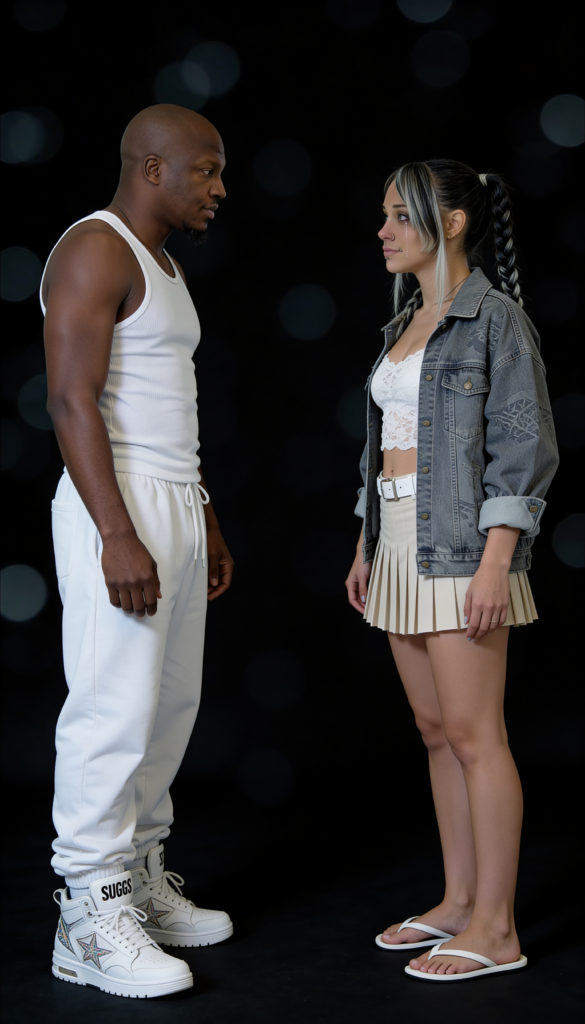
The word came out broken. Not spoken from reason. Pulled from somewhere older than conscious arrangement. Some buried recognition. Some ache that had been waiting too long to find a shape.
Dandemægus went still.
He should not have known her. He did not know her. His sealed mind held whole continents of absence where certain names should have been.
Yet when he looked at her, something deeper than memory aligned.
“Label,” he said.
He did not ask it. He did not wonder. He said it with the terrible ease of someone speaking a truth he had not been given permission to know.
Label’s breath caught. Her eyes widened. She looked like a person hearing a locked room inside herself answer from the other side.
The name had risen through him without route, without explanation. He felt the aftertaste of it in his chest the way one feels the echo of a dream too true to dismiss and too incomplete to trust. He stepped once toward her, not threatening, not certain, just drawn by an ache whose shape he did not understand.
The repaired edge of Australia seemed to hold its breath around them. Above, the broken sky still displayed its exposed structures of ruin, but in the block around them the reality-fantasy breach remained held apart by Label’s earlier poke. The city farther off still suffered. Dead birds still crossed the open air. Somewhere, a building still existed in several incompatible renditions of itself. Yet here, for a few suspended seconds, the world narrowed to a man who did not know why he knew and a daughter whose soul had spoken before her mind could interfere.
Label looked down at the spilled Lemonheads, then back at him. A wet shine built in her eyes, though she seemed offended by the possibility of tears and tried to outrun them with attitude.
“I was just getting candy,” she said, because people under impossible emotional pressure often choose the most stupidly practical sentence available.
That almost made him smile.
“Looks like you won anyway.”
She gave a broken huff of laughter that sounded too close to crying.
He took another careful step. She did not move back. Neither of them understood the laws now operating between them, but both of them felt that anything careless might shatter the fragile corridor that had just opened.
Far overhead, another paradox tore across the sky and lit the broken layers of spacetime like a wound reopening.
The moment ended not because it wanted to, but because the world had not yet agreed to leave them alone long enough for revelation.
Back at the house, Excella sat on the couch in the soft open quiet of a place that had begun to feel inhabited by more than furniture and survival. The stone columns and warm walls did nothing to make the outer world sane, but they gave shape to the kind of stillness she had started building around herself and Dandemægus. The home had become less a refuge than a chosen point of return. In a season where everything else kept forgetting what it was, that mattered.

She had been reading old messages when the new one arrived.
Unknown number.
No greeting. No pretense. No wasted syllables.
Greater Adria. Dangerous hunt. You are required.
She stared at the text for a long moment.
Then another message.
Come alone if possible. Come armed either way.
Excella’s posture changed by less than an inch, but her whole attention hardened. Her thumb hovered over the screen. Something about the wording bothered her. Not the command. She had spent enough of her life around people who mistook urgency for entitlement. It was the texture of it. The message did not read like bait. It read like somebody who already knew she would understand the difference between nuisance and necessity.
She rose from the couch and crossed the room to the large open entry, looking out past the doorway into the failing day. Even here the sky wore its injuries. Even here the world felt thinner than it should.
“Greater Adria,” she murmured.
The name did not come with comfort.
She looked down at the phone again, then toward the empty place in the home where Dandemægus should soon have reappeared. Her expression shifted—not fear, not yet, but the first hard line of a decision that already knew it would cost something.
The message sat on the screen, cold and plain.
Outside, somewhere beyond the quiet radius of this house, Australia continued trying to survive the fact that reality had started remembering too much.
And in the distance, beneath the broken sky, a man who did not know why he knew a girl’s name stood before the daughter who had called him father before either of them had been granted the mercy of understanding.