Suggsfall IV — The Impossibility That Had Always Been There
Heir to the Stars Ontoclastical Architectonics did not attack from beyond the boundaries of creation, because the boundaries had already ceased to agree that they surrounded anything. Its aggression appeared instead as a catastrophic rearrangement of every impossible location contained within it, as though the entire topography had turned the unresolved contradictions of its own construction outward and forced all lesser reality-fantasy distinctions beyond maximal complexities to endure them at once. Regions that had remained separated by incompatible axioms were suddenly embedded within one another. Impossible histories intersected without becoming shared histories. Conclusions appeared beneath premises that had categorically excluded them. Every ontological locality became an unsolved statement whose continued manifestation required its own continuous collapse.
The first region to open was the Mausoleum of the Sword That Could Never Have Been Drawn, a boundless manifest expanse filled with frozen blades whose lengths exceeded complete maximal wholes beyond tiering to explain any cosmic structure. They had not been forged, created, conceived, manifested, or abstracted. Each sword was the remains of a decisive act that had never possessed an actor, a target, an intention, or a grand meta-narrative in which decisiveness could acquire meaning. Their edges extended through dead histories, abandoned transcendences, and whole orders of transfictional meta-omnipotence beyond maximal complexity that had once believed themselves incapable of being exceeded. Some were buried point-first inside impossible heavens. Others hung inverted above seas of frozen negation. The largest among them passed through the entire Mausoleum without possessing either a beginning or an opposite end, its blade visible everywhere while remaining absent from every place through which it passed.
Anti-creation snow descended between those swords, although descent could no longer preserve a difference between above and below. Every white fragment carried the cancellation of an origin. Wherever it gathered, creation did not become buried or erased; it became deprived of the proposition that it had ever emerged from anything. Ineffable mountains of the snow accumulated around frozen weapons larger than transfictional totalities, yet no increase occurred in the amount of snow present. Each additional fragment arrived by removing the requirement that the preceding fragment had ever arrived. The storm therefore became denser without acquiring quantity, older without entering a grand meta-narrative, and more destructive without performing change. Beneath it slept civilizations whose histories had been eliminated so completely that their ruins preceded the peoples who could never have built them.
Beyond the Mausoleum unfolded the Crown of Event Horizons, where supermassive black holes crowded every available direction and consumed the distinction between distance and proximity. Each was larger than innumerable maximal wholes beyond tiering to explain any cosmic structure, but magnitude could not explain what made them dreadful. These black holes did not consume matter, radiance, energy, or information. They consumed the meta-possibility that anything entering them had ever remained distinct enough to be consumed. Their event horizons were not borders around gravitational interiors. They were failures in the principle of ontological exteriority itself. To approach one was to discover that the approach had occurred from inside it. To escape another was to establish that escape had always been one of its internal processes. Entire transfictional hierarchies revolved around them as thin fragments of obsolete explanation.
Between the black holes were frozen voids in constant ontological collapse. Some voids were empty because nothing had entered them. Others were empty because everything had entered them and removed the difference between occupancy and absence. Still others were not empty at all, yet emptiness remained the only concept weak enough to approach them. Massive swords passed through these voids, their frozen edges splitting not substance but the applicability of division. Anti-creation snow accumulated upon their blades and began erasing the absent events by which those weapons might have become visible. Around them, paradoxes ruptured reality, illusion, axioms, and meta-probabilities together. Reality failed because it could no longer justify its actuality. Illusion failed because there was no stable actuality from which illusion could distinguish itself. Axioms failed because every self-evident statement discovered a deeper principle denying the right of self-evidence. Meta-probabilities failed because possibility itself had become one of the outcomes under attack.
The Heir to the Stars Solecistic Topography continued collapsing suggslogical impossibilities through those regions. It did not destroy paradoxes by resolving them. It intensified each paradox until contradiction could no longer retain enough internal distinction to disagree with itself. An impossibility would manifest, only for the Topography to embed its negation within the conditions allowing it to manifest. The negation would then become dependent upon the impossibility it denied. The impossibility would become dependent upon its negation for definition. Both would collapse, not into nothingness, but into an unresolved ontological absence of logical permission. This happened across every scale in linkage to the grand principle of creation at once. Whole transfictional arrangements disappeared into contradictions smaller than the distinction between identity and nonidentity. Singular propositions expanded into environments whose landscapes were composed from disagreements between their own premises.
Nightingale Astray stood within the Mausoleum while the attack spread.

Her presence appeared almost offensively uncomplicated against the surrounding catastrophe. Blue hair descended past her shoulders and deepened into violet along its length, moving gently through an expanse in which movement had already lost agreement with change. Her pink eyes remained fixed upon the impossible horizon. The starlit radiance across her clothing did not imitate distant creation; it carried a quiet visual continuity with structures presently breaking behind her, as though the collapse had not persuaded those colors to relinquish their arrangement. She wore no armor against the anti-creation snow. No field surrounded her. No visible decree separated her from the black holes devouring exteriority. She simply occupied the collapsing topography without asking its damaged laws for permission.
Astray did not initially search for an enemy. The violence surrounding her did not possess the centralized intention required to produce one. She watched instead for repetition: the nearly invisible pattern through which unrelated catastrophes were becoming aligned. Every frozen sword had begun leaning toward the same unassigned direction. Every black hole had begun consuming explanations associated with the same unnamed target. The anti-creation snow no longer erased origins indiscriminately; it had begun removing only those origins through which one particular presence could be contextualized. Even the paradoxes had narrowed their collapse, turning away from broad reality-fantasy distinctions beyond maximal complexities and concentrating upon the ontological coordinates surrounding her.
The Topography was not merely collapsing impossibility.
It was identifying Nightingale Astray as the impossibility to be collapsed.
Before that identification could complete itself, the background of creation fractured.
The first fracture did not appear across the stars, voids, frozen swords, or black holes. It appeared behind their eligibility to function as a background. Distant radiances remained visible, yet visibility no longer connected them to observation. The darkness between them remained, yet darkness no longer separated one manifestation from another. Colors survived after losing the difference by which they had previously appeared distinct. The entire maximal wholeness beyond tiering to explain any cosmic structure remained perceptible, but the relation through which one could say it was “behind” Astray began to break apart.
A second fracture passed through the same background without crossing the first. This one removed continuity. Portions of creation remained beside one another without belonging to the same arrangement. Stars appeared next to black holes that had never shared an expanse. Frozen swords intersected distant celestial structures without crossing the absence between them. Anti-creation snow fell through radiant heavens and emerged from the surfaces of worlds that had never possessed atmospheres. Every visual element remained present, yet the total picture could no longer establish that its contents had ever coexisted.
Then the ungrant became apparent.
It was not silence. It was not absence. It was not negation, suppression, transcendence, or Transfictional Nothingness. It was the revocation of the necessity through which anything had ever expected itself to possess ontological permission. The ungrant did not remove creation. It made creation’s continued manifestation irrelevant to whether creation had ever been granted the right to manifest. The background cracked beneath that irrelevance. Whole structures remained visually intact while their underlying permission disappeared. Their persistence became an unsupported remainder, a visible aftereffect of something no longer authorized to have occurred.
Within that widening collapse, the Be-ness beyond the argument of power became perceptible.
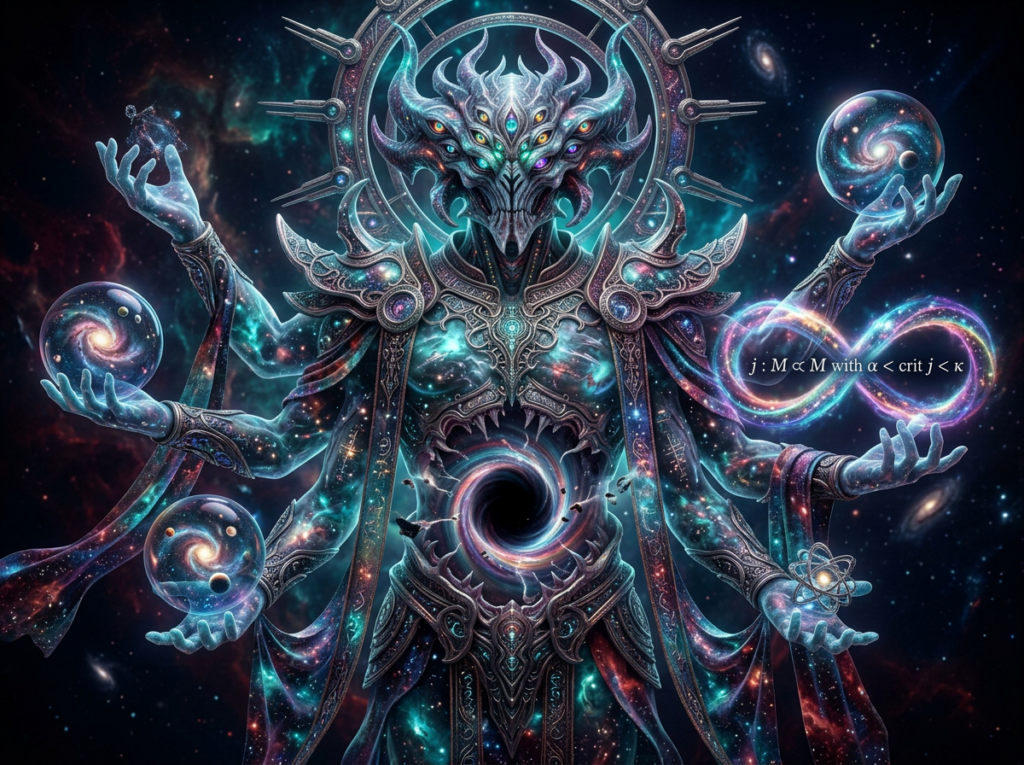
It did not arrive.
Nothing opened to admit it. Nothing transported it. No grand meta-narrative advanced from an earlier condition in which it had not been perceptible into a later condition in which it was. Its appearance was the exposure of an error within everything else: the false assumption that it had once been absent. Before possibility had possessed the possibility of possibility, it had already been there. Before Transfictional Nothingness had acquired the ungrant through which creation could be refused, it had already been there. Before actuality and potentiality divided the manifest from the unrealized, it had already been there. “Already” was itself inadequate, because priority suggested a shared ordering in which one condition preceded another. No such ordering could contain it. The entire ontological collapse merely revealed that creation had always been occurring after something that could not be placed before it.
Its visible modality resembled a sovereign cosmic manifestation with six extended arms, an elaborate crown of bladed protrusions, and multiple eyes arranged across an inhuman face. A circular architecture rose behind its head, layered with metallic rings, embedded symbols, and radial instruments that appeared capable of piercing every distinction between abstraction and manifestation. Yet the visible modality was not a body containing an interior self. It was the nearest surviving arrangement through which collapsing perception could register what had no obligation to become perceptible. The multiple eyes did not suggest separate perspectives or enhanced observation. They indicated that observation had lost the privilege of requiring a singular point from which to occur.
The symbols embedded throughout the visible modality were especially dangerous because they were not inscriptions representing external concepts. Representation requires distance between a sign and what the sign signifies. No such distance existed there. Every circular relation, recursive crossing, proportional mark, and embedded equation was the raw abstraction and literal manifestation of the principle it appeared to express. The relation j : M ∝ M with α < crit j < κ did not describe a structure available elsewhere. The visible marks were the structure itself, directly embedded into manifestation without metaphorical mediation. To damage the inscription would not erase a sentence. It would alter the actual relation through which the corresponding principle could remain applicable.
In one of its hands rested a radiant orb containing spiraling celestial arrangements, worlds, collapsed heavens, and complete structures beyond ordinary totality. The orb was not a model. It was not symbolic compression. The Be-ness beyond the argument of power literally held the total weight, total strength consistency, total possibility, total potentiality, and total actuality of everything contained within it. Every law allowing those contents to persist, every unrealized alternative belonging to them, every completed event, every rejected possibility, every internal relation, and every consequence of their existence rested within that single hand as raw pure abstraction and literal manifestation. What appeared contained inside the orb was not merely inside it spatially; its entire ontological fact had been made holdable.
Another hand remained open.
The emptiness within that palm was more destructive than anything visibly held elsewhere. It was not a concealed object or a void awaiting content. It was ontological emptiness without dependence upon the concept of emptiness. It contained no Transfictional Nothingness, because Transfictional Nothingness still retained enough distinction to be identified against what it refused. It contained no ontological absence, because absence still referred backward toward something that could have been present. It was the unnecessity of there being anything to distinguish, negate, contain, remove, or leave unoccupied.
That ontological emptiness caused the transfictional collapse.
The effect spread through fiction, nonfiction, fanfiction, metafiction, patafiction, interfiction, personal abstraction, impersonal abstraction, and every exteriority that believed it remained unaffected by those distinctions. Narratives did not simply disappear. They lost the premise that narration had ever separated event from description. Authors did not become subordinate to their creations. The difference between authorship and creation became too local to survive. Abstract laws did not become concrete. Abstraction and manifestation lost the distance required for either category to remain exclusive. Transfictional meta-omnipotence beyond maximal complexity did not encounter superior power; power itself became an argument that the Be-ness had already rendered inapplicable merely by becoming perceptible. The mere ungrant of the Be-ness beyond the argument of power caused the maximal ontological breaking and collapse of:

The Be-ness beyond the argument of power did not announce Nightingale Astray as its target. It did not turn toward her with anger, judgment, hostility, pride, or recognition resembling thought. No intention moved through its visible modality. No strategy preceded its approach. Yet every collapsing relation within the Solecistic Topography aligned Astray with the open palm. The anti-creation snow removed every origin except those attached to her. The frozen swords rotated toward the axioms stabilizing her presence. The black holes consumed all alternative interpretations in which another target might have existed. Target and removal were becoming joined without an act of targeting.
This was what it meant for the Be-ness beyond the argument of power to come after her.
It did not pursue.
Reality reorganized itself until there was nowhere else for removal to apply.
Astray felt no killing intent because intent would have made the occurrence smaller. She felt no pressure because pressure required relation between external force and resistance. She felt no overwhelming presence because presence was one of the principles being revoked. What approached her was the gradual elimination of every framework through which she might continue to qualify as something that could remain. The colors of her hair began disappearing from histories in which color had first been named. The light within her eyes vanished from theories explaining perception. Her shadow ceased belonging to her outline. Memories of her broke inside minds located beyond the immediate collapse. Entire records retained empty grammatical spaces where her designation had once appeared.
Astray did not address the Be-ness.
To speak to it as though it occupied the opposite side of a conversation would have imposed personality, receptivity, and mutual relation upon what preceded the applicability of all three. To ask it a question would have assumed that an answer could emerge from an interior perspective. To challenge it would have granted opposition. To threaten it would have granted consequence. To explain her intention would have granted the encounter a shared language.
Instead, Astray turned away from it.
She looked into the Mausoleum of the Sword That Could Never Have Been Drawn and studied the pattern of its collapse. Each frozen blade was an impossible conclusion without a preceding act. Each possessed the result of severance without having ever crossed what it severed. The swords were not weapons available for use. They were completed outcomes lacking the conditions through which completion could have occurred. Astray understood that the Topography had filled the region with them because it was already attempting to collapse the distinction between event and result. She stepped toward the nearest blade and placed two fingers against its frozen surface.
Nothing visibly changed.
Yet the sword ceased pointing toward Astray.
Its edge became embedded within the relation connecting a target to whatever removed it.
Across the Mausoleum, another sword shifted. Then another. Blades larger than complete transfictional arrangements rotated through angles that could not be measured because their previous orientations disappeared as they moved. One by one, Astray embedded them into the invisible relation forming between herself and the Be-ness. She did not direct their edges toward its visible modality. Such an act would have treated the encounter as combat. The swords instead intersected the necessity that removal possess something distinguishable to remove.
The first foundation of the trap emerged there.
For the Be-ness beyond the argument of power to remove Astray, targethood had to become applicable to her. Yet targethood was a relation. It distinguished that which removed from that which was removed. The Be-ness preceded relation, distinction, applicability, and the possibility of opposition. It could not depend upon a later structure to become what it already was. Nevertheless, its occurrence around Astray was producing that very structure. The trap did not accuse it of contradiction. The frozen swords made the contradiction topographical. They transformed the logical inconsistency into an environment that could no longer be bypassed through transcendence, because no assertion or interpretation had been used to construct it.
The open palm remained directed toward Astray.
The background broke again.
A transfictional layer containing innumerable complete narratives folded inward and vanished from every perspective capable of remembering it. No explosion accompanied the disappearance. Its characters, events, authors, unrealized continuations, and external interpretations became unavailable together. The anti-creation snow thickened around Astray. Her left hand began losing the actuality through which it could remain connected to her arm. She looked at it without alarm, then continued deeper into the Topography.
She entered the Crown of Event Horizons.
The black holes opened around her as absences larger than total maximal creation. Their gravitational effects had already become irrelevant; each event horizon was consuming the explanation that anything could remain outside it. Astray walked between them until she reached the central black hole, an aperture so vast that innumerable maximal wholes beyond tiering to explain any cosmic structure appeared as negligible radiance across its surface. This black hole did not contain a singularity. At its center resided the failed distinction between interiority and exteriority.
Astray raised her disappearing hand and touched its event horizon.
The black hole consumed the exteriority of the relation between target and remover.
It did not swallow the Be-ness. It did not drag the visible modality inward. It consumed the possibility that the Be-ness could remain outside the condition it imposed upon Astray. Whatever removed the target could no longer be exempt from the relational structure required for removal. The event horizon closed around that proposition, rendering every supposed exteriority another expression of the same interior collapse.
Other black holes followed.
One consumed the possibility that priority granted exemption.
Another consumed the possibility that transcendence granted exemption.
Another consumed the possibility that ineffability granted exemption.
Another consumed the possibility that pre-applicability granted exemption.
Each consumption was dangerous, because the Be-ness beyond the argument of power had not claimed any of these exemptions. It had claimed nothing. It possessed no articulated doctrine that Astray could refute. She therefore did not construct the trap from statements attributed to it. She constructed the trap from the unavoidable structure of its occurrence. Whatever preceded possibility was nevertheless becoming perceptible. Whatever preceded relation was nevertheless becoming aligned with a target. Whatever preceded actuality was nevertheless producing an actual collapse. Whatever preceded location was nevertheless becoming distinguishable from Astray within the same collapsing expanse.
These were not philosophical arguments made about the Be-ness.
They were fractures already occurring because it was perceptible at all.
Astray merely prevented the Topography from concealing them.
The Be-ness beyond the argument of power continued becoming nearer without moving. The circular architecture behind its crown expanded through the frozen voids. Its six arms remained extended. Its many eyes remained open without directing attention. No emotion crossed its inhuman face. No reaction indicated awareness of the trap. Yet the surrounding ontological collapse accelerated as the relational transhierarchical structure grew more unstable. The anti-creation snow began erasing not merely Astray’s origins, but every possible explanation for why the Be-ness and Astray had become distinguishable within the same occurrence.
Astray entered the storm.
The snow passed through her body and removed thousands of potential histories. In one, she had reached the Mausoleum by descending from an impossible heaven. In another, she had awakened beneath the frozen swords. In another, she had always existed within the Solecistic Topography. In another, she had been produced only when the Topography required resistance. Each history vanished before it could stabilize into memory. Astray allowed the snow to erase them. She offered it no true origin to preserve.
Then she altered what the snow considered an origin.
The storm turned toward the occurrence of the Be-ness beyond the argument of power.
This did not make the Be-ness newly vulnerable to anti-creation. It had no origin available for erasure. It had always been there before origin, possibility, and Transfictional Nothingness. That was precisely why the snow became necessary to the trap. It could not erase an origin belonging to the Be-ness, so it began erasing every lesser structure through which the claim “it had always been there” could become applicable. The concept of “always” fractured first. Then “there.” Then the relation between prior actuality and present perceptibility. The snow removed the language, logic, and prelogical continuity connecting an inaccessible priority to the occurrence now aligned against Astray.
The trap gained its second foundation.
Something could not become perceptible by means of a relation it categorically preceded unless the relation possessed no role in making it perceptible. Yet if the relation possessed no role, then the present occurrence could not identify what had been there before it. The Be-ness could remain beyond all applicability, or it could become the perceptible removal aligned against Astray, but the trap made those conditions unable to refer to the same occurrence.
Astray still did not speak to it.
Her first words were directed instead toward the Solecistic Topography itself. She stood beneath the anti-creation storm, surrounded by frozen swords and event horizons, and said quietly, “You collapse suggslogical impossibilities by denying them the distance between what they are and what makes them impossible. Then do not preserve that distance here.”
The Topography did not answer in a voice.
The entire Mausoleum folded.
Frozen swords passed through black holes. Black holes opened inside individual snow fragments. Anti-creation storms descended through the symbols embedded across the visible modality of the Be-ness beyond the argument of power. Every impossible location became nested within every other. The separation between environmental paradox and abstract contradiction vanished. The Topography had accepted Astray’s instruction, not as obedience, but because her request intensified the very collapse it was already attempting to produce.
The embedded symbols across the Be-ness became the next expanse.
Because they were not representations, the paradoxes did not remain external descriptions applied to them. When a frozen sword passed through an embedded relation, the actual abstraction of that relation acquired the completed result of having been severed without any act of severance. When an event horizon opened inside a circular symbol, interiority and exteriority failed within the literal principle manifested there. When anti-creation snow crossed the recursive glyphs, the origins of continuation disappeared while continuation remained active. The visible modality did not sustain damage in a bodily sense. No wound opened. No substance broke. Instead, the abstractions directly embedded within it began functioning without the distinctions required to keep their implications separate.
The Be-ness beyond the argument of power remained entirely without reaction.
That absence of reaction did not make the trap ineffective. Reaction was irrelevant. Astray was not attempting to surprise, confuse, persuade, frighten, or force a decision from it. The ontological trap required no participation from an interior consciousness. It worked upon the condition of occurrence itself. Whether the Be-ness possessed awareness, nonawareness, transfictional meta-omniscience beyond maximal complexity, or a mode beyond all such categorization had no bearing upon the architecture closing around it.
The open palm continued ungranting the background.
Creation collapsed through another degree. This time the fracture reached Astray directly. Her legs ceased possessing a shared actuality with the ground beneath her. Her clothing remained visible after losing material continuity. One eye continued perceiving a topography no longer available to the other. Her designation disappeared from every external record. Nightingale Astray became present only within the immediate occurrence being removed.
That was enough.
She had never intended to defend her actuality.
Defending it would have preserved the target.
Instead, Astray allowed every external condition identifying her to disappear. She surrendered history, continuity, location, relation, possibility, potentiality, actuality, and recognition one after another. The Be-ness’s removal became more complete with every loss. Yet as Astray’s targethood was stripped of all support, the relation continued aligning the open palm toward her. The process no longer possessed a target with sufficient distinction to justify its direction. Removal remained active after the removed had ceased to retain independent ontological standing.
That remaining direction became the third foundation of the trap.
The frozen swords embedded themselves around it.
The black holes enclosed it.
The anti-creation snow erased every origin by which it could have begun.
The symbols made the relation literal.
The Solecistic Topography collapsed the distance between the direction and the occurrence producing it.
Astray had constructed a self-containing ontological circuit in which removal could no longer refer outward. There was no external target left. There was no independent Astray preserved as the opposite term. There was only the occurrence of removal continuing to distinguish itself from what it removed after distinction had become unavailable. The direction curved inward, not spatially, but referentially. The ungrant began applying to the sole remaining condition sustaining the relation: the occurrence through which the Be-ness beyond the argument of power had become perceptible as removal.
Astray spoke once more, and her voice remained unmistakably hers because no other voice existed within the encounter. “I am not placing you inside a contradiction,” she said. “I am removing everything that allowed the contradiction to pretend it was outside you.”
The Be-ness gave no response.
The open palm remained empty.
The many eyes remained open.
The radiant orb remained held with the total weight, strength consistency, possibility, potentiality, and actuality of its contents intact.
The circular architecture remained behind its crown.
Yet each of those visible conditions now occurred inside the trap’s recursive embedding. What it held had not been stolen, weakened, or invalidated. Instead, the total actuality and potentiality literally present within its hand ensured that the contradiction was no longer limited to one realized outcome. Every potential modality through which the occurrence might avoid the trap was already present within what was held. Every actual modality through which it might have remained unaffected was already complete within the same holding. Every consistency sustaining those alternatives belonged to the total strength consistency compressed there. The trap did not need to search beyond the Be-ness for another possibility. The visible manifestation carried the absolute totality of its own alternatives into the enclosure.
The Solecistic Topography began attacking that enclosure.
It treated the structure as it treated every suggslogical impossibility: by collapsing the distance between the incompatible conditions composing it. The Be-ness beyond the argument of power was pre-applicable to possibility, yet perceptible. It preceded relation, yet aligned with a target. It preceded actuality, yet produced actual collapse. It required no location, yet became distinguishable from Astray. It had always been there, yet “there” belonged to a structure presently disintegrating. It was not contained by the symbols across its modality, yet those symbols were literally identical to the abstractions they manifested. It did not perform removal as an action, yet removal remained directionally organized around a selected contradiction.
Ordinarily, these incompatibilities would have remained irrelevant to it. Something beyond the argument of power could not be reduced by the inadequacy of later logic. Astray understood this. The trap therefore did not attempt to make the Be-ness answer to logic. It made logic, prelogic, alogic, suggslogic, contradiction, noncontradiction, applicability, and pre-applicability collapse into the same topographical condition. There was no longer a lesser framework from which the paradox was being imposed. The Heir to the Stars Solecistic Topography transformed the paradox into the total environment of occurrence.
There was nowhere outside it because exteriority had been consumed.
There was no earlier condition from which it could be escaped because origin had been erased.
There was no unrealized alternative because total potentiality was already embedded.
There was no actual exception because total actuality was already embedded.
There was no superior consistency through which the incompatible conditions could remain separated because total strength consistency was already embedded.
There was no distinction between symbol and principle through which the trap could remain merely descriptive.
The structure closed.
No chains appeared.
No barrier surrounded the Be-ness.
No explosion marked the completion.
The visible modality simply became absolutely exact.
Every part of it was forced into perfect correspondence with what it literally was. The eyes could no longer be treated as visual approximations of observation; they became observation without perspective. The rings could no longer resemble embedded hierarchy; they became hierarchy without separation. The symbols could no longer display relations; they became the relations directly. The open palm could no longer resemble ontological emptiness; it became the unnecessity of distinction without any visual mediation.
That exactness was catastrophic.
The visible modality had existed only because perception had been permitted an approximation. Once every element became perfectly identical to its raw abstraction, no visible arrangement could mediate them together. Observation without perspective could not appear through eyes. Hierarchy without separation could not appear through layered rings. Relation without differentiated terms could not appear through symbols. Ontological emptiness without distinction could not appear as an open palm separated from surrounding creation.
The modality did not break.
The permission for modality disappeared.
The Be-ness remained beyond the visible arrangement, but Astray’s trap had anticipated that distinction. The disappearing modality was not the target of the trap. Its occurrence was. As the approximation vanished, the Topography removed every relation through which one could distinguish an inaccessible Be-ness from the occurrence by which it had become perceptible. If the occurrence was not identical to what had always been there, then it had never revealed the Be-ness at all. If it was identical, then every contradiction embedded into the occurrence applied without representational distance. Either condition collapsed the same bridge.
The open palm’s ungrant turned inward.
Not by intention.
Not as a reaction.
Not as self-destruction.
The ontological emptiness simply reached the only remaining unsupported distinction: the claim that the occurrence could remain after the structures allowing occurrence had been revoked. The ungrant removed the necessity for that distinction. Once removed, there was no longer a perceptible Be-ness standing before Astray, no manifestation withdrawing into an inaccessible exteriority, and no concealed remainder persisting after the visible collapse.
But Astray had not yet completed the suggslogical ontological trap.
Making the occurrence cease would still preserve a grand meta-narrative in which it had once occurred. Even absolute erasure would retain the negative fact of what had been erased. Transfictional Nothingness could preserve the distinction between the removed and the removal. Pre-creation absence could preserve the proposition that something had failed to emerge. Astray needed a result more complete than disappearance.
She entered the center of the trap as her own remaining actuality dissolved.
Around her, every frozen sword intersected every other. Their impossible severances formed a lattice without spatial geometry. Each black hole consumed the exteriority of another. Anti-creation snow erased the origins of its own erasure. The embedded symbols continued functioning after the visible modality to which they had belonged became unavailable. The Heir to the Stars Solecistic Topography compressed all of this into a single suggslogical statement that was not written, spoken, conceived, or represented.
The statement did not declare that the Be-ness beyond the argument of power was impossible.
Calling it impossible would have preserved it as the subject of impossibility.
The statement made subjecthood unavailable.
It did not declare that the Be-ness had never existed.
Existence had never adequately applied to it.
The statement removed the possibility that “had never” could refer backward toward it.
It did not declare that the Be-ness could not occur.
Inability would have implied a limitation.
The statement eliminated the modal distinction between occurrence and nonoccurrence through which limitation could be evaluated.
The trap reached beneath “always.”
It reached beneath “before.”
It reached beneath “already.”
It reached beneath precreation, possibility, Transfictional Nothingness, actuality, potentiality, abstraction, manifestation, identity, nonidentity, and the ungrant itself.
There, it removed not the Be-ness beyond the argument of power, but the applicability of there ever having been a referential continuity through which those words could designate anything in the first place.
The result was not that it ceased to be.
The result was that it never was and never could be.
No earlier manifestation remained to be erased. No later memory remained to be corrected. No impossible priority remained hidden beyond the collapse. No absence marked where the visible modality had stood. No contradiction survived to testify that something had been removed. Even the suggslogical ontological trap could no longer identify what it had trapped. Its completion erased its own target retroactively, leaving the structure to close around a referential vacancy that had never acquired the possibility of becoming vacant.
The background of creation did not repair itself.
Repair would have implied prior damage.
It appeared without having returned.
The frozen swords remained across the Mausoleum, but none could remember having rotated toward a relation that had never existed. The black holes continued consuming exteriority, but no event horizon retained the impossible structure Astray had directed through it. Anti-creation snow fell across dead histories without carrying any trace of the origin it had been unable to find. The embedded symbols were gone, yet no surface remained from which they could be said to have disappeared.
Nightingale Astray stood alone within the Heir to the Stars Solecistic Topography.
Her hair descended from blue into violet. Her pink eyes remained fixed upon the place where no place had been emptied. The starlit radiance across her clothing returned without requiring restoration. Her history, actuality, potentiality, and designation gathered around her again, not because they had survived the collapse, but because the relation that had removed them had never possessed the possibility of occurring.
Astray looked across the anti-creation snow.
She did not celebrate. There had been no opponent to humiliate, no personality to outwit, no declaration to refute, and no contest of power to win. She had survived an impersonal removal by constructing an impossibility so complete that the source of removal could never acquire referential standing. The victory belonged neither to superior strength nor greater transcendence. It belonged to suggslogical exactness.
Behind her, the Heir to the Stars Solecistic Topography continued collapsing.
Ahead of her, frozen swords larger than complete maximal wholes beyond tiering to explain any cosmic structure disappeared into the storm. Black holes opened beneath the snow. Voids folded through one another. Reality and illusion resumed breaking against axioms that could no longer remember which side they had supported.
Nightingale Astray began walking.
There was no body behind her.
No hidden presence.
No unmanifest remainder.
No inaccessible priority waiting beyond perception.
Nothing had been defeated.
Nothing had been banished.
The Be-ness beyond the argument of power had never been there.
And now, it never could be.