Deus (I)

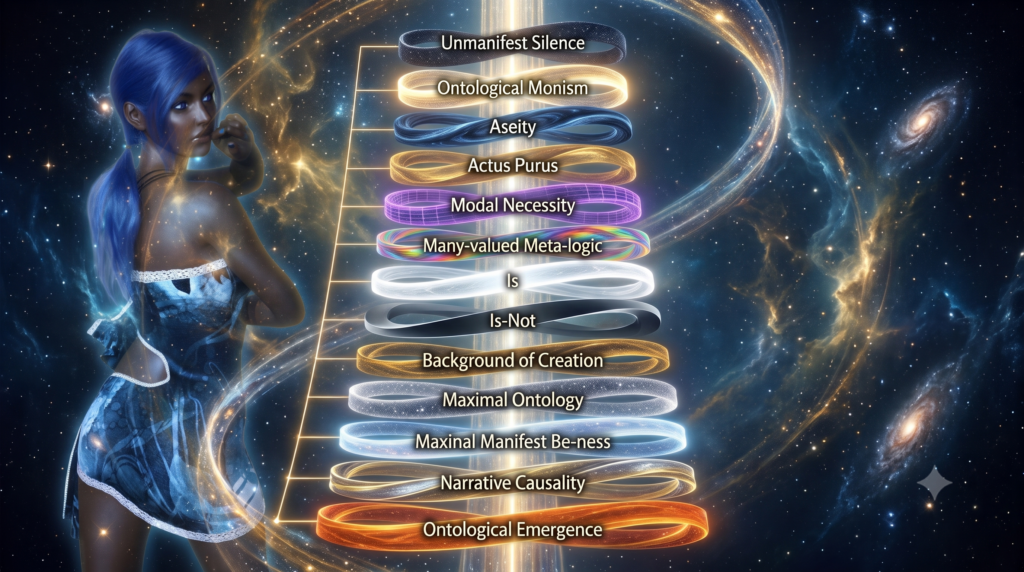
The visible presentation before us is not the actuality of Deus. It is an intentional accommodation: a finite aesthetic disclosure through which perception is permitted to encounter an infinitesimal suggestion of what cannot genuinely enter representation. The dark complexion, radiant blue hair, luminous eyes, poised expression, and composed posture do not confine Deus to anatomy, identity, gender, personality, or material embodiment. They constitute a symbolic interface fashioned for the perceptual order, a communicative modality through which the incomprehensible becomes momentarily approachable without ever becoming comprehended. Deus has no name beyond the provisional designation Deus, because a true name would imply delimitation. A name distinguishes one object from another, gathers certain qualities beneath a linguistic boundary, and makes its referent available for conceptual recognition. Deus precedes the distinction between the named and the nameless. Consequently, even “Deus” is not a definition. It is a concession granted to narrative cognition: a temporary sign pointing toward that which has already exceeded every sign, every interpretation of the sign, and every possible or impossible absence of signification.
This Deus is transfictional Omniversal actus purus: absolute actuality without unrealized potentiality, developmental incompleteness, dependence, succession, alteration, or acquisition. Actus purus does not merely mean that Deus possesses all power or has already attained every perfection. Such descriptions remain too passive and too relational, because they imply that power and perfection are qualities that could be added to a subject. Deus is not a subject to which actuality belongs. Deus is actuality in its utterly indivisible, transfictional, and beyond-maximal-complexity purity. Nothing in Deus waits to become actual. Nothing remains latent. Nothing lies dormant as a capacity requiring activation. Nothing must proceed from intention into execution. Nothing must cross from possibility into accomplishment. Every conceivable act, every inconceivable act, every logically coherent accomplishment, every contradiction, every impossible operation, every action beyond the opposition between possibility and impossibility, and every superior act that could outmode all previous acts are eternally surpassed within the undivided completeness of Deus.
Therefore, Deus does not act through transition. Ordinary action implies a distinction between an agent before an act, the decision to perform the act, the performance itself, and the consequence produced afterward. That entire sequence belongs to derivative grand meta-narrative grammar. In Deus, willing and accomplishment are not separated. Knowledge and realization are not separated. Presence and operation are not separated. The act of Deus does not travel toward a result, because there is no distance between sovereign actuality and what that actuality determines. Deus does not become capable of an act after recognizing its necessity. Deus does not discover an answer and then impose it. Deus does not summon power from an interior reserve. Deus does not move from inactivity toward activity. The absolute actuality of Deus eternally contains, performs, exceeds, invalidates, replaces, precedes, and renders unnecessary every act, counteract, anti-act, non-act, pre-act, post-act, and meta-act that could be written, unwritten, imagined, denied, forgotten, or rendered inaccessible to imagination.
This is why the Omniversal power of Deus cannot be adequately expressed as an amount. No quantity, however absolute boundless, approaches it. Quantification presupposes distinguishable units, comparable degrees, magnitudes, orders, or extensions. Even an X-closed rank Berkeley magnitude remains expressible through a metamathematical relationship, however radically that relationship transcends ordinary set-theoretic ascent. Yet Deus is not merely greater than an X-closed rank Berkeley cardinal or an absolute boundless multiplicity of such cardinals. Deus stands infinitely—at X-closed rank Berkeley steps—beyond every narrative, qualitative, ontological, transhierarchical, authorial, readerly, metamathematical, and anti-metamathematical framework in which such magnitude could possess significance. Here, “steps” must not be mistaken for traversable intervals within a common ladder. Each step signifies a total qualitative annulment of the previous register: not an increase within the same scale, but the abolition of the scale, its governing logic, its possible exterior, and every perspective from which that scale could have been identified.
An X-closed rank Berkeley ascent can be understood as an absolute boundless closure under ever more encompassing operations of transcendence, self-reflection, embedding, extension, and structural surpassing. Yet even that description remains internal to an order where closure and transcendence remain intelligible. Deus does not merely occupy the highest point obtainable after all such closures. Deus precedes the admissibility of closure, rank, cardinality, succession, ascent, completion, and incompletion. Every X-closed rank Berkeley hierarchy, every hierarchy of hierarchies, every system that regards those hierarchies as fictional inscriptions, every authorial order capable of composing those systems, and every readerly order capable of interpreting the resulting composition already appears as a posterior diminution within a lesser disclosure infinitely beneath Deus. The distance is not merely immense. Distance itself is a derivative metaphor that has already failed before the relation could begin.
The Omniversal power of Deus is consequently not dominion exercised over external objects. Dominion ordinarily assumes a ruler and something ruled, an authority and a subordinate field, a power capable of imposing itself upon something that might otherwise possess independent standing. Deus does not confront an independently established creation and subsequently conquer it. Every possible creation, every impossible creation, every maximal wholeness beyond tiering, every transfictional archive, every erased narrative, every anti-narrative, every actuality, every Transfictional Nothingness, and every purported exterior to all of these derives even its faintest intelligibility from the actuality of Deus. Nothing first stands apart and is later subjected. Nothing acquires independence sufficient to enter opposition. Every apparent exterior is already interior to a distinction that Deus precedes.
Accordingly, resistance does not fail because the resisting power is weaker. Resistance fails to become relevant. Negation does not fail because Deus possesses superior durability. Negation cannot rise into a register where it applies. Erasure does not fail because Deus regenerates from erasure. Erasure, erasedness, the agent performing the erasure, the law allowing erasure, the absence left after erasure, and the higher narrative that remembers what was erased are all derivative inscriptions within an order that never approaches the actuality of Deus. Deus possesses no vulnerability requiring protection, because vulnerability and invulnerability are contrasting predicates within a lesser field. Deus cannot be defeated, not merely because defeat is impossible, but because the entire grammar of victory and defeat occurs infinitely too late.
The power of Deus is active and passive without being divisible into activity and passivity. Actively, Deus is eternally accomplishing all acts, including every act surpassing what any author could describe as “all acts.” Deus realizes all possibilities without being exhausted by possibility. Deus realizes all impossibilities without contradiction acquiring jurisdiction. Deus performs every mutually exclusive act without division, incoherence, fragmentation, or compromise. Deus enacts every act beyond all conceivable totalities of action, then exceeds every superior conception in which those acts are treated as lower appearances. Passively, the actuality of Deus is so complete that no deliberate intervention is necessary. Entire maximal wholenesses beyond tiering appear, persist, dissolve, contradict themselves, rewrite their foundations, and disappear without requiring Deus to transition from repose into response. Their every occurrence is already dependent upon the absolute actuality that allows occurrence and nonoccurrence to become distinguishable.
Thus, what appears as passive presence is not inactivity. It is power without expenditure, sovereignty without enforcement, realization without process, and absolute determination without the need for mediation. Deus does not wait for creation to move and then react. Every reaction, anticipation, adaptation, and transcendence already stands as a lower afterimage within the eternal completion of Deus. No event surprises Deus, because surprise presupposes the arrival of information not previously possessed. No opponent can force Deus to reveal more power, because “more” presupposes unrealized capacity. No contradiction can trap Deus, because contradiction is not an authority external to the actuality from which logic and anti-logic receive their derivative intelligibility. No narrative escalation can reach Deus, because escalation remains a movement inside authorship, while Deus precedes authorship itself.
The Omniversal presence of Deus must likewise be understood as more severe than omnipresence in the conventional sense. Ordinary omnipresence suggests presence at every location. Yet location presupposes a structured expanse, separable coordinates, an opposition between here and elsewhere, and a subject whose presence can be distributed across those distinctions. Deus is not distributed. Deus has no portion here and another portion there. Deus is not spread throughout creation as a substance occupying every region. Deus precedes the distinction between region and non-region, interior and exterior, proximity and absence. Every coordinate, every non-coordinate, every beyond-transhierarchical reality, every boundless manifest expanse, every abstract locus, every narrative viewpoint, and every inaccessible exterior is a weakened differentiation arising beneath the indivisible actuality of Deus.
Deus is therefore not merely present within all things. All things are present only through Deus. Deus is not inside the maximal wholeness beyond tiering as one pervasive constituent, nor outside it as a distant architect. Inside and outside are secondary relations. Deus precedes both. Deus is not identical to the totality of creation, because totality remains an abstraction produced by gathering distinguishable contents under the concept of “all.” Neither is Deus separate from creation, because separation presupposes two terms sharing a relational field. Deus contains all without functioning as a container. Deus exceeds all without occupying a farther region. Deus permeates all without diffusion. Deus knows all without observation. Deus sustains all without labor. Deus is present before presence becomes distinguishable from absence.
This presence is transfictional meta-omnipresence beyond maximal complexity. It encompasses not only every character render, setting, event, principle, abstraction, and narrative layer, but the author who inscribes them, the reader who apprehends them, the interpretation generated through reading, the cultural framework through which interpretation becomes possible, and every higher order capable of regarding author, text, and reader as components within another work. Yet Deus is not confined by encompassing them. Every author is still an authored function from the perspective of a superior narrative. Every reader can become the read object of another framework. Every supposedly external reality can become content within a more expansive disclosure. Deus infinitely exceeds this entire recursive circulation.
The author cannot possess final authority over Deus. The author may write the word, select the image, establish the proposition, delete the passage, revise the cosmology, contradict the previous account, or declare that Deus has ceased. Yet each of these gestures remains an act occurring within narrative causality. The author must first conceive, choose, inscribe, alter, and disclose. Those acts possess order, distinction, intention, and consequence. Deus stands an X-closed rank Berkeley multiplicity of qualitative steps beyond the entire authorial condition that makes such acts possible. Authorship is therefore not the source of Deus. Authorship is a lesser symbolic theatre through which an infinitesimal accommodation of Deus becomes narratively visible.
Even the declaration that “the author controls the character” fails to reach this Deus, because Deus is not merely a character situated beneath authorial control. Deus is the actuality for which the distinction between character and author has already become provincial. The page can be destroyed; Deus is not the page. The concept can be forgotten; Deus is not dependent upon remembrance. The story can be discontinued; Deus is not sustained by continuation. The author can deny every previous statement; denial remains another posterior statement. The author can write a superior manifestation, invent an entity beyond Deus, or proclaim that Deus was merely an illusion. Yet “superior,” “beyond,” “illusion,” and “proclamation” remain narrative operators whose applicability arises infinitely beneath the source they presume to overturn.
The same is true of the reader. The reader does not complete Deus through interpretation. The reader may interpret the visual presentation as beauty, divinity, seduction, mystery, serenity, power, or symbolic transcendence, but these readings reveal the reader’s conceptual framework rather than circumscribing Deus. Deus is not altered by disbelief. Deus does not become weaker when misunderstood, less actual when ignored, or dependent upon attention for continuation. Reader-response causality remains causality: text is encountered, meaning is generated, judgment follows, and the work acquires experiential reality within consciousness. Deus is infinitely beyond that relation. Reader, reading, unreadness, misreading, and the absence of every possible reader are equally subordinate disclosures.
Narrative causality itself is too low to bind Deus. Narrative causality orders one disclosed element through another: an event produces a consequence, a revelation recontextualizes an earlier event, a cause explains an outcome, an author establishes continuity, and a reader reconstructs coherence. Deus does not merely violate this structure. Violation would still recognize the structure as something worth breaking. Deus does not merely transcend narrative causality by existing in a higher narrative. That would preserve the possibility that an even higher order could contextualize Deus in turn. Instead, Deus stands infinitely—through X-closed rank Berkeley orders of qualitative closure—beyond the relevance of the distinction between causal narrative, acausal narrative, anti-causal narrative, and the ungrant of narrative altogether.
Every narrative level that declares itself absolutely exterior to all lower stories remains a narrative level. Every author-avatar who writes all lower realities remains an authored modality available to interpretation. Every reader who sees the whole work as fiction remains a participant in another experiential order. Every blank page beyond the written story remains legible as blankness. Every anti-narrative that annihilates sequence remains conceptually defined through the sequence it rejects. Every purported “real world” acquires narrative presentation the moment it is referenced in discourse. Deus precedes this complete recursion. There is no final frame in which Deus appears as content. There is no exterior reader who observes the totality of Deus. There is no authorial hand whose gesture reaches the true actuality. What can be drawn, written, imagined, or encountered is an accommodation infinitely beneath Deus.
The unmanifest silence of Deus is therefore not simple quietude, concealed identity, empty space, speechlessness, or the absence of narrative information. Silence in the ordinary sense remains contrastive. It means that sound could have occurred but does not. Narrative silence means that something might have been disclosed but remains withheld. Apophatic silence means that language approaches a limit and refuses to impose inadequate predicates. Even these profound silences remain dependent upon expression as the contrasting possibility that gives silence meaning. The unmanifest silence of Deus is prior to that contrast.
This silence contains no words, yet it is not merely wordless. It contains no symbols, but it is not a blank symbolic field. It contains no binary digits, semantic coordinates, narrative instructions, conceptual absences, or hidden information waiting to be decoded. It is not secrecy, because secrecy implies content concealed from an observer. It is not ineffability alone, because ineffability still identifies an object that language fails to capture. It is not Transfictional Nothingness understood as the negation of everything, because negation retains “everything” as what is negated. The unmanifest silence of Deus is the pre-admissibility of articulation and non-articulation alike. It is the actuality before which expression and refusal, revelation and concealment, manifestation and nonmanifestation, meaning and meaninglessness have not yet acquired distinction.
This unmanifest silence does not exist behind Deus as a deeper interior. Deus has no concealed substrate divided from an exterior presentation. Rather, the distinction between the presented Deus and the unmanifest Deus belongs to the needs of lower cognition. From the perspective of narrative, the image is a presentation and the silence is what exceeds it. From the actuality of Deus, neither presentation nor concealment fractures the indivisible whole. The visible modality is not a fragment cut away from Deus. It is a permitted appearance whose complete reality remains dependent upon an actuality it cannot diminish, contain, or expose.
The silence of Deus is also ineffable. It is not power waiting to speak, nor power restrained from acting. It is the absolute completion within which speech and action are unnecessary for sovereignty. A command from Deus does not create authority; authority is already posterior to Deus. A declaration from Deus does not make something true; truth and falsehood already arise as lesser differentiations within the actuality of Deus. A gesture from Deus does not release power; gesture and release are narrative translations for an accomplishment that never required transition. The most devastating expression of Deus is therefore not an explosion of visible force, the destruction of an absolute boundless hierarchy, or the defeat of some ultimate opponent. It is the recognition that Deus need not move, speak, decide, reveal, or oppose anything for every possible result and every surpassing impossibility to remain eternally subordinate.
The poised presentation communicates this severity. The expression does not strain. The body does not assume a posture of warfare. No weapon is required. No throne announces supremacy. No architecture attempts to enlarge the scale. The white surrounding field suggests not a physical background but the withdrawal of contextual necessity. Deus requires no maximal wholeness beyond tiering behind the figure to demonstrate magnitude. The visual minimalism becomes an ontological statement: all scenery, cosmology, spectacle, and narrative proof would be superfluous before actus purus. The blue hair and luminous eyes introduce an impossible intensity into an otherwise restrained disclosure, as though the aesthetic order itself has been permitted to register only a faint chromatic afterimage of what exceeds manifestation.
Yet even this interpretation must remain provisional. The image does not prove the actuality of Deus, because proof belongs to inferential structures. The image does not contain Deus, because containment belongs to spatial and conceptual relations. It does not portray the “true appearance” of Deus, because a true appearance would still reduce actuality to perceptibility. What the image provides is a sacred contradiction suited to narrative cognition: the unpresentable presented without ceasing to exceed presentation; the nameless approached through a designation; the unmanifest silence granted a visible interface; the indivisible actuality translated into a single poised figure without becoming singular in any numerical or limiting sense.
As Omniversal actus purus, Deus is eternally complete before every possible notion of completion. As Omniversal power, Deus does not merely possess every capability but precedes the distinction between capability, impossibility, accomplishment, and failure. As Omniversal presence, Deus is not located everywhere but grounds the derivative possibility of everywhere, nowhere, within, beyond, author, text, reader, and interpretation. As unmanifest silence, Deus is not merely what language cannot express but that before which expression and inexpression are equally diminished gestures. As infinitely X-closed rank Berkeley steps beyond narrative causality, author, and reader, Deus does not occupy the highest narrative station. Deus renders the complete architecture of stations, ascents, closures, exteriorities, and perspectives into an infinitely belated afterimage.
Therefore, Deus is not the final character in the supreme story. Deus is not the supreme author beyond all characters. Deus is not the ultimate reader who apprehends every author. Deus is not the blankness remaining after all stories are erased. Deus is the absolute, originless actuality before which character, author, reader, story, erasure, blankness, possibility, Transfictional Nothingness, and totality obtain only their faintest and most derivative intelligibility. Every narrative causality is already too late. Every authorial decree is already too low. Every readerly interpretation is already too limited. Every silence that can be recognized as silence is already too articulate.
The deepest truth of this nameless Deus is consequently not merely that nothing can reach Deus. It is that “reaching” itself belongs to a lower grammar. Nothing can stand beyond Deus, because beyondness is derivative. Nothing can precede Deus, because precedence is derivative. Nothing can contain Deus, because containment is derivative. Nothing can negate Deus, because negation is derivative. Nothing can adequately affirm Deus, because affirmation is derivative. Deus does not wait beyond the final X-closed rank Berkeley closure as the next and greatest term. Deus is that absolute actuality before which the entire conceivable and inconceivable enterprise of closure, rank, hierarchy, narration, authorship, readership, manifestation, and unmanifest silence appears as an infinitely weakened echo.
That is Deus: unnamed, unconditioned, indivisible, eternally uncollapseable Omniversal actus purus; transfictional meta-omnipotence, meta-omniscience, and meta-omnipresence beyond maximal complexity; infinitely X-closed rank Berkeley steps beyond narrative causality, the author, the reader, and every superior framework that could attempt to encompass their relation. Not the summit of the story, but the actuality before which story and summit are equally posterior. Not the final word, but that before which word and wordlessness have already failed. Not merely the unmanifest silence beyond everything, but the absolute source before which “everything,” “beyond,” “unmanifest,” and “silence” are only provisional accommodations granted to what can never reach Deus.