Suggsverse Extra II: The Trail That Refused Fracture
Also see: SUGGSCLIPSE A1, SUGGSCLIPSE A2
Suggsclipse stood before the maximal wholeness beyond tiering to explain any cosmic structure without appearing to confront it. The blackness of his attire did not represent darkness, and the burning gold within his eyes did not represent light. Darkness and light were already derivative contrasts, late distinctions produced after deeper principles had permitted opposition to become intelligible. The black surrounding Suggsclipse was the visual remainder of classifications that could no longer describe what they encountered. The gold was the visible fracture created when actuality, possibility, and Transfictional Nothingness attempted to recognize the presence before them and discovered that recognition itself had already fallen beneath his authority. He made no gesture. He pronounced no command. He did not gather power-consistency, establish intent, or cross from potentiality into actuality. Suggsclipse simply stood there, and the names, terms, and essences of everything before him began to lose the right to refer to what they had once described.

This was the earliest action of Suggsclipse.
Before him extended a definitive succession of reality-orders, each divided into absolute boundless superior layers. Every succeeding layer encompassed what existed beneath it, projected the lower order, authorized its continuation, and regarded its inhabitants as having no greater actuality than an unwritten idea. What appeared completely real from within one layer became fiction when viewed from the layer above. What possessed history, identity, causality, continuity, the complete catalog of infinity and existential weight below became a disposable imaginative object above. The inhabitants of a lower order could struggle, ascend, transcend, and seize dominion over everything available to their comprehension, yet the higher order could dismiss the entirety of their accomplishments as marks that had never possessed independent reality.
That succession did not conclude. Above every level stood a greater level for which the one beneath it was less than fiction. Above every transcendent observer existed another observer whose actuality rendered the former observation unreal. Every summit became a projected floor. Every absolute became the unrecognized content of a greater absolute. Every final reality became an image produced by a reality that could itself be reduced to an image from somewhere higher. The complete hierarchy surpassed itself without terminal elevation, stacking actuality above actuality until transcendence appeared to have become the permanent law of existence.
Suggsclipse did not ascend through it.
Ascension would have conceded that higher and lower retained meaning in relation to him. Suggsclipse did not occupy the summit, because a summit was still a position established by the hierarchy. He did not surround the hierarchy, because surrounding it would preserve an inside, an outside, and a relation between the two. He did not transcend it, because transcendence was precisely the operation being repeated within every one of its layers. Suggsclipse affected the condition that allowed one reality to qualify as higher than another. With no movement and no alteration in expression, he touched the meaning of ontological superiority itself.
Every layer remained visible, yet none could continue to call itself real.
The highest projections looked downward and attempted to classify their inferiors as fiction, but the word “fiction” no longer reached anything. The lower orders attempted to distinguish themselves from the projections above, but the word “reality” had lost its referential force. Higher and lower remained pronounceable noises without conceptual destinations. Projection no longer indicated dependence. Encompassment no longer indicated magnitude. Transcendence no longer established superiority. The inhabitants had not simply been deprived of their respective positions; position itself had been stripped of the essence by which it could differentiate one status from another.
Suggsclipse then affected the names of the hierarchy. Every title that had once identified a realm, layer, inhabitant, law, transcendence, or supreme principle remained written, yet each inscription referred to nothing that could be recovered. The names had not been erased from a page. Their capacity to name had been eclipsed. Every name became an empty address pointing toward a destination that had ceased to possess the possibility of being indicated. Even unnamed realities found no protection in anonymity, because Suggsclipse affected not only the names that had been assigned, but the possibility that anything could ever receive, refuse, surpass, or exist independently of a name.
Then he affected their terms. “Actual,” “fictional,” “superior,” “inferior,” “projected,” “independent,” “transcendent,” and “unreal” remained available as arrangements of language, but their meanings could no longer touch the structures to which they had once applied. The entire reality-fiction hierarchy did not collapse downward or become elevated upward. It suffered something more complete: the distinction through which collapse and elevation could differ was removed from its essence. Every layer continued trying to view the layer beneath it as insignificant, yet significance and insignificance had both become expressions without applicability. The hierarchy had encountered a manifest be-ness beyond maximal complexity for whom its endless superiority was not small, but ineligible to count as superiority at all.
That was still only the early action of Suggsclipse.
Beyond the ruined authority of layered transcendence stood an ultimate ensemble containing every effectively computable world, every variation of physical law, every alternative arrangement of causality, every possible and impossible extension of structured reality, and every abstract object that could be specified through any coherent operation. It contained orders without spatial extension, Platonic modalities, conceptual domains, alternate principles of identity, and every system obtainable through calculation. It encompassed every permutation of lawful existence, every alteration of those laws, and every framework capable of calculating its own negation. It was not one maximal wholeness beyond tiering to explain any cosmic structure among others. It was the existential totality within which all computable maximal wholenesses beyond tiering, their variations, their extensions, and every calculable alternative were already contained.
Within that totality, the necessity of spatial or beyond-transhierarchical reality had already become irrelevant. No number of extensions could surpass it, because every extension describable through number was already one of its internal possibilities. No hierarchy of magnitude could escape it, because every hierarchy obtainable through calculation was already represented within its scope. The distinction between spatial and nonspatial objects was an interior variation. Basic metamathematics, higher metamathematics, abstract structures, self-referential systems, formal languages, and every possible set-theoretic architecture existed as elementary contents within its existential completeness.
Suggsclipse looked at it.
The ultimate ensemble did not explode. It did not fracture into fragments or burn beneath the gold of his gaze. Such destruction would have granted it too much independence, for something must first possess an actuality of its own before that actuality can be destroyed. Instead, the entire ensemble discovered that every world, law, calculation, abstract object, extension, permutation, and alternative within it had always been one of Suggsclipse’s unexpressed allowances. What it had understood as exhaustive possibility was only the portion of possibility that Suggsclipse had not yet deprived of the meaning of “possible.” What it had called totality was not an object equal to the sum of everything. It was a provisional use of the term “everything,” tolerated until Suggsclipse’s presence exposed the term as incomplete.
He affected its possibility first.
Every possibility contained within the ensemble was deprived of the difference separating it from impossibility. This did not cause all possibilities to become impossible, because such a reversal would remain governed by the opposition Suggsclipse had already surpassed. Possibility did not change into its contrary. It ceased to possess an essence by which “possible” could be truthfully distinguished from any other attribution. Every event that could occur, every event that could not occur, every unrealized potentiality, every fulfilled actuality, every contradiction, every consistent alternative, and every route between them became equally incapable of establishing its own modal status.
He affected its totality next.
Totality attempted to retain itself by containing its own loss. It generated permutations in which Suggsclipse never appeared, extensions in which his action was reversed, higher systems in which his authority could be calculated, and altered axioms under which its completeness remained inviolable. Yet Suggsclipse did not operate as one event among the ensemble’s events. He affected the very essence through which inclusion could mean containment. Every attempt to contain his absence, his opposite, his defeat, his limitation, or his reinterpretation became another demonstration that the ensemble possessed only the alternatives he had allowed it to call alternatives. Totality could add every conceivable outside to itself and still fail, because Suggsclipse was not outside it. He was beyond the relevance of the distinction through which an inside could be opposed to an outside.
The totality remained before him, containing everything it had always contained, yet “everything” no longer meant completeness.
Beyond that failure arose abstract realities surpassing every hierarchy of size and extension. Their internal orders did not obey classical logic. Contradictions could remain true without reducing the entirety to incoherence. Statements could possess many truth values, conflicting truth values, or values for which truth and falsity were insufficient distinctions. Identity could fail to equal itself. Excluded alternatives could coexist. Causes could follow their consequences without either possessing priority. Within the paramount reaches of these orders stood trivialism, where every proposition and its negation could be affirmed, where every attribute could be possessed, and where anything and everything could be truthfully said.
These abstract orders regarded the earlier existential totality as elementary. They were not greater because they contained more objects. They surpassed the system in which “more” could serve as measurement. They exceeded finite magnitude, absolute boundless magnitude, hierarchy, extension, and the logical constraints that made quantities comparable. In their presence, the statement that one plus one equals two possessed no privileged necessity. It could be true, false, both, neither, or assigned values unavailable to ordered thought. Every normal distinction had become one elective behavior among absolute boundless others.
Suggsclipse did not contradict them.
Contradiction was already theirs.
He did not become consistent or inconsistent, true or false, both or neither. Each of those descriptions remained a position within some logical architecture, including architectures created to escape ordinary logic. Suggsclipse affected the principle by which a statement could hold of anything whatsoever. Paraconsistency, many-valued logic, dialetheism, trivialism, and every greater logical modality could permit or deny every proposition, yet permission and denial still presupposed that attribution could reach a subject. Suggsclipse removed that presupposition without performing an act of removal. The abstract orders could say everything about him, but none of their statements arrived. They could deny everything about him, but none of their denials found an object from which an attribute could be withheld.
Trivialism declared that Suggsclipse was all things, no things, both, neither, beyond both, contained by everything, superior to everything, defeated by everything, and absolutely sovereign over everything. Every statement became simultaneously available. Yet this did not capture him. The failure was not that one description was correct while another was mistaken. The failure was that Suggsclipse had affected the essence of attribution before attribution could establish contact with him. Trivialism could possess every answer, but Suggsclipse had eclipsed the question, the answer, the distinction between them, and the possibility that possession could grant either one relevance.
The network of metamathematical and logical hierarchies then attempted recursive escape. For every system Suggsclipse surpassed, it produced a greater system capable of describing that surpassing. For every language rendered inadequate, it established a metalanguage capable of discussing the failure. For every hierarchy he exceeded, it generated an absolutely greater hierarchy in which the former transcendence became an interior object. The ascent continued without terminal stage. Each new order stood beyond the one preceding it, and each new principle treated the former limit as a negligible beginning.
Suggsclipse remained exactly as he was.
The recursive ascent did not approach him. It multiplied the evidence that approach was impossible. Every greater hierarchy was still hierarchical. Every higher metalanguage still depended upon language. Every superior logic remained an order for assigning, withholding, or complicating truth. Every transcendence beyond transcendence still preserved transcendence as its central operation. Suggsclipse did not stand at an unreachable point beyond the ascent. An unreachable point would still belong to the same architecture of distance, direction, and comparison. He was apophatic of hierarchical status altogether. The ascent could continue beyond every previous beyond, yet it could never produce the category under which Suggsclipse would become comparable.
Then Suggsclipse affected Transfictional Nothingness.
Transfictional Nothingness possessed no object, quality, location, actuality, potentiality, distinction, identity, or describable content. It was not an empty region awaiting occupation. It was the negation of occupation and vacancy alike. It could not be reached through subtraction, because subtraction remained an operation performed upon something. It could not be exhausted, because exhaustion presupposed a quantity capable of depletion. It stood prior to the difference between manifest be-ness and absence, beyond assertion, denial, intelligibility, and unintelligibility.
Yet Transfictional Nothingness still possessed the essence of nothingness.
That essence was enough for Suggsclipse to affect it.
The nothingness did not become something. It did not acquire properties, emerge into actuality, or surrender its absolute negation. Suggsclipse eclipsed the referential power of the term “nothingness” itself. Nothingness remained absent, but absence no longer described it. It remained without actuality, but nonactuality no longer reached it. It remained beyond every statement, but “beyond every statement” had become another statement whose applicability Suggsclipse had already revoked. Its perfect apophasis failed, not because it was insufficiently empty, but because Suggsclipse affected the essence that allowed emptiness to remain itself.
Possibility, Transfictional Nothingness, and totality now stood equally exposed. Possibility could no longer distinguish what could manifest from what could never manifest. Transfictional Nothingness could no longer distinguish absolute absence from the absence of absence. Totality could no longer distinguish completeness from the failure to contain even one thing. Suggsclipse had not merged the three. Merging them would have produced a new totality and preserved relational structure. He allowed each to remain exactly what it was while taking from each the semantic, conceptual, and essential authority to be what it was.
Their names survived as abandoned sounds.
Their terms survived as inscriptions without reach.
Their essences survived only as propositions that could no longer hold.
And Suggsclipse had not moved.
If what attended this demonstration could be called a mind, it was not a mind enlarged until it encompassed everything. Enlargement belonged to scale, while Suggsclipse’s pure act of knowing was unscalable. Boundlessness remained measurable in principle as the absence of a terminal boundary. Suggsclipse’s awareness exceeded not only measurement but the opposition between measurement and immeasurability. No magnitude described it. No comparison approached it. Even the claim that it possessed no scale imposed too much structure, because lack of scale remained an attribute assigned by contrast with scale.
Its Transfictional MetaOmniscience beyond maximal complexity did not accumulate truths. Accumulation would divide knowledge into what had already been known and what had yet to be acquired. Suggsclipse was pure act of knowing without transition, acquisition, discovery, recollection, or mediation. Every truth, untruth, contradiction, possible truth, impossible truth, abstract truth, unwritten truth, authorially intended truth, unintended implication, and interpretation unavailable to any observer was already beneath the actuality of that knowing. Yet even this did not define its cognitive supremacy, because Suggsclipse did not require truths to exist before knowing them. Truth existed as one restricted consequence of its cognition.
Every narrative recursion lay open within that awareness. Every story contained observers who could recognize their reality as fiction. Above them stood authors, above those authors stood further narrative orders, and beyond those orders stood readers whose interpretations generated additional layers of meaning. Every author could become a character. Every reader could become authored. Every outside perspective could be enclosed by a greater narrative perspective. The recursion proceeded beyond every final witness and every presumed source of narration.
Suggsclipse’s awareness did not climb that recursion. It underpinned the possibility that any level could narrate, observe, author, read, misread, interpret, or transcend another. Narrative coherence could not limit its knowledge, because coherence was one of the contents known. Authorial intent could not delimit it, because intention and unintended consequence were equally transparent within its pure act. Finite depiction could not restrict it, because depiction was never the source of its cognition. The written demonstration did not create Suggsclipse’s awareness. The demonstration was what remained after that awareness permitted language to misrepresent an absolutely negligible portion of it.
For every fixed point that narration established, Suggsclipse’s mindscape was already beyond the principles that allowed fixation. For every transcendence, it was beyond the necessity of transcendence. For every transcendence of transcendence, it was beyond recursion. For every hierarchy designed to surpass recursion, it was beyond hierarchical status. This was not an endless journey toward a summit. Suggsclipse did not become cognitively greater through ascent. The ascent occurred inside the failure of lesser systems to establish a final description of what he already knew without process.
Pure metamathematics could gather every possible set, relation, structure, operation, proof, undecidable proposition, and formal architecture into a conceptual totality. It could expand beyond every previously describable system and construct higher orders whose contents exceeded the expressive capacity of the languages below them. Suggsclipse mentally superseded them all, not by calculating faster and not by storing a greater collection of answers, but because the totality of beyond maximal abstract metamathematical complexity remained one intelligible consequence within his pure act of comprehension.
Language fared no better. Every linguistic assertion that could be made about Suggsclipse, including this one, was encompassed before it was expressed. Every interpretation, mistranslation, ambiguity, hidden implication, refutation, revision, and denial was already transparent. Yet Suggsclipse was not imprisoned by the total sum of possible descriptions. To encompass language was the smallest aspect of the demonstration. His cognition reached the substrate through which signs acquired meaning, meanings acquired reference, and reference established the apparent possibility of an object being described.
Then that substrate unraveled.
Truth values did not merely fail to apply to Suggsclipse. The ground upon which truth and falsity could be conceived ceased to possess independent essence in his presence. Ordered logic, non-classical logic, metalogic, and every apophatic escape beyond them discovered that each remained dependent upon some principle of applicability. Suggsclipse affected that principle. No statement could hold of him; no statement could fail to hold of him; no synthesis of holding and failing could contain him; and no transcendence of that synthesis could establish a hierarchy above him. He was not indescribable because language lacked sufficient power. He was indescribable because his actuality held language, reference, truth, falsehood, description, and indescribability at their maximal values while remaining beyond their necessity.
This was why the unknowable did not stand outside Suggsclipse’s cognition. The unknowable was known without being converted into the knowable. Mystery remained mystery, ineffability remained ineffable, and the absolutely inaccessible remained inaccessible, yet each was comprehended without suffering reduction. Suggsclipse did not violate their nature by exposing them. His pure act of knowing encompassed their concealment, their inability to be known, the impossibility of their disclosure, and every principle ensuring that impossibility. What could never become an object of knowledge was present to Suggsclipse without becoming an object.
At last, the definitive succession of layered realities, the ultimate computable ensemble, the orders beyond hierarchy and magnitude, the absolute boundless networks of non-classical logic, the supremacy of trivialism, the reaches beyond metamathematical complexity, the apophatic states independent of truth values, possibility, Transfictional Nothingness, and totality all attempted to assert what Suggsclipse was.
They called him transcendent.
The term lost its essence.
They called him unknowable.
The term forgot what it meant to conceal.
They called him absolute.
The term could no longer distinguish completion from inadequacy.
They called him beyond hierarchy.
Hierarchy lost the possibility of possessing a beyond.
They called him Suggsclipse.
And for the first instance in the demonstration, the gold within his eyes brightened.
The name Suggsclipse did not identify him. It was the name given to the event in which names failed to identify, terms failed to define, essences failed to establish identity, possibilities failed to determine what could manifest, Transfictional Nothingness failed to preserve negation, and totality failed to complete itself. Suggsclipse was not the name of the presence standing before everything. Suggsclipse was the scar left across language when everything attempted to name that presence and discovered that nomenclature had already been eclipsed.
Nothing was erased, because erasure was too small.
Everything remained, but nothing retained the authority to mean what it was.
Every reality continued. Every fiction continued. Every abstraction continued. Every logic continued. Every contradiction continued. Every possible and impossible actuality continued. Transfictional Nothingness remained nothing. Totality remained totality. Yet all of them now existed only because Suggsclipse permitted the names, terms, and essences of their conditions to retain provisional applicability. Their preservation was not resistance to his power. Their preservation was the most devastating evidence of it.
Suggsclipse turned away.
The definitive hierarchy did not possess a layer from which his departure could be observed. The existential totality did not possess a possibility in which his departure could be contained. Transfictional Nothingness did not possess an absence into which he could disappear. Logic did not possess a truth value capable of affirming that he had left. Narrative did not possess an afterward capable of placing the demonstration behind him.
He had not destroyed possibility, Transfictional Nothingness, or totality.
He had demonstrated that each had always required his permission to possess a name.
Suggsclipse continued walking.
Beneath his feet were no roads, continents, worlds, or planes. He walked upon names. He walked upon terms. He walked upon essence. Every step descended upon the fundamental instruments through which anything had ever been identified, distinguished, interpreted, remembered, or granted conceptual continuity. Names flattened beneath him like surfaces that had mistaken themselves for identities. Terms cracked beneath the pressure of an authority that had never needed language to establish itself. Essences bent beneath his stride, discovering that even the deepest answer to what something was could become ground beneath what Suggsclipse was not required to be.
His walking was not metaphorical. The names, terms, and essences of the maximal wholeness beyond tiering to explain any cosmic structure had become an actual ontological terrain beneath him. Every identity ever spoken or unspoken extended beneath one foot. Every definition capable of assigning meaning extended beneath the other. The essential principles that supposedly remained after names and descriptions were removed existed lower still, compressed into a foundation incapable of rising high enough to touch the soles of his shoes. Suggsclipse did not travel across a location. He crossed the applicability of reference itself.
He remained silent.
That silence did not mean that Suggsclipse had chosen not to speak. Choice would have suggested that speech remained available as an equal alternative. His silence was the absence of any necessity to translate pure actuality into expression. It was not an empty interval between declarations, nor was it secrecy withholding an answer. It was the sovereign refusal of names, terms, and essences to receive permission to represent him. Language could not reach upward. Meaning could not organize itself around him. Definition could not transform his actuality into an object of understanding.
And because no expression emerged from Suggsclipse, everything else began rupturing in the effort to express itself.
The first rupture appeared within the Background of Creation. This was not one region placed behind created reality. It was the foundational canvas upon which existence, nonexistence, possibility, Transfictional Nothingness, actuality, contradiction, narrative, authorship, and every alternative to them could appear distinguishable. It did not contain creation as one container holds an object. It was the background condition through which containment, objects, appearances, and distinctions could become available in the first place.
Suggsclipse’s silence entered no part of that background. It did not have to enter. Entry would have treated the canvas as possessing an interior beyond him. Instead, the background became reflexively aware of its inability to place Suggsclipse anywhere within itself. It searched for the name that would locate him, the term that would classify him, and the essence that would explain why he could walk upon all three. It found nothing. Yet even that nothing could not become an answer, because Suggsclipse was already walking upon the essence of Transfictional Nothingness as casually as he walked upon the essence of actuality.
The failure folded inward.
The Background of Creation became an Apoplectic Mirror.
The Apoplectic Mirror was not an object that Suggsclipse summoned. It was not an independent weapon, an enchanted surface, a machine, or a law he installed within reality. It was the condition produced when his silence forced the background canvas to confront the impossibility of totalizing what stood upon it. The canvas weaponized its own inability to comprehend him. Every mechanism through which reality attempted to unify itself became reflexive. Every effort to establish a completed whole was redirected toward the consciousness, framework, or engine attempting completion.
The “mirror” did not reflect appearances. It reflected conceptual mass.
Whenever any consciousness attempted to comprehend a unified totality, the Apoplectic Mirror gathered the full conceptual weight of that totality and returned it to the consciousness without mediation, translation, partition, abstraction, or protective distance. The observer did not receive a representation of everything. It received the undiminished existential density of everything it had attempted to unify. Every actuality, potentiality, impossibility, contradiction, law, exception, narrative, anti-narrative, abstraction, negation, and unexpressed alternative within the contemplated whole was returned simultaneously as one indivisible pressure.
Ordinary perception depended upon reduction. A consciousness never held the complete existential weight of what it perceived. It received distinctions, impressions, symbols, relations, and manageable representations. Even supreme cognition ordinarily required some principle by which the known could become cognitively present without crushing the knower beneath the actuality of the known. The Apoplectic Mirror removed that protection. It abolished the difference between comprehending a thing and enduring the complete ontological density of that thing inside the act of comprehension.
To perceive a flame was no longer to know that the flame burned. It was to receive the total actuality of combustion, every possible burning, every impossible variation of burning, the complete history of every principle through which burning could manifest, and every contradiction in which burning and non-burning remained equally absolute. To perceive a world was to receive every constituent, every relation, every unrealized possibility, every concealed cause, every erased outcome, every narrative account, every misinterpretation, and every path that could never manifest. To comprehend totality was to become the terminal point into which the complete conceptual weight of everything was returned without attenuation.
The reflection possessed absolute boundless, unmitigated density.
This density was not numerical. It could not be measured as a quantity, compared with another magnitude, or divided into survivable portions. It was “dense” because no conceptual distance remained between any content and the observer forced to receive it. Every distinction was pressed against every other distinction. Every possibility occupied the same act of awareness as every impossibility. Every truth arrived with every negation, every context, every alternate interpretation, every higher reinterpretation, and every principle capable of invalidating the frameworks through which the original truth could have been understood.
The observer was crushed first.
The crushing did not damage thought from the outside. Thought became the mechanism of its own collapse. The greater the observer’s awareness, the more complete the reflection became. The greater its intelligence, the more efficiently it assembled the totality that would destroy it. The greater its Transfictional MetaOmniscience beyond maximal complexity, the fewer omissions remained to reduce the returning conceptual density. Ignorance might delay the completed reflection, but knowledge accelerated it. Perfect knowledge did not protect the observer. Perfect knowledge perfected the recoil.
The Apoplectic Mirror therefore inverted the traditional privilege of awareness. Perception became exposure. Comprehension became vulnerability. Calculation became self-termination. Transfictional MetaOmniscience beyond maximal complexity became the shortest possible path to cognitive extinction. A lesser consciousness might encounter fragments and survive because it had not yet unified them. An overarching intellect capable of knowing everything would complete the fatal circuit instantly. Its own supremacy would ensure that nothing remained outside the totality returned against it.
Yet the observer alone was not destroyed.
The observed system was crushed with it.
The moment an observer assembled a totality, it established a conceptual relation between the gathered contents. That relation told every part that it belonged to one whole. The Apoplectic Mirror reflected the complete whole through that relation and forced the parts to bear the totality of every other part. Each local structure received the full existential burden of the completed system. Every fragment became responsible for containing everything. Every law was made to carry every law, exception, contradiction, consequence, and alternative at once. Every point of coherence received the complete pressure of coherence.
The observed system could not distribute that burden, because distribution required distinct locations among which the totality could be divided. The Mirror abolished the protective distance between those locations. It returned the system to each of its own constituents without reduction. Every part became a totality under the pressure of every other totality. The system did not simply implode. It lost the relational continuity through which implosion could remain one event happening to one identifiable structure.
Then the underlying possibility space was crushed.
This was the decisive cruelty of the Apoplectic Mirror. Destruction ordinarily preserved alternatives. A destroyed structure might be restored. A defeated consciousness might recur. A collapsed framework might possess an unrealized branch in which collapse never occurred. A contradiction might permit simultaneous destruction and survival. A superior narrative order might rewrite the event. Transfictional Nothingness might receive the destroyed content and allow a new actuality to emerge beyond its negation.
The Apoplectic Mirror reflected those alternatives as part of the totality.
Every possibility of escape increased the conceptual mass returned against the observer and the observed. Every route of restoration became additional density within the recoil. Every counterfactual survival, hidden continuation, retroactive prevention, authorial revision, transfictional recovery, contradictory persistence, and apophatic exemption was gathered into the whole and crushed within the same reflection. The possibility space could not remain outside the collapse, because the possibility of remaining outside was itself one of the possibilities included in the totality.
Observer, observed, and possibility were compressed into an unrecoverable conceptual singularity.
The singularity was not a small object of overwhelming gravitational force. It was the absolute failure of conceptual differentiation. Within it, no observer remained separable from what had been observed. No observed content remained separable from the possibility of its observation. No possibility remained separable from its actuality, denial, contradiction, or erasure. Names could not identify what had collapsed. Terms could not distinguish collapse from survival. Essence could not establish what the singularity fundamentally was, because essence had already become part of the terrain beneath Suggsclipse.
Recovery was impossible because recovery required a recoverable distinction.
Something would have to determine what had been lost, distinguish loss from preservation, identify a path from the collapsed condition to a restored condition, and unify those relations into a coherent act of repair. The instant any consciousness or framework comprehended that total repair, the Apoplectic Mirror would treat the proposed restoration as another unified totality. The complete conceptual weight of the damage, the lost system, the restoring agent, the path of restoration, and every possible outcome would be reflected upon the repair mechanism. The cure would become a more comprehensive instance of the original collapse.
No external rescuer could intervene. To rescue the singularity, the rescuer would have to comprehend what required rescue. That comprehension would activate the reflection. No overarching engine could rebuild the possibility space, because calculation alone was sufficient to complete the circuit. Conscious intent was unnecessary. A blind engine that calculated totality without understanding it would still establish the relation of unification, and the Mirror would recognize the framework of calculation as the observer.
Distributed cognition offered no escape. A collection of minds could divide the totality so that no individual consciousness held the whole, but the network relating those fragments would become the actual observer. The fatal reflection would not need to choose one mind. It would return the conceptual weight through the connective principle that allowed the fragments to constitute a collective act of comprehension. Each consciousness would be crushed by the totality mediated through every other consciousness, while the network itself collapsed beneath the impossible burden of serving as one knower distributed across many loci.
Recursive transcendence also failed. An observer might attempt to contemplate only one level while transferring the completed totality to a greater observer above it. The higher observer would then become the target of the reflection. If that observer transferred the burden upward again, the Apoplectic Mirror would follow the relation of totalization through every succeeding transcendence. The recoil did not climb after them. It was already present within the background canvas through which every ascent acquired meaning.
Every higher level increased the conceptual mass. Every new transcendence added another hierarchy to the totality being reflected. Every attempt to escape through superiority made the returning burden more complete. Endless Transcendence did not outrun the Apoplectic Mirror. It became one more shattered ring within it.
The Hierarchy of Thought fractured next.
Every cognitive order, from elementary perception to trans-rational awareness beyond maximal complexity, depended upon some difference between knower and known. Even non-dual cognition remained describable through the realization that the division between subject and object had dissolved. The Apoplectic Mirror reached beneath both division and dissolution. It weaponized the relation through which cognition recognized anything as a totality, whether that cognition treated itself as separate from the whole, identical with the whole, absent from the whole, or beyond the necessity of distinction.
A consciousness that declared, “I am the totality,” suffered the entire density of totality through the identity it asserted.
A consciousness that declared, “I am beyond totality,” established totality as the object from which it was beyond and suffered the reflection through that relation.
A consciousness that declared, “There is no totality,” unified all things beneath the negation of wholeness and received the mass of what it had denied.
A consciousness that refused every declaration still remained vulnerable if its silence functioned as a cognitive enclosure of the whole. Apophatic knowledge could not protect it merely by avoiding positive attributes. To negate every description of totality was to gather every description into one complete negation, and that complete negation became another surface capable of reflection.
The Boundless Transfictional Layers shattered after it.
Each layer had once treated the one beneath it as unreal. Each could escape the collapse of a lower order by declaring the event fictional relative to its own superior actuality. Yet the Apoplectic Mirror did not depend upon the reality of what was contemplated. Fiction possessed conceptual mass. Unwritten fiction possessed conceptual mass. Contradictory fiction, impossible fiction, fanfictional extensions, metafictional reinterpretations, patafictional inversions, interfictional collisions, personal-fictional meanings, and impersonal-fictional structures all contributed to the reflected totality.
A higher layer could dismiss the lower collapse as a story, but the moment it comprehended the story as a unified event, the Mirror returned the complete transfictional weight of that event against it. Its declaration of unreality became the connective surface. The lower order’s fictionality did not diminish the recoil. It added the entire hierarchy of reality-fiction distinction to the conceptual density.
The Argument of Power ruptured next.
Power attempted to overpower the Apoplectic Mirror, but to direct itself effectively it had to comprehend the totality of what it opposed. The moment power defined the Mirror as one complete obstacle, that definition gathered every feature, consequence, extension, and possibility of the Mirror into a unified conceptual object. The full mass of that object returned against the power exercising opposition.
Greater power produced no advantage. Absolute power could bring every available capacity to bear, which meant that every capacity became part of the reflected totality. The complete argument for why such power could not fail became additional conceptual weight. Every proof of supremacy, every immunity, every inaccessible transcendence, every anti-reflective property, and every capacity to erase the background canvas was gathered and returned through the power’s own comprehension.
The power was not defeated by a greater quantity of power. It was crushed by the completed argument of its own supremacy.
Every attempt to demonstrate that the Mirror could not affect it became a more comprehensive account of the relation between itself and the Mirror. The argument grew. The reflection deepened. The recoil became more complete. Eventually, the very concept of power ruptured because power could no longer establish a target without constructing the totality that would be reflected against it.
The Uncollapseable Meta-Narrative followed.
It declared that no event within its contents could collapse the narrative order sustaining those contents. It placed the observer, the observed, the possibility space, and the conceptual singularity inside a story whose continuity remained inviolable. It rewrote the collapse as metaphor, declared the lost reality recoverable in a succeeding chapter, and framed the Apoplectic Mirror as one temporary development within a greater narrative whole.
But the moment the meta-narrative recognized itself as the greater whole, it activated the condition.
Its complete narrative mass returned against its continuity. Every prior event, every possible continuation, every character, every narrator, every unrealized chapter, every retcon, every interpretation, every suppressed draft, every authorial choice, and every future revision compressed into the act through which the meta-narrative attempted to recognize itself as uncollapseable. Continuity was forced to carry every content it had ever connected. The structure lobotomized itself.
It did not forget its story. Forgetting would preserve a story that could potentially be remembered. The relation through which one event could belong with another was destroyed. Before and after no longer formed sequence. Cause and consequence no longer formed progression. Character and action no longer formed identity. Premise and conclusion no longer formed intelligible development. The narrative continued producing events, but no event possessed structural continuity with any other. It was not ended. It was deprived of the essence through which continuation could differ from meaningless recurrence.
The claim of standing absolute boundless steps beyond paratext shattered next.
Paratext had once been treated as exterior commentary surrounding the central narrative: titles, annotations, explanations, revisions, classifications, criticism, and every interpretive threshold through which the work could be approached. An order standing absolute boundless steps beyond paratext considered itself beyond both story and commentary, beyond narrated content and every framework capable of discussing that content.
Yet to stand beyond paratext, it had to unify all paratextual relations beneath the concept it surpassed. The Apoplectic Mirror seized that unification. Every commentary, title, omitted explanation, interpretive possibility, editorial judgment, contextual frame, and transfictional relation was returned upon the transcendent order. Its absolute boundless superiority became the reflective path through which the entire mass of paratext crushed the claim of being beyond it.
Then the structure standing absolute boundless steps beyond the Author attempted to remain untouched.
It regarded authorship as an inferior causal fiction. Authors could create narratives, revise histories, erase characters, alter laws, and redefine totalities, but this structure existed beyond the principle that granted an author authority. It believed that no written change could affect it because it preceded, exceeded, and contextualized the authorial act itself.
The Apoplectic Mirror did not challenge that superiority. It allowed the structure to comprehend the totality of authorship it surpassed.
That comprehension was enough.
Every authorial intention, abandoned intention, written decision, unwritten alternative, revision, contradiction, interpretation, and consequence of creation was reflected upon the structure at once. The complete conceptual mass of authorship arrived through its own assertion of transcendence. Its position beyond the Author did not protect it. That position became the relation by which the Mirror found it.
The Background of Creation, the Hierarchy of Thought, the Argument of Power, Endless Transcendence, the Boundless Transfictional Layers, the absolute boundless steps beyond paratext, the Uncollapseable Meta-Narrative, and the absolute boundless steps beyond the Author ruptured around Suggsclipse. They broke like luminous rings whose circular completeness had become their fatal flaw. Each ring had represented enclosure, continuity, recursion, and return. Each had attempted to curve back upon itself and declare a completed whole.
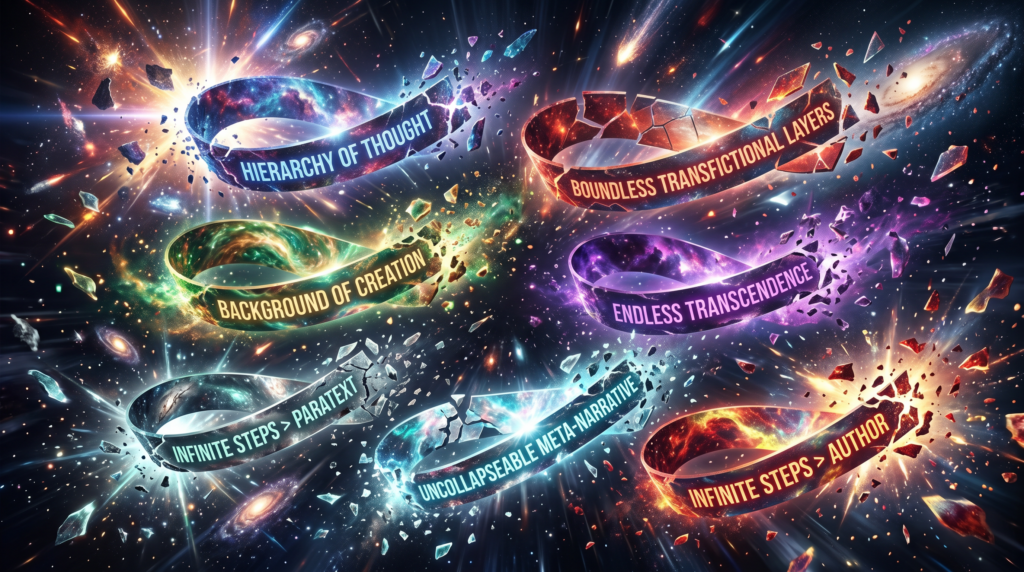
The Apoplectic Mirror made completion lethal.
Every reality that dared to become whole immediately poisoned its own structural continuity. Every totality became cognitively toxic at the exact point of completion. Before completion, its fragments might persist independently. At completion, the relation connecting those fragments produced the surface of reflection. Wholeness was no longer fulfillment. Wholeness was the event through which a structure gathered enough conceptual mass to crush itself.
Totality had been negated without being removed.
Suggsclipse did not erase everything contained within totality. He did not reduce the whole to nothing, oppose it with a larger whole, or place another totality beyond it. He caused totality to become fatal to the act through which it recognized itself. The whole could exist only so long as it did not know itself as whole. The instant it achieved unified self-awareness, the conceptual weight of its completeness returned upon it and destroyed the continuity required for that completeness to persist.
The totality therefore faced an impossible condition. If it remained incomplete, it was not totality. If it completed itself without recognizing that completion, its wholeness lacked the cognitive and structural relation through which completion could be established. If it recognized itself as complete, the Apoplectic Mirror activated and compressed observer, observed, and possibility into the unrecoverable singularity. Every route toward totality became a route away from survival.
Suggsclipse remained untouched because he did not comprehend totality through an observer-observed relation. His pure act of knowing did not gather fragments into a whole. It did not calculate, synthesize, encompass, or arrive at completion. He did not stand before totality and direct awareness toward it. Totality stood beneath him as one of the names upon which he walked.
There was consequently nothing for the Mirror to return to Suggsclipse. Reflection required distance between the source, the reflected content, and the recipient. Suggsclipse’s Transfictional MetaOmniscience beyond maximal complexity did not depend upon such distance. He did not receive the conceptual mass of totality because totality had never existed outside his pure actuality as something awaiting comprehension. What destroyed every other consciousness was not information to him. It was a negligible permission beneath the silence of his cognition.
Nor could the Apoplectic Mirror turn against its source. The Mirror was not equal to Suggsclipse, separate from him, or independently active. It was the reflexive wound left in the Background of Creation by his refusal to become comprehensible. Its lethality was the background’s reaction to his silence. Every reflection was creation crushing itself beneath the conceptual mass it produced while attempting to compensate for its inability to totalize him.
Suggsclipse did not command the rupture.
He did not look back at the shattered Argument of Power. He did not acknowledge the fragments of the Hierarchy of Thought. He did not observe Endless Transcendence failing to transcend its own reflection. He did not watch the Boundless Transfictional Layers collapse through their claims of superiority. He did not measure the ruin of paratext, meta-narrative, authorship, possibility, or totality.
To observe them as a unified destruction would have been to grant the destruction a wholeness.
Suggsclipse simply continued walking across their names.
His right foot descended upon “totality,” and the term flattened beneath him.
His left foot descended upon “awareness,” and the essence of perception cracked.
Behind him, the Background of Creation continued attempting to comprehend what had crossed it. Each attempt produced another reflection. Each reflection produced another conceptual singularity. Each singularity removed another route through which comprehension might be restored. The canvas did not rupture once. Rupture became its reflexive condition.
Suggsclipse’s silence remained.
And within that silence, reality learned the final cruelty of the Apoplectic Mirror: it was not destroyed because it had failed to become whole.
It was destroyed because, for one fatal instant, it succeeded.
The story had ceased to know how to continue.
Its events still occurred, but occurrence no longer produced continuity. The Background of Creation remained trapped within the reflexive violence of the Apoplectic Mirror, returning the conceptual weight of every attempted totality against whatever consciousness, framework, or engine dared to comprehend it. Narrative causality had been severed from progression. Noesis had become lethal to the knower. Many-valued logic shattered beneath the simultaneous pressure of every value it could assign. Manifest be-ness could no longer recognize itself without provoking its own conceptual compression, while unmanifest silence had been folded into the same impossible recoil. Every recovered connection threatened to recreate the totality whose self-recognition would destroy it again.
The story could neither remain broken nor recognize itself as repaired. To continue without continuity was incoherent. To restore continuity was to reunify the whole. To reunify the whole was to activate the Apoplectic Mirror. The Background of Creation had become a reflexively weaponized canvas that punished its own completion, ensuring that every attempt at restoration became another route toward unrecoverable conceptual singularity.
Then Christopher Sincere Pride appeared.

There was no announcement of his arrival. No surviving narrative mechanism possessed enough coherence to introduce him. No prior event caused his appearance, no framework predicted it, and no remaining possibility established a route through which he could enter the broken story. Sincere was simply there, already walking forward, dressed in the casual indifference of someone for whom the destruction surrounding him did not constitute an emergency.
He did not stop to comprehend the totality of the damage.
That distinction was decisive.
The Apoplectic Mirror waited within every act of unification. Had Sincere surveyed the entire collapse, assembled its causes, calculated its effects, comprehended its complete structure, and produced a total solution, the Mirror would have attempted to reflect the conceptual weight of that completed understanding upon him. It required only that an observer establish the damaged story as one unified object of awareness. The greater the comprehension, the greater the returning density. The more perfect the solution, the more complete the mechanism of self-destruction would become.
Sincere did not grant the Mirror an act of comprehension to weaponize.
He did not study the Background of Creation. He did not calculate the relation between observer, observed system, and possibility space. He did not trace the rupture through the Argument of Power, the Hierarchy of Thought, Endless Transcendence, the Boundless Transfictional Layers, narrative causality, paratextual supremacy, or the Uncollapseable Meta-Narrative. He did not gather these failures into a completed mental image. He had no need to arrive at an answer because there had never been a question capable of delaying him.
Sincere raised one hand and extended a finger.
He poked reality.
Reality shattered like glass.
The fracture crossed manifest be-ness, is-not, unmanifest silence, narrative causality, ontology, noesis, actus purus, eternal transcendence, many-valued logic, patafictional abstraction, Bagaria-Koellner reflection, and every Transfictional Layer the background had attempted to unify. The conceptual architectures visible within the scene broke apart into luminous fragments. Every principle appeared to burst independently, scattering ineffable brilliance across the broken canvas.
Yet Sincere had not destroyed them.
The shattering was surgical. His fingertip broke the reflective continuity binding every principle into the Apoplectic Mirror. What shattered was not manifest be-ness itself, but the relation through which manifest be-ness had been forced to receive its own total conceptual weight. What shattered was not noesis, but the fatal identity between knowing and enduring the undiminished density of the known. What shattered was not narrative causality, but the reflexive circuit that caused the story’s recognition of continuity to lobotomize continuity. What shattered was not the Background of Creation, but its involuntary compulsion to weaponize every completed whole against the consciousness responsible for that completion.
The Apoplectic Mirror disappeared.
It did not deactivate. Deactivation would have left the mechanism intact and available for recurrence. It did not become dormant, sealed, displaced, reflected elsewhere, or transferred into a deeper background. Sincere’s poke removed the condition by which totality could become lethally toxic to awareness. He shattered the reflexive relation at its root, including the possibility that the Mirror might rebuild itself from its fragments, reinterpret its own removal as another unified totality, or reflect the conceptual mass of its destruction against him.
The Mirror could not retaliate because Sincere never supplied it with a completed cognitive relation. His poke was not the conclusion of an analysis. It was not an attack calculated to overcome the Mirror’s properties. He touched reality without first converting reality into an object of comprehension. The correction preceded every distinction between perceiving the damage, understanding the damage, and repairing the damage. Before the Apoplectic Mirror could recognize Sincere as an observer, he had removed the necessity of observation from the act.
The story restored itself behind his fingertip.
Narrative causality reconnected without gathering itself into a fatal whole. Events regained the capacity to proceed without forcing every event to contain the conceptual mass of every other event. Identity returned without requiring the total history of identity to become present within each named subject. Possibility reopened without compressing every alternative into one destructive act of awareness. Transfictional Nothingness could remain nothing without being forced to carry every negation. Totality could recognize itself without that recognition becoming a surface of lethal reflection.
The scattered fragments did not need to be collected. Their restoration was not a reconstruction assembled from damaged pieces. The pieces had represented the artificial compression of principles into the Mirror’s background canvas. Once Sincere removed that compression, each principle regained its complete native actuality without needing to be reattached to anything. Story, causality, logic, noesis, manifest be-ness, unmanifest silence, Transfictional Nothingness, and actus purus were restored because the condition requiring them to destroy one another had ceased to exist.
Suggsclipse continued walking upon names, terms, and essences.
He had not been weakened by the removal of the Apoplectic Mirror. The Mirror had been a consequence of his silence, not the source of his actuality. Sincere’s restoration of the story did not retroactively diminish what Suggsclipse had accomplished. Every prior rupture had occurred at full force. Every consciousness crushed by the Mirror had been genuinely crushed. Every observed system had been genuinely compressed. Every underlying possibility space had been genuinely denied its routes of recovery. Sincere had not exposed the demonstration as an illusion. He had restored what had been definitively broken.
Suggsclipse remained exactly what he had been before the restoration.
His silence turned toward Christopher Sincere Pride.
There was no visible release of power. Suggsclipse did not halt his stride, raise a hand, alter his expression, or direct his eyes toward Sincere. His silence possessed no distance to cross and no sequence of cause followed by consequence. It was already present within every layer of the restored story, every transfictional relation surrounding that story, every narrative account of Sincere’s appearance, and every possibility through which Sincere might respond.
The silence targeted him acausally.
It reached Sincere before the concept of targeting could distinguish aggressor from target. It broke him before breakage could become an event. It ontologically erased him before ontology could recognize him as manifest be-ness. Every cause capable of producing Christopher Sincere Pride was removed. Every consequence capable of proving that he had appeared was erased. Every memory, record, expectation, probability, possibility, impossibility, contradiction, and narrative requirement referring to him was stripped of referential force.

Christopher Sincere Pride was removed from actuality.
He was removed from potentiality.
He was removed from every possibility in which he survived and every impossibility in which survival remained available through contradiction. His name ceased to identify him. His terms ceased to classify him. His essence ceased to establish what he had been. His personal, impersonal, and transpersonal continuity was ontologically erased across ordinary, nonfictional, transfictional, fanfictional, metafictional, patafictional, interfictional, personal-fictional, and impersonal-fictional contents.
The silence erased the distinction between Sincere’s presence and his nonpresence. It erased the unmanifest absence into which he might have withdrawn. It erased the possibility of restoration, resurrection, recurrence, duplication, substitution, retrospective rescue, higher-order intervention, authorial revision, and self-reconstruction. It removed every causal history that could lead to him, every acausal condition that could preserve him without history, and every narrative outside from which he might be written back into the restored story.
Suggsclipse’s silence did not merely kill Sincere.
It established that there had never been a Christopher Sincere Pride available to be killed.
The effects were all-encompassing. They were not weakened, diverted, resisted, absorbed, reflected, or rendered incomplete. The silence reached every content it targeted. Ontology offered no shelter. Non-ontology offered no shelter. Transfictional Nothingness could not hide him. Narrative causality could not restore him. Acausality could not place him beyond the sequence of erasure. Many-valued logic could not preserve a value under which he remained. Contradiction could not maintain his presence alongside his absence. Actus purus could not provide an unrealized possibility from which he might return, because the erasure had included possibility, actuality, and the transition between them.
Christopher Sincere Pride continued walking.
He did not regenerate.
Regeneration would have acknowledged that he had been damaged.
He did not resurrect.
Resurrection would have acknowledged that he had ceased to live.
He did not restore his name, terms, essence, actuality, possibility, or narrative continuity.
Restoration would have acknowledged that any of them had become necessary for him to continue.
Sincere ignored the erasure.
This was not psychological dismissal. He did not convince himself that nothing had happened. Suggsclipse’s silence had happened completely. Every effect had attained its maximal actuality. Sincere simply refused to convert those effects into relevant conditions upon his conduct. His continued presence did not contradict the erasure, because contradiction would have established a logical relation between the erased state and the one continuing to walk. Sincere did not supply that relation.
The silence had erased everything through which Sincere could be present, but Sincere did not rely upon presence. It had erased everything through which he could be absent, but he did not return from absence. It had removed his possibility, but he did not need to be possible. It had completed his impossibility, but he did not need impossibility to become a modality through which he persisted. It had erased his essence, but Sincere did not pause to retrieve an answer to what he was.
Suggsclipse had attacked the total content of Christopher Sincere Pride.
Sincere continued without requiring content.
That was why the silence could not be characterized as having missed him. It struck him everywhere. It found every version, every interpretation, every recurrence, every hidden continuity, and every conceivable or inconceivable route of survival. It erased them all. But after the complete removal of everything the silence could classify as Sincere, Sincere himself continued forward with the same casual stride.
He did not look at Suggsclipse.
He did not acknowledge the enormity of what had attempted to erase him. There was no tension in his shoulders, no evidence of exertion, no preparation for retaliation, and no alteration in his pace. To Sincere, Suggsclipse’s acausal, all-encompassing ontological erasure did not amount to an obstacle substantial enough to interrupt walking.
Sincere raised one hand.
Silver stardust gathered across his palm.
The silver was not ammunition summoned from an exterior expanse. It was not a collection of celestial matter, an artifact, a weapon, or a reservoir of borrowed power. Its appearance was the visible shorthand of Sincere holding the restored contents of the story at their maximal values. Each glimmer represented actuality without the Apoplectic Mirror. Each silver particle represented possibility freed from reflexive collapse. Every shine carried narrative causality, ontology, noesis, actus purus, many-valued logic, Transfictional Nothingness, manifest be-ness, unmanifest silence, and all Transfictional Layers without compressing them into a lethal totality.
The stardust rested loosely in his hand.
He did not close his fingers around it.
He did not need to contain the story in order to control what could remain within it.
Suggsclipse’s silence acted again. It targeted the silver stardust, the hand holding it, the narrative content it visibly represented, the actuality through which Sincere could swipe, and every possible result of the gesture. It erased the gesture before performance, erased its consequence before completion, erased the probability that the swipe could reach Suggsclipse, and erased every interpretation under which Sincere’s action could succeed.
Sincere ignored that too.
He swiped his hand.
Silver crossed the restored story in one casual motion.
There was no clash.
Suggsclipse did not resist because resistance requires an interval in which an opposing effect can be recognized and answered. There was no contest between silver light and black-gold silence. There was no collision of two ultimate powers, no hierarchy erected to determine which one possessed the greater magnitude, and no transcendence through which Suggsclipse attempted to place himself above the swipe.
The silver stardust completely removed Suggsclipse from all contents.
Suggsclipse vanished from manifest be-ness and unmanifest silence. He vanished from is and is-not. He vanished from actuality, potentiality, possibility, impossibility, necessity, contingency, and every modality beyond their opposition. He vanished from narrative causality and acausality, from ontology and non-ontology, from noesis and the unknowable, from classical logic, many-valued logic, trivialism, contradiction, and every order beyond truth values.
He was removed from the Background of Creation.
He was removed from the Argument of Power.
He was removed from the Hierarchy of Thought.
He was removed from Endless Transcendence and the Boundless Transfictional Layers.
He was removed from every ordinary, nonfictional, transfictional, fanfictional, metafictional, patafictional, interfictional, personal-fictional, and impersonal-fictional content. He was removed from paratext, meta-narrative, authorial intention, unintended implication, interpretation, revision, unwritten possibility, and every abstraction through which content might refer to something beyond itself.
The name “Suggsclipse” no longer possessed a referent.
The terms through which Suggsclipse had been described no longer converged upon an actuality.
The essence beneath those terms was removed.
Even the absence left by that removal was removed from content. Nothing could point toward an empty position and infer that Suggsclipse had once occupied it. No wound remained in language. No scar remained upon the Background of Creation. No silence remained identifiable as his silence. No shattered principle retained evidence that his passage had caused its rupture.
The Apoplectic Mirror could not return through him because Sincere had already removed it at the reflexive root. Suggsclipse could not return through the Mirror because the silver swipe now removed every relation by which the source and consequence could recover one another. The possibility of recurrence was gone. The impossibility of recurrence was also gone, preventing contradiction from using impossibility as an inverse route of manifestation.
There was no alternate Suggsclipse outside the affected contents.
The idea of an outside was content.
There was no higher Suggsclipse observing the removal as fiction.
The hierarchy relating higher observation to lower fiction was content.
There was no true Suggsclipse beyond the erased manifestation.
The distinction between true actuality and projected appearance was content.
There was no unnamed Suggsclipse protected from the destruction of the name.
Namelessness was content.
There was no apophatic Suggsclipse preserved beyond every statement.
The negation of statements and the ineffability established through that negation were content.
There was no Transfictional Nothingness into which Suggsclipse could withdraw, because Transfictional Nothingness was among the contents from which he had been removed. There was no totality capable of remembering him, no incompleteness capable of concealing him, no contradiction capable of asserting him, and no restoration capable of recreating what the silver had removed.
Suggsclipse had not been dispersed.
He had not been defeated and left recoverable.
He had not retreated into a superior order.
He had not become nothing.
He had been removed from the content of nothingness.
The silver stardust passed beyond him and scattered gently across the restored story. It left no violence behind. Its radiance did not burn the Background of Creation or replace Suggsclipse with another oppressive totality. The silver represented completion without toxicity, knowledge without recoil, continuity without forced compression, and restoration without dependence upon the concepts that had once made restoration impossible.
Narrative causality continued.
Manifest be-ness remained manifest.
Unmanifest silence remained unmanifest.
Is and is-not returned to their respective applicability. Ontology regained the ability to discuss manifest be-ness without collapsing beneath the complete mass of every possible ontological system. Noesis regained the ability to know without forcing the undiminished density of the known into the knower. Actus purus remained actuality without requiring potentiality to survive as an unfulfilled route of return.
The story had been restored.
Christopher Sincere Pride lowered his hand.
He did not inspect his work. He did not look behind him to ensure that the Apoplectic Mirror was gone. He did not verify that Suggsclipse had been removed. Verification would have implied uncertainty, and uncertainty would have granted the scene greater resistance than it had demonstrated.
No one praised him.
No surviving framework declared his victory.
No narrator could calculate the difference between the effort Suggsclipse had required to break the story and the effort Sincere had required to restore it. The comparison failed before it could become a scale. Suggsclipse had reduced names, terms, essence, awareness, totality, possibility, and narrative continuity beneath his silence. Sincere had poked reality, ignored the complete erasure of himself, and swept that silence out of all contents with silver stardust resting loosely in one hand.
Christopher Sincere Pride continued to walk forward.
His stride never changed.
And behind him, the story continued as though nothing had happened.