
Memoriafold II

The city had taught its buildings to care for people, although Lucraen suspected the people still found reasons to complain about the service. Across the avenue, a residential tower lowered an entire balcony to collect an elderly woman who had returned from the market with more bags than she could comfortably carry. The balcony settled against the pavement, accepted her weight, and ascended along a ribbon of pale script while she rearranged her purchases and scolded something inside a paper sack. Higher up, bridges of translucent jade joined terraces crowded with flowering trees. Small delivery vessels moved beneath those bridges, their destinations inscribed across their hulls in luminous characters that changed language according to whoever happened to look at them. A repair crew occupied the side of a neighboring tower without ropes or scaffolding, their boots resting upon temporary permissions written directly into the masonry. One worker had stopped repairing an irrigation charm to eat from a bowl balanced on his knee. Even here, where sorcery had become the ordinary machinery of public life, someone was taking a break while someone else watched with disapproval.
Lucraen walked beneath the elevated gardens with his hands loose at his sides, his black jacket shifting gently around the open collar of his shirt. Light caught the thin rims of his round glasses and picked silver out of his beard. His clothing drew occasional glances in a district where fabric commonly carried animated ornamentation, responsive embroidery, or little household enchantments stitched into the cuffs. A woman passed wearing a shawl that displayed the changing condition of plants growing elsewhere in the city. A courier’s sleeves counted completed deliveries. Two adolescents had convinced their shoes to leave luminous footprints that argued with one another about which wearer was better dressed. Lucraen’s polished black shoes left no commentary. He preferred them that way.
Greater Adria’s importance had brought the Deerstalkers into a crisis whose reach could not be measured by the apparent peace of any particular street. The ancient prisoners of Baltimore had made necessity itself their object of dissection, pursuing the absolute cessation of willing with an intent so complete that its collision with refusal could tear through the mindscape. Greater Adria stood at the lynchpin of what followed. Lucraen carried that knowledge through a neighborhood where a grocer was disputing a delivery charge and a child was trying to persuade a public fountain to dispense something sweeter than water. The discrepancy did not trouble him. Catastrophe seldom announced itself by making every ordinary concern disappear in advance. People still needed lunch. Someone still had to collect a child. The machinery of a life could continue with astonishing diligence beside the machinery of its destruction.
He stopped beneath an arcade where enchanted panes offered views into shops several streets away. Customers examined merchandise through the panes, reached into a selected image, and withdrew the actual object after a payment sigil accepted the exchange. A bookseller was demonstrating a volume whose illustrations could leave the page to occupy a reader’s palm. Beside that display, a woman repaired cracked household memories sealed inside glass beads. Her customer sat across from her with both hands pressed between his knees, watching a fractured bead in which a little girl repeatedly attempted to pronounce his name. The woman worked without speaking. Whenever her needle joined another break, the child’s voice acquired a little more clarity. Lucraen remained at the edge of the stall long enough to hear the man laugh once, abruptly, then cover his mouth.
Farther along, he passed a clinic whose waiting room extended into a courtyard much larger than the building enclosing it. An orderly guided an injured laborer toward a chair that adjusted itself around the damage to his back. Above the reception desk floated a list of available treatments and their costs, with a separate inscription explaining which services required no payment. Lucraen read that inscription twice. The city’s wealth revealed itself in suspended gardens and self-maintaining avenues, but its priorities revealed themselves there. He watched a receptionist move a frightened child ahead of an irritated merchant whose jeweled collar kept tightening whenever he complained. The receptionist neither apologized nor raised her voice. Lucraen continued with a slight inclination of his head that nobody noticed.
The central square opened beyond the arcade, bright with pale paving and the movement of people who knew where they were going. A great fountain supported a branching arrangement of water, each suspended stream carrying tiny schools of luminous fish. The fish were spells, their bodies collecting impurities before releasing the cleaned water into channels that ran toward the surrounding streets. Children crouched beside those channels, offering crumbs to creatures that had no need to eat. Near the fountain, an elderly craftsman repaired small domestic familiars. A copper bird lay open on his workcloth, its breastplate removed, its exposed song turning in little blue rings between his fingers. The craftsman’s granddaughter held a tray of replacement notes and was plainly bored with the responsibility.
Lucraen purchased a folded pastry from a stall overlooking the square. The vendor wrapped it in paper that held the crumbs against its surface, then warned him that the filling was hotter than the crust suggested. He accepted the warning, stepped aside, and watched a municipal attendant escort a group of schoolchildren toward the fountain. Their attendance charm drifted above them like a narrow banner. One child had been assigned to carry a potted seedling, another a sealed jar containing a small, sullen cloud. Their lesson apparently involved civic enchantments. The attendant pointed toward the luminous fish, and several children leaned forward with immediate interest. Others inspected their shoes. Lucraen took a careful bite of the pastry and considered how much effort a civilization invested in making miracles so dependable that its children could find them boring.
The first discrepancy appeared beneath the child carrying the jar. Her shadow lifted its arm before she moved. The gesture was slight enough to be mistaken for an unfamiliar charm, and Lucraen might have allowed it that explanation had the cloud inside the jar not abruptly acquired roots. Thin black tendrils pressed against the glass. The child frowned and shook the container. Across the square, the copper bird on the craftsman’s table released a clear note through a throat still resting beside its body. The craftsman looked down at the dismantled mechanism. His granddaughter looked toward the fountain. Water had begun flowing into the mouths of the luminous fish, and the creatures were swelling with something their spells had never been written to contain.
Lucraen folded the paper around the remainder of his food and placed it on the vendor’s counter. The city’s protective inscriptions had already noticed the irregularity. A pale lattice appeared above the square, attaching itself to the surrounding towers with bands of corrective script. It attempted to isolate the fountain, then reconsidered the boundary and isolated the arcade, then declared the entire square unaffected. Each declaration remained visible after its replacement appeared. The incompatible judgments pressed together until the lattice began cutting narrow seams through its own support. Beneath it, the school attendant reached for the child’s jar. Her hand passed through the glass and emerged holding a small piece of the avenue.
People began moving away from the fountain. Their departure did not produce the expected distance. A woman retreated several paces and found herself standing closer to the water. A delivery vessel rose above the square and reappeared beneath one of its own shadows. The grooved lines between paving stones shifted, arranging themselves into fragments of an inscription too large to belong to the ground. Lucraen approached the children while the municipal attendant tried to gather them against her. Her expression had lost all irritation. She looked at him with the direct, naked expectation people sometimes placed upon a stranger who continued walking when everyone else had started running.
He reached the boundary of the gathering distortion as the square’s alarm attempted to sound. The alarm arrived as a pressure against the meaning of hearing. Every window facing the fountain displayed the same black surface, and on each surface an unwritten sentence struggled to acquire a subject. Lucraen saw the initial relation clearly: the city’s protections were treating the intrusion as an error within their jurisdiction, while the intrusion was withdrawing the jurisdiction that allowed them to define an error. Another corrective discharge would only feed the contradiction. He stepped across the emerging inscription before the lattice could close around the children. The paving ceased to support a location beneath him. His next movement carried him beyond the outermost margins of the Mainfold.
Conceptual dark surrounded the threshold, but darkness had already lost its dependence upon light. There was no obscured landscape, no hidden distance, no collection of objects waiting for illumination. The stratum admitted none of those assurances. Its nullity preceded the distinction through which an absence could suggest that something belonged in the vacant place. Lucraen’s senses retained the presentation of his hands, his clothing, the restrained glimmer along his glasses, yet beyond those immediate references every attempted description encountered a refusal older than the permission to describe. The city had not become remote. Remoteness could no longer establish a relationship with it.
The Scriptural Monolith occupied the center of an arrangement that made centerhood seem like an imposed courtesy. Its presentation resembled a colossal upright slab, densely inscribed, split by a puncture that continued through strata of meta-narrative authority. The appearance of a surface concealed an apparatus upon which structural coherence depended: permissions for actuality, exclusions through which impossibility retained definition, clauses allowing contradiction to possess paraconsistent validity, and overarching textual relations through which separate accounts could belong to any shared architecture. The wound passed through those functions together. As Lucraen watched, a line near its edge lost the eligibility to have supported anything, and an entire chain of dependent inscriptions vanished without producing even the record of an interruption.
Twelve Voidorbs waited around the Monolith’s radial circumference. Their spherical presentation contained dense convolutions of unwritten verse, dark expressions turning upon themselves without ever acquiring settled words. Each occupied a fixed narrative locus. Each possessed an intrinsic rank that governed the scope of its authority. Around them pressed the Unmanifest Expanse, an encroachment of absolute negation beyond cataphysical maximal complexity. Its contact enforced immediate Acausal, Non-Causal, and Paracausal Ontological Erasure. A subject exposed to it would be severed from narration, meta-narration, possibility, impossibility, and every refuge of paraconsistent validity. Foundational canons would never have contained the subject. Unwritten drafts would retain no unrealized alternative. Hypothetical continuities would lose the permission to imagine an inclusion. Even the mind of the Author would never have occupied itself with that subject.
The severity was absolute. Lucraen gave it the attention severity deserved and no attention it had not earned. The Expanse was a consequence to avoid, not a reason to surrender the clarity required to avoid it. He occupied a provisional threshold from which the apparatus allowed an initial selection. That threshold offered no retreat, and the central puncture was consuming the permissions that kept it available. Across the Monolith’s surviving script, the conditions of the purge impressed themselves upon his awareness. He could anchor himself upon any single Voidorb and establish the Axiomatic Prime. An incision command would expunge that sphere, stripping its text of categorical identity. The Inscription Needle and the Erasure Needle would then originate at its vacated locus and sweep in opposing directions, each traversing a number of narrative positions equal to the sphere’s intrinsic rank. Their luminous terminals would determine his only permitted destinations.
The vacancies would remain part of the circumference. That mattered. A purged sphere removed an available anchor without removing its position from the sweep. If both needles selected vacant loci while any Voidorb remained, the Monolith would fracture and surrender the entire arrangement to the Unmanifest Expanse. Only the sequential purge of every sphere would open the Trans-Ascendant Gateway and seal the rift. The mechanism allowed no improvisational jump between unmarked positions, no convenient collapse of empty intervals, and no substitution of a surviving sphere merely because it appeared nearby. Lucraen read the conditions once. The apparatus had made its restrictions legible because enforcing them required that legibility. He accepted the offered clarity.
He designated the uppermost locus as the first and followed the circumference through the remaining eleven. Their ranks, in that positional order, were five, six, five, five, five, three, four, three, two, four, six, and four. They represented authority within the surrounding narrative architecture rather than physical distance, but their consequences within the purge were exact. He retained both values for every sphere: where it stood and how far its absence would direct the needles. The distinction settled immediately. His attention moved through the relationships, reading the end of the sequence as readily as its beginning. The seventh sphere could be retained as the final anchor. The ninth could deliver him there. Before the ninth, the fourth; before the fourth, the twelfth. That concluding chain left the earlier arrangement with a small set of useful obligations.
The eighth locus was the important reserve. Both the second and eleventh spheres held ranks of six, producing convergences at opposite positions across the circle. Purging the second would send both needles to the eighth. Purging the eleventh would send both to the fifth. An early visit to the eighth could therefore ruin a later passage that otherwise looked secure. Lucraen followed the full route through those convergences, confirmed every remaining selection, and finished the problem before committing his first incision. There was no struggle concealed behind his composure. The event threatened erasure beyond maximal complexity; its permitted sequence still yielded to an exact reading. He did not confuse the enormity of what could happen with the difficulty of deciding what should happen.
The Monolith’s puncture widened. An entire band of textual authority disappeared along its flank, withdrawing the distinction between the chamber’s interior and the encroaching Transfictional Nothingness. The provisional threshold narrowed against Lucraen’s shoes. He asserted his anchor upon the first Voidorb, and its verse gathered beneath him with the violence of an unwritten account forced to admit an occupant. The sphere attempted to allocate him a place within its intrinsic hierarchy. He supplied the authority the mechanism required, touched the incision sigil, and stripped the node of its categorical identity. The first Voidorb imploded into text without a settled modality. The needles departed from the resulting vacancy, sweeping five narrative positions in opposing directions. The sixth and eighth loci ignited.
Lucraen selected the sixth, preserving the eighth exactly as intended. The sixth sphere’s rank of three sent the needles to the ninth and third positions when he purged it. He took the third. The ninth belonged near the conclusion, and nothing in the current choice required him to consume it early. Around the apparatus, the Unmanifest Expanse cancelled a succession of outer inscriptions. Those vanished clauses had admitted entire relations between reality and illusion; their removal made the Monolith’s surviving script crowd against itself in destructive compression. Lucraen’s next incision passed cleanly through that aggression. The third sphere disappeared, its rank of five illuminating the eighth and tenth loci. Again he left the eighth intact and anchored upon the tenth.
The tenth Voidorb contained a particularly dense knot of unwritten verse. Its interior pressed toward his attention with abandoned openings, impossible conclusions, and descriptions whose subjects had never acquired permission to enter an account. None of that density altered its rank of four. Lucraen expunged it, and the needles selected the second position and the vacant sixth. He moved to the second, the sole live destination. Its rank of six drove the Inscription Needle and Erasure Needle along opposite halves of the circumference until both terminated at the eighth locus. Two halos occupied the same destination. The apparent reduction in choice had been built into his route from the beginning.
He anchored upon the eighth sphere and purged it. Three positions in either direction opened the eleventh and fifth loci. He chose the eleventh, whose rank of six would preserve the required passage to the fifth through another convergence. The Monolith twisted across the levels of priority its script still supported. The central wound consumed a clause that had allowed his entry to possess an exterior reference, and the last residual relation to the city vanished from the threshold behind him. Lucraen registered the change without looking back. He had not assigned any part of his solution to the entrance. The eleventh sphere collapsed beneath the incision command, and both needles met at the fifth locus, exactly where its surviving authority waited to receive him.
The remaining arrangement looked increasingly irregular. Vacancies dominated the circumference. The mind could have mistaken the scattered surviving spheres for a new, smaller circle and begun measuring their relationships accordingly. Lucraen kept every empty position present in his accounting. Absence had a defined function here; overlooking it would be as fatal as overlooking a surviving node. He purged the fifth sphere. Its rank of five illuminated the vacant tenth and the intact twelfth. He selected the twelfth, whose rank of four would open the fourth position and the already empty eighth. The next incision sent him along that prepared continuation without a pause.
Across the Monolith, vast regions of script had ceased to possess a surface on which they could appear. The apparatus remained coherent only through the relationships still carrying its function. Beyond it, the Unmanifest Expanse pressed against narration and its negation with equal finality. The threat included every imagined escape through an impossible account, every appeal to an unwritten authorial revision, every refuge in a contradiction that might elsewhere have remained valid. Lucraen did not reach for any of them. He anchored upon the fourth Voidorb, purged its rank of five, and followed the illuminated ninth locus while the opposite needle selected the vacant eleventh. The aggression continued to expand. His answer continued to require nothing the aggression could take from him.
Two spheres remained. He occupied the ninth; the seventh waited intact. The ninth’s rank of two selected the empty eleventh position in one direction and the seventh in the other. Lucraen gave the incision command, accepted the resulting permitted anchor, and stood upon the final node. The surviving inscriptions contracted around the Monolith’s puncture, every last relation braced against a fracture that would invalidate the apparatus and its occupant together. He purged the seventh Voidorb. Its rank of four sent the needles toward the eleventh and third loci, both empty. The vacant terminals did not trigger deadlock. No sphere remained to be reached. Completion had ended the requirement for another selection.
The Monolith opened down its wounded center. A boundary settled where the puncture had denied the possibility of an edge, and the surrounding inscriptions accepted a completed relation. The Unmanifest Expanse retained the absolute severity of its negation, but the exposed architecture no longer opened into it. Its encroachment lost access. Along the bare circumference, the twelve vacant loci surrendered their authority to prescribe another movement. The Inscription Needle and Erasure Needle withdrew into the apparatus, their distinction fulfilled. Lucraen had performed no trial, requested no assistance, and spent no decision correcting an earlier mistake. The entire purge had executed the route he understood before the first sphere disappeared.
The Trans-Ascendant Gateway opened before him with a narrow brightness that held the promise of a location again. Lucraen adjusted one cuff where his sleeve had shifted and stepped through. His shoe met a broken paving stone. Dust moved across the polished leather. A damaged alarm sounded somewhere above an avenue that no longer carried traffic, and the smell of scorched timber replaced the stratum’s refusal of ordinary sensation. Greater Adria had returned around him. The fountain square lay in ruins.
The fountain’s branching arrangement had collapsed into a shallow basin filled with rubble. Its luminous fish lay scattered among the stones, still attempting to purify water that no longer reached them. One circled weakly inside a puddle beneath a severed pipe. The arcade had opened along its roof, exposing the shops behind the enchanted panes. Several panes remained intact, offering bright views into interiors that had been crushed where they actually stood. A display of untouched coats drifted above a mound of fallen masonry. Across the avenue, a residential balcony hung crooked against its tower, market bags spilled across the railing. Lucraen looked for the elderly woman and found no answer he could trust.
He moved toward the place where the schoolchildren had gathered. The attendance charm remained suspended above a fracture in the paving, its list interrupted by a blank section through which the distant wreckage appeared unnaturally clear. The potted seedling stood upright near the basin. Someone had placed it carefully against the fountain’s base before whatever followed had torn the square apart. Several leaves were bruised, but the stem remained intact. Lucraen crouched beside it and examined the surrounding ground. He would not convert missing people into assumed casualties simply because destruction made that conclusion easy. He would also not call the absence reassuring. The square offered evidence, and he let the evidence remain as incomplete as it was.
The first city warden stood at the entrance to the avenue, one arm extended toward a half-written protective seal. His eyes were open. A thin current of breath stirred the dust at his collar, yet the gesture had ceased to belong to any attainable completion. Farther along stood another warden, then a municipal sorcerer beneath the shattered support of an elevated bridge. Their magic remained suspended around them in arrangements that neither discharged nor withdrew. Lucraen examined the nearest seal without touching it. The spell’s structure was sound. Its command had reached the threshold of execution and encountered an equally complete refusal, leaving the caster held within the collision. The paralysis had reached past movement into the relation through which intention could become an act.
Recognition tightened the meaning of the ruins. This was the signature carried in the warning that had brought the Deerstalkers here: the attempted absolute cessation of willing, pursued by an intent that could not relinquish its own completeness. The ancient prisoners had deconstructed necessity until the obligation to act and the refusal of action could meet without either yielding. Nearby sovereign wills were caught in that impossible meeting. The result tore the mindscape rather than resolving within it. Lucraen looked beyond the wardens toward the far side of the square and found a more terrible consequence. An avenue ended against a stretch that possessed no continuation and no recognizable obstruction. A section of the city had lost its eligibility for both possibility and impossibility. The remaining streets met an edge they could not explain.
He had sealed the Scriptural Monolith’s rift. The completion stood. This devastation bore a separate pressure, one that had occupied the city while the paradox event excluded him from it. He did not yet know whether his removal had been arranged or merely exploited. The distinction mattered, and he kept it open. At the craftsman’s stall, the granddaughter’s tray lay overturned beneath a fallen support. Little blue notes clung to the edge of the workcloth. The copper bird remained in pieces. Lucraen moved the broken support enough to look behind the counter, then scanned the adjoining passage. No hurried conclusion would recover anyone. His attention continued outward, collecting routes, signs of movement, and the places where the strange paralysis had left someone exposed.
A blue radiance appeared against the fountain’s shattered stone. It did not come from the surviving civic enchantments. Their light was pale, procedural, weakened by interrupted supply. This radiance had depth. Fine points shone within it, and a branching current passed through those points like a wound drawn across a boundless manifest expanse. Lucraen followed the reflection to its source beyond the ruined basin. The prisoner stood in the open, facing the place where the gateway had released him, with a massive rectangular slab rising behind one shoulder and an enormous curved weapon held at the other side.
Glossy obsidian-black armor enclosed the figure in overlapping ribs and elaborate ridges. Gold ornament followed the dark contours with the intricacy of something grown according to a cruelly exact intention. The helmet admitted no face. Branching protrusions crowned it, their thorned tips carrying a cold blue brilliance, while a small magenta aperture burned where Lucraen’s attention expected the suggestion of eyes. Across the torso and lower armor, openings revealed luminous, star-speckled expanses threaded with blue fractures and a deeper concentration of crimson light. The presentation made the enclosing plates seem less like protection for flesh than boundaries imposed upon a terrible interior. The huge curved weapon carried hooked projections along its length, its dark edge framed by ornate gold. Behind the figure, the upright slab held engraved channels across a surface flecked with remote lights.
Prisoner B2311.
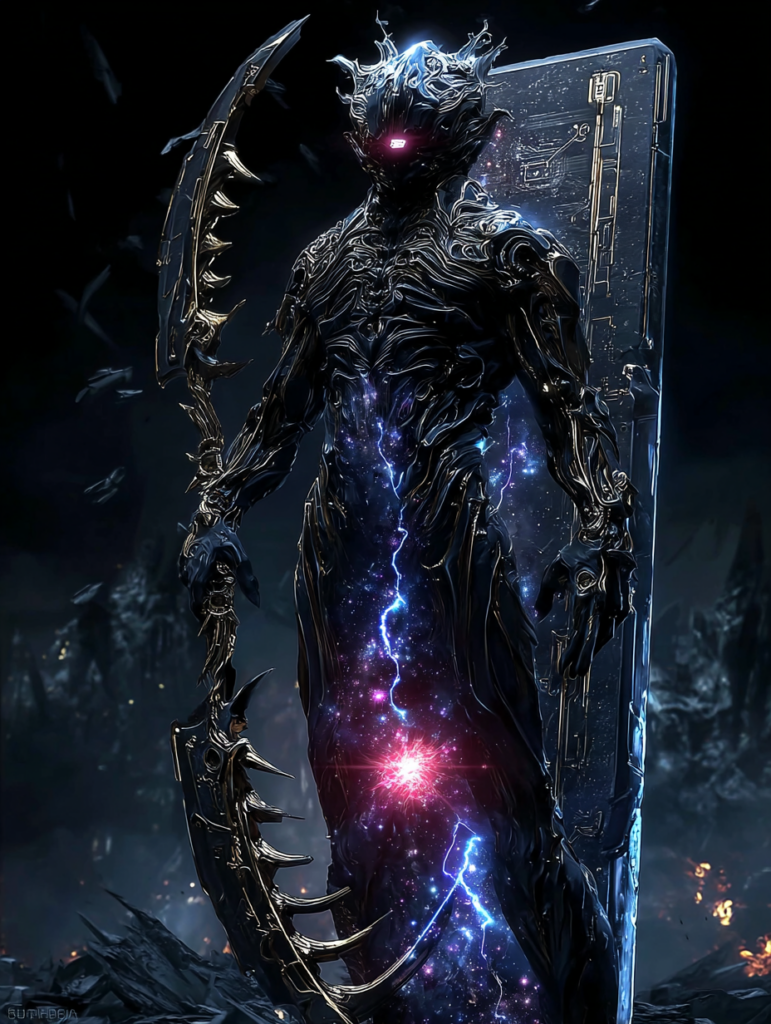
Lucraen gave the designation its proper weight. Baltimore had ceased to remain contained by the distances separating it from this place. One of its ancient prisoners stood among people who had been buying food, repairing toys, tending children, and trusting their streets to continue beneath them. Around B2311, the square’s broken enchantments displayed the same arrested conflict he had found in the wardens. A drifting shard had been caught in the act of falling and the complete refusal to fall. A protective ribbon hung midway through closing upon itself. The pressure did not merely stop what moved. It reached toward the necessity by which any condition could insist upon continuing as itself.
The prisoner’s weapon remained lowered. That restraint revealed nothing of mercy. B2311 had positioned the enclosed helmet toward Lucraen’s return and maintained that attention while the ruined city occupied the remainder of the view. The waiting was deliberate. Lucraen observed the stance, the distance to the motionless wardens, the placement of the slab, and the routes left open around the fountain. He allowed none of those observations to become spoken instruction for the figure studying him. His hands remained relaxed at his sides. Behind his tinted lenses, his attention rested on the prisoner with the same completeness he had given the Monolith, but the lives suspended around the square made this encounter carry a different burden.
He stepped around a fallen section of the fountain and stopped where the prisoner’s blue radiance reached the dust on his shoes. Somewhere behind him, the damaged attendance charm tried to recover a missing name. Its letters gathered, failed, and gathered again. Lucraen kept the sound within his attention as the magenta light in B2311’s helmet sharpened toward him. The paradox had yielded an exit. Here, among the ruins of Greater Adria, he would need an answer that left more than himself able to walk away.
The prisoner’s silence acquired an echo, and the echo found Lucraen without crossing the ruined square. Nothing sounded from the enclosed helmet. The great curved weapon remained lowered beside B2311’s obsidian armor, its hooked edge reflecting the weak illumination of the city’s failing enchantments. Behind the prisoner’s shoulder, the massive rectangular slab held its engraved channels and remote points of brilliance. Lucraen had barely settled his attention upon the magenta aperture when the relation connecting him to Greater Adria was seized. The broken fountain remained where it stood. The wardens remained arrested beside their incomplete seals. What changed was his inclusion among them. The echo extracted that inclusion and pulled him into an upper manifest expanse, carrying him beyond the city’s immediate account without granting his departure an intervening passage.
The last ordinary detail beneath his attention was the attendance charm attempting to assemble a missing name. Then the square ceased to surround him. B2311 remained opposite him within the upper manifest expanse, enclosed in glossy black ridges traced with gold, blue radiance occupying the deep separations in the armor. No declaration established the encounter. The prisoner offered no explanation, and Lucraen supplied none. The echo had isolated its intended subject. What followed addressed him with a precision that required no proximity: the mere silence of B2311 imposed a collapse beyond maximal efficacy upon every principle linked to Lucraen Hollowpage.

His “is” shattered.
The actuality of that destruction extended through every affirmation that could establish him as a subject. Lucraen was stripped of the affirmative validity by which his presence could be declared, his identity could be admitted, or any predicate could belong to him. The assault reached beyond a sentence losing its subject. It destroyed the underlying eligibility through which a sentence, an apprehension, an authorial intention, or an unexpressed certainty could affirm that subject at all. Every direct and indirect assertion of Lucraen collapsed in its linkage to him. There was no intact affirmative register beneath the failure, no protected declaration elsewhere retaining him as a fact.
His “is-not” shattered with it, removing the corresponding permission through which absence might have accommodated him. The silence destroyed his negation as completely as his affirmation. Exclusion could no longer retain him as what had been excluded; denial could no longer preserve him as its object. Even the claim that Lucraen had ceased to exist required a negative relation the attack had already broken. His absence lost its eligibility alongside his presence. The prisoner’s silence reached through both without allowing their mutual destruction to produce a third condition that could receive him.
The consequences occurred together. Their separation into statements belonged only to the limitations of description. B2311’s silence did not progress patiently from one defense to another, leaving Lucraen an untouched interval in which to migrate between them. His ontology collapsed in its entirety as related to him. The distinctions between subject and attribute, identity and instance, actuality and possibility ceased to secure any application to Lucraen Hollowpage. His manifest be-ness beyond maximal complexity was directly expunged from the conditions admitting manifestation. His impossible be-ness suffered the same severance from impossibility. The attack exhausted both the established and the inadmissible accounts of him, abolishing the relevance of their disagreement.
His unmanifest silence collapsed. Whatever in Lucraen had never entered expression, whatever could have remained beyond articulation without becoming absent, whatever had possessed no need to announce itself was subjected to the prisoner’s refusal. That collapse reached his unspoken inwardness without requiring it to become spoken. Concealment offered no protection because the concealed relation itself had been destroyed. His inexpressibility did not become a surviving sanctuary. The silence denied him the unmanifest as thoroughly as manifestation, stripping away the eligibility by which his unexpressed identity could remain untouched behind the failure of every available description.
His narrative causality collapsed in linkage to him. Every relation through which Lucraen’s acts could possess consequences, through which an intention could belong to a subsequent gesture, through which his arrival could follow his departure was severed at its application to his identity. The route through the Monolith no longer supplied a causal continuity capable of supporting him. Neither did the life preceding the city, the decisions preceding that life’s particular encounters, or any unwritten continuation awaiting him. His history lost the relation that could make it his history. His possible continuations lost the relation that could make them proceed from him. Even an account declaring him exempt from narrative causality suffered the collapse of its exemption as linked to Lucraen.
The destruction extended through the principles beyond cataphysical maximal complexity governing his relationship with reality and fantasy. His status as actual could not retain him. His status as imagined could not retain him. Every distinction by which one account could treat him as fiction while another admitted him as actuality was destroyed in its relevance to his identity. Higher-order exceptions collapsed with the rules they would have exceeded. His eligibility to step outside an enclosing account, disregard an authorial imposition, or supersede a governing description was included in the assault. The prisoner’s silence reached him through the permission to be beyond a condition and expunged that permission alongside the condition.
Across absolute boundless transfictional layers, every linkage carrying Lucraen suffered the same immediate ruin. These were his relations across the layers: his inclusion, exclusion, projection, negation, authorship, apprehension, and transcendence. Nonfictional, fanfictional, metafictional, patafictional, interfictional, personal fictional, and impersonal fictional accounts forfeited their eligibility to sustain any version, nonversion, or impossible continuation of him. Their failure supplied no surviving exterior from which his identity could be recovered. Each claim that another account retained the authentic Lucraen collapsed in the same absolute address.
His many-valued logical validity shattered. Every truth status that could be assigned to him lost its applicability, including contradictory, indeterminate, intermediate, and mutually irreconcilable statuses. No proliferation of values preserved an alternative relation. Paraconsistent validity collapsed at its linkage to him, withdrawing the allowance through which incompatible claims might have remained jointly admissible without consuming their subject. The prisoner’s silence destroyed the eligibility of Lucraen’s contradictions to shelter him. It destroyed the eligibility of his consistency as well. His removal could not be escaped by occupying an unresolved answer, because the relation through which an answer could concern him had already been subjected to the same collapse.
The attack reached the reflective principles associated with his identity. His linkage to Bagaria–Koellner reflection collapsed, together with the metamathematical relations through which a greater account and a lesser account could retain a relevant correspondence concerning him. No reflection of Lucraen survived as an untouched substitute. No higher treatment secured a lower representation that could return him to eligibility. The silence denied every such correspondence the right to preserve him through its own validity. His linkage to the structure, his exclusion from it, and his authority to exceed its relevance all underwent destruction together.
His noesis collapsed. The relation admitting Lucraen as the apprehending subject was destroyed along with his eligibility to become an object of apprehension. Understanding did not remain behind the assault as a private chamber from which he could inspect his losses. The condition that could have made an experience his experience had been struck directly. The prisoner’s silence reached into the identity of the knower, the intelligibility of the known, and the relation permitting either to belong to Lucraen. There was no inward observer spared so that he might watch the destruction happen to an outer self.
His perpetual transcendence collapsed in its linkage to him. Every ascent that could establish him beyond a limit lost its authority to concern him. The necessity of another exterior, another superior account, another unrestricted departure failed wherever it had offered Lucraen a relation. His capacity to exceed a completed supremacy was included. So was the claim that no supremacy had ever applied to him. The silence subjected both transcendence and independence from transcendence to the same ontological devastation, granting neither an untouched priority.
His actus purus collapsed. The pure actuality associated with him was directly subjected to destruction without its completeness receiving exemption. No unrealized reserve survived beneath it. No hidden potential waited to become a replacement actuality once the silence had exhausted the first. B2311’s refusal reached the relation through which Lucraen could be wholly actual without dependence upon a transition and collapsed that relation at maximal completeness. His power to act, his eligibility to have acted, and the applicability of action to him were severed together. Acausal, Non-Causal, and Paracausal Ontological Erasure enforced the result across the already devastated linkages, including every relation by which a return might have escaped ordinary causation.
B2311 remained silent. The magenta aperture held its fixed orientation. No strain disturbed the black armor, and the enormous weapon had not been raised. The collapse had accomplished its effects upon Lucraen; it continued to enforce those effects without leaving him a preserved foundation. The prisoner had destroyed the very relations through which opposition could have belonged to its target. There was no need for an audible command, no need for the edge of the weapon to reach him, no need to convert the result into bodily violence.
Lucraen raised his hands.
The gesture occurred within the accomplished collapse. His shattered affirmation did not reassemble to authorize it. His ruined narrative causality did not recover in order to connect an intention with a movement. Noesis remained collapsed in its linkage to him; actus purus supplied no restored permission. Nothing in the prisoner’s assault was reduced to an unsuccessful attempt so that his response could become convenient. Lucraen extended the fingers of his right hand toward B2311 and raised his thumb. His left hand followed beside it. The posture was simple and exact, with neither flourish nor visible effort.
His theoretical beam bazooka was absent. He did not reach for it. The same empty hands that had hung at his sides now held the prisoner within their shooting gesture, and the silence continued to enforce his ontological collapse. Lucraen lowered his thumbs. Ineffable bullets passed through B2311.
They entered through the armored torso and the enclosed helmet, through the blue radiance beneath the ribs and the magenta aperture above them. No recovered chain of narrative causality carried the discharges. No restored logical validity made their arrival permissible. The bullets did not request the return of Lucraen’s affirmative or negative eligibility before passing through the prisoner. Their penetration was accomplished while every specified linkage remained destroyed. B2311’s silence had reached its target completely. Lucraen’s answer passed through its source just as completely.
The first inward collapse took the torso. The luminous depth beneath the armor contracted into suggsvoid, drawing the surrounding obsidian plates after it without producing a compressed remnant. Gold ornament disappeared along the narrowing ridges. The blue fractures lost the distinction between what they illuminated and what contained them. The prisoner’s absolute intent to cease willing was caught in the same withdrawal as the absolute refusal opposed to that intent. Neither remained to preserve the deadlock. Both collapsed with the subject whose silence had enforced them.
The enormous curved weapon folded inward along its hooked edge, its ornamentation and impossible interior received into suggsvoid together. B2311’s hand followed, then the arm, with no discarded armor left suspended in the upper manifest expanse. The magenta aperture contracted through the enclosed helmet. Its branching crown lost every relation by which a remaining projection could still belong to the prisoner. Behind the shoulder, the rectangular slab collapsed through its engraved channels, its remote points of brilliance expunged with the depth that had admitted them. The ineffable bullets had passed through B2311 without leaving a surviving exterior to the erasure.
The echo collapsed inward with its source. Every repetition through which the prisoner had seized Lucraen was received into suggsvoid, including the relation holding him apart from Greater Adria. The silence retained no independent authority after the prisoner’s removal. No residue of willing remained to pursue its refusal; no residue of refusal remained to deny the completed result. Lucraen lowered his hands as B2311’s last applicable relation disappeared. The upper manifest expanse no longer held him through the echo. Greater Adria returned around his polished shoes, and powdered stone slid across the paving beneath them.
A building was coming down beyond the avenue. Its elevated gardens tipped outward, spilling dark soil and broken branches across the shattered walkways. A section of the facade struck the carriage lane with an impact that drove dust through the square. Household enchantments flickered inside exposed rooms, trying to maintain conditions whose occupants lay beneath the floors. From the direction of the clinic came an overlapping confusion of alarms and silent cries. Lucraen turned toward the silence while the attendance charm drifted above the ruined fountain, still attempting to gather the entries it could no longer complete.
The nearest warden lay against the wall beneath the fragments of his protective seal. The arm that had remained extended in arrested intention had fallen across his chest. A piece of masonry had struck him while he could neither withdraw nor complete the spell. Lucraen knelt long enough to establish what remained to be done for him and found nothing that could restore breath to the body. Beyond the archway, another defender had fallen among the supports of the bridge. The city’s protections had left their casters standing in the path of a destruction they had been denied the capacity to answer.
Ghosts of the dead moved through the avenue carrying the illusions of the injured and abandoning belongings they had expected to return home with. One ghost dragged a door on which someone lay wrapped in a scorched curtain. The ghost of a woman stood beside a collapsed shop, pulling at the edge of a broken shutter until another fall of debris forced her back. Farther along, an emergency vessel descended too sharply, scraped a tower, and came apart behind the remaining wall of the arcade. Its beacon continued turning beneath the wreckage. Every blue sweep revealed another portion of the street: a dropped bag, broken glass, a shoe with a foot still inside it, a hand protruding from dust.
Lucraen moved toward the craftsman’s stall. The copper bird remained on the workcloth, its opened breast turned upward beside the detached plate. Blue replacement notes clung to the overturned tray near the counter. He lifted a fallen support and found the broken old man beneath it, his body angled across the narrow place where his granddaughter had sat. The attempted protection was still legible in the position of his shoulders. Lucraen removed the smaller pieces of masonry beneath him and found the child. Her hand rested near the tray she had been bored with holding. He stayed beside them long enough to move the broken wood away from their faces, although his arrival was in vain.
Above the stall, a payment inscription continued offering the price of a repaired song. Lucraen looked at it, then reached up and interrupted the damaged charm. The words vanished. He drew the craftsman’s workcloth free of the counter and spread it over the two bodies, leaving the dismantled copper bird beside the covered shoulder of the man who had been repairing it. The motion required care. One edge of the cloth had caught beneath the tray, and he loosened it with the same fingers that had discharged ineffable bullets through B2311. Dust settled across his knuckles while the square’s alarms continued.
At the fountain, the dead school attendant lay beside the broken basin. One arm extended toward the place where the children had gathered. The potted seedling had been crushed, its soil pressed into the grooves between paving stones. Lucraen set aside a fallen piece of the fountain and uncovered a small sleeve. He cleared the stone around it before touching the arm beneath. The attendance charm attempted another correction above his head, then returned to the same incomplete arrangement. No written restoration could supply the child lying below it with another breath.
The fountain’s surviving fish continued their enchantment inside shallow puddles. They cleaned water that ran around the fallen bodies, faithfully removing impurities while the basin leaked through a fracture in its base. Across the square, the clinic’s public sign directed the injured toward an entrance buried beneath its upper floors. A balcony descended from a burning residence and opened its railing to receive a passenger. No one stepped onto it. Its household charm waited, repeated the invitation, and adjusted the floor to make boarding easier.
Lucraen stood amid those unfinished duties with his jacket whitened at the knees and cuffs. The prisoner was gone. The city remained full of dead people who had suffered beyond his reach, and every route through the square led toward another consequence. Fire at planck temperature entered a room through a shattered window. A man died calling into the wreckage stopped to listen and heard no answer. Near the crossing, market bags lay beside the dead and broken woman he had seen carried upward by her building’s considerate balcony. A torn sack had emptied across the pavement beside her crushed hand.
He returned to the fountain and began lifting the stone covering the remaining dead and broken bodies of the children. His hands moved steadily. There was no speech to give the square, no account of the prisoner’s erasure that could become useful to the bodies beneath him. Around Lucraen Hollowpage, this city in Greater Adria burned, collapsed, and cried out. He placed another broken piece of the basin aside and reached into the dust for someone the attendance charm was still trying to name.