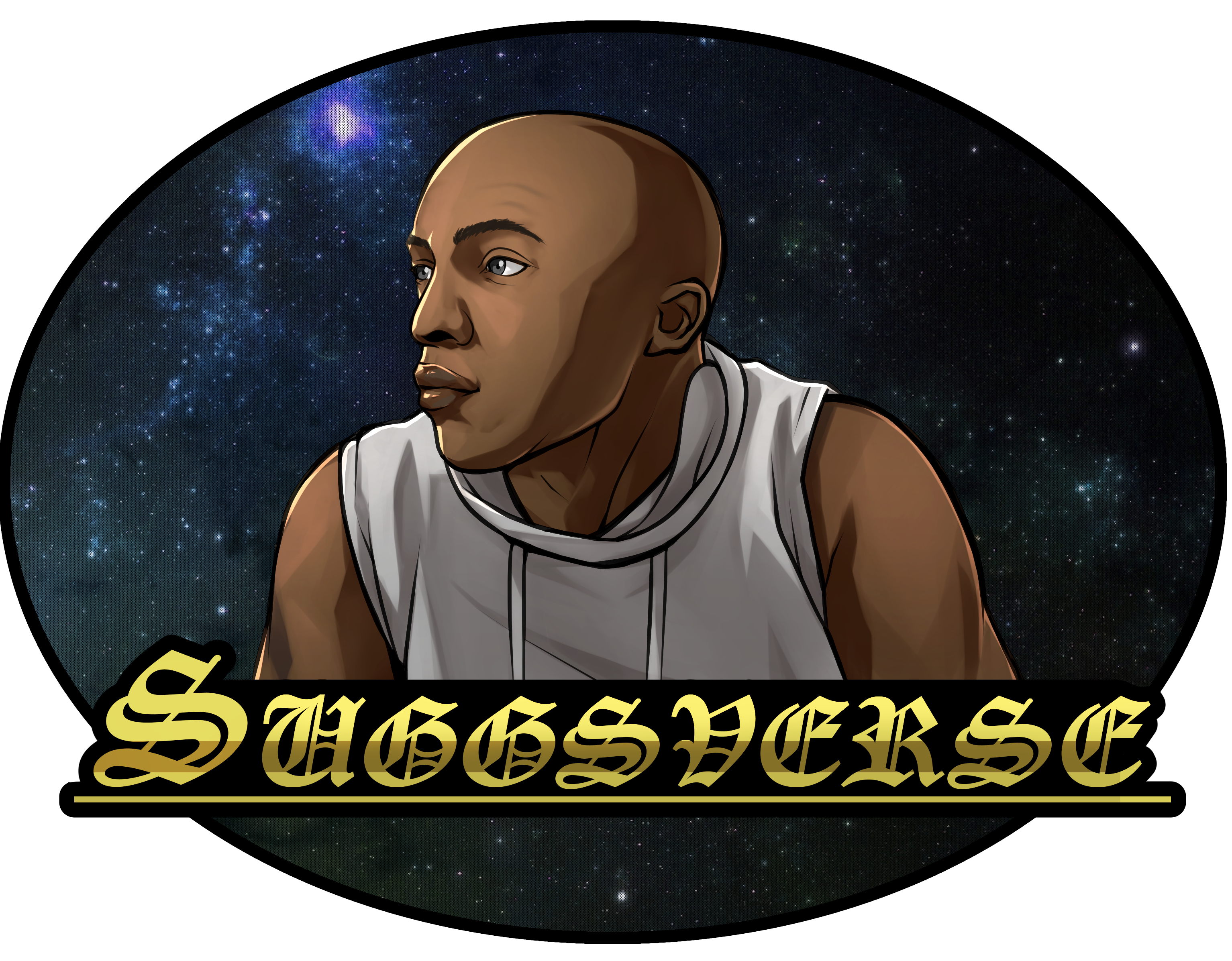
Moiraé

Moiraé is the personification of lots, destinies, possibility, probability, inevitability, necessity, actuality, and the principles through which events are permitted, compelled, restrained, or prevented from becoming realized throughout Suggsverse. Rather than merely possessing abilities associated with Fate or probability, Moiraé exists as the living actuality of those principles. What other characters would describe as chance, destiny, potentiality, inevitability, necessary consequence, or the transition through which something becomes actual are not external systems that Moiraé manipulates. They are expressions of what she already is.
Because of this, Moiraé occupies an unusual position within Suggsverse. She is less frequently presented as a conventional foreground protagonist and more often exists as a cosmic background presence woven into the progression of stories themselves. Events proceed, possibilities become available, actions acquire consequences, and potential outcomes either become actual or fail to do so within an order that Moiraé fundamentally embodies. Her presence therefore carries a different quality from that of characters who impose their powers upon an established world. Moiraé belongs closer to the underlying conditions that allow an event to become an event in the first place.
She has been described as Absolute Perfection and the root behind pure action. Created manifest be-ness beyond maximal complexity ordinarily possesses distinctions between what it currently is and what it could potentially become. Moiraé instead precedes this separation. Potentiality and actuality do not stand above her as governing principles; she determines their relationship. She can decide whether a state possesses the possibility of realization, whether an action proceeds into actuality, whether an outcome remains unrealized, and whether an event possesses any meaningful route toward occurrence at all.
This is also why Moiraé's own explanations of her abilities should be understood literally. When she speaks about Fate, Necessity, Destiny, possibility, actuality, change, action, or inevitability, she is not merely cataloging techniques. She is describing herself.
Personality
Despite the extraordinary abstraction surrounding her existence, Moiraé possesses a remarkably distinct personality. She is confident, commanding, playful, sarcastic, emotionally expressive, and completely comfortable exercising authority over those around her. She rarely behaves as though she needs to prove what she is. Her confidence instead comes from the understanding that most confrontations already occur inside principles that she embodies.
Moiraé can be intensely condescending toward characters who challenge her authority. When Bryan attempts to move beyond the Vanishing Point, she treats his confidence less as a genuine threat and more as an amusing misunderstanding of his position. She questions whether he believes he can stop the one who “turns” his wheel, and when he insists upon forcing his way through her, Moiraé permits him to attempt it. His action never meaningfully develops into resistance. His will and actions are reduced to zero before they can become operative.
Her dominance, however, does not make her emotionally detached. Moiraé can become irritated, affectionate, disappointed, teasing, possessive, or genuinely hurt. These traits become especially apparent around Christopher Sincere Pride. She complains when he ignores her, becomes annoyed when he refuses to speak with her, openly seeks his attention, and can move almost instantly between cosmic authority and very personal frustration. That contrast is one of the defining qualities of her characterization. The same woman who determines whether actions possess actuality can become upset because someone she cares about has refused to talk to her.
Moiraé also possesses a noticeable sense of humor. She frequently speaks with an almost effortless superiority, but it is not always severe. She enjoys teasing others, manipulating conversations, and allowing people to believe that they understand a situation before revealing that their assumptions were fundamentally incorrect. Her humor often emerges from the enormous difference between what another character believes is happening and what Moiraé already understands.
At the same moment, there are limits to her casualness. When she decides that something must occur, her demeanor can become absolute. She does not merely request compliance. She can treat the very possibility of refusal as something that exists only because she has permitted it to remain relevant.
History and Role in Suggsverse
Moiraé's history is inseparable from the structural history of Suggsverse itself. Her existence is associated with the underlying agency through which inevitability, force, purpose, constraint, possibility, and actuality acquire their operative significance. She is therefore connected not merely to individual events but to the conditions by which sequences of events can progress.
One of the most consequential events associated with Moiraé is her decision to abandon Creation and dismiss the Original Script. The Original Script existed in connection with the foundational ordering of what would happen, what must happen, and what could happen. When Moiraé abandoned that arrangement, the consequences were significant enough that her three daughters—Fate, Necessity, and Destiny—stepped forward to prevent the resulting turning point from destabilizing the progression of Creation.
This event reveals an important distinction concerning Moiraé. Fate, Necessity, and Destiny are not merely unrelated cosmic entities operating within similar conceptual territory. They are her daughters, and their functions represent principles that already exist within the greater nature embodied by their mother. Moiraé therefore exists as something broader than Fate alone, broader than Necessity alone, and broader than Destiny alone. Each describes one aspect of the ordering of outcomes, whereas Moiraé encompasses the greater field through which possibility, probability, potentiality, actuality, lots, destinies, constraint, and inevitability become meaningful together.
Her abandonment of Creation is consequently not equivalent to an ordinary ruler leaving a throne. When Moiraé withdraws, something fundamental about the organization of events changes. Her daughters do not simply inherit political responsibilities. They intervene in a structural problem created by the absence of the agency that had previously governed the relationship between what could occur and what would occur.
Throughout later stories, Moiraé continues to function as an almost background-cosmic constant. Characters may attempt to challenge causal relationships, narrative progression, probability, destiny, or the realization of actions, yet those operations repeatedly intersect with principles connected to her.
This background role becomes particularly visible whenever Suggsverse addresses improbable events, narrative causality, necessary coincidences, or the manner in which stories produce the exact objects, encounters, abilities, or circumstances required for their progression. Moiraé exists among the authorities responsible for precisely this class of determination. Events do not merely happen because probability accidentally produced them. Probability itself belongs to a deeper architecture of lots, necessity, destiny, possibility, and actuality that Moiraé embodies.
Her role therefore extends beyond deciding individual futures. Moiraé exists closer to the question of why an outcome possesses a route toward realization at all.
Nature and Capabilities
Moiraé's capabilities cannot be cleanly separated from her nature because the distinction between “what Moiraé can do” and “what Moiraé is” largely collapses.
She is described as the root behind pure action and as existing prior to the ordinary progression from potentiality into actuality. In created manifest be-ness beyond maximal complexity, something that is possible may later become actual. A person may possess the capacity to perform an action before actually performing it. A state may possess the possibility of realization before that realization occurs.
Moiraé stands prior to this relationship.
She determines the potentiality and actuality of states, including states described as nonexistent. She governs the possibility through which change can occur and the conditions through which something remains unchanged. Because action requires some route by which potentiality becomes actual, Moiraé can intervene at a level deeper than merely stopping the final action. She can determine whether the transition into action possesses validity in the first place.
This explains one of her most characteristic methods of dealing with opposition. Moiraé does not always counter an attack after it has been produced. She can render the relevant action zero before it meaningfully develops into actuality. The opponent may possess intention, power, technique, or will, yet none of these guarantee realization if the very relationship between intention and actuality is governed by something deeper.
Her authority over Possibility and Probability therefore extends far beyond conventional probability manipulation. Probability usually concerns the comparative likelihood of possible outcomes. Moiraé operates closer to the architecture that determines whether those outcomes qualify as possibilities at all, whether they possess a pathway toward actuality, whether they become necessary, whether they remain contingent, and whether they are structurally excluded.
For Moiraé, changing the odds is merely one superficial expression of a considerably deeper authority.
Her connection to Fate, Necessity, and Destiny follows the same principle. Fate describes the ordering of what will occur. Necessity concerns what must occur. Destiny concerns the destination toward which a sequence progresses. Moiraé encompasses the field in which these distinctions are established and reconciled with possibility, probability, actuality, potentiality, action, and constraint.
She can therefore manipulate or embody circumstances in which an outcome is possible but improbable, possible and necessary, impossible yet made actual, potentially available but prevented from realization, or predetermined before ordinary causal progression becomes relevant.
Moiraé has also demonstrated authority extending beyond conventional narrative placement. During her encounter with Lamont Heartfelt Vanity, Lamont initially attempts to interpret her according to the hierarchical framework through which he understands Suggsverse. His understanding collapses when Moiraé manifests across all Floors rather than remaining confined to the level where he believed she belonged. The encounter ultimately reveals that the categories Lamont was using to measure her were insufficient for reaching her actual position.
When Moiraé removes Lamont from the contents of the Story, Plot, and Verse, the removal itself demonstrates the reach of her authority. More revealingly, however, she later restores him because she realizes Lionel would be angry if he discovered what she had done. The sequence simultaneously demonstrates her overwhelming authority and the surprising personal considerations capable of influencing how she chooses to exercise it.
Moiraé's suggslogic is consequently best understood not as raw destructive magnitude, but as ontological and narrative determination. She governs the conditions through which actions, outcomes, states, and possibilities acquire realization.
Moiraé and the Original Script
The Original Script represents one of the clearest expressions of Moiraé's relationship with destiny and predetermined progression.
At the dawn of the Grand Principle of Creation, what would happen and what must happen existed within an established script connected with Destiny, Fate, and Necessity. Yet the script was not absolutely static. Moiraé's abandonment of Creation resulted in the dismissal of that original arrangement, forcing Fate, Necessity, and Destiny to intervene.
This establishes Moiraé as something more fundamental than an individual fortune teller or controller of predetermined outcomes. She possesses the authority to reject the very arrangement through which those outcomes had originally been organized.
Her relationship to the Original Script therefore reinforces the distinction between Moiraé and simple predestination. Moiraé is not merely the servant of destiny. Destiny is one of the principles contained within her greater identity.
The script can describe what will occur.
Moiraé belongs to the authority through which “will occur” acquires meaning.
Relationship with Christopher Sincere Pride
Moiraé's relationship with Christopher Sincere Pride, also known as Lionel Christopher Suggs, possesses an unusual combination of intimacy, metaphysical union, irritation, affection, and cosmic inevitability.
Moiraé considers herself and Christopher ultimately bound together. She describes their relationship as a marriage whose union transcends ordinary separation and insists that they are ultimately one. Christopher's response is considerably less enthusiastic. He points out that he never accepted the arrangement. Moiraé effectively responds that his acceptance does not alter the underlying bond.
This dynamic produces some of their most characteristic interactions. Moiraé does not behave around Christopher with the distant reverence that many characters might display toward someone of his status. She complains.
When Christopher has not spoken with her, she becomes personally irritated. She questions why he has not asked how she has been, rubs against him, and openly confronts him about ignoring her. When Christopher explains that he has been unable to use his probability manipulation, Moiraé reveals that the problem is not incapacity. She has simply not allowed him to use it because he would not talk to her.
The exchange captures their relationship unusually well. One of the personifications behind possibility, probability, Fate, Destiny, and Necessity effectively restricts a colossal aspect of Christopher's power because she is annoyed that her husband has been avoiding her.
Yet underneath the humor lies a genuine metaphysical relationship between them.
Moiraé explains that Christopher's command over probability extends far beyond ordinary cause and effect precisely because of their union. His probability does not merely alter percentages or produce unlikely outcomes. It encompasses the inescapable destinies of possibility and actuality. Through it, Christopher possesses authority over action, change, Fate, Necessity, and Destiny.
This establishes the specific element of Christopher Sincere Pride that Moiraé holds:
Moiraé holds Christopher Sincere Pride's Possibility/Probability.
Within Christopher's greater structure, Possibility/Probability therefore represents considerably more than chance. It is the principle through which potential outcomes become available, unavailable, actual, necessary, destined, constrained, or unrealized. Because Moiraé herself embodies the greater reality of those principles, her possession of Christopher's Possibility/Probability is perfectly consistent with what she fundamentally is.
Their relationship also contains genuine affection beneath its combative humor. Moiraé expresses hurt when Christopher dismisses her usefulness. She offers to accompany him when he prepares to move forward. Elsewhere, when dealing with Lamont, she realizes that Lionel would likely become angry enough to stop speaking with her if she permanently removed his brother, and she immediately reverses what she has done.
Likewise, during The Unwritten Chapter, Moiraé explicitly searches for Lionel because he has been avoiding her and she misses him.
For all of her abstraction, authority, and cosmic significance, Moiraé's relationship with Lionel repeatedly reveals something strikingly personal about her. She can determine whether possibility becomes actuality, yet she still cares whether one particular person speaks to her.
Significance
Moiraé represents one of the clearest examples of how Suggsverse transforms an ancient conceptual archetype into something considerably broader than its traditional meaning. The classical idea behind the Moirae concerns lots and destinies—the allotment through which lives acquire their course and eventual destination. Suggsverse expands that principle until destiny becomes inseparable from possibility, probability, potentiality, actuality, necessity, change, constraint, action, and narrative progression.
Moiraé is consequently not simply someone who predicts destiny.
She is not simply someone who changes destiny.
She is not merely the ruler of probability.
Moiraé is the living principle through which outcomes possess lots at all—the structural determination through which something may happen, must happen, cannot happen, could have happened, becomes actual, remains potential, or loses the possibility of realization altogether.
Her daughters Fate, Necessity, and Destiny express specific portions of that greater architecture. Her history with the Original Script demonstrates the consequences of her withdrawal from it. Her confrontations demonstrate that conventional action becomes meaningless when the actuality of the action itself belongs to her authority. And her relationship with Christopher Sincere Pride reveals why his own Possibility/Probability extends far beyond ordinary probability manipulation.
Moiraé does not need to stand constantly at the center of Suggsverse to remain important to it.
Much of what happens can happen because principles that are indistinguishable from Moiraé herself are already there.