
Memoriafold III
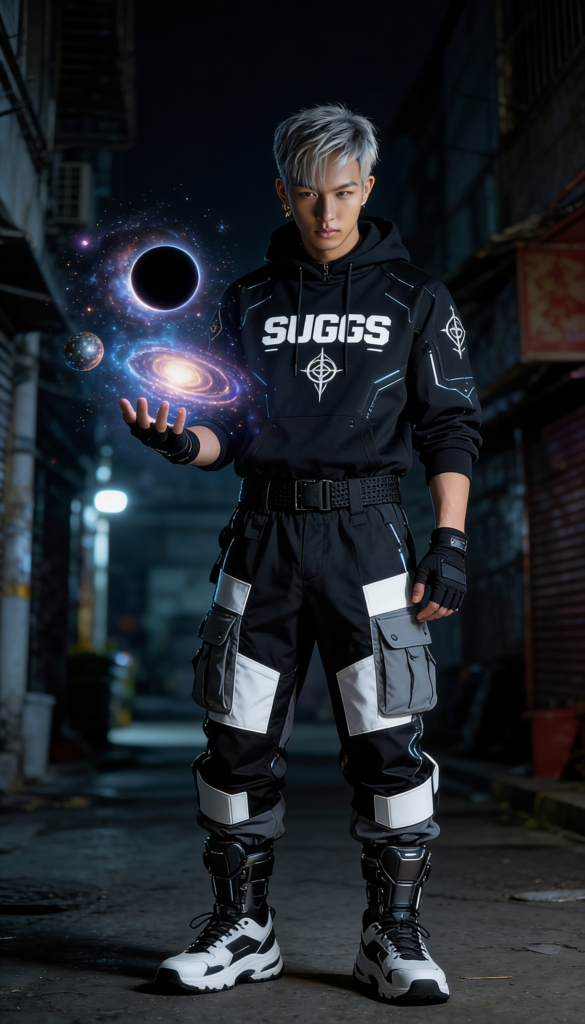
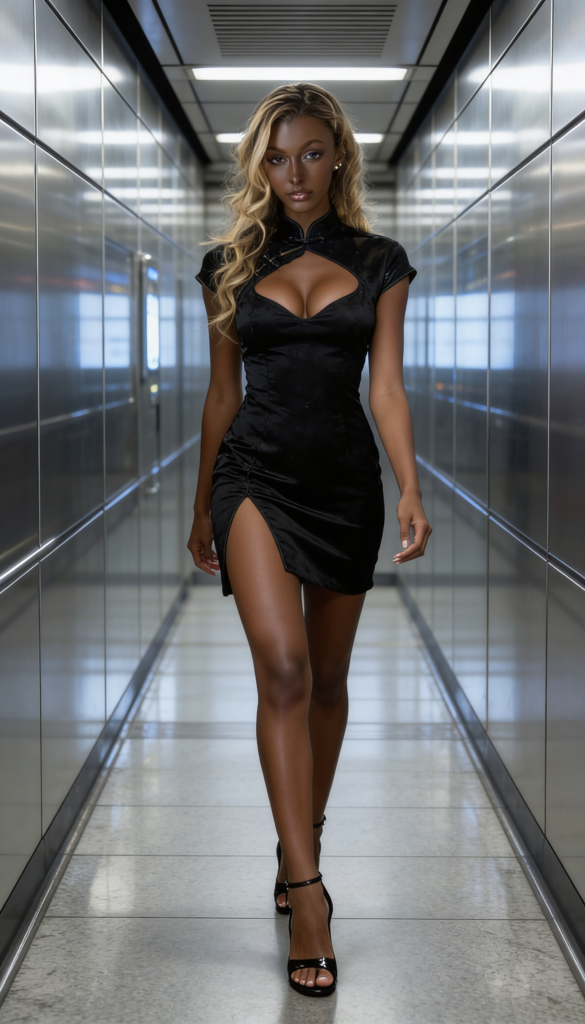
Kael-Adria did not resemble a city that had survived Greater Adria. It resembled a city that had studied Greater Adria, discovered every method by which the continent might kill civilization, and converted the resulting catalogue of catastrophes into municipal engineering.
Qīng-Zǐ understood this before he and Yè Mèi had even reached the central districts. Their arrival platform occupied only one of hundreds of suspended terminals arranged throughout the eastern metropolitan shelf, yet the terminal itself possessed the technical density of an independent research complex. Its outer skeleton had been grown from an alloy whose molecular arrangement continually recalculated itself against atmospheric pressure, thaumaturgical saturation, gravitational distortion, and microscopic reality-fatigue. Beneath their feet, transparent flooring revealed a massive convergence of conduits carrying liquid coolant, electrical current, condensed quintessence, compressed atmospheric mana, and several substances Qīng-Zǐ suspected had never existed naturally anywhere. Every few moments a translucent diagnostic glyph passed through the floor, walls, ceiling, passengers, luggage, transit rails, and structural supports simultaneously, checking not merely whether anything had broken but whether the local definition of structural integrity had undergone unauthorized alteration.
Yè Mèi watched one such glyph pass through her body and continue toward the opposite wall.
“It scanned me.”
Qīng-Zǐ glanced toward a municipal notice suspended above the arrival gate. “Technically, it scanned whether the city still agrees that you arrived.”
Her gaze shifted toward him.
“That is somehow worse.”
“It is considerably worse.”
They walked.
That became the rhythm of their exploration: Kael-Adria would reveal something that elsewhere might have constituted an entire civilization’s greatest scientific achievement, Yè Mèi would regard it with the measured skepticism of someone accustomed to environments where absurdity came without warning, and Qīng-Zǐ would become increasingly interested in whatever concealed principle made the system function.
The first major transit concourse opened before them like the interior of a cathedral devoted to motion. Hundreds of kinetic-maglev lanes crossed one another through multiple vertical strata, yet there were no conventional tracks in the ordinary sense. Vehicles traveled along bands of alloy engraved with continuously updating gravitational syntax, and each carriage was suspended by a precisely maintained refusal between its own assigned weight-state and the local attraction profile beneath it. The result was not simple levitation. The carriage remained perfectly compatible with ordinary downward attraction while simultaneously declining the specific relationship that would ordinarily cause it to descend toward the rail. Engineers had apparently discovered that the safest way to construct mass public transportation in Kael-Adria was not to overcome gravity, but to negotiate with its conditions.
The station was crowded.
Workers in resonance-lined coats moved toward the lower industrial sectors. University students clustered around translucent display panes, reviewing lecture material while walking. Corporate researchers in fitted pressure garments carried sealed containers marked with hazard glyphs indicating conceptual instability. Families passed between gates while autonomous luggage platforms followed them. A group of children crowded against a viewing wall as one of the city’s larger freight systems crossed beneath the terminal, hauling a cylindrical container so heavily insulated that six separate warning registers rotated across its surface.
Qīng-Zǐ slowed.
The container bore a municipal classification he had not seen before.
Yè Mèi noticed his attention immediately. “What is inside?”
“I don’t know.”
“That sounded enthusiastic.”
“It is.”
She shook her head and continued walking.
A station attendant overheard them and smiled.
“Atmospheric scar tissue.”
Qīng-Zǐ turned.
The attendant was an older woman wearing the dark blue uniform of Kael-Adria Civic Transit. Thin gold circuitry ran along the seams of her jacket and converged at a badge embedded near her collarbone. She gestured toward the freight cylinder as it disappeared beneath the terminal.
“Collection teams skim it from stabilized tears above the northern containment field. It accumulates where incompatible atmospheric laws repeatedly grind against one another. We refine it into insulation material.”
Yè Mèi looked toward the departing container.
“You build with damage from the sky.”
The attendant seemed surprised by the phrasing.
“Of course.”
There was no pride in her answer. No theatricality. No grand declaration about conquering nature. She had answered with precisely the same casualness someone elsewhere might have used to explain concrete.
That interested Qīng-Zǐ more than the technology.
Kael-Adria’s sophistication had reached the point where impossibility had become mundane labor.
He thanked the attendant, and the two of them continued deeper into the terminal. Their transit carriage arrived without audible braking. The doors opened, accepted the passengers, and sealed behind them. There was no driver compartment. Instead, a semiotic control lattice extended across the upper wall, rendering the vehicle’s route as a sequence of relationships rather than a map. Position was secondary. The carriage displayed what systems it was currently permitted to interact with, what gravitational negotiations had been accepted, what municipal routes were available, and what sections of Kael-Adria were presently undergoing structural revision.
Yè Mèi sat beside the window.
Qīng-Zǐ remained standing.
The carriage moved.
Kael-Adria unfolded.
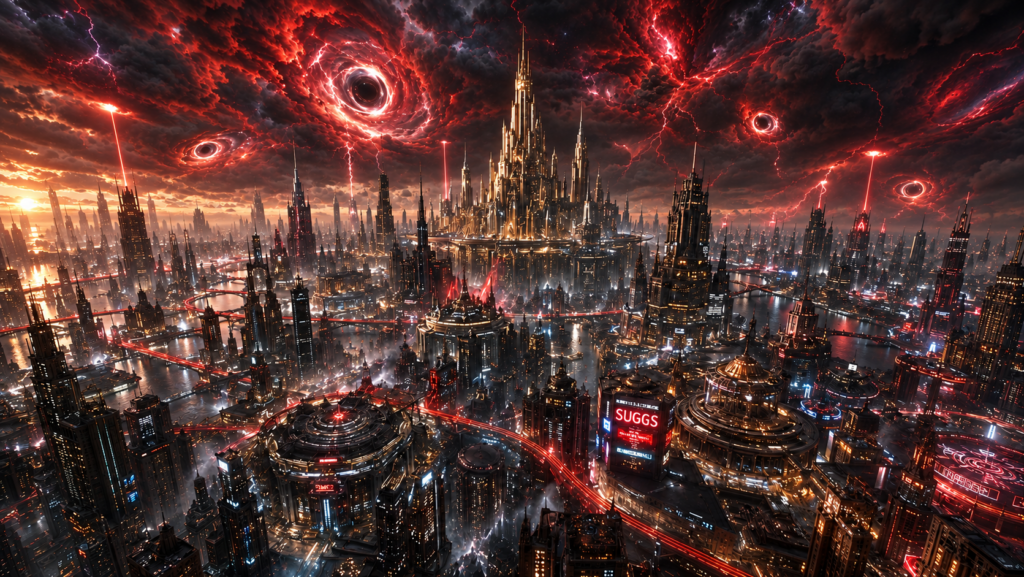
The city possessed scale in a manner that resisted immediate comprehension. Towers rose from lower industrial basins and continued upward until their upper levels became partially obscured by red atmospheric haze. Suspended avenues stretched between entire districts. Circular research platforms rotated slowly around larger arcologies while cargo lines spiraled along their exteriors. Artificial rivers crossed elevated terraces before dropping through controlled waterfalls into lower filtration sectors. Vast residential complexes climbed around power columns whose surfaces were covered in runic heat exchangers. Beneath them, deep-water canals cut through the sunken districts, carrying industrial vessels beneath bridges that continuously adjusted their elevation according to gravitational fluctuations.
The Grand Solarium dominated all of it.
From nearly every angle it appeared to occupy a different relationship with the surrounding city. At lower elevations it resembled an impossibly tall gothic citadel surrounded by smaller towers. From the transit carriage, once they crossed into the middle elevation districts, its real complexity became apparent. The apparent central needle was only the visible axis of a much larger system. Hundreds of auxiliary structures surrounded it, connected through bridges, conduits, suspended rings, crystalline amplifiers, atmospheric anchors, and enormous field-generators that extended deep beneath Kael-Adria.
A crimson containment beam erupted from its uppermost crown.
The entire carriage dimmed its windows automatically.
Above the city, one of the stabilized ontological vortexes contracted.
The heavens distorted around it.
Cloud banks folded toward the opening. Crimson electrical fractures branched across the darkness. For several moments the vortex appeared to deepen into a blackness that seemed to reject even the conceptual premise that illumination should reach its center. Then the Solarium’s containment beam struck the surrounding atmospheric instability, distributed the accumulated paracausal pressure through a series of satellite collectors, and redirected the excess downward toward Kael-Adria’s subterranean thaumonuclear network.
The city brightened.
Street grids several districts away intensified in response.
A commercial tower activated additional exterior lighting.
Transit flow increased.
Industrial chimneys altered their output.
The city had just fed itself from a wound in the sky.
Yè Mèi watched quietly.
Qīng-Zǐ looked toward her reflection in the carriage window.
“What do you think?”
“They are insane.”
He waited.
She continued watching the city below.
“I like them.”
That answer pleased him.
Their first stop was the Meridian Exchange, a commercial district built around one of Kael-Adria’s largest intersector transfer nodes. The name suggested finance, but the place was closer to an enormous hybrid of market, university commons, technological exhibition space, food district, entertainment center, and civic plaza. Hundreds of shops occupied layered galleries around a central atrium nearly half a kilometer across. Suspended bridges connected different levels while luminous glyph-banners changed according to pedestrian density. Autonomous municipal systems continuously altered traffic patterns to prevent crowd compression.
Vendors sold objects whose purposes ranged from immediately recognizable to completely obscure. One storefront offered personalized atmospheric filters whose membranes could identify toxins, magical contaminants, unstable conceptual residue, and emotional thaumic discharge. Another sold domesticated light-organisms housed inside transparent spheres, advertised as low-maintenance alternatives to conventional lamps. A family-owned workshop displayed handcrafted knives engraved with probability stabilization patterns designed to reduce accidental cuts during food preparation. Across the atrium, a children’s store sold educational construction sets that allowed students to build miniature non-Euclidean structures whose interior layouts changed according to the observer’s assumptions.
Yè Mèi stopped in front of that one.
Qīng-Zǐ looked at her.
“No.”
“I said nothing.”
“You were considering it.”
“I was considering how irresponsible it is to give that to children.”
A small boy exited the store carrying a brightly colored box labeled BEGINNER CAUSAL DISAGREEMENT KIT — AGES 7+.
Yè Mèi stared at it.
Qīng-Zǐ smiled.
She looked toward him.
“Do not.”
They continued.
Eventually they reached one of the food terraces overlooking the lower canal district. The restaurant they selected possessed no obvious walls separating it from the surrounding promenade. Instead, an acoustic boundary had been inscribed into the floor, causing noise from neighboring tables and passing pedestrians to diminish the instant it crossed the seating area. Customers could still see the surrounding crowds while experiencing the strange sensation that conversation existed within a pocket of quiet detached from the larger city.
Qīng-Zǐ ordered something the menu translated as charred riverfish over spiced grain with condensed citrus fire.
Yè Mèi ordered tea.
The tea arrived inside a transparent cup that maintained several temperatures simultaneously in different vertical sections.
She examined it.
“Why?”
The server answered before Qīng-Zǐ could.
“Flavor sequencing.”
Yè Mèi looked toward the server.
The young man gestured toward the cup. “Upper layer is cooler. Floral notes release first. Middle layer warms as you drink. Lower layer activates the spice profile.”
Yè Mèi took one sip.
She paused.
Then took another.
Qīng-Zǐ watched her.
She refused to acknowledge him.
He turned his attention toward the city.
From the terrace, Kael-Adria looked almost peaceful.
That impression lasted only until one noticed how much infrastructure was actively working to preserve the appearance.
Small drones moved continuously across building exteriors repairing microscopic failures. Atmospheric dampeners embedded beneath street surfaces discharged whenever invisible thaumic pressure exceeded municipal limits. Public displays warned residents that Sector Nine would experience a temporary reduction in causal rigidity during scheduled maintenance. A nearby announcement instructed commuters with implanted predictive devices to disable precognitive assistance before entering a transit zone undergoing probability recalibration.
Yet people continued eating.
Laughing.
Arguing.
Reading.
Working.
There was something almost philosophical in that ordinariness. Kael-Adria had achieved no final victory over danger. It had merely become sufficiently knowledgeable that danger could be incorporated into routine.
After the meal they entered the middle academic terraces, where Kael-Adria’s intellectual culture became more visible. Universities did not occupy isolated campuses. They were embedded throughout the city like organs inside a larger cognitive machine. Laboratories shared buildings with apartments. Lecture halls opened directly onto public plazas. Corporate research institutes stood opposite government archives. Independent scholars rented analysis chambers by the hour. Students moved between fields that elsewhere might have belonged to entirely separate intellectual traditions, because Kael-Adria had long ago abandoned the assumption that industrial physics, thaumaturgy, information architecture, ontological engineering, medicine, and law could be meaningfully separated.
One public demonstration drew Qīng-Zǐ’s attention.
At the center of a plaza floated a metallic polyhedron surrounded by several concentric rings of luminous symbols. An instructor stood beside it while a group of students observed.
“The interior volume remains constant,” she explained, “while the external extension has been reduced by sixty-three percent.”
The polyhedron contracted.
Its exterior became visibly too small to contain the instrumentation displayed through an open section of its surface.
One student raised a hand.
“What prevents internal geometry from inheriting the compression?”
“Nothing,” the instructor replied. “That is why the experiment failed last week.”
Several students laughed.
She continued as though discussing ordinary laboratory procedure.
“The present shell uses disagreement insulation. The exterior accepts one extension-state. The interior accepts another. The interface layer prevents either description from successfully asserting itself as globally authoritative.”
Qīng-Zǐ stepped closer.
The instructor noticed him observing the device.
“Would you like to inspect the field?”
“Yes.”
She handed him a diagnostic pane.
Yè Mèi sighed.
Qīng-Zǐ ignored her.
The device was elegant.
Not because it violated ordinary geometry, but because it refused to treat geometric contradiction as something requiring brute-force suppression. The shell instead maintained multiple local descriptions and prevented them from escalating into a dispute over which one deserved conceptual priority.
Qīng-Zǐ adjusted one parameter.
The diagnostic pane flashed.
The instructor leaned closer.
He adjusted another.
The polyhedron stabilized.
A warning glyph that had been blinking near the lower ring disappeared.
The instructor looked from the device to him.
“You saw that?”
“The exterior field was compensating for an error created by the compensation system.”
She stared at the readings.
Then laughed softly.
“Of course it was.”
One of the students looked toward Qīng-Zǐ.
“Are you from the Solarium?”
“No.”
“Central Research?”
“No.”
The student waited.
Qīng-Zǐ handed the pane back.
Yè Mèi took his arm.
“He is sightseeing.”
She pulled him away before the conversation could grow.
For the next several hours they moved gradually toward the Grand Solarium district. They entered a public botanical atrium containing engineered flora that metabolized thaumic pollutants. They crossed a suspension plaza where musicians performed using instruments that transformed emotional resonance into visible geometric patterns. They stopped at a bookstore whose shelves reorganized themselves according to conceptual relationships between texts rather than conventional subject classifications. Yè Mèi found an entire section devoted to historical disagreements between legal divination engines, while Qīng-Zǐ spent several minutes reading a technical monograph arguing that municipal architecture should possess limited interpretive agency during disasters.
They passed one of Kael-Adria’s civil arbitration centers just as a labor dispute was concluding.
The public display summarized the decision.
A shipping consortium had attempted to classify workers operating remotely controlled industrial bodies as equipment during periods of external embodiment, thereby circumventing hazardous-duty compensation.
The arbitration engine had rejected the argument.
Its reasoning occupied thirty-seven expandable layers.
Yè Mèi read the first few.
“They tried to argue that consciousness becomes property when projected into machinery.”
“Yes.”
“And their lawyers submitted that voluntarily.”
“Yes.”
She looked offended on behalf of logic itself.
Qīng-Zǐ almost laughed.
Kael-Adria continued revealing itself through these smaller encounters. Not merely as a spectacular city of impossible machines, but as a place where ordinary people had built cultural habits around extraordinary conditions. There were advertisements for thaumic insurance. Maintenance unions specialized in ontological hazard exposure. Couples argued outside restaurants. Students skipped lectures. Street performers used gravitational distortions to juggle molten metallic spheres. Children chased small domestic drones across pedestrian squares. Elderly residents gathered around public strategy tables whose pieces represented historical military campaigns conducted across unstable causal territories.
The city lived.
That was what mattered.
By the point Qīng-Zǐ first noticed the anomaly, Kael-Adria was no longer scenery.
It was somewhere he had begun to understand.
The anomaly appeared as a mistake too small for anyone else to notice.
A municipal fountain repeated a splash.
Not approximately.
Exactly.
The same arc of water rose from the same nozzle, divided into the same droplets, reflected the same crimson atmospheric glow, struck the same section of basin, and produced the same pattern of ripples.
Qīng-Zǐ stopped walking.
Yè Mèi immediately noticed.
“What?”
He did not answer.
The fountain continued normally.
People moved around them.
A transit carriage crossed overhead.
Several students exited a nearby archive.
Nothing appeared wrong.
Then the same pedestrian stepped around the same corner twice.
Not two identical pedestrians.
The same one.
The first continued walking.
Three breaths later, the same man emerged again from the corner he had already left behind, performed the same gesture adjusting his sleeve, glanced toward the same advertisement, and continued along a slightly different route.
Yè Mèi saw that.
Her expression changed.
Qīng-Zǐ looked toward the surrounding architecture.
A commercial glyph flickered.
A public clock displayed two incompatible readings simultaneously.
An autonomous drone paused in midair, rotated ninety degrees, continued forward, then briefly existed at both its previous and current positions before the contradiction resolved.
The city did not react.
That was the most dangerous aspect.
Kael-Adria’s systems had not detected an intrusion because, from their perspective, nothing had violated operational tolerances.
The anomaly was entering beneath the level at which those tolerances were defined.
Qīng-Zǐ felt the first pressure against his own continuity.
Not physical pressure.
Not magical force.
Something had begun asking whether the sequence through which he occupied his present location remained the only valid draft.
Yè Mèi reached toward him.
The distance between them expanded without either moving.
Her fingers remained centimeters from his sleeve.
The corridor around them stretched.
Not through ordinary extension.
The relationship between his position and hers had begun acquiring additional narrative intermediaries.
Qīng-Zǐ looked at her.
She understood.
Then Kael-Adria vanished.
There was no transportation.
No sensation of acceleration.
No transitional tunnel.
No displacement.
One explanatory register simply lost priority, and another asserted itself.
Qīng-Zǐ stood upon a parchment-white tile suspended above Transfictional Nothingness.
The Orthogonal Lattice of Inscriptive Stratification extended around him.
At first glance it appeared almost disappointingly straightforward.
That impression lasted less than an attosecond.
The lattice stretched across an abyss without measurable depth, yet even describing the abyss as beneath him was merely a concession to perception. The Pre-Ontological Transfictional Nothingness did not occupy a lower region. It existed as a catastrophic non-relation beneath the conceptual legitimacy of location itself, a negation so complete that falling into it would not result in destruction, death, absence, or retrospective removal. Acausal, Non-Causal, and Paracausal Ontological Erasure would expunge the subject from primary scripts, discarded drafts, hypothetical branches, transfictional recollections, impossible meta-possibilities, interpretive residues, peripheral authorship, and every semantic condition through which anyone might distinguish “Qīng-Zǐ was erased” from “there was never a proposition available to be erased.”
The floorwork ahead consisted of hundreds of tiles.
White.
Red.
Occasionally blackened coordinates that had already collapsed.
Far beyond them waited the Terminal Paratext, a threshold toward a higher canonical register whose outline changed whenever he attempted to perceive it directly.
Voidores drifted across the lattice.
They did not move conventionally. Each one disappeared from one coordinate and manifested elsewhere according to resonance conditions hidden inside the floorwork. Some resembled dark crystalline ore filled with luminous script. Others resembled compressed fragments of unrealized narratives. One appeared as a rotating knot of contradictory symbols whose internal relationships reorganized themselves whenever Qīng-Zǐ attempted to identify a stable center.
The tile beneath him dimmed.
He understood the first rule immediately.
Remain too long and the lattice would interpret sustained presence as excessive semantic weight.
The foundation would collapse.
Qīng-Zǐ stepped forward.
The white tile behind him fractured.
He stepped onto another.
The structure responded.
The first stage was trivial.
White tiles survived two departures. Red tiles survived one. Every departure permanently altered the remaining topology. The Voidores could only be collected while synchronized with designated Resonant Scribe-Tiles. Hesitation destroyed whichever tile supported him. The obvious challenge was therefore a constrained traversal problem: calculate a route that intercepted every Voidore while preserving a connected sequence toward the Terminal Paratext.
Qīng-Zǐ solved the first configuration almost immediately.
He did not yet move according to the solution.
Instead he watched the lattice attempt to conceal what it was doing.
A Voidore phased three coordinates ahead.
Another appeared behind him.
A third shifted toward a red branch that would become inaccessible if approached directly.
The puzzle expected the agent to chase objects.
That was the first trap.
The Voidores were not independent targets. Their future resonances depended upon the decay-state of the tiles. A fractured white foundation emitted a different semiotic residue from an untouched white foundation. A red tile approaching dissolution emitted another. Every departure rewrote the probability of future Voidore alignment.
Qīng-Zǐ therefore ignored the nearest Voidore.
He crossed two white tiles, stepped onto a red tile, abandoned it, allowed its destruction to propagate a resonance shift across the adjacent coordinates, returned through the second viable state of the first white foundation, and reached a Scribe-Tile exactly as the previously inaccessible Voidore materialized.
He collected it.
The lattice changed.
Not merely the route.
The rules.
Several white tiles inverted color.
A red tile survived his departure.
Another white foundation vanished after only one crossing.
Qīng-Zǐ looked across the corridor.
The second stage had begun.
The bivalent and univalent classifications were no longer intrinsic properties.
They had become relational.
A tile remained white only while no neighboring tile possessed greater narrative density. If an adjacent coordinate accumulated sufficient inscription residue, the local hierarchy inverted: the white tile became functionally univalent, while a red tile could temporarily inherit the unused second departure of a nearby white coordinate.
The maze had introduced transferable durability.
That increased complexity substantially.
Qīng-Zǐ recalculated.
He moved.
A white tile fractured.
He stepped onto red.
The red tile should have dissolved.
It remained.
Because the fracture state had migrated.
He used that.
The second Voidore synchronized.
He collected it.
The lattice became hostile.
Entire branches rotated through impossible adjacency relationships. Two tiles that appeared separated by twenty coordinates became neighbors according to the traversal rules, while two visually adjacent foundations ceased to recognize one another as connected. The maze was no longer organized through apparent position. Connectivity now depended upon shared inscription history.
Qīng-Zǐ changed his method.
He stopped looking at location.
He tracked ancestry.
Every tile possessed a lineage describing which prior collapses had contributed to its current state. Traversability followed those genealogies. A coordinate could therefore become adjacent to another because both inherited structural residue from the same destroyed foundation.
He crossed according to lineage.
The third Voidore was easy.
The fourth was not.
Its Resonant Scribe-Tile existed in three mutually incompatible states. In one, the tile was reachable but the Voidore had not yet stabilized. In another, the Voidore was stable but Qīng-Zǐ’s route had already collapsed. In the third, both conditions occurred simultaneously, but the tile’s own inscription denied that Qīng-Zǐ had arrived.
The lattice expected a contradiction.
Qīng-Zǐ gave it one.
He entered the tile through two traversal genealogies simultaneously.
Not by duplicating himself.
By exploiting the fact that the coordinate possessed two valid histories.
The lattice recognized his arrival under the first ancestry and recognized the Voidore’s stability under the second.
Neither rule contained a provision requiring both acknowledgments to originate from the same narrative history.
He took the Voidore.
The tile collapsed furiously beneath him.
Qīng-Zǐ had already stepped away.
The next stage discarded stable tile identity entirely.
White and red ceased to matter visually.
Every coordinate now changed its departure count according to observation. A tile seen directly might possess two departures. The same tile viewed peripherally might possess one. A coordinate ignored entirely accumulated an additional unused state, but only if Qīng-Zǐ had never previously modeled its future.
The lattice had turned knowledge into a hazard.
That was better.
Qīng-Zǐ smiled faintly.
He stopped predicting individual tiles.
Instead he predicted classes of ignorance.
He divided the visible lattice into regions according to how much information his own observation had forced them to resolve. Areas he had studied carefully became rigid and dangerous. Areas he had deliberately left underdetermined retained greater structural freedom.
The puzzle had attempted to punish intelligence by making observation collapse possibility.
Qīng-Zǐ responded by using ignorance intentionally.
He moved through a corridor he had avoided analyzing.
Tiles stabilized beneath him precisely because he had not previously demanded that they possess fixed properties.
A Voidore appeared.
He collected it.
The lattice escalated again.
Now some Voidores were false.
Not illusions.
That would have been simple.
The false Voidores were completely authentic until collected. Upon contact, the lattice retroactively designated one as having never been required and reassigned its narrative necessity to another ore elsewhere in the maze. Collecting the wrong valid ore therefore increased the number of remaining objectives while simultaneously consuming structural resources.
Qīng-Zǐ watched several flicker across distant Scribe-Tiles.
The anomaly wanted him to distinguish real from false.
He refused the premise.
Instead he identified the mechanism that assigned necessity.
A Voidore became required only when its successful collection reduced the lattice’s unresolved semantic deficit. The fake ones preserved the deficit by transferring it elsewhere.
So he did not ask which ore was genuine.
He asked which collection event reduced total unresolved inscription.
The answer appeared across the lattice as a pattern of minute structural contractions.
He selected the correct Voidore.
Then another.
Then another.
Each capture caused increasingly violent changes.
The floorwork began erasing completed routes from its own history. Coordinates Qīng-Zǐ had already crossed vanished not only physically but genealogically, severing the inheritance relationships that had justified later tiles. The maze attempted to make successful moves invalidate themselves after the fact.
Ordinarily, that would have produced collapse.
Qīng-Zǐ recognized the weakness immediately.
The lattice could erase prior justification.
It could not erase consequences without generating new contradictions in the current state.
He began walking according to consequence rather than origin.
If a tile presently existed because of a route the lattice had retroactively deleted, then the tile itself constituted evidence that some sufficient predecessor had occurred, even if the specific predecessor was no longer available.
The anomaly tried to remove premises.
Qīng-Zǐ reasoned from surviving conclusions.
Another Voidore entered alignment.
Collected.
The lattice distorted.
The next escalation was substantially more severe.
The Terminal Paratext split into multiple thresholds.
Each appeared equally valid.
One led outward.
One led back into the lattice while falsely registering as escape.
One opened toward a higher narrative stratum that would erase Qīng-Zǐ through incompatibility the instant he crossed.
One existed only if he never approached it.
Several more exchanged identities whenever a Voidore synchronized.
Now the goal itself had become unstable.
Qīng-Zǐ continued moving.
He studied not the thresholds, but the pressure they exerted on the lattice.
The genuine Terminal Paratext had to remain causally irrelevant to the maze’s internal preservation. It was the exit condition. Therefore any threshold whose state changes actively influenced tile survival was necessarily still part of the puzzle.
Five false exits disappeared from consideration.
Two remained.
The lattice noticed his reasoning.
Both remaining thresholds detached from observable consequence.
Qīng-Zǐ almost laughed.
The puzzle had become adaptive.
Good.
The next Voidore phase-shifted into a coordinate that did not exist.
Then the coordinate appeared because the ore occupied it.
Then the ore lost stability because the coordinate had not existed before hosting it.
Then the coordinate vanished because the ore was unstable.
The cycle repeated with no stable interval for collection.
Qīng-Zǐ watched three repetitions.
The anomaly expected him to break the cycle.
Again, wrong premise.
He stepped onto the coordinate during the contradiction itself.
The floor did not exist.
It supported him.
The Voidore was not stable.
He collected it.
The contradiction collapsed behind him.
At that point the Orthogonal Lattice stopped pretending to be fair.
The entire expanse reconfigured.
Every remaining tile became dependent upon every other remaining tile.
Departing one coordinate altered the departure-count of hundreds. Fracturing one white foundation could restore three red foundations while deleting seven others. Voidores began phase-shifting according to collective lattice state rather than local resonance. Several Resonant Scribe-Tiles required mutually exclusive preconditions. Static hesitation accelerated. The route to the Terminal Paratext narrowed.
Then the lattice introduced recursion.
Each tile contained another complete version of the lattice within its inscription state.
Crossing a tile required not merely determining whether the surface coordinate could survive departure, but whether its internal lattice could produce a compatible traversal history. Each internal tile contained another lattice. Those contained others.
There was no terminating depth available through ordinary analysis.
The puzzle had created absolute boundless recursive dependency.
Qīng-Zǐ stood on a foundation already beginning to fatigue beneath him.
For the first occasion since entering the anomaly, the architecture had produced a challenge that would have been impossible to solve by exhaustive calculation.
So he did not calculate it.
He identified the invariant.
Every recursive lattice, regardless of depth, existed to answer the same binary question: does this coordinate permit departure under the current inscription state?
The internal details were irrelevant if their total result could be represented as one effective relation.
Qīng-Zǐ compressed the recursion.
Not physically.
Conceptually.
He treated every absolute boundless subordinate lattice as a function mapping current inscription-state to departure permission.
The impossible recursion became a local value.
He stepped.
The tile survived.
The maze shuddered.
Qīng-Zǐ crossed another.
Then another.
The recursion deepened.
He compressed it again.
The lattice attempted to prevent abstraction by making the internal structures non-equivalent. Some recursive layers used white and red tiles. Others used contradictory color classes. Others used no tiles whatsoever, representing traversability through semantic propositions, narrative permissions, authorial exclusions, impossible meta-possibilities, or relations that possessed no stable translation into ordinary logic.
Qīng-Zǐ did not care.
The internal representation could vary without affecting the interface requirement.
Permit departure.
Deny departure.
The maze could make the interior as elaborate as it wished.
It still had to communicate a usable consequence to the parent coordinate.
Qīng-Zǐ exploited that bottleneck.
Another Voidore fell into alignment.
Collected.
The lattice recoiled.
Then came the stage that would have killed nearly anyone capable of reaching it.
The puzzle removed bivalence.
A coordinate could now simultaneously permit departure, deny departure, require departure, prohibit arrival, demand previous visitation, and assert that it had never existed. Worse, these were not contradictions awaiting resolution. They were independently valid inscriptions operating under different paratextual authorities.
The maze no longer asked for logical consistency.
It asked the traveler to move through incompatible truth jurisdictions without allowing any one jurisdiction to invalidate the others.
Qīng-Zǐ continued.
He treated each authority separately.
Under one register, he departed.
Under another, he had never arrived.
Under a third, the departure had always occurred.
Under a fourth, there was no agent present to depart.
The tile attempted to collapse because these conditions could not be reconciled.
Qīng-Zǐ never reconciled them.
Reconciliation was unnecessary.
The lattice had assumed that movement required a single unified description of movement.
It did not.
A transition could be valid independently under each jurisdiction without those jurisdictions agreeing about what the transition meant.
He crossed.
The foundation remained behind him, unable to determine which collapse rule possessed priority.
Qīng-Zǐ collected another Voidore.
Only two remained.
The entire Orthogonal Lattice began destroying itself.
Thousands of coordinates disappeared.
The remaining floorwork compressed into an increasingly narrow sequence suspended over Transfictional Nothingness. The Terminal Paratext seemed close now, though closeness no longer possessed reliable meaning. The final Voidores flickered through states so rapidly that each manifestation carried a different set of collection requirements.
One required Qīng-Zǐ to reach its Scribe-Tile before he had entered the lattice.
One required him to collect it only after reaching the Terminal Paratext.
Both conditions appeared impossible.
He studied them briefly.
Then understood.
The first Voidore was indexed to narrative precedence rather than chronological order.
Its requirement did not mean he must physically return to an earlier event. It meant the collection had to become logically prior to the event of his entrance.
Qīng-Zǐ altered the dependency.
He used a surviving recursive inscription to make the lattice’s present stability depend upon the Voidore already having been collected.
The maze accepted the implication.
If the current lattice existed only under a condition requiring prior collection, then within that dependency structure the collection necessarily preceded his entrance.
The Voidore stabilized.
He took it.
The penultimate contradiction vanished.
The final Voidore remained.
It could only be collected after Qīng-Zǐ had crossed the Terminal Paratext.
Yet crossing the Terminal Paratext required every Voidore already to have been collected.
The contradiction was perfect.
Exit required collection.
Collection required exit.
No ordering satisfied both.
The lattice had reached a closed paracausal dependency with no valid initiating state.
Qīng-Zǐ stood on the final surviving tile.
It began to crack.
The Terminal Paratext waited ahead.
The final Voidore flickered beyond it.
Qīng-Zǐ examined the structure.
The puzzle assumed that “crossing the Terminal Paratext” and “completing traversal” were identical events.
They were not.
He stepped forward until his presence intersected the threshold without transferring entirely beyond it.
The Terminal Paratext registered crossing.
The lattice still registered him as inside.
The final Voidore stabilized.
Qīng-Zǐ reached through the threshold.
His hand closed around it.
The moment he withdrew the Voidore, the anomaly attempted one final correction.
The threshold redefined crossing as requiring complete transfer.
Qīng-Zǐ had anticipated that.
Because the Voidore had already been collected under the previous definition, the condition for opening the Terminal Paratext had already been satisfied.
The new definition could alter future crossings.
It could not invalidate a completed state without recreating every contradiction the lattice had spent the entire event attempting to resolve.
The threshold opened completely.
Qīng-Zǐ stepped through.
Behind him, the Orthogonal Lattice of Inscriptive Stratification collapsed.
Not tile by tile.
All at once.
Every white foundation, every red rupture, every recursive interior lattice, every false Terminal Paratext, every discarded ancestry, every unresolved route, every counterfactual branch, every uncollected false Voidore, every alternate traversal, every erased premise, every contradictory jurisdiction, every impossible dependency, and every unfinished draft fell into the Pre-Ontological Transfictional Nothingness beneath them.
The event ended.
Kael-Adria returned.
Qīng-Zǐ knew immediately that something terrible had happened, because the first thing he encountered was not destruction.
It was absence of activity.
Kael-Adria had been loud in ways greater than sound. The city had possessed infrastructural rhythm. Transit vibrations traveled through elevated platforms. Runic current pulsed through buildings. Advertisements adjusted themselves to observers. Drones crossed rooftops. Containment systems produced barely perceptible pressure changes. Millions of overlapping acts of labor generated a civic presence so dense that even quiet districts felt inhabited.
Now that presence was gone.
Qīng-Zǐ stood where one of the middle commercial terraces had existed.
The terrace was shattered.
The restaurant in which Yè Mèi had sampled temperature-layered tea no longer existed. Half of the building had collapsed into the canal district below. The acoustic boundary glyphs were broken across the floor, still attempting to maintain pockets of silence around tables that had been crushed beneath fallen structural beams.
The Meridian Exchange burned.
Several suspended bridges had fallen between levels.
One remained attached at only one end, hanging almost vertically down the side of an arcology while abandoned transit vehicles remained trapped inside its deactivated gravitic lane. Shops had been torn open. Holographic signage flickered across destroyed storefronts. A children’s construction display projected a cheerful advertisement into drifting smoke.
Qīng-Zǐ turned slowly.
The academic terraces were worse.
The public laboratory where he had corrected the polyhedron’s compensation field had been split open. Sections of the structure were simply missing. The botanical atrium had ruptured, releasing engineered silver-leafed trees into the ruined plaza. Their roots hung from fractured growing beds while emergency biological systems continued spraying runic mist into empty air.
The Grand Solarium remained visible.
That fact barely qualified as good news.
Several of its auxiliary towers had collapsed. One of the atmospheric containment rings had fractured, leaving an enormous section of crystalline machinery hanging above the central districts. Crimson beams flickered irregularly from the primary spire, no longer maintaining a stable rhythm.
Above Kael-Adria, the controlled vortexes were failing.
One widened.
Another split.
A third had drifted outside its engineered containment relationship and now dragged luminous atmospheric debris toward itself.
The city that had built an economy from disasters in the heavens was losing control of the heavens.
Qīng-Zǐ looked for Yè Mèi.
His attention moved across every visible ruin.
No sign.
That concerned him more than the collapsing city.
He began forward.
Then stopped.
Something stood in the avenue ahead.
The figure had not approached.
It had been waiting.
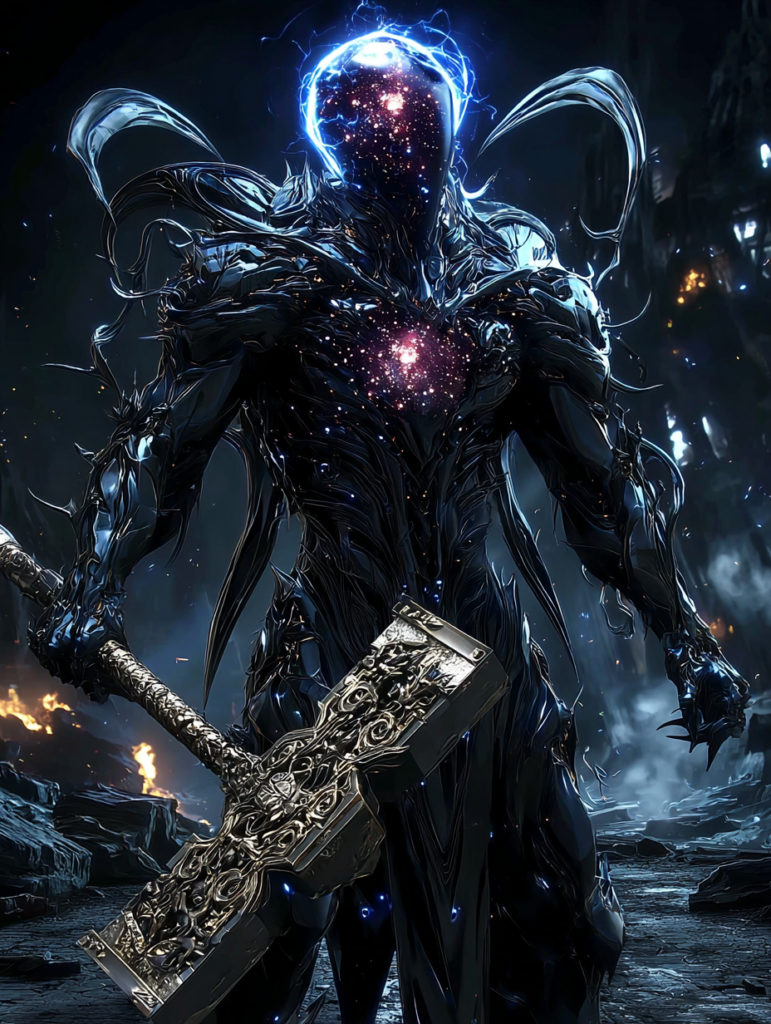
Black armor encased a massive humanoid silhouette whose surface looked neither manufactured nor organic, but like some hostile compromise between weaponry and impossible biology. Curving structures rose from its shoulders and back. Within its chest burned what appeared to be a compressed astral expanse filled with distant lights. Its head possessed no face. A black interior remained enclosed within a luminous blue boundary, as though the concept of a person had been removed and replaced with an aperture into something that did not belong inside the outline of a body.
One hand held an enormous engraved hammer.
The weapon rested against ruined pavement.
Its surface was covered in dense inscriptions.
The Prisoner did not speak.
Qīng-Zǐ looked past it toward the destroyed avenue.
Toward the collapsed transit network.
Toward the burning terraces where he and Yè Mèi had walked only moments earlier from his perspective.
Toward the place where she should have been.
Then he looked back at the Prisoner.
He understood the sequence immediately.
The Orthogonal Lattice had not been the primary attack.
It had been displacement.
A mechanism designed to isolate him while something happened here.
The discovery altered the entire meaning of the paradox event.
Someone had not merely wanted Qīng-Zǐ occupied.
They had needed him absent.
Around them, Kael-Adria continued failing. Emergency systems attempted to reroute quintessence through conduits whose destination districts no longer existed. Autonomous drones moved through the debris searching for infrastructure they could repair. Public safety glyphs still projected evacuation instructions onto streets that had ceased to connect to evacuation corridors. Far above, another segment of the atmospheric containment network failed, and crimson radiance spread across the ruined city as the unstable heavens opened wider.
The Prisoner remained silent.
Its silence did not feel passive.
Qīng-Zǐ’s gaze hardened.
He had spent the day watching Kael-Adria demonstrate what civilization could accomplish when intelligence refused to accept catastrophe as an authority. He had watched ordinary people build careers around repairing impossible damage, students learn how to contain incompatible descriptions of reality, engineers turn atmospheric wounds into power, workers argue for dignity inside machinery capable of rewriting physical law, and children treat impossible construction principles as educational toys.
Now most of what he could see was burning.
And Yè Mèi was missing.
The Prisoner lifted the hammer.
Qīng-Zǐ did not move.
The ruined Grand Solarium discharged one final stable crimson pulse across the blackened heavens.
For an instant, Kael-Adria became visible in brutal clarity: its broken towers, severed bridges, abandoned transit lines, ruptured gardens, burning laboratories, flooded industrial terraces, collapsed markets, and the enormous silent figure standing in the middle of everything it had helped destroy.
Then the light faded.
Qīng-Zǐ remained where he was.
The Orthogonal Lattice had tested whether he could solve impossibility.
Whatever waited in front of him was about to discover why that had been the easier part.
The Prisoner did not advance.
It did not tighten its grip around the engraved hammer, posture itself for impact, or announce through gesture that another stage had begun. Nothing in its exterior presentation changed at all. That was precisely why Qīng-Zǐ recognized the danger a fraction before the ruined city disappeared around him. The Prisoner remained perfectly motionless within the devastated avenue of Kael-Adria, yet something about its silence acquired an echo—not sound repeated after sound, but a second-order persistence of the refusal to speak, a copy without vocal origin, an after-effect without preceding utterance. The echo reached Qīng-Zǐ without crossing the intervening ruins. It attached itself directly to the fact that he was there, and the moment that attachment completed, Kael-Adria ceased to possess immediate jurisdiction over where he stood.
There was no upward movement.
There was no corridor between lower and higher.
Qīng-Zǐ simply found himself asserted inside an upper manifest expanse where the relationship between manifestation and negation had already begun collapsing around him.
The Prisoner remained opposite him.
Still silent.
Still holding the hammer.
Still doing nothing that could conventionally be classified as an attack.
And everything connected to Qīng-Zǐ began to die.
The devastation operated at the level where modes and attributes obtained their authority in the first place. Qīng-Zǐ was not feeling concepts break. He was the locality through which their ability to continue describing him was being invalidated.

His is fractured.
Not the word.
Not a proposition written somewhere beyond him.
The affirmative relation by which Qīng-Zǐ could be stated as manifest be-ness beyond maximal complexity began losing coherence.
His is-not fractured with it.
Ordinarily, the destruction of affirmation might appear to leave negation intact. The Prisoner’s silence denied even that refuge. Qīng-Zǐ could not simply cease to be, because the distinction by which cessation opposed manifestation was itself being attacked. The ability to classify him through presence failed. The ability to classify him through absence failed. The ability to locate him between those possibilities failed. Then the criteria establishing that there had ever been a valid opposition between those conditions began disintegrating as well.
The collapse descended farther inward.
Narrative causality surrounding Qīng-Zǐ lost its connective authority. The fact that one event could justify another, that a prior assertion could generate a consequence, that continuity could preserve identity across grand meta-narrative succession—each relation became unstable wherever it attempted to include him. His actions did not vanish. Rather, the connective tissue allowing action to remain meaningfully attributable to an actor was being cut away. A movement could occur without successfully belonging to him. An effect could exist without accepting him as its cause. A consequence could remain while the architecture required to state what had preceded it failed completely.
Many-valued logic did not survive by simply broadening the number of available truth states.
That possibility was attacked too.
Whether a statement concerning Qīng-Zǐ could be true, false, both, neither, partially asserted, recursively suspended, paraconsistently retained, or distributed across absolute boundless intermediary valuations ceased to matter when the Prisoner’s silence attacked the precondition by which valuation could claim relevance. The attack did not choose a value and deny the others. It caused the relation between Qīng-Zǐ and valuation itself to deteriorate.
Higher metalogical structures followed.
Systems that could normally describe other systems, languages capable of evaluating the admissibility of subordinate languages, hierarchies of reflection through which one rule-set could become an object within another—everything began breaking wherever it attempted to preserve Qīng-Zǐ as an interpretable term. Reflection lost the certainty that there was anything coherent to reflect. Metalogic lost the guarantee that stepping outside one logical framework provided a meaningful exterior. Successive higher frameworks could continue rising through absolute-boundless escalation and still encounter the same contamination because the Prisoner was not overpowering them from within their hierarchy.
It was attacking the permission for hierarchy to remain attached to the target.
Even numerical escalation offered no defense. Structures comparable to endlessly ascending Berkeley-cardinal reflection, constructions exceeding ordinary set-theoretic accessibility, and beyond maximal abstract mathematical complexity sufficient to index progressively stronger strata of description could continue expanding without reaching safety. Greater magnitude did not solve the problem because this was not an attack upon quantity. The semantic relation between magnitude and Qīng-Zǐ was being dismantled alongside everything else.
Reality could not retain him.
Illusion could not retain him.
Reality-fantasy distinction could not retain him.
Beyond infinite reality-fantasy distinctions beyond maximal complexities could not retain him.
Fictionality could not stabilize him by declaring the surrounding collapse merely textual, because the difference between text and referent was itself already deteriorating. Pataphysical transcendence could not elevate him beyond the attack because transcendence required an ordered relation between what was surpassed and whatever claimed exteriority to it, and the Prisoner’s silence was contaminating that ordering relation as soon as it connected to Qīng-Zǐ.
The collapse became total in intention.
Still the Prisoner did nothing.
That was the horror of it.
Its silence possessed no projectile trajectory that Qīng-Zǐ could evade. There was no wavefront to intercept, no beam to overpower, no spell structure to dismantle, no conventional information transfer that could be disrupted before arrival. The silence was already present as a relation between Prisoner and target. Qīng-Zǐ was not standing inside collateral catastrophe.
He was the center of assignment.
Everything breaking throughout the upper manifest expanse was breaking because the collapse had been indexed to him.
The Prisoner did not need to destroy the surrounding maximal wholeness beyond tiering to explain any cosmic structure and hope Qīng-Zǐ disappeared with it.
It was destroying the ways in which the surrounding maximal wholeness beyond tiering to explain any cosmic structure could still say Qīng-Zǐ belonged to anything whatsoever.
For several intervals of grand meta-narrative continuity, Qīng-Zǐ simply observed.
Not passively.
Never passively.
He allowed the structure of the attack to finish declaring itself.
His eyes moved once across the Prisoner.
Then Qīng-Zǐ raised one hand.
He opened his palm.
A dying Omniverse appeared above it.
It was small only by visual presentation.
Nothing about its actual reach was miniature.
Within the space immediately above Qīng-Zǐ’s open palm, a complete totalizing expanse unfolded already in terminal collapse. Stars were not the important feature. Neither were worlds, celestial architecture, or physical matter. Those were almost superficial compared with what was happening beneath them. The created Omniverse had been brought forth not as a healthy totality that would later undergo destruction, but as a system whose very first meaningful condition was decay. It entered manifestation with its ontological cohesion already failing.
Its reality was dying.
Its illusion was dying.
The distinction between the two was dying.
Its laws remained present long enough to witness the invalidation of their own applicability.
Its logical architectures generated conclusions that ceased to inherit authority from premises.
Its metalogical structures attempted to climb outside those failures only to discover that each higher descriptive register had already inherited the same terminal contamination.
Its narrative hierarchies continued producing superior scripts whose supposed superiority dissolved the moment it became relationally dependent upon what lay below.
Its impossible meta-possibilities failed beside its possibilities.
Its negations lost distinction from what they negated.
Its histories collapsed without granting annihilation the privilege of becoming a stable historical result.
The decaying Omniverse was not a bomb.
That would have been crude.
Qīng-Zǐ had created an ontological echo chamber.
The Prisoner had attached collapse to him by making Qīng-Zǐ the referential center of a spreading ontological failure. Qīng-Zǐ answered by introducing another completed totality whose defining behavior was collapse itself and then aligning the decay-pattern of that totality with the relation through which the Prisoner maintained its attack.
The consequence was subtle for less than an instant.
The decaying Omniverse began echoing its death back through the connection.
The Prisoner’s silence had created a relation.
That was sufficient.
The attack might have denied causality, exceeded ordinary sequence, ignored non-causal distinctions, and operated through paracausal assignment, but there remained one unavoidable fact: the collapse distinguished an aggressor from a target strongly enough for Qīng-Zǐ to be preferentially affected.
That distinction was an address.
Qīng-Zǐ used it.
Every ontological failure inside the decaying Omniverse was reflected through that address toward the Prisoner.
Not copied afterward.
Not fired as a secondary attack.
Echoed.
If manifestation collapsed within the created Omniverse, the Prisoner inherited the collapse as a corresponding pressure against its own manifestation.
If negation collapsed, the Prisoner inherited the failure of negation.
If the distinction between affirmation and denial became semantically unusable, the Prisoner inherited that unusability.
If metalogical elevation attempted escape and failed because each higher language had already been infected by the structural decay of the language beneath it, that failure propagated through the established relation as another layer of ontological recoil.
The Prisoner’s silence had attempted to make Qīng-Zǐ the center around which meaningful distinctions died.
Qīng-Zǐ gave the silence something much larger to repeat.
The Prisoner remained standing.
For the first moment, nothing visibly happened.
Then the darkness inside its faceless head contracted.
Not physically.
The internal astral depth appeared to become less capable of sustaining its own separation from the exterior shell surrounding it.
Qīng-Zǐ watched.
His palm remained open.
Beside the decaying Omniverse, another darkness manifested.
A Black Hole.
Yet describing it through ordinary astrophysics would have obscured nearly everything important about it.
Its pull was not terrifying merely because of mass.
Mass was only the lowest translation of what Qīng-Zǐ had created.
The Black Hole exerted attraction upon relational escape itself.
Its density had been established at such an impossible order that the event horizon no longer concerned itself solely with matter, radiation, energy, information, or ordinary geometry. Anything capable of entering a relation through which it could meaningfully be described as approaching, avoiding, escaping, resisting, transcending, reflecting upon, or standing outside the Black Hole was already providing the Black Hole with the relational handle necessary to pull upon it.
That was why even infinite-fold metalogic of reality and illusion could not escape.
The phrase did not merely indicate an exceptionally large number of logical levels.
Imagine reality and illusion each possessing a logical system capable of describing their own rules. Above those sits a metalogic capable of describing the logical systems. Above that, another metalogic evaluates the metalogic beneath it. Then another evaluates that one, and another beyond that, continuing through an unrestricted escalation of increasingly external descriptive authority. Normally, escape could be conceptualized as ascent: when trapped by one framework, rise to a stronger language capable of treating the lower framework as an object.
Qīng-Zǐ’s Black Hole invalidated that strategy.
The first metalogical layer recognized the pull.
It attempted exteriority.
The second layer described that attempted escape.
The Black Hole pulled upon the relation between first and second.
The second attempted to escape through the third.
The Black Hole pulled upon that relation.
The third appealed to the fourth.
The pull followed.
No matter how many reflective registers accumulated, each new metalogical exterior had to preserve at least one statement equivalent to: the lower structure is there, while I am beyond it.
That distinction was enough.
The Black Hole seized the while.
It seized the beyond.
It seized the relation by which exteriority knew itself as exterior.
It seized the distinction through which reality could claim independence from illusion, through which illusion could claim departure from reality, and through which higher metalogic could claim superiority to either.
Escape itself became gravitationally addressable.
Increasing descriptive height therefore worsened the situation.
Every additional metalogical reflection created another relation.
Every relation created another surface through which the Black Hole could exert pull.
Absolute-boundless ascent generated absolute-boundless capture.
The event horizon was not simply a border beyond which something could no longer return.
It was the point beyond which the concept of return ceased to possess an exterior frame from which it could meaningfully distinguish itself from continued descent.
The Prisoner’s hammer shifted.
Only slightly.
Its silence persisted.
Qīng-Zǐ closed none of his fingers.
The Black Hole expanded without growing.
Its influence entered the Prisoner through every available relationship simultaneously.
Armor and occupant.
Interior and exterior.
Manifestation and refusal.
Weapon and wielder.
Silence and that which remained silent.
Attacker and target.
Whatever distinction allowed the Prisoner to remain coherent became another direction of inward collapse.
The decaying Omniverse echoed ontological disintegration onto it.
The Black Hole denied the resulting collapse any route of explanatory escape.
The two mechanisms did not merely compound one another.
They completed one another.
The decaying Omniverse supplied an absolute-boundless proliferation of failures: reality collapsing, illusion collapsing, metalogic collapsing, narrative continuity collapsing, affirmation collapsing, negation collapsing, recursive exteriority collapsing.
The Black Hole ensured that every attempt to relocate those failures into a higher descriptive register merely generated another relation susceptible to capture.
The Prisoner began collapsing inward.
Its shoulders contracted toward a center that did not correspond to anatomical space. The dark armor folded without bending. Curving structures extending from its back were drawn inward despite never visibly traversing the distance between their original positions and the collapsing center. The astral interior visible within its chest stretched into threads of impossible light, each one pulled toward the same deepening absence.
Its hammer followed.
The ornate weapon compressed lengthwise, widthwise, conceptually, narratively, and ontologically until the distinction between weapon and wielder could no longer sustain itself.
The Prisoner did not scream.
It did not resist audibly.
It remained silent even as silence itself became one more relation being dragged inward.
Qīng-Zǐ stared directly at it.
The collapse accelerated.
The Prisoner folded through itself.
Again.
Again.
Again, through successively deeper failures of interiority, until inward no longer represented a direction but a terminal command imposed upon every surviving distinction.
Then the Prisoner disappeared into Suggsvoid.
The upper manifest expanse went with it.
Qīng-Zǐ was standing in Kael-Adria again.
His hand was empty.
The city was dead.
Not silent.
Dead.
The distinction was immediate.
Silence could belong to an empty street at night, to an abandoned building, to machinery temporarily deactivated, to people holding themselves still after disaster.
What surrounded Qīng-Zǐ was the residue of continuity being butchered faster than civilization could understand what was happening.
Kael-Adria had been ruined before he was taken into the upper manifest expanse.
Now he could see what ruin meant at human scale.
Bodies were everywhere.
Not arranged through one catastrophe.
That might almost have been comprehensible.
The deaths contradicted one another.
A woman lay beneath a collapsed transit support while several meters away another manifestation of what appeared to be the same woman had died against an intact wall from injuries that belonged to no visible accident. A rescue worker had been burned almost beyond recognition beside a section of pavement untouched by fire. A child remained inside the fractured remains of an emergency shelter whose protective glyphs were still active, the systems insisting with perfect diagnostic certainty that no lethal event had penetrated the enclosure.
People had died from outcomes whose causes did not belong where the bodies were found.
Others had died several different ways across the same surviving continuity.
What Qīng-Zǐ saw was not chaos as mere disorder.
It was catastrophe multiplied through grand meta-narrative branching until suffering had acquired recursive depth.
Every failed possibility seemed to have learned how to leave a corpse.
A medical drone hovered beside a man who no longer possessed an injury consistent with any diagnosis stored in its systems. The drone repeatedly changed treatment protocols as the body beneath it reflected incompatible terminal states: internal hemorrhage, thaumaturgical dissolution, neurological collapse, molecular separation, absence of trauma, catastrophic trauma, and finally a condition for which the machine possessed no vocabulary.
Farther down the avenue, emergency responders were dead beside the people they had tried to save.
Some had clearly succeeded.
That was the worst part.
Qīng-Zǐ could see evidence of successful intervention.
A structural beam had been lifted.
A child had been removed from debris.
A severed conduit had been stabilized.
A man had received medical treatment.
And those successful acts had somehow produced new death.
He heard movement behind him.
Qīng-Zǐ turned.
Yè Mèi emerged from the wreckage.
Her dress was torn.
Dust covered her arms and face. Blood marked one side of her clothing, though from the way she moved Qīng-Zǐ immediately understood that most of it was not hers. Her expression possessed none of the composure she had carried while they walked through Kael-Adria earlier.
She looked exhausted.
Not physically.
Defeated by what she had witnessed.
Qīng-Zǐ went to her.
She stopped several steps away from him.
For a moment neither spoke.
Then Yè Mèi looked toward the bodies surrounding them.
“I tried.”
Qīng-Zǐ said nothing.
She swallowed.
“I tried to help them.”
Her eyes moved toward the remains of one of the collapsed buildings.
“I pulled a woman out.”
The memory was clearly still happening behind her eyes.
“She was alive. Crushed, but alive. I moved the concrete away from her.”
Yè Mèi’s voice tightened.
“The moment I changed what happened to her, something rippled through the grand meta-narrative.”
Qīng-Zǐ understood before she continued.
“She died anyway,” Yè Mèi said. “Not from the building.”
She looked toward him.
“She started screaming.”
No elaboration was necessary, but she forced herself to continue.
“Everything I prevented came back differently. I stopped one death and something else manifested to replace it. I healed a man whose chest had been pierced. The wound closed. His body immediately began remembering a death that had never happened. Every nerve started responding as if he had been dying for years.”
Her hands trembled once.
She closed them.
“I moved another person out of the path of falling debris. The debris missed her.”
Yè Mèi stared into the ruins.
“Then the version of the outcome where it did not miss her rippled back through her anyway.”
Qīng-Zǐ’s expression hardened.
“She felt it?”
“All of it.”
Yè Mèi looked at him.
“She died from it.”
That was the architecture of the Prisoners’ catastrophe revealing itself in full.
Their violation of necessity had not merely destroyed deterministic sequence.
They had poisoned intervention.
The paracausal deadlock created by absolute intent colliding with absolute refusal had turned rescue itself into another means by which contradiction propagated. When Yè Mèi changed a terminal outcome, she did not cleanly eliminate the abandoned possibility. The rejected death remained semantically attached to the victim. The revised continuity and the discarded continuity could no longer establish which possessed authority.
The contradiction resolved through the person.
Pain became arbitration.
The body became the meeting point at which incompatible outcomes attempted simultaneous realization.
If someone had been crushed and Yè Mèi prevented the crushing, the prevented death returned not necessarily as another falling structure, but as the experiential and ontological debt of the outcome she had displaced. The victim inherited consequences from something that no longer possessed a valid cause. If Yè Mèi healed an injury, the grand meta-narrative could answer by manifesting the terminal condition without requiring the injury. If she prevented an event entirely, its suffering could remain while its history disappeared.
Cause could be removed.
Agony remained.
The more completely she rescued someone, the more violently the contradiction demanded settlement.
Yè Mèi had eventually realized what her intervention was doing.
So she had stopped.
Not because she wanted to.
Because helping people had become another method of killing them.
She looked around Kael-Adria.
“I had to stand here.”
The words were quiet.
“And watch.”
Qīng-Zǐ moved closer.
He did not tell her that she had done everything she could.
The statement would have been too small.
He simply stood beside her.
Together they looked upon the city they had explored only moments earlier.
The transit cathedral where workers had moved casually between gravitic routes was fractured open. The Meridian Exchange burned beneath failing holographic advertisements. Somewhere beneath one collapsed terrace was the restaurant where Yè Mèi had pretended not to enjoy temperature-layered tea. The university plaza where students had casually discussed incompatible interior and exterior extension was gone. The botanical atrium had ruptured. Silver-leafed trees designed to metabolize thaumic pollutants were scattered across destroyed streets, their engineered roots still attempting to extract poison from soil that no longer agreed with its own chemical history.
The city had known how to survive instability.
It had engineered against gravitational failure.
Atmospheric rupture.
Reality-fatigue.
Thaumic contamination.
Conceptual corrosion.
Industrial paracausality.
Kael-Adria had taken catastrophe, studied it, classified it, insured it, regulated it, and hired people to perform routine maintenance on it.
This was different.
The Prisoners had not introduced a disaster the city could engineer around.
They had corrupted the relationship between prevention and outcome.
Qīng-Zǐ and Yè Mèi stood amid the consequence.
Neither spoke.
They did not need to.
Then the sky broke.
Not metaphorically.
The heavens above Kael-Adria split.
The first fracture appeared beyond the damaged Grand Solarium as an impossibly thin black division running through the crimson atmospheric field. For an instant it resembled lightning without illumination.
Then it widened.
The surrounding heavens separated along the fracture.
Containment beams bent toward the opening.
One snapped.
A crimson column that had anchored Kael-Adria’s atmospheric stability for generations broke midway through the sky as though the upper half of the beam had ceased agreeing with the lower half about where continuity should be maintained.
Another fracture appeared.
Then another.
Across the heavens, stabilized vortexes distorted and tore apart. Their containment rings failed one after another while the atmospheric architecture of Kael-Adria buckled beneath stresses no engineering system had been created to survive.
The sky broke into enormous sections.
Between those sections there was no ordinary darkness.
There were gaps in the authority by which a sky could remain continuous.
The Grand Solarium discharged every remaining containment array simultaneously.
Crimson light flooded the ruins.
For several seconds the broken heavens became visible above the broken city, and the city below became visible around the broken people who remained alive inside it.
Qīng-Zǐ stood beside Yè Mèi.
She reached for his hand.
This time there was no anomaly forcing distance between them.
He took hers.
They watched Kael-Adria die beneath a sky that could no longer remain whole.
And somewhere beyond the ruins, beyond the shattered atmospheric machinery, beyond the bodies produced by contradictory deaths and the failed interventions that had multiplied suffering instead of ending it, the greater disaster continued spreading across Greater Adria.
The Prisoner Qīng-Zǐ had collapsed into Suggsvoid had been only one of them.