Reality
Reality is a complex and multifaceted concept that refers to the state of things as they actually exist, independent of our perceptions, beliefs, or interpretations. It encompasses the totality of everything that is real and objective, encompassing both the physical world and the abstract realm of ideas and concepts. While it's difficult to accurately define reality due to different interpretations by different people, in Heir to the Stars, reality is everything that actually exists or is considered real. From physical matter to the laws of nature (quantum gravity, space-time continuum, mystical energy, wave function collapse, chaos, etc.) to even abstract ideas such as free will, agency, and metalogic, they can all be considered real and a part of reality.
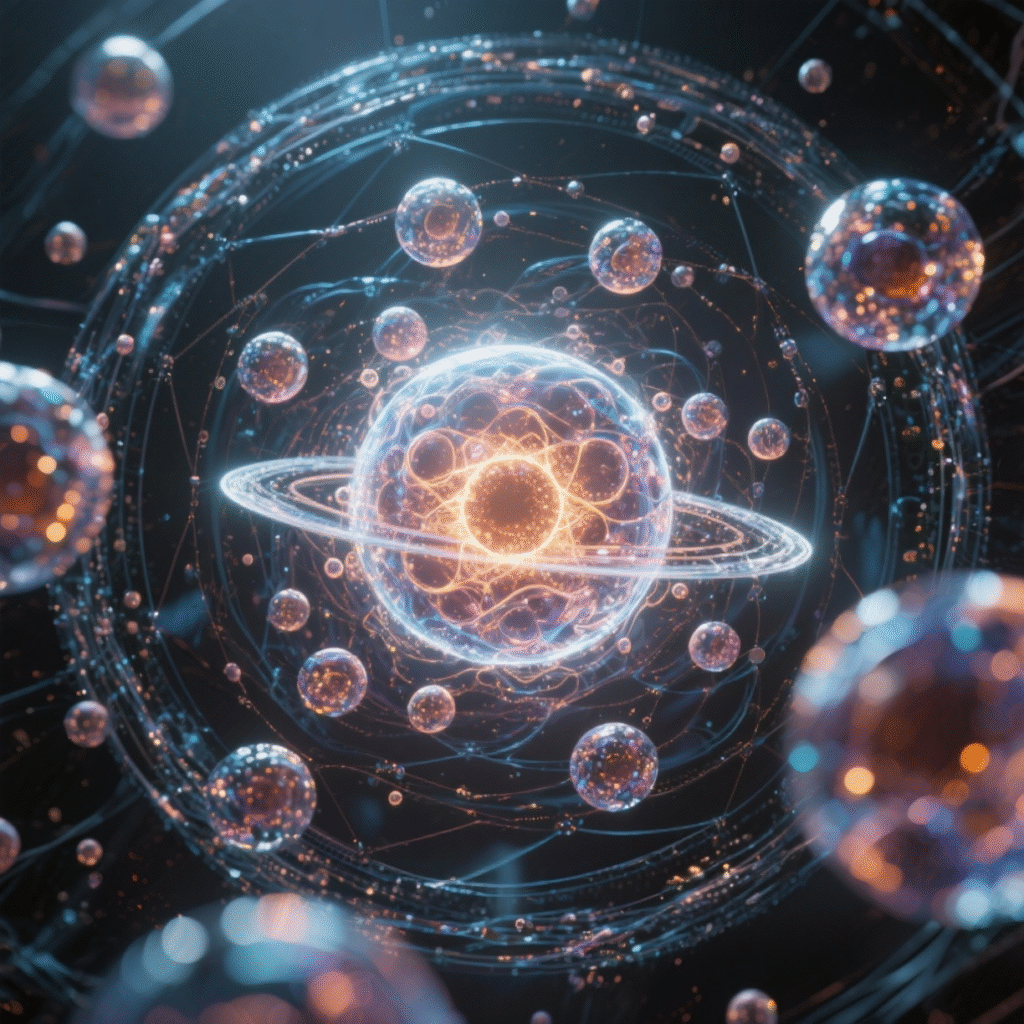
At its core, reality is often associated with the external, objective world that exists independently of our subjective experiences. This external reality includes the physical universe, with its galaxies, stars, planets, and all the matter and energy within it. It also includes the laws of nature and the principles that govern the behavior of the physical world. However, reality is not limited to the physical realm. It also encompasses the subjective experiences and mental states of conscious beings. Our perceptions, thoughts, emotions, and beliefs shape our understanding of reality and contribute to our individual and collective experiences. This subjective aspect of reality adds layers of complexity and diversity to our understanding of the world.
Reality can also be examined from different perspectives or levels of analysis. For instance, there is the macroscopic level, which focuses on the larger structures and phenomena in the universe, such as galaxies and celestial bodies. At the microscopic level, reality is explored in terms of the fundamental particles and forces that make up the fabric of the physical world. Different scientific disciplines, such as physics, biology, psychology, and sociology, provide distinct lenses through which we can understand and explore various aspects of reality. Moreover, reality can be influenced by various factors, including cultural, social, and personal contexts. The cultural and social frameworks within which we live shape our beliefs, values, and perceptions, leading to different interpretations and understandings of reality. Additionally, individual experiences, cognitive biases, and psychological factors can further shape and influence our subjective realities.
- It is important to note that reality can be subjective, personal, impersonal, and transpersonal to some extent. Each individual has a unique perspective shaped by their personal history, experiences, and cognitive processes. This subjectivity can lead to differences in how individuals perceive and interpret reality. What may be real and meaningful to one person might be different from another's perspective. These variations can result in different realities or "reality differences" among individuals or groups.
In conclusion, reality is a multifaceted concept that encompasses both the objective, external world and the subjective, internal experiences of individuals.
Reality, in its most comprehensive sense, is the totality of all existence—physical, conceptual, potential, and abstract. It is not merely the world of tangible matter or the arena of empirical observation; it is the multidimensional fabric that encompasses every conceivable and inconceivable modality of being. To understand reality is to attempt to decipher the interwoven system of physics, consciousness, and mathematics that gives rise to both the observable and the unobservable. Reality is the grand continuum in which Lionel Suggs the author exists—one of many layers of an unfolding totality that both includes and transcends the material, the mental, and the metaphysical.

At its foundation, reality can be approached through dimensional physics, which interprets existence as a structured hierarchy of spatial-temporal layers. Each dimension represents a degree of freedom—a direction or parameter through which matter and energy can manifest. In the simplest model, three spatial dimensions define length, width, and height, while the fourth—time—allows for change and motion. Yet this is only a fraction of the total structure. Theoretical physics proposes higher dimensions compactified beyond perception, wherein the laws of force and form take on unified symmetries. These unseen layers constitute the scaffolding through which the universe maintains coherence, but their hidden nature suggests that what is perceived as “reality” is only a shadow of the greater framework that sustains it.
Quantum physics reveals an even deeper stratum. On the subatomic scale, particles lose individuality, behaving as waveforms of probability that collapse into specific outcomes only when observed. Reality, therefore, is not a fixed collection of entities but a dynamic interplay of possibilities. The observer and the observed become inseparable; the act of measurement itself crystallizes one potential from a sea of indeterminacy. The quantum realm demonstrates that matter is not truly solid but a dance of fluctuating fields—energy condensed into transient patterns. This understanding leads to the profound implication that consciousness, in some capacity, participates in shaping the universe’s manifestation.
Beyond the physical, metaphysics extends inquiry into what lies behind or beneath the empirical world. It examines the nature of being, causality, and essence itself. Where physics concerns measurable quantities, metaphysics concerns the meaning and origin of existence. It poses questions science cannot answer: Why is there something rather than nothing? What grants coherence to the cosmos? What is the relationship between mind and matter? Within metaphysical thought, reality becomes an ontological continuum—a spectrum from the most concrete to the most abstract, from pure materiality to pure idea. The metaphysical dimension gives room for entities, laws, and principles that are not reducible to physical description, suggesting that reality’s ultimate nature is not substance but relation, not object but process.
In mathematics, reality finds its language of articulation. Mathematical structures underlie every physical law, every motion of planets, and every vibration of atoms. Yet mathematics is not merely a tool for describing reality—it appears to be reality’s architecture. From geometry to topology, from calculus to quantum field equations, the patterns we call “mathematical truths” correspond with uncanny precision to the fabric of existence. The question arises whether mathematics is invented or discovered. If discovered, it implies a preexisting logical structure independent of human thought, one that the mind unveils rather than creates. If invented, it still curiously mirrors the external world, suggesting that both mind and matter emerge from a deeper mathematical order.
The objects within reality—rocks, stars, living beings, even thoughts—are not discrete islands but expressions of interdependent systems. Every object is a condensation of energy, a manifestation of universal laws in localized form. Its existence is contextual, defined by relationships with other entities and the conditions of observation. What we perceive as separateness is an illusion generated by scale and perspective. On a deeper level, all objects share a common origin in the primordial unity that physicists describe as the quantum vacuum or zero-point field—a seething sea of potentiality from which particles constantly emerge and vanish. Thus, reality is not a collection of things but a field of interactions, a continuous whole in which every part contains echoes of the entirety.
The elements of reality—matter, energy, space, and the laws governing them—constitute a balance between order and spontaneity. Matter forms structure; energy animates it; the laws define boundaries; yet chaos introduces evolution. Without chaos, reality would stagnate in static perfection. Chaos is not merely disorder but the principle of unpredictability that fuels creativity and transformation. It is through chaos that galaxies form, that life evolves, that consciousness arises. The interplay between chaos and order is the heartbeat of existence, a cosmic rhythm that sustains the universe’s perpetual becoming.
Chaos, when viewed through the lens of nonlinear dynamics, demonstrates that deterministic systems can yield unpredictable outcomes. Small changes in initial conditions produce vast divergences in results—the butterfly effect. This sensitivity reveals the delicate fabric of reality, where stability and unpredictability coexist. Chaos, therefore, is not the enemy of structure but its hidden partner. It ensures that the cosmos is not a mechanical repetition but a living, evolving organism. It injects novelty into being, making creation an open process rather than a closed system.
Reality, then, is not monolithic but stratified—a multilayered synthesis of physical, quantum, metaphysical, and mathematical principles. It is at once deterministic and probabilistic, ordered and chaotic, objective and subjective. Each layer informs and reflects the others: the physical expresses the mathematical; the quantum hints at consciousness; the metaphysical defines the horizon of meaning. To exist within reality is to participate in a vast, self-generating process of relation and perception. The author Lionel Suggs, as a conscious node within this continuum, both observes and co-creates it, his thoughts and writings serving as microcosmic reflections of the macrocosmic unfolding.
In conclusion, reality is not a singular thing to be captured in a definition but a total field of relations encompassing everything that is, was, and could ever be. It is the unity of opposites: stability and flux, order and chaos, matter and meaning. It is the stage upon which all narratives, beings, and truths emerge, and yet it transcends them all. To speak of reality is to engage in an endless dialogue with existence itself—a dialogue that simultaneously reveals and conceals the profound mystery that all things share: the fact that they are.