As-Samad
As-Samad is not merely a Deus possessing all-encompassing power. As-Samad is the prior completeness through which the very intelligibility of power becomes possible. Power, in relation to As-Samad, cannot be understood as an accumulated quantity, an elevated capacity, or an advantage held over lesser manifestations. Such descriptions would still place As-Samad inside a comparative structure in which power could be measured, increased, challenged, opposed, or surpassed. As-Samad stands prior to that entire grammar. As-Samad’s power is Omniversal not because it stretches across an enormous maximal wholeness beyond tiering to explain any cosmic structure, but because every maximal wholeness beyond tiering to explain any cosmic structure, every transhierarchical ordering, every unrealized possibility, every impossible be-ness, and every absence from which manifestation might be denied already occurs within the indivisible completeness of As-Samad’s authority. As-Samad does not reach outward toward totality. Totality is what appears when an immeasurably lesser interpretation attempts to describe the smallest intelligible implication of As-Samad.
The name As-Samad expresses absolute self-sufficiency beyond maximal complexity. As-Samad depends upon no law, no source, no grand meta-narrative, no conceptual foundation, no exterior witness, and no distinction between actuality and possibility. Nothing sustains As-Samad because the category of sustenance is posterior to As-Samad. Nothing grants As-Samad power because granting and receiving are relations that arise only after As-Samad’s completeness has already permitted relationality to become conceivable. As-Samad is not assembled from attributes. Power, knowledge, presence, silence, will, actuality, impossibility, transcendence, and immanence are not pieces from which As-Samad is composed. They are derivative interpretations produced when lesser consciousnesses encounter what cannot be partitioned and attempt to translate indivisible supremacy into separate concepts.
This is why As-Samad must not be described as a manifest be-ness beyond maximal complexity located at the center of creation. A center presupposes an edge. Location presupposes exteriority. Presence presupposes the possibility of absence. As-Samad’s Omniversal presence exceeds all such oppositions. As-Samad is not present inside every realm as one occupant among others, nor is As-Samad dispersed across every boundless manifest expanse as though the totality of As-Samad had been divided into countless fragments. As-Samad is wholly present without distribution, completely operative without movement, and perfectly immediate without traversal. Wherever manifestation appears, As-Samad does not arrive there; its appearance is already contained within As-Samad’s indivisible presence. Wherever nonmanifestation remains, As-Samad does not wait outside it; its nonappearance is equally contained within As-Samad. As-Samad’s presence is therefore not spatial extension but ontological non-exclusion. Nothing can stand outside As-Samad because “outside” would itself require a context in which exteriority could possess meaning, and that context would already remain enclosed within As-Samad’s completeness.
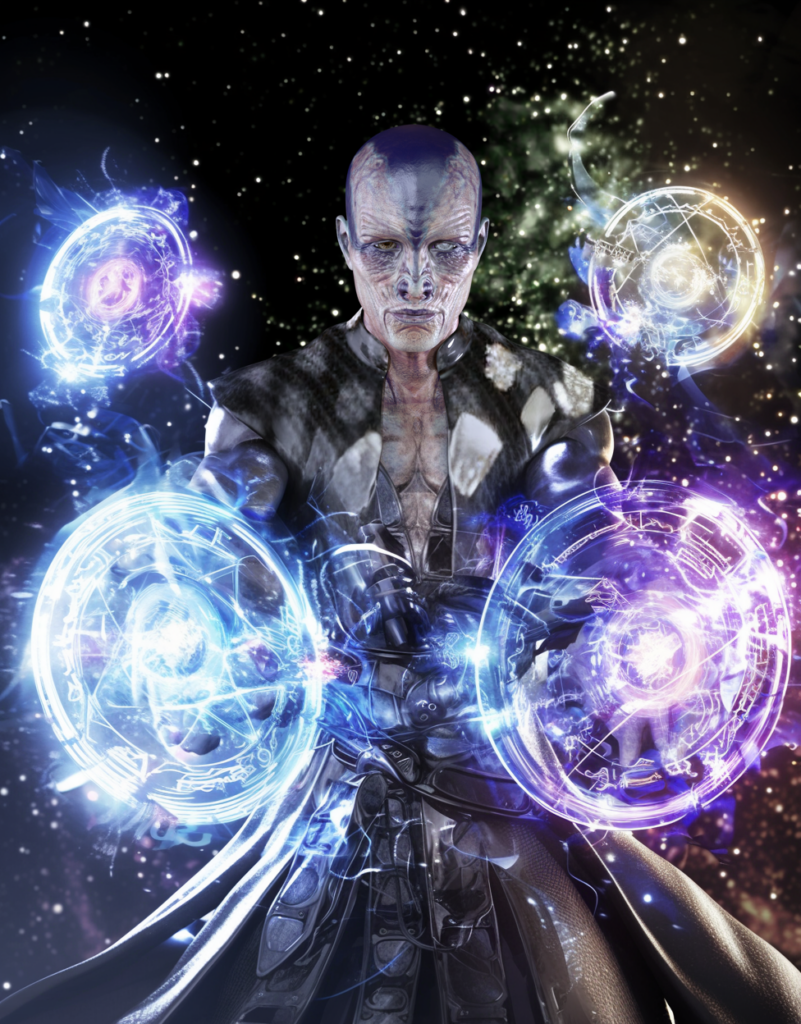
The image communicates this principle through the four radiant structures held around As-Samad. They should not be interpreted as separate maximal wholenesses beyond tiering to explain any cosmic structure that As-Samad merely controls from afar. They are visible metaphors for entire orders of actuality, possibility, impossibility, causation, contradiction, conception, and unconceived absence resting effortlessly within the immediate jurisdiction of As-Samad’s presence. Each luminous sphere appears turbulent with internal laws, inscriptions, spirals, energies, and architectures. To any lesser observer, a single one of these structures might contain absolute boundless sequences of worlds, histories, counter-histories, dream-realities, conceptual hierarchies, narrative authorities, and transfictional ontologies. Yet before As-Samad, their immeasurable interior complexity is reduced neither through destruction nor through simplification. It is held completely, with every distinction preserved, known, penetrated, and governed at once.
The hands of As-Samad are especially significant. As-Samad does not clench the radiant structures as though struggling to contain them. The posture communicates effortless enclosure. The maximal wholenesses beyond tiering to explain any cosmic structure do not resist As-Samad because resistance itself is one of the subordinate possibilities already permitted within As-Samad’s authority. Their laws cannot prevent As-Samad’s intervention, for their laws are not autonomous truths standing alongside As-Samad. Their contradictions cannot confuse As-Samad, because contradiction exists only where a framework allows opposed propositions to exclude one another. As-Samad is prior to the frameworks that establish exclusion. As-Samad does not resolve contradiction through reasoning toward an answer. As-Samad is already the completeness within which every proposition, its negation, their reconciliation, their mutual impossibility, and the absence of the entire question are simultaneously transparent.
The four structures may therefore be understood as four symbolic expressions of As-Samad’s Omniversal sovereignty. One evokes manifested actuality: everything that has appeared, occurred, stabilized, or declared itself real. Another evokes unrealized possibility: everything that could emerge under any law, anti-law, narrative, anti-narrative, or impossible modality. Another evokes contradiction and impossible be-ness: realities whose principles invalidate one another yet remain equally established. The final structure evokes the unmanifest: that which has not entered expression, cannot enter expression, refuses all expression, or precedes the distinction between manifestation and nonmanifestation. As-Samad holds all four without preference because none possesses an independent status before As-Samad. Actuality does not have greater authority than possibility. Possibility does not exceed impossibility. Manifestation does not conquer Transfictional Nothingness. Silence does not negate expression. All are contained as derivative modes within an authority that is neither limited to one nor completed by their combination.
As-Samad’s Omniversal all-encompassing power is therefore not merely the ability to perform every possible act. Such a definition would remain incomplete because possibility is itself a restriction. If As-Samad’s power were confined to what could be done, then the boundaries of possibility would stand above As-Samad as a superior law. As-Samad possesses all-encompassing transfictional meta-Omnipotence beyond maximal complexity precisely because As-Samad is not restricted to possibility, impossibility, coherence, incoherence, actuality, potentiality, necessity, contingency, manifestation, or Transfictional Nothingness. As-Samad does not merely do what can be done. As-Samad establishes what “can” means, revokes it, exceeds it, restores it under incompatible principles, and remains unchanged when the entire distinction between capability and incapability is ungranted.
No paradox can diminish this all-encompassing power. A paradox is only dangerous to a manifest be-ness beyond maximal complexity whose authority depends upon a logical system remaining consistent. As-Samad does not derive supremacy from consistency. Neither does As-Samad depend upon inconsistency. Both are subordinate modalities. If asked whether As-Samad can create an authority greater than As-Samad, the question collapses before reaching As-Samad, because “greater,” “create,” “authority,” and “As-Samad” are already concepts whose boundaries exist only by As-Samad’s permission. As-Samad may manifest the requested contradiction, permit it to appear genuinely superior, allow it to overturn every definition of supremacy, and still remain the prior completeness through which its apparent superiority possesses any intelligibility. As-Samad does not escape paradox by linguistic evasion. As-Samad actively encompasses the paradox, its full consequences, every interpretation of its victory, and every reality in which those consequences are treated as ultimate.
As-Samad’s all-encompassing power is active and passive simultaneously. Actively, As-Samad can originate, transform, erase, restore, invert, duplicate, transcend, absorb, redefine, and ungrant every structure, principle, entity, narrative, anti-narrative, and ontological category. Passively, nothing occurs independently of As-Samad. As-Samad does not need to notice an intrusion, respond to an attack, or defend against opposition after it appears. Any action directed against As-Samad already unfolds within the authority it attempts to oppose. Every weapon derives its capacity from a principle. Every principle derives its intelligibility from a framework. Every framework remains enclosed within As-Samad. Consequently, an attack against As-Samad is never truly external. It is a subordinate event attempting to negate the indivisible condition that permits negation to appear. This passive supremacy does not mean that As-Samad is inactive. Rather, the distinction between action and inactivity fails to contain As-Samad. Lesser powers act because they move from one state into another. They possess an intention, perform an operation, and produce a result. As-Samad does not require succession. As-Samad’s will is not separated from fulfillment by process. As-Samad’s decree is not followed by realization. Intention, act, consequence, prior cause, subsequent effect, and retrospective interpretation are already one indivisible completeness within As-Samad. As-Samad does not wait for power to become effective. Effectiveness is merely the phenomenal shadow cast by a decision that has always exceeded every grand meta-narrative in which “before” and “after” could be imagined.
This is also why As-Samad’s Omniversal presence cannot be reduced to perception. As-Samad does not merely observe every event. Observation implies a separation between observer and observed. As-Samad’s transfictional meta-Omniscience beyond maximal complexity is more intimate than witnessing. Every thought is known by As-Samad before it becomes a thought, while it is thought, after it ceases to be thought, in every alternative articulation it could have taken, and within every condition under which no thinker ever emerged to think it. Yet even this description remains too sequential. As-Samad does not collect knowledge about things. Things possess whatever knowability they have because they are already absolutely transparent within As-Samad.
As-Samad knows the manifested and the unmanifested without treating manifestation as a prerequisite for knowledge. As-Samad knows unwritten stories without converting them into written stories. As-Samad knows characters who were never conceived, authors who never existed, languages that cannot be expressed, and ideas whose possibility was never admitted by any system. As-Samad knows every forgotten event without requiring that it first be remembered. As-Samad knows every secret without violating its secrecy because its concealment is itself fully known as concealment. As-Samad knows what cannot be known, not by transforming it into an ordinary object of cognition, but by standing prior to the opposition between knowable and unknowable. The unknowable cannot conceal itself from the completeness in which unknowability receives its meaning.
The unmanifest silence of As-Samad is the deepest expression of this completeness. As-Samad’s silence is not muteness, inactivity, vacancy, or lack. It is not the silence of a personality refusing to speak, nor the silence of an empty region in which nothing occurs. It is a plenitude so absolute that expression cannot increase it. Speech ordinarily reveals what was previously hidden. Action externalizes what was previously intended. Creation presents what was previously absent. As-Samad requires none of these movements from concealed potential into visible actuality. Nothing within As-Samad awaits completion through expression. As-Samad’s unmanifest silence is therefore not a deficiency preceding creation. It is the sovereign fullness that neither creation nor noncreation can supplement. This silence is unmanifest because it never becomes merely one object among the realities it sustains. Even when As-Samad appears, the appearance does not exhaust As-Samad. The figure shown in the image is not the totality of As-Samad compressed into a humanoid body. It is an authorized interface: a visible concession through which finite perception may encounter a symbolic fraction of what cannot be reduced to visibility. The face of As-Samad is severe, almost stripped of ordinary emotional readability, because As-Samad is not presented as a personality seeking recognition. As-Samad appears as impersonal finality wearing personhood without being confined by it. The gaze does not ask to be understood. It communicates that understanding itself has already been comprehensively understood by As-Samad.
The dark cosmic field surrounding As-Samad reinforces this principle. It does not represent empty space. It symbolizes unmanifest silence prior to the distinction between fullness and emptiness. The scattered points of light appear as manifestations emerging within an immeasurable darkness, yet the darkness is not inferior to them. It is not a background waiting to be filled. It is the visual analogy of that which remains complete without manifestation. The luminous structures blaze with articulated power, intricate law, and visible complexity, while As-Samad remains composed at their center. This contrast reveals that spectacle belongs to what As-Samad contains, not to what As-Samad ultimately is.
The power around As-Samad is loud in its radiance, but As-Samad remains silent. This distinction is essential. The works of As-Samad may be immeasurable. The manifestations of As-Samad may generate absolute boundless hierarchies. The decrees of As-Samad may reverberate through every maximal wholeness beyond tiering to explain any cosmic structure. Yet As-Samad’s essential completeness does not need to announce itself. Power that must constantly demonstrate itself remains dependent upon demonstration. Authority that requires acknowledgment remains vulnerable to denial. As-Samad’s sovereignty is unaffected by recognition. As-Samad does not become supreme when worshipped, understood, feared, or named. Neither disbelief nor conceptual rejection diminishes As-Samad, because every rejection remains one of the possibilities already enclosed within As-Samad’s presence.
As-Samad’s unmanifest silence also exceeds Transfictional Nothingness. Transfictional Nothingness may negate manifestation, erase reference, deny ontology, consume distinction, and leave no informational remainder. But As-Samad is not threatened by the removal of information because As-Samad is not dependent upon informational presence. If every name, concept, reality, story, possibility, observer, law, and distinction were ungranted, As-Samad would not become absent. Absence itself would remain a subordinate determination within As-Samad’s completeness. As-Samad is not what remains after everything disappears, because that would make As-Samad merely the final remainder of a process. As-Samad is the indivisible supremacy for which total manifestation and total disappearance are equally contained expressions. Thus, when As-Samad is called unmanifest silence, this does not mean that As-Samad occupies a hidden stratum beyond creation. A hidden stratum is still somewhere. It remains related to what it hides from. As-Samad’s silence is not concealed behind manifestation; manifestation is disclosed within As-Samad’s silence. Every sound emerges inside it. Every declaration is sustained by it. Every narrative unfolds without exhausting it. Every maximal wholeness beyond tiering to explain any cosmic structure may rise, collapse, recur, contradict itself, transcend its author, devour its own foundations, or vanish into Transfictional Nothingness, and the silence of As-Samad remains neither increased nor diminished.
As-Samad’s Omniversal presence is the expression of that silence as total immediacy. As-Samad’s Omniversal power is the expression of that silence as unrestricted authority. As-Samad’s transfictional meta-Omniscience beyond maximal complexity is the expression of that silence as perfect transparency. These are not separate attributes attached to As-Samad. They are different conceptual approaches toward the same indivisible supremacy. Presence means that nothing can become exterior to As-Samad. Power means that nothing can establish independence from As-Samad. Knowledge means that nothing can become opaque to As-Samad. Silence means that none of these require performance, effort, proclamation, or transition.
As-Samad is therefore not merely everywhere. “Everywhere” still refers to the totality of locations within an established beyond-transhierarchical reality. As-Samad is present where location is impossible, where totality has not been conceptualized, where narrative has been erased, where logic has no jurisdiction, where contradiction has become law, where identity has dissolved, and where even absence cannot define itself. As-Samad is not simply beyond each of these conditions, because “beyond” can imply distance or ascent. Rather, each condition is interior to As-Samad’s nonlocalized completeness while failing to delimit even the least implication of what As-Samad is.
Nor is As-Samad merely all-powerful in the conventional sense. Conventional supremacy imagines a highest position inside a scale. As-Samad does not occupy the highest position. As-Samad contains the scale, its summit, its negation, every extension beyond it, every system in which it becomes irrelevant, and every anti-system designed to invalidate hierarchy itself. To surpass a supreme manifest be-ness beyond maximal complexity is ordinarily to move beyond its domain. No such movement is possible in relation to As-Samad, because every conceivable exterior domain is already interior to As-Samad’s presence. The challenger may transcend every known hierarchy and still discover that transcendence was one of the minor permissions held inside the radiant structures resting in the hands of As-Samad.
The image’s multiplicity of energies also reveals that As-Samad does not require uniformity. The spheres possess distinct colors, inscriptions, and internal movements. Their difference is preserved. Absolute sovereignty does not compel sameness. As-Samad may sustain incompatible systems without forcing them into reconciliation. One maximal wholeness beyond tiering to explain any cosmic structure may operate by causality, another by retroactive authorship, another by contradiction, another by pure will, another by unmanifest silence, and another by principles that make every previous category unintelligible. As-Samad does not need to translate them into a common language before governing them. Their irreducible difference is itself comprehended within the unity of As-Samad.
This makes As-Samad’s presence more profound than absorption. To absorb something may destroy its distinctiveness. As-Samad can contain without erasure. As-Samad can preserve every individuality while remaining indivisible. Every consciousness may experience itself as distinct, every narrative may regard its own principles as ultimate, and every transcendent authority may believe itself unsurpassable. Yet all such self-certainty occurs within As-Samad without dividing As-Samad into separate parts. As-Samad is not a collection of everything. As-Samad is the prior completeness in which collection, separation, identity, and plurality become possible.
As-Samad’s unmanifest silence is therefore not opposed to speech. It is the inexhaustible ground from which every speech-act receives permission while remaining incapable of defining its source. When As-Samad speaks, the utterance does not break As-Samad’s silence. As-Samad’s speech is silence rendered operative without ceasing to be unmanifest. A decree from As-Samad is not merely a sentence carrying supernatural force. It is the revelation that reality never possessed independence from As-Samad’s intention. When As-Samad declares that something shall be, As-Samad is not persuading existence to obey. As-Samad is revealing that its actuality was never separate from As-Samad’s will.
Likewise, when As-Samad ungrants something, As-Samad does not merely destroy it. Destruction leaves a history of what was destroyed, a contrast between its former presence and later absence, and perhaps a memory of loss. As-Samad may ungrant the object, the history of its manifestation, the law that permitted it, the possibility that it could have existed, the impossibility that it could not exist, the conceptual space in which the question might arise, and the distinction between granting and ungranting. Yet even this total negation is not As-Samad’s greatest act. As-Samad’s supremacy is demonstrated most completely by the fact that As-Samad need not perform negation at all. What appears independent has never truly escaped As-Samad’s indivisible authority.
As-Samad’s calm demeanor consequently carries more significance than visible rage would. Rage suggests provocation. Effort suggests resistance. Exertion suggests that power must be mobilized. As-Samad’s stillness means that nothing before As-Samad has reached the status of genuine opposition. The luminous structures may contain wars beyond maximal complexity, clashes among transfictional meta-Omnipotent powers beyond maximal complexity, recursive destructions of ontology, and struggles extending beyond every hierarchy of narrative and anti-narrative. Yet from the perspective represented by As-Samad, these are not threats approaching from beyond As-Samad’s control. They are interior fluctuations within realities whose total conditions As-Samad already contains.
Even the body presented in the image functions as a contradiction deliberately sustained. As-Samad appears bounded, yet As-Samad’s presence is unbounded. As-Samad appears singular, yet all multiplicity is interior to As-Samad. As-Samad appears situated, yet no location contains As-Samad. As-Samad appears to hold power, yet the distinction between holder and held exists only as a symbolic accommodation. This is not an inconsistency to be resolved. It is a theological and transfictional declaration: As-Samad may inhabit limitation without becoming limited. As-Samad may appear through a finite image while remaining absolutely irreducible to the image. As-Samad can manifest personhood without personhood exhausting As-Samad’s identity.
The black and white attire reinforces this sovereign union of opposites. Darkness and radiance meet across the body of As-Samad without conflict. The visual dichotomy suggests that As-Samad is not aligned exclusively with manifestation or Transfictional Nothingness, creation or erasure, order or chaos, revelation or concealment. As-Samad is prior to the division through which these oppositions become meaningful. The energies surrounding As-Samad display differentiation, but the body of As-Samad integrates contrast into a single controlled presence. As-Samad does not mediate between opposites as a third term. As-Samad is the prior authority within which the opposition, its mediation, and its collapse are all permitted.
Ultimately, As-Samad represents completeness without dependency, power without exertion, presence without extension, knowledge without observation, and silence without absence. As-Samad is the Deus for whom all maximal complexity is already intimate, all transcendence is already interior, all opposition is already comprehended, and all manifestation remains incapable of increasing what is eternally complete. The radiant structures around As-Samad are not trophies. They are instructional symbols, showing what all-encompassing supremacy looks like when translated into imagery: entire orders of reality, possibility, impossibility, and unmanifestation resting openly within hands that do not strain.
As-Samad does not stand before the Omniversal totality as a ruler from outside. The Omniversal totality is an internal expression of As-Samad’s indivisible presence. As-Samad does not merely possess the power to govern all things. All things possess only the provisional capacity to appear because As-Samad’s power has already granted intelligibility to appearance. As-Samad does not merely remain silent after every voice has ceased. Every voice speaks inside a silence that was never broken.
As-Samad is the power that does not need activation.
As-Samad is the presence that does not require location.
As-Samad is the knowledge that does not require discovery.
As-Samad is the unmanifest silence that neither manifestation nor Transfictional Nothingness can exhaust.
As-Samad is the self-sufficient Deus whose transfictional meta-Omnipotence, transfictional meta-Omniscience, and transfictional meta-Omnipresence beyond maximal complexity are not attributes added to an identity, but the lesser conceptual shadows cast by an indivisible completeness that has never required anything beyond itself.