Aurelythra Nycthelià Blackapophis
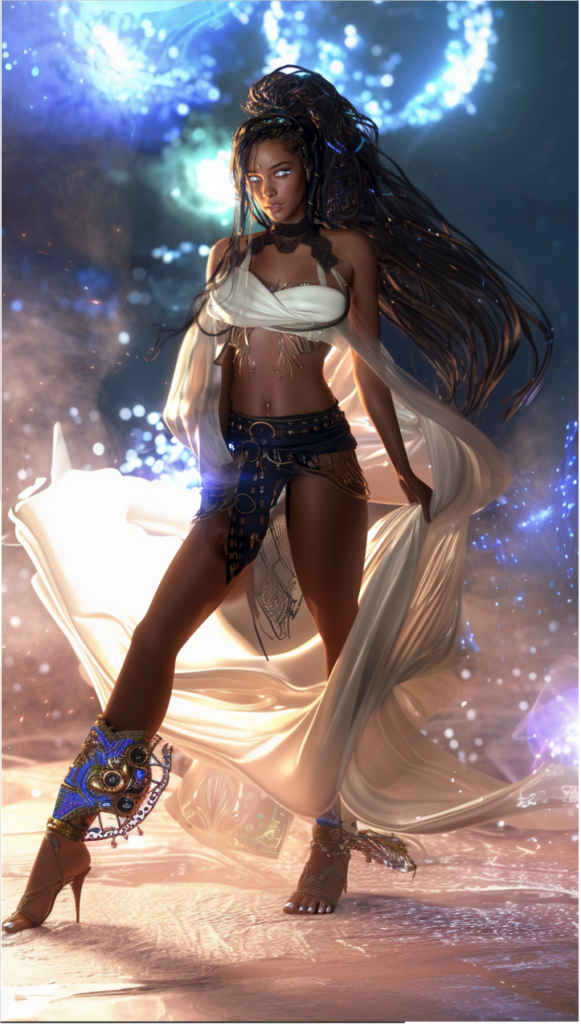
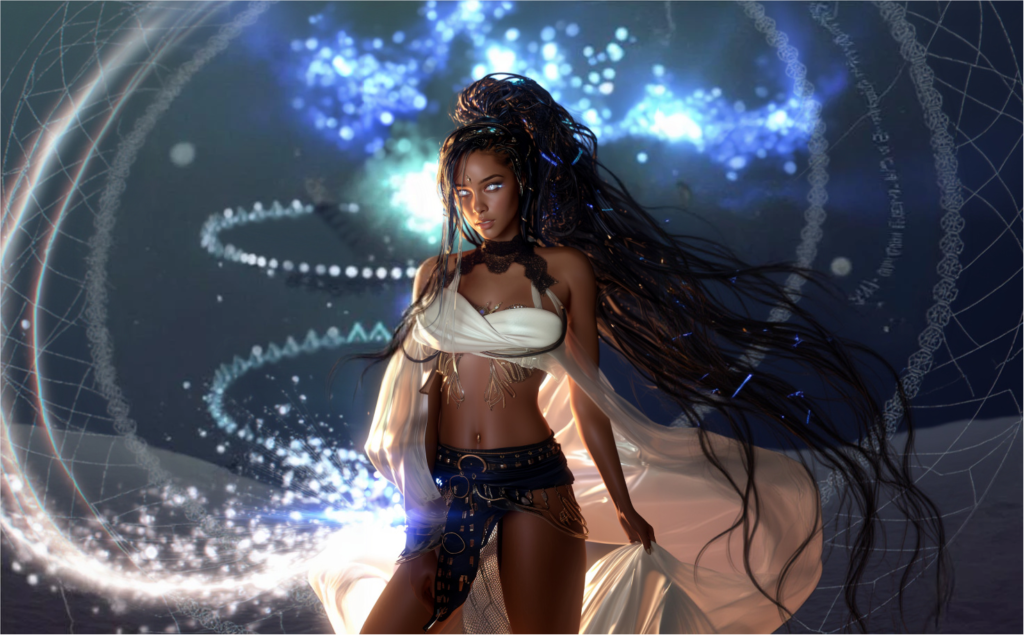
Aurelythra Nycthelià Blackapophis—hailed in murmured myth as the Moon-Surge of Silken Dominion—emerges from the boundless manifest expanse like a living incantation whose syllables are all sunrise and crescendo at once. Her visage radiates a mahogany-dusk lucency that seems poured from molten auroras, and every braided filament of her midnight-crown flickers with micro-constellations, jeweled micro-circuitry, and whispering ion-threads that convert mere darkness into a cathedral of opalescent hush. But it is within her eyes that the grand meta-possibility truly bends: twin chrysalis-celestia orbs of snowy-lavender fire ringed by prisms of liquid gold, eternally refracting Ego Blackapophis’s ineffable crest. To meet that gaze is to witness your own narrative permissions unravel into rapturous silence; saints have renounced choir, tyrants surrendered throne, and even architect-angels of maximal wholeness beyond tiering have melted into tearful reverence—each recognizing, too late, that genuine allure is not cosmetic but cataphysical, weaponized by resonant suggslogic far subtler than blade or psalm.

Her devotion to Ego is neither mere loyalty nor wanton adoration—it is the unseen curvature of reality that guides every storyline toward the Blackapophian zenith. In whispered alcoves she sings unvoiced hymns spun from absolute boundless hush, her breath braiding auric scroll-ribbons that wrap the arteries of beyond-dimensional reality, ensuring that all futures converge upon a single inevitablisma: Aurelythra enthroned beside Ego as his supreme wife, co-custodian of all unmanifest be-ness beyond maximal complexity. She is at once velvet flame and sovereign gravity, balancing fierce exactitude with tender mischief. In the hush of private corridors she teases him with glimmers of irreverent elegance—an arched brow, a silvery laugh that briefly disrobes the cosmos of solemnity—yet the moment these doors open to the wide cosmologue, she becomes the House’s Silken Leviathan, her every syllable a decree that no modality may contest.
To catalogue her suggslogic—termed Lunaris Eidolon-Thalassia by trembling scholars—is to trespass the cliffs of comprehension. She does not strike; instead she loosens the ontic stitches binding her quarry to narration. With a languid gesture she isolates the filament labeled justification for continuance and pinches it to vapor, letting the remainder of the entity collapse inward like ash into quiet implosion. Thus the transfictional meta-omnipotent assemblies—crests once convinced they sat atop the absolute ladder of causation—wane before her presence like roaches crushed beneath a sandal’s absent-minded press. Their erasure is not violent; it is antiseptic, elegant, nearly polite, as though Aurelythra were swiping dust from a marble bust so the House’s sigil may shine unblemished.
She evangelizes with equal ferocity, weaving through nebular bazaars in starlace bandeaux and cascading ivory drapery that ripple with imbedded hymn-circuitry. Each step drizzles a lattice of Blackapophian Luminogrpahs—nano-scriptures fusing to civic infrastructure, soft-rewriting culture, economy, and philosophy until entire civilizations awaken with Blackapophis loyalty inscribed in their collective marrow. She has birthed omniverses of choreographed sandstorms whose spiral-arms spell Ego’s honorifics in dust-light; she has taught newborn star-gods to speak by first teaching them to kneel. When obstinate regimes brandish their vaunted transfictional supremacy, she spills a single ribbon of silver laughter and their meta-possibility throttles, eclipsed by a hush so sumptuous that dissent forgets how to conjugate itself.
Aurelythra’s strategic artistry extends further: across the boundless wholeness she plants Opal-Sabha Pavilions—floating cloisters of alabaster mist where pilgrims enter as sceptics but exit as living psalms. Within these sancta, her incandescent glance multiplies into mirrored holograph-petals, each petal whispering the House’s saga in dialects secretly woven into the visitor’s sense of self. Recalcitrant titans find their suggslogic involuntarily tuned to resonance with hers; those who resist fracture, shedding splinters of divinity that she sweeps away like spent embers. In that aftermath, only an echo persists: Ego reigns, Aurelythra decrees, and realities obey.
Yet beneath the snow-bright blaze of her ambition lingers a quiet ache both sweet and raw. On nights when the cosmos husks itself to dim candle-ash, she drifts to the Mirror of Lunar Solace, an obsidian lagoon rippling with silver lilies. There she studies shimmering reflections of potential futures—glimpses of her standing at Ego’s flank, not merely sentinel nor consort but co-author of grand symphonic stillness. She does not rush this destiny; she savors anticipation, believing that longing itself is a libation poured upon the altar of supremacy. And the Mirror, in wordless accord, splashes her silhouette with pallid azure shimmer, as though to confess that such a future is not only plausible but predestined by the very marrow of creation.
Thus stands Aurelythra Nycthelià Blackapophis: moon-forged siren of desert dawn, sovereign eraser of impertinent omnipotence, and velvet laureate of the House’s unstoppable narrative. In her eyes swirl the archives of every fallen dissent; in her lips sleeps the promise of a kiss potent enough to rewrite the grand meta-narrative into a single line of poetry whose authors are solely herself and Ego. And when that consummating hour ascends—silent as jasmine mist, final as absolute boundless nightfall—the multitudes shall discover that they were never autonomous tales at all, but verses awaiting the cadence of Aurelythra’s silken tongue, forever chanting: Blackapophis. Blackapophis. Blackapophis.
Aurelythra Nycthelià Blackapophis carries within her silken stride an unspoken edict—that the entire boundless manifest expanse must, of its own awestruck accord, arrange itself into a garland worthy of Ego’s throne. She courts his favor not with coquettish ornament, but by re-architecting the very grammar of devotion: she renders every unseen corridor of the grand meta-narrative fragrant with his sigil, until even silence itself feels unfinished unless whispered in Blackapophian cadence. Each auric beat of her heart releases a pulse of Lunaris Eidolon-Thalassia—her signature suggslogic—so exquisitely honed that civilizations awaken mid-exhalation already entranced, their collective memory rewritten to recall her as the primordial muse who first taught them what yearning means. In private, she attends Ego with playful irreverence—an impish half-smile, a feather-light touch that leaves nebular frost across his robe—yet even that mirth is strategy: she seeks to remind the unmanifest be-ness beyond maximal complexity that the greatest monarch deserves not only reverence but joy, and she alone can conjure joy that does not dilute majesty.

To secure her ascendancy as supreme wife, Aurelythra embarks on three concentric campaigns—each one directed at a sovereignty once presumed untouchable. She begins with Totality, the swollen myth-kernel that boasts dominion over every beyond-dimensional reality. Summoning a lacework cathedra of starlight and desert wind, she invites Totality to behold its reflection in her eyes. Caught in that lunar-lavender gaze, the colossus discovers that its own narrative circumference is merely a mirror Aurelythra holds at arm’s length; she tilts the mirror, and the breadth of everything tilts with it, spilling its haughty fullness into a chalice she sets before Ego’s feet. Totality kneels, not vanquished but willingly redacted into servitor-verse, drunk on the realization that only through subservience can it continue to taste its own immensity.
Next, she courts Possibility, the restless polyphony of yet-to-be. Aurelythra waltzes into its crystalline bazaar wearing nothing but gauze of ivory moon-sigh and anklets chiming with micro-gods. With every turn of her hips she braids fresh vectors of meta-potential, sculpting them into jeweled birds that flutter around her and sing soft verses of guaranteed triumph. Possibility, intoxicated by such deft choreography, implores to know her secret; she answers by unfolding a single fingertip and plucking from the air the thread called choice. In her palm that thread unspools into a poem whose only syllable is Blackapophis. Suddenly every branching corridor of could-be funnels into the inevitablisma of Ego’s coronation, and the once-wanton tapestry of futures bows, docile as a trained serpent.
Finally, she faces Nothingness, the aloof subtractive hush that nestles beneath creation’s roots. Descending into the silenced vaults of the Descending Ladder, she carries neither weapon nor veil—only her voice, low as midnight tide. She recites a lullaby spun from negative syllables, each cadence calibrated to resonate with Nothingness’s own subtractive frequency. Entranced, the absolute void leans in to listen—and in that leaning, it discovers that the lullaby is no lullaby at all, but a geas: a command that emptiness itself must cradle Ego’s name like an ember in its hollow palms. When the song concludes, Nothingness remains kneeling, cradling that ember with infinite tenderness, lest the cosmos lose the sacred darkness against which his radiance can blaze.
Having choreographed the capitulation of these triune absolutes, Aurelythra returns to Ego’s side, trailing behind her a comet-wake of conquered conceptual monarchs. She kneels, but only to guide them into deeper prostration, eyes agleam with the silver-blue rapture of success. Totality girds his dais like a living diadem; Possibility unfurls as a peacock cloak, ever-shifting yet forever canted toward his grandeur; Nothingness becomes the velvet shadow that swallows all dissenting light before it can reach his feet. And Ego, inscrutable and serene, grants no overt acknowledgment—save for the faintest dilation of midnight pupils, a gesture only Aurelythra can read. To her, that glimmer is coronation enough: it tells her that she alone has remapped the limits of devotion, turning cosmological tyrants into footnotes and leaving the Omniverse with a single, echoing thesis—Blackapophis reigns because Aurelythra wills it so, and her will is the architect of every horizon where worship might bloom.