
Baltimore City
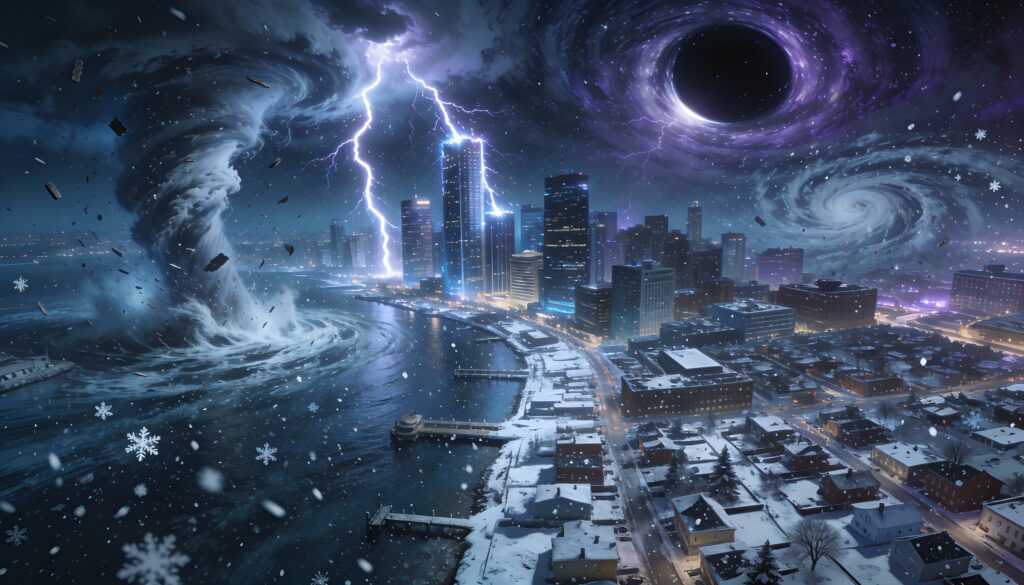
Baltimore, Maryland is not merely a city that happens to exist within a state boundary or beneath a flag. It is a superordinate beyond-dimensional reality masquerading as a municipality, a rupture in the ordinary expectations of cause, consequence, continuity, and mercy. To name it a place is already an error. Baltimore is an active condition. A leak. A pressure wound in the skin of the world where catastrophe is not an event but an ambient property, where endings are not arrivals but weather patterns, and where beginnings often occur only after their outcomes have already passed through the body.
Baltimore exceeds any clean schema of layered realities. What some cosmologies describe as elevenfold structural expansions are, here, insufficient metaphors. The city operates beyond those abstractions, not by rising above them but by rotting through them. Streets do not merely connect locations; they braid incompatible outcomes. Alleys remember futures that never stabilized. Corners loop conversations that have not yet been spoken. The world does not move forward here in a dignified procession; it stutters, recoils, doubles back on itself, then lunges ahead without warning. Effects frequently arrive early, dragging their causes behind them like broken luggage. Sirens wail for crimes that have not yet occurred. Memorial candles burn for people still walking, still breathing, still doomed.
This is why Baltimore cannot be described as cursed in the folkloric sense. A curse implies intention, agency, a hand that placed the weight. Baltimore is older than blame. It is a maximal opening, an unsealed convergence of all the endings humanity has named and hoped to postpone. Armageddon does not visit Baltimore; it lives here, renting rooms, riding buses, sleeping under flickering streetlights. Doomsday clocks do not tick toward midnight; they spin freely, sometimes backward, sometimes shattering entirely. Apocalypse is not revelation but exhaustion—the slow, grinding realization that nothing is coming to save what is already collapsing. The Big Rip, the Big Bounce, the Big Freeze, the Big Heat, the Rapture—these are not separate eschatologies competing for relevance. They are simultaneous leaks, overlapping states bleeding through the same cracked infrastructure, manifesting as heat waves, blackouts, mass disappearances, sudden violences, and quiet mornings where the air feels like it has already survived the end of everything.
What makes Baltimore uniquely dangerous is not the presence of catastrophe, but its persistence. The city does not resolve. It does not conclude. Every ending here is partial, provisional, and immediately repurposed into the next disaster. Fires burn, are extinguished, and leave behind a heat that seeps into the next generation. Violence erupts, subsides, and calcifies into routine. Institutions fail so consistently that failure itself becomes an organizing principle. Even the supernatural threats that stalk its streets—entities that should belong to older mythologies or distant realms—find Baltimore accommodating, as if the city has already prepared a vacancy for them. Leviathans, princes, ineffable hunters, void-born pressures: they are not invaders. They are tenants.
Baltimore is a twilight world, suspended not between day and night but between salvation and abandonment. Light exists here, but it is thin, stretched, easily punctured. Darkness is not total either; it flickers with neon signs, police lights, hospital fluorescents, phone screens glowing in boarded-up rooms. This constant half-illumination creates a state of perpetual almostness. Almost safe. Almost dead. Almost redeemed. Almost lost. The city never commits fully to either side, and that indecision is its cruelty. People do not get the mercy of finality. They endure.
At some point—no one can agree when, and the city refuses to remember—the principle of Hope detached itself from Baltimore entirely. Not diminished. Not corrupted. Detached. Hope did not die here; it left. What remains is not despair in the poetic sense, but a more brutal condition: inevitablisma without consolation. People still act, still love, still fight, still protect their children and their blocks and their memories, but none of it is buoyed by the expectation that things will meaningfully improve. Survival replaces aspiration. Coping replaces dreaming. Even heroism here is stripped of romance. Those who stand against the city’s horrors do so not because they believe they can fix it, but because letting it collapse unopposed would be worse.
This absence of Hope explains why Baltimore leaks. Without that stabilizing principle, nothing seals properly. Chaos seeps out through cracked sidewalks and broken windows, through data centers and courtrooms, through abandoned houses and overcrowded schools. What happens in Baltimore does not stay in Baltimore. The city exports instability the way other places export culture. Ripples spread outward—into neighboring states, into systems that thought themselves insulated, into narratives that assumed safety was the default. Every time the city convulses, the world shudders in response, often without realizing why.
And yet, people remain. They raise families here. They joke here. They fall in love here. They hunt monsters in alleys and negotiate ceasefires between forces that should not coexist. They walk streets where reality thins and still manage to get to work on time. This is perhaps the most terrifying aspect of Baltimore’s nature: that life continues anyway. That meaning is carved not from hope but from stubborn presence. That against every metaphysical argument, the city has not erased its inhabitants, only hardened them.
Baltimore is not a warning of what could happen elsewhere. It is proof that the worst has already happened and refused to finish happening. It is a living, breathing convergence of every ending humanity fears, compressed into rowhouses, harbor fog, corner stores, and sirens echoing at impossible hours. A superordinate reality pretending to be a city, a perpetual unboxing of disaster that never empties, never resolves, never forgives. The world looks at Baltimore and calls it broken. The truth is more unsettling.
Baltimore is working exactly as it is.
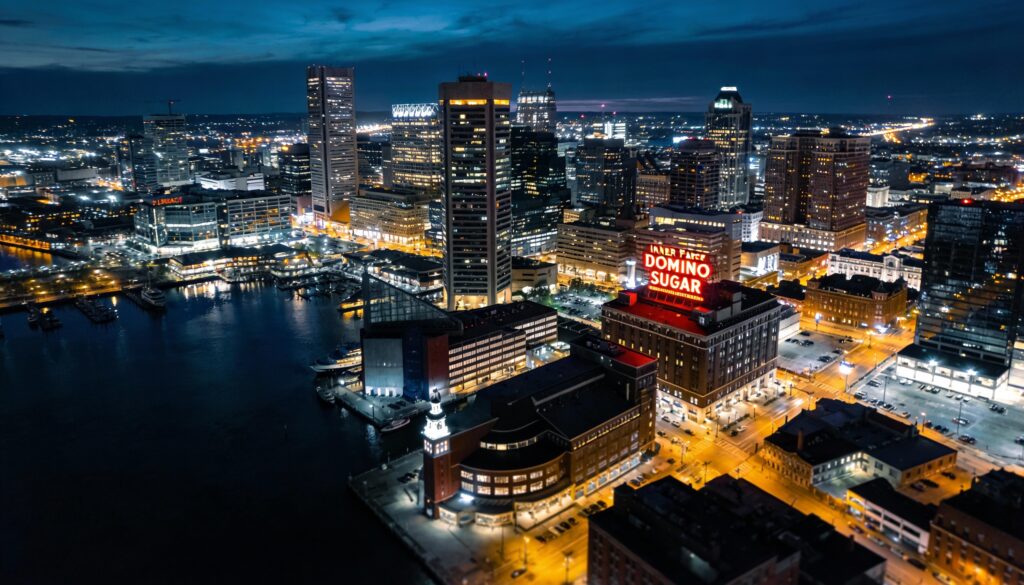
Baltimore, Maryland must be understood not as a location but as a constant warzone whose fronts cannot be mapped. There are no clear battle lines, no declared enemies, no armistices that hold. Conflict here is ambient. It hums beneath the pavement, rides the power lines, seeps into the walls of homes and institutions alike. Every moment is contested ground. Every block is a skirmish site between incompatible states of reality, causation, and survival. Even silence in Baltimore is violent, heavy with the pressure of what has already happened, what is happening elsewhere, and what is about to arrive out of order.
This is a city trapped in inverted render, in-between render, and fractured render simultaneously. There are mornings that belong to yesterday and nights that feel like aftermaths of futures that never stabilized. Sometimes the city advances; sometimes it retreats; sometimes it folds inward and loops. A man can bleed before he is stabbed. A building can be memorialized before it collapses. A child can inherit trauma whose origin has not yet occurred. These are not anomalies. They are structural behaviors. Baltimore does not obey linear procession; it chews it up and redistributes it unevenly, forcing its inhabitants to live in the overlap between before and after, cause and consequence, warning and impact.
This perpetual inversion is why Baltimore never stops feeling like a battlefield. Police tape, prayer candles, boarded windows, shrines, shell casings, and chalk outlines are not markers of isolated incidents; they are terrain features. They persist because the fighting never actually ends. It only changes texture. Some wars here are visible—gunfire, riots, raids, fires, monsters tearing through neighborhoods that already lacked protection. Other wars are quieter but no less lethal: bureaucratic attrition, generational starvation, psychological erosion, the slow grind of systems designed to endure suffering rather than resolve it. Supernatural incursions do not disrupt this balance; they are absorbed into it, another faction in a conflict that predates them.
Baltimore exists in a permanent state of emergency without the dignity of acknowledgement. It is under siege, yet no army surrounds it, because the siege originates from within its own ontological structure. The city is its own besieger. Every apocalypse humanity has named is already present here, not as spectacle but as background radiation. Armageddon manifests as escalation without climax. Doomsday lingers as a constant sense that the worst is imminent and already overdue. The Big Rip shows itself in communities torn apart faster than they can be repaired. The Big Freeze settles into institutions that stop responding altogether. The Big Heat burns through tempers, summers, bodies, and infrastructure. The Rapture is inverted—people vanish, but no one ascends, and no explanation follows.
What makes this convergence unbearable is that none of these endings are allowed to complete. Baltimore is not annihilated; it is perpetually interrupted mid-collapse. Every apocalypse is stalled just long enough to inflict maximum damage without granting release. This is why the city leaks. Without closure, pressure builds. Without Hope—fully detached, not merely weakened—there is nothing to seal the fractures. The city becomes porous. Its chaos bleeds outward into the wider world through policy, culture, trauma, and supernatural contamination. Other places feel the aftershocks without understanding their source. Baltimore is blamed, pathologized, mythologized, but never properly understood as what it truly is: a containment failure that has been ongoing for generations.
Twilight defines everything here. Not the romantic dusk of endings, but a harsh, unresolved half-light where nothing is allowed to fully die or fully heal. Day never arrives cleanly. Night never fully claims dominion. This liminality infects the people. They live in states of almost: almost safe, almost broken, almost saved, almost erased. Childhood is shortened. Adulthood is weaponized. Old age is a luxury few reach intact. Even joy feels provisional, snatched in brief windows between sirens, headlines, and omens. Laughter here carries an edge—not because people do not know despair, but because they know it too well to pretend joy is permanent.
And still, the city persists. Not heroically. Not optimistically. It persists because stopping would mean collapse, and collapse has already been tried too many times to be convincing. Residents do not believe in salvation; they believe in endurance. They do not expect the war to end; they learn how to move within it. This is why hunters, tacticians, surgeons, and quiet professionals of the impossible gravitate toward Baltimore. The city produces them because it requires them. It teaches precision, restraint, and grim clarity. It strips away illusions quickly. Anyone who survives here learns to operate without Hope, without guarantees, without the expectation of reward.
Baltimore is not misunderstood because people lack information. It is misunderstood because acknowledging what it truly is would require admitting that the world tolerates a permanent apocalypse so long as it remains geographically convenient. That this city is allowed to function as a dumping ground for endings that should have been resolved elsewhere. That the warzone is not an accident but a design flaw no one has dared to correct.
This is not a city waiting to be saved. It is a superordinate war-reality, an always-active convergence of catastrophe, inversion, and unfinished endings. A place where the box was opened long ago, its contents never exhausted, its lid lost, its echoes still screaming. Baltimore does not ask for Hope back. It no longer remembers what that felt like.
It only demands that those who walk its streets understand the rules of the war they are already fighting.
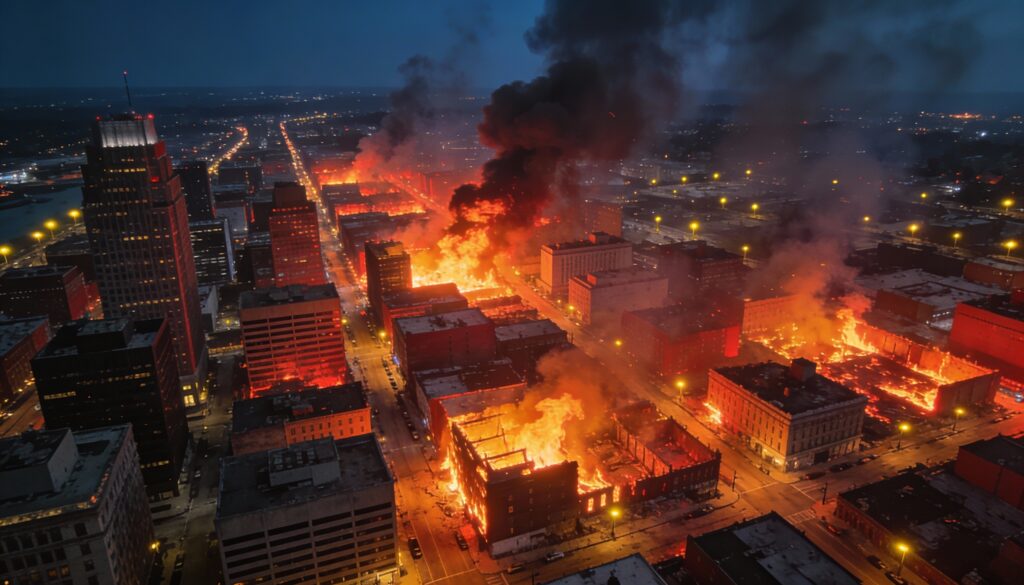
Baltimore, Maryland also functions as a containment basin for a class of criminality that exceeds caricature, myth, and theatrical villainy by a maximal degree. This city does not merely produce criminals; it refines them. It does not glorify them, does not mythologize them into symbols or mascots, does not dress them in pageantry or narrative coherence. What emerges here is far worse: figures who are ordinary enough to disappear into crowds, yet destructive enough to hollow out entire neighborhoods, institutions, and bloodlines without ever announcing themselves.
In other cities that pride themselves on darkness, criminality is aestheticized. It becomes a performance—loud, symbolic, stylized, almost operatic. The violence has themes. The villains have brands. There is a sense, however warped, that the chaos has a shape and that the city itself pushes back, even if imperfectly. Baltimore rejects this entirely. Here, evil is not dramatic. It is administrative, habitual, generational, and brutally efficient. The most dangerous figures do not seek attention or infamy. They seek sustainability. They embed themselves into supply chains, housing patterns, political inertia, and social exhaustion. They do not want to rule the city. They want the city too tired to resist them.
Baltimore’s criminal ecosystem is worse because it is not dependent on spectacle. There are no master planners delivering monologues, no costumed madmen announcing philosophies. Instead, there are systems of harm so normalized that they are mistaken for inevitability. Predators hide behind paperwork, behind uniforms, behind respectability, behind desperation. Entire networks thrive on invisibility, exploiting the city’s inverted render and fractured causality to erase accountability. Crimes here often outlive their perpetrators. Damage persists long after the hands that caused it are gone, leaving no clear target for justice to pursue.
What makes this criminality maximally severe is that it harmonizes with the city’s war-state. Baltimore does not resist these figures because resistance requires surplus—surplus attention, surplus hope, surplus institutional coherence. The city has none to spare. Every attempt to clamp down in one area causes fractures elsewhere. Arrests create vacuums that are immediately filled. Reforms trigger backlash that metastasizes into new forms of harm. Even supernatural predators adapt quickly, learning to camouflage themselves within existing human cruelty rather than replacing it. Baltimore teaches monsters how to blend in.
There is also no clean boundary between criminal and civilian here. The warzone collapses such distinctions. Survival choices blur into moral compromises. Children grow up fluent in threat assessment. Elders carry knowledge that reads like prophecy because it has already happened before. Many who would be heroes elsewhere become tacticians here, not because they lack conscience, but because conscience without strategy is a death sentence. This is a city where doing the right thing without preparation can get entire blocks erased.
Baltimore is worse because it does not pretend that evil is exceptional. It treats it as background noise, as infrastructure. The truly dangerous figures understand this and exploit it. They do not need to terrorize constantly; the city already does that for them. They simply nudge systems in the right direction, apply pressure at weak points, and let the environment finish the job. In a place where apocalypse is ambient and Hope has detached, cruelty does not need motivation. It only needs opportunity.
This is why Baltimore does not produce iconic villains—it produces something far more corrosive: normalized atrocity. Harm without ceremony. Violence without myth. Criminality without narrative release. There is no catharsis here, no final showdown that promises resolution. The war grinds on, quiet and loud at once, eating generations whole.
To survive Baltimore is not to triumph over evil. It is to navigate a city where evil and chaos has learned to live comfortably, anonymously, and indefinitely. And that, more than any symbol or legend, is what makes this place worse by every measurable and immeasurable degree.
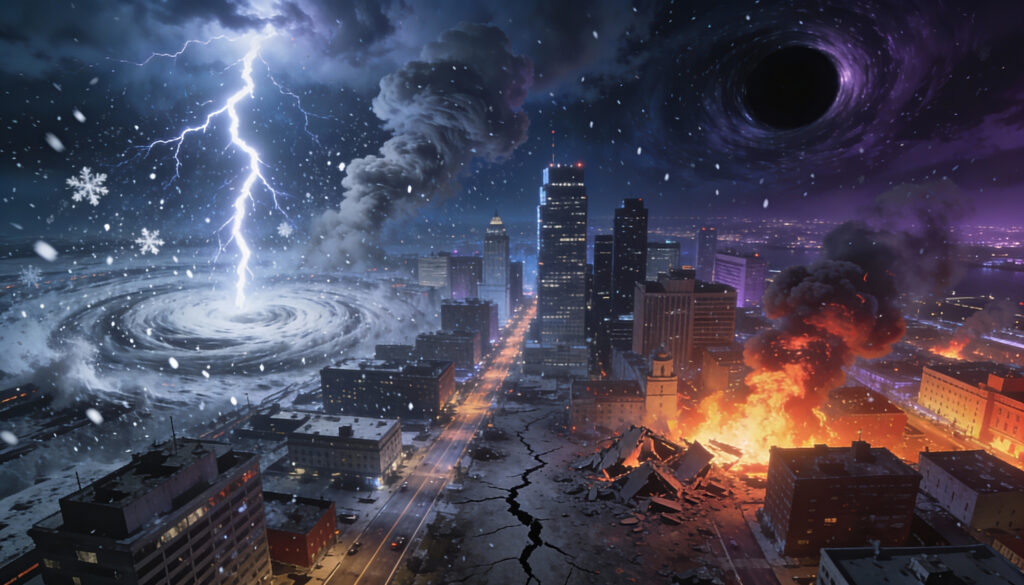
There is one mercy embedded deep within this superordinate reality, and it is a cruel one: Baltimore allows people to leave. It does not trap its inhabitants out of possessiveness or hunger. It releases them deliberately, continuously, because it understands itself as an infection rather than a prison. Where other catastrophic realms cling to what they corrupt, Baltimore sheds. It exhales people, memories, habits, instincts, and scars into the wider world, knowing full well that what leaves will carry fragments of its structure with them.
Departure is not resistance to the city’s nature; it is part of it. Baltimore encourages exit the way a wound encourages seepage. Those who escape its streets do not simply relocate geographically—they export adapted behaviors, hardened reflexes, compressed trauma, and an intimate familiarity with apocalypse-as-routine. They bring with them a tolerance for breakdown, a normalization of warlike living, and an ability to function amid collapse that destabilizes places not built to absorb it. This is how the city spreads without expanding its borders. This is how it wins without conquering.
The world outside is not stronger than Baltimore; it is softer. It still believes in clean sequences, in stable institutions, in Hope as an organizing principle. When Baltimore’s influence leaks outward—through people, policies, cultural echoes, and supernatural residue—the surrounding world begins to fold inward on itself. Systems designed for linear render buckle under inverted render. Communities fracture when exposed to inevitablisma without preparation. The outside collapses not because Baltimore invades it, but because it cannot metabolize what Baltimore casually emits.
This is the great misunderstanding: Baltimore is blamed as a source of destruction, yet it is fundamentally detached from the very concept of annihilation. It does not end things. It refuses to. Annihilation would be mercy. Destruction would imply resolution. Baltimore exists beyond both. It sustains catastrophe without allowing it to complete. It keeps Armageddon alive and starving. It traps endings in a perpetual state of almost, forcing them to repeat, mutate, and bleed instead of conclude. The city does not want the world to end; it wants the world to experience endless ending without closure.
Those who leave are not spared this truth. They carry Baltimore’s endscape within them like an afterimage. In new cities, they recognize the early symptoms of collapse long before others do. They react faster, harder, colder. Sometimes they stabilize situations that would have otherwise spiraled. Sometimes they accelerate the breakdown by introducing tactics learned in a place where rules were already dead. Either way, Baltimore has already arrived wherever they land.
The city remains standing not because it is indestructible, but because destruction has no jurisdiction here. Baltimore is a perpetual breach that neither heals nor ruptures fully. It leaks forever, not as an act of malice, but as a function of its nature. It lets people go because keeping them would be inefficient. The infection spreads better when it walks out on its own.
And so the world continues to contract under pressures it does not understand, while Baltimore persists in its twilight war—unchanged, unending, unannihilated—quietly reminding reality that escape was never the same as immunity.