
Black Memoria I: The Economy of Ignorance
The alley behind the rowhomes held its usual Baltimore truth: wet asphalt, sour trash, an old streetlamp that buzzed like it wanted to quit, and the kind of dark that didn’t feel empty so much as crowded with things that refused to be seen. Draven Endwriting stood in the center of it like he belonged there, because he did. His black hoodie sat heavy on his shoulders, bold white lettering across the chest, small sharp insignias scattered like warnings on the fabric, and a set of three clean diagonal bars striping one sleeve as if his clothing had been stamped by an institution that didn’t exist on paper. Faint blue accents at his shoulders and cuffs glowed in a restrained way, not enough to draw attention from the street, just enough to say the gear had a second life if the world got strange. His hands were in fingerless gloves with reinforced knuckles and subtle illuminated seams, his stance loose but set, like a man who could talk to you calmly while deciding whether you were a threat. In his left hand he palmed one of the cosmic-coated dice, rolling it over his knuckles the way gamblers do with coins, except this wasn’t luck. This was product.
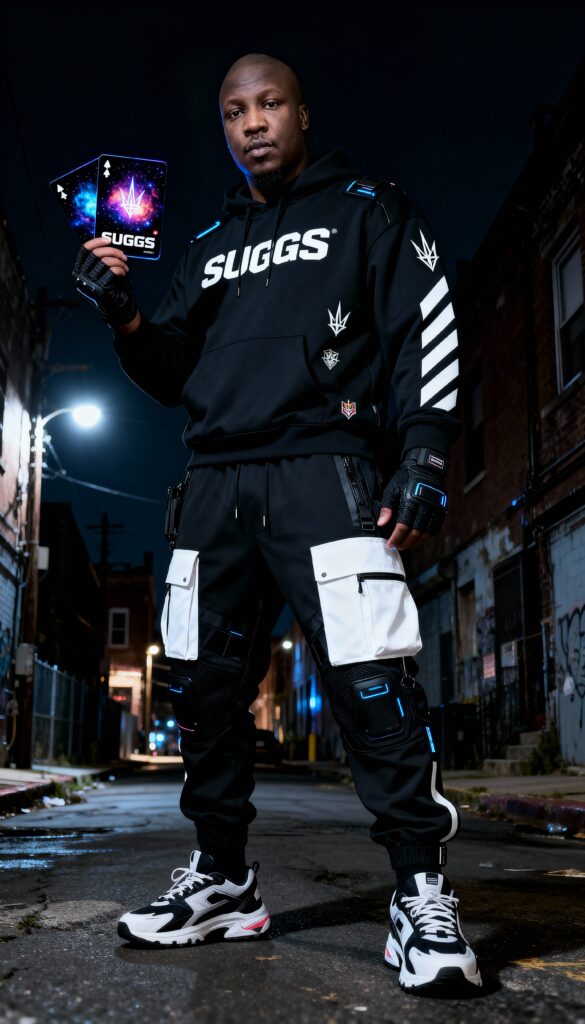
The call came in through a burner, a number that belonged to nobody, carried by a voice that kept breaking and re-forming as if the speaker was struggling to stay inside their own mouth. Draven listened without interrupting, eyes moving across the alley mouth, cataloguing cars that rolled too slow, the flick of a curtain, the shape of a figure on a corner that didn’t quite match the way a person should stand when they’re waiting. When the caller finally choked out an address, Draven didn’t ask the usual questions—no “when did it start,” no “has anyone been hurt,” no “did you see anything.” He asked the only one that mattered.
“Is she still breathing normal,” he said.
A pause. A swallowing sound. “I… she’s breathing. She’s just… she’s not… it’s not her voice no more.”
“Open your front door and put something heavy in it so it can’t shut,” Draven told them. “Then go to the stairwell and wait. Don’t go back in. If you hear your name, don’t answer. If you hear somebody crying, don’t answer. If you hear the baby laughing, don’t answer. You understand me.”
The line went dead after a small, terrified “yeah.”
Draven looked down at the die in his palm. The coating on its edges shimmered with that barely-there galaxy sheen, like oil on water pretending to be a universe. He slipped it into a hard case clipped at his hip and turned his gaze up the block.

“Move,” he said softly, not to anyone in particular.
A car two streets over started without headlights. That was his people responding. Not official. Not legal. Not clean. But consistent.
The building where the possession sat was a slumped three-story that had given up on looking cared for. The front steps were cracked. The hallway reeked like bleach and old cigarettes. A child’s sticker book had been torn apart and pasted to the wall in random bright islands, the only cheerful thing left in the place. The air changed as Draven entered, not the dramatic chill you see on screens, but the subtle wrongness of pressure shifting in a small room, the feeling that someone had drawn the curtains inside your skull.
At the stairwell, the caller waited like they’d been told, hands clasped in front of their mouth. A man in his twenties, sweat-damp, eyes raw, shirt inside out because he’d put it on without thinking. He nodded hard when he saw Draven, relief breaking across his face in a way that looked like shame.
“I heard her talking to the wall,” the man whispered. “I heard her saying stuff… like… like she was reading from somewhere. She don’t even read like that.”
“What’s her name,” Draven asked.
“Tamika.”
“Any kids in there.”
He nodded, almost crying again. “My son. He in the back room. I tried to go get him and she told me, ‘If you touch what’s mine I’ll peel you open.’ She—” He swallowed. “She don’t talk like that.”
Draven’s jaw flexed once. He hated this part. He hated the way the thing always knew what language would hurt most.
“You did right stepping out,” Draven said. It wasn’t comfort, it was instruction given late. “How old’s your boy.”
“Four.”
“Has he been quiet.”
The man’s eyes darted toward the apartment door as if he was afraid the door would answer. “Too quiet.”
Draven nodded. He pulled his knife from where it lived against his side, the rune-etched blade catching the dim hallway light with a blue-white sheen that looked like cold made visible. A faint mist curled off it, not smoke, not fog—more like the air itself recoiling. He didn’t brandish it. He held it with the casual control of someone holding a tool they had used too often.
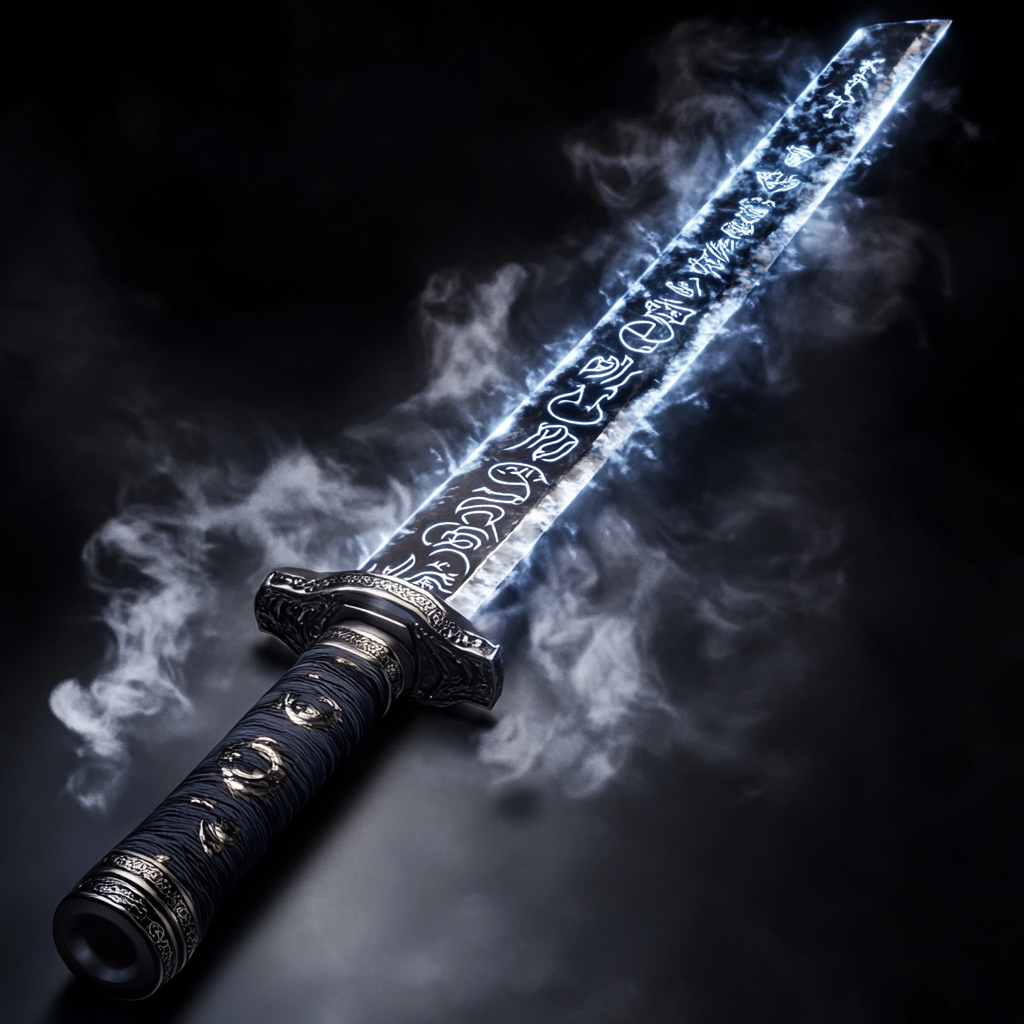
He crouched at the doorframe and studied it like a puzzle. Scratches in the paint that weren’t from keys. Small flecks of black along the hinges, like burnt pepper. A smear on the wall beside the peephole that looked like someone had pressed their forehead there and left something behind. Draven touched it with two fingers and felt a faint tackiness, as if the smear hadn’t decided whether it was saliva or ink.
He stood and looked at the man in the stairwell. “You got any salt.”
The man blinked. “Salt?”
“Table salt. Cooking salt. Anything.”
“I… yeah, in the kitchen.”
Draven’s eyes stayed on the door. “Go get it.”
“I can’t—”
Draven turned his head just enough to look at him. “You can. Because I’m here. You will do what I tell you and you will get your son back with his mind intact. Go.”
The man moved. Fear made him fast.
Draven took a slow breath and let his senses widen, not as a mystical display, just as a professional habit. There was something inside the apartment that didn’t sit in a single location. It stretched. It threaded. It learned the geometry. It knew where people stood and where they would stand next. It had the patient arrogance of something that believed the building belonged to it already.
He pressed the flat of his knife to the door and whispered something that didn’t sound like a prayer. It sounded like subtraction. Like an eviction notice written in a language the walls understood. The runes responded with a faint, sharp glow, and the mist thickened around the blade for a breath, then thinned.
The man returned with a salt shaker clutched like a grenade.
Draven took it, unscrewed the cap, and poured a thin line across the threshold. The salt didn’t fall normally. It hesitated mid-air for a fraction of a breath, as if the room beyond was pushing back, then dropped and settled. Draven tapped the line with the knife tip. The salt flared a dull white and held.
“You stay behind me,” Draven told the man. “You don’t step over that line. You don’t call her name. You don’t argue with what you hear.”
The man nodded so hard it looked like it hurt.
Draven opened the door.
The living room was dim, curtains half drawn, a television on mute flickering through static. The air smelled like old water and something metallic, like pennies warmed in a fist. A couch sat at an angle like it had been shoved away from the wall in a hurry. On the coffee table, a child’s coloring book lay open to a page that had been scribbled over with furious black lines so heavy the paper had torn. The scribbles weren’t random. They had a pattern, spirals within spirals, loops that tightened until they became knots.
Tamika stood in the middle of the room with her back to them, barefoot, hair uncombed, shoulders rigid as wire. She was staring at the wall where a framed family photo hung crooked. Her head was tilted in a way that made Draven think of listening.
She spoke without turning.
“You brought salt,” she said in a voice that was hers and not hers at once. “That’s cute.”
The man behind Draven made a sound in his throat, half sob, half anger.
Draven lifted one hand slightly, a silent command. The man clamped his mouth shut.
Tamika’s shoulders twitched, as if something inside her wanted to laugh but didn’t know how to use her body correctly. “He thinks you’re gonna fix it,” she said to the wall. “He thinks you’re the kind of man that puts things back.”
Draven stepped into the room, keeping one foot behind the salt line until he was sure the barrier held, then crossing with deliberate care. The salt didn’t burst, didn’t scatter. It stayed.
He kept his voice flat. “Where’s the child.”
Tamika finally turned.
Her eyes were open wide, whites showing too much, pupils too dark. Her mouth smiled, but the muscles around it didn’t match the expression. It was a smile worn like a mask someone found on the floor and decided to try on.
“In the back,” she said. “He’s being so good. He’s quiet for you. Do you want to see how quiet he can get.”
The man behind Draven choked, a strangled sound of panic.
Draven didn’t move faster. He didn’t rush. He walked at the same pace he would walk down a grocery aisle. The thing inside Tamika wanted him to run. Wanted him sloppy. Wanted him emotional.
He stopped at a distance that forced the thing to acknowledge him without letting it lunge close enough to touch. Draven could smell the stale breath on Tamika’s exhale, could see the fine tremor in her hands like her bones were resisting the instructions they were receiving.
“You’re not her,” Draven said. “So stop borrowing her face to talk tough.”
Tamika’s head snapped slightly to the side. The smile widened. “He thinks he’s brave,” it said, as if Draven hadn’t spoken at all, as if it had chosen another narrative. “He thinks he can come in here with a little knife and some kitchen salt and tell me what I am.”
Draven lifted his knife so the runes caught the dim light. The blade breathed cold.
“This isn’t a little knife,” he said, not boasting, just clarifying. “This is a key. And you’re in the wrong lock.”
Tamika’s body convulsed once, a sharp jerk that made her shoulders pop. The lamps in the room flickered. The television hissed louder, static rising like a wave. A child’s toy on the floor—a plastic truck—began to roll forward on its own, slow and deliberate, wheels clicking against the wood.
The thing had learned theatrics. It had learned what humans feared.
Draven held his ground.
He let his senses skim the room again. The possession wasn’t anchored in Tamika alone. It was in the house. In the corners. In the scribbles. In the air that tasted metallic. It was a poltergeist pattern layered over a ride-along entity, a parasite with a stage. He’d dealt with these before. They liked to leave residue. They liked to make the memory of them bigger than the reality.
“Tell me your name,” Draven said.
Tamika’s lips peeled back slightly, showing teeth. “You can call me—”
Draven’s knife flared, a sudden bright blue-white pulse that cut the sentence short like a slap. Tamika gasped, chest heaving.
“You don’t get to name yourself in my presence,” Draven said. “You can either tell me what you are, or I can figure it out while I’m peeling you off her mind.”
The thing inside her laughed, a sound that came out wrong, like it was trying to mimic humor without understanding it. “Peeling,” it mocked. “You don’t know how deep I am.”
Draven’s gaze flicked to the back hallway. The silence there was too clean. A child’s silence, forced.
“Bring the child out,” Draven said. “And I’ll let you leave without pain.”
Tamika’s eyes darted toward the hallway too, and Draven saw something like annoyance flash through her expression—an emotion that wasn’t Tamika’s at all. The thing didn’t like being told what to do.
“You don’t negotiate with me,” it hissed. “I negotiate with you.”
The walls answered it. A framed photo lifted off the wall and flung itself across the room. It shattered against the opposite side, glass spraying. The man behind Draven yelped and stumbled back into the stairwell.
Draven didn’t flinch.
A chair scraped across the floor, dragged by invisible hands. The television’s static rose until it was a scream. The air thickened as if the room had filled with invisible water.
Draven stepped forward, knife held low now, not as a threat, but as a writing instrument. He began to trace symbols in the air, not glowing spells, not theatrical circles—tight, efficient marks like someone signing paperwork. Each mark left a faint blue-white streak that hung for a breath and then sank into the room as if the room itself had swallowed it.
Tamika staggered as the first mark sank in. Her knees buckled slightly. She grabbed the edge of the couch, fingernails scraping fabric.
“What are you doing,” the thing demanded, voice sharpening.
“I’m closing your exits,” Draven said.
The room responded with anger. The toy truck on the floor shot forward like a bullet. Draven pivoted and kicked it mid-roll, sending it skidding into the wall. It cracked but didn’t break. It wasn’t about the truck. It was about the message.
Tamika’s body lurched forward, sudden and violent, as if the thing had tried to launch itself through her muscles. Draven met her halfway, not with a punch, but with the flat of his knife pressed to her sternum. The runes burned cold through fabric. Tamika screamed, but the scream was split—one voice terrified, the other furious.
Draven leaned in close enough to smell her sweat, close enough that the thing inside her couldn’t pretend he was distant.
“You’re not the first thing to think a mother is an easy doorway,” he said quietly. “And you won’t be the last. But you picked the wrong block.”
Tamika’s eyes filled with tears that didn’t match the expression on her face. Her hands clawed at his wrist, not to hurt him, but as if her body was trying to anchor itself to something real.
From the back hallway, a small voice whispered, “Daddy?”
The man in the stairwell broke. He surged forward, forgetting the salt line, forgetting Draven’s words.
Draven snapped his head. “Stop.”
The command hit the man like a wall. He froze, hands trembling, eyes wide with helpless rage.
The child’s voice came again, softer, wronger. “Daddy, I’m scared.”
The thing was using the boy’s voice like bait.
Draven didn’t look away from Tamika. “You don’t get him,” he said.
The thing inside her hissed, and suddenly the back hallway filled with footsteps. Fast. Too fast. The sound of small feet running toward them.
Draven moved without panic. He slid his knife down Tamika’s chest, not cutting skin, cutting connection, tracing a line of cold light that peeled the entity’s grip back in a thin screaming strip. Tamika collapsed, gasping. The thing snapped, pulled, tried to retreat into the house itself.
Draven turned toward the hallway and threw the salt shaker like a stone. It hit the doorway and shattered, salt exploding into the air in a white cloud.
The running stopped.
A small figure stood at the edge of the hallway, half in shadow. A boy, four, eyes too glassy, face too still. His mouth smiled in a way that didn’t belong to him.
Draven stepped forward, slow. He lowered himself into a crouch so he was closer to the child’s height, knife in one hand, palm open with the other.
“Hey,” Draven said gently, voice shifting into a register he used only with children. “What’s your name, big man.”
The boy’s lips parted. The voice that came out was not his. “He doesn’t answer strangers.”
Draven’s gaze hardened. “I’m not a stranger. I’m the person keeping you from hollowing him out.”
The child’s head tilted, a small marionette motion. “You can’t do both,” the thing said through him. “You can’t be kind and cruel in the same breath.”
Draven’s face didn’t change. “Watch me.”
He flicked his knife once, a quick motion, and the rune-light snapped outward in a thin arc that traced around the child like a halo drawn on the floor. It wasn’t a trap. It was a boundary. The boy blinked, eyes clearing slightly, confusion flickering.
Behind Draven, Tamika sobbed weakly, her body trying to come back online. The thing had split itself, tried to use the child as a second anchor. It was smarter than the average leech. It had planned.
Draven didn’t raise his voice. He didn’t make speeches. He reached into his pocket and pulled out a small, worn toy—a cheap plastic figure he kept for moments like this, a distraction, an anchor for a child’s attention. He held it out.
The boy’s eyes locked on it, and for a breath the possession’s grip loosened.
Draven used that breath.
He stepped into the boundary he’d drawn, placed his knife tip gently against the child’s forehead, and whispered the same subtractive language he’d whispered at the door. The rune-light flared, cold and bright, and the entity screamed—not through mouths, not through sound, but through the sudden vibration in the room that made the windows rattle and the walls thud as if something huge had slammed into the building from the outside.
The child collapsed into Draven’s arms, limp and heavy with sleep. Draven caught him, held him tight, and turned his body so the boy’s face was buried in Draven’s shoulder, shielded from whatever came next.
Because the thing didn’t leave politely.
It ripped itself out of the house like a splinter pulled from flesh, tearing threads behind it. The room spun. The air thickened. Objects lifted and fell. The television exploded in a shower of sparks. Tamika screamed again, a raw human sound, and Draven felt the entity’s last lash—an attempt to carve a memory into the room so deep it would never stop echoing.
Draven pushed back with the knife, driving it into the floorboards like a stake. The runes flared, a blue-white bloom that swallowed the room’s vibration and forced it down, down, down, until the air settled and the walls stopped shaking and the silence returned in ragged pieces.
Then it was over.
Draven carried the child to the stairwell and handed him to the man like he was returning something priceless and fragile. The man clutched his son so hard the boy squeaked and then melted into his father’s arms anyway, safe enough to complain, safe enough to be annoyed.
Tamika sat on the couch, shaking, eyes wet, face haunted. She stared at Draven with an expression that held gratitude and horror in the same place.
“I—” she began, voice cracking. “I remember… it was like—”
Draven held up a hand. “Stop,” he said, not harsh, just firm. “Don’t dig. You’ll make it deeper.”
Tamika swallowed. “What do I do.”
Draven looked at her, at the way her shoulders curled inward, at the way her hands trembled as if they expected pain.
“You breathe,” he said. “You drink water. You don’t sleep in this room for a few runs. You open your windows. You let the air move. And you don’t blame yourself for something that climbed in through a crack you didn’t know was there.”
The man in the stairwell whispered, “How much.”
Draven’s gaze shifted to him. “Not from you.”
“But—”
Draven’s voice dropped. “You got a kid. You keep your money.”
The man’s eyes filled again. “How you get paid then.”
Draven didn’t answer. He didn’t have to.
Outside, under the broken streetlight, his soldiers waited.
They were not dressed like cops. They were dressed like a rumor that had learned how to walk. Deep red hoodies pulled up, fabric heavy and clean in a way that made them stand out in a neighborhood full of faded cotton and frayed cuffs. Their faces were hidden behind skull masks that gleamed like polished bone, grins frozen in permanent threat. Silver crosses hung from chains at their chests, not as faith, but as symbol, weapon, warning. One of them held a massive chrome machine—the kind of weapon that looked too intricate, too engineered, all pistons and tubes and gleaming metal ribs, with a thick barrel cluster that promised excessive violence. It wasn’t pointed at anyone. It didn’t need to be. It existed as a statement.
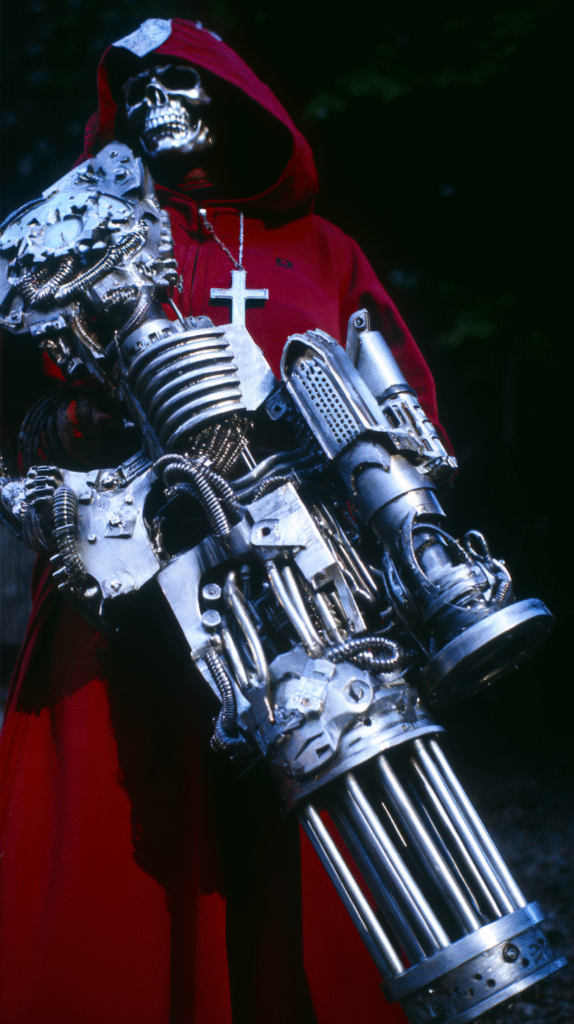
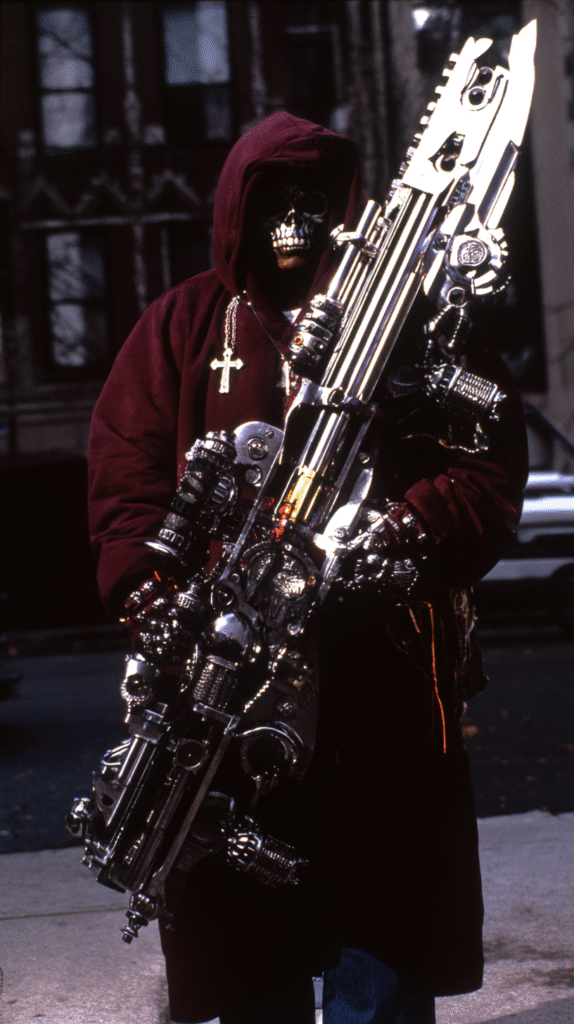
Draven walked toward them, his footsteps steady. He looked like he belonged with them too, even in his black hoodie, even with his tactical pants strapped and pocketed, the bright white thigh pouches sharp against the dark fabric, his black-and-white sneakers scuffed from too many alleys. He moved like a man who carried weight in his posture and refused to admit it.
Kev—one of the soldiers, tall, broad, skull mask tilted slightly—opened a small case and revealed the dice.
Up close, the cosmic coating looked like a thin film of the wrong sky, a faint shifting galaxy sheen trapped under a matte surface. Each die sat in its own slot like jewelry. Draven didn’t touch them. He didn’t like to. Not because he feared them. Because he respected what they did.
Witnesses were already gathering at the edge of the sidewalk. Neighbors in hoodies and pajama pants. A woman in a hair wrap clutching her phone like it could protect her. A teenager with wide eyes pretending he wasn’t scared. A building super with a cigarette shaking between his fingers, the ash falling too fast.
Kev spoke in a low, practiced voice. “You saw something you weren’t supposed to see,” he said. “You heard something you wasn’t supposed to hear. You keep it, it keep you. You let it go, you can sleep. Ain’t no shame either way.”
The building super scoffed. “Y’all out here selling magic dice now.”
Kev didn’t react. “Call it what you want.”
“How it work.”
“You roll,” Kev said. “You agree to forget the sharp part. You keep the lesson, you lose the nightmare.”
The super’s eyes narrowed. “That sound like dying a little.”
Kev’s skull grin didn’t change. “Maybe. Or maybe it’s living a little.”
Draven watched from a slight distance, arms folded, gaze scanning the block. He didn’t just watch the customers. He watched the shadows behind them. He watched the corners where things liked to hide. He watched the street the way a man watches water when he knows something swims beneath it.
The first witness stepped forward: a young woman with shaking hands, mascara smudged, a baby on her hip that kept squirming. Her eyes were fixed on Draven like she needed him to say it was okay.
Kev didn’t rush her. “You want it,” he said. “Or you want to hold it.”
Her lips trembled. “I can’t… I keep hearing her voice. I keep hearing—” She swallowed hard. “It’s in my head.”
Kev opened the case wider. “Pick one.”
She reached like she was touching something hot, selected a die, held it in her palm. Her fingers tightened.
Draven saw the moment she hesitated—the human instinct to cling to memory because memory feels like control. He saw her look down at her baby and realize that control wasn’t worth losing sleep when she had a child who would wake and cry and need her.
She rolled.
The die clicked against the pavement and spun, edges catching the streetlight. It landed. The galaxy sheen pulsed once, faint, almost imperceptible.
The woman blinked. Her shoulders dropped, not dramatically, just enough to signal a weight had slid off. Her jaw unclenched. She inhaled like she’d been holding her breath for too long without realizing.
“What do you feel,” Kev asked.
She frowned, searching. “I… I feel… tired,” she said, surprised. “But like… regular tired.”
Kev nodded. “Go home.”
She turned away, hugging her baby tighter, and for the first time her steps didn’t look like she was running from something invisible.
The next witness was a kid, maybe fifteen, trying to act tough. He stepped up with his chin raised.
“I ain’t scared,” he said.
Kev’s voice stayed steady. “Then don’t roll.”
The kid hesitated, the act cracking. “I ain’t… I just… I don’t want it in my dreams.”
Draven’s eyes narrowed slightly. He hated that this was the choice: keep the truth and suffer, or soften the truth and survive.
Kev slid the case forward. The kid rolled.
The die landed and the kid blinked, then laughed once, sharp and confused. “That’s crazy.”
Kev’s skull mask tilted. “What’s crazy.”
“I can’t remember the… the face,” the kid said, suddenly quieter. He looked at Draven, eyes wide. “I remember… I remember it was wrong. But I can’t see it no more.”
Draven didn’t smile. He just nodded once. “Good.”
A third witness stepped forward and didn’t touch the dice. An older man, stiff posture, hands in his pockets, eyes hard. He stared at the case like it offended him.
“You erasing people,” he said, not a question.
Kev didn’t argue. “We editing pain.”
“That’s the same,” the man snapped. “Y’all out here making folks dumb so they don’t talk.”
Draven finally spoke. “If I wanted folks quiet, I got cheaper ways.”
The man’s eyes flicked to Draven. “Then what is this.”
Draven held the man’s gaze. “This is me trying not to leave a block full of people with nightmares just because a thing decided to make a show out of somebody’s apartment.”
The man’s jaw worked. “You think that’s kindness.”
Draven’s voice stayed low. “I think it’s maintenance.”
The man’s eyes dropped to the dice again. “You selling ignorance.”
Kev’s skull grin didn’t move, but his voice softened slightly. “We selling rest.”
The man shook his head once, sharp. “I’m keeping mine,” he said. “I want to remember. If something come back, I want to know what it look like.”
Draven respected that. He didn’t try to convince him. He only said, “Then you keep your head on a swivel. And if you start hearing your name in the walls, you call me before you start answering.”
The man stared at him, then gave a small nod and walked away, shoulders stiff, burden chosen.
Kev closed the case halfway and looked at Draven. “That’s three.”
Draven’s phone buzzed.
A notification lit the screen, and Draven’s face shifted in the smallest way, the hardness easing at the edges. A meme from Eira. A picture of a cartoon skeleton wearing a cowboy hat with text that read something stupid and proud, like it was daring the world to laugh. Under it, Eira had typed, this you when you say you not tired.
Draven exhaled a sound that wasn’t quite laughter but wasn’t nothing either. He typed back, go do your homework before you become a comedian.
Another buzz came immediately. I did it. I’m a genius. Also Nyra said you wearing your “villain hoodie.”
Draven glanced down at himself as if seeing his outfit through his daughter’s eyes. The black hoodie, the bold lettering, the small insignias, the sleek glow at the shoulders. The strapped tactical pants with bright white thigh pockets and black panels reinforced at the knees. The fingerless gloves. The black-and-white sneakers like he’d stepped out of a catalog for people who fought in alleys.
He typed, tell Nyra I’m a working man.
Eira replied with a string of laughing faces and a skull.
Draven pocketed the phone and looked at Kev. “Wrap it,” he said.
Kev nodded and gestured to the soldiers. The red hoodies shifted, skull masks turning in unison. Their chrome weapon caught the streetlight and threw it back in cold shards. They weren’t here to intimidate the block. They were here to remind anything watching that Draven Endwriting did not operate alone.
Draven walked away from the building and into the city’s moving darkness, his head already splitting into the next obligations. A father’s mind didn’t switch off just because the work was done. It rearranged. It stacked. It prioritized.
He had school visits. He had co-parenting logistics. He had a fridge that needed filling and a house that needed to feel safe enough for children to be children.
His phone buzzed again, this one a different tone.
Asantewaa.
Draven answered with a thumb press and put it to his ear as he walked. “What’s up.”
Her voice came through clear, controlled, with that underlying warmth that always made him feel like he’d stepped under a blanket he didn’t deserve. “Liora said you were coming,” she said. “You still on that.”
“I’m on it,” Draven replied. “I’ll be there.”
“You got the visitor sticker,” she asked, and he could hear the smile in her voice.
Draven snorted softly. “I always got the sticker.”
A pause. A shift. “You okay,” she asked, quieter.
Draven knew what she meant. Not physically. Not functionally. Spiritually. Emotionally. The version of okay that mattered.
“I’m here,” he said.
Asantewaa exhaled. “That’s not an answer.”
“It’s the only one I got.”
She didn’t push. She knew him too well. “Nyra got science lab today,” she said. “She been talking like she’s teaching the teacher.”
Draven smiled despite himself. “That sound like her.”
“She wants you there,” Asantewaa said. “She acting like she don’t care, but she do.”
“I’ll be there,” Draven repeated, and it was never just a promise. It was an anchor.
“Good,” Asantewaa said. “And Draven… don’t forget Eira got you for the weekend too. Hatshepsut said she dropping her off.”
Draven’s chest tightened slightly at the mention of Hatshepsut, not in a bad way, just in the way a familiar door creaks open in your mind. “I know,” he said. “I’m ready.”
Asantewaa’s voice softened again. “Don’t be late.”
Draven’s mouth curved. “Yes ma’am.”
She hung up, but not before he heard the faintest laugh.
The school was bright and clean in a way that felt almost offensive after the apartment. Fluorescent lights. Freshly waxed floors. Posters about kindness. A security desk with a bored guard who looked Draven up and down like he was trying to decide whether to ask questions.
Draven signed in, clipped the visitor badge to his chest, and walked the halls with the slow, steady confidence of a man who had survived worse buildings than this.
Liora’s classroom door had a paper sign with her teacher’s name and a cartoon star. Draven knocked softly and stepped in.
Liora stood when she saw him, and even though she tried to act casual, the way her shoulders squared gave her away. She looked like she’d prepared for this. Her outfit was bold for a ten-year-old in a way that felt like personality made visible: an oversized black-and-white long-sleeve sweatshirt dress with graphic panels like a comic strip, images and blocks of contrast stitched into a loud collage. White ribbed socks rose to mid-calf, and black-and-white sneakers matched the clean confidence of her stance. Two long ponytails fell on either side of her head, each tied with big black ribbon bows that bounced slightly when she moved. In one hand she held a small black plush toy by a thin strap, letting it dangle like it was a charm she didn’t want to admit she needed.
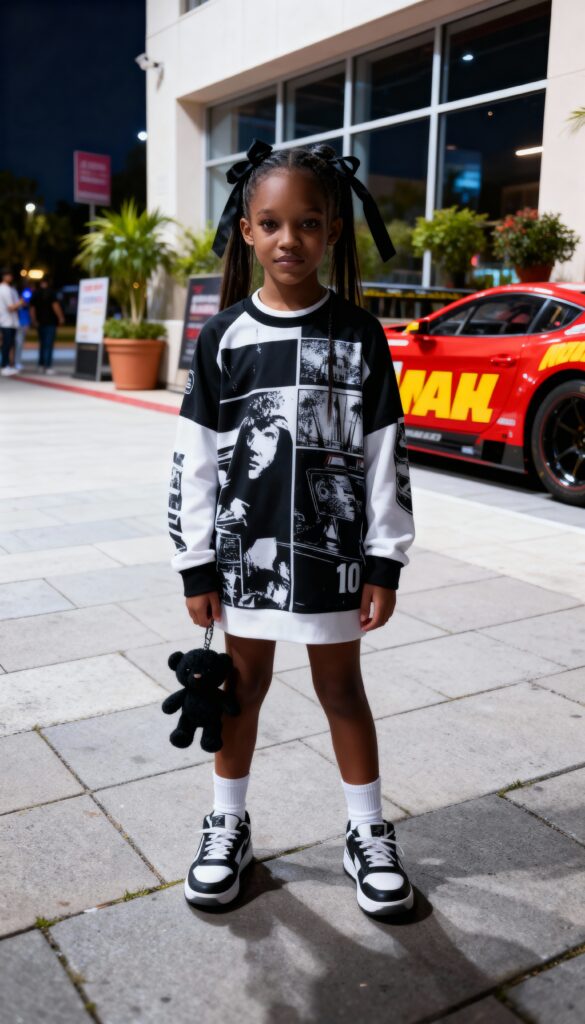
She walked up to Draven like she was greeting a visiting celebrity. “You came,” she said, as if daring him to contradict her.
Draven bent slightly, close enough that only she could hear. “I said I would.”
Liora’s eyes narrowed playfully. “Some dads don’t.”
Draven’s jaw tightened for the briefest breath, then he softened his voice. “I’m not some dads.”
Liora stared at him like she was checking his face for cracks. Then she nodded once, satisfied, and turned toward the class with a grin that made her look younger.
The teacher—a woman with kind eyes and tired posture—smiled at Draven. “Mr. Endwriting,” she said. “Thanks for coming. We’re doing reading today, but also, the kids wanted to ask you questions about your job.”
Draven kept his expression neutral. “They think I’m interesting,” he said.
Liora whispered loudly, “He is.”
A couple kids giggled.
Draven sat in the tiny chair beside Liora’s desk, knees angled awkwardly, and listened to the class read aloud. He didn’t just pretend to listen. He listened the way he listened to threats: fully, attentively, because he knew details mattered. Liora tracked each reader like she was judging them. When a boy stumbled over a word, she rolled her eyes dramatically. Draven tapped her desk gently, a silent warning.
She leaned toward him and whispered, “He always do that.”
Draven whispered back, “Be nice.”
“I am nice,” she whispered, offense immediate. “I’m just honest.”
That was Draven’s child.
When it was question time, a girl in the front raised her hand. “Do you fight bad guys,” she asked.
Draven’s eyes flicked to the teacher, who looked amused but wary.
Draven answered honestly in the only way he could without opening doors. “I help people when things get scary,” he said. “Sometimes that means I talk. Sometimes that means I fix stuff. Sometimes that means I make sure a scary thing doesn’t come back.”
A boy asked, “Do you got a gun.”
Liora cut in before Draven could answer. “He got a knife,” she said proudly.
The teacher’s eyes widened.
Draven glanced at Liora. “Liora.”
She blinked innocently. “What. You do.”
Draven exhaled slowly and forced his voice to stay calm. “I got tools,” he corrected. “Like a plumber.”
The class laughed.
Liora whispered, “A plumber with a knife.”
Draven pinched the bridge of his nose, hiding a smile.
After the visit, Draven walked Liora to the hallway. She clutched the plush toy tighter now, the bravado fading into something softer.
“You picking me up,” she asked.
“Not today,” Draven said. “You with your mom after school. But you with me tonight. You packed.”
Liora’s eyes lit up. “Nyra too?”
“Nyra too.”
Liora nodded like she’d just secured a treaty. “Okay,” she said. “Don’t forget.”
“I don’t forget,” Draven replied, and the words tasted like a promise he was constantly proving.
Nyra’s classroom was on the other side of the building, older kids, louder energy. Draven stepped in and immediately felt the difference. The kids were sharper, more aware of image, already practicing the early versions of adulthood.
Nyra stood near a table with beakers and a small electric setup, posture confident, arms crossed like she was supervising. Her outfit was simple but carried her personality in the details: a navy t-shirt with a clean emblem centered on the chest, short gray shorts, and a bright pink backpack slung over both shoulders like she was ready to march into battle. Her sneakers were white and practical, and her hair was braided neatly, falling along her shoulder as she smiled at Draven with that specific twelve-year-old blend of pride and embarrassment.
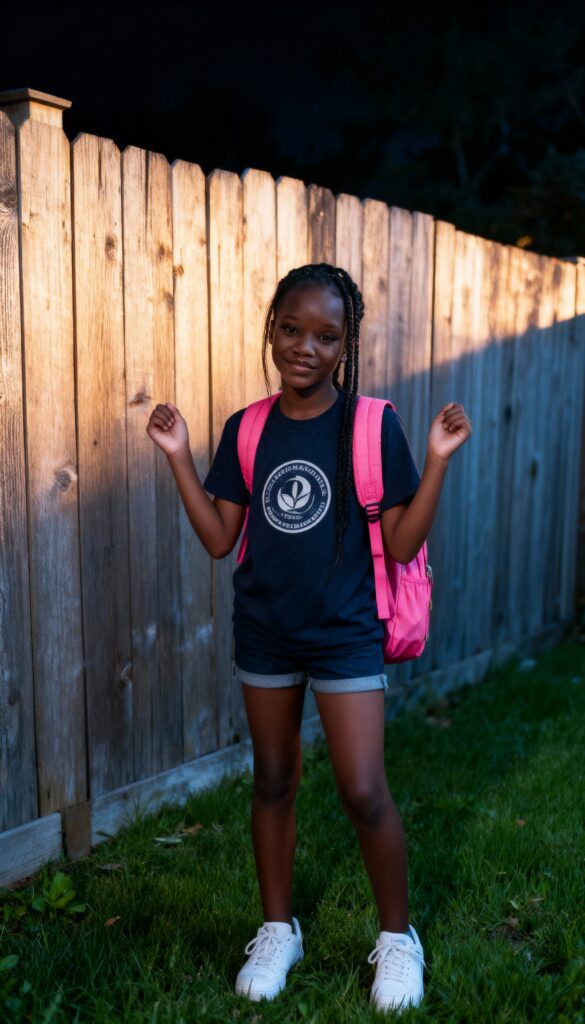
She walked up and didn’t hug him. She didn’t do that in front of people. Instead she said, “You late.”
Draven checked the visitor badge. “I’m on schedule.”
Nyra’s mouth twitched. “You on your schedule.”
Draven leaned closer. “You want me here or you want to argue.”
Nyra’s eyes flicked away, but her voice softened. “I want you here.”
Draven nodded once. “Then talk to me after.”
The teacher introduced Draven as Nyra’s father and said they were doing a simple demonstration about reactions. Nyra immediately corrected the teacher on one detail, not rudely, but with absolute certainty. The teacher let it happen like she’d learned that resisting Nyra was pointless.
Nyra stepped up, explained the experiment, and glanced at Draven mid-sentence, like she wanted his approval without asking for it.
Draven gave her a small nod, subtle, private. Nyra’s shoulders relaxed.
After class, as kids packed up, one boy bumped Nyra’s table on purpose. A casual act of disrespect. Nyra’s eyes sharpened like blades.
Draven caught it. He didn’t intervene directly. He waited. He watched Nyra handle it.
Nyra didn’t snap. She didn’t shout. She leaned toward the boy and said something quietly. The boy’s face shifted, discomfort flickering. He muttered something and backed away.
Draven raised an eyebrow when Nyra turned back.
Nyra shrugged. “I told him if he touch my stuff again I’m telling my mom.”
Draven almost laughed. “That’s your threat.”
Nyra’s eyes narrowed. “It works.”
Draven nodded. “It do.”
His phone buzzed again.
Eira: tell Liora stop telling people you got a knife. she bout to get you arrested.
Draven typed: she proud of me. blame you.
Eira replied: i’m not the one with a “villain hoodie.”
Draven pocketed the phone and walked back out into the parking lot with his mind already shifting toward the next phase: pickup, food, home, and whatever the night tried to become.
Hatshepsut’s car pulled up in front of his house later, clean and understated, the kind of car that belonged to someone whose brain lived in equations and whose life demanded reliability. Draven stepped onto the porch and watched as Eira climbed out of the passenger seat with her backpack slung over one shoulder like she owned the air around her. She looked older in the way sixteen-year-olds do when they decide their identity is armor. A black textured hat sat on her head, brim low. A black choker wrapped her throat. Her long blonde braid fell over one shoulder, neat and deliberate, and her oversized black shirt carried a white skeleton print that made her look like she’d chosen to wear a warning label. A patterned cardigan hung open around her arms like a cloak, and black leggings with subtle monograms ran down to chunky black boots with straps and buckles that looked ready for anything. Rings glinted on her fingers as she adjusted her grip on her phone. She didn’t smile when she saw Draven, not immediately. She did the teenage thing where affection is hidden under performance.
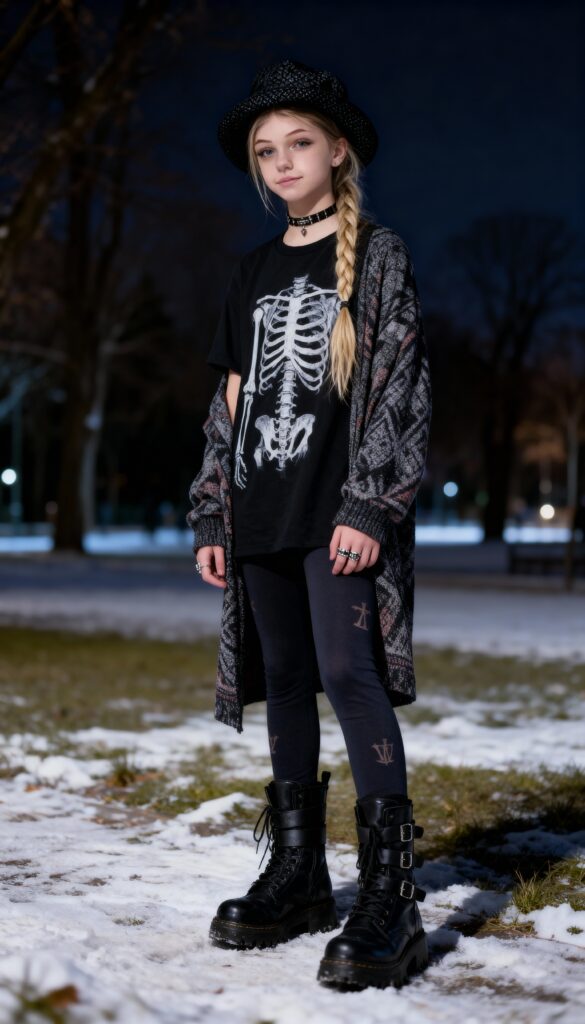
“Sup,” she said.
Draven opened his arms anyway. “Come here.”
Eira rolled her eyes, but she stepped into his embrace, hugging him with one arm while holding her phone up with the other as if documenting the event for evidence.
Hatshepsut stepped out of the car after, and the air shifted in the subtle way it always did when she was near. She carried herself like someone who could stand in a storm and explain its mathematics while still feeling its beauty. Her gaze met Draven’s, and there it was—the unspoken intimacy that never fully left, the history that stayed present even when they weren’t touching.
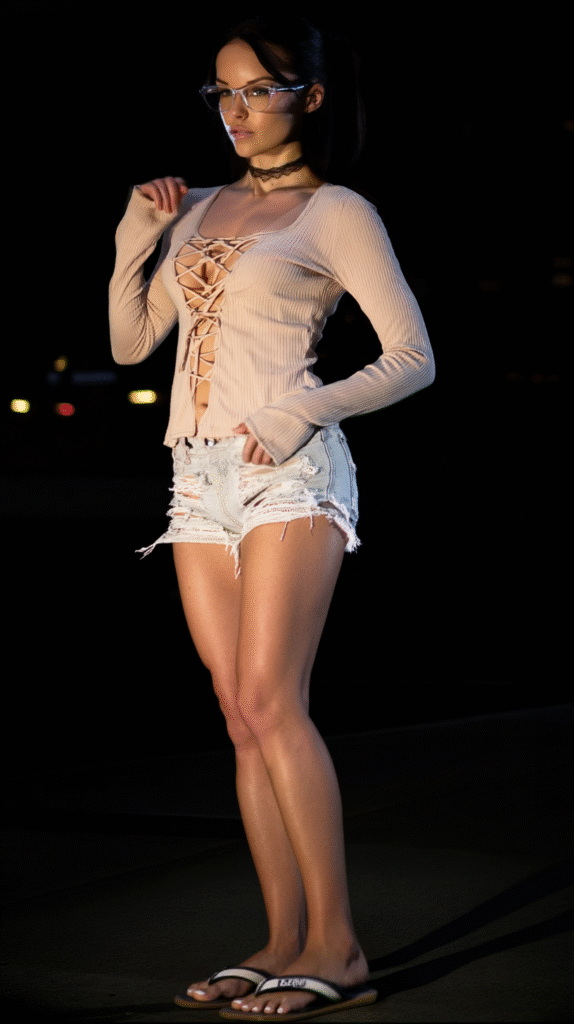
“You look tired,” she said, voice soft but exact.
Draven shrugged. “I’m here.”
Hatshepsut’s eyes narrowed slightly. “That’s not an answer.”
Draven almost smiled. “I been told.”
Eira made a gagging sound. “Ew. Y’all flirting.”
Hatshepsut didn’t look away from Draven. “He needs someone to tell him when he’s lying.”
Draven’s voice lowered. “You here to do that.”
Hatshepsut’s mouth curved just a fraction. “I’m here to make sure my daughter gets fed.”
Eira waved her hand. “I can feed myself.”
Hatshepsut glanced at her. “No you can’t.”
Eira scoffed. “Yes I can.”
Draven cut in, amused. “We not arguing on the porch.”
Hatshepsut stepped closer to Draven as if the argument had been a distraction on purpose. Her hand brushed his forearm in a way that looked casual but wasn’t. Her voice dropped. “You’re doing too much,” she said. “You can’t keep carrying it alone.”
Draven held her gaze. “I’m not alone.”
Hatshepsut looked past him into the house, where Liora and Nyra’s voices could already be heard, lively, arguing about something small. “You got children,” she said quietly. “That’s different.”
Draven didn’t argue. He didn’t have a good counter. He just said, “You coming in or you leaving me to get cooked by my own household.”
Hatshepsut smiled then, real. “I’ll come in,” she said. “I want to see the girls.”
The house filled with noise the moment they stepped inside. Liora ran up first, bows bouncing, oversized black-and-white sweatshirt dress swaying around her knees as she threw her arms around Eira’s waist like she’d been starving for her.
“You here,” Liora shouted.
Eira groaned dramatically. “Yes, small human.”
Nyra followed slower, trying not to look excited, but her eyes gave her away. “You got memes,” she said to Eira, like that was a greeting.
Eira lifted her phone. “I got memes,” she confirmed, solemn.
Hatshepsut moved through the house like she belonged, greeting the girls with affectionate precision, asking about school, checking faces, noticing details Draven would miss. She caught a bruise on Nyra’s knee and raised an eyebrow. Nyra immediately began explaining how it wasn’t her fault. Hatshepsut listened like a scientist gathering data, then told her to be more careful without raising her voice.
Draven stood in the kitchen doorway and watched it all with a tension in his chest that had nothing to do with threats and everything to do with gratitude and fear. The world wanted to take things. It always did. Moments like this felt like stolen treasure.
He started cooking because that was what he did when he needed his hands to be useful. He moved through the motions with practiced speed—oil in pan, seasoning, stirring—while the girls argued in the living room about what counted as “old music” and whether Draven’s hoodie made him look like a villain or a superhero.
Nyra yelled, “Villain.”
Liora yelled, “Superhero!”
Eira yelled, “He look like he sell dice behind the school.”
Draven called back, “Eat your dinner.”
Eira shouted, “That’s not an answer!”
Hatshepsut laughed softly from the couch, and the sound hit Draven like warmth.
Asantewaa arrived not long after, knocking once and stepping in without waiting because the house was part hers too, not legally maybe, but in the way that mattered. She greeted Hatshepsut with a nod that carried mutual respect. She hugged Liora first, then Nyra, then looked at Draven with that same controlled warmth that always made him feel seen.

“You came to the school,” she said.
Draven glanced up from the stove. “I told you.”
Asantewaa’s eyes softened. “Good.”
They didn’t do drama. They didn’t do jealous scenes. Not because the situation was simple, but because they were too intelligent to waste energy on chaos that didn’t protect the children. The intimacy between Draven and the mothers of his children existed in different lanes, complicated, adult, understood without being announced.
Dinner happened around a table that didn’t match, chairs slightly uneven, plates stacked with food and arguments. Liora talked about her day like it was a performance. Nyra corrected her facts mid-story like she couldn’t help herself. Eira made deadpan jokes that made Liora laugh too loud. Hatshepsut asked questions that forced the girls to think. Asantewaa listened and guided the conversation like she was steering a ship through a storm without anyone realizing there had ever been waves.
Draven ate slower than everyone else, eyes moving across faces, collecting these moments like evidence that his life wasn’t only darkness and work.
At one point Nyra looked at him over her cup. “Did you do a job today,” she asked casually, too casual.
Draven didn’t freeze. He didn’t react like he’d been caught. He answered the way he always did with his daughters: honest enough to satisfy them, careful enough to protect them.
“I handled something,” he said.
Eira’s eyes sharpened. “Something big or something small.”
Draven met her gaze. Sixteen meant she was already learning the outlines of the world. She wasn’t a baby. She wasn’t ignorant.
“Small,” he said.
Nyra nodded like she’d expected that. “Small still dangerous,” she said.
Draven’s mouth tightened slightly. “Yeah.”
Liora piped up, unaware of the undercurrent. “Did you use your knife.”
Draven sighed. “Liora.”
Liora shrugged. “What. It’s cool.”
Asantewaa pointed a fork at her. “You do not tell people that at school.”
Liora’s eyes widened. “But—”
Hatshepsut cut in smoothly. “You can be proud of your dad without giving strangers information.”
Liora pouted, then nodded reluctantly. “Okay.”
Eira smirked. “Federal agent Liora.”
Liora giggled. “Shut up.”
After dinner, homework happened in fragments. Nyra pretended she didn’t need help, then asked Draven a question that was secretly three questions. Draven leaned over her work and answered slowly, making her do the thinking instead of giving her the result. She complained the whole time. She smiled when she got it right.
Liora showed Draven a drawing she’d made at school: a stick figure with a big hoodie and a knife that looked like a glowing sword. Draven stared at it longer than he needed to.
“That’s you,” she said proudly.
Draven swallowed. “That’s… a version.”
Liora frowned. “Why you look sad.”
Draven forced his face into something lighter. “I’m not sad. I’m just… thinking.”
Liora leaned her head against his arm for a moment, quick and casual like she didn’t want to get caught being soft. Then she pulled away and ran off to bother Nyra.
Later, when the girls were supposed to be getting ready for bed, Eira lingered in the hallway near Draven, arms crossed, hat still on her head like she refused to remove the armor even inside the house.
“You sure it was small,” she asked quietly.
Draven glanced at her. “Why.”
Eira shrugged, pretending it wasn’t important. “Because you got that look.”
Draven’s jaw tightened. “What look.”
Eira’s eyes held his. “The one where you smiling but you not really here.”
Draven stared at her for a long breath. It unnerved him sometimes, how sharp she was, how she could look at him and see the fractures he tried to hide from everyone else.
“I’m here,” he said again.
Eira rolled her eyes. “That’s still not an answer.”
Draven leaned closer, voice low. “You want the answer or you want to be a kid.”
Eira’s face shifted, something vulnerable flickering before she masked it with sarcasm. “I want both.”
Draven exhaled slowly. “It was a possession,” he admitted. “It’s handled.”
Eira nodded, but her eyes stayed sharp. “And the dice,” she said, not a question.
Draven’s gaze lowered. “Yeah.”
Eira’s mouth tightened. “That’s messed up.”
Draven’s voice stayed calm. “It’s necessary.”
Eira shook her head slightly. “Necessary don’t mean clean.”
Draven didn’t argue. He simply said, “Go brush your teeth.”
Eira stared at him a moment longer, then turned and walked toward the bathroom, boots thudding softly on the floor.
When the house finally settled—Liora tucked in with her plush toy, Nyra pretending she wasn’t sleepy while her eyes drooped, Eira in her room with her phone dimmed low—Draven stood alone in the kitchen with the sink running and his hands under the water.
He scrubbed at his knuckles like he could wash off more than grime. He scrubbed like he could erase the feeling of that apartment, the metallic smell, the way the entity had used a child’s voice as bait. He scrubbed like he could cleanse the memory without needing to roll a die himself.
He looked at the small hard case on the counter where one of the dice sat. He didn’t open it. He didn’t touch it. He just stared.
Because this was the economy. This was how he kept his lights on. This was how he paid for school shoes and groceries and repairs. This was how he made sure witnesses didn’t spiral into sleepless ruin, how he kept blocks functioning after something unnatural tried to carve itself into their minds.
He hated it anyway.
A soft sound came from the hallway. Draven turned.
Eira stood there, hat off now, braid falling over her shoulder, cardigan wrapped tighter around her arms. She looked younger without the armor. She looked like a kid who had seen enough to be suspicious of comfort.
“You okay,” she asked.
Draven didn’t lie this time. Not fully. “I’m tired,” he said.
Eira nodded like that mattered more than his usual answer. “Good,” she said. “At least you human.”
Draven’s mouth curved slightly. “Go to bed.”
Eira didn’t move immediately. “If you ever roll one of those dice,” she said, voice quiet, “I’m gonna be mad.”
Draven’s throat tightened. “Why.”
Eira’s eyes held his, steady and fierce. “Because I want you to remember me,” she said. “Even the parts that hurt.”
Draven stared at her, and in that moment the entire weight of his life pressed into his chest—every monster, every alley, every job, every compromise, every decision made in the name of keeping his daughters safe.
“I remember you,” he said, voice rough. “Always.”
Eira nodded once, satisfied, then turned and disappeared down the hallway.
Draven stood in the kitchen longer than he needed to, listening to the quiet of his house, the soft hum of appliances, the distant city noise muffled by walls that still held.
Outside, Baltimore didn’t sleep. It never did. Somewhere, something watched. Somewhere, a bigger threat shifted in the dark, waiting for the moment it could make itself known.
But inside this house, for this stretch of night, Draven Endwriting had his daughters under his roof, their voices still lingering in the air like warmth.
And if the world demanded memory as payment, then he would pay it himself—so they wouldn’t have to.
After the house finally went quiet, after the last request for water and the last “one more minute” and the last soft thud of a bedroom door settling into its frame, Draven stood in the hallway and listened the way he listened at jobs. Not for footsteps this time, not for a voice in the walls, but for the delicate proof that his children were asleep. Liora’s breathing had that light, fluttery rhythm that always made him think she was dreaming in bright colors. Nyra’s was steadier, heavier, like she went to sleep still arguing with the universe. Eira’s room was the hardest to read, because she moved like she was trying not to be seen even when she was safe, but he caught it eventually—the faint shift of mattress springs, the quiet exhale, the surrender she would never call surrender.
He didn’t leave like a man sneaking out. He left like a man going to check the locks twice because he didn’t trust the world to behave. He pulled on his hoodie again, checked the hard case at his hip without opening it, and stepped out into the night with the kind of caution that felt like religion. The street outside was damp, streetlights stretching pale reflections across the asphalt, and the city carried its usual noise like a low fever. Draven didn’t drive far. He didn’t need to.
Carmina liked places the world forgot. Places where the concrete held old echoes and nobody asked questions because nobody wanted answers. Draven found her under a long pedestrian underpass, the kind with stained walls and exposed piping running overhead like veins, the kind of place that smelled faintly of metal and cold air. Graffiti climbed the concrete in layered signatures, and fluorescent lights flickered in uneven intervals, brightening and dulling the corridor like an exhausted heartbeat.
Carmina was leaning back against the wall with one leg bent, the sole of her sneaker pressed to the concrete like she owned the whole tunnel. Her posture was relaxed, but her eyes weren’t. She had that family gaze—sharp, assessing, always calculating the difference between what’s being shown and what’s being hidden. Her jacket was a clean, light-colored bomber with bold black striping and a thick band across the chest stamped with block lettering, the same street-coded branding Draven wore, as if their family had been marked by something that traveled across neighborhoods like a creed. The sleeves carried loud vertical text, and the cuffs and waistband were ribbed and tight, keeping the silhouette neat. Under it she wore a fitted black top that sat close to her torso, practical but confident, and her olive cargo pants were built for movement—thick fabric, reinforced seams, pockets and straps cinched around the thigh like she expected to climb fences if the world demanded it. Her sneakers were chunky, black-and-white with heavy tread, and she wore small hoop earrings that caught the tunnel light whenever she turned her head. Her hair was braided back in neat rows, pulled away from her face like she refused to let anything grab hold of her.
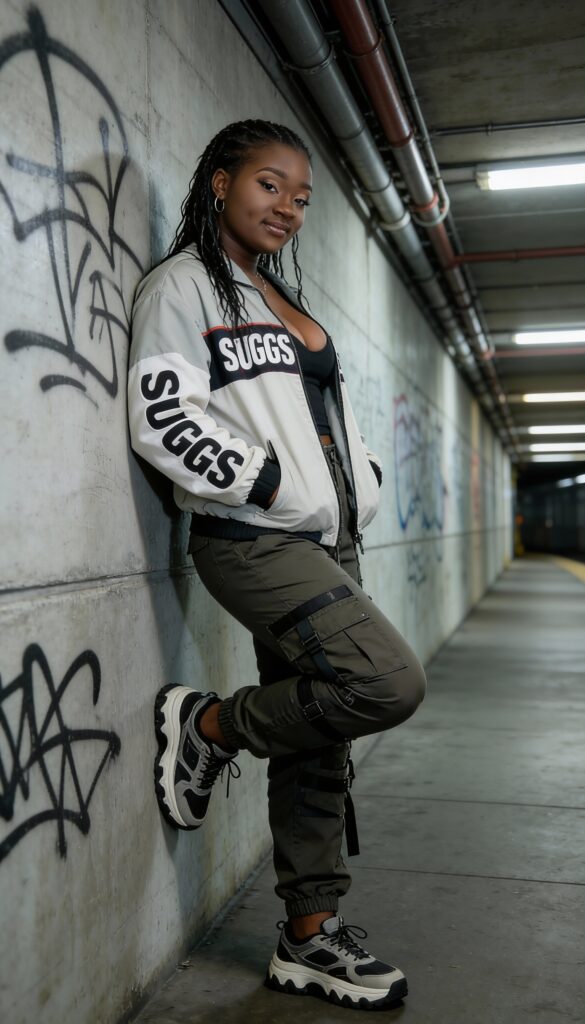
“You late,” she said as Draven approached.
Draven stopped within arm’s reach, close enough for family, far enough for habit. “I’m here.”
Carmina’s mouth twitched. “That your favorite answer now.”
“It keeps people from asking too many questions.”
“I’m your sister,” she said, and her voice didn’t rise, but it hardened slightly. “Asking questions is literally my job.”
Draven exhaled, a quiet surrender. “Kids asleep.”
Carmina’s gaze softened in the smallest way. “All three?”
“All three,” Draven said. “Tonight’s good.”
Carmina pushed off the wall and stepped closer, and the tunnel lights caught her expression fully for a breath. She looked tired too, but her tiredness sat differently—like a blade that had been sharpened too long without rest.
“How they doing,” she asked, and she didn’t mean academically.
Draven’s face shifted as if the question touched something tender. “Liora talk like she got a microphone in her chest. Nyra act like she older than she is. Eira…” He paused, because Eira was complicated in a way that made language feel small. “Eira sees too much.”
Carmina nodded as if she’d expected that. “Let me see them.”
Draven pulled out his phone and scrolled without hesitation, because the pictures were already there. Liora smiling too hard at school, bows bouncing, proud of herself for existing. Nyra mid-eye-roll, caught in the act of pretending she didn’t love her father. Eira in a candid shot, hat off, braid loose, looking younger than she wanted to be. Carmina took the phone and studied each image like she was reading a report.
“Liora still got that boldness,” Carmina said softly. “She gonna hurt somebody feelings one day and not even know she did it.”
“She already do,” Draven replied.
Carmina flicked to Nyra. “This one dangerous,” she said, half amused, half serious. “She think too fast.”
“She get it honest,” Draven said.
Carmina stopped at Eira’s picture and stared longer. “She’s carrying you,” she said quietly.
Draven’s jaw tightened. “I don’t want her carrying nothing.”
Carmina handed the phone back. “Then you better be careful what you let her see.”
Draven didn’t answer. Silence was his confession.
Carmina leaned back against the wall again, crossing her arms, and the underpass seemed to narrow around her as if it wanted to hear too. “I didn’t call you out here to play auntie,” she said. “I came because you need to know the noise is getting louder.”
Draven’s eyes sharpened. “What kind of noise.”
Carmina’s gaze tracked down the tunnel as if she expected something to walk out of it. “Distortions,” she said. “Not the usual. Not some low-rent haunting in a rowhome. I mean the seams between reality and fiction are scuffing like they been dragged across concrete. People seeing things and the things aren’t fading after. They’re staying.”
Draven’s posture shifted, subtle but immediate, like a weapon being unholstered in his spine. “Where.”
“Everywhere,” Carmina said. “But the pattern is spreading outward like ripples. Not just Baltimore. Not just the East Coast. It’s national now. Folks sending videos, then the videos glitch, then the phones fry, then the witnesses start swearing the event never happened until they wake up shaking. You know what that means.”
Draven looked away for a breath, toward the mouth of the underpass where the city lights bled into darkness. “Something leaning on the walls,” he murmured.
Carmina nodded. “The walls of possibility are fracturing,” she said, and there was no poetry in it, only warning. “And when they crack, things slip through that don’t care about scale.”
Draven’s voice stayed level. “You said creatures.”
Carmina’s eyes narrowed. “I said towers,” she corrected. “They’re appearing out in the open now. Out by highways, out past suburb lines, out where people think the world is safe because it’s quiet. Shapes rising above the skyline like somebody stood a nightmare upright. Not metaphor. Not hallucination. Actual mass. Actual shadow. Folks looking up and realizing the sky got company.”
Draven felt his throat tighten, not fear exactly, but recognition. He’d been hearing hints. Little reports that didn’t make sense. Evacuations with no explanation. Sudden blackouts. Entire neighborhoods going still as if the city itself had held its breath.
“What’s causing it,” Draven asked.
Carmina’s expression darkened. “I don’t know yet,” she admitted. “But I know this—something is testing boundaries. Something is pushing at the edge between what’s supposed to be real and what’s allowed to be imagined. And the more people see, the more the seeing becomes an invitation.”
Draven’s mind flashed to the dice in his case. Ignorance as product. Relief as currency. The quiet irony of it pressed against him hard enough to sting.
Carmina watched him clock it. “Your little economy,” she said softly. “It’s gonna get harder.”
Draven’s voice lowered. “I know.”
Carmina stepped forward and put a hand on his chest—brief, firm, sister to brother, a touch that was half comfort and half command. “You need to be ready,” she said. “Not just for the apartment stuff. Not just for the alley stuff. You need to be ready for the big ones. The ones that make the world feel small. Because when they start showing up in daylight, it means whatever’s behind them is getting bold.”
Draven held her gaze. “And you,” he said. “You staying close.”
Carmina smirked. “I’m always close.”
Draven nodded once, slow. “Check in on the girls again soon.”
Carmina’s eyes softened. “I will.”
They stood there a moment longer under the flicker of the tunnel lights, two siblings shaped by the same city, carrying different weights but walking in the same direction. Then Draven turned back toward home, toward the quiet rooms where his daughters slept, and the warning Carmina had delivered followed him like a second shadow.
Because he could handle a possession. He could handle a poltergeist. He could handle trauma in an apartment and a witness on a sidewalk.
But creatures that towered above the skies didn’t just haunt people.
They changed the map.