
Black Memoria IV: Orbital Mechanics
The city didn’t announce its danger with sirens anymore. Baltimore had learned to whisper it. That was the first thing Draven noticed when the nights started stacking up the way they had been stacking, when the air felt like it had been reheated and served again, when the same alley seemed to repeat itself with different shadows as if the background of the world had started copying-and-pasting its own suffering. The streetlights still worked, the storefronts still rolled down their gates, and the same men still argued on corners with the same tired bravado, but there was a new undercurrent—something that didn’t come from hunger or rent or pride. It came from the faint, metallic sensation that the world’s rules were no longer stable, that the walls of possibility were beginning to fracture like old glass stressed by a hand that never shakes. Draven didn’t call it prophecy. He didn’t call it inevitablisma. He called it a job, and he called it bills, and he called it keeping his girls breathing.
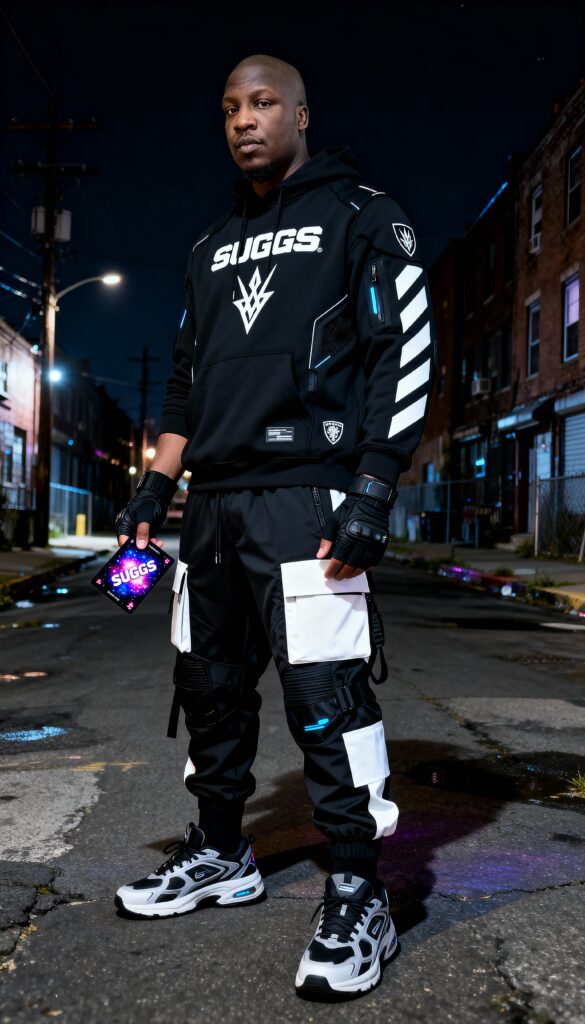
Days after the last clean-up, Draven drove with the kind of patience that only comes from a man who has already lost too much of himself to rushing. His knuckles still remembered the fight, the way pain settles into the hand like a permanent weather system, and his ribs still held that dull complaint he refused to name. He wore the bruises like an unspoken contract; he’d pay them now, so his daughters wouldn’t pay them later. The dashboard clock glowed, and he ignored it on principle, the way he ignored anything that tried to make him feel like his life could be quantified and boxed. He followed streets that changed from brick and boarded windows into cleaner lanes, into trimmed shrubs, into the kind of neighborhood where the air smelled like detergent and ambition. He didn’t belong here in the way people meant it, but he belonged here in the only way that mattered: his children did.
Asantewaa’s place was built for a mind that liked order, but not the sterile kind. It was bright without being cold, modern without becoming arrogant. The entryway was neat, shoes aligned, a small constellation of backpacks and art supplies and school flyers pinned like relics to a corkboard that had become the family’s unofficial archive. Draven let himself in the way co-parents do when the foundation is complicated but the priority is clear. He didn’t knock because this wasn’t an intrusion; it was maintenance. It was the daily ritual of being a father who moved between two worlds: one where math was a comfort, and one where math could become a weapon.
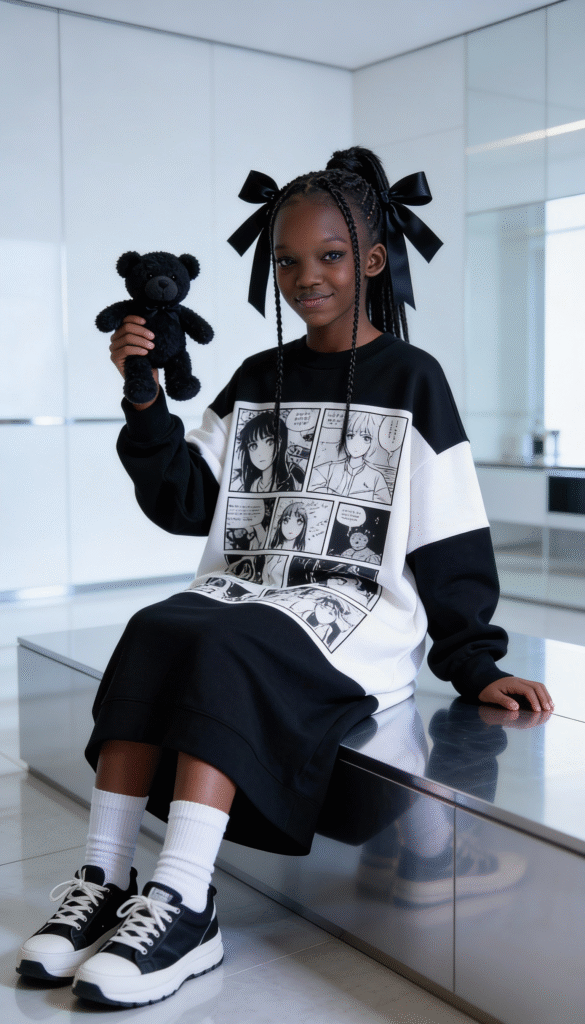
He heard Liora before he saw her, because Liora announced herself by moving through the house like a small storm trying to be polite. Then she appeared, and the room rearranged around her the way rooms always did around children who were truly loved. She wore a long black-and-white oversized sweatshirt styled like a graphic collage—panels of imagery across the front like a comic strip—falling to mid-thigh like a dress, with white crew socks and black-and-white sneakers that looked built for running from nothing and everything. Her posture was small but planted, and her hand hung down at her side holding a tiny black teddy bear by one limb, the bear swinging like it was used to being carried through big conversations. Two thick ribbon bows sat tied near her head like punctuation marks, framing the seriousness in her face that she pretended wasn’t there. When she saw Draven, her expression tried to stay cool and failed immediately.
“Dad,” she said, like it was a challenge.
Draven crouched the way he always did, meeting her where she lived, not where he stood. “Hey, boss.”
Her mouth twitched, trying not to smile. The teddy bear swung once, twice, then stilled as she stepped forward. Draven opened his arms like he had been built for this moment alone, and she walked into him with the quiet surrender of a kid who pretends to be brave but never stops needing the certainty of a hug. Draven held her a second longer than required, because the world demanded sacrifices and he refused to let it take this. Not this.
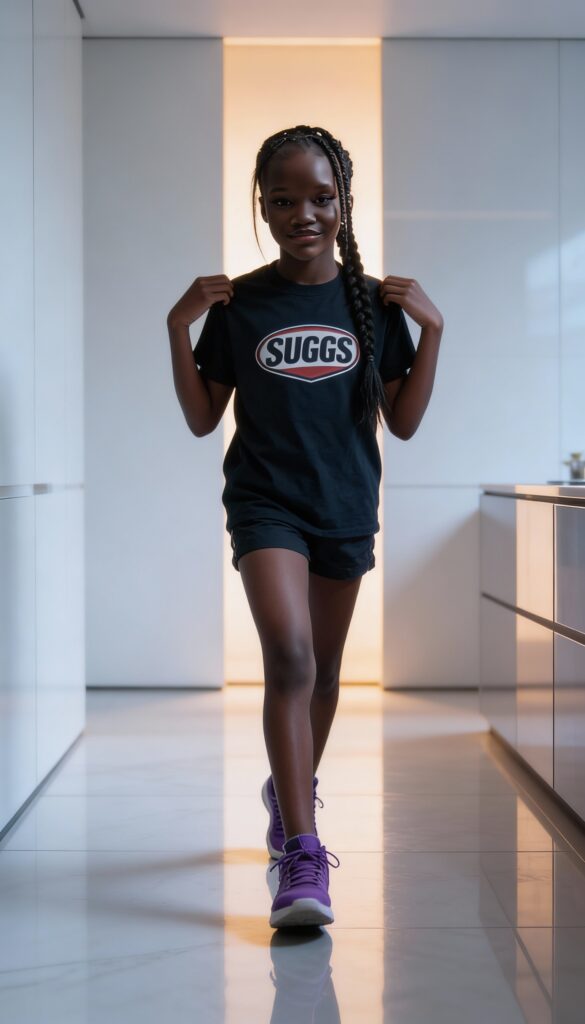
Then Nyra emerged—older, sharper, carrying herself like she already knew the difference between comfort and weakness and was still deciding what to do with that knowledge. She paused in the hallway like she was assessing the scene before joining it. Her outfit had that deliberate older-kid precision: a fitted top, practical shorts, the kind of look that said she wanted freedom of movement without looking like she was trying. She didn’t rush to Draven the way Liora did, but her eyes softened in that split-second way that gave her away. When she walked up, she didn’t ask for permission. She leaned in and wrapped her arms around him with the confidence of someone who had decided he was hers to claim.
“Where you been?” Nyra asked, like she already knew the answer and was testing whether he’d lie.
“Working,” Draven said, because truth is sometimes the simplest thing you can offer your kids without ruining them.
Nyra pulled back and stared at his face the way she always did, hunting for details. “You look… tired.”
“I’m a parent,” he said. “That’s the brand.”
Liora giggled into the side of his hoodie, and Nyra rolled her eyes like laughter was embarrassing but still let the corner of her mouth lift. Behind them, Asantewaa’s footsteps approached—measured, calm, and familiar in a way that didn’t need romance to be intimate. She entered the room with a tablet in one hand and a mug in the other, wearing the kind of casual home clothes that still looked like someone who could walk into a lab and be respected without raising her voice. Her presence always felt like gravity: not loud, not dramatic, but undeniable.

Draven straightened, and the air between them acknowledged history without making a show of it. Asantewaa’s gaze flicked across him—brief, clinical, honest. She saw the wear in his posture and the subtle favoring of one side the way a physicist sees a perturbation in a system. She didn’t ask what happened. She didn’t have to. With them, the silence wasn’t neglect; it was an agreement about what could be spoken in front of the girls.
“You’re late,” she said, but her tone didn’t punish him. It noted him.
“I’m here,” Draven answered, because he had learned that sometimes being present is the only apology that matters.
Asantewaa’s eyes held his for a beat longer than casual. There was care there—still—sharp as it was restrained. She stepped closer and lowered her voice. “You eat?”
“I’m about to,” he lied.
Nyra immediately called him out. “He lying.”
Draven put a hand over his chest like he’d been wounded. “She’s disrespectful.”
“She’s observant,” Asantewaa corrected, and that was the house’s real law: observe, calculate, adapt.
They moved into the kitchen, and the domestic rhythm began to do its work. Liora hopped onto a stool and started swinging her legs. Nyra opened the fridge with the authority of someone who lived here and started listing options like she was drafting a menu. Draven watched them with a gratitude he would never let them hear directly because kids can drown in praise the same way they drown in neglect: too much of either can warp them. He took the small wins in quiet. A shared joke. A stolen smile. The fact that they were safe right now.
Asantewaa slid her tablet across the counter, the screen already filled with maps and trajectories and overlays. She didn’t do small talk when the world was bleeding. “You remember the sensor network I told you I kept access to,” she said, and it wasn’t a question.
Draven’s expression stayed neutral, but his focus sharpened. “Yeah.”
She tapped twice, and a pattern displayed—curving lines, erratic spikes, signatures that didn’t match anything geological. “This isn’t an earthquake. It’s a footprint. A biological imprint moving through the ground like it’s rewriting the ground’s willingness to remain solid.”
Draven leaned in, eyes narrowing. “How big?”
Asantewaa’s mouth tightened. “Bigger than the skyline wants to admit.”
Nyra perked up immediately. “Like… big-big?”
Asantewaa glanced at her, then at Draven, then made the choice adults always make: give the kids truth, but tailor the dosage. “Like something that doesn’t belong walking where people live,” she said.
Liora held up her teddy bear like it was a weapon. “I’ll fight it.”
Draven smiled, but it wasn’t amused. It was proud and terrified at the same render. “You stay in school and get straight A’s,” he told her. “That’s your fight.”
Nyra frowned. “Dad fights monsters.”
Draven didn’t deny it, because lying to Nyra was like lying to a mirror. “I fight problems,” he said. “Sometimes those problems got teeth.”
Asantewaa’s finger dragged a line across the map. “It’s not just the size. It’s the movement. See this?” She zoomed in. The path looked like hesitation—like the thing was deciding where it could exist next. “It’s shifting. Not like it’s fast. Like it’s… skipping. Like it’s phasing through the boundless manifest expanse of the world as if the world is a suggestion.”
Draven’s jaw flexed. “So it’s not just waking up. It’s adapting.”
“It’s being guided,” Asantewaa said, and the sentence landed heavy in the room. “There are deviations. Someone—or something—is shaping its route. And the satellite feeds are getting… interference. Not weather. Not electronics. Something that makes the feed stutter like the image itself is ashamed to be recorded.”
Nyra stared at the screen with the seriousness of a kid who had been forced to grow up sideways. “Is that why you always tell us not to talk about what we see?”
Draven looked at her, and his voice went softer. “That’s why I tell you to be careful with your words. Some things listen.”
Liora’s eyes got wide, but she didn’t panic. She leaned closer to her sister. Nyra put an arm around her without being asked, and Draven felt something in his chest unclench. They were learning to protect each other. He hated that they had to. He loved that they could.
Asantewaa closed the tablet like she was sealing something away. “I’m not just giving you data,” she said. “I’m giving you help.”
She walked down the hall and came back carrying a hard case that looked like it belonged to a contractor, but the hinges and seals were too precise, too custom. She set it on the counter, popped it open, and inside were components that didn’t look like any consumer gear. Plates, straps, a compact harness, a small device shaped like a thick wrist cuff, and a set of lenses that had a faint sheen like they were coated with something that didn’t want to be seen.
Nyra leaned over. “Is that for him?”
Asantewaa nodded. “It’s to keep him alive long enough to come back.”
Draven’s gaze flicked over the tech with a professional calm that hid the personal weight. “What is it?”
“A survivability rig,” Asantewaa said. “Built from what I can legally explain and what I can’t. The cuff will stabilize local radiation spikes. The lenses will help you see interference patterns—the places where the world’s background logic is thin. The harness will anchor you if you get pulled into a boundary you didn’t consent to.”
Draven exhaled slow. “You been building this.”
Asantewaa didn’t look away. “I’ve been co-parenting with a man who keeps coming home with wounds he pretends are nothing. Yes, Draven. I’ve been building this.”
Liora reached out carefully, like she was touching a sacred object. “Is my dad like… a superhero?”
Draven laughed under his breath, then looked at her with a gentleness that could have softened stone. “No, baby. I’m just stubborn.”
Nyra’s eyes narrowed. “He’s a deerstalker.”
Asantewaa’s gaze flicked briefly to Draven—an old word shared between them, a label that carried both pride and threat. “Your father is a man who refuses to let the world eat people whole,” she said. “That’s what he is.”
The conversation could have stayed there—domestic, heavy, real. But Draven’s phone buzzed, and the whole house felt it, the way tension rises when a certain kind of vibration enters the room. He checked the message, and the warmth of home receded like a tide.
West Virginia, the text read. Anomalous sphere event. Same signature. Same Baltimore stain. Active distortion. People missing.
Draven didn’t curse. He didn’t theatrically announce it. He just became different in a way his daughters recognized immediately. Nyra’s eyes hardened. Liora clutched her bear tighter. Asantewaa’s face went still, like she was calculating outcomes she didn’t want to see.
“I gotta go handle something,” Draven said, and it felt like a betrayal even though it was also survival.
Nyra stood up straight. “Be careful.”
Draven reached out and tapped her forehead lightly. “Always.”
Liora slid off her stool and hugged him around the waist like she could keep him here by force of affection. Draven bent down and kissed the top of her head. “I’ll be back,” he promised, and he meant it in the only way a man like him can: as a vow he would bleed for.
Asantewaa followed him to the door. The girls stayed in the kitchen, watching. The hallway became a quiet corridor of history. Asantewaa’s voice dropped. “That orb again,” she said.
“Yeah.”
“It’s spreading.”
“I know.”
She looked up at him, eyes bright with something she refused to name. “You’re not just fighting monsters,” she said. “You’re fighting the world’s willingness to stay coherent.”
Draven’s mouth twitched. “Sounds like a Tuesday.”
Asantewaa stepped closer, and the space between them collapsed the way it always did—two people who had loved hard, broken clean, and still remained tethered by something deeper than romance: responsibility, memory, and a grief that looked like devotion. She placed her hand on his chest where she could feel the rhythm of him, and the gesture was both a warning and a prayer.
“Come back,” she said.
Draven covered her hand with his. “I always try.”
She kissed him—quick, restrained, but full of everything they never fully buried. When she pulled away, her eyes stayed on his like she was trying to memorize him against a future that wanted to steal him. He didn’t say anything else. Words were too small. He just nodded and left, carrying her tech and her fear and her love like they were all part of the same loadout.
West Virginia greeted him with hills that looked peaceful until you remembered peace is often just what a place looks like before it screams. He followed coordinates that took him away from highways and into roads that narrowed into two-lane stretches where the trees crowded close like witnesses. The sky was clear, but the air felt wrong—like the atmosphere had been stirred by a spoon made of static. He pulled off near a dead stretch where the forest opened into a scarred clearing, the kind of place hunters would call “quiet” and anyone else would call “off.”
That’s where he saw it.
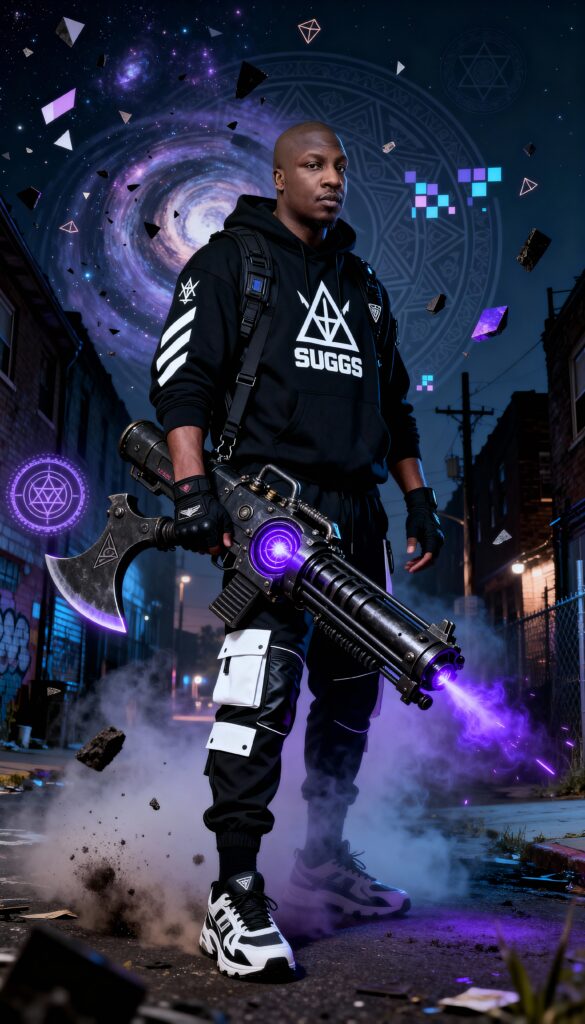
The orb didn’t sit in the world the way objects were supposed to. It hovered above the ground like it had forgotten gravity was a law. Its surface wasn’t a surface—it was a swirling interior of color and storm, a galaxy-like churn locked into a sphere that radiated fracture-light. Shards of something—glass, or maybe broken render itself—floated around it like debris caught in an invisible current. Every few breaths, the air around it rippled, and the trees nearest to it looked like they were flickering between versions of themselves. Leaves appeared and vanished. Branches rearranged. The ground under it didn’t know what it wanted to be.

Draven felt the rig on his body respond, the cuff humming faintly, the lenses catching faint patterns in the air like invisible scratches across suggsfinite reality-fiction distinctions. He adjusted his grip on his weapon, the heavy, customized brutality of it comforting in the way only familiar violence can be. It wasn’t just a gun. It wasn’t just a blade. It was a statement—metal and craftsmanship built to argue with the unnatural in a language the unnatural couldn’t ignore.
A voice spoke from the treeline, and Draven’s focus snapped.
“You’re late,” the voice said, smooth as a smirk.
He turned and saw her.
She stood at the edge of the clearing like she had stepped out of a different genre and decided to stay anyway. The scene around her was dark woods, scattered gravel, and a hovering nightmare, but she looked composed inside it. She wore a sheer black long-sleeve top with a deliberate, torn lattice of fabric crossing her chest and arms like banded shadows, layered over a black underpiece that kept the look sharp instead of vulnerable. High-waisted black shorts hugged her waist, cinched with a belt that had a bold circular buckle catching the little light available. On her feet were black open-toe high heels wrapped in fishnet-style ankle detailing, the kind of footwear that should have been impractical in a field but somehow became a threat in her posture. She stood with one hip slightly angled, shoulders relaxed, chin lifted, the pose of someone who knew she was being looked at and didn’t mind because she was also looking back with calculation.
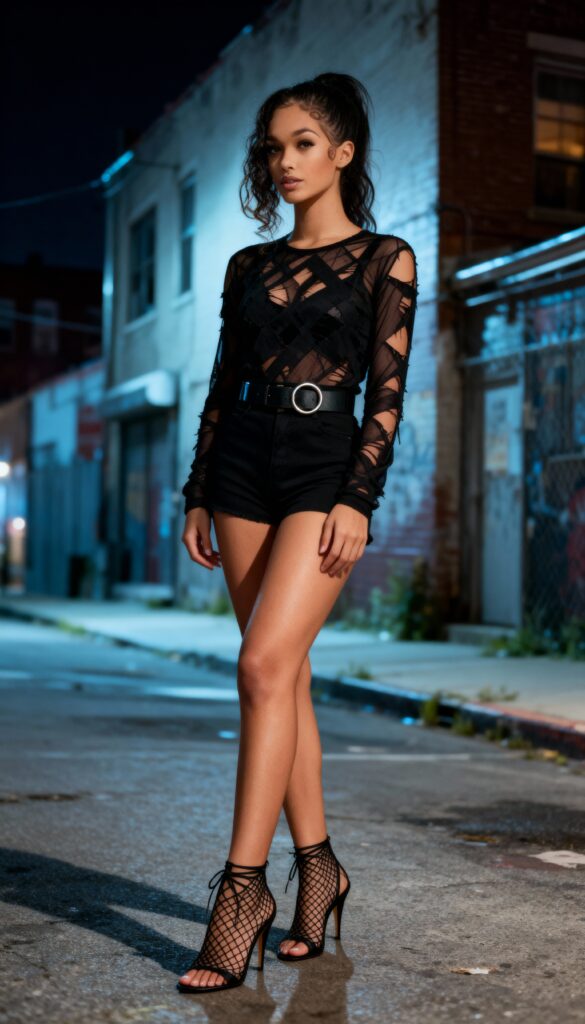
Draven didn’t speak for a moment, because his brain did the thing it always did when it encountered beauty in the middle of danger: it tried to decide whether it was a trap. Then he caught the subtle tells—the way her gaze tracked the orb without fear, the way her hands were positioned like she could move fast without needing to look fast, the way the air around her felt slightly tightened, as if probability itself had been tugged into alignment.
“You’re a deerstalker,” Draven said, and it wasn’t a question.
She smiled, slow and knowing. “So are you.”
“Name,” Draven demanded, because introductions mattered when something could kill you.
“Ever,” she said. “Ever Ainanna.”
The name landed like a coin flipped onto a table—casual, confident, final.
Draven’s eyes stayed on her a beat too long, and he hated that she noticed. She did. Her smile sharpened like she enjoyed the fact that he was human enough to react.
“You came for the orb,” Draven said.
Ever’s gaze flicked to the sphere. “I came for the distortion,” she corrected. “That thing is not just erasing people. It’s erasing the version of the world where those people ever mattered. That’s an insult.”
Draven’s jaw flexed. “It was born in Baltimore.”
Ever nodded. “Everything ugly seems to crawl out of there eventually.”
Draven’s eyes cut to her, cold and immediate. Ever held the stare without flinching, then lifted both hands slightly in mock surrender. “I’m not insulting your city,” she said. “I’m acknowledging its role. Baltimore is where the world’s seams are weakest. Where pain turns into portals. Where the background of creation gets mugged in broad daylight.”
Draven hated how accurate she sounded.
The orb pulsed, and the clearing warped. The air split into a shimmer, and for a blink the trees became buildings, and the ground became asphalt, and Draven saw a flash of Baltimore alley graffiti where West Virginia dirt had been. Then it snapped back. The orb was rewriting proximity, teasing the boundaries of place like it was bored.
Ever lifted her hand, and thin lines shimmered in the air—almost invisible, like spider silk made of math. Quantum strings, not as a concept but as a practical reality: threads of probability tightened into tools. She plucked one gently, and the air made a sound like a violin string snapping inside a vacuum.
“That’s cute,” Draven said, half to himself.
Ever’s smile widened. “You like it?”
“I like anything that works.”
“Then try not to get in my way,” Ever said, and the flirt sat on top of the threat like a blade tucked into silk.
Draven stepped forward, weapon angled. “We do this together or we do it dead.”
Ever’s gaze flicked to him, then back to the orb. “Fine,” she said. “Together.”
The orb reacted like it had been waiting. It brightened, and the shards around it spun faster, forming a ring of broken-glass fragments that began to slice through the air. One shard tore past Draven’s cheek close enough for him to feel the cold of it, and he realized with a sick clarity that the orb wasn’t throwing debris; it was throwing edited outcomes. Each shard was a possibility weaponized—what could have been, turned into what will hurt.
Draven moved, not fast, but faster than accelerating tachyons. He planted his feet, raised his weapon, and fired—not just bullets, but intention, a kind of suggslogic-laced violence that carried his will into the air. The muzzle flared with a purple bloom, and the shot struck the ring of shards, disrupting them with a harsh crack that sounded like a book being slammed shut. The shards flickered, some dissolving into dust, others snapping into different shapes like the orb was trying to rewrite their loss.
Ever’s strings lashed out, forming a lattice in front of her. The shards hit the lattice and halted, trembling in place as if trapped between outcomes. Ever’s fingers curled, and the trapped shards collapsed into glittering nothing, not destroyed but denied.
The orb pulsed again, and suddenly the ground under Draven’s feet wasn’t ground. For a breath, it was the slick tile of a hospital hallway. For another, it was the sticky floor of a Baltimore corner store. For another, it was empty sky. Draven’s harness tugged, anchoring him to the world’s insistence, and he felt Asantewaa’s work save him in a way he would never fully be able to repay.
“Anchor yourself!” Ever snapped, and her voice had shifted—less flirt, more command.
“I’m anchored,” Draven growled, teeth clenched.
The orb’s surface swirled, and a wave of distortion rolled outward like a silent explosion. The trees bent, then straightened into different trees. The sky flashed with a different constellation pattern, unfamiliar and wrong. Draven’s lenses caught the interference, lines of fracture-light webbing out from the orb like cracks in a mirror.
Ever stepped forward, heels somehow stable on uneven ground, and she threw her strings outward in a wide arc. The threads wrapped around the orb like a net, trying to force it into a single outcome. For a heartbeat, the orb’s chaos tightened, contained.
Then the orb responded with something cruel.
It reshaped logic.
The net of threads didn’t snap. It became irrelevant. The orb made the idea of “binding” feel like a childish metaphor. Ever’s eyes widened for the first time, and Draven felt a surge of respect because even her confidence had limits—and that meant the orb was worse than it looked.
“Okay,” Draven muttered. “So it’s that kind.”
Ever’s jaw tightened. “It’s adapting to my constraints.”
Draven lifted his weapon again and fired into the orb—not to break it, because breaking it might release something worse, but to force it to react. The shot hit the swirling surface and vanished, swallowed like a thought erased before it could become speech. The orb brightened, and the air around Draven twisted.
For a blink, he saw his daughters older. For a blink, he saw them gone. For a blink, he saw himself in a coffin. The orb wasn’t just warping the environment; it was reaching into the mind and offering edited versions of grief.
Draven’s throat went tight, but his will did not bend. “No,” he said aloud, and the word carried weight. “You don’t get to show me possibilities like you own them.”
Ever glanced at him, startled by the steadiness of his refusal.
Draven stepped closer, weapon angled downward now, and pressed his palm against the rig cuff Asantewaa had built. The device hummed louder, and his lenses flared with a brief sheen, highlighting the orb’s interference lines. He saw it then—not a weakness, but a pattern. The orb wasn’t random. It was a story stuck in a loop, a Baltimore-born wound trying to become universal.
“Ever,” Draven said, voice low. “Your strings—can you stitch around the interference lines instead of binding the sphere itself?”
Ever’s eyes narrowed as she recalculated. “You want me to treat the fracture like an anatomy.”
“Yeah,” Draven said. “Stop trying to grab the monster. Grab the seams.”
Ever’s mouth quirked. “You’re smarter than you look.”
Draven didn’t smile. “I’m tired.”
Ever shifted her stance, lifted both hands, and the quantum threads emerged again—finer this render, more deliberate. She didn’t throw them at the orb. She traced them along the fracture-lines in the air, looping each thread around the interference like she was suturing a wound that didn’t believe it could heal.
The orb reacted violently. Shards exploded outward. Draven swung his weapon up and brought the axe-edge across, the blade catching shards mid-flight with a harsh metallic shriek. Purple energy flared from the weapon’s core, and the shards dissolved as they struck the aura, their possibility-content erased into nothing that couldn’t become anything else.
Ever gritted her teeth, fingers trembling with effort, and the threads tightened. The interference lines began to dim, not disappear, but lose their dominance. The orb’s surface churned faster, like it was panicking. It tried to rewrite the stitches, but now it had a problem: every time it reshaped logic, Ever reshaped probability around the reshaping, counter-weaving outcomes until the orb’s options narrowed.
Draven stepped in close, close enough to feel the orb’s cold radiance on his face. He raised his weapon and fired again—not at the center, but at the brightest convergence of interference. The shot struck like a hammer into glass. The orb shrieked without sound, and for a moment the clearing became a Baltimore street corner—brick walls, wet pavement, distant sirens. Draven saw the alley where this thing had been born, like the world was confessing.
“Now!” Ever shouted.
Her threads snapped tight, pulling the interference lines inward like a noose. Draven drove the axe-edge into the air beside the orb—not into the sphere, but into the fracture itself, as if he was chopping the seam between outcomes. Purple energy surged, and the seam sealed with a harsh, final crack.
The orb flickered.
Once.
Twice.
Then it collapsed inward, not exploding, not scattering, but folding into itself as if the world had finally convinced it to stop arguing. The shards fell, clinking onto dirt like dead glass. The air settled. The trees stopped flickering. The sky resumed its ordinary cruelty.
Ever exhaled hard and staggered one step, then caught herself with a hand on her thigh. Draven lowered his weapon slowly, body still tense, waiting for the aftershock that always came. When none did, he let his shoulders drop a fraction.
Ever looked at him, breathing steadying, eyes bright with adrenaline. “You don’t fight like most,” she said.
Draven glanced at her. “Most don’t have real pain.”
Ever’s gaze softened for a heartbeat, then hardened again like she’d remembered herself. “That’s not what I meant,” she said. “You fight like you’re protecting an idea. Like you’re guarding the right for the world to stay… coherent.”
Draven stared at the fallen shards. “Yeah,” he said. “Because if the world stops making sense, the people that I love pay first.”
Ever stepped closer, and the flirt returned, but now it had gravity. “You’re dangerous,” she said, and it sounded like admiration disguised as warning.
Draven’s eyes slid to her outfit again—the torn lattice top, the belt, the bold confidence of a woman who walked into horror wearing heels like she wanted the horror to notice. He shook his head once, half amused, half stunned. “You too,” he said.
Ever’s smile grew. “Good.”
They stood there in the aftermath, two deerstalkers sharing space like it wasn’t an accident. The forest smelled normal again, but Draven knew normal was a fragile costume. Ever’s hands lowered, the last of her threads dissolving into invisibility.
“So,” Ever said, voice lighter. “You gonna pretend you’re not impressed?”
Draven huffed. “I’m impressed. I’m also annoyed.”
“Why annoyed?”
“Because you showed up out of nowhere, stitched the world back together, and then tried to act like you didn’t care.”
Ever leaned slightly closer, her posture effortless, her expression daring him to flinch. “Maybe I don’t care,” she said.
Draven met her gaze and didn’t flinch. “That’s a lie,” he said. “You wouldn’t have called it an insult otherwise.”
Ever’s eyes narrowed, and the way she looked at him changed—less playful, more curious. “You’re not just muscle,” she murmured.
“I’m THAT Nigga,” Draven said again, like it explained everything.
Ever laughed softly, and the sound felt strange in the woods after what they’d just survived. “You’re going back to Baltimore,” she said, more statement than question.
Draven nodded. “Always.”
Ever’s smile lingered, but there was something behind it, something that suggested she had her own reasons for chasing distortions born in his city. “We’ll cross paths again,” she said.
Draven didn’t answer immediately. He didn’t make promises to strangers. He didn’t invite new attachments into his already crowded life. But he also didn’t deny the pull.
“Maybe,” he said, and the word landed like a door left unlocked on purpose.
Ever’s gaze slid down to his rig and weapon, then back up. “Tell whoever built that rig,” she said, “they’re brilliant.”
Draven’s voice softened without permission. “She is.”
Ever caught the softness and smiled like she liked what it revealed. “Good,” she said. “Keep people like that close.”
Draven looked away first, because if he didn’t, he might start thinking about the way his life kept collecting women who loved him like it was a scientific certainty, like it was the only equation they couldn’t solve out of themselves.
He drove back with the smell of home still on his clothes—his daughters’ shampoo lingering in the fibers of his hoodie, Asantewaa’s kiss still like a ghost on his mouth, Ever’s presence still like heat behind his eyes. He didn’t romanticize it. He didn’t have the luxury. But he felt it, because Draven was not a machine. He was a man navigating parenthood, co-parenting, and the supernatural like a balancing act performed over a pit that never stopped widening.
When he returned to Asantewaa’s place, the house was quieter. The girls had shifted into their evening routines—Liora on the floor with markers spread out like a creative battlefield, Nyra at the table with homework open but attention split between math and watching the door. When Draven stepped in, Nyra looked up immediately, her eyes scanning him like a sensor.
“You okay?” she asked.
Draven spread his arms slightly. “I look okay?”
Nyra narrowed her eyes. “That means you got lucky.”
Draven smiled. “That means I got careful.”
Liora ran to him and hugged his waist again, teddy bear pressed between them like a mediator. “Did you fight the big thing?” she asked.
“Not the big-big one,” Draven said. “Just a mean little sphere that wanted to mess with people.”
Nyra’s eyebrows lifted. “A sphere?”
Draven nodded. “A bad idea with an attitude.”
Asantewaa appeared in the doorway, her gaze going straight to the rig, then to his face. “It held?”
Draven nodded. “It held.”
Asantewaa exhaled like she’d been holding her breath the whole render. She stepped closer, and in front of the girls she kept it professional—checking the cuff, scanning for damage, making sure the tech hadn’t overheated. But when her fingers brushed his wrist, the touch lingered a fraction longer than necessary, and Draven felt the private language between them hum to life again.
Nyra pretended not to see. Liora didn’t understand but felt the warmth and smiled anyway.
Later, when homework was done and the anime was queued up—bright colors and exaggerated voices cutting through the heaviness—Draven sat on the couch with Liora tucked against one side and Nyra leaning against the other, trying not to look like she wanted to lean. They watched together, and Draven let himself laugh at something ridiculous on screen because he needed the reminder that the world still contained joy. Liora asked questions every five seconds. Nyra corrected the plot like she was a critic. Draven teased them both until they were arguing with him, and for a while the distortions felt far away.
Asantewaa watched from the kitchen doorway, arms crossed, expression softened by the sight. She didn’t interrupt. She let him have this. She let them have him.
When the episode ended and the credits rolled, Liora yawned dramatically like she’d been fighting a war. Nyra stretched, eyes heavy, but still tried to look tough. Draven stood and scooped Liora up, ignoring her protest that she was “too old.” He carried her anyway because sometimes being a father means refusing to accept the lie that kids don’t need carrying anymore. Nyra followed them to the hallway, and Draven ruffled her hair gently.
“Goodnight, Ny,” he said.
Nyra rolled her eyes but didn’t move away. “Goodnight, Dad.”
After the girls were settled, Draven returned to the living room, where Asantewaa was waiting with two mugs. She handed him one without a word. He took it, and the silence between them was full rather than empty.
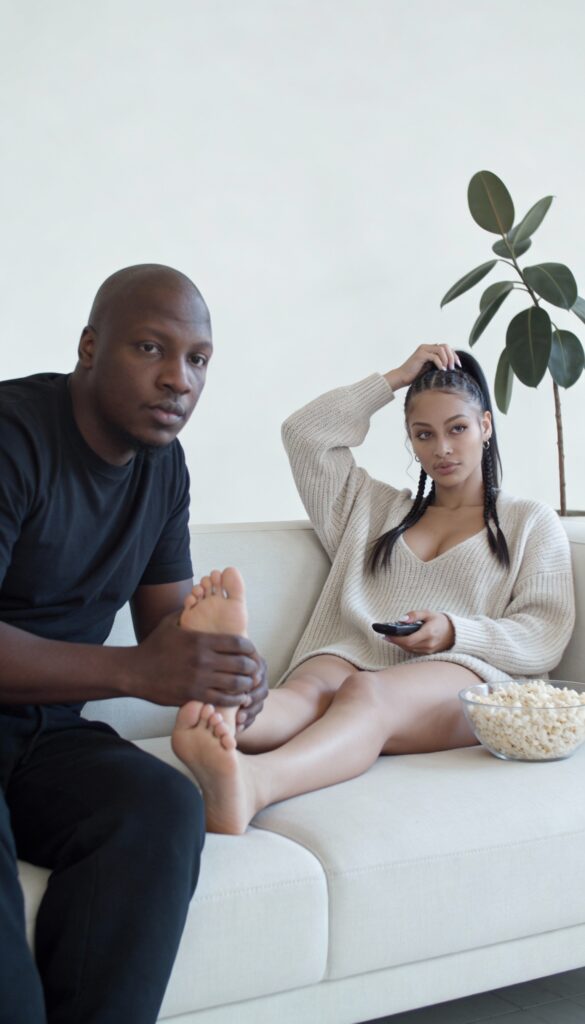
“You met someone,” Asantewaa said finally, voice calm but sharp.
Draven’s gaze flicked to her. “You always know.”
Asantewaa nodded once. “You carry new variables on your face.”
Draven let out a slow breath. “Her name’s Ever. She helped.”
Asantewaa studied him, and the love in her eyes didn’t vanish. It just adjusted, recalculated. “Is she a risk?”
Draven thought of Ever’s threads stitching fracture-lines shut, of her fearless stance, of the way she looked at him like she saw more than the job. “She’s… capable,” he said carefully.
Asantewaa’s mouth tightened. “That’s not what I asked.”
Draven didn’t dodge. “She’s a risk,” he admitted. “Everything is.”
Asantewaa looked down at her mug, then back up, and her voice softened in a way that always hit him hardest. “Just don’t forget what you’re building,” she said. “Don’t let the job swallow the parts of you that your daughters need.”
Draven stepped closer, and the space between them felt charged—history, intimacy, the kind of connection that doesn’t end just because people stopped dating. He lifted a hand and touched her cheek lightly, like he was reminding himself she was real.
“I don’t forget,” he said.
Asantewaa’s eyes glistened, and she leaned into his touch for half a heartbeat before she caught herself. “You better not,” she whispered.
Outside, the night remained Baltimore’s night even though they weren’t in Baltimore—the same vast dark, the same indifferent sky. Somewhere far away, something titan-class was moving through the Midwest like a new chapter preparing to break the spine of the world. Somewhere else, distortions were learning how to travel, how to leave the city they were born in and infect other places with their impossible hunger.
But inside this house, for this render, Draven Endwriting was not just a supernatural deerstalker. He was a father. He was a co-parent. He was a man holding the line between the unthinkable and the people who deserved to stay innocent a little longer.
And even as the walls of possibility trembled somewhere beyond the window, he stayed.