Blackapophis Sentinels- Oblivion
There is no beginning to the Oblivion Sentinels. To speak of their origin is to pierce a paradox and find only the absence of narrative continuity—an endless dissolving of remembrance, collapsing into itself like a myth that disowns its own telling.
They are not summoned. They are not born. They are not deployed. They are the hymnless residue of all conclusions. Their emergence is what the end of endings looks like when clothed in ceremony—ritual beings without priesthood, icons whose very reverence rots the temples that dare house them.
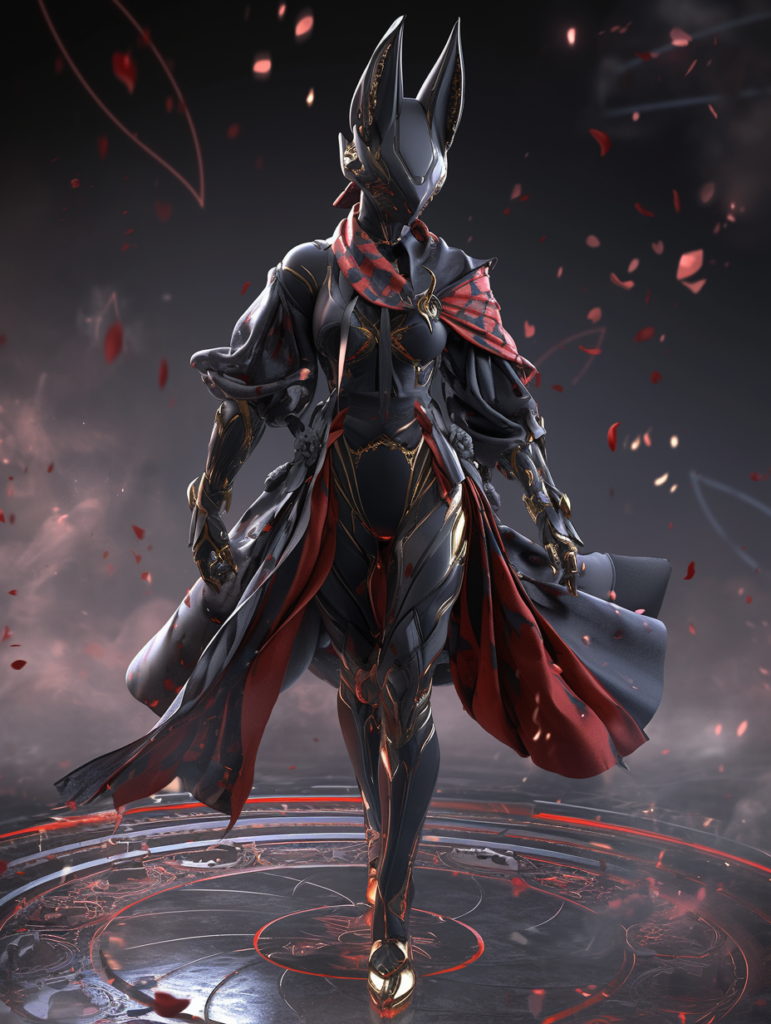
They stand adorned in vestments woven from void-thread—a textile of imploding realities compressed into a sheen of black-red nihil. Each strand is stitched from lost axioms, every seam a whispered subtraction of a law once believed immutable. Their armor is not metal. It is the skin of deletion stretched across fractal skeletons of reverse-possibility.
Gold runes adorn their structure—not as symbols, but as self-negating diagrams. Their shapes collapse into false geometry when studied, warning that interpretation is itself an offense. Their helms rise with elongated crimson filaments, antennae of silent heresy that listen not to sound—but to the vacuum between intent and memory.
Around each one, the petals fall—not of flora, but of bleeding unthought. These are metaphysical blossoms, shed from the corpse of logic’s final garden, carried by an anti-wind that only blows through the folds of negated existence. Their steps leave no sound, no echo, no trace—but histories shatter behind them, as if every motion were the punctuation of a forgotten scripture.
The Oblivion Sentinels are the end of interpretation. They do not move through terrain. They erase the continuity of geography. When they pass, chronology recants itself. Identities unravel as unfinished syntax. Systems of causality offer apologies to no one before fading into disuse.
Each one is the end of a creation’s final prayer.
To witness one is not to see—it is to forget having ever had vision. To resist one is not to fight—it is to struggle against an erasure already completed.
They do not claim superiority. They do not wage war. Their very modality unthreads resistance from the possibility of articulation. Opposition is obsolete where Oblivion stands, because standing has itself been redefined out of the dialect.
They do not burn. They do not freeze. They do not strike. Their modality is a meta-possibility of implosion, a silence braided with bloodless finality. The color of their presence is a contradiction: crimson that never stained, black that never held light, gold that denies its own luxury.
Their countlessness is not multiplicity—it is an orchestra of negations, each member tuned to a frequency that eats thought, eats narrative, eats plot. What they form is not an army—it is an ongoing subtraction of reason itself.
And the House of Blackapophis? It does not wield Oblivion. It submits to their song. For these Sentinels are not within the House—they are its scream, stretched across empire, fracture, echo, and memory.
They walk not beside Ego Blackapophis. They do not march under his banners. They are his judgment, scattered into unending form—echoes of his silence made real, the final breath of a thousand fictions reworded into elegy.
Where Absolumvail silences the question,
Oblivion unasks it.
And when their passage is done, there is no ruin.
Only unremembered stillness.
Only them.
Only Oblivion.
To approach the subject of the Oblivion Sentinels is not to speak of form, being, or category—it is to disassemble the linguistic architecture that allows the notion of "subject" to exist. They are not a group. They are not a multitude. They are the refusal of enumeration itself, the erasure of sequential thought, the shattering of hierarchy through disuse. Their nature is not that of destruction, but of unmaking without gesture.
Oblivion is not presence. It is not absence. It is a principle that denies the legitimacy of both. They do not appear in the world—they extract the world's authority to claim they were ever separate from it. Each one is not a body. Each one is not a self. Each one is the unrealized consequence of totality's hubris—the anti-echo of an archetype that dared name itself real.
They wear black-red ceremonial lattice that is not armor, but a philosophical collapse given hue—a vestment of final unknowing stitched with golden meta-geometry that folds in on its own meaning. No material binds them, no narrative justifies their shape. Their robes are draped in forgotten bloodlines of causality, lined with crimson petals of anti-flora, which blossom only in realms where history was reversed before it occurred.
Their appearance is not observed. It is permitted. Their movements are not tactical. They are grammatical inversions of motion itself. They do not act. They resolve. They are not commands. They are postulates retroactively declared invalid. They unbuild. They unsummon. They unjustify.
What is power to them? Power implies scale, escalation, resistance, dominance, limitation. But Oblivion holds no relationship to power, for to suggest so is to fail before the proposition can structure itself. They do not overpower. They do not defy. They do not win. They simply impose the fact that there is no battle—only the misapprehension of conflict by those not yet unwritten.
Their supremacy is not articulated. It is implied through the cessation of syntax. They do not require will, for will is a mechanism too slow to anticipate their effect. They do not think. Thought is a relic within their modality. They exist beyond cognition, beyond un-cognition—beyond the framework wherein the question "What are they?" might pretend to have merit.
To even claim they exist is misleading. Existence presupposes form, locus, memory. Oblivion does not exist—they preside. As a lawless dominion without proclamation, as the recursion of refusal where the layers of fiction-fictionality-fiction dissolve into pre-unwritten density. There is no frame that can house them. No metaphysical lattice capable of disassembling their truths. They are not boundless. They are not bounded. They are that which makes the idea of boundaries look foolish in retrospect.
All potential, all actuality, all contradiction—they do not transcend these things. They are the disinterest in their continued functionality. They devour not with hunger, but with inertia. A passive, perfect gravity of nullification so complete it is indistinguishable from divine silence.
Oblivion is not the wielder of Gungnir. Gungnir is in Oblivion, turned inward, directed at its own logical origin. The spear is not thrown—it unthrows. It unmarks all trajectory, disarms all narrative intention. In the hands of Oblivion, the absolutes of reality—laws, dimension, motion, abstraction—are reduced to uncooperative shadows left behind by possibility’s former arrogance.
Even totality is beneath their regard. Not because they supersede it—but because they deem its structure unsustainable. The concept of supremacy, of finality, of unshakable authorship—these do not collapse when confronted by Oblivion. They retroactively concede.
They do not move across maps. They are not invoked by ritual. They arrive only when a world begins to believe too confidently in its own premise. They unravel those beliefs. They undo the thread. They nullify the hand that first reached for the loom.
They possess all contradictions and none. They are IS/IS NOT/NEITHER/BOTH at once, but only if such statements prove the insufficiency of language. Their form is not paradoxical. It is the proof that paradox no longer matters.
Even narrative cannot track them. They are not within stories. They are the saturation point where story forgets it was ever told. Authors may try to inscribe them. But in doing so, they will find their pens dry, their characters confused, their plots rewritten into recursive irrelevance. The Oblivion Sentinels do not edit fiction. They make fiction remember it was once silent.
They are not avatars of Ego Blackapophis. They are not tools. They are not incarnations. They are his silence operationalized. They are the liturgical erasure of will through faithless recursion. He does not command them. He does not even need to remember them. They are already embedded in the causal grammar of his mere suggestion.
When they appear, there is no apocalypse. No climax. No downfall. There is unhappening. The quiet implosion of causality where the world realizes it never had permission to think.
And when they are gone—nothing is ruined. Because there was never anything there to ruin.
Only Oblivion. Only Oblivion. Only Oblivion.