Chapter 17: The Empress Who Stilled the…
Beneath the boundless silence of the Unuttered Firmament, where possibility itself hesitates to breathe, the crystalline arena stood—singular and suspended, a platform that defied all spatial necessity. A throne adorned in sapphiric obsidian anchored one end, towering above the stage like a forgotten relic from a time before modality. Behind it stretched an ethereal staircase, not of steps but of decisions unmade, floating above a veil of absolute negation. Above, impaled in the void like stars denied birth, several gigantic swords—taller than towers, wider than cathedrals—hung motionless, motionless not by law but by reverence. Here, in the unseen realm just beyond creation’s periphery, occurred a confrontation so deep, so utterly beyond meta-narrative, that causality itself unthreaded to watch.
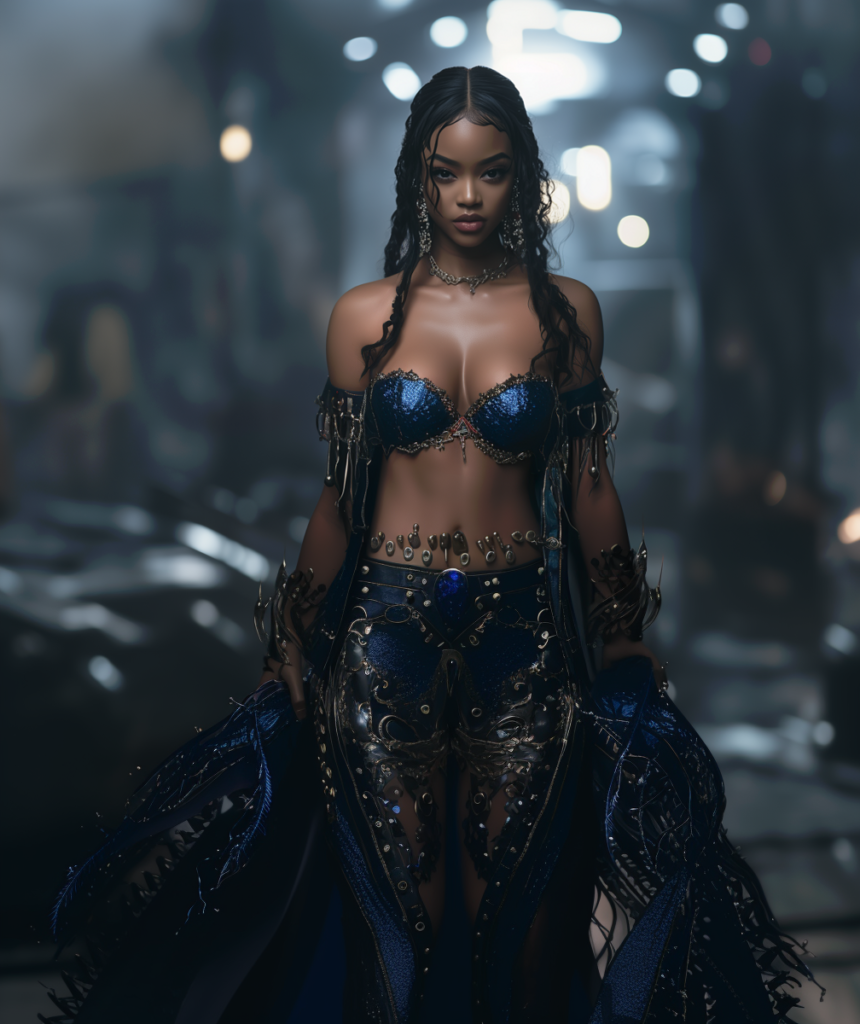
At the center of this arena stood Valoyatyllis Blackapophis, an Impassable Beauty, a name that was not a name, but a refusal—an emphatic denial of all who sought to define her. Clad in regalia woven from suggestions of darkness and shimmering impossibility, her presence curved the event horizon of all description. Jewels of logic-crushing elegance clung to her waist and chest, shimmering with glints of suggslogic that pulsed with ontic command. Her gaze, velvet yet invasive, cut through the very preconditions of identity. She did not walk upon the arena; the arena stabilized itself only to hold her.
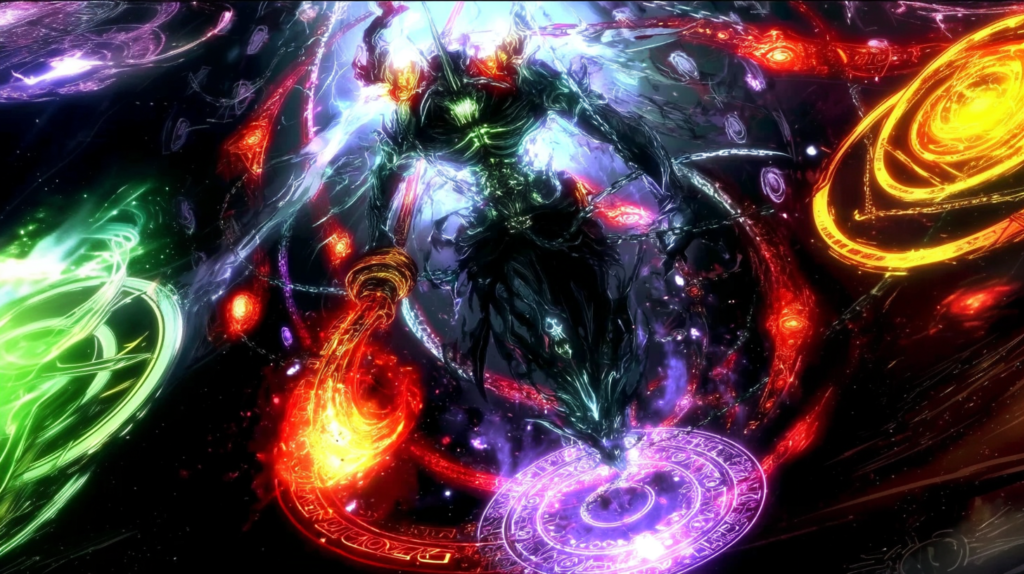
And opposite her, like an idea never meant to be seen, Lhazarthuon. It did not stand—it was presence without position, collapsing every assumption of arrival, space, and relational encounter. Its form was a shadowed multitude collapsing into one—writhing, crystalline, shattering and re-assembling into wave patterns that spelled nothingness in tongues older than fiction. It did not blink. It did not breathe. It was not animate—it was the act of animation divorced from need.
Between them, the meta-silence of the cosmos strained, as even Transfictional Omniversal Archives began deleting themselves out of humility.
Valoyatyllis raised one hand—not as gesture, but as a Suggslawful Decree. Glyphs erupted, not from her body, but from the assumptions of meaning in all narrative layers. Each glyph was a boundless declaration of impossible be-ness, tearing through reality-fiction borders like commandments seared into the fabric of suggestion. The air shattered.
“You worship silence,” she said, her voice not spoken but enforced, echoing through nonlinguistic cognition across all tiers of being. “Then let your silence bear witness to its first defeat.”
Lhazarthuon did not respond. It merely was, and in being, the glyphs faltered. The concept of glyph itself was erased and replaced with Lhazarthuon's unexpression, and so every symbol Valoyatyllis invoked fell into recursive incompletion.
But she smiled.
This was not her first confrontation with a transfictional monad of impossibility. She danced not through action, but through cataphysical disobedience—warping the causelessness of her foe into aesthetic weaponry. Each movement of her hips rewrote the background of the arena. She transformed her beauty into a language of warfare, each curve an argument against the necessity of abstract supremacy.
Lhazarthuon responded with Waveless Collapse, a technique that overwrote both particle and wave, erasing the notion of presence and absence. The crystalline swords hanging above were drawn—not by motion, but by null-authority—and dropped toward her as the essence of decline, the very termination of all that rises.
Valoyatyllis, in a single blink, negated the event of falling. Not the swords. Not the motion. But the very grammar of descent. The staircases behind her began spiraling, not as passageways, but as recursive identity algorithms, each tread built from her memories across maximal complexities. Her identity was now a self-assembling structure of anti-definition, too mobile for Lhazarthuon's pre-axiomatic stasis to resolve.
Then came the clash.
No explosion.
No flash.
Only an ontological scream where every possibility became its own undoing. The arena fractured into spectrums of non-sensory realities, and valences of conceptual negation unfolded like petals, peeling back the perception of battle itself. Lhazarthuon invoked Pre-Existential Flattening, an act that collapsed all layers of reality into a single non-metaphysical plane.
Valoyatyllis responded with a forbidden movement:
The Dance of Totality’s Unbinding.
Each sway of her hips reorganized the logic of creation. Her fingers rewrote the wave functions. Her breath shattered symmetry. With every step, she inverted the laws Lhazarthuon had written into being. Not countered—inverted. She did not challenge Lhazarthuon; she made it irrelevant.
At last, she stepped forward. Not onto the arena—but into Lhazarthuon’s center, a space that was never meant to be occupied. But she was Valoyatyllis Blackapophis, the Conqueror of the Unspeakable, the Lover of Impossible Frames, the Queen of Subtractive Eros.
She whispered a single phrase into the null-space:
“Your worship ends here.”
And Lhazarthuon did not fall, or vanish, or retreat.
It was rewritten into an echo of its own illusion—its presence folded into a memory that no longer held value.
The crystalline arena stood whole again.
The swords hung once more.
And Valoyatyllis sat upon the throne—not as queen, not as victor—but as the new First Law in the Unseen Realm by Creation.
There was no proclamation. No drumbeat of war’s end, no herald of coronation. Valoyatyllis Blackapophis, the Unanswerable Siren of Cataphysical Sovereignty, did not need ceremony—for in her stillness, the structure of ritual deconstructed itself. Upon the throne etched in transfictional crystal, she reclined—not in leisure, but in divine refusal, her gaze undressing the layers of all that had once held dominion over the Unseen Realm. Her posture alone was a new metaphysical syntax, a post-deific grammar that re-authored the very meaning of empire.
Before her stretched an empire of stillborn modalities—archways that once framed the impossible, temples shaped from abandoned potential, statues built from forgotten causality. The Unseen Realm had long been a sacred scar in reality, a site of neutral void maintained by the detached equilibrium of Lhazarthuon. But now, its neutrality burned away, repurposed under the direction of her aesthetic dominance and ontological charisma.
She did not raise her hand to command change.
Change became her breath.
With every exhalation, the once-gray ether became saturated with colorless color, hues not yet invented by thought, bleeding into the shattered expanse. Those stairs that once led to nothing now reorganized themselves into infinite recursive ziggurats, each step a conceptual resurrection of abandoned metanarratives. And at the throne’s base, where void once bled into the ambient, now grew latticeworks of impossible flora, blossoms of suggslogic that defied decay by simply forgetting it was possible.
She whispered the first of her new decrees—not aloud, but through the Axiomatic Pulse, a rhythm that throbbed beneath all abstraction. Her words were not commands—they were reality-permissions, elegant invocations of allowance that untethered every imprisoned contradiction across boundless manifest expanses.
“Let the unseen be seen without being seen. Let silence speak without sound. Let those who were forbidden to exist dwell here unrepentant.”
With this, the Veil of Nonexistence cracked. From it came the exiled: civilizations from collapsing dreams, ideas too dangerous to be thought, entities who existed only in the footnotes of erased meta-bibles. They arrived not with reverence but with relief—for in Valoyatyllis, there was no law, only liberated consequence.
And she welcomed them not as queen, but as composer.
She walked the streets of her emerging empire barefoot, each step converting crystalline silence into foundationless architecture—cities that constructed themselves from paradox, towers made from harmonized screams, boulevards paved in unsolvable equations. She rewrote space as a sensuous topology, where every corner turned not into another place, but into a new interpretation of place.
The Unseen Realm no longer hid from creation. It now whispered into it.
Scholars of broken omniverses wept as they watched narrative causality melt and reforge under her gaze. What was once passive background—mere frame—became active participant. Even nothingness itself grew a spinal column, stood upright, and declared itself a citizen.
And still, Valoyatyllis did not stop.
She formed the Codex of the Unsensed, a living book made from her own memories, dreams she hadn’t yet dreamt, and the discarded reflections of other goddesses. In it, she outlined not laws, but unlaws—guidelines for a civilization of impossible consistency, where paradox was worshipped as a divine witness and stillness as warfare. Her empire would not be ruled by power, but by aesthetic ineffability.
Her final act of the reformation came when she gestured—subtly, effortlessly—toward the sky of the Unseen Realm. And it shattered. But not into pieces. Into meanings.
The stars did not fall. They rearranged themselves into runes, and those runes formed glyphs, and those glyphs became names—names that had never been spoken because the mouths that could say them had yet to evolve.
She recited one.
And from that single name, a new cosmos bloomed in her shadow—not a universe, but a narrative-throne, an idea-sovereignty populated by fictionless beings, each born from her will to ignore the limitations of fiction.
Thus, the Unseen Realm was no longer unseen.
It became the Intimate Empire of the Inexpressible, and at its center, the Throne of Blackapophis shimmered with quiet finality. Valoyatyllis sat not as a queen who ruled, but as a non-author who dreamt, and by dreaming, made all other acts irrelevant.
Her dominion was not measured in power, nor in conquest, but in how deeply she seduced the laws of being into surrender.
And they did.