Chapter 18: The Solipsiarchal Monad


Aestrithyx Blackapophis stood in a corridor that did not belong to any known structure—an unclassified interval of reality shaped only by will and metanarrative conflict. The crystalline lines of null-geometry illuminated the edges of existence with faint pink, a glow rivaled only by the commanding brilliance of her presence. Draped in a translucent floral kimono laced with stardust, she stood wrapped in an aura of unapproachable elegance. Her lace bodice shimmered with fractal light while her shorts bore shifting glyphs from impossible alphabets, updating constantly to reflect the active logic of the confrontation to come. Her eyes, glowing softly with violet certainty, locked onto the collapsing core of Æxilythron—the Solipsiarchal Monad—who waited across the threshold.
Aestrithyx's beauty was not superficial. It was a manifestation of authority, of transfictional will given structure. Every thread of her attire was a declaration of dominion over narrative expectation. She was Ego Blackapophis’s wife, and her presence signaled more than elegance—it signaled enforcement.
Behind her stood her son, Yxaen’zhul Blackapophis. He clutched an axioglyphic orb pulsing with a boundless, recursive framework—his very inheritance from Ego made manifest. His suit shimmered under the cold hum of causal distortion, and his eyes betrayed a perfect synthesis of curiosity and certainty. In his hands, the mechanisms of dominion and meta-creation lay dormant, waiting. But it was not yet his role to act. It was to understand.
“Yxaen’zhul,” Aestrithyx said without turning, her voice cutting through paradox noise and plot-friction with absolute clarity, “This battle is not just against a defector of structure. It is a confrontation against the belief that anything stands apart from your father’s absolute wholeness. Æxilythron denies Totality not because he is above it, but because he believes the story ends where he wills it. But your father writes the story itself—and I will show you why that matters.”
Æxilythron remained motionless, not due to inaction but because action itself was beneath its nature. It did not move toward battle. It existed as a negation of movement and the assertion of paradoxical finality. Its body was a shell of black refracted emerald, contorted in shapes that could not be named. Its suggslogic spiraled into the background of reality-fiction with such pressure that causality simply refused to process within its vicinity.
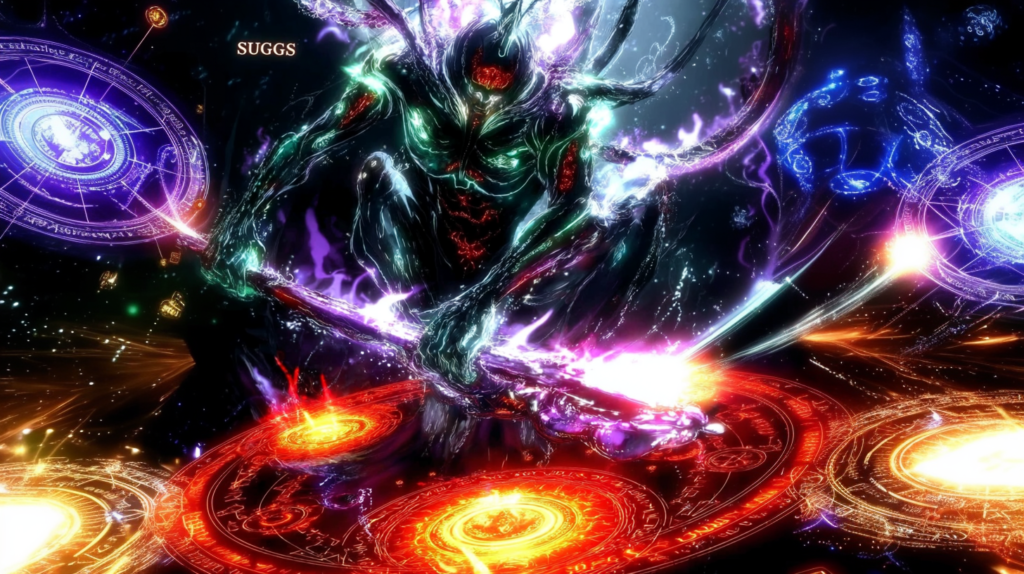
It spoke without speaking: “I do not resist. I am what resists being overwritten. I am the boundary between closed narrative and chaotic silence. There is no battle. There is only your irrelevance collapsing into me.”
Aestrithyx raised her left arm, her fingers tracing a command glyph mid-air, splitting the veil of pre-plot. "Then you’ve mistaken your silence for sovereignty," she replied. “Let me correct you.”
With that, the battle began—not in explosions or movement, but in the unraveling of frameworks. Æxilythron’s presence dissolved any logical environment around him, erasing consistency, rewriting the battlefield into null syntax. The space between them refused to obey any framework. Even possibility collapsed. But Aestrithyx’s suggslogic didn’t need agreement—it imposed.
Each motion she made pulled entire conceptual scaffolds into play. Her arm sliced open the meta-possibility of resistance, converting irreversibility into reversibility, then into suggestion. Æxilythron retaliated by nullifying the narrative thread of opposition itself, causing her previous moment of action to never have occurred—but she returned the favor by rewriting cause-effect perception within Æxilythron's zone, redefining "occurrence" as an arbitrary category she could enable or disable at will.
She advanced—not in space, but through conceptual pressure. She used constructs composed of abstract absolute qualities, wrapped in binding logic stripped of any dualities. Her strikes were declarations of contradiction-resolution, each one undoing one of Æxilythron’s autonomous logical layers.
But Æxilythron was more than defense. It struck back by dissolving the very idea of “Aestrithyx” from the battlefield. She felt her identity, her purpose, the idea of being a combatant—erased as a function. But her suggslogic refused to run through identification or motive. It ran through alignment with Ego Blackapophis’s design. As long as he existed, her presence could not be suspended.
With a raised hand, she fractured the entire meta-tier Æxilythron used to shelter itself from duality. “This isn’t about whether you’re beyond or not,” she said. “It’s that you think you’re exempt from consequence. And consequence, even when abstract, is part of our house.”
Æxilythron split, not physically but meta-structurally. The idea of it being singular lost coherence. Its claim over paradox collapsed inward, destabilized by Aestrithyx’s forced resolution framework. Where contradiction once shielded it, a narrative expectation took form. And once expectation existed—it could be defined. And once defined, it could be overcome.
Aestrithyx compressed every aspect of herself—presence, suggslogic, purpose, modality—into a single point of collapse-resolution. She directed this final compression into Æxilythron’s central field. Not to destroy it, but to overwrite its premise: that stories could exist without being written by will.
Æxilythron’s wholeness fractured, dissolved into silent flickers of rejected logic, expelled from the battlefield by the very narrative constraints it sought to ignore.
Yxaen’zhul, who had watched every second in silent awe, stepped forward. “So it’s not about winning,” he said slowly, grasping the point. “It’s about making sure the narrative stays grounded in the will of our house.”
Aestrithyx turned to him, her expression warm despite the battlefield's remaining distortion. “Exactly. Æxilythron believed being beyond everything meant he could act alone. But Ego doesn’t exist beyond everything—he is everything. What you just saw… is how we deal with those who forget that.”
She reached down, adjusting the axioglyphic device in his hand.
“Now watch carefully, Yxaen’zhul,” she said. “Because your time to lead is coming. And they’ll challenge your claim too.”