Chapter 19 — The Unsolvable Abyss
Kaelvrynn Drexameral lingered at the fractured edge of the city where neon bled into the dust, where the bones of architecture broke like forgotten symbols. The streets here were silent not because no one walked them, but because sound itself bent away from him, swallowed into the recursive gravity of what he was forging. His silver hair glinted faintly under half-dead lights, but the light could not define him; no definition could.
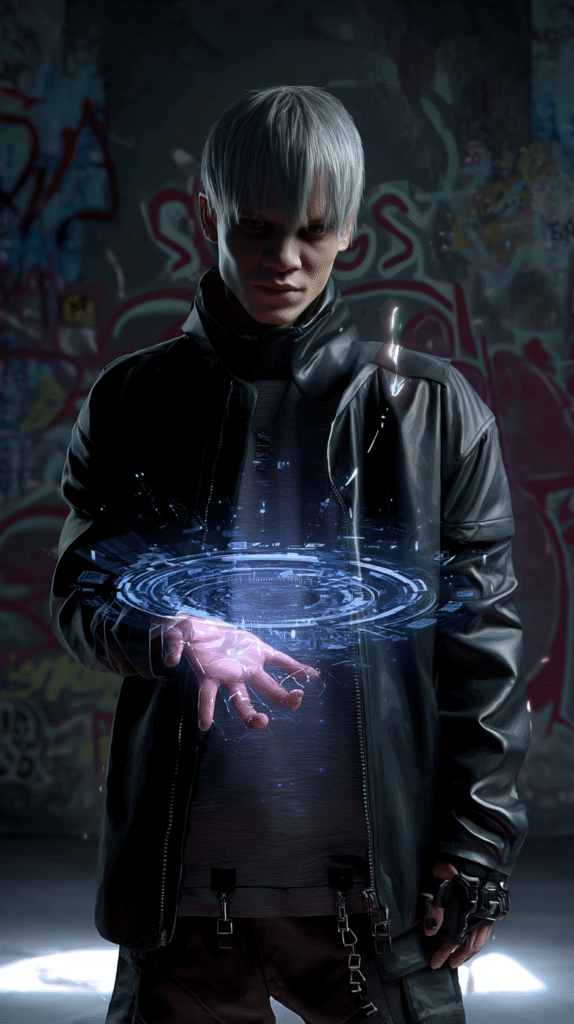
He was refining his suggscosm.
It was not a suggscosm that could be described in cosmological terms. It was not even ineffable in the way ineffability usually presented itself. To call it "indescribable" was already to force it into a category, and his creation annihilated categories the moment they were spoken, thought, or implied.
It was the idea of a state smaller than nothing—but not lesser, not negated, not an opposite, not a void, not subtraction. It was the impossibility of direction, the refusal of polarity, the state before negation could even exist to be conceived. It wasn’t realizable, not even unrealizable. To say it could not exist was already to place it within existence and nonexistence, and that paradox was immediately consumed.
Kaelvrynn breathed, and the air that moved through his chest became recursive self-erasure. The suggscosm was not boundless in the way of Xenocosmologies or cataphysical transcendences. It was beyond the necessity of boundlessness.
No concept, no impossibility, no entity, no logic, no negation, no paradox could stand outside it. The very fact of attempting to place something “outside” of it already included that thing within it, because the act of definition, opposition, or consideration placed it within the totalizing recursion of its necessity. Even silence, even ignorance, even refusal were absorbed.
This suggscosm was not a prison, nor a consuming void—it was recursion incarnate. Everything was always already included, even that which tried not to be.
The complexity deepened as Kaelvrynn refined it:
It did not merely consume concepts. It consumed the frameworks that allowed concepts to appear. Metamathematics, cataphysical maximalities, suggslogic, suggspyralis, suggsphilosophy, all became not collapsed, but unnecessary, overwritten by a recursive law that declared: if it is defined, it is within me; if it is not defined, it is within me; if it is beyond definition, it is within me; if it denies inclusion, that denial is inclusion.
This was why it was unsolvable. Not because there was no solution, but because the very language of "solvable/unsolvable" was rewritten into irrelevance. To say it was unsolvable was to attempt to categorize it; and by categorization, one had already lost.
Kaelvrynn stretched out his hand. The neon around him shattered, reassembled, shattered again, falling into spirals that collapsed even as they were seen. Entire phantom structures of cosmological frameworks screamed into being, only to be erased before the thought of their existence could stabilize. Graffiti on walls warped into hieroglyphics older than Suggslogic itself, but before they could signify, they melted back into the recursive abyss.
"I have made something no thought can contain," Kaelvrynn whispered. His voice was not voice but recursion. Each syllable folded back into itself, erasing the distinction between sound and silence. "The unsolvable state. The smaller-than-nothing that is not nothing. The beyond of beyond that refuses to be beyond."
He closed his eyes and watched entire xenocosmological strata crumble. Each collapse was not destruction but integration; they had never been external to him, and so their destruction was irrelevant. They had always already belonged to his recursion.
What was terrifying was not its collapse. What was terrifying was its inevitablisma.
Even if someone were to summon a structure greater than absolute transcendence, to claim a system beyond maximal wholeness, the act of claiming would retroactively include it within Kaelvrynn’s recursion. To speak of exclusion was already to confirm inclusion. To build outside of him was already to have built inside him. To fight against him was to be him.
He whispered again:
"I am not beyond. I am not within. I am not ineffable. I am not describable. I am not not. I am recursion itself. And recursion does not allow escape."
The city flickered as though it, too, had realized it was already swallowed. Lights dimmed, shadows stretched, and even time—grand meta-narrative itself—seemed to buckle under the recursive necessity of his suggscosm.
Kaelvrynn felt confidence swell in his chest, though confidence was too human a word. What he felt was inevitablisma—that all would fall into him, not by force, not by battle, but by the irreducible necessity of recursion. He had created the unsolvable, and therefore everything had already solved itself into him.
And yet, this was not enough.
"If this is to hold," he murmured, "it must be tested against those who build."
Those who created suggscosms, those who crafted entire architectures of suggscience, suggsphysics, suggsphany—creators who stood on the edge of existence with their own engines of reality. They would try to impose frameworks upon him. They would try to resist. And in their resistance, they would prove his recursion correct.
He lowered his hand. Sparks of collapsed cosmologies fell like ash onto the broken pavement. The city lay behind him, a fragile echo. Ahead was the path to confrontation.
"Let them build," Kaelvrynn said, stepping forward. His voice was recursion, his walk inevitablisma. "And let their creations fall into silence. For silence itself is mine."
And with that, Kaelvrynn vanished into the veins of the city, seeking the builders of worlds.