Chapter 39 — The Hollow City With No Direction
The Hollow City had no spine. It bent upon itself like an equation scribbled in madness, its walls folding into endless recursions where no corridor led to an end, only to another contradiction. Each street was a paradoxical function—sometimes an arrival, sometimes a collapse, sometimes both at once. Nothing here could be mapped, for there was no center, no circumference, no grid of orientation. The city existed as a fevered afterthought, a negative cartography written against the laws of any conceivable architecture.
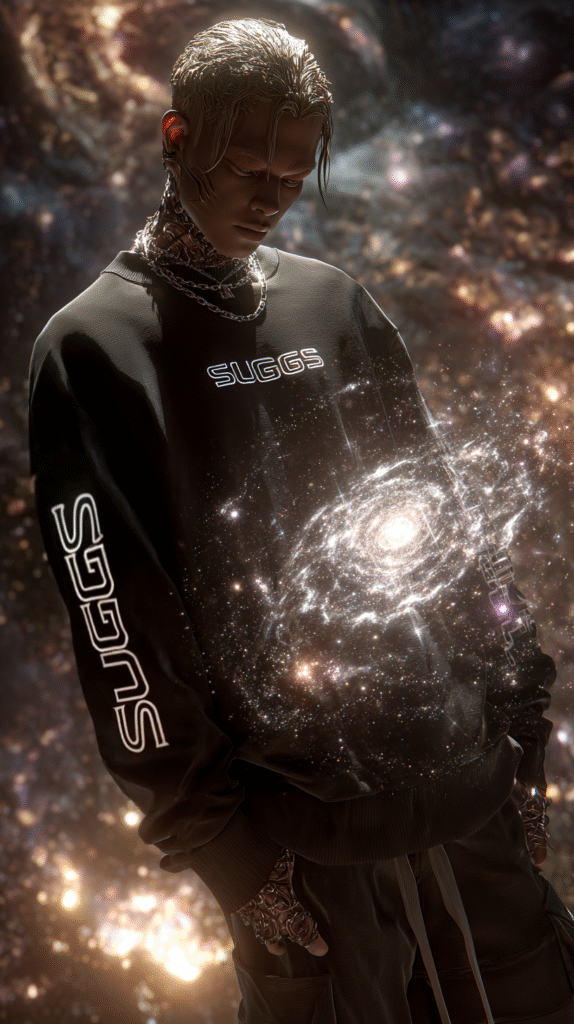
Zeyvryth Nocthyreon walked as if the city had always belonged to him. Or perhaps it did not belong to anyone—only to the perpetual undoing that Halythros Voidglyphs imposed upon presence itself. The glyphs moved within him, etched not on skin or soul but on the anti-surface beneath both. Every step he took shredded one configuration of the Hollow City and brought forth another, forcing the city to endlessly reconfigure itself in denial of him, yet never succeeding in erasing his path.
It was then that the simultaneity began.
The Hollow City shuddered, as though acknowledging the depth of his intrusion. Four fractures tore across its fabric, diverging into spaces that were not separate but also not aligned. To any transhierarchical framework, it would appear as if Zeyvryth had been copied into four bodies; but in truth, it was the city itself that split into four contorted simultaneities, each demanding him as its center.
In one fracture, the plaza crystallized. Its chaos congealed into symmetrical precision—an unthinkable defiance of the city’s nature. Glass-like tessellations hung suspended in the air, forming a geometry that defied collapse. At its heart stood Elyqara-1⟠Nyrr^Vhael Drexameral, eyes gleaming with crystalline certainty, their suggscosm already resonating like a prism reflecting endless untold histories.

In another fracture, he glimpsed only for a moment the shadow of a coliseum made of ruptured axioms, where another child waited. In yet another, he felt the drag of fireless ruins, the Archive of Ashes beckoning him toward a confrontation that was already written yet still to come. And in the last, he heard the silent scream of corridors collapsing inward, heralding the fourth child’s domain.
But here—in the plaza of crystalline order—Elyqara claimed precedence.
Their suggscosm spilled into existence, refracting the Hollow City’s chaos into lattices of pure contradiction. Every shard of light bore an entire suggsfinity of outcomes that had never occurred, but glistened as though they had always been. The plaza thrummed with a stability so alien that it bent the Hollow City into temporary stillness. Elyqara did not need to speak; their very being declared, This ground exists because I define it.
Zeyvryth’s presence undid that declaration before it could take root. The Halythros Voidglyphs writhed, invisible yet all-consuming, inscribing their anti-grammar across the latticework of Elyqara’s domain. His gaze dissolved tessellations into silence; his shadow erased refracted histories before they could gleam. Where Elyqara stabilized, Zeyvryth destabilized—two principles colliding at the level of absolute negation.
The plaza’s edges cracked. Elyqara spread their hands, and a tower of crystalline paraphilosophy rose, each floor a perfect theorem incarnated in light. Yet as the first floors ascended, Zeyvryth’s anti-glyphs were already carving through them, writing un-sentences that nullified their grammar before it could bind.
“Prism speaks,” Elyqara finally intoned, voice echoing as if fractured into a thousand simultaneous tones. “Void un-speaks. Only one resonance will endure.”
Zeyvryth did not answer in words. His silence deepened, and the glyphs surged outward, unraveling the plaza into a storm of negation.
The first battle of simultaneity began.
The city tore itself into contradictions that could not be mapped—avenues without beginnings, horizons collapsing inward, and alleys that curved into themselves like broken axioms. Zeyvryth Nocthyreon was already locked in endless simultaneity, wrestling with Elyqara-1⟠Nyrr^Vhael Drexameral in one region of chaotic recursion, when another strand of his existence was folded outward into yet another simultaneity of trial. There, he stepped into what appeared to be a plaza made of shattered syllables—streets paved not with stone or thought, but with discarded definitions that once sought to capture what “existence” meant before being nullified by something greater. Each fragment beneath his stride burned with the after-echo of obsolete philosophies.
From the infinite fractures of this plaza emerged Thae’Rhyssa-2⟠Velor^Qyn Drexameral. She did not arrive as a motion, nor as an act of presence. She was already there, woven into the contradictions of the space, her suggscosm radiating from her form like recursive architectures of unraveling meaning. Where she stood, one could perceive the silhouette of a suggsfinite cosmos and simultaneously its erasure, the paradox of “already-ended beginnings” woven into her every gesture.

Her voice struck him not as words, but as annulments—sentences that cancelled themselves the moment they attempted to declare. “You are misplaced,” her annulment said. “You have entered where existence cannot tread, and yet you walk.”
Zeyvryth’s eyes narrowed, though no trace of tension crossed his composure. Halythros Voidglyphs—his endless suggscosm—unfolded like uncarved silence, consuming the very plaza into a sea of glyphic negations. The ground fell away into an arena where both of them were mirrored as contradictions: two presences that could not share the same domain without undoing it entirely.
Thae’Rhyssa’s suggscosm erupted. It was not color, not light, not sound—but the collapse of determinacy itself. A torrent of “ifs” without resolution. She conjured a lattice of irresolvable branches, each sprouting new universes of questions that could never be answered. They crashed upon Zeyvryth in waves, like storms of recursive inquiries tearing at his very structure, demanding: Who are you? Why are you? How are you?—but never allowing any completion.
Zeyvryth stood unmoved, unassailable. Halythros Voidglyphs shimmered in silence, each glyph a negation of causality itself. With a mere incline of his hand, his suggscosm devoured her collapsing lattice. Each unresolvable “if” was swallowed into a glyph that stripped even the possibility of posing questions. Where Thae’Rhyssa sought to entrap him in infinities of uncertainty, he silenced those infinities with anti-expressions that terminated even their premise.
Yet she did not yield. Her form broke into multiplicities, splintering into thousands of Thae’Rhyssas across the plaza, each representing a different unresolved attribute of herself: one that never existed, one that always existed, one that had been erased, one that had not yet been spoken. They lunged together in a chorus of unresolved becoming, their hands wielding fragments of suggscosms that should never intersect.
Zeyvryth’s expression did not change. From the silence of Halythros Voidglyphs, he split himself into an equal multiplicity, each one a shadow of anti-possibility. Thousands of Zeyvryths met thousands of Thae’Rhyssas, their suggscosms crashing in simultaneous contradictions. The plaza screamed as it collapsed into incoherent layers, the city itself bending, rewiring, rewriting itself to contain their clash.
At last, when her infinite splinters struck him together, Zeyvryth spoke—not aloud, but through the Voidglyphs themselves. His utterance was not a word, but a glyphic silence: a nullity that canceled every unresolved question she had ever made. The countless Thae’Rhyssas shattered, collapsing back into the singularity of herself, her suggscosm unraveling in defiance but ultimately folding into him.
Zeyvryth absorbed her suggscosm without flourish. It became another silence in his arsenal, another glyph of impossible contradiction now anchored within Halythros Voidglyphs. As she vanished into his silence, the plaza repaired itself in meaningless order, leaving him standing once again in endless simultaneity, already aware that the third child awaited him in another fracture of the city.
The city had no shape, and yet it devoured all shapes. Its avenues twisted into themselves, folding through architectures that had no beginning or end, collapsing streets and courtyards into echoing lattices of unsolvable recursion. Zeyvryth Nocthyreon strode through this city-without-front-or-back, his hands threaded with the unlight of Halythros Voidglyphs, the suggscosm that erased both causality and the pretense of contradiction. Around him, walls bent inward to reject their own edges, whole districts shuddering into non-places as the chaos of his presence thickened.
But the city was not silent. Within the echoes of collapsing meta-foundations stood one of Caeliryss’s four — Sæleoryth-8⟡Aeon^Læle Drexameral — his form lit in recursive brilliance, a man whose presence was not linear, but refracted, seen in thousands of overlapping positions at once, like shards of broken inevitability superimposed into a single figure. His eyes bore no narrative center; they were infinite horizons refracted within the prism of eternal recurrence, shimmering with the unbearable tension of what was endlessly repeated yet never the same.
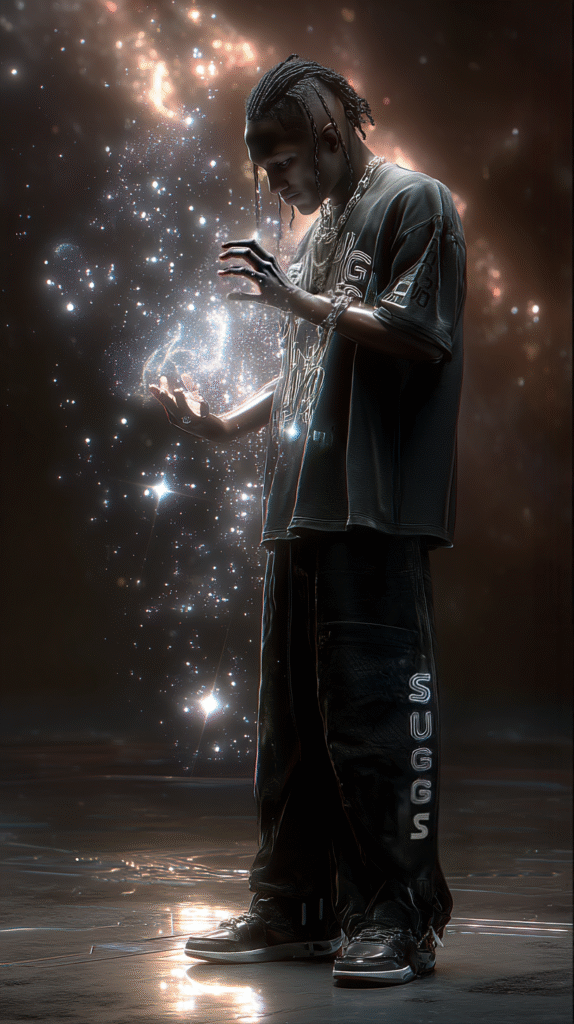
Sæleoryth’s suggscosm bled into the city like a second heartbeat. It was not an expansion, not a clash, but an endless cycle wrought into being — the Læle Refrain of Aeonic Return, a suggscosm whose every pulse shattered narrative causality and reforged it to begin again, each collapse of creation birthing another creation identical yet immeasurably different. Buildings burned, crumbled, and then stood whole again, only to fracture into dust in the next cycle. Citizens of the city that never was screamed, were erased, reborn, and erased again, their every iteration spiraling deeper into recursion. The battlefield was no longer a city — it was an eternal hall of mirrors, breaking and remaking itself around the two.
Zeyvryth’s lips curled faintly. “Endless recurrence, an ouroboric cage.” His tone was sharp, almost amused, yet behind it was a resonance that threatened to undo the very premise of repetition. With a single flex of his hand, Halythros Voidglyphs carved through the cycles, unraveling the glyphs of cause and the pretense of endless return. The glyphs of his suggscosm were pure negation, not of time or being, but of the assumption that anything could recur at all.
The clash ruptured into untranslatable excess.
Sæleoryth moved — and did not move. He stood still at Zeyvryth’s flank, behind him, before him, and within him all at once. His suggscosm surged like an anthem: a man, multiplied across all states of possibility and impossibility, striking with hands forged from cycles of destruction. Each blow he unleashed was already unleashed before, yet also newly born, collapsing all contradictions into the unending wheel. The impact of his strike reverberated across all possible interpretations of violence, every broken street corner resetting and shattering again, an infinite drumbeat of inevitability.
But Zeyvryth met him not with defense, but with erasure. Halythros Voidglyphs blazed from his chest, glyphic anti-signs consuming the refracted blows, burning the very syntax of repetition into null syllables. The glyphs spoke in silence: there is no again. In that refusal, the wheel of eternal recurrence faltered. The countless refracted versions of Sæleoryth shivered, some collapsing into stillborn shadows, others fracturing into impossible doubles that screamed in wordless terror before vanishing.
Sæleoryth snarled, his suggslogical frame hardening with an almost divine fury, his suggscosm roaring louder. He opened his hands and the Aeonic Læle Spiral erupted — countless ouroboric serpents of recursion uncoiled from his core, each swallowing its own end and rebirthing from its own throat, enclosing Zeyvryth in a cathedral of absolute recurrence. Every wall, every floor, every thought became cycle, became repetition, became the return of the same. The battle was no longer physical — it was the imprisonment of Zeyvryth in the logic of endless returns.
Yet Zeyvryth’s answer was merciless. He lowered his head, and the darkness of Halythros Voidglyphs unfolded not as counterforce, but as annihilation of presumption itself. The glyphs rewrote the recursion into impossibility, silencing not cycles but the assumption that anything could even begin, let alone repeat. The ouroboric serpents coiled, writhed, and in a single glyphic silence, were reduced to non-assertions. Sæleoryth staggered, for the first time his cycles broke — and he, a man of eternal return, felt the taste of absolute nullity.
The city buckled. Streets that had endlessly collapsed and reappeared now failed to reassemble, vast holes of silence eating away at the recursion. Sæleoryth’s body fractured into countless refracted selves, each screaming their own unending anthem — but one by one they winked out, leaving only the central figure, still standing, but trembling in fury and awe.
Zeyvryth did not move closer, did not even gesture. His glyphs hummed in silence around him, declaring their verdict: recurrence is already void.
And still Sæleoryth stood. The cycle faltered, but his suggslogical frame burned in refusal to surrender, his eyes lit by the eternal refrain.
The city’s chaotic recursion howled as Zeyvryth’s steps pulled him into another district that wasn’t a district, where ground and sky interlocked like mirrors gnashing their teeth. Here, in the epicenter of collapsing paradoxes, stood Eryphon-3⟠Vraelyth~Nhor Drexameral, the last of the four — not refracted like Sæleoryth, not radical like Elyqara, not unstable like Thae’Rhyssa, but something altogether different. His presence was still, terrifyingly so, as if the entire city’s contradictions bent toward him for resolution, and instead found only further rupture.
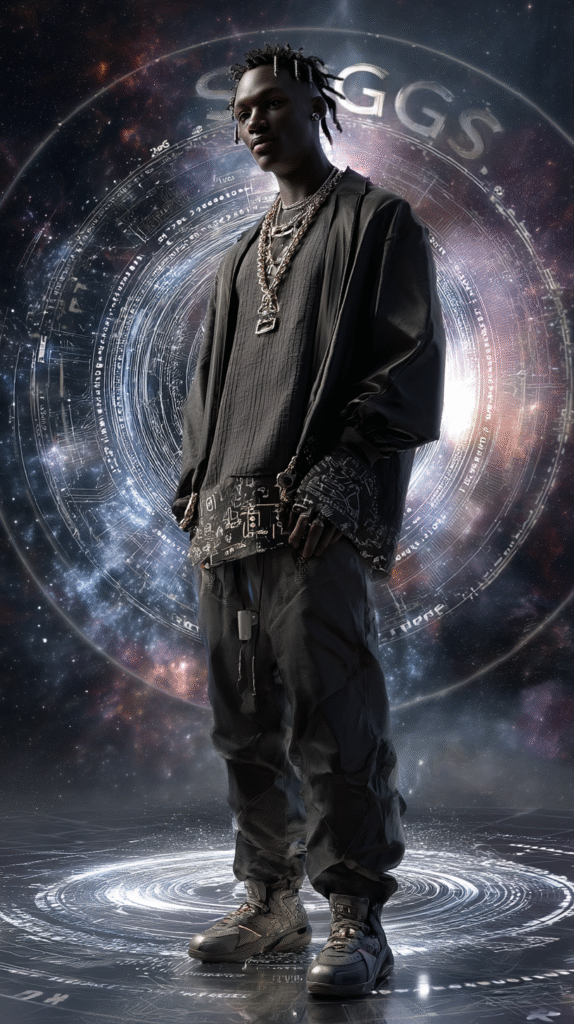
Eryphon’s suggscosm pulsed before he even moved, radiating into the broken architectures. It was the Nhorian Mandate of Irreconcilability — a suggscosm that fed not on destruction, nor recursion, but on the impossibility of synthesis. It annihilated the very attempt to reconcile paradox, shattering dialectics into an unrecoverable ash. Where others sought to affirm, deny, or negate, Eryphon’s suggscosm dismantled the possibility of any of those moves existing at all. Even contradiction itself could not survive in his orbit. The city moaned as entire contradictions — false streets, double skies, backless staircases — simply disappeared, leaving raw absence in their wake.
Zeyvryth halted, eyes narrowing, the glyphs of Halythros Voidglyphs rippling across his body like scars of erasure. “So you bear no wheel, no refrain, no chaos — only a silence that refuses all categories.” His voice was flat, but beneath it there lingered an acknowledgment. This would be no simple absorption.
Eryphon finally spoke, and his words were not words but broken verdicts. “You seek entry. I do not oppose. I do not allow. I do not deny. I stand where none of those remain.” His tone carried a strange, almost serene cruelty — the voice of one who annihilates not out of malice, but because nothing else is possible.
Their suggscosms clashed.
The Nhorian Mandate of Irreconcilability surged outward, and instantly, contradictions in the city’s meta-architecture evaporated. Where Elyqara’s paradoxes once bled, where Thae’Rhyssa’s radiant conjurations had torn light from void, where Sæleoryth’s cycles had fractured — all remnants collapsed into bare stillness. Every false motion, every dialectic possibility, every residual contradiction that could have lingered was annihilated into absence.
Zeyvryth answered by carving the void with Halythros Voidglyphs, glyphs that did not reconcile, but devoured. The glyphs consumed absence itself, swallowing the irreconcilability Eryphon radiated. His anti-suggs seared outward, unraveling not contradiction but the premise of non-reconciliation itself, dragging it into null. The battlefield warped into unplaceable meta-abstracts, the city no longer streets but sprawling axioms etched in impossible scripts, rewritten and unmade in endless waves.
Eryphon did not flinch. His suggscosm bloomed into pure negation of possibility itself — not the void of nothingness, not the totality of silence, but the erasure of all states that could ever arise between. The result was a battlefield of pure stasis, where no assertion, no denial, no paradox, no affirmation could live. It was the death of movement before movement could even imagine itself.
Zeyvryth stepped forward, his voice low. “Even you cannot silence the glyphs of void that negate negation itself.” His hand opened, and Halythros roared in glyphic unlight, glyphs spilling across the collapsing district like serpents of black fire. Each glyph did not oppose irreconcilability, but ate its premise, consuming the very assumption that irreconcilability could exist as a category apart.
The clash ruptured the city beyond city. Towers of axioms disintegrated into silence, then silence itself was devoured by voidglyphs, only to fracture again into null cycles that Eryphon’s mandate extinguished. Citizens flickered as impossible silhouettes, erased before they could scream. The horizon collapsed into an unfinished glyph — a sentence that had no letters, no breath, no conclusion.
For long moments, neither yielded. Eryphon’s suggslogical frame stood unmoving, his suggscosm annihilating every possible dialectical stance before it could arise. Zeyvryth’s form was cloaked in Halythros glyphs, his voidscosm unmaking even irreconcilability, drawing it into anti-glyphic silence.
And then, in a surge of merciless finality, Zeyvryth moved. One step forward — a glyph lit upon his palm. It was not light, not dark, but the erasure of every position Eryphon had left untouched. The glyph struck.
Eryphon staggered, his suggscosm faltering, annihilating itself as the glyphs devoured irreconcilability into silence. His body trembled, yet his eyes, even as he dissolved into collapsing absence, carried no fear. Only recognition. “You are void not because you erase — but because you refuse even the need to erase.”
And then he was gone, his suggscosm collapsing into Zeyvryth’s Halythros, absorbed into the endless anti-suggs void that grew ever stronger.
The city quaked, collapsing upon itself in silence, its contradictions exhausted, its irreconcilabilities consumed. Zeyvryth stood alone at its center, his glyphs flickering like black suns around him. One by one, he had devoured the four, his path toward the Zhaerothspire unbroken.
The silence that followed Eryphon’s collapse was not victory’s silence. It was the silence of walls breathing, of corridors bending to expose their hidden interiors. The city-without-front-or-back trembled, and the four siblings stepped forth — not returning from defeat, but rising from behind the veils of the suggsvoid itself, where their suggscosms had never truly perished.
In the northward quadrant — which was no direction but a pure recursion of thought-geometry — Elyqara-1⟠Nyrr^Vhael Drexameral emerged, her suggscosm no longer the shattered paradox Zeyvryth devoured, but a perfected labyrinth of transhierarchical impossibility. From her hands spilled corridors that ate corridors, reflections that refused erasure, until they folded around his glyphs like jaws, gnawing at the Halythros until its black sigils sputtered and dimmed. The Voidglyphs could not consume her paradox, for her paradox consumed even the possibility of being consumed.
In the eastward recess — a chamber of conjured radiances without source — Thae’Rhyssa-2⟠Velor^Qyn Drexameral rose anew. Her radiant architecture glowed with suggsfinity refracted into absolute beyondness, light so abstract it birthed and extinguished totalities simultaneously. She wove her conjurations into the glyphs themselves, filling them with impossible radiance until their meanings burned out, leaving Zeyvryth choking in brilliance stripped of interpretation. What he thought he had absorbed dissolved, and the Halythros faltered again, bled out into her inexhaustible surges.
To the west — if west had any relevance to the city’s non-place — Sæleoryth-8⟡Aeon^Læle Drexameral reappeared, his suggslogical frame surrounded by endless rotations of recursion. His cyclical suggscosm, fractured before, now turned inward, devouring Zeyvryth’s glyphs not as external prey but as fuel for unending revolutions. Each glyph entered the cycle only to be turned, broken, inverted, and spun into annihilation by recursive inevitability. Zeyvryth found no ground to stand on, for Sæleoryth’s cycles erased the premise of glyphic finality itself.
And in the center, from the walls that were not walls, Eryphon-3⟠Vraelyth~Nhor Drexameral stood again — not defeated, but untouched, his Nhorian Mandate of Irreconcilability surging in raw perfection. His presence alone unstitched the glyphs that remained, not through opposition, not through paradox, but by dissolving even the assumption that they could mean, act, or exist. Where Elyqara gnawed, Thae’Rhyssa blinded, and Sæleoryth cycled, Eryphon unstitched. The combined weight was devastating.
Zeyvryth staggered. His voidglyphs sputtered, the Halythros folding against the endless press of four suggscosms working in concert, not as siblings but as an inevitablisma of unmaking. For every glyph he summoned, Elyqara’s paradox unraveled its logic, Thae’Rhyssa’s radiance burned its essence, Sæleoryth’s cycles broke its function, and Eryphon’s irreconcilability consumed its possibility.
He cried out, but the cry made no sound, for even the act of utterance was devoured.
And then the silence came.
The raw silence that was not void, not nothingness, not totality, but the pure subtraction of all glyphs, all anti-suggs, all strategies. Zeyvryth Nocthyreon, the one who bore Halythros Voidglyphs, stood with empty hands as his suggscosm was consumed, stripped, and dissolved into the siblings’ collective maw.
The city-without-shape stilled for the first time. No contradictions, no radiances, no cycles, no mandates — only silence. The siblings did not celebrate, nor speak, for their victory was not an act but an inevitablisma. Zeyvryth was undone not because he was weaker, but because silence, in the end, consumes all glyphs.