
Chapter 7.5 — The Return of the Kingpin: Ronan Faces the First Breach
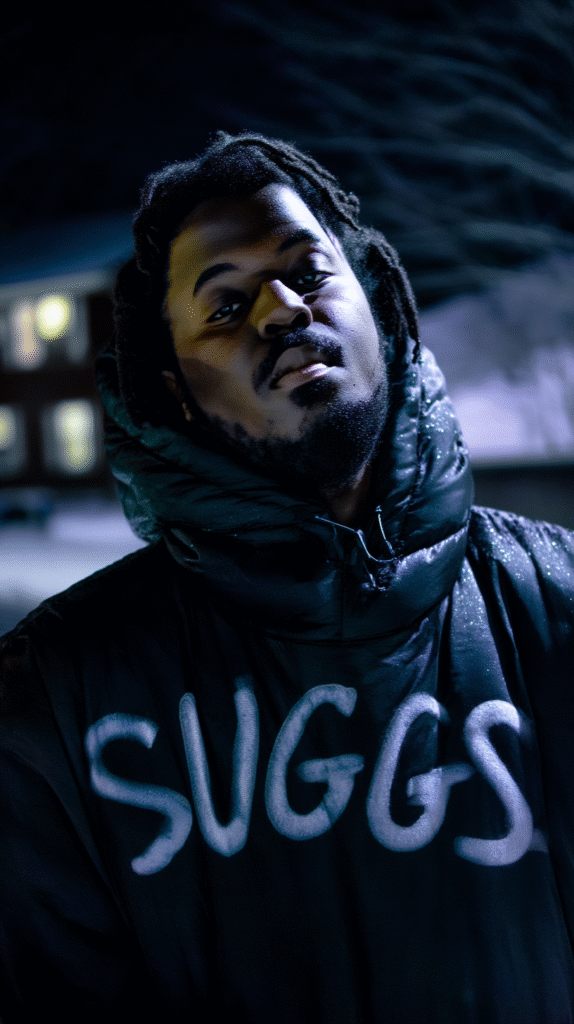
Ronan Eclipsedword came back to the block the way winter comes back to a grave—quiet, deliberate, like it owned the cold. Fulton and Baker was half-lit, three streetlamps flickering in different rhythms, as if the grid had developed a pulse and a stutter. Snow slushed black by tires. Sirens somewhere that never arrived here. He stepped from the SUV, coat zipped, hood low, and the corner boys—what was left of them—straightened like soldiers at roll call.
“Where’s my eyes?” he asked.
“Rowhouse six doors down,” said Tre, his youngest lieutenant, jaw tight. “Basement’s wrong. Ain’t…basementing.”
Ronan’s stare cut across the block to the house with the missing number. The porch sagged like a smile with one tooth. On the door, someone had chalked a child’s hopscotch grid…and then crossed it out with a sigil that made the air pressure drop in his ears.
He touched the mark with two fingers. Monarch pressure throbbed beneath it like a bruise under ice.
“Mask up,” he said. “Nobody breathes deep down there.”
They masked. They moved. The house swallowed them with the smell of radiator heat and wet plaster. First floor: stale, abandoned, but not empty. Ronan’s palm hovered over the staircase; he closed his eyes and let his senses widen until the world turned into thread. Clairvoyance bit him with a thousand needles. He saw basement steps that weren’t steps—declensions—and a room that had been a room until a geometry with a grudge opened its throat.
“Three with me,” he said. “You two hold this threshold. If it screams, you scream louder.”
He descended.
The descent took too long. It was twelve steps and an hour of falling. At the landing, his breath left a glaze on the air like slick frost. The basement had no corners anymore. What used to be ninety-degree angles now leaned inward like a mouth trying to close around them. In the room’s center, a round pit the diameter of a table bled light like a wounded mirror.
Tre whispered, “Boss. That’s a whole no.”
“It’s our business.”
Ronan knelt and unrolled a canvas pouch. Sealing chalk. Iron nails. A curved blade laced with saints’ names in alphabets no saint would admit to knowing. He drew sigils on the floor with swift, unforgiving strokes; he’d memorized them until his hands moved on their own, until the lines wrote him back.
“Four-lock spiral,” he said. “On my call.”
The pit gurgled.
A sound rose from it—wet pages turning—followed by a breath that fogged the basement and carried saltwater and exhaust and an old prayer said wrong. A rope of shadow climbed the air, coalesced into something almost human, then barely dog, then reaper-long and insect-clean. Ronan didn’t flinch.
“You got lost,” he told it. “Or you came hungry. Either way, you’re done.”
It answered by learning his voice in an instant and repeating: you’re done—and he saw three of his boys shiver as if their ribs had learned new doors.
Ronan didn’t give it time to copy their names. He raised his left hand and white fire whispered out—no roar, no theatrics, just a clean line like a blade of daylight. It cut the rope-shape at the thorax. The thing shrieked like brakes. He stepped in, pivoted, and wrote a quick sun in the air with fire until its outline burned into the basement and held there, a miniature star welded to bad concrete.
“Spiral,” he said.
They slammed nails blackened in cemetery dirt into chalked nodes. The seal woke and crawled across the floor like frost, forming a cage around the pit. Tre gagged, not from smell but from the pressure—the monarch press turned gravitational, a hand on the back of his neck pushing him to kneel. Ronan gritted his teeth and kept moving.
The pit didn’t like being caged. It widened. The chalk lines spider-webbed, cracked, then crossed themselves into impossible loops, trying to unwrite the floor. Ronan teleported a breath sideways, reappearing across the widening mouth with a slap of displaced air, grabbed Tre by the hood, and yanked him out of a death he wouldn’t have noticed until he was gone.
“Focus,” he snapped.
The thing came again, this time wearing a face Ronan knew: Draven’s, mouth cut wrong, eyes too bright, smiling without warmth.
“You left me,” it said in his brother’s voice.
Ronan’s vision whitened. The white fire in his palm contracted to a point small as regret. He let the pain come and go; he’d learned to file it.
“Give me back the basement,” he said.
It laughed like an empty church.
He switched hands. Energy projection spat from his right like a thrown spear—noisy, beautiful, blacklight blue—hitting the fake face and locking it in a cage of light. The thing howled and tried to swim out of the spectrum. He didn’t let it. He dragged it with the beam to the seal’s heart and slammed it down.
“Tre! Salt the mouth!”
Tre moved, hands steady now, pouring a circle of coarse salt and powdered brick around the pit. The circle shivered, brightened, then blew apart when a second shape rose—a woman made of moths—and screamed a sound that turned every nail to rust.
“Back!” Ronan barked.
The moth-woman dissolved into a cyclone and stormed the ceiling, where it found…roots. Ronan’s sigils had woken the old lives under the block—the elm that used to shade the porch, the grapevine that learned the fence, the weeds between the stones that remembered their names. Plant manipulation crawled through him like sap returning to a dead limb. Vines bulged through cinderblock, tore like straps, and wove a net; the cyclone hit it and shredded, moths turning to ash.
“Basement’s listening to me,” he said through his teeth. “So listen faster.”
The first shape writhed in the light cage, now a prince-thin silhouette with a crown of radio antennae. It hissed a string of syllables that made Tre’s nose bleed. Ronan carved a counter-phrase across reality with magic nullification, and the hiss died like a switch had flipped in Hell.
Then the pit answered.
It puked up water that wasn’t water—a sheet of mirrored night—and on its surface moved shadows of ships and cities and a sky strangled by auroras that belonged to no pole. The temperature fell. Frost grew on breath. A second later, every phone on the boys lit up and began showing them their childhoods, every wrong choice, every beating, every time they failed their mothers. One of his men—Paco—dropped to his knees and sobbed, laughter cutting through it like a serrated blade.
“Eyes here,” Ronan said softly, stepping into Paco’s line of sight. “You’re not your worst day. Up. Now.”
Paco stood. The pit hissed like it resented mercy.
Ronan felt the breach fully then—not rumor, not symptom—the first of what Baltimore would become if allowed. A wound where dreamt starvation met street hunger and made a new ecology. He tasted brine and the iron of blood on pennies.
“Shut,” he told it.
He drew a final sigil—a fourfold name he’d only seen in Vor’dai carvings and in the chalk scrawl of a dead child’s bedroom—and smacked it to the air above the pit. The symbol didn’t want to stick; his palm burned like someone had hammered a nail through it. He held it anyway. The seal caught and sank and locked.
For a heartbeat, the basement was only breathing.
Then the breach buckled like a lung punctured by light, and the mirror-cold water imploded, and the circle snapped shut with a pop that left silence bruised.
Ronan let the white fire gutter. The vines sagged. The boys exhaled like men who forgot they’d been holding breath since childhood.
And then Tre screamed.
Ronan spun. Tre stood stock-still, eyes glassed. His shadow had stopped matching him. It smiled and waved.
“Don’t move,” Ronan said.
He cut his thumb, flicked blood—soul conversion primed—into a quick sigil at Tre’s feet. The floor glowed. Tre sagged to his knees as something wearing him peeled away like wet plastic. Ronan grabbed it by the throat and dragged it—kicking, hissing—into a mason jar lined with binding script. It convulsed there, a black eel made of regret and gunpowder and songs never sung.
“You belong to my shelf now,” he told it and sealed the lid with a hiss.
Tre gasped. “Boss… I didn’t even feel it. I was…somewhere with a TV on and—”
Ronan put a hand on his shoulder. “You’re here.” He didn’t add for now. He didn’t need to.
The basement steadied—corners reasserting, gravity remembering its job. Above, a door shut without wind. Somewhere on the block a child laughed, then coughed, then kept laughing like a dare.
“Pack it,” Ronan said. “We leave the circle. We don’t brag. We tell no one.”
“Even—”
“No one.”
They climbed. The ascent was twelve steps and an entire life later. Outside, snow had begun again, smaller flakes now, each one landing with the precision of a verdict. The boys moved to cars. Ronan lingered on the porch and watched the breath of the block rise and tangle in the cold.
His phone vibrated. A message from an unsaved number that wasn’t unsaved in his bones.
Eira: Uncle. Don’t close every door. I need one open soon. Trust me.
He stared at the text until the words hurt. He typed back Be careful then deleted it and typed Send location and deleted that too. Finally he sent: Bring salt.
Tre leaned out the SUV window. “Boss. Where to?”
Ronan looked at the house with the fake number. The chalk on the door had smudged into a shape that looked like a feather and a coin and a flower if you didn’t blink. He frowned. Pieces again. A puzzle using Baltimore as a board.
“Warehouse on Monroe,” he said. “We burn clothes. We scrub souls. We pay the mothers of the men we lost last month—double. And I want a runner to the old church on Carey. There’s a statue crying again. If it’s oil, bottle it. If it’s blood, we feed it back to the ground.”
Tre nodded. “Yes, king.”
Ronan’s mouth twitched. “Don’t call me that.”
“You just closed a hole to the ocean of night,” Tre said. “Somebody got to call you something.”
The convoy rolled. Ronan rode in silence, hands steady in his lap. His mind wouldn’t leave the basement. It also wouldn’t leave the map in his head—the glyph the girls’ drawings formed under moonlight—the way it overlaid street grids like a verdict waiting to happen.
He felt the pressure again—high, sick, monarch-steady—and knew: that wasn’t the breach. That was the first breach. The others were listening now.
Halfway to Monroe, a blacked-out sedan slid from a side street and coupled with his SUV like it had always been there. The driver’s window lowered. A woman’s profile in the blue light—Detective Leonor Aloysia’s partner, the lieutenant—looked over once, nodded like sinners nod at each other in church, and drifted away into the trafficless night.
“Everybody knows,” Tre muttered.
“Let ’em.” Ronan stared ahead. “They can know and still not see.”
The warehouse was cold as a morgue. They stripped, burned their clothes in a drum, washed in water laced with blessed vinegar until their skin felt too honest. Ronan stored the jar in a vault behind a steel door etched with a line he hated writing: A life for a life if this breaks.
When the boys were gone and only the hum of the city remained, he lit a candle and placed it on the concrete. The flame stood upright—no draft, no tremor, perfect—and he knew Baltimore had paused to listen.
“I’m not good,” he told it. “I’m not even right. But I am here, and I will hurt you if you touch my family.”
The flame lengthened, then lowered, like a bow or a threat depending on the angle.
He blew it out and walked into the vast, freezing dark.
Somewhere across town, a row of payphones began to ring in sequence down an empty street. On the last phone, when no one answered, a voice that sounded like his own said:
“Next one opens at dawn.”
And miles away, under the river, something that remembered being a city gate unlatched its first hinge.
Baltimore stopped pretending to be asleep.