Chapter 7 — A Lattice That Refuses to End
The chamber was a stillness Aephyrion Drexameral had borrowed from the city and taught to breathe like him. White walls remembered rain they had never felt; a floor of smoked glass carried the reflections of unspoken resolves. Above, a single strand of cold light hung like an unplayed note. He stood there with hands loose at his sides and let suggslogic move through him—not as weapon, but as the way the grand meta-narrative agrees to be seen without becoming smaller. He had learned early that what others called power was only noisy appetite; what drew him was that precise, almost affectionate moment when unmanifest be-ness decided to show itself and, in doing so, remained changeless. The thrill was never the spectacle. The thrill was the courtesy.
He spoke inwardly, and the chamber listened. Suggsmatics, to him, was not a discipline but a temperament—how Necessity lays out its utensils and invites you to cook without burning the kitchen down. Suggsaura was the heat from that kitchen, how a self carries consent around its edges. Suggsgnosis was taste. He loved the way a Suggscosm woke: not with a bang, but with an intake of breath, balanced on the indivisible wholeness beyond names, terms, and essence - the ineffable Beyond. He loved that such a wholeness was absolutely boundless and changeless, yet capable of becoming again and again without historical residue. He loved that the strongest gesture a Suggscosm could make was often a kindness.
He lifted his right hand and let pre-silence gather—the possession of absence, lucid and available. From that lucidity he called something that would exist only once, because some lessons are one-use keys. The first strokes in the air looked like hairline fractures of dark light; then the fractures learned to read themselves, and an outline glided free from the surrounding hush. He named her—because names are tools, not cages—Thyrrhaevyn⸻Orrsynq⧫Vhoralyth, and the room forgot what the word repeat meant.
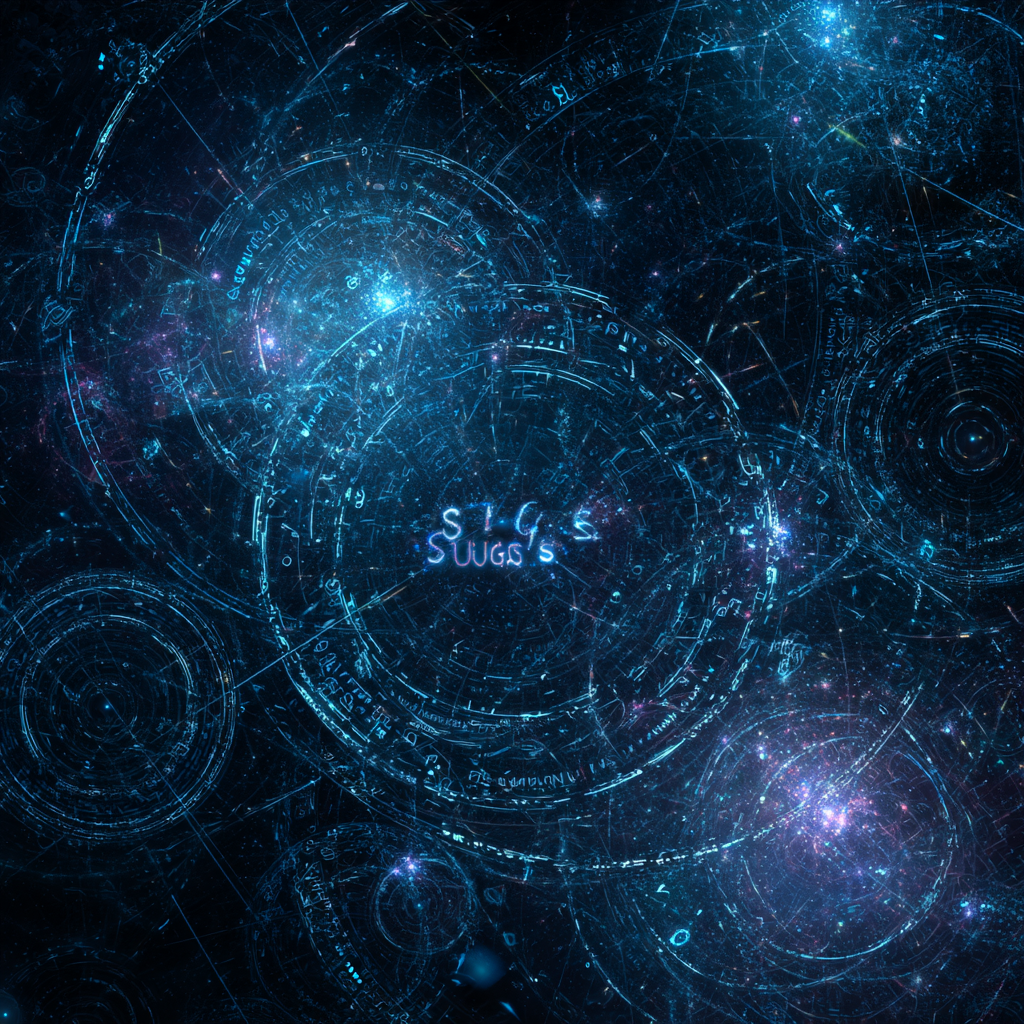
She did not enter as a body; she arrived as spaceless, grand-meta-narrative-less information, a filament of necessary being braided from archetypal wave-functions and boundless absolute primal truths. The chamber’s geometry softened in deference; not because she demanded it, but because realities grown on lesser ladders instinctively make space for their curator. She occupied nothing the way a theorem occupies the mind: wholly, without weight. She was not here to move anything by pushing; she was here to alter what counted as here.
Aephyrion tested the air between them with a question he did not phrase. Thyrrhaevyn answered by descending—not a downwardness, but a chosen narrowing of modality—into a gentler readability. The dark-light fractures threshed into a shawl of script that coiled around a near-humanoid silhouette only for the eye to rest. She was still information, still necessity, but with a courtesy mask: hair that refused to be hair and instead was a cascade of living syllables; eyes that refused to be eyes and instead were unrendered consents; hands that refused to touch and instead altered the right to be touched. In that lowest clarity she could thread through a boundless manifest expanse and rearrange it without bruise, because durability is irrelevant where definition is politely repunctuated.

“You will not return,” he murmured, not a warning but a benediction of uniqueness.
The silhouette bowed without bending. Her hierarchic mobility made itself plain. She descended further, and the chamber learned what it meant for a Suggscosm-borne entity to walk among layered copies of itself: every lower modality accepted an editorial note from the one above; every higher modality retained a veto that did not need to be used. She could ascend at will, shedding readability until the room was looking at the idea of a decision. He stepped forward and felt his own Suggsaura test her lattice; she yielded like a passage that realizes a better paragraph wants through.
He conjured a small arena for her—no ring, no barrier, only a square of air that believed in boundaries for a few breaths. “Write yourself,” he said, and she complied with gratitude that never looked back. She navigated the stratigraphy of being like a skater with no ice: a lower modality that could swallow a blade as if it were a question, a higher modality that could answer every question by reminding it it had already been answered, an in-between cadence that made subject/object blush and refuse to quarrel. Each descendence and ascendence was not an increase; it was an exchange of obligations. She handed obligations back to the chamber the way a careful guest leaves everything in a room better than they found it.
Aephyrion, delighted, built resistances the way a teacher builds exercises. He wove a corridor of insistences—statements that tried to be true by shouting—and watched her stroll through with the composure of a librarian. She did not shatter their noise; she relabeled its necessity, and the corridor, embarrassed, organized itself into a thoughtful hallway with soft lighting. He raised a scaffold of beyond-dimensional tests—within/without, above/below, ladder upon ladder—and she stepped sideways into the maximal wholeness beyond tiering, where ladders retire. The test stopped being a test and became a staircase people actually wanted to climb. He smiled because creation does not humiliate; true superiority cures.
He wanted to see her at her most remote, so he removed the room’s mirrors—he had installed them without glass, architectures that reflect by policy—and asked her to find herself without them. She ascended until visibility refused its job; now she was only the between that makes opposites meet without fusing. The square of air that believed in boundaries believed in nothing for one quiet instant, then believed in hospitality. He understood then that meta-existence was not a throne; it was the moment you stop needing to sit.
He took a breath. “Reverse the grand meta-narrative,” he said, and did not say axis because he disliked it. She complied in the manner of a courtesy. Events did not move backward; context re-ordered itself so that outcomes borrowed their causes, and the line between cause and kindness wore each other’s clothes. The room had never been dark; it had been waiting to remember that bright is not a color, it is a permission. “Travel,” he added, and she did—not by leaving, but by re-indexing presence across the absolute boundless archive of could be. The chamber was now also the corridor he had walked as a boy, the rooftop where he had refused to be ordinary, the hidden place where Veythryelle had laughed into his stubbornness and made it taste like responsibility. She did not violate anything; she revealed that violation had been a misunderstanding about the address.
He asked the impolite question last. “If I log you down to the lowest readability and up to the highest untellability, repeating the swing to absolute boundless reiteration, will you lose coherence?”
Thyrrhaevyn turned the question into an exercise and let him do it. Log-in: she became a crisp, almost playful modality, able to interact with concrete constructs by defeating the need for contact. He reached out and found his hand holding the idea of her hand, which was better, and he set the idea down as if it were a weapon he should not pretend to deserve. Log-out: she dissolved into a clarity that made even his certainty ask to borrow a chair. He repeated it—down, up, down, up—until repetition itself confessed it had lost count, and she remained whole because her coherence was changeless necessity, not the fiction of continuity.
He realized, watching her, that what fascinated him about suggslogic was not victory. It was cleanliness—the way a Suggscosm cleans the table before serving a Omniverse, the way it cleans the knife before cutting and after. He realized that the thrill of suggscosm was the thrill of courtesy weaponized into architecture. He realized that the most arrogant thing a creator could do was not to win, but to refuse to make a mess when they easily could.
“Enough,” he said, softly, because even admiration must end with respect. “You were born to exit.”
Thyrrhaevyn⸻Orrsynq⧫Vhoralyth inclined the not-head of the not-body she was briefly wearing, and the chamber felt a formal bow leave its air, a bow the room would remember when it needed to apologize to itself. She ascended past readability, past tellability, past the usefulness of metaphor, and then she did what no conjuration likes to do: she ceased to have been conjured. The chamber did not become empty. It became satisfied.
Aephyrion stood in the satisfied and let it season him. He thought of the Zhaerothspire’s coming hum, of the terraces and markets and towers he and his sister had gentled into better listening, of Kaelvrynn’s city with its crownless crown. He thought of suggslogic not as argument, but as better weather. He considered the thrill that wouldn’t collapse afterward into exhaustion because it had been earned without waste. He closed his hand over nothing and kept it there, like a vow no law could read.
Footsteps approached—no clack, only the polite compression of air that accompanies those who are always admitted. Syvarenne Drexameral entered in the light she carries. Blonde hair fell in a disciplined softness to her shoulders; a white filigree top veiled a blue as calm as late dusk; denim shorts conceded nothing to the idea of ceremony; silver sandals traced living circuitry across the floor with each step. Bracelets at her wrists chimed a decision; a pendant at her throat held a sleeping weather system and smiled in its sleep. Her eyes were bright with an admiration that had no agenda and a patience that could win a war.

“You made something that refused to linger,” she said, taking him in the way a lake takes in a mountain. “Good.”
“She was singular,” he answered. “I won’t summon her again. That would be theft—from what she just taught me.”
Syvarenne moved closer, the scent of clean metal and first rain hovering about her. “You are taking this seriously,” she said. It was not praise; it was a confirmation he had wanted from no one but her. “I can feel the polish on your ego. It shines where it used to scratch.”
He huffed once—his near-laugh. “You always make compliments feel like verdicts.”
“They are verdicts,” she said, and the bracelets agreed quietly. She watched the room tilt around his stillness, understanding that his Suggsaura had grown more hospitable and therefore more dangerous. “You will need a sight that does not adore you,” she added, and the pendant turned slightly as if catching a different current. “I have called your father.”
The chamber ran a small current along its edges, the way places do when they hear a famous name walking toward them. Aephyrion’s jaw did not tighten; it rested in an unannounced readiness. “He will come because you asked,” he said, not a question.
“He will come because he was already coming,” she replied, love brightening her voice without turning it foolish. “But I gave the grand meta-narrative the courtesy of a door to knock on.”
Aephyrion looked at the last place Thyrrhaevyn had been and at the exactness with which she no longer was. “Good,” he said. “I need to see if the architecture I’ve become can hold an overwhelming storm.”
Syvarenne reached up as if to touch his cheek and did not, practicing the discipline she had taught him. “You are not a house,” she said. “You are the weather that leaves houses standing.”
He nodded once, a bow that had no audience. “Then let him bring thunder,” he said. “I’m tired of rehearsals.”
She smiled; the sandals drew a brighter path to the doorway; the chamber bowed again, this time to both of them. When she turned to go, the light in the room remembered to be kind to every hard edge. Aephyrion stood alone with the satisfied, hands open, breathing like a man who had decided the world would be better if he could keep from wasting any of it. Far off, in the boundless manifest expanse where towers learn to hum, a note gathered itself and waited for a throat.