
Chapter 8 — The Countdown Begins: Baltimore Stops Pretending to Be a City


The storm had not ended so much as it had been rearranged. Snowbanks leaned like pale tombs along North Avenue; windows glowed with that uneasy calm people put on after a week of screaming. News anchors said the world was “stabilizing.” A few even used the word “miracle.” They were talking about the red-skinned woman seen fixing a skyline with one touch and the quiet girl who stitched a coastline shut like it was a torn coat. They were talking about how oceans went still, how satellites flickered back to life, how power grids hummed again.
But Baltimore breathed differently now.
Lucraen Hollowpage felt it as a pressure behind the eyes, like a migraine that could read. His beads rattled against his coat as he hustled across the icy lot of an abandoned supermarket. “They didn’t heal it,” he said, glancing at the others. “They re-tuned it. Moved the fracture off the surface and into the load-bearing bones.”
Ronan Eclipsedword cocked his head. “Meaning?”
“Meaning the city is a drumhead. Something’s about to be struck.”
Seren Splinteredcrown didn’t answer. The masked vigilante stood at the lip of the lot, black coat drinking the streetlight, eyes fixed on the night. She was the one who’d first heard the hum—through security cams that weren’t on and earbuds with no power. Technomancy had a way of hearing things before they were heard.
Qīng-Zǐ, breath pluming in the cold, unwrapped three paper talismans. “We are not in a lull,” he murmured. “We are in a corridor.”
Ronan snorted steam and checked the weight of his white-fire lighter in his palm. Kingpin posture, priest’s hands. “Good. Corridors make it easy to choose who dies.”
Lucraen would’ve smiled if his stomach hadn’t been twisting. The map they’d spent months assembling—the daughters’ moon-inked drawings, the backward-speaking graffiti, the Vor’dai glyphs carved into church basements—had resolved last night into a single sigil scrawled across West Baltimore. It matched the pressure patterns he was feeling now. The repairs the two women had performed—the ones the city called miracles—had finished the glyph for them. Not mercy. Guidance.
“Look,” Seren said.
The sky buckled over Edmondson Avenue.
It was not a thunderhead and not a tear. It was a silent, lightless bloom, and from its center a shape shouldered through, dragging a shadow like a solar eclipse. The shape kept coming until perspective lost its argument with size: a body of night-slick armor, red veins like magma threaded beneath obsidian, a head like a horned comet wreathed in scintillant frost. It landed beyond the rowhouses with a weight that rolled the snow into waves.
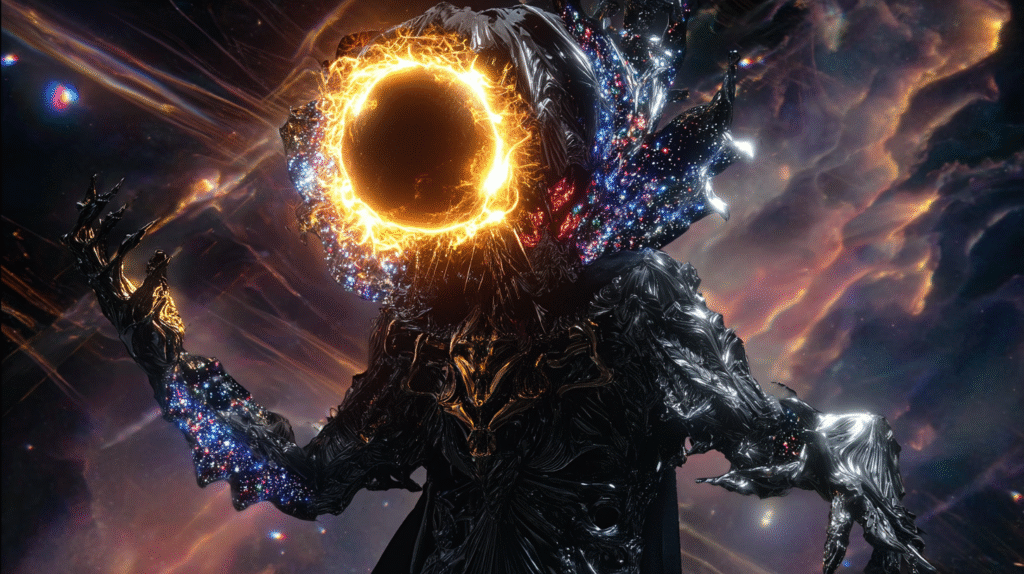
The anomaly was not the size of the silhouette dropping through the cloud deck, but the radiation surge that arrived eight minutes earlier than light. Hopkins’ neutrino monitors spiked, then every home Geiger counter posted to hobbyist forums in Essex and Dundalk began screaming in chorus. Pilots over BWI reported a black reflection moving under them like a second fuselage—no radar return, only the shape suggested by what it erased.
At 06:11, cameras on the Key Bridge caught a thing descending behind the city like a storm cell grown bones. A hundred street views turned to static, then came back with glare: light distorted by particulate air suddenly ionized. The object hit the Patapsco’s mist with no splash, no displacement—just contact—and the river’s surface froze to mirror for a full mile in each direction as if the water’s molecular lattice had forgotten it was liquid.
Height: ~300 meters when upright on visible limbs.
Mass: estimated 100,000 metric tons from bridge torsion readings when it stepped through the outer lanes of I-95.
Configuration: not constant. Projected into the physical world in segments that behaved like articulated probes. True body remained off-frame—measurable only as an unbounded source field that instruments could not bracket.
It held a star in one hand. Not metaphor. Spectrometers from a Towson amateur group grabbed a spectrum with hydrogen alpha blazing and a photosphere in the 5,500–6,000 K band. The star did not obey gravity relative to Earth; it orbited the creature’s wrist like a captive electron.
“Phau’drexh,” Qīng-Zǐ said from the roof of a shuttered school in Park Heights, prayer beads wrapped around one wrist, radio bud in his ear. “The first of them.” His voice was clipped. He sounded as if he’d been waiting to say that name for years.
Across the metro, Ronan Eclipsedword had already moved three crews to vacate blocks along Edmondson Avenue. Seren Splinteredcrown was in a stolen municipal drone van with the back doors open, field kit spread, fingers in a tangle of cables like veins pulled from the machine. Lucraen Hollowpage walked the nave of a burned church in East Baltimore with a case of chalks, salts, iron nails, and handblown glass vials—his traveling altar.
The creature turned its head. Every parabolic microphone in range clipped to white and stayed there.
PHASE I — Epiphenomena Breath
The thing exhaled. Witnesses described it as a wind that didn’t move air, a pressure event that climbed through the rib cage and pressed the spine forward. On instruments, it registered as a multi-band energy discharge whose leading edge carried coherent phonon spikes—sound structured into a material action. Where the breath struck, brick powderized to the consistency of flour. Tempered glass didn’t shatter; it unwove, separating into vapor and thin floating plates at the thickness of mica.
Qīng-Zǐ threw a palm outward and a laminated seal unfolded above the school—six concentric rings of cinnabar script, each joined to steel anchor plates he’d welded there hours earlier. The first wash of the breath bowed the seals until the rivets groaned. Children sheltered below in the gym didn’t hear anything—pressure gradients lifted the sound out of the air like a sieve.
“Epiphenomena,” Lucraen said on the net, voice steady. “Not magic. Nature’s strongest weapon—but applied as nature. It’s hijacking causal side effects and firing them like artillery.”
“Keep your channels tight,” Ronan returned, running. “We’re split across the metro; no heroics. We buy time.”
Thirty miles north, the cloud deck tore in a ring. Airliners gave it a wide berth. The ring’s inner edge ionized, fluorescing blue. Phau’drexh inhaled again. Traffic cameras in Halethorpe saw the airstream reverse along the ground, pulling trash, leaves, and ten thousand glittering bits of road salt uphill in straight lines toward the thing’s mouth. The second exhalation skimmed along the surface of the Jones Falls Expressway, ablated asphalt to a soft rolling edge, and annealed rebar inside a retaining wall to a buttery shine. A city block became dull mirror.
PHASE II — Gamma-Burst Cellularity
Lucraen’s phone bristled with improvised dosimeters. They pegged, failed, and rebooted. Through binoculars he watched a patch of chitinous hide crackle—not lightning, but microscopic jets of hard radiation cutting from each cell like a star’s polar beam. “Every cell is a gamma ray burst,” he said, breath tight. “Not a metaphor. Signature aligns with pulsar bursts around supermassive black holes. Output equivalent—call it ≥12 kiloFOE per emission cycle if projected to full body.”
“Say that in English,” Seren snapped, eyes flicking between drone feeds.
“Twelve thousand supernovas worth of energy per cell if it went full. It isn’t. It’s throttling to touch us.”
“This thing could flex and cook Jupiter,” Ronan said, voice flat. “Move.”
PHASE III — Resonance Phenomenon (Roar)
The creature leaned forward and roared like a siren four octaves too low. Not decibels. Resonance. Sodium lights across the harbor went molten in their housings as their lattice structures were driven into failure. Parked cars pancaked by an inch as subatomic crush rippled through sheet metal; then the wave ratcheted tighter, turning forged axles into corkscrews. In Fells Point, oysters in a cooler burst without being touched, shells popping like knuckles in a God’s hand.
Qīng-Zǐ bit through a thread to finish a seal. “West anchorage holding,” he reported. “East is compromised.”
Seren’s technomancy hit the municipal network. Traffic lights flipped to all-red, smart meters dumped load into isolation, and five independent radio towers began broadcasting anti-phase noise modeled from the incoming roar—not to cancel it (impossible at that amplitude), but to spread its efficiency into the wideband so fewer structures found their resonant death note at once.
Lucraen drew a sun. Literally. He struck chalk into a circle, salted its rim, and set a match to the center. Heat gathered where there was no fuel. A white core swam up like a pearl through milk and hovered, fist-sized, at head level. When he pushed, it flew—a miniature photosphere shedding bright wind—and found the breath channel the creature left. The heliac ball expanded to a man’s height by the time it reached the thing’s face, and hammered it sideways.
It did not hurt Phau’drexh. But it changed the math. The wind path warped, and for six seconds air returned to normal pressure. People could breathe.
PHASE IV — Silence-Song (Plasma Detonation)
The creature sang. Witnesses reported it as a silence, like the dead space after a firecracker when ears hunt for sound and find none. In the spectrogram the team watched, there was a gap—a band-stop filter across the world. Within that gap, plasma appeared as if poured from the missing audio. It rolled out in a hemispherical shock that polished concrete steps to glass and flash-evaporated lake ice in Druid Hill Park into a silver fog.
“Down!” Ronan threw a seal the size of a manhole cover; it opened in mid-air like a steel flower, each petal stamped with a sigil. The first ridge of the plasma shock hit—and folded. The petals glowed orange, then white. Ronan’s hands bled through the gloves where the symbolic charge grounded through him.
Qīng-Zǐ answered from three blocks away with a veil array, seven sutra-lines triangulated from rooftop to rooftop. The second wave of the silence-song struck that net and diverged, skimming along it to boil off into harmless auroras that rose as thin green curtains over Charles Village.
“Containment buys minutes,” Qīng-Zǐ said, chest heaving. “Not hours.”
The City as Battlefield
It moved. A step put it over Westport; a reach put its star-hand over the Inner Harbor. It didn’t throw the star. It pressed it into the water until steam cored the basin. Ferries listed, sirens far away. Then it turned inland, walking through Pigtown, Hollins Market, Upton. Every time its foot contacted, soil compacted to bedrock; earthworms rose boiled to the surface and lay like punctuation in the mud.
Above the clouds, commercial satellites captured its crown rising—a corona that brushed the lower stratosphere in a dull, constant burn. The burn line preheated air for miles. If it chose, this same preheat could be flared into a planet-wide ignition front. Analysts watching from Fort Meade exchanged looks and did not say the word extinction.
Counter-Operation: Four Lines Converge
“Shift to multi-sector harassment,” Ronan ordered. “We can’t stop it. We can make it choose. Lucraen, cut its breath lanes. Qīng-Zǐ, keep the schools and hospitals wrapped. Seren—give me a break in its sensory band. I need to touch it.”
“You want point of contact?” Seren asked.
“I want to write on it.”
Seren yanked her hood up and plunged both hands into the city’s grid. Traffic cams, weather radar, transit telemetry, aging private security networks hanging like cobwebs around storefronts—she pulled their eyes into a single lens and then lied to them, inventing phantom signatures that pulsed a block and a half to the east of wherever Phau’drexh actually was. The creature’s head ticked toward each new false echo—not fooled, exactly, but interested—and adjusted breath and song by degrees. That was enough.
Ronan teleported. No flare; just absence, then presence at the thing’s ankle, the world hushing where he arrived. He slapped a seal onto the outer integument—a sigil designed to bind the idea of passage rather than matter. Phau’drexh’s projected limb met the symbol and hesitated, the connection back to its off-world body experiencing latency for the first time. The hesitation measured in milliseconds, but those were human seconds won.
Lucraen used them. He walked into the wind and drove three suns like nails. Each lodged in the creature’s breath channel and burned counter-currents, vectoring the epiphenomena sideways instead of down. Sideways meant office towers instead of rowhouse schools, parking decks instead of clinics. It was triage by physics.
Qīng-Zǐ chanted under breath. The city block around him scrolled with ink that did not exist a heartbeat earlier. His sutras stapled real to real, buttoning the neighborhood together every time the resonance tried to shake it apart. People lived because he pushed pins into the world and said stay.
Phau’drexh Escalates
It learned. The next roar came banded, a braid of frequencies that unseated Qīng-Zǐ’s sutras without breaking them, like fingers teasing a knot until it slid. It rotated the star in its hand as if tuning a radio; the photospheric turbulence shifted; the magnetic loops around the star’s crown caught and re-cast downrange as magnetar-like sweeps that scrubbed Seren’s false echoes from the air.
Seren swore softly. “It’s reading me.”
“Then you read it back,” Ronan said. “And when you finish reading—stab it.”
Cross-City Run
They ran the monster across multiple sectors to keep it from dropping full-body. Ronan harried with teleports and white-fire bursts that didn’t burn flesh—they burned rules. Every time he touched down, sound damped; he left behind quiet scars on the pavement where tire rubber squealed and then remembered silence instead.
Lucraen exorcised a hospital wing as the resonance shook oxygen tanks like maracas; he pulled a parasite of pure intent out of a nurse’s throat and bottled it in a jar with a paper sun pasted to the glass. He found a line of text carved behind paint on cinderblock sixty years old and read it to life—a blessing left by a janitor who loved the world enough to hide words in its walls. The blessing held.
Qīng-Zǐ met the creature at Druid Hill, his footprints tracking in ash that somehow fell as snow around him. He lifted two fingers and opened a space that smelled like cedar. He stepped through; he stepped out on an adjacent plane and ran across it, returning into our world above Phau’drexh’s shoulder, where he hammered a prayer nail down into a point behind its collar. The nail rang like an anvil, and the ring crawled through the creature’s projection, making its edges strobe.
The Sky Breaks, Literally
The creature looked up. It spread its arms; the star swung out, a pendulum of sun. It sang again—silence—and the ionosphere above Baltimore pulsed like a drum head tapped by a god. The shock climbed, hit the field line, and spread around the entire mid-Atlantic like a coat of plasma lacquer. For a minute, the northern lights came south and stood over rowhouses.
“Containment impossible if it scales,” Lucraen said quietly. “If it chooses to escalate, this becomes an Andromeda event. Not hyperbole. Just math.”
Ronan’s reply was a breath. “Then we finish before it chooses.”
The Turn — Language Slips
Seren stood on the roof of a parking garage downtown, breath misting, city metal vibrating like a choir of saw blades under Phau’drexh’s low roar. She closed her eyes and let the grid slide out of her hands. She reached for the thing behind the grid—the script of the city that existed before the wires, before the asphalt. In that script, Baltimore was a pattern: seven hills and a river mouth; a harbor like an empty palm facing east; alleys like capillaries; spires like signal towers left by a people who believed the sky could speak.
Her voice went low. “You don’t belong here,” she told Phau’drexh. “And neither do I.” She pulled a blade from inside her coat—steel as black as wet asphalt, etched with letters that were not an alphabet so much as directions back to before things had names.
Ronan felt the air shift around her and smiled without humor. “Your lane,” he said. “Take it.”
Lucraen lit a new star and placed it in Seren’s chest like a borrowed heart. It did not burn her; it aligned her. Qīng-Zǐ stitched one prayer to her sleeve and let it loose to ride the air around her, a quiet thing that would not be noticed until it was too late.
Closing the Distance
They drew Phau’drexh into Patterson Park by giving it what it seemed to want: resistance that hurt not at all, but measured it. It hates to be measured. Its breath like erasure, its roar like subatomic crush, its silence like plasma birth—these mean less to what it is than the act of being held within a frame. So they framed it: Ronan with binding seals that made its limbs late to themselves, Lucraen with torch-suns that reshaped its wind, Qīng-Zǐ with sutra pins that stapled the city’s canvas tight.
Seren walked under it as its shadow rolled over the park like a tide. Steam rose from snow. The star in its hand flared; flare ropes snapped outward and searched the ground like white serpents. She stepped between them. Every step left a glyph like a heel-brand in the frost. The glyphs did not burn; they reminded.
“Remember,” she told the world, and the world did.
Phau’drexh noticed. It brought its head down, and for the first time it focused on a single thing that was not a city. Its mouth opened. Epiphenomena breath rolled out in a straight, incremental wall. Seren lifted her free hand, and the breath went around her—the wall split on either side as if water flowed around a pillar. Behind her, rowhouses ground down to powder in a neat cut, making a canyon where an alley used to be.
She reached the ankle. Up close it was not skin, not armor; it was statement. Here is an edge, it said, between where I am and where you are. She wrote across that statement with the black blade, the steel eating its own reflection, and crossed out the word edge.
The limb fuzzed. The connection back to its unseen body developed a stutter. Ronan slammed a seal onto the wound—not to close it, but to keep the stutter open. Lucraen drove a sun into the same spot; it didn’t explode—it shone inside the idea of the limb and threw shadows where there shouldn’t have been any.
Qīng-Zǐ spoke one line in a language that had no vowels. The line tied the shadows to the ground.
The Creature Shows the Galaxy
Angered, Phau’drexh lifted its star and tilted it. The star’s magnetic reconnection events went nonlocal, ropes of incandescent plasma looping up through the cloud deck into the stratosphere and then returning miles away in Columbia and Laurel as sky-falling fire. Instruments in orbit read those loops as toy examples of what the same geometry would look like at Jupiter scale, at Andromeda scale. Not threat. Declaration. I can. And everyone who could read a plot knew it was true.
“Seren,” Ronan said, teeth clenched around blood. “End it.”
The Slide Beyond Physics
She moved and the language of the chapter slid. Street names lost capitals. Snow did not melt; it unspecified. Gravity did not drop; it became a suggestion that most things continued to obey out of habit. Seren’s blade drew a curve in the air that closed not on itself, but on the argument that there should be a self to close on. The curve caught in Phau’drexh’s projection and rewrote it as already concluded elsewhere.
The creature sang its silence to pull a new plasma shock into being. She answered with a counter-silence that had grammar. The two collided and produced nothing, and that nothing tore a neat, person-sized hole through the breath channel. Through that absence she stepped and stood where the limb connected to its remote body—a place that is not a place. You could call it the bridge between here and what sends itself here.
“Go back,” she told it in a tone that has never failed a door.
She drove the black blade down. The edge did not cut matter. It cut the commitment the creature had made to arrive. The commitment snapped with a sound like a mainspring unwinding.
Ronan’s seals rang in sympathy. Lucraen’s suns winked out, their work complete. Qīng-Zǐ’s sutra-pins relaxed, lines of ink dissolving into harmless soot that drifted like gentle ash on the wind.
Phau’drexh retracted in segments, projection collapsing along tidal curves. The star in its fist dimmed, then flickered sideways—not moving, simply deciding, all at once, to be not here. The last of it drew upward through the cloud deck and left behind a pressure deficit that snowed in a ring over the beltway like feathers shaken from a wing.
Silence—the real kind—fell. It felt thin. People cried without sound because their inner ears hadn’t remembered how to believe noise yet.
Seren’s knees buckled. Ronan was there, one hand under her elbow. “You got the final strike,” he said softly, half proud, half afraid of what it meant.
“Not a kill,” she whispered, shivering. “A disinvitation.”
Lucraen looked up at the clouds where the ring still glowed faintly with trapped aurora. “It can come back,” he said.
“It will,” Qīng-Zǐ answered, eyes on the horizon. “And the others will learn from this contact.”
“Then we learn faster,” Ronan said. He touched his comm. “All units: damage assessment, casualty triage, grid triage. Move.”
Above the City
Satellites continued to log afterglow. In Fort Meade, analysts annotated frame after frame: micro-faults running like hairline cracks across lines of reality stress—as if the city had been bent and then let go. Simulations suggested the event could be scaled—Jupiter, yes, Andromeda Galaxy erasure in principle. No one wrote that part into the executive summary. They only wrote: Baltimore remains.
Seren wiped the blade clean on her coat and sheathed it. The black metal did not shine, but it did reflect a little shadow of her, and in that shadow she looked taller than she was. She glanced at Ronan. “We can’t do this three times,” she said.
Ronan’s mouth was a line. “We’ll do it as many times as it takes until Draven comes back or doesn’t.”
Lucraen, listening to far sirens that were only now allowed to be heard, let out a long breath. “Ravvixa and Kyrissya bought us this window,” he said. “You all felt it—the world tilt back, only to tilt again. They weren’t salvation. They were interruption.”
Qīng-Zǐ nodded once. “A reprieve is not a pardon.”
A gust lifted loose snow along Patterson Park’s brick walk and chased it into small spinning columns. Seren watched them, tired in a way that lived behind the bones. “Then we use the reprieve,” she said. “We heal what we can, we lace the city tighter, and when the next one leans over our harbor holding a star, we make it late to itself again.”
From the zoo hill, a dozen kids cheered because the aurora hadn’t gone away yet. In their phones the sky was green fire. In their throats, finally, laughter returned like a lost dog finding its house.
For now—only for now—Baltimore stood. The countdown did not stop. It just paused long enough for the living to count their numbers out loud and for the dead to be named.