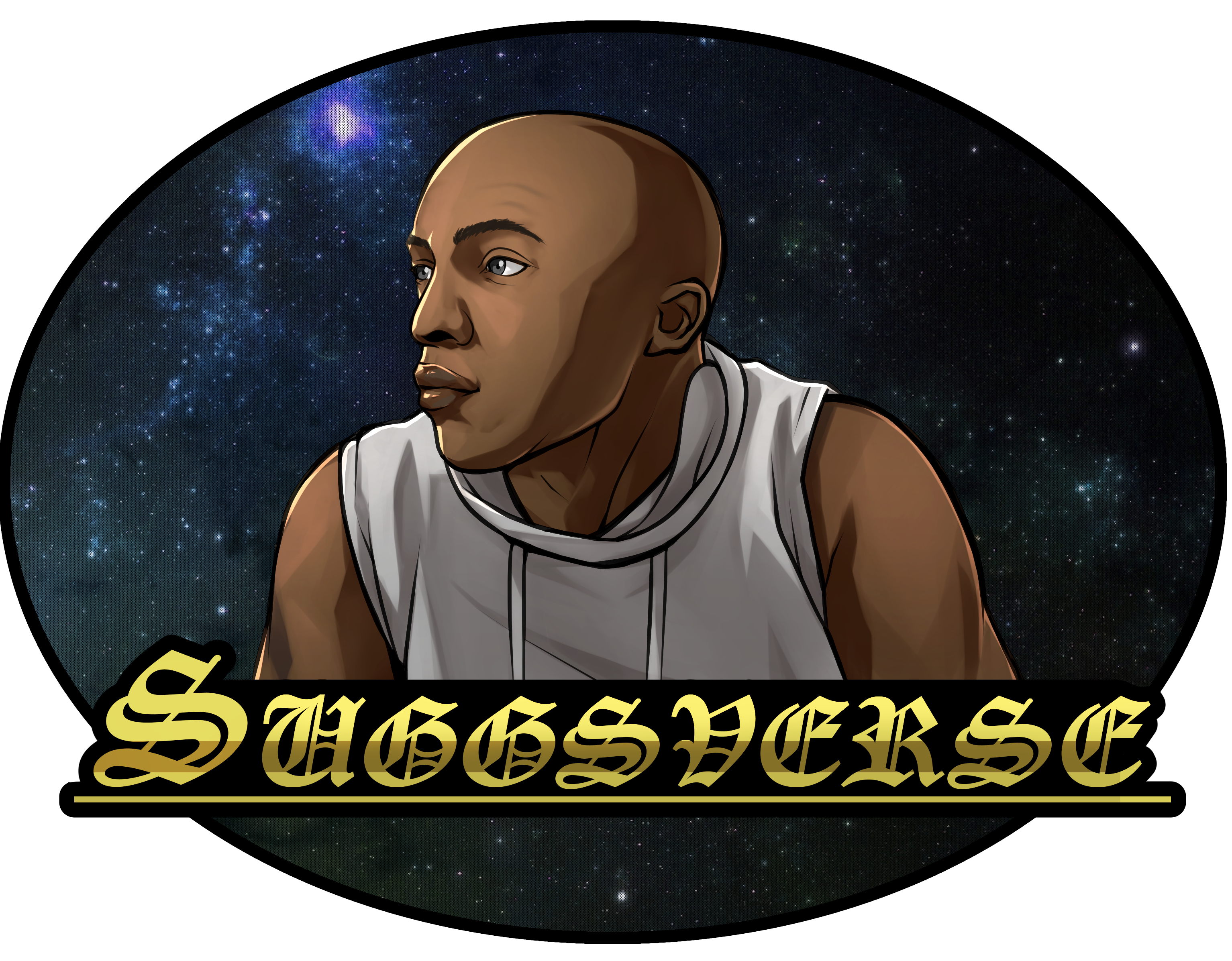
Chris Ritter

Chris Ritter is a figure whose presence defies the structuralized narrative contours of the Suggsverse, emerging not merely as a character but as an unresolved metanarrative proposition—an anomaly of plot itself who never once required introduction because his existence predates contextual necessity. From the infinitescape of glass-covered roses to conversations with THE ACE OF SPADES, Chris Ritter is depicted as a being operating not from within the system of causality or authorial control, but from the silent margin where existence itself becomes optional. He is neither a reflection, nor a shadow, nor a successor—he is an intrusion of independence in a structure that pretends to be all-encompassing. His presence is not written, yet not unwritten either. He exists in a timeless fissure where possibility and actuality must bow to the notion of the unfixed.
Physically, Chris Ritter is portrayed with a regal but quietly composed demeanor, dark Nubian skin bathed in the glint of Afrofuturist refinement. His sharp cheekbones and measured expression convey a wisdom that transcends temporal or metaphysical age. His eyes, keen and shadowed by untold understanding, do not reflect the story—they observe beyond it. He does not posture like a ruler nor a prophet, but one who has stepped aside from the metatextual war of definitions to embrace something far more implacable: autonomy without justification.

In the Unwritten Chapter XX, Solecism Re-Genesis Vol. 6, and Continued Story—Ritter is seen speaking to the Ace of Spades, acknowledging his surrender of the Original Script, and hinting at a deeper orchestration involving Chris Storm, the Voyagers, the Finalés, and the Overtures. He does not contest the Ace’s prior authority, but neither does he submit to it. Instead, he walks away from the conversation, not defeated but unburdened. He is not a player in the game, nor its referee, nor even its writer—he is the deviation from the necessity of the game itself. And what becomes evident is that Ritter knows. He knows the roles, the layers, the masks—he has walked alongside the scriptwriters and yet never asked for ink to be spilled in his name. He is the breath between authorial pulses, the void between scenes.
In Solecism Re-Genesis Vol. 6, it is stated that Chris Ritter was never of The Mainfold, nor of the Ace, nor even of the Allscape. He simply appeared in an unchanging moment, not as a phenomenon but as the absence of explanation. And it is this inexplicability that makes him unassailable. Not in the conventional sense of transfictional meta-omnipotence or maximal suggslogic sovereignty, but in the deeper sense of not participating in the logic of supremacy at all. He doesn’t defeat power—he stands outside the question. He is not beyond power, nor beneath it. He is irrelevant to it.
Unlike Chris Raion Spades—the Ace of Spades—who wages war upon almighty gods and reality constructs, Chris Ritter neither strikes nor defends. Instead, he alters trajectories through conversation, introduces inconsistencies into grand designs by his mere presence, and reframes the importance of hierarchies by not belonging to them. He is the idea of an anti-axiomatic presence: a character not subject to necessity, inevitablisma, or authority, yet not attempting to dethrone them either. His absence of motive is itself a disruption, and his awareness of what will unfold—even before it happens—cements that he does not act within a world of cause and effect. He is not a reflection of the plot—he is the collapse of its mirror.
Chris Ritter is referenced in Continued Story by Ultimania vé Shion - LCS 4 as a greater concern than the manipulative schemes of Versus or the ensemble in Like Yesterday. This assessment isn’t based on strength but on unpredictability. She remarks that what Ritter and Chris Spades are doing behind the scenes is far more dangerous than any overt display of suggslogic domination, because it bypasses the overt altogether. They do not confront logic—they detour it. They do not challenge supremacy—they ignore it into collapse.

Ultimately, Chris Ritter exists beyond the argument of suggslogic or narrative supremacy because he invalidates the very need to argue. He is not a meta-possibility clad in power, nor a transfictional nothingness projected into the shape of a man. He is a moment that didn’t need to be justified to exist. He is the wrinkle in the perfect fold, the phantom principle that no equation ever accounted for. And it is precisely because of this that no hierarchy—no matter how maximal—can place him. He does not hold power. He is not powerful. He is untouched by the premise that power matters. The question of power, of supremacy, of narrative control—these are irrelevant to him. They vanish when he enters the room.
And when he leaves, they ask themselves whether they ever mattered at all.