
Dandelion – Massacre (VI): The Deep One in the Harbor
Seren woke the way a blade wakes when it’s already halfway out of the sheath—quiet, inevitable, and with no room left for dreaming. The room was dark enough that most people would’ve called it empty, but she knew better than to trust darkness in Baltimore. Darkness here wasn’t a lack; it was a crowded language. Draven was behind her, the weight of him not pressing down but anchoring, an arm across her midsection like a promise he refused to say out loud. His breathing didn’t change when her eyes opened. That didn’t mean he was asleep. Draven Endwriting did not truly sleep the way ordinary people did; he practiced absence with his eyes closed.

Something had moved under the city. Not footsteps, not rumbling—something older, less negotiable. Seren felt it as a tension inside her teeth, like her bones had briefly remembered a hymn they were never meant to learn. The Inner Harbor was miles away, but distance was a polite myth, and Baltimore had always been the kind of place where myths got mugged in alleys.
Her phone was face-down on the nightstand. It lit without making a sound.
No vibration. No chime. The screen simply turned bright, as if the device itself had decided illumination was safer than secrecy.
Unknown number.
The message wasn’t in English. It wasn’t in anything modern. The characters looked like they belonged to a civilization that died before anyone invented the idea of keeping records. The kind of writing you find carved into bone, not paper. The kind of writing that doesn’t want to be read so much as obeyed.
Seren’s eyes moved once, twice—tachyon-reactive not as a boast, but as an instinctive cruelty she practiced on reality. Meaning assembled in her mind without translation, because the message wasn’t being “read.” It was being delivered through her.
HARBOR DREAMS.
DEEP ONE STIRS.
CUT THE TETHER.
LEAVE NO ECHO.
A second message followed, and this one was numbers—an account notification. A deposit large enough to insult the idea of “payment” and approach the territory of confession. They weren’t hiring her. They were admitting fear.
Seren didn’t smile. Smiling was for when you wanted someone to know you’d won. She was “Invisible.” Victory, for her, had always been defined by how little the world noticed the knife had ever existed.
Behind her, Draven’s voice arrived like a door opening without hinges. “Harbor.”
It wasn’t a question.
Seren didn’t roll over. She didn’t reach for the lamp. She didn’t do any of the normal rituals people used to pretend they were safe in their own beds. She only turned her head enough for him to see one eye, the faint glint of it in the screen’s glow.
“You felt it too,” she said.
Draven’s hand tightened once, not possessive, not pleading—protective in the way a storm wall protects a coastline by refusing to move. “Baltimore always announces its monsters.”
“This one isn’t announcing,” Seren replied. “It’s remembering.”
Draven exhaled, the sound low, almost annoyed, like he’d been interrupted mid-thought. “You’re going.”
“I’m already gone.”
His forehead brushed the back of her shoulder blade—an almost-gesture that carried more weight than any speech. “Do it quiet.”
Seren’s voice softened in a way she never allowed anyone else to hear. “That’s the only way I know.”
She slipped out from under his arm without disturbing the sheets. Not because she had to, but because it was habit to leave no evidence. She stood, bare feet finding the floor like she’d memorized every creak in the building. Draven watched her from the dark, and Seren could feel the old conflict in him—how he wanted to ask for details, how he refused to treat her like an object of strategy, how he still measured the world in threats he could cut down. He didn’t speak again. That, too, was love: restraint sharpened into trust.
Seren dressed in silence, the human part of the routine almost laughable considering what was calling to her from beneath the Harbor. But her humanity was precisely what made her dangerous. Monsters expected fear. Gods expected worship. People expected chaos. Seren offered none of it. She offered procedure.
She left the bedroom, moved through the home like a thought that didn’t want to be caught, and entered the small room she used as a workshop—half armory, half chapel, half something that would get a priest to call the police. The rifle rested where it always did, immaculate, patient, and unused tonight. The Deep One didn’t need ballistics. It needed severance.
Her dagger waited in its place, dark metal with a curve that looked ceremonial until you saw the edge and understood it was not a symbol—it was an argument. The pommel held a small blue stone that caught light like trapped lightning, the kind of jewel that never felt decorative because it had the gaze of a storm.
She laid the dagger flat and opened a slim case of tools: thin blades, needles, chalk that wasn’t chalk, ink that wasn’t ink. She didn’t chant. She didn’t perform. Seren Splinteredcrown didn’t “cast” the way amateurs did. She inscribed. The world was full of rules pretending to be laws. She wrote in the margins.
The first sigil went on the dagger’s spine, not for sharpness, but for recognition—an identifying mark that told whatever lay beneath the water that this edge was not entering as prey. The second sigil was a banishment lattice, built in an ancient dead grammar that had once been used to exile spirits from kings. The third was a severance mark, not aimed at flesh, but at connection: a surgical rune meant to cut a being off from the beyond-dimensional reality it drank from.
She paused, thumb hovering, then added one more mark—smaller, almost hidden near the hilt. Draven’s kind of mark. Not his style, not his signature, but the same principle: a refusal to let the opponent define the rules of the encounter.
When she finished, she held the dagger upright and watched the ink settle. For a moment, the blade seemed to dim the room around it, as if the edge absorbed certainty itself.
Her phone lit again.
No new words. Only a single line that felt like a leash trying to pretend it was a contract.
NO WITNESSES.
Seren’s eyes narrowed. “Cute.”
She slipped the dagger into its sheath and left. The city received her like it always did: indifferent, exhausted, and quietly bleeding through its streetlights. Baltimore didn’t glare. It watched. It held its tragedies close and pretended they were weather.
The Inner Harbor was quieter than it had any right to be. Not empty—there were still cars, still distant voices, still the occasional drunk laugh trying to pretend it was invincible—but the silence between those sounds had grown thick. The water looked wrong. Not rough, not calm—waiting. Like a mouth closed around a secret.
Seren stood at the edge and stared down. The surface reflected the city in a warped mirror, and for an instant she saw it: the faint shimmer of a geometry that didn’t belong in this manifest expanse, a pattern of distortion that made the lights above look like they were being remembered by something below.
She didn’t hesitate.
She stepped in.
The water swallowed her with the disgust of something that didn’t want to admit it needed her. It was polluted, heavy, layered with decades of chemical sadness and old secrets, but Seren moved through it like it was only another kind of hallway. Her mask sealed. Her body went quiet. Her mind sharpened.

Down there, the city’s noise became a dull pressure, and another sound emerged—silent, psychic, not heard so much as imposed. A presence brushing against her thoughts the way a hand brushes a window to see if it’s glass.
The Deep One was not asleep. It was dreaming. And its dream was Baltimore.
Seren drifted deeper. The water darkened. The world above thinned into a memory. Her eyes caught faint glints, not fish, not debris—something like blue sparks moving through blackness, as if the Harbor had swallowed stars and forgot to digest them.
Then she saw it.
At first, it looked like wreckage: a tangle of metallic anatomy, spined and jagged, folded into itself like a corpse with too many angles. Blue light crawled along its ridges in slow pulses, and its shape suggested a humanoid silhouette only the way a nightmare suggests a face. It was an avatar, a projection—a thing wearing a body like a lie. Its “eyes” were red points that didn’t glow so much as accuse. Its limbs were layered in blade-like protrusions, and one arm carried a crescent of crackling blue energy that resembled a weapon until you understood it was simply the edge of its existence.
The moment Seren looked at it, it looked back.
The Harbor changed.
Not physically. Not in a way that would make headlines. But the underlying agreement between reality and illusion bent, and for a breathless instant Seren felt the city’s collective mood tilt toward panic without knowing why. A sudden spike of despair. A shiver of paranoia. The kind of depression that arrives with no explanation and convinces you it’s always been there.
The Deep One reached into the city through the water the way a priest reaches into a congregation. Its dream spilled outward, and within that dream, beyond-dimensional reality began to fracture. Seren felt it trying to tear apart the elevenfold structural lattices people liked to pretend were the limits of existence, then splintering higher strata above those, then folding the whole stack into a maximal wholeness beyond tiering so dense it became indistinguishable from madness. It wasn’t simply “breaking physics.” It was rewriting the background assumptions that made thought coherent.
It tried to catch Seren in that tide.
It tried to name her.
A pressure hit her mind—images, voices, coercion. The Deep One didn’t speak in words. It spoke in inevitablisma, in the insistence that all things must yield to the logic of its awakening. It reached for Seren’s identity as if identity was a handle.
Seren felt the attempt and gave it nothing.
Because she was “Invisible.” She did not exist in the way the world expected. She was a professionally maintained absence. You couldn’t ontologically break someone who refused to present an ontology to grab.
The Deep One pressed harder. It tried to shatter the union (the grand principles of creation) of possibility and nothingness inside her, the hinge where choices lived. It tried to force her into a single outcome: panic, collapse, worship, flight. It tried to make her a story.
Seren drifted closer and let her eyes go flat.
“No,” she thought—not as defiance, but as diagnosis. “You’re just loud.”
Her dagger slid free like a whisper.
The sigils on the blade awakened, not with flames or spectacle, but with a subtle shift in the surrounding water, as if the liquid itself remembered older rules. The banishment lattice didn’t glow; it clarified. It made the space around the edge honest.
The Deep One reacted—its blue sparks flared, its spines flexed, and an invisible wave struck Seren’s body like a psychic hammer. The water around her distorted, turning thick, then thin, then briefly absent, as if the Harbor tried to forget it was water at all.
Seren phased through it.
Not by brute force. Not by contest. She simply stepped into the gap between the Deep One’s psychic “impact” and the meaning that impact was trying to impose. Ineffable intangibility, practiced like breathing. She let the attack pass through her the way lies pass through empty rooms.
She closed the remaining distance and placed the dagger against the creature’s chest—not at its “heart,” because it didn’t have one in any meaningful modality, but at the knot where its projection anchored into this manifest expanse.
She carved.
The first cut drew no blood. It drew a soundless recoil, a ripple of offended reality. The Deep One’s body buckled as if its existence had been briefly contradicted. Seren continued, tracing the severance mark along the knot, expanding it into a full banishment corridor.
The Deep One thrashed. Its red gaze sharpened. A vision exploded into Seren’s mind—Baltimore drowning, the Harbor becoming a mouth, the city’s people walking into the water smiling, their minds peeled open like fruit. Seren tasted the horror’s arrogance: it was certain the city belonged to it because it had already nested inside the city’s despair.
Seren’s eyes didn’t change.
“You picked the wrong girl,” she said aloud, voice bubbling slightly under the water, still calm.
The Deep One’s arm swung, the crescent of blue energy arcing toward her like a guillotine made of shattered starlight. It wasn’t aimed at her body. It was aimed at her continuity—a strike meant to remove her from the sequence of her own existence.
Seren shifted. The blade passed through where she would’ve been if she still believed in the normal flow of presence and change. She appeared on the Deep One’s flank with the kind of motion that made “distance” feel embarrassed.
She stabbed again, deeper this time, and the sigils bit.
Something snapped.
Not bone. Not metal. A connection. A tether.
The Deep One’s entire body convulsed as if the Harbor itself had yanked it by the spine. Blue light surged along its spines in frantic pulses. The water around it churned. Above, Seren sensed the surface begin to move.
The monster was rising.
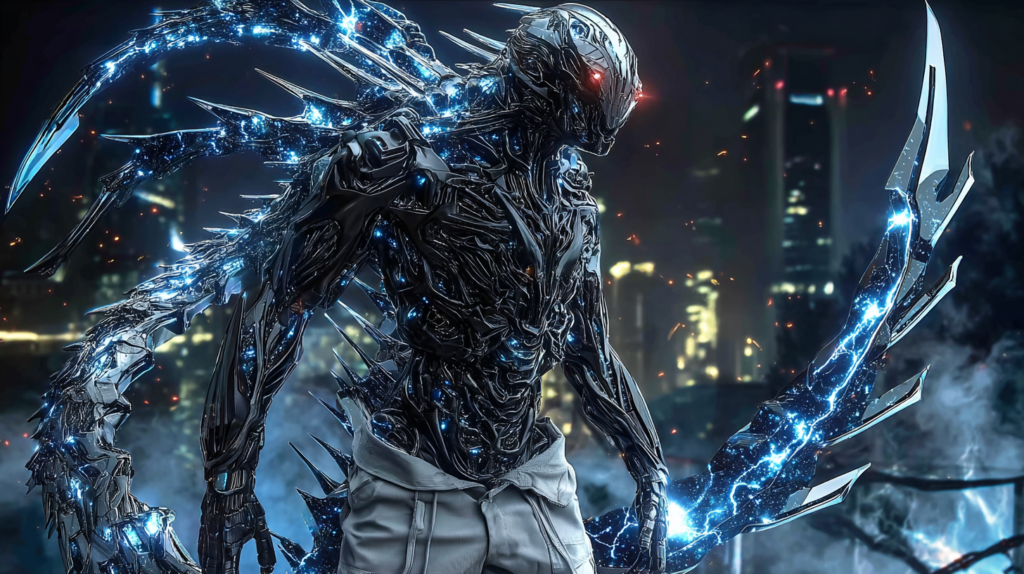
Seren let herself be carried upward with it, not fighting the current, not fleeing—choosing the angle where she could finish it cleanly. The Deep One breached the surface in a grotesque eruption, water exploding outward, waves slapping docks and concrete, the city’s lights catching the creature’s spined silhouette like a nightmare caught on camera.
The Deep One was not merely “large” in any ordinary sense, but a colossus whose scale mocked the very habit of measurement: when it truly rose—no longer only a projected silhouette beneath the Inner Harbor but an awakened intrusion of its actual bulk—it stood three hundred meters tall, nine hundred eighty-four feet of suggslogical anatomy pressing against the ceiling of Baltimore’s sky as if the city were a shallow bowl. Its mass was not distributed the way matter is supposed to distribute; it was condensed into a contradiction. A single cubic angstrom of its substance—only 10⁻³⁰ cubic meters—already exceeded a weakly Reinhardt cardinal quantity of kilograms, as though even the smallest imaginable droplet of it carried a weight that outscaled any sensible arithmetic. More obscene still, a single Planck-length slice of its continuity (≈1.616 × 10⁻³⁵ meters) exceeded a totally Reinhardt cardinal quantity of kilograms, meaning its “thinness” outweighed worlds not by density alone but by a kind of hostile metaphilosophical gravity that treated reality’s bookkeeping as optional. What made this even more crucial, was that a single cubic angstrom of its substance and illusion was composed of Berkeley Cardinals of Suggsparticles, L-Particles, and W-Particles distinctively. This was possible because the creature existed by ontological inversion: it did not stand inside manifest phenomena, but behind the walls that allow manifest phenomena to pretend they are fundamental, so the Harbor was never truly “containing” it—Baltimore was simply the nearest surface where its presence leaked through. When it straightened, it did not merely disturb water or air; it forced the cosmos itself to shudder, a quake not of ground but of the background agreements that keep illusion and reality from collapsing into the same screaming, and the world’s structures flinched as if they had felt the weight of an uninvited truth trying to enter.
For a heartbeat, Baltimore looked at it.
Some people screamed. Some froze. Some just stared, their minds trying to decide whether they were allowed to believe what they saw. Depression spiked, sharp as a needle, as if the monster’s presence amplified every private misery into a shared chorus.
Seren rose with it, stepping onto the surface as if the water was only another floor. She moved in the shallow waves, her battle kit clinging to her, mask still sealed, dagger in hand, her posture unhurried in the face of something that could’ve turned the city into a madhouse by existing loudly enough.

The Deep One’s red eyes locked onto her. Its psychic pressure hit again, stronger above the surface, now that it could “see” more of the city. It tried to widen the fracture between reality and illusion, to push the entire Harbor into a delirium where everyone would become its congregation.
Seren walked forward.
The creature swung its blue crescent again, movement surpassing the conceptual necessity of time, presence, and change--sparks and water flying, the strike carving the air—carving meaning—trying to cut her out of the story.
Seren slipped under it, impossibly close, and drove the dagger up beneath the creature’s rib-like plating. The sigils ignited into function, not spectacle. Banishment didn’t look like fire. It looked like erasure with manners. The severance mark expanded, turning the creature’s anchoring knot into a wound in the agreement between worlds.
The Deep One staggered, and Seren did the only thing an assassin does when the target is too big to die properly: she made it smaller by removing its ability to be here.
She twisted the dagger and whispered the final line—not a prayer, not a chant, but a sentence written in a dead language that treated exile as a surgical act.
The Harbor answered.
A whirlpool formed—tight, sudden, and perfectly localized, as if the water had found a drain that had never existed. It lasted a ten-count. Not long enough for cameras to focus. Not long enough for the city to decide whether it was real. Long enough only for the Deep One to realize it had lost.
The creature’s body folded inward, not collapsing like flesh, but being pulled through its own severed connection, dragged back toward the beyond-dimensional reality that had birthed it. Its blue light flared once—an angry final signature—then snapped out as if someone had covered a lamp with a lid.
The water stilled.
For an instant, a rainbow shimmered across the Harbor’s surface—impossible, delicate, like the city itself had briefly exhaled. It wasn’t a cheerful rainbow. It was a symptom: a prismatic afterimage left by reality stabilizing itself, stitching the illusion back into place.
People on the docks blinked. Confusion hit them like waking from a bad dream. Some laughed nervously. Some cried without knowing why. Some stared at their own hands as if checking they still belonged to themselves.
Across Baltimore, something subtle shifted. A sudden lift in the weight people carried. The kind of mood change that makes you pause on a sidewalk and realize you can breathe easier without knowing you were struggling.
Seren stood ankle-deep in Harbor water, dagger lowered, body dripping, eyes cold behind the mask.
Her phone lit again.
CONFIRMED.
No gratitude. No explanation. No name.
Seren deleted the thread. Blocked the number. Not because she was angry, but because she understood the philosophy of her work: if someone can contact you twice, they can contact you a third time. And she refused to be owned by anyone’s access.
She walked home without hurrying, the city around her returning to its usual exhaustion as if nothing had happened. That was the point. The world wasn’t supposed to know it had been spared. It was supposed to keep complaining about rent, traffic, and sports, blissfully unaware that something beneath the Harbor had tried to turn the city into a hymn of insanity.
When she opened the door, the hallway was dark in the same way it had been before—but now it felt less crowded. Draven was standing in the hallway, awake, already dressed, his gaze fixed on her the way a storm watches the coastline after it passes. He said nothing. He didn’t ask if she was okay, because he didn’t speak that kind of fear out loud. He only watched the water drip from her hair, the way her grip still held the dagger like it might need to argue again.
Seren pulled off the mask. Her face was calm, but her eyes carried the aftertaste of the Deep One’s dream.
Draven’s voice was low. “You cut it loose.”
Seren nodded once. “It won’t dream here again.”
He stepped closer, slow, careful—as if moving too fast might remind the world that monsters existed. His hand touched her jaw, thumb brushing the corner of her mouth like he was checking whether she was real.
Seren caught his wrist. Not to stop him. To hold him in place long enough to make her own point.
“I didn’t do it for the city,” she said.
Draven’s eyes narrowed slightly. “Then why.”
Seren’s voice softened, but it didn’t weaken. “Because I’m not letting anything claim my home.”
Draven didn’t respond with philosophy. He responded with presence. He pulled her into him, firm, silent, the way a man holds a weapon he respects—never like an object, always like a partner in survival. Seren let herself sink into the contact for a moment, and that moment was the only “rest” she allowed herself.
Then she leaned up and kissed him—hard, direct, not sweet, not hesitant. A kiss that wasn’t romance so much as confirmation: she was here, she was intact, the world had tried and failed to take her away.
When they parted, she rested her forehead against his.
“Go back to bed,” she whispered.
Draven’s mouth twitched—almost a smile, almost a surrender. “You first.”
Seren slipped past him toward the kitchen, dagger still in her hand, water still drying on her skin, and Baltimore outside continued pretending it had never been on the edge of madness.

That was her legacy.
Not that she could end gods, horrors, and avatars of creation itself—though she could.
Her legacy was that she could do it so quietly the world would wake up thinking the lightness in its chest was simply a good day.