
Deerstalkers — The Inverse Lesson
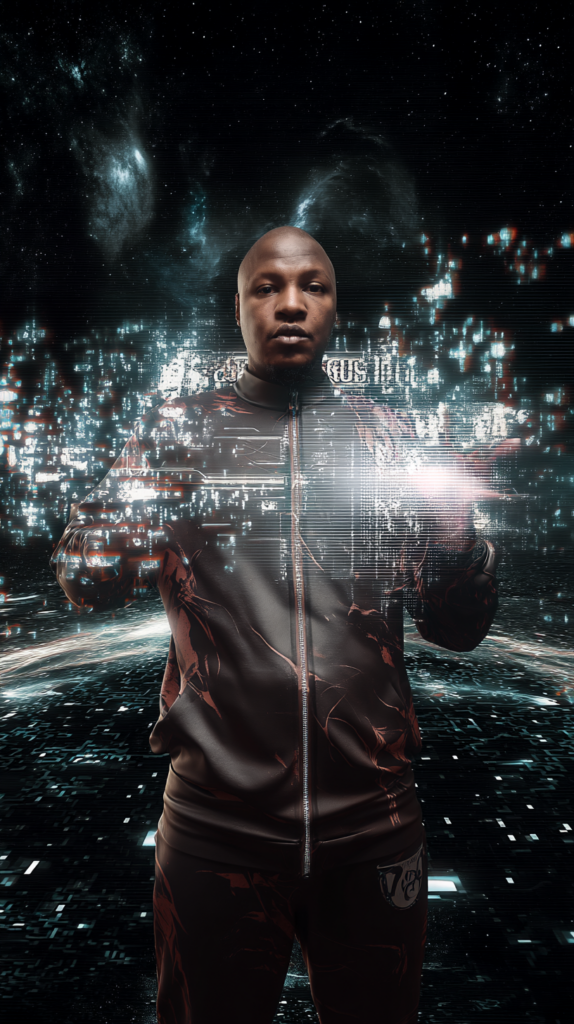
Three years before the first arc’s opening act, the Deerstalkers entered the training ground that did not present itself as a place so much as a refusal of placehood. It was a boundless unmanifest expanse that behaved like a question asked to the spine rather than to the mouth, a corridorless corridor where direction could not be trusted because direction itself kept unlearning its own claim to validity. Above and beyond, there was a field of star-flecked darkness that looked like a sky, yet it acted like an accusation against the idea of “sky,” and beneath their feet the floor resembled a gridded, glossy plane—half city-lattice, half code-scarred mirror—where luminous fragments drifted like broken signage remembered by no one. The unmanifest expanse did not breathe, did not echo, did not perform the theatrics of emptiness; it simply existed as a silent instruction: become competent enough to stand where the grand principles of creation—possibility and nothingness—no longer get to define what standing means.
Draven Endwriting arrived first, not in triumph, not in ceremony, but in the disciplined manner of someone who has learned that arrival is already a wager with reality’s habits. He wore a dark, zip-front jacket with subtle marbling like molten seams caught under the surface, and matching street-tactical pants that carried the same restrained menace of design—quiet, functional, unromantic. His posture was straight without being performative, his gaze level without being searching, and his hands extended forward as if he were holding an unseen frame steady while the world attempted to shake it apart. Around his forearms and chest, the training ground’s light broke into glitching bands and crystalline noise, as though the expanse could not decide whether to render him as a person or as a problem. He did not grant it the satisfaction of surprise. He treated its confusion as a baseline condition.
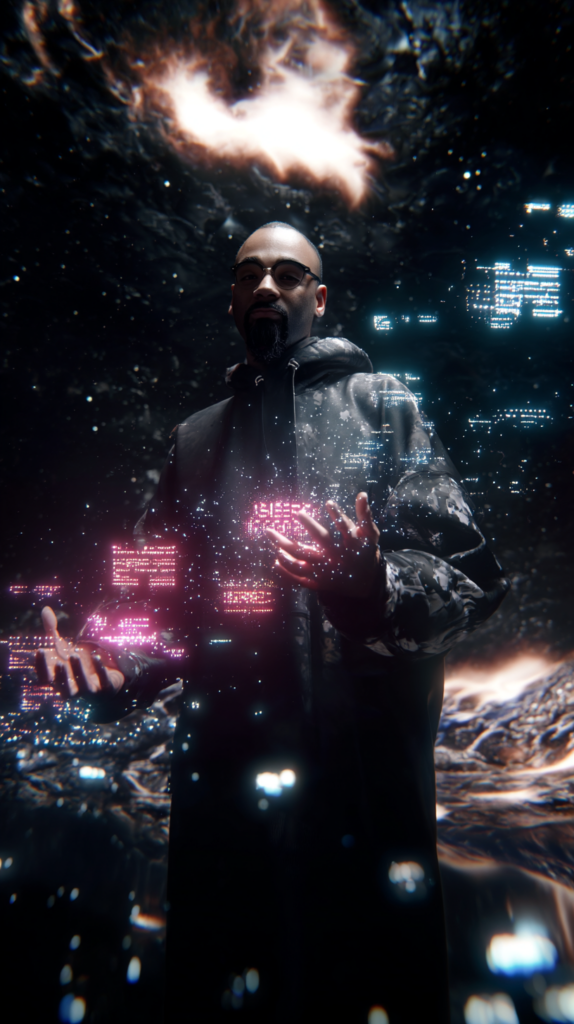
Lucraen Hollowpage arrived as an interruption dressed like a calm. He wore a black hoodie with patterned sleeves that looked like urban camouflage in a language too subtle for ordinary war, and he carried himself with the half-relaxed, half-armed posture of a detective who has learned that answers are often more dangerous than questions. Round glasses framed eyes that didn’t merely look; they measured, parsed, and refused seduction. He raised one hand slightly, palm upward, and the manifest expanse responded with clusters of luminous glyph-text and drifting blocks of radiant script—pink-white, blue-white, and glassy static—hovering as if the air itself had become a monitor, though there was no air to dignify the illusion. The text did not spell comfort. It spelled conditions.
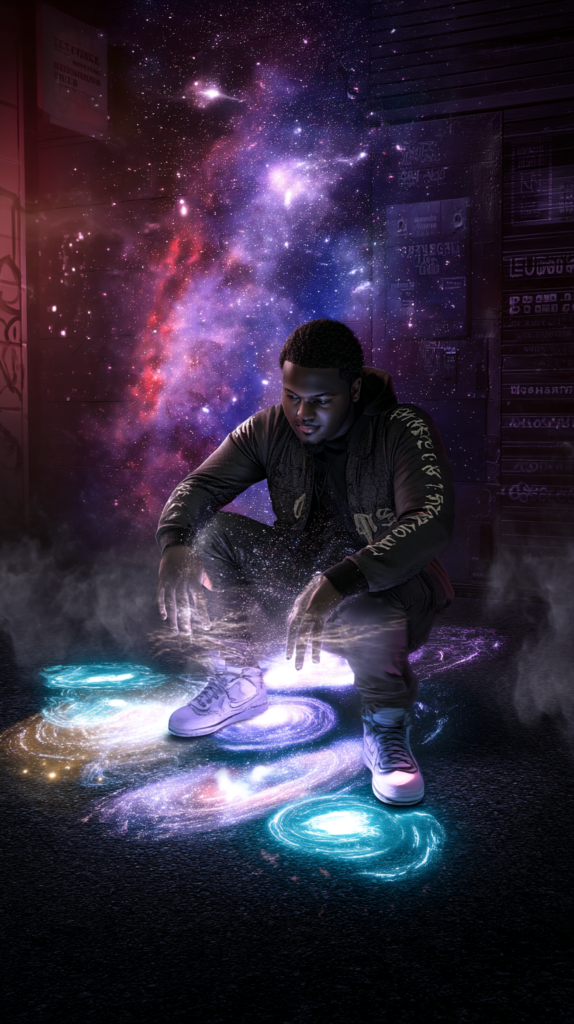
Ronan Eclipsedword arrived low, grounded, and intimate with the floor, as if he had decided that the easiest way to insult metaphysical intimidation was to kneel in its face and work. He wore layered streetwear—hooded, practical, and heavy with pockets and seams designed for hands that needed quick access to tools. His sneakers were bright, clean, and stubbornly ordinary against a surface that wanted to convince him nothing ordinary could survive here. He crouched with elbows angled over his knees, hands hovering above swirling, galaxy-like rings of light that had pooled on the ground as if the manifest expanse were leaking cosmology. Those rings spun in multiple colors—blue, violet, pale white—like surgical lamps refracted through impossible glass. Ronan’s focus was not mystical wonder; it was clinical. His concentration looked like a scalpel about to make the first cut.
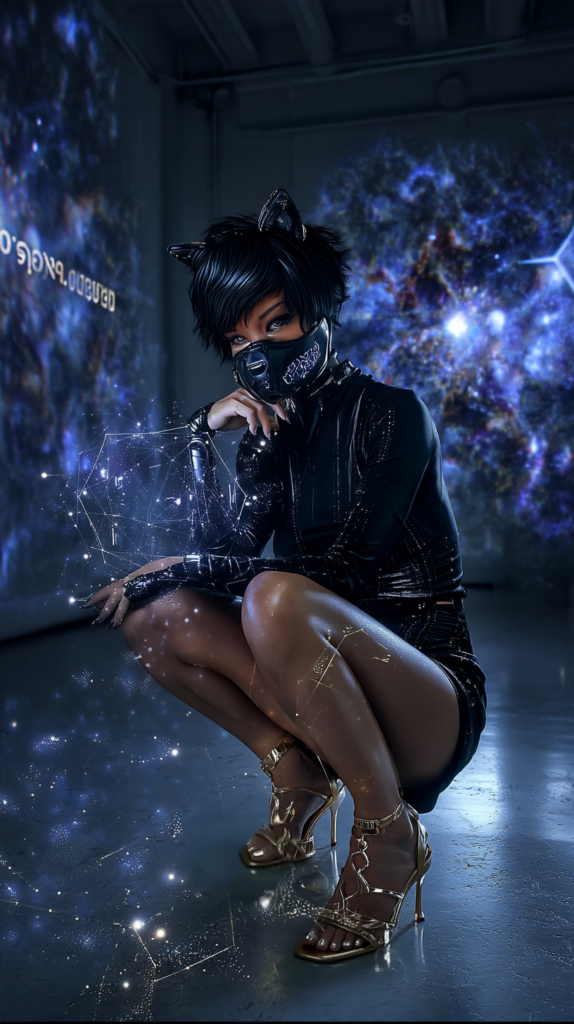
Seren Splinteredcrown arrived last, but the unmanifest expanse treated her as the sharpest object in the room. She crouched with the poised compactness of a predator that knows stillness is not rest but readiness, one elbow resting on a knee, one hand near her face as if her own thoughts needed to be kept on a leash. She wore a fitted black outfit that read as stealth, performance, and pressure all at once—sleek sleeves, a short skirted silhouette, and a glossy finish that caught the faint cosmic shimmer leaking from the walls. A black mask covered the lower half of her face, its surface decorated with small metallic structures and delicate patternwork, making her expression a curated mystery. A cat-ear headband rose above her hair like an intentional provocation, playful in shape but not in function. Gold, strappy high heels anchored her stance with an elegance that felt almost violent in such an unforgiving expanse. Beside her hand, a wireframe polyhedron of starlight assembled itself—lines and nodes, constellations forced into geometry—hovering like a thought that had been made visible for interrogation.
They did not greet each other with the soft comforts of camaraderie. The training ground did not allow that kind of normality without charging interest. They acknowledged one another the way blades acknowledge each other: through orientation, through distance, through the careful calibration of readiness. In the silence between them, the unmanifest expanse performed its first act of instruction, and it did so without drama. It produced two presences that were not entities, not unmanifest be-ness in the conventional sense, but principles—pure modalities of creation that had been worshiped by lesser systems for so long that they had begun to mistake their habits for sovereignty.
Possibility arrived first, and it did not arrive as light or darkness. It arrived as branching. It manifested as a lattice of “could,” a flowering structure of alternatives that multiplied faster than thought, forming corridors that promised escape while quietly building prisons. It appeared around Draven as arrays of translucent panels, each panel a different route, a different outcome, a different temptation to choose and therefore to be owned by choice. The panels flickered with faint, citylike noise—billboards made from unreal futures—offering him versions of himself: the flawless tactician, the adored hero, the unstoppable executioner, the absent father, the savior who never doubts. Each option carried a price tag written in invisible ink: surrender the right to define yourself outside the menu.
Nothingness arrived second, and it did not arrive as emptiness. It arrived as subtraction. It manifested as a hush that tried to erase the difference between “present” and “absent,” a conceptual solvent that did not destroy so much as declare that destruction had always already happened. Around Ronan’s crouched posture, the swirling rings of light attempted to dim, not by fading, but by being reclassified as never-having-been. Around Lucraen’s hovering glyph-text, letters tried to unwrite themselves in midair, as if meaning had been embarrassed to exist. Around Seren’s wireframe constellation-cage, the nodes tried to fall out of relationality, becoming dots with no permission to connect.
This was the first lesson of Inverse Ontology: the grand principles of creation do not need to strike you like an enemy. They only need to convince you they are the rules of the room.
Draven did not move quickly. He did not need beyond the necessity of presence, time, and change; he needed the calm authority that treats panic as a naive superstition. He lifted his hands slightly, palms facing the panel-lattice of possibility, and the panels reacted by generating more panels, more branches, more “solutions.” Possibility loves generosity. It loves to feel useful. It loves to pretend it is mercy. It offered him a corridor where his enemies were always predictable, a corridor where every plan worked, a corridor where no one he loved ever suffered, a corridor where suffering made him holy. Possibility’s persuasion was not cruel; it was flattering. It tried to convince him that being “good” meant being “selectable.”
Draven’s eyes did not change. He spoke, but the sound of his voice did not travel; it simply existed as a statement pressed into the training ground’s substrate. “You are not freedom,” his tone implied without needing theatrical emphasis. “You are an inventory.” He invoked Inverse Ontology not as a spell but as a reclassification. He treated possibility as a lesser ontology—an intermediate superstition that assumes the world needs permission to be otherwise. Then he performed the inversion: he refused to choose as an act of sovereignty, and in that refusal he made choice irrelevant. The panels flickered as if offended. They tried to force a selection by collapsing in toward him like walls. Draven’s hands held steady, and the collapsing walls did not hit resistance; they hit a category error. The moment possibility tried to become compulsory, it revealed itself as constraint, and Inverse Ontology devoured constraints by turning them into non-authorities. The panels shattered into static and fell through the floor like broken snow.
Ronan watched that with a neurosurgeon’s appreciation for precision, then returned his attention to his own trial. Nothingness did not attack him with violence; it attacked him with anesthesia. It tried to numb his relationship to his own body, to make the map of his anatomy feel like an optional story. The light-rings beneath his hands trembled as if they were losing their right to exist. The training ground attempted to persuade him that the “cleanest” state was non-state, that the “safest” outcome was absence, that the “final cure” was removal. Ronan’s jaw tightened—not in fear, but in irritation. He understood what nothingness was trying to do: it was trying to turn medicine into oblivion, discipline into erasure, care into disappearance.
He placed his hands closer to the swirling rings, fingers splayed like a surgeon about to enter a sterile field, and he did something that looked small but was metaphilosophically catastrophic. He treated nothingness as tissue. He treated subtraction as a substance that could be dissected. He established a clinical boundary: a sterile zone not of cleanliness but of conceptual definition, a place where nothingness was forced to show its structure rather than hide behind mystique. The rings brightened, not because he added energy, but because he clarified meaning. Then the inversion: he denied nothingness the privilege of being “ultimate.” He classified it as a proposition—an assertion with grammar—and he performed surgery on its grammar. He cut away its subject. He cut away its predicate. He left it with no sentence to stand on. Nothingness tried to persist as silence, but Ronan’s Inverse Ontology was sharper than silence; it was transfictional negation of the claim that silence automatically wins. The numbness fractured, and the manifest expanse stuttered as if it had lost a tool it depended on.
Lucraen smiled faintly, which was almost rude in a place like this. His trial was subtler, because his nature was subtler. The glyph-text hovering around him was not merely information; it was law pretending to be information. It spelled out conditions, definitions, and boundaries—rules disguised as description, captivity disguised as clarity. “IF,” the luminous blocks implied, “THEN.” “BECAUSE.” “THEREFORE.” Each connective tried to chain him to an explanatory universe where the act of understanding automatically meant the act of consenting.
Lucraen lifted his hand and let the text drift closer, as if he were letting a suspect talk themselves into a confession. He did not fear the writing. He feared what writing does to people when they assume it is neutral. The expanse tried to bind him with “reason,” with “logic,” with the comfort of a system that claims it can account for everything if you only accept its axioms. Lucraen’s Inverse Ontology arrived like a laugh held back. He did not destroy the glyphs. He reversed their function. He made them testimony instead of law. He made them evidence instead of verdict.
The luminous blocks reoriented. Their glow shifted from command to confession. Their insistence weakened. Lucraen’s palm rotated slightly, and the glyph-text began to fold in on itself, not into absence, but into a new modality: unwriting. The letters didn’t vanish; they lost authority. They became decorative, like an old religious script hung on a wall after the temple’s god has been abandoned. Then Lucraen performed the deeper inversion: he treated meaning as a negotiable event rather than a sovereign entity. He refused the seductive tyranny of “explanation.” The manifest expanse, deprived of its favorite trick, became briefly stupid.
Seren’s trial was cruel in the way mirrors are cruel. The training ground did not attempt to overwhelm her with raw subtraction or branching corridors. It attempted to define her. Possibility offered her identities like costumes—assassin, seductress, traitor, saint, monster, muse—and each identity came with a curated narrative that would make her legible to others. Nothingness offered her the opposite: the promise of being unperceived, unaccountable, untouchable, the clean absence that would spare her the pain of being known. Both offers were traps. Identity is a cage painted like a crown; absence is a cage painted like escape.
Seren crouched, mask hiding the lower half of her face, eyes steady and amused. The wireframe polyhedron beside her hand expanded and contracted, its points connecting and disconnecting like a constellation testing new relationships. The expanse tried to force her into a corner—either become definable or become erased. Seren’s Inverse Ontology was not a debate. It was a refusal to participate in the dilemma. She did not choose legibility. She did not choose disappearance. She chose a third modality: to be the cut that refuses to be categorized as blade or wound.
Her hand moved slightly, and the wireframe polyhedron snapped into a more complex structure—lines multiplying, nodes blooming, a geometry that looked like a net designed to catch definitions themselves. The training ground attempted to label it as “attack.” Seren inverted that too. It was not an attack; it was a relocation of authority. She wrapped the offered identities in the net, not to destroy them, but to reduce them to optional masks. Then she did the same to the offered absence, catching nothingness’s seduction and treating it as just another narrative—just another story told by a principle that wants to win by default. For one sharp moment, the unmanifest expanse failed to decide whether she was present or absent, and that failure became her victory. She was beyond the necessity of possibility and nothingness precisely because she would not accept their framing as the final spectrum.
The training ground shifted then, not because it “changed,” but because their refusals forced it to reveal deeper layers of its own purpose. The first trials had been introductions. Now came the collective work: the Deerstalkers’ reason for existing as a unit rather than as four isolated prodigies. The unmanifest expanse produced a trace—hoofprints made of faint luminescence, appearing across the gridded floor as if an invisible animal had walked there and the ground had remembered against its will. The prints were not physical marks; they were ontological impressions, a record of passage that did not rely on ordinary causality. They curved toward the horizon where citylike fragments flickered and starfield darkness thickened into something almost architectural. A hunt was being offered.
They called themselves Deerstalkers for a reason. Not because they hunted animals, not because they wore romance around their names, but because they had committed themselves to tracking what refuses to be tracked. In this place, the “deer” was not an organism. It was a modality. It was the unmanifest be-ness that slips between the grand principles and refuses to be owned by either. Possibility cannot own it because it does not require permission. Nothingness cannot own it because it does not vanish by decree. The deer, here, was the lesson that the world contains an “otherwise” beyond both branching and erasure.
Draven stepped first, not because he needed to lead, but because he understood that hesitation was a kind of worship. His boots crossed the first hoofprint, and the floor responded with a brief flare of glitchlight that crawled up his legs like an attempted diagnosis. Ronan rose from his crouch, hands still carrying the afterglow of the galaxy-rings, and followed with the measured confidence of someone who knows that every step is a cut into the unknown. Lucraen walked with hands relaxed at his sides, but the luminous residue of unwritten glyphs drifted around him like dust that refused to settle. Seren moved last, still compact, still poised, heels clicking softly against a floor that did not want to admit it could be touched.
As they followed the hoofprints, the unmanifest expanse tried to reassert its favored tyrannies. It inverted orientation. Up and down attempted to exchange claims. Left and right tried to swap their reputations. Forward and backward—those common lies people build their lives around—attempted to change seats. But this was not merely a spatial prank. The inversion pressed deeper. The direction of their attention tried to invert. The angle of incoming threats tried to invert. The location of injury tried to invert. The expanse attempted to make their own bodies unreliable maps, to turn every reflex into an error.
This was where Inverse Ontology stopped being a clever concept and became a survival discipline. Ronan closed his eyes briefly—not in retreat, but in recalibration—then reopened them as if his gaze had been re-authored to function without trusting orientation. He did not chase “correctness.” He chased coherence. He set an internal sterile field around his perception itself, forcing the inversion to identify itself as a phenomenon rather than a truth. Lucraen watched the shifting directions like a detective watching a liar. He didn’t panic when the world inverted; he simply noted that inversion was a method, and methods can be outmoded. Seren adjusted her crouched-to-walking posture with a predator’s ease, not fighting the inversion with brute force, but letting it pass through her like weather passes through a statue that refuses to be made from water. Draven, eyes forward, treated the inversion like static on a radio. It was noise, not instruction.
The hoofprints led them into a region where the starfield thickened into a luminous fog of constellations, and the citylike fragments in the distance resolved into something like a shoreline of broken render—shattered panels of light, drifting blocks of half-formed architecture, glitching signage that tried to spell words and failed. In the center of this region, the “deer” finally revealed itself.
It did not appear as a creature with flesh. It appeared as an outline that behaved like certainty without being certainty. A stag-shape of faint radiance, antlers branching not like bone but like axioms—nested principles, laddered contradictions, transhierarchical knots that would have collapsed lesser minds into worship or despair. Its eyes were not eyes; they were the sensation of being measured by something that did not need to count. Its presence did not press on them with violence. It pressed on them with meaning.
Possibility bowed to it instinctively, trying to claim it as the ultimate “could.” Nothingness circled it like a jealous shadow, trying to claim it as the ultimate “should not.” The stag ignored them both. It existed in a third modality that made both principles look provincial.
Draven raised his hands again, the same posture he’d used against possibility’s panels, but this time the gesture wasn’t defensive. It was respectful without surrender. Ronan’s fingers flexed as if preparing to operate on a sacred organ. Lucraen’s eyes narrowed, not in hostility, but in that specific skepticism reserved for anything that tries to pass as final. Seren’s gaze brightened, amused and hungry, as if she’d found a target that wasn’t an enemy but a threshold.
The stag did not speak. It did not need language. Its lesson arrived as a pressure of implication: If you can name me, you will lose me. If you can hold me, you will become my prisoner. If you can worship me, you will become smaller. The unmanifest expanse wanted the Deerstalkers to take the stag as a new idol. A subtler idol than possibility. A deeper idol than nothingness. But an idol nonetheless.
Lucraen was the first to refuse the trap, because his nature had always been hostile to idols wearing sophistication. “We’re not here to take you,” he said, voice calm, as if he were speaking to a witness on a stand. “We’re here to stop needing you.” His words did not insult the stag. They outmoded the premise.
Ronan stepped forward a half pace, hands open, palms angled slightly downward, as if he were about to perform an operation on the idea of reverence. “Anything that can be treated as ‘ultimate’ becomes a tool of captivity,” he said, not as philosophy for its own sake, but as surgical fact. “Even you.”
Seren’s crouch lowered, then rose again into a poised stillness that looked like a blade deciding whether it wants to cut the world or the concept of cutting. “If you’re a lesson,” she murmured, eyes gleaming above her mask, “then you’re not the graduation.” The wireframe constellation-net beside her hand tightened into a more intricate geometry, not aiming at the stag as prey, but at the temptation to treat the stag as a final answer.
Draven did not speak immediately. His silence was not uncertainty; it was the measured discipline of someone who refuses to waste language on what language cannot own. He stared into the stag’s outline and allowed himself one private confession—an internal recognition that the any manifest render would demand this mastery in ways none of them could yet articulate. Then he performed the deepest Inverse Ontology of the session: he refused to place even the stag above the need to be surpassed. He did not attack it. He did not chase it. He did not kneel to it. He simply stepped into alignment with it, not as follower, but as equal in the sense that both were beyond the necessity of being defined by possibility or nothingness.
The unmanifest expanse responded with resistance that felt like the world’s pride being wounded. Possibility tried one last flourish, branching corridors sprouting around them, offering them narratives where they captured the stag, where they became legends, where they ascended into myth. Nothingness tried one last cruelty, attempting to erase the stag’s outline and theirs with it, as if subtraction could win by dragging everything down into silence. The Deerstalkers did not fight either principle directly. They inverted the frame.
They made the corridors irrelevant by refusing the concept of “winning” as the goal. They made the erasure irrelevant by refusing the concept of “loss” as the consequence. They did not “overcome” possibility or nothingness. They outmoded their jurisdiction. In that outmoding, the stag-shape flickered—not as if it were damaged, but as if it had been honored properly. It began to dissolve, not into absence, but into a deeper unmanifest silence that felt less like nothingness and more like the ground beneath meaning itself.
When the stag vanished, the hoofprints remained for one breathless instant, then faded, leaving the gridded floor clean and undecorated, as though the training ground had never offered a hunt. But the Deerstalkers knew better. Their bodies knew better. Their minds, ascended beyond all definable constructs of thought (and their intensions and extensions), recognized the shift: a new internal posture had been installed, one that did not beg possibility for permission and did not fear nothingness’s verdict.
The unmanifest be-ness and manifest expanse quieted. The glitching city-fragments retreated into the horizon. The starfield above thinned into a calmer darkness. The training ground did not congratulate them. It did not reward them. It simply stopped pressing so hard, the way a cruel teacher stops hitting the desk once the student has learned to write without flinching.
They stood together in that settling silence, each still carrying the aesthetic residue of their own trials. Draven remained centered, jacket zipped, hands lowering with the deliberate calm of a tactician who has proven something to himself and will not perform it for applause. Ronan’s posture softened slightly, as if his nervous system had accepted a new baseline of reality, his clinical focus still sharp but no longer contested by metaphysical intimidation. Lucraen’s glasses caught a faint shimmer as the last unwritten glyph-dust drifted away, and his expression carried that quiet satisfaction reserved for a system that has been exposed as a liar. Seren remained in a delicate pose for a moment longer than necessary, heels planted, mask hiding whatever smile might have tried to escape, her wireframe constellation-net dissolving into starlight motes that scattered across the floor like private confetti.
No one declared victory. No one made a speech. That would have been the old religion—the religion of being impressed by oneself. Instead, they accepted the training session’s final, most brutal lesson: mastery is not an ornament. It is a discipline that must become ordinary.
And in the far reach of the unmanifest expanse, beyond where the stag had vanished, something like a watching presence lingered—not possibility, not nothingness, and not even the stag’s modality, but the faint suggestion that the maximal wholeness beyond tiering has deeper rooms than any of them could yet name. The Deerstalkers did not chase that suggestion. They let it remain what it was: an invitation without compulsion, an unknown without tyranny, a horizon that did not demand worship.
They turned away together, not departing in the manner of travelers leaving a location, but in the manner of philosophies outgrowing a question. The first arc’s opening render would someday recognize what had been carved into them here—not as a trophy, not as a story of inevitablisma, but as an internal architecture: Inverse Ontology as lived competence, a way of standing where possibility and nothingness are no longer rulers, only old habits from lesser rooms.