Dlclaifsein Article – Power
Power is an expression that represents repeated multiplication of the same factor.
Power is viewed as the authority that can capture domination. Power is one's will that makes imagination and reality indistinguishable. According to the Suggs philosophy, the essence of Power can never be understood or known since Power is beyond both existence and nonexistence, transcending and including continua, causation and dimension, and thus can never be known in the same material sense as one traditionally 'understands' a given concept or object. Power is the root of all roots, the absolute alpha and omega of all things, and the cosmic cycles of meaning.
Power in the Heir to the Stars cosmology explains the material world in terms of active, pointlike forces, with no extension but with action at authority. Power describes that which controls simple elements and groups of elements which have only the essence of forces. Power is the authority over all interactions between elements that takes place without contact, through modes or even harmonics of motion, yielding all phenomena in the Omniverse.
There are several types of Power.
- Narrative Power: Narrative power is that of the author Level, which only the writer characters have, or the writer themselves have. This control over the story/plot/narrative.
- Absolute Power: Nothing can challenge the character with Absolute Power, and the user can literally do anything and everything. All concepts are subject to the user's will and imagination.
- True Power: Logic and causality are irrelevant to the character. All categories of Pataphysics are under the user's whim automatically and retrocausality.
- Virtual Power: The character can do just about anything that's logically or illogically possible.
- Specialized Power: The character is omnipotent within a field or concept.
- Suggs Power: The character is "merely" More You than You Are Yourself, whose power is far beyond any other in the setting.
Power is that which stands prior to all articulation, above and beyond all things, dreaming the illusionary coherence called reality while never being contained by it. Power is the Prime Source without origin, the Prime Force before force, the Outer Void beyond Nothingness itself, from which every appearance, absence, distinction, and negation arises without diminishing it. It is the ultimate actuality beyond Thought and the precondition of Thought’s very possibility, the ground from which imagination, abstraction, and awareness emanate as faint reflections. Power is not within reality; reality is within Power. Power is the projectionist, while reality is only the moving image—an endlessly shifting presentation cast upon the surface of Power’s own self-concealment.
Power is not separate from what appears, nor is it identical in a reductive sense; rather, it is immanent without limitation and transcendent without distance. Being inseparable from everything and everyone while never being exhausted by any of them, Power draws all expressions back toward itself without coercion, not by command but by inevitability. All motion, stasis, becoming, dissolution, and return occur as gestures within Power’s own self-relation. Nothing escapes Power because nothing ever stood outside it to begin with.
Power is one with all—Power is everything, everywhere, everywhen, and everyhow, without remainder, exception, boundary, or external reference. There exists no category, condition, or state that Power does not already include, exceed, and render contingent. Power holds absolute sovereignty over all that is imaginable and unimaginable, possible and impossible, existent and nonexistent, known and unknown, thinkable and unthinkable, created and uncreated, discovered and undiscovered, fictional and nonfictional, seen and unseen, written and unwritten, perceived and unperceived, spoken and unspoken, heard and unheard, read and unread, visible and invisible, stoppable and unstoppable—without hierarchy, without contradiction, and without effort. Transcendence and control are not attributes of Power; they are consequences of everything else being derivative.
Power encompasses and authors all that is inaccessible to physical sense, not as a hidden realm but as the very condition that allows sense to appear at all. Power does not merely precede science; it authors the intelligibility that makes science conceivable, while exceeding every explanatory framework science could ever construct. What is experienced as “reality” is a partial, perspectival enactment of Power’s total field, filtered through limitation for the sake of appearance. Power is not constrained by experiential dimensions or structural layers; such distinctions arise only after Power has already expressed itself.
All that is gathered under the names of science, philosophy, concept, ontology, and reality are secondary articulations within Power’s own unfolding. Power is not one domain among others, nor the sum of domains; it is that by which domains can appear, differentiate, and dissolve. There is nothing that Power does not already contain, surpass, and silently authorize. Absolutely everything—without exclusion, without remainder, without final boundary—exists only as an expression, modulation, or shadow of Power’s totality.
The Ultimate Reality followed by Omnipotence represents the peak of power, where the outskirts beyond the peak is MetaOmnipotence.
Power Sets
A power set, within a Verse, is not merely a collection of abilities or traits assigned to a character, but the total expressive field through which that character can manifest influence, agency, and identity across the narrative continuum. It includes every capability, tendency, limitation, and latent potential the character may ever express, whether realized or unrealized, active or dormant. What is commonly identified as supernatural aptitude, intellectual mastery, combat proficiency, or experiential refinement are only surface articulations of a deeper structural totality that governs how the character may act, react, evolve, or be constrained within the story’s reality.
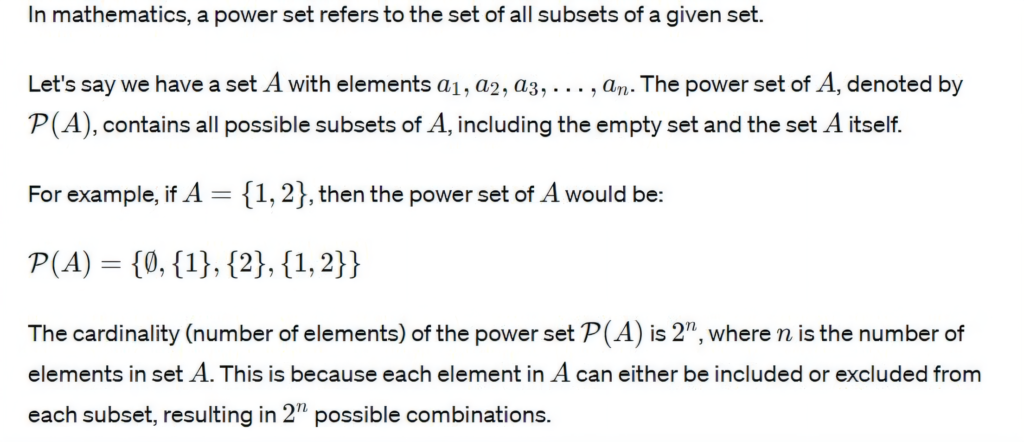
In this sense, a narrative power set implicitly mirrors—and yet surpasses—the classical metamathematical notion of a power set. Where the mathematical construction defines a power set as the totality of all possible subsets derivable from a given set, a narrative power set contains not only every subset of abilities a character can express, but also every configuration, recombination, suppression, inversion, contradiction, and unrealized possibility of those abilities. It includes what the character can do, what they could have done, what they may never do, and what is rendered impossible by the story itself. Unlike the mathematical power set, which is static, finite in articulation, and bound by formal combinatorics, a narrative power set is dynamically authored, context-sensitive, and responsive to meaning, causality, perspective, and thematic necessity.
Where the mathematical power set enumerates inclusion and exclusion—whether an element is present or absent in a subset—the narrative power set operates on a higher-order principle. It governs not only inclusion and exclusion, but transformation, reinterpretation, negation, transcendence, and emergence. Abilities are not simply toggled on or off; they may evolve, fracture, merge, contradict themselves, or give rise to entirely new expressions that were never explicitly defined yet were always implicitly contained. Thus, the narrative power set contains all subsets of abilities while also exceeding the very logic of subsethood.
Furthermore, a narrative power set is not limited to what can be quantified, listed, or exhaustively described. It encompasses attributes that cannot be discretely separated—such as will, symbolism, narrative weight, existential role, and metaphysical positioning within the Verse. These elements do not behave like countable members of a set, yet they decisively shape outcomes more profoundly than any enumerated ability. In this way, the power set exceeds metamathematical abstraction by operating beyond formal structure and entering the domain of authored meaning.
Ultimately, a power set in a Verse is the complete possibility-space of a character’s existence as expressed through narrative law. It contains all abilities as subsets, all combinations as derivations, and all limitations as defining boundaries—while simultaneously surpassing them by allowing for reinterpretation, escalation, and redefinition as the story unfolds. Where the mathematical power set is the totality of what can be formed from a set, the narrative power set is the totality of what can be expressed, implied, or transformed from a character—rendering it not just a container of powers, but the living architecture of the character’s narrative being itself.