
ECLIPSE III — The Deacon of the Unmade Choir
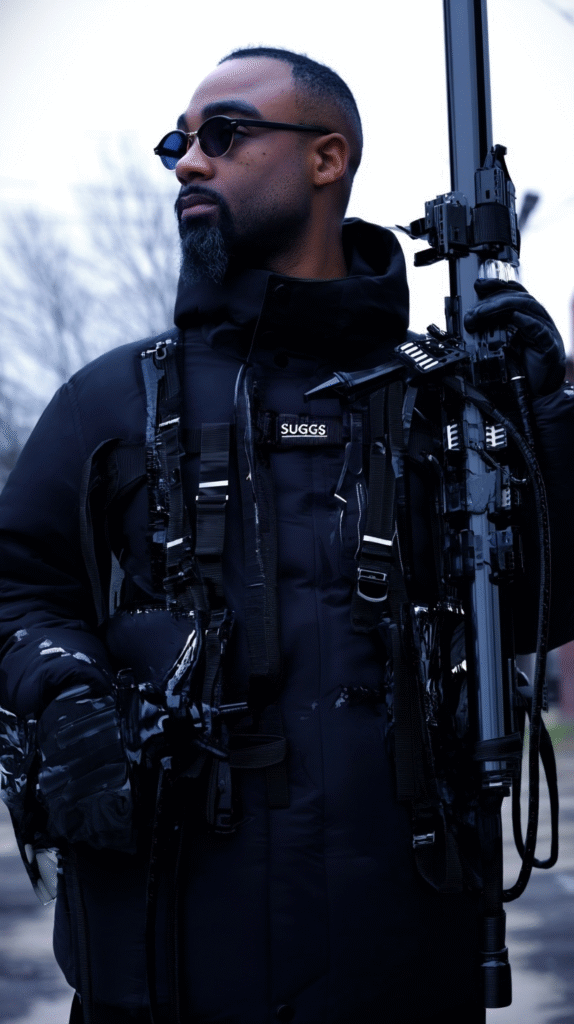
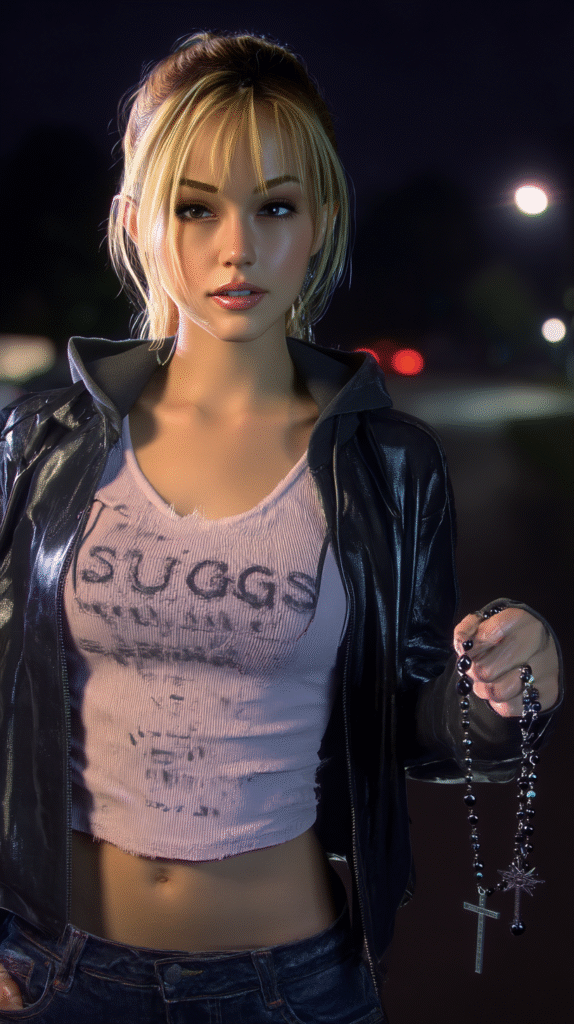
The closer Lucraen and Mira moved toward Saint Meridian, the thicker the night became—like the darkness itself was souring, coagulating, learning new ways to breathe. It wasn’t just quiet anymore; it was expectant. The kind of silence that means something enormous is holding itself perfectly still, just long enough for you to wander closer.
The street narrowed into a corridor of abandoned rowhouses, their windows black, their doors ajar. Each front step looked as if someone had sat on it recently—shoes scraping the stone, elbows resting on knees—yet every home was completely empty. Furniture overturned. Photographs missing. Even the air inside each doorway smelled faintly of old hymn books and dust.
“Place feels scraped out,” Mira murmured. “Like someone took the block and gutted it with a spoon.”
Lucraen glanced at the broken stoops. “The Church has been coming through here.”
“You think Saint Meridian sends an entire congregation?”
“No,” Lucraen said, voice tightening. “It only needs one.”
Mira frowned. “One who?”
He didn’t answer.
Because saying the name was like opening a door that was better left sealed.
Instead he lifted his flashlight, scanning the row of stained-brick homes. A string of chalk sigils—crudely drawn—clung to the pavement. Kids’ handwriting. Children had tried to protect themselves.
Failed.
The sigils were broken, scraped away by long fingernails.
Their footsteps echoed louder than they should have.
Mira paused at a crosswalk where all four streetlights flickered out simultaneously, as if bowing in reverence to whatever lay ahead. The Church’s steeple began to moan in the wind, bending slightly like a crooked spine.
“You feel that?” she asked.
Lucraen stopped breathing.
The sensation pressed into his ribs like an invisible thumb.
The pressure of a presence.
A watcher.
A priest.
“The Deacon,” he whispered.
Mira’s eyes widened. “He’s really here.”
“I hoped he wasn’t. Means the Church is awake.”
She smirked. “We woke it.”
“Not intentionally.”
“That’s the fun part.”
They crossed into the empty lot behind Saint Meridian, a wide broken circle of asphalt covered in leaves and cracked prayer stones. Five burned pillars rose in a semi-circle, each etched with Latin that had long since melted into nonsense. A rotted playground sat in the corner—slides twisted like they’d been bent by invisible hands.
The air hummed.
A soft footstep echoed behind them.
Lucraen and Mira turned.
Footsteps. Slow. Heavy. The measured cadence of someone who has been walking between pews longer than anyone alive has been breathing.
A shadow separated from the darkness and began to approach.
When he finally moved into what little ambient glow remained—the faint light bleeding through the stained glass eye overhead—they saw him properly.
He was not young.
The Deacon’s face carried age the way some men carry armor: worn in, accepted, weaponized. Deep lines around the mouth, cut by years of speaking things that should never be said aloud. A close-cropped beard streaked with iron gray. Eyes like burnished metal—steady, appraising, neither cruel nor kind, just frighteningly sure.
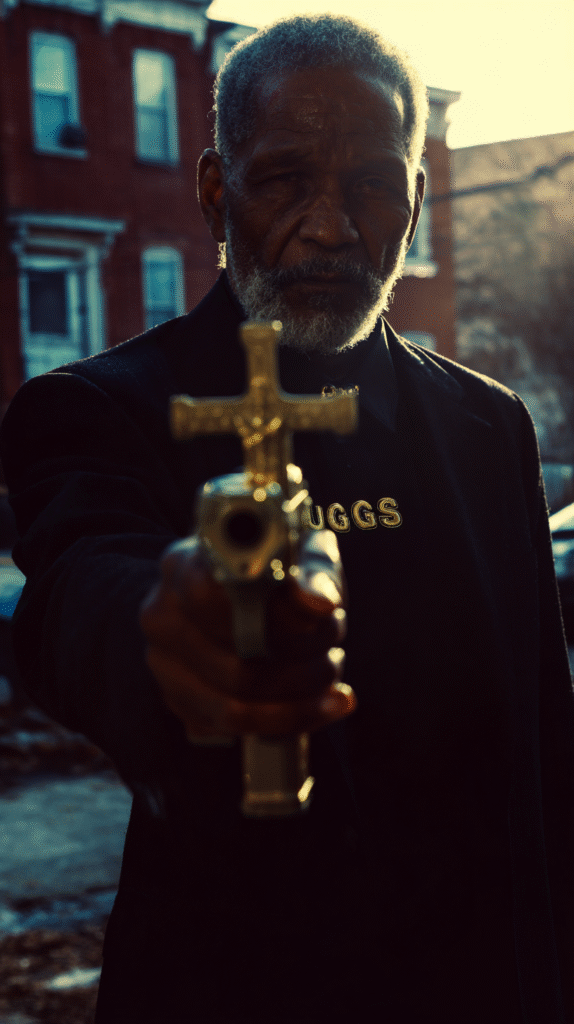
His clothing was not bright, not white, not clean-robed innocence. He wore layered vestments in dark, heavy fabric—deep blacks, aged crimson, muted gold thread tracing symbols around the edges. Over that, a long, reinforced coat that could have passed for urban armor if not for the faint embossed crosses stitched into the leather, almost worn away by time and use.
In his right hand he held his weapon.
It was not a dainty staff or ornamental cross. It was a brutal, sanctified instrument of execution—a long, hybrid thing that fused a heavy haft with a cruel, bladed head and a rear chamber that hummed like a low-powered engine. Scripture and sigils had been carved into it, not delicately but with the force of someone etching words into stone with a knife. The metal along its edge seemed to flex, as if remembering every neck, limb, and soul it had already separated from the world.
He stopped a few paces down the central aisle, regarding them with the calm of a man who had seen a thousand intruders and buried nine hundred and ninety-nine.
Lucraen’s throat tightened. He had seen sketches. Fragments. Descriptions whispered by people who swore they’d never come near a church again. This man was older than those stories should allow, and somehow more solid.
Mira leaned in, voice low. “So. That him?”
Lucraen’s reply was almost a breath. “Yeah. That’s him.”
The Deacon let the silence sit for a moment longer, as if measuring how it sat in their lungs.
Then he spoke.
“Lucraen Hollowpage,” he said, his voice low, gravel threaded with resonance. “Mira Calder. You walk like thieves into consecrated ground. You bring with you the smell of street blood and old demons. You have been seen.”
“Not the worst introduction I’ve ever had,” Mira muttered.
Lucraen didn’t look away from him. “You’ve taken people from this neighborhood. Whole families. Kids. I’m not here to talk theology. I’m here to end that.”
The Deacon tilted his head a fraction. “You believe this is about taking. It is about returning.”
He shifted his weapon, the metal ringing softly. The sound didn’t echo; it sank.
“This city is rotten to its rafters. Every corner, every alley, every stairwell hums with blasphemy and despair. We built this Church as a refuge. When the faithful refused to come, we went to them. We brought them back where they belong.”
Mira stepped forward, jaw set. “You erased them.”
“They were erased by the streets long before I arrived,” the Deacon answered calmly. “I salvaged what remained. Offered them peace in the unspoken hymn.”
Lucraen’s hand went to the strap of the bazooka across his back. “You don’t get to decide what peace looks like for them.”
The Deacon’s eyes flicked to the weapon, then back. No fear. Only assessment.
“You have brought a device that spits defiled scripture and broken sigils. You have partnered yourself with a woman whose hands are steady but whose soul is stitched with doubt.” He studied them both. “You stand in defiance of a Church that has outlived empires. And you believe you can win.”
He raised his free hand.
The floor under their feet lurched.
Stained glass shattered inward—not from impact, but from inversion, the colors peeling off the glass like layers of skin. The pews shuddered, then folded in on themselves, collapsing into thin lines that twisted up toward the ceiling.
The Deacon’s voice echoed, deep and layered, not alone anymore.
“Then step into the true sanctuary, and let us see whose conviction holds.”
Reality inside Saint Meridian dropped away.
The walls dissolved into pale, swirling haze. The ceiling shot upwards until it was a distant suggestion. The floor beneath Lucraen and Mira became a shifting, featureless span of not-quite-ground, not-quite-air, an unanchored expanse where nothing had labels anymore.
The Unmanifest Expanse swallowed the nave.
Lucraen staggered, boots skidding on something that didn’t feel like surface. Mira braced herself with a curse, catching her balance an instant before her stomach decided to abandon the effort.
“You alright?” he asked.
“I hate churches,” she replied between her teeth. “I especially hate extradimensional ones.”
The Deacon did not stagger. He rose.
He did not fly so much as disengage from gravity, his steps leaving the ground and continuing upward in silent confidence. His coat drifted around him, not flapping, just existing in defiance of any wind. His weapon thrummed with growing light, symbols along its body igniting one by one like a litany.
“Here,” he said, “the sanctuary is no longer bound by your cracked sidewalks and grimy alleyways. Here, holiness is not a metaphor. It is a blade.”
Lucraen glanced at Mira. “We’re not getting out of this with words.”
“We never do,” she replied, already shifting her stance, hands dropping into that easy, vicious readiness that had put more than a few demons in the ground.
The Deacon moved.
It was not flashy. It was not wild. His step was measured, but with each stride the expanse seemed to compress, closing distance faster than accelerating tachyons, faster than his body actually crossed it. One second he was distant; the next the bladed head of his weapon was carving downward toward Lucraen’s shoulder.
Lucraen barely got his warding charm up in time. The blow detonated against his forearm, sparks and sigil fragments blasting outward. Pain ricocheted through his bones.
Mira came in from the side, knife flashing, trying to hamstring a man who might not even need legs in this place. The Deacon twisted with uncanny precision—fluidity sharpened by decades of practice—letting her blade scrape along his armored coat without finding flesh. In the same motion he turned his elbow and drove it into her ribs.
The impact launched her backward, boots scraping across the nothing-ground.
Lucraen darted into the opening. He snapped a paper seal from his belt and slapped it onto the Deacon’s chest, ink and blood symbols flaring to life.
“Bind,” he hissed.
The sigil pulsed… then cracked. Every stroke turned inside-out, the ink running backward, the characters rearranging themselves into a hostile hymn.
The Deacon smiled thinly. “Do not bring dead liturgies into living sanctuaries, Hollowpage.”
He stepped forward and the backlash hit Lucraen like a Quasar. The broken spell erupted in his face, slamming him down onto the expanse. His ears rang. For a moment, the world became white noise and pressure.
Through the haze he heard the Deacon’s voice, echoing in too many layers.
“You both carry strong will. You both have walked alongside horrors. But you are still bound to your own endings. You believe in death as a finish line. You believe in nonexistence as an escape. I do not.”
Mira staggered up, coughing, hand pressed to her ribs. “That’s real poetic for a guy kidnapping half a neighborhood.”
The Deacon’s eyes turned toward her. For the first time, something like genuine wrath sparked behind them.
He raised his weapon. The symbols along it burst into full radiance with a luminosity exceeding $10^{44} joules per attosecond.
“Then let me show you,” he said softly, “a certainty that has no use for your notions of death or absence.”
He swung the weapon in a wide arc—not at them, but through the air.
The Unmanifest Expanse split open.
Below the tear, there were no streets, no stars, no void. There was simply less. An absence so absolute it hurt to look at. Mira felt her mind skidding near the edge of that nothing, like a car losing traction on black ice.
Lucraen forced himself upright. “We can’t let him drag us into that.”
“Working on it,” Mira snapped.
He shrugged the bazooka off his back. “Then we escalate.”
“Oh, hell no—”
“Yes,” he said. “We’re past subtle.”
He dropped to one knee, bracing the weapon on his shoulder. The etched runes along its side began to glow, reacting violently to the Expanse’s non-rules. The barrel thrummed like a heartbeat out of sync with both of theirs.
Lucraen bit the inside of his cheek until he tasted blood, then spat it onto the sigils and whispered an old line of Latin he had never taught anyone.
The bazooka hummed deeper.
The Deacon’s head turned. “An abomination dressed up as a sacrament.”
“Fitting, right?” Lucraen grinned, teeth red. “You’re about to hate this.”
He pulled the trigger.
What roared out of the tube was not a missile. It was a compressed column of howling symbols, torn scripture, a guided riot of broken prayers. The blast ripped across the expanse, warping the Unmanifest field around it, forcing rules into a place that loathed them. The energy coming from the bazooka was 2.7 x 1071 J.
The Deacon met it head-on.
He slammed the butt of his weapon into the nothing floor, and a vast lattice of holy script erupted in front of him—a radiant barrier shaped like a cathedral window.
The blast hit.
The collision was like two choirs screaming at each other. The barrier splintered. The sigil-column shattered. Shards of fractured light and meaning exploded in every direction.
Mira dove, grabbing Lucraen and dragging him sideways as a fragment tore a canyon through the expanse where his head had been.
“Next time,” she rasped, “warn me.”
“Would you have agreed to stay back?”
“Absolutely not.”
“There you go.”
The air felt thinner now. The Unmanifest Expanse trembled, destabilized by their clash. Cracks spider-webbed across it, showing glimpses of streets, apartments, alleys—places from Baltimore—flickering in and out like radio stations through static.
The Deacon steadied himself, coat torn, a shallow line of blackened damage along one sleeve where the blast had grazed him. He regarded them with something almost like respect.
“You force this place to remember rules,” he said. “You use your profanity as leverage. Impressive.”
“Thanks,” Mira said. “We have more.”
“I know,” the Deacon replied. “So do I.”
He closed his eyes.
The world went still.
Lucraen felt a pressure slide behind his thoughts, a cold push that tried to separate his past from his present, his name from his body. He gritted his teeth as memories flickered—Tess’s laugh at some dumb joke, the way Ronan leaned against a doorway when he was worried, Seren’s quiet smirk when she spotted something no one else did. For a heartbeat, those things felt optional.
Mira made a strangled sound. “Luc… he’s… trying to write us out.”
The Deacon opened his eyes.
“You will not die,” he said. “You will not vanish. You will continue to exist—just rewritten, re-purposed, folded into a choir that never ends. You will praise, and in praising, you will finally be useful.”
Lucraen dug his fingers into the non-floor until they hurt. “I’d rather choke.”
Mira spat blood. “You go first. I’ll heckle from the crowd.”
She flicked three smaller knives into the air, each etched with her own crooked sigils. They hung for a split second, then rocketed toward the Deacon in staggered arcs.
He swept his weapon casually. Each blade froze in mid-air, then disintegrated into fine grains of glowing dust.
Lucraen’s vision blurred at the edges. The pressure behind his thoughts intensified, turning memories into images on parchment that someone else was editing. He felt sentences crossing themselves out, lines being redacted.
He did the one thing he still could.
He reached sideways and grabbed Mira’s hand.
It grounded him like a punch. Her fingers squeezed back, hard.
“You with me?” he asked, voice raw.
“Unfortunately,” she managed.
“Good,” he said. “On three, we break his script.”
“How?”
“We don’t. We break ours.”
She frowned, then understood.
Most of Lucraen’s active defenses were written into his own narrative—wardings, self-bindings, identity anchors he’d etched into his psyche over years to keep demons and gods from puppeteering him. The Deacon was threading through those, using holy force to repurpose rather than destroy.
So Lucraen did something insane.
He started tearing them down himself.
He yanked at the inner sigils, ripping away protections, unraveling wards from his own mind. The pain was nauseating. It felt like scraping his name off his own bones.
But with each self-inflicted tear, the Deacon’s influence slipped.
Mira did the same in her own way. She let go of the little mental rigidities that kept her sane—the careful distance, the compartmentalization, the disciplined control around everything she’d seen. She let the chaos in her own mind surge up, a jagged storm that refused to be cleanly rewritten.
The Deacon’s eyes widened, just slightly.
“You—”
“Yeah,” Lucraen growled, forcing himself to his feet. “We’re not giving you anything worth rewriting.”
Mira laughed once, a harsh, broken sound. “You want perfect choir material, go somewhere else. We’re defective stock.”
The Unmanifest Expanse shook. The cracks widened. A gust of cold night air burst through one of them, carrying distant city noise.
Lucraen seized the moment.
He stumbled forward, every step like walking through deep mud. The Deacon raised his weapon, but the rhythm of his rewriting faltered as his framework struggled to get a grip on two targets violently dismantling their own internal order.
Lucraen slammed a hand onto the Deacon’s chest, not with a spell tag this time, but with bare fingers.
For a heartbeat, he saw something behind the older man’s eyes: a vision of pews filled with kneeling figures that had no mouths, only throats, their voices channeled into the Deacon’s weapon as white fire.
He hissed through his teeth. “Found you.”
He pushed.
Not power, not light—just stubborn, human refusal. A raw assertion that they did not belong to the Church, that they did not accept the rewrite, that they rejected the certainty of the Deacon’s holy narrative.
It should not have worked.
But in a place built on story and faith, sometimes the ugliest, most exhausted denial is enough to knock a hymn off-key.
The Deacon staggered backward, boots scraping the nothing-floor. His weapon flared, uncontrolled, a beam of holy force lancing sideways.
It hit one of the fractures in the Expanse.
The hole tore open.
Night rushed in—real night, Baltimore night, the cold taste of exhaust and distant trash fires. The Unmanifest Expanse convulsed, its edges fraying.
Mira didn’t hesitate. She grabbed Lucraen by the collar. “We’re leaving.”
“We haven’t finished him,” he rasped.
“We’re not finishing anything if we stay,” she shot back.
The Deacon regained his footing, lines of strain etching deeper into his face. “You cannot outrun liturgy,” he snarled, voice finally cracking at the edges. “You cannot escape a sanctuary once you’ve entered.”
Mira flicked him the finger as she dragged Lucraen toward the widening tear. “Watch us.”
They jumped.
For a moment, Lucraen felt both places at once—the bleeding, collapsing purity of the Unmanifest Expanse and the filthy, uneven concrete of the church lot. Then gravity chose sides. They hit pavement hard, rolling in a tangle of limbs and weapons.
Above them, Saint Meridian’s stained-glass eye flashed.
The tear snapped shut with a sound like a book slamming shut at the end of a sermon.
The church loomed, silent again, the bells quiet for the first time since the night began.
Mira lay on her back, panting, staring at the cloudy sky. “I hate you.”
“You dragged me,” Lucraen groaned.
“Because you were about to do something stupid.”
“Probably,” he admitted.
They pushed themselves upright. Both of them were shaking, not just from exertion but from something deeper—having stood too close to being unmade and then shoved back into existence.
The doors of Saint Meridian remained closed.
But the sense of being observed had intensified.
The Church now knew them.
“We didn’t kill him,” Mira said quietly.
“No,” Lucraen replied. “We hurt his certainty. That’ll be louder in there than any wound.”
She looked at him. “And now?”
He slung the bazooka over his shoulder, fingers still trembling. “Now the Church stops seeing us as insects.”
“And starts seeing us as a problem,” Mira finished.
“Good,” he said. “It should.”
They stood in the shadow of Saint Meridian, chests heaving, knowing with a terrible clarity that this had been nothing more than the opening move. Somewhere inside that structure, in whatever layers of reality and unreality it commanded, the Deacon would be resetting his liturgy, rewriting his approach.
The next time they stepped onto those grounds, there would be no testing. No measuring. No patience.
They had declared themselves as enemies.
And the Church would answer like a wounded god.