
Flowers for the Grave I
The city pretended it was asleep, but Toronto never truly slept anymore; it only learned to lie still. The streets outside Velvet Honesty’s pod-apartment were quiet in the particular way a wounded animal goes quiet when it hears a bootstep, when the alley mouths swallow sound, when the light itself feels instructed to keep its distance. Her place sat above a laundromat that never closed, a perpetual hum of tumbling drums and detergent steam rising like a cheap incense offering to whatever watched from the unseen places. The ceiling was low enough that the room forced honesty out of posture. The bed was a slab. The kitchenette was a suggestion. Her entire life could be folded and carried if someone ever decided she didn’t deserve even this.
She didn’t rise like a heroine. She rose like somebody clocking in. The first thing she did was stand still and listen to her own body inventory itself—what hurt, what had shifted, what had calcified into the baseline. Her ribs ached in a way that reminded her she had been collecting trauma since her early twenties the way other people collected souvenirs. She stripped to what was necessary, then wrapped athletic tape around her torso with the practiced severity of a laborer bracing before lifting. The tape went tight enough to make breathing feel like a negotiation. It wasn’t vanity. It was prevention. She flexed, tested the resistance, and moved on.

Her heels waited near the door like an argument she had already lost. Reinforced, delicate, impractical, heavy in the hand even before they were on her feet. She checked the seals the way a diver checks oxygen, fingers tracing the seams and the gasket lines, nails pressing into the rubberized edges to see if anything gave. In this city, a cracked seal wasn’t inconvenience. It was a mouth. It was an invitation. It was an affidavit signed in the dark. Only after the heels were confirmed did she dry-swallow a handful of ibuprofen from a bottle that had once belonged to someone else; the label had been peeled off, because names were an indulgence and she didn’t trust paper not to betray her. She washed the pills down with cold water, felt them settle like stones, and accepted that pain would remain but would at least become distant enough to work through.
On the narrow shelf above the kitchenette sat the only thing in the pod-apartment that she treated like an altar, though she would never call it that out loud. It was a small arrangement of ordinary evidence that her life was not solely this work. A child’s drawing, wrinkled from being handled too often, the colors pressed hard as if the crayon had been held with a fist. The picture was simple—stick limbs, a sun, a house that looked more like a box—yet it contained a devotion that made her throat tighten every time she let her eyes rest on it. Beside it was a court document in a plastic sleeve, the ink dull and bureaucratic, stamped with the kind of authority that pretends its judgments are clean. Her appeal had been denied. Not discussed. Denied. Reduced to a paragraph and a signature, as if motherhood could be folded into formatting. She touched the edge of the plastic with one finger, not tenderly, not reverently—more like a person checking a bruise to confirm it was still there. It always was.
Her bounty pager vibrated against the counter like a trapped insect. The device was old, battered, modified, and more trustworthy than the official channels because it didn’t pretend morality had anything to do with survival. It fed her alerts the way the city fed rats. Low-level pings first, the kind that paid enough to keep a vehicle moving and a landlord patient. In the scrolling text, she saw the higher category notices too—Class A, the kind of thing that made news tickers stutter and made neighborhoods evacuate inward like lungs collapsing. She ignored those for now with the cold discipline of someone who understood money as a sequence of stepping stones. You didn’t leap first. You didn’t sacrifice gasoline to bravery. You got paid for what you could finish quickly, and you used that to afford the privilege of doing the larger work. Romantic narratives called that compromise. Velvet called it math without mercy.
She pulled on her base layers with the same blue-collar efficiency as the tape. Black fabric, cut close, a lace-front panel that crisscrossed down her torso like a ritual binding rather than decoration, the kind of piece that read as nightlife to strangers and as concealment to anyone who knew how hunters dressed when they had to pass through places that hated uniforms. Over it went a jacket that swallowed the shape, heavy enough to hide the gear and unremarkable enough not to start rumors. Her pants were dark and fitted, a lace-up detail along one lower leg that looked like style until you noticed the reinforced stitching and the way it allowed quick access to a strapped tool sheath. A thin chain rode her waist like a quiet line of metal punctuation—part ornament, part anchor. If you asked her why it mattered, she would shrug, and if you watched her fight, you’d see it sway just enough to tell her where her hips were when her body stopped trusting itself.
The pager buzzed again, insisting. A Debt-Leech alert floated to the top of the stack, tagged in a district code she recognized like a scar. The Iron Orchard. The Wet Markets there didn’t smell like fish or fruit the way the name suggested; they smelled like cold metal, spilled chemicals, mold in hidden concrete, and the faint sweetness of desperation. The payout was small but immediate. She stared at the alert long enough to feel the weight of the bigger notices pressing behind it, then closed the screen as if shutting a door on something that could speak her name. Gas first. Rent first. Then halo-weight work.
Outside, the stairwell was dim and stained with years. The laundromat’s fluorescent glare rose through the floorboards, making the hallway look like it had been lit from below by something clinical and uncaring. Velvet descended without rushing, her boots thudding in a rhythm that matched the machines’ churn. The street greeted her with cold that didn’t feel like weather so much as the city’s own mood. Snow had been pushed into ugly banks along the curb, gray from exhaust and foot traffic, crusted like something that had given up on being clean. The alley mouths and side streets of this part of Toronto were a geography of neglect, where buildings leaned toward one another like conspirators and the distance between streetlights felt deliberate.
She drove a reinforced SUV that had once been somebody’s weekend toy and was now a work truck with scars. The windows were thickened. The undercarriage had been welded in places where damage had been expected. There were dents that didn’t come from traffic. She slid behind the wheel, started the engine, and let the vibration settle into her hands like a familiar pressure. For a moment she thought about calling, not because she believed she would get an answer, but because the act of dialing was a kind of prayer she no longer believed in. She didn’t. Not yet. There was work. There was always work.
The Iron Orchard announced itself long before you crossed into it. The air of the place was full of industrial sighs—distant cranes, the groan of trucks, the clatter of metal on metal—and the architecture carried the memory of ambition that had rotted into something predatory. Shipping containers stacked like teeth. Half-finished developments turned into shelters turned into traps. Overpasses that collected graffiti and cold, their concrete ribs sheltering commerce that couldn’t survive daylight. In the Wet Markets, tarps were stretched between poles and rusting frames, creating narrow corridors where stalls sold things that shouldn’t have had a price. A jar of saint-bone powder next to a bag of counterfeit prescriptions. A bracelet woven from copper wire and hair that hummed faintly when Velvet walked past. Ammunition in small boxes stamped with symbols that didn’t belong to any nation she recognized.
She parked where she could still get out fast. In the Wet Markets, standing still for too long was how you became a story. Velvet moved through the crowd with her shoulders relaxed and her eyes working, reading faces and hands, listening for the subtle offness that meant someone was carrying more than they should. A man leaned against a post near a stall selling sanctified lead, his posture careless in the way people become careless when something else is doing the thinking for them. The informant. She didn’t need his name to find him; she needed the way his gaze kept snagging on numbers that weren’t present, the way his fingers twitched as if scrolling through a ledger only he could see.
The Debt-Leech was there, though you’d miss it if you expected a creature with fangs and claws. It clung close, almost polite, more idea than animal, a parasite of obligation. A bruise-like shape at the base of the informant’s neck where the collar met skin, the outline shifting when the man swallowed. The Leech fed on interest, on the swelling mathematics of exploitation, on the little percentages that turned survival into bondage. It didn’t drink blood. It drank the future. It drank the interval between what you owed and what you could pay, and it made that interval wider while whispering that it was your fault.
Velvet stopped in front of the sanctified lead stall and let her presence do the talking. The pawn shop owner behind it—older, shoulders sloped, eyes exhausted in a way that suggested he’d watched the city degrade for decades and had given up on being surprised—looked up and exhaled like he’d been holding it since last winter. He had a coffee in one hand and a small box of heavy rounds in the other.
“You’re early,” he said, voice rough with familiarity. It wasn’t accusation. It was observation, like noting a bruise.
“I’m not,” Velvet replied. “You’re late.”
He made a sound halfway between a laugh and a cough. “You here for the small stuff again?”
She glanced toward the informant without moving her head. “Gas money.”
“Gas money,” the man echoed, and there was no judgment in it, only the shared fatigue of people who understood that the world ran on petty necessities. “I got sanctified lead. I got something newer too, if you’re feeling rich.”
Velvet’s mouth twitched in something that wasn’t quite a smile. “If I’m feeling rich, I’m not standing in your market.”
The owner’s eyes flicked down to her hands, to the small scar patterns on her knuckles, to the way her jacket hung heavy in a manner that implied hidden geometry. “Leech on him?”
“Yeah.”
“They’re getting bold.”
“They’re getting hungry.”
He slid the box across the counter, and she didn’t open it. She didn’t need to. Weight told her enough. She reached into her pocket and set cash down, not counting where he could see. Trust between scavengers wasn’t purity; it was practicality.
Then she moved toward the informant like she was just another customer. Her body language didn’t announce threat. It announced boredom, the kind of posture people used when they were too tired to care what happened next. The informant looked at her with eyes that were trying to focus and couldn’t. He opened his mouth to speak, and the Leech tightened invisibly, forcing him into silence the way debt forces you into compliance.
Velvet’s hand rose, slow and casual, as if she were adjusting his collar. Her fingers slipped beneath the fabric, not touching skin at first, testing the contour of the parasite’s attachment. She felt it as a cold pressure, like a suction cup made of regret. In the same motion, her other hand produced a thin strip of paper—an old loan statement she’d kept folded in her pocket for months, a talisman of someone else’s ruin. She pressed it against the parasite’s edge. The Debt-Leech reacted instantly, drawn to the promise of compounded suffering, its shape blooming outward in hungry attention.
That was the only opening it would ever give.
Velvet’s wrist snapped. Her fingers hooked and pulled with brutal precision, not a yank but a twist that followed the parasite’s own tension lines. It came loose with a sound like wet adhesive tearing. The informant gasped and staggered, eyes widening as if he had just been released from an invisible chokehold. The parasite writhed in Velvet’s grip, half-visible now, an ugly thing that wanted to become a contract again. She didn’t give it that chance. The sanctified lead round she’d palmed earlier clicked into place in a small hand tool—unremarkable, almost mundane—and she drove it through the parasite’s center with the short, ugly decisiveness of someone who had done this since she was barely old enough to rent a car. The Leech convulsed once, then collapsed into a smear of ash and paper fibers, as if obligation itself had been reduced to debris.
The informant bent forward, hands on his knees, breathing like he’d been underwater too long. Velvet stepped back and let him recover without comfort. Comfort cost too much in this line of work.
“You’re going to feel empty,” she said, voice flat.
He blinked up at her. “That’s it?”
“That’s it,” she replied, and her gaze flicked to the stall owner. The old man gave her a small nod, as if confirming the world had remained consistent in its ugliness.
Velvet turned away before gratitude could form. She didn’t like watching people realize they owed her. Debt had too many faces already.
The diner on the edge of the Dead Zone pretended to be normal in the way a condemned building pretends it isn’t leaning. Neon in the window, cheap booths, a counter that had been wiped so many times the laminate had gone dull. Beyond the glass, the city’s scar opened up—blocks where buildings had been hollowed by a previous colossus event, streets that still carried the memory of evacuation, fences around nothing. The Dead Zone wasn’t abandoned because of crime. It was abandoned because the place had learned what it meant to be stepped on by something that didn’t recognize it as real.
Velvet sat alone, because solitude was easier than being mistaken for safe. She ordered something hot and something greasy, not out of pleasure but out of necessity, and the waitress didn’t linger. People didn’t linger around hunters. Hunters were reminders. Hunters were alarms given human shape. The other patrons glanced at her gear—subtle but readable if you knew what to see—and looked away quickly, as if eye contact might invite catastrophe.
The television in the corner didn’t show ordinary forecasts anymore. It showed Entity Weather Reports. A map of the city in muted colors, district lines highlighted, warnings scrolling in a language that had become common enough to feel obscene. The anchor’s voice was calm in that deadened professional way, talking about “projection likelihood” and “bell deployment readiness” and “recommended evacuation corridors” the way older broadcasts used to talk about rain and wind. Velvet watched without turning her head fully, absorbing the information like a worker clocking hazard notices.
She pulled her phone out and stared at the contact name that felt like swallowing glass. She dialed anyway.
It rang until it didn’t, until the call slid into voicemail with a sterile beep. Velvet didn’t hang up. She waited for the prompt, because waiting was its own kind of devotion.
“Hey,” she said when the recording allowed her voice in. Her tone was clipped, deliberately ordinary. “It’s me. I sent the transfer. The school form needs your signature, not mine. The appointment… you know which one. If he’s sick, don’t—just don’t take him to a walk-in. Go to the place on the card. They’ll ask questions, but tell them it’s on file. Call me back if there’s a problem.”
The words were logistics, nothing more, the kind of message a responsible parent leaves. But her hand trembled around the phone, betraying the truth her voice refused to carry. She wanted to say more. She wanted to apologize in a way that mattered. She wanted to promise she would be different, that she would be present, that she would be safe. She didn’t believe any of those promises would survive contact with reality, so she didn’t poison the voicemail with them. She ended the call with a quiet exhale that sounded like surrender.
When she looked up, one of the patrons was watching her. The man’s expression held no hostility, only a particular kind of fear that had been trained into social reflex. He turned away quickly, as if he’d caught himself staring at a wound.
Vulture, Velvet thought without bitterness. That’s what they call people like me. Not because we cause the bodies. Because we show up when the bodies are already there and we get paid not to look away.
Outside, the city changed its posture.
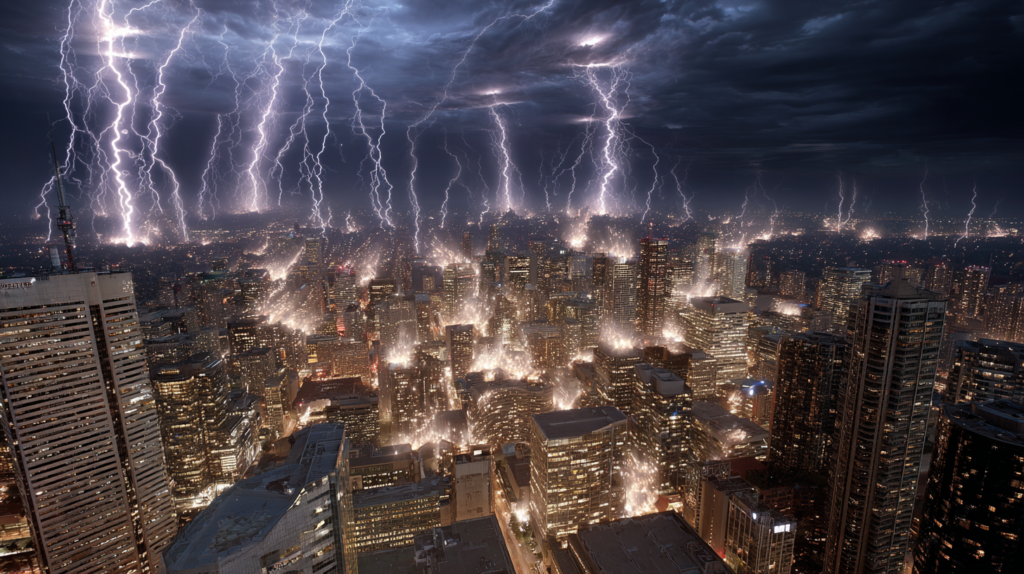
It began as a shift in light, subtle enough that an untrained mind might have blamed cloud cover. But the sky over Lake Ontario took on the color of a fresh bruise, that deep swelling purplish darkness that suggests impact before pain registers. The television’s calm voice stuttered for the first time, the map glitching as if the city itself had flinched. Then the Toll Bells began to ring.
They weren’t church bells. They were enormous, infrastructural, engineered—massive resonant instruments placed across the city in strategic locations, designed to disorient entities whose projection relied on coherence. Their sound rolled through Toronto like a pressure wave, a low, mournful vibration that made teeth ache and made glass shiver in its frames. People in the diner froze. Some covered their ears. Some didn’t move at all, as if the bells had turned them into statues.
Velvet stood up immediately. Not because she was brave. Because the moment had arrived where bravery and employment became indistinguishable.
Outside, the ground trembled with the slow insistence of something large and approaching. Sirens started in the distance, then multiplied, then became a chorus that couldn’t decide if it was warning or lament. Cars flooded the streets heading inward, away from the waterfront, away from the docks. Velvet moved the opposite direction, driving her battered reinforced SUV toward the Port Lands as if she were driving into a storm that had already been named.
Traffic fought her. People cut her off in panic. A city bus leaned into a turn too sharply, its tires skidding on slush. A police cruiser tried to redirect vehicles, and the officer’s face was pale under the streetlamp glare, eyes wide the way people’s eyes get when they realize their authority is decorative. Velvet kept going. She didn’t look at faces. Faces were distractions. Faces were how you remembered you were human when the job demanded you become something else.
The closer she got to the waterfront, the stranger the world behaved. The streetlights flickered in patterns that felt like language. The sound of the Toll Bells became layered, not just ringing but harmonizing with something deeper, as if the city’s machinery had been forced into an argument with an unseen throat. The air tasted metallic, and the water beyond the docks looked too still, as if it were holding its breath.
Then the breach revealed itself as absence given shape.
It wasn’t a hole in the sky the way stories liked to describe it. It was a seam. A tear in coherence. A vertical gash that didn’t look like darkness so much as the rejection of light, a refusal of interpretation. From that seam, something began to pull itself forward, not fully arriving but projecting, the way a hand might push through a curtain. The first thing that emerged was wreckage: a freighter’s broken skeleton dragged upward, metal screaming, containers spilling like teeth knocked loose. The water beneath it erupted in violent churn, but the source of that violence wasn’t the water—it was the idea of something larger displacing reality.
Velvet parked outside the impact perimeter and stepped out into a rain that had turned black and oily, droplets leaving stains on the ground like ink. The docks were chaos. Emergency crews moved like ants, trying to manage evacuation lines, trying to set barriers. Hunters were already arriving too—some in armored rigs, some on foot, some with eyes too bright and posture too eager. Velvet recognized that eagerness. She had worn it once. It didn’t survive.
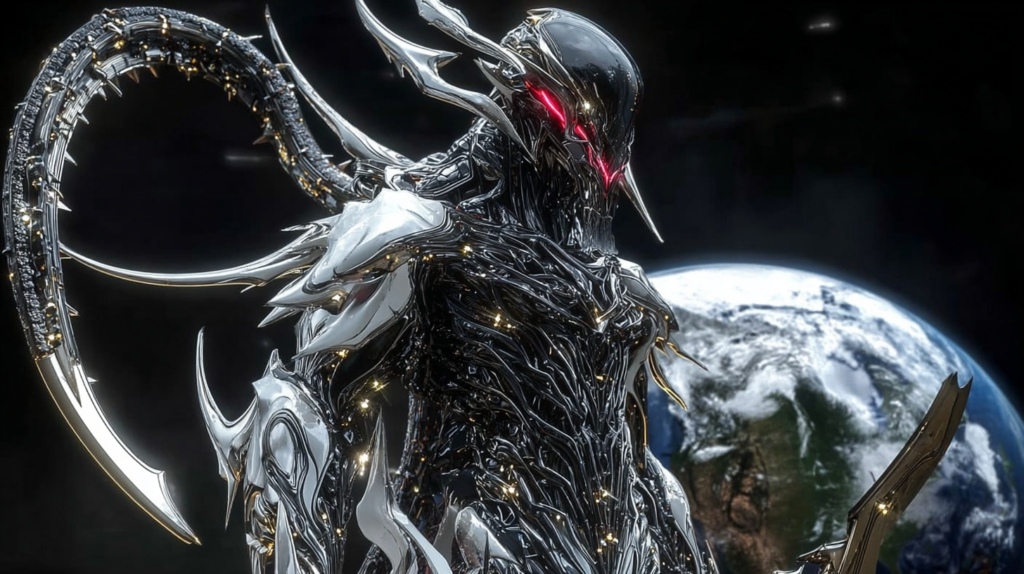
The entity’s projection completed enough for the mind to begin measuring it, and what Velvet’s mind measured made the rest of the dockside feel like a toy set. Three hundred meters tall, a vertical calamity with a mass near one hundred thousand tons, yet those numbers felt inadequate, like using a ruler to describe an ocean. The projection wore a kind of gleaming nightmare skin, a biomechanical lattice of black and chrome interwoven with sharp white plating and gold glints that looked like distant city lights trapped under metal. Its head was a helm of smooth, predatory curves, and its eyes were red slashes that didn’t merely glow—they accused. Spines and blade-like protrusions arced from its shoulders and back, curving like scythes designed for harvest rather than war. A tail, long and segmented, curled behind it with barbed edges that caught the dim light and threw it back like broken mirrors.
But even as Velvet’s eyes took in the projection, something deeper pressed at her senses, a suggestion of the entity’s true modality existing outside the normal beyond-dimensional reality. The projection felt like a fingertip. The rest of it (even in projection)—unbound, absolute boundless in extension, a scale better described as an absolute infinity beyond all multiplicity and distinction—remained elsewhere, watching through what it had sent into this place like a probe.
The broadcast voice from someone’s cracked radio cut through the bell-hum, trying to remain clinical. Velvet heard the words the way a worker hears hazard codes. The entity’s epiphenomenal breath was categorized as nature’s strongest weapon, not as metaphor, not as drama, but as a literal description of output. Each of the thing’s cells contained eruptions analogous to real gamma-ray bursts found in pulsars near supermassive black holes, each micro-eruption registering at least twelve KiloFoe in energy. The danger wasn’t only the scale of its body; it was the scale of what lived inside its flesh, a distributed apocalypse humming beneath armor.
It moved, and the dock groaned as if it were bending under a weight that exceeded engineering’s imagination. When it roared, the sound wasn’t just loud. It was resonance as phenomenon, a vibrational assault that reached into matter’s smallest arrangements and shattered them. Concrete dusted into powder. Metal frameworks buckled. People who hadn’t evacuated far enough collapsed as their bodies forgot how to hold themselves together. Velvet felt the roar press against her teeth, felt her taped ribs protest, and she forced her hands to remain steady.
Then it did something worse. It opened its mouth—if mouth was the correct word—and sang its silence.
The shockwave that followed didn’t behave like ordinary force. It was plasma carried on an absence, a destructive field that moved outward over roughly six hundred meters, not primarily by pushing objects aside but by targeting the constituent particles of matter, instructing coherence to fail. A line of dock equipment simply ceased to be intact, disassembled into sprayed debris that looked like it had been atomized and then thrown away. A shipping container folded inward like paper. The edges of the wave left behind a faint glow on surfaces, as if the world had been briefly cauterized.
And beneath all of that, a deeper effect spread—render-distortion. The sequence of motion thickened around the entity, the flow of events becoming viscous, making witnesses move as though their limbs were trapped in syrup. People near the perimeter froze mid-step, their panic translated into stillness. Eyes widened and remained widened. A scream opened in someone’s throat and never fully became sound. Velvet felt the distortion claw at her too, trying to slow her into helplessness, trying to make her a spectator. She reached into her jacket and pressed a small geometric anchor against her palm—cold metal inscribed with angles meant to bite into the world’s assumptions—and the distortion loosened just enough for her to keep moving.
She crossed into what everyone else would have called the kill zone, but Velvet thought of it as the work boundary. The place where stories ended and invoices began.
Her kit was not a cape and a catchphrase. It was geometry, hardware, and brute familiarity. She unfolded compact frames that clicked into triangular and tetrahedral shapes, driving them into the ground with a hammer that had seen too much. She chalked lines that weren’t spells in the theatrical sense; they were arguments. She placed anchors of sanctified lead where the lines intersected, because sanctified lead wasn’t holy for comfort—it was heavy with meaning, weighted enough to pin certain things to solvable reality when they wanted to remain ungraspable. The traps were ontological collapse devices, engineered cruelty for beings that lived by refusing definition. They didn’t “damage” the entity the way bullets damaged flesh. They forced its projection into a constrained modality, made it pay the price of occupying a world that insisted on rules.
A younger hunter arrived from the left—too confident, too loud, gear polished like it had been purchased more than earned. Velvet saw him glance at her, saw contempt flash as he judged her battered kit and her lack of theatricality. He shouted something to someone behind him, some bravado meant to be witnessed. Velvet didn’t answer. She didn’t even look his way fully. She had already watched that story.
The entity moved again, tail whipping. The younger hunter lunged, trying to strike at a protruding blade-limb as if it were a dragon in a book. He didn’t understand projection. He didn’t understand that hitting what you see is irrelevant if the thing you see is only a fraction of what is acting. The entity’s red gaze flicked toward him, and the render-distortion thickened around his body so abruptly he became slow in the cruelest way—aware but unable to adjust. The resonance roar hit like a physical law changing its mind. The hunter’s body buckled, not thrown, not torn, simply crushed as if his structure had been judged inadequate. He dropped with a sound that wasn’t dramatic, only final.
Velvet didn’t flinch. Flinching was wasted motion. She used the moment the entity’s attention angled toward the fallen hunter. Distraction was currency. She cashed it.
She triggered the first set of geometric traps. The frames hummed, lines of force snapping into alignment. The chalked angles lit faintly, not with fantasy glow but with the cold insistence of something being compelled. The entity’s projected limb—a scythe-like extension near its shoulder—jerked as the trap bit. Velvet felt the resistance through the anchor in her hand like a shock traveling up her arm. The trap didn’t cut flesh. It collapsed the limb’s permission to exist in that configuration. The projection stuttered, glitching, as if the world had rejected the limb’s claim to coherence.
The entity’s epiphenomenal breath surged, and Velvet felt the pressure of it like a verdict. She saw, in a flicker of engineered perception, the implication of those internal cellular eruptions—twelve KiloFoe per cell, distributed, relentless. She saw the potential for a single deliberate strike: a minimum single-attack energy output quantified as 2.825 QuettaexaFoe, equating at least to 2.825×10^92 joules, with an energy-equivalent mass conversion on the order of 6.752×10^82 tonnes. The broadcast voice had been very clear, in the way the world becomes clear when it wants you terrified: attack potency here was defined strictly by the energy output of a single strike, not by the area the strike happened to touch. It could carve a narrow corridor through the docks and still be carrying an apocalyptic ledger in its wake. Radius was a comfort word. Output was the truth.
Velvet didn’t rely on comfort. She relied on procedure.
She rolled under a piece of shattered dock equipment as the silence-song shockwave tore through the space where she’d been standing. Her shoulder clipped metal. Pain flared. The tape held her ribs together. She came up on one knee and drove a sanctified lead anchor into the ground at the final intersection point of her trap array, completing the geometry. The array snapped shut like a jaw.
The entity convulsed, not in agony but in disruption. Its projection wavered. For a moment, the chrome-black armor looked like it was being peeled by invisible hands, the gold lights within it flickering like stars drowning. Velvet saw the seam in the sky tremble, felt the tension of connection between projection and unbound source. The trap didn’t destroy the entity’s true modality; that would be arrogance. It severed the projection’s stability enough to force withdrawal.
She followed up with her finishing act—an erasure-oriented strike that was less “attack” and more “closing argument.” She raised a compact device that resembled an industrial staple gun more than a wand, loaded with a sanctified lead cartridge etched with constraining angles. She fired into the destabilized projection point, not aiming for a heart, because things like this didn’t have hearts in any useful sense. She aimed for the locus of coherence. The round struck, and the projection collapsed inward with a sound like metal sighing in relief, then unraveled into black rain and shivering debris that scattered across the docks like ash from a burned contract.
Around her, the docks were a graveyard of wreckage and unnatural carrion. Smaller entities that had ridden the breach’s wake—parasites, scavengers, half-manifest appendages—lay strewn in broken heaps, their bodies dissolving into sludge and splintered bone-like fragments. Velvet stood atop a pile of it without triumph, drenched in ichor that cooled on her jacket and boots. Her breath came hard, but her face stayed composed, the way it had learned to stay composed when composition was the only dignity left.
Sirens continued. The Toll Bells faded into a lower, exhausted ringing. Evacuees would return to streets that smelled like burned metal and fear. Reporters would talk about survival as if survival had been evenly distributed. The younger hunter’s body would be collected if there was anything left worth collecting. Someone would tell his family a sanitized story.
Velvet didn’t linger for any of that. She looked down at her wrist out of habit, at a watch that had a cracked face and kept bad track of the world’s sequence, then she looked beyond it toward the city skyline where banks and offices waited with their ordinary cruelty. Her mind ran the calculation automatically—how fast she could get to the nearest branch before it shuttered for the day, how long it would take to file the bounty claim before some administrator decided her paperwork smelled too much like blood, how much of the payout would disappear into rent and gasoline and transfers and the long, humiliating proof that she was trying to be worthy of the child whose drawing waited in her pod-apartment like a small, silent god.
People called her a vulture because she arrived at horror and left with money. What they didn’t say—what they couldn’t say without admitting the world’s structure—was that the city needed vultures because it kept breeding corpses. Velvet walked back to her SUV with the heavy calm of someone who understood inevitablisma not as prophecy, but as the simple guarantee that tomorrow would demand more work, more geometry, more sacrifice, and that the halo, whatever people imagined it to be, weighed most on the neck of the person forced to carry it.