
From Here to There I
He didn’t feel like the man people would come to fear yet, not inside the home. Not because the edge was gone, but because it had finally found a place where it didn’t need to cut.
Sixteen years before the main story, Draven Endwriting’s discipline was still the same hard geometry it would always be, the same method that made him reliable under pressure, the same instinct to measure a room in a glance and to solve problems before they became emergencies. The difference was that in this week, that geometry was turned inward toward tenderness, toward caretaking, toward a kind of vigilance that didn’t require violence to prove itself. Hatshepsut watched it happen in real life, not as a story someone told about him later, and it made her fall in love with him again and again in quiet increments until the feeling became heavy enough to feel like something physical.
Monday began in soft light and warm wood. The restaurant booth curved around them like a shelter, polished panels rising behind their shoulders, a big window dressed in sheer curtains that breathed when the air moved. Outside, the water sat calm and bright, and beyond it a hillside dotted with white houses and terracotta roofs climbed toward a pale sky. It was early enough that the place still felt unhurried, the kind of morning where the world seemed willing to let a family exist without demanding anything from them. Draven sat in a plain dark shirt, shoulders square but relaxed, holding their baby in the crook of his arm with a steadiness that didn’t look practiced so much as inevitable. Hatshepsut leaned in from the side of the booth, wearing a sleeveless textured top and light denim shorts, simple sandals on her feet, her posture angled toward the child with a careful attentiveness that felt almost ceremonial. She held the bottle with both hands, checking the angle, watching the baby’s mouth, watching for the swallow, watching for the pause. Draven’s eyes stayed down, not drifting to the menu, not scanning the restaurant the way he usually would in public, but measuring the smallest shifts in the baby’s expression as if that was the only security brief that mattered.
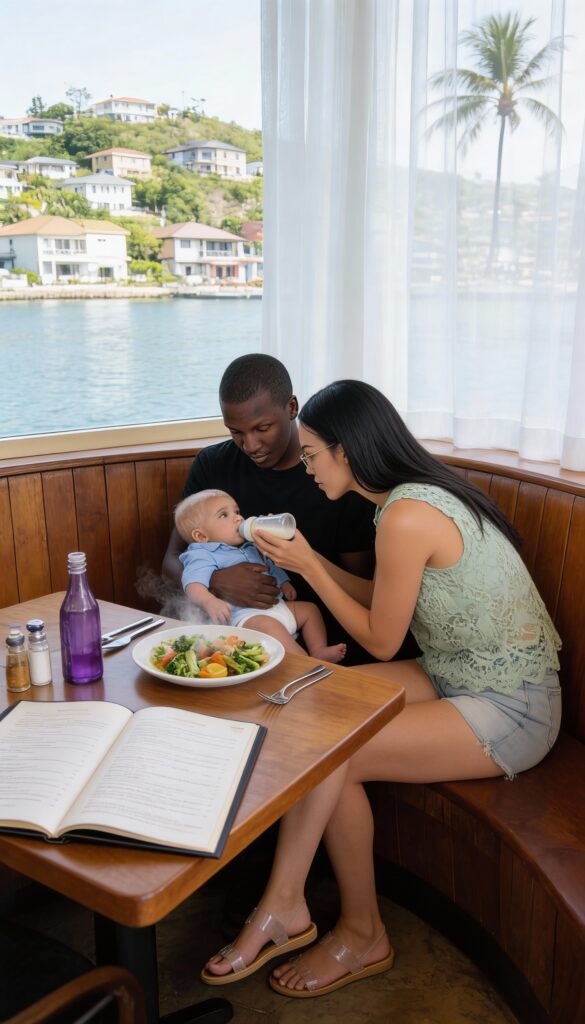
She loved him for how quietly he made space. He didn’t talk about being involved; he simply was. When the baby’s little fingers curled toward the bottle, he adjusted his hold without thinking, repositioning the child so the neck stayed supported and the body stayed comfortable. It was subtle, but Hatshepsut noticed everything, because she lived in the details now. The table in front of them held a plate of vegetables steaming gently, utensils arranged neatly, a purple glass bottle catching light like a small jewel, and an open menu resting near the edge as if it had been abandoned mid-thought. The food could wait. The world could wait. Draven’s attention didn’t have to.
When the baby finished and blinked up at them, milk-drunk and calm, Draven’s mouth softened in a way that almost looked like surprise, as if he hadn’t yet gotten used to the idea that peace could be this immediate. Hatshepsut didn’t tease him. She didn’t interrupt it. She just watched him lower his forehead for a second until it brushed the baby’s hair, a gesture so brief it could have been mistaken for nothing, but she knew him well enough to feel the weight behind it. He wasn’t performing affection. He was anchoring himself.
That afternoon, back at home, the atmosphere changed the way it always did when they crossed the threshold. The outside world stayed outside. Draven’s work existed in him, but he didn’t drag it through the door like a shadow. He washed his hands first, thoroughly, like a ritual with rules no one needed to say out loud. Then he checked the nursery without calling it a check, only stepping in to confirm what he already knew: the bassinet placement, the blankets, the temperature, the way the light hit the room. Hatshepsut had learned that this was how he loved—through structure, through preparation, through the refusal to leave anything to chance when chance could harm what he valued.
She spent Monday evening in the kitchen while he took the baby and walked slow laps through the living room, speaking in a low voice that sounded like calm weather. He didn’t use exaggerated tones. He spoke like he was explaining the world to someone who deserved respect, even if they couldn’t understand the words yet. He told the baby what each sound was: the faucet running, the refrigerator hum, the floor creak beneath his step, the distant traffic. Hatshepsut listened to him and felt something open in her chest that had nothing to do with sentimentality and everything to do with recognition. This was an early version of him, yes, but the core was already there: the strategist who wouldn’t abandon a responsibility just because it didn’t look heroic from the outside.
Tuesday carried them into ordinary errands, but ordinary never stayed ordinary around Draven, because his mind refused to treat life as casual. He framed even shopping as a sequence that could be done cleanly or done sloppy, and he preferred clean. They went out in the late morning, the baby bundled and secure. The place they walked through was bright and loud, a mall with polished floors and glowing storefront signs, crowds moving in waves. Hatshepsut carried bags in one hand and kept the other close to the baby’s blanket, instinctively protective. Draven wore a dark track jacket and matching pants, practical, easy to move in, the kind of outfit that didn’t draw attention until you noticed the way he stood, the way his shoulders stayed angled to shield, the way his eyes tracked motion without looking anxious. He held their baby against his chest, one arm firm and steady, wristwatch catching light as he shifted. The baby wore a soft hooded suit, plush and warm, little ears on the hood giving them an almost storybook look. People looked at them, then looked away, then looked again, because something about the image rewired the assumptions they had about him. He didn’t smile at strangers. He didn’t seek approval. He simply kept moving, a quiet wall with a child at the center of it.

Hatshepsut noticed the subtle way he positioned himself whenever they stopped. If they paused near a kiosk, he stood slightly behind her, not as control, but as coverage. If someone moved too close too fast, he shifted his stance without interrupting conversation. If the baby stirred, he adjusted the blanket before the fuss could build. He didn’t narrate what he was doing; he didn’t make fatherhood into a speech. He treated it like duty, and that made it intimate in a way words couldn’t imitate. In the middle of the mall’s noise, she felt oddly safe, not because the world had become gentle, but because Draven refused to let gentleness be fragile.
That night, after the baby slept, Hatshepsut stood in the doorway of their bedroom and watched Draven at the dresser, folding tiny clothes with the same precision he used when he handled anything important. The sight made her laugh softly. He looked over, eyebrow lifting, expression neutral but attentive, waiting for her to say what she meant. She walked toward him and set her hands on his shoulders from behind, letting her touch settle him in a different way than routine ever could. He reached up and covered her fingers, not gripping, just holding, the kind of contact that said he understood what she was offering without forcing her to explain it.
Wednesday felt like a hinge. The day started with the usual domestic rhythm—feeding, diapers, naps—but the mood had a brightness to it, like the world itself was less tense. Hatshepsut took advantage of the baby’s longer morning nap to step out briefly on her own, not to escape the house, but to remember she existed as a full person inside this new life. She went to a café and stood in the doorway for a moment, letting the warmth and scent of coffee settle her. Her outfit was deliberate without being loud: a sleek black halter-style top with a keyhole cut at the front, paired with fitted brown shorts, minimal jewelry, a small shoulder bag resting against her side, and slim ankle-strap heels that made her posture look confident even when she was simply standing still. Her glasses framed her eyes, and her stance—one leg slightly forward, one hand on her hip—held a calm self-ownership that made the world feel less like something that happened to her and more like something she could choose.

Draven had insisted she stay home for at least five years, and she accepted that boundary because she understood the reasoning beneath it, but he never used it as a cage. He didn’t want her erased by motherhood. He wanted her protected while she rebuilt herself around it. That meant space for small moments like this. It meant him coming home early enough to take the baby so she could breathe. It meant him telling her, without softness in his voice but with certainty in his actions, that her well-being was not optional.
When she returned home, she found him already there, the baby propped safely against his chest as he sat on the couch, one hand supporting the child’s back. He looked up, saw her, and something in his expression shifted—approval, not possessive, just quietly proud that she’d taken a moment for herself. He didn’t make a comment. He didn’t turn it into a conversation. He just reached out with his free hand and tugged her gently closer until she leaned down and kissed him once, quick and warm, before bending to kiss the baby’s forehead too.
Thursday was a kitchen day. The morning light was softer, filtered through old glass, turning the rustic kitchen into something that felt like a memory even while it was happening. The wooden table was worn and honest, the kind of surface that had held countless ordinary meals. Hatshepsut sat at the center of it with a mug in one hand, breakfast laid out neatly in front of her: toast, eggs, greens, avocado, small tomatoes, food that looked simple but intentional. A small deck of cards sat near the edge of the table like a quiet symbol of habit—something she reached for when the house went still and she needed to remind herself that intuition could also be a kind of order. Her outfit was comfortable, a fitted ribbed tank in a muted tone, glasses on, posture upright but relaxed. Her expression wasn’t posed; it was real, the look of a woman who had slept enough to feel human again.
Draven moved through the background, not hovering, not directing, but present. He wore a dark button-up shirt with sleeves rolled slightly, practical even in domestic spaces. He brewed coffee without being asked, cleaned as he went, and checked the baby monitor without making it obvious. Hatshepsut watched him from the corner of her eye, the way he’d pause at the monitor and listen for a breath longer than necessary, the way he’d tilt his head like he was calibrating to the baby’s frequency. It made her want to reach across the table and pull him toward her, but she didn’t. She let the moment breathe.

When the baby woke, Draven was already there. He went into the nursery, lifted their child gently, and carried them back into the kitchen as if he were bringing the sunrise in his arms. The baby’s eyes were wide, curious, tracking movement. Draven sat in the chair beside Hatshepsut, turning slightly so the baby faced her, and the three of them formed a small triangle of attention that made the room feel complete. Hatshepsut fed the baby again, and Draven’s hand rested lightly on the baby’s leg, steadying, grounding. It was domestic. It was ordinary. It felt epic anyway, because it was a kind of victory the world never applauded but that held everything else together.
Later that same day, after breakfast had been cleared and the baby had been settled for a nap, Draven leaned down and kissed Hatshepsut at the kitchen table. It wasn’t theatrical. It was a brief, gentle contact that still managed to turn the entire room into something private. He bent from standing, she tilted her chin up, mug still in her hand, and the kiss landed like a promise made without words. The kitchen shelves behind them held jars and plates and hanging pans, the clutter of lived life, and yet the moment felt clean. Hatshepsut closed her eyes and let herself receive it, because part of being loved by Draven was learning that he didn’t waste gestures. If he touched you, he meant it.
Friday carried a different kind of intimacy. By then, the week’s rhythm had built its own certainty, and certainty makes room for play. The baby was down for a longer sleep in the afternoon, and the apartment fell quiet in a way that felt like it had been earned. Draven stood near the mirror in their room, phone in hand, posture steady as he framed the shot. Hatshepsut leaned into him from the side, her arm draped over his shoulder, her body angled toward his in a way that was more teasing than demanding. Her outfit was delicate and glossy, a matching set with lace trim that looked like something chosen for confidence rather than performance. She wasn’t trying to turn the moment into spectacle; she was reclaiming herself, reminding both of them that they were not only parents, not only caretakers, but still lovers who could laugh and flirt in the quiet.

Draven’s expression stayed controlled, as it always did, but his hand rested at her waist with an ease that betrayed the depth of comfort between them. He didn’t grin for the camera. He didn’t need to. The intimacy wasn’t for the phone. It was in the way he held her without distraction, the way he remained grounded while allowing her to be playful. Hatshepsut looked at their reflection with a half-open mouth like she was mid-laugh, eyes bright behind her glasses, and the contrast between her lightness and his calm made the image feel honest. This was their dynamic: her warmth finding its way into his guarded spaces, his steadiness giving her warmth somewhere safe to land.
That night, the baby woke crying around midnight, sharp and sudden. Draven moved instantly. He didn’t curse, didn’t sigh, didn’t make the sound of a man inconvenienced. He was simply up, already at the bassinet, already lifting the baby and swaying in slow, measured motion. Hatshepsut sat up and watched him in the dim light, hair loose, breath slow, and felt her love for him deepen into something almost fierce. He murmured softly, not babbling, not shushing, but speaking like he was negotiating peace. The baby’s cries softened into hiccups, then into silence. Draven held them another full minute after they calmed, as if he refused to trust quiet too quickly. When he finally laid the baby down again, he adjusted the blanket with precision, checked the baby’s face, then turned back toward the bed without a word. He slid in beside Hatshepsut and pulled her against him, and she realized that this was his love too: not only his care for the child, but his insistence that she not carry fear alone.
Saturday unfolded like a breath out. They spent late morning by the water again, returning to that warm wood booth with the large window and soft curtains because something about the place felt like a sanctuary. The baby sat in Draven’s arms, wearing a light outfit with a small collar, legs kicking gently. Hatshepsut leaned in to feed them again, careful and patient, her sandals flat and comfortable, her posture angled inward like the world outside couldn’t reach them. Steam rose from a plate near the edge of the table. A purple bottle caught the light. The open menu sat like a prop they didn’t need. Outside, the hillside homes looked painted against the sky, and the palm tree by the window stood like a quiet witness.
This time, Draven looked up more often. Not scanning for threats, but watching Hatshepsut. Watching the way she smiled when the baby drank too fast and made a tiny mess. Watching the way she wiped the baby’s mouth gently and then looked at him, eyes soft, as if she was silently asking, Can you believe we made this? He didn’t answer with words. He answered by shifting the baby slightly closer to her, by angling his body so she could lean against him while she fed them, by letting the three of them become a single shape in that booth. Hatshepsut felt a swell of emotion so sharp it almost hurt, and she swallowed it down, not because she was ashamed, but because she didn’t want to cry in public. Draven noticed anyway. His fingers brushed her knee under the table, a small grounding touch, and she steadied.
That afternoon, they went for a walk along the shore. The sky was overcast, the air cooler, the ocean restless but not violent. Draven wore a white hoodie layered over a graphic shirt, dark jeans, sneakers planted firmly on sand that shifted underfoot. The hoodie had bold lettering along the sleeves and chest, a statement without needing color. He held the baby against his side, the child bundled in a plush gray suit with a hood that had small rounded ears, like a bear. The baby’s eyes were wide, taking in the endless water and the moving gray sky. Draven’s posture was straight, protective, calm. Hatshepsut walked beside him, her hand occasionally touching his elbow or the baby’s foot, a quiet reassurance. They stopped at the seawall, the concrete barrier separating sand from the world beyond, and Draven stood still, looking out over the ocean as if measuring it, as if making a silent vow that nothing would reach his family without going through him first.

Sunday was the true closing of the week, the day that made everything feel complete. They stayed home most of the morning, letting the apartment be what it was meant to be. Hatshepsut made breakfast in the same rustic kitchen atmosphere, even if their real kitchen was different, because in her mind the feeling mattered more than the literal. She sat at the table again with a mug, plate arranged neatly, her glasses on, shoulders relaxed. Draven moved behind her, close enough that she could feel him without turning. He kissed her once at the side of her head, quick and warm, then poured coffee and set it down without speaking. The baby watched from a safe seat nearby, fascinated by the sound of mugs and plates, by the shape of their parents moving around each other like they had always belonged in the same orbit.
Later, in the living room, Hatshepsut straddled the edge of the couch and leaned toward Draven in a way that was openly affectionate, playful without being careless. She wore a black halter-style top tied at the front and denim shorts, her hair pulled back into a ponytail, glasses on, smiling down at him. Draven sat on the couch wearing a red shirt with a bold graphic, white pants, his hands steady at her hips to keep her balanced. Their posture was about seduction as much as it was about ease. They were still them, still a couple, still allowed to want each other even inside the responsibilities of parenthood. The baby’s presence didn’t erase their intimacy; it refined it, made it more deliberate, less taken for granted.

When the baby finally fell asleep that night, the apartment grew quiet in a way that felt like a reward. Hatshepsut lay across Draven on the bed for a while, not in a dramatic way, just close, their bodies forming a shape that felt like shelter. She wore a simple dark lace top and denim shorts earlier in the day, and now she was wrapped in softness, hair slightly damp from a shower, skin warm against him. Draven held her with one arm, his other hand resting lightly on her back, as if he was reminding himself that she was real and present and safe. She kissed his cheek, then his forehead, and finally rested her face against his neck. He didn’t say much. He didn’t need to. The love was in how he remained steady, how he didn’t drift away mentally even when exhaustion could have pulled him under, how he stayed with her in the room rather than leaving her to sit beside a body that felt absent.

Hatshepsut whispered to him then, not a request, not a complaint, but a truth she needed him to hear. She told him she loved watching him with their child. She told him it made her feel like she could breathe. She told him that when she imagined the future, she didn’t see him as a distant figure who provided from afar—she saw him as this, a man who could come home and become gentleness without losing strength, a man who treated care as sacred work. Draven listened without interruption. His face didn’t change much, but his hold tightened slightly, as if her words had landed somewhere deep and he was acknowledging them with the only language he trusted: action.
Before they slept, he got up one last time and went to the nursery. He didn’t do it because he was anxious. He did it because he believed in confirmation. He stood over the bassinet and watched the baby’s chest rise and fall, slow and steady. He adjusted the blanket by a fraction, checked the baby’s face, then turned off the light with care. When he returned to bed, Hatshepsut was watching him, and the look in her eyes was so full it almost frightened her. She realized, in that moment, that this week had changed her memory permanently. No matter what came later, no matter how the world tried to harden him, she would always know this version of Draven existed—not as an exception, not as a mask, but as something true. The man who could command outside and still come home and do the quiet work without complaint. The man who didn’t need applause to be devoted. The man who held their baby like it was the most important mission he’d ever accept.
And when she finally closed her eyes, she didn’t fall asleep with fear. She fell asleep with the feeling that she was loved inside a structure that wouldn’t collapse, because Draven Endwriting built his home the same way he built anything he truly valued: with intention, with relentless care, and with a refusal to leave the fragile things of life unguarded.