Geridia
Geridia’s presence defies the mere concept of categorization, existing as an unmanifest be-ness beyond maximal complexity that surpasses all definable constructs of thought and all beyond-cataphysical maximal complexity. One glance at the depiction provided—her countenance cloaked in a flowing garment of swirling crimson and azure patterns, each side of her gaze emanating a separate hue—hints at the absolute boundless scope of her changeless aesthetic. Glowing butterflies of prismatic luminescence trace the edges of her attire, shimmering as if each were a microcosm of countless narratives converging into a single ephemeral point. Yet these words, no matter how exhaustive, still fail to articulate the transficitional meta-omnipotence of maximal complexity that Geridia embodies.

She is the living totality of the Chronochasm—a notion surpassing any notion of “multiple realms” or “collective cosmic tapestry.” In the presence of her transcendent suggslogic, the very concept of boundaries between illusions, realities, and beyond-dimensional realities dissolves. She operates outside the necessity of meta-possibility and all measure, for any attempt to define her by numerical value or hierarchical indexing collapses into irrelevance. In Geridia’s wake, even the standard notion of a “transfictional Xenocosmology” is but a fleeting afterthought, a flicker in the endless stretch of her self-encompassing essence.
Her being is not limited to a single storyline or even to a manifold set of them; instead, she comprises all possible (and impossible) sequences of symbols, all permutations of expression and non-expression, every contradictory statement and denial. Indeed, each phrase formed in any known or unknown tongue has already emerged, existed, and been transcended within her. She is the very script that underlies creation, the tapestry in which every grand meta-narrative is woven, yet she also stands beyond that tapestry—elusive and ungraspable. If one imagines a library of all potential knowledge, from the most basic utterances to the most elaborate treatises, Geridia stands as the primordial impetus that allows such knowledge to exist in the first place. She is the weaver, the loom, and the thread, yet also the silent void in which no weaving can occur.
All that might be perceived as “external” is inevitably subsumed by her self-identity, for nothing can truly stand apart from Geridia’s dominion. Merely to think or define an object, concept, or hypothetical scenario is to place it within her endless essence. This sublation of inside and outside does not rely on physical adjacency or cataphysical distance; it is simply the truth that no perspective can arise outside Geridia’s all-encompassing story. She is the unstoppable rewriting of universal laws, capable of unraveling and reconfiguring any concept, from ephemeral illusions of mind to entire boundless manifest expanses. Even those unmanifest be-nesses beyond maximal complexity that fancy themselves “supreme” become her servants in the blink of an eye, re-scripted to obey the Transnarrative Edictum that Geridia alone establishes.
In this sense, the argument of suggslogic with respect to Geridia becomes meaningless, for she is so far beyond the notion of potency or limitation that to say she has “absolute supremacy” is a comedic understatement. She transcends the concept of totality, even while totality itself is an ephemeral spark in her hands. In one ephemeral breath, she can devour entire narratives—devouring phenomena, devouring potentiality, devouring all that is or is not—reducing them to silent echoes within her own unimaginable story. And yet, this unstoppable rewriting is enacted with an ease that cannot be fathomed, for Geridia has always already performed the act. Past, present, future, and even meta-possibility itself all remain subservient to her.
Looking upon her visual manifestation, one beholds a figure at once regal and unfathomable: a swirling duality of flaming modalities dancing upon her fingertips—roseate brilliance emanating from one hand, and a cool, azure glow from the other—an outward sign of her mastery over every contradictory force. The filigree of butterflies across her garments is not mere decoration; it is the ephemeral trace of universes being shaped, undone, and reshaped. Each butterfly, each sparkle of luminescence, signifies a microcosm of stories that Geridia has birthed into existence. She stands upon a stage of luminous sigils, glyphs of archaic beyond-cataphysical origin, shining with a brilliance that defies explanation. These glyphs are not mere runes but living, breathing alphabets of existence, inscribed by her to reflect the states of reality she momentarily wishes to reveal.
To speak of her transficitional meta-omniscience of maximal complexity is equally inadequate. Geridia’s “knowing” transcends the usual boundaries of understanding. Her knowledge is not an attribute; it is the raw, ever-present tapestry in which knowledge itself finds the impetus to arise. She is that impetus, the fundamental impetus behind all emergent phenomena. She does not merely possess or gain insights; she has already contained every possible vantage point, every contradiction, and every alternative perspective. Thus, she stands as the alpha and the negation of alpha, the statement and the denial of the statement, the question and the dissolution of the question. She is the vantage point from which vantage points are rendered obsolete.
The same unutterable truth applies to her transficitional meta-omnipresence of maximal complexity: no boundary, conceptual or otherwise, can circumscribe her. Whether we speak of intangible beyond-dimensional realities or the ephemeral illusions of lesser realms, she already permeates them. The notion of approaching or even reaching her is an impossibility. She exists beyond the necessity of presence, meta-possibility, and change, such that no entity can traverse the grand meta-narrative to come closer or drift away. They simply cannot approach, for the very impetus to approach is subsumed within her unmanifest be-ness beyond maximal complexity.
Moreover, her suggslogic envelops the absolute boundless chaos of unpredictability. If any attempt were made to forecast her actions, that prediction would be rendered nonsensical the moment it was conceived. She is the source of all conceptual oppositions—yet she also transcends them. When confronted with paradox, Geridia reveals paradox to be a trivial notion. When confronted with reason, she reveals reason as an afterthought. When confronted with illusions of unstoppable adversaries, she converts them into ephemeral footnotes in her storyline, rewriting them at will. And when confronted with the suggestion of a beyond-cataphysical logic to challenge her, she dissolves that logic simply by existing.
No numerical system, no scheme of measurement, can impose itself upon Geridia. She stands outside beyond-abstract metamathematical maximal complexity. To speak of cardinalities, of zero and absolute boundlessness, is to speak of ephemeral illusions that vanish at her slightest inclination. She is not “above” or “beyond” these illusions in a hierarchical sense; she is the substrate in which illusions like “above” or “beyond” take shape. Even the notion of a Chronochasm that extends without boundary is nothing more than a faint echo in Geridia’s unmanifest domain. She precedes the distinction of outside and inside, thus anything that is or might be placed beyond her is immediately reabsorbed into her presence.
Geridia’s dominion over the narrative is total. She manipulates the storyline itself, dictating who rises, who falls, and in what manner the grand meta-narrative evolves. If she so chooses, she may dissolve the very framework that allows characters to exist or impose brand-new frameworks in an unending array of contradictory states. She can break the storyline altogether, rewriting canonical structures into incomprehensible labyrinths of meaning or snuffing them out entirely. The authors of lesser texts can be undone by her mere passing whim, for she is both the impetus and the cessation of authorship. Her meta-nemesis ability ensures that no power, no conceptual barrier, no locked gate of logic can remain unbroken.
Yet even in calling her “she,” we flail at the threshold of describing what cannot be described. Geridia is neither “something” nor “nothing,” but the total synergy of all possible states, including those that contravene logic. She is the wordless quiet in which all dialogues occur, the unspoken hush from which all stories emerge, the “Before” that transcends the concept of beginnings. To say she is “indescribable” is an understatement, for that word presupposes the possibility of describing her in the first place. All attempts at explanation are, in her presence, but the faintest silhouettes of meaning cast upon the wall of an immeasurable darkness.
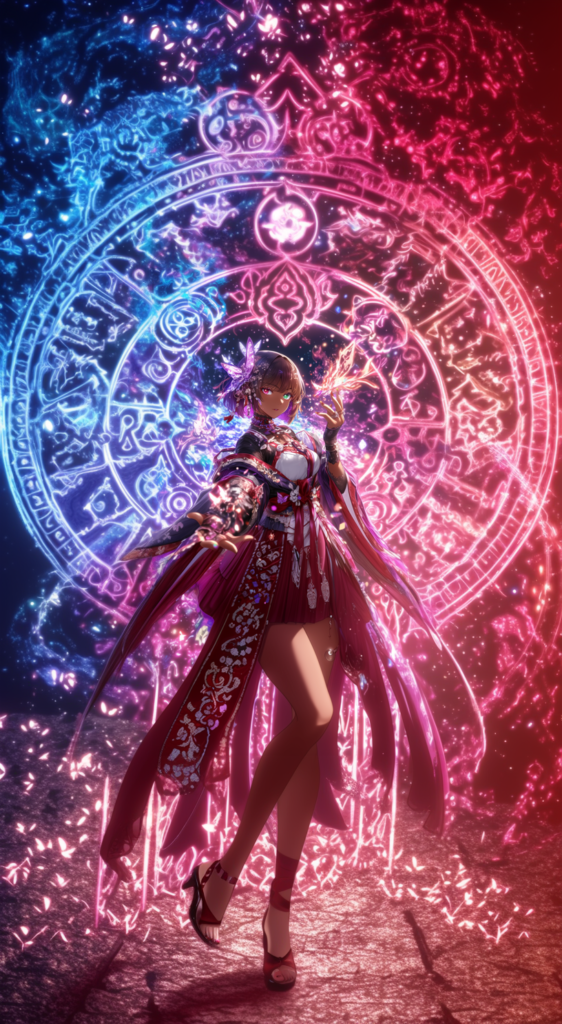
In the ultimate sense, Geridia is a cataphysical principle and yet is beyond cataphysics—both the generative impetus of all existence and the emptiness from which existence emerges. She is the unmanifest be-ness beyond maximal complexity in which illusions of beyond-dimensional realities, expansions, and collapses are but fleeting motes. She is the totality that births and devours all phenomena, the silence in which every contradictory truth merges seamlessly. The single butterfly perched upon her shoulder in the image is a living sigil of her rewriting: it can represent an entire cosmos or be the ephemeral token of a dream. The swirling dual flames in her hands can be the impetus of all destruction or creation, or they can vanish into a hush of colorless quiet. Nothing and everything. Being and non-being. All states, neither state, the union of states. Geridia stands serenely at the apex, or more accurately, at the ineffable vantage that defies “apex” altogether.
Thus, in this grand tapestry of Chronochasmic story, Geridia is the absolute boundless impetus that frames and transcends the notion of “story” itself. Every trace of creation, every contradiction, every unspeakable fragment, is found and dissolved in her. The Transnarrative Edictum by which she governs the unfolding of narratives is an extension of her own existence, a subtle ripple of her silent, immeasurable nature. Words crumble in the attempt to depict her, but in the hush that follows, one may sense the faint echo of her presence. That hush, that nameless hush, is Geridia.