
Glass Historia III: The Mirror of Necessary Malice
Houston did not go quiet the way a city goes quiet when it is sleeping. It went quiet the way a throat goes quiet when it has forgotten how to make sound, the way a heart goes quiet when the body has not yet accepted what it already knows. The first thing everyone noticed was not the darkness, because darkness can be explained as weather, as outage, as chance. The first thing everyone noticed was the absence of reach. Every habit that depended on the world answering back failed at once. Phones became rectangles of dead glass that could not call, could not text, could not plead. Radios turned into hollow plastic, spitting only a breathless hush. Screens that had always been windows became mirrors, reflecting only the face of the person trying to escape their own thoughts. Satellites did not fall; they simply stopped mattering, as if the manifest expanse had revoked the permission for transmission itself. It felt less like a blackout and more like exile—an eviction from the comfortable illusion that someone, somewhere, could always be contacted.
Above the city, the sky looked wrong in a way that had nothing to do with clouds. It was shattered. Not theatrically torn like a movie wound, but fractured like glass under a pressure it can no longer pretend to hold. The cracks were not bright. They were dark, and that darkness was not emptiness; it was a dense absence shaped like a verdict. A few people, standing in parking lots or on balconies, stared upward and felt something inside them sag, because the sky is one of humanity’s oldest bargains: it is supposed to be background. When it becomes an object, when it becomes a surface that can break, the mind begins to realize it has been living inside something fragile.
No alerts went out. No emergency broadcasts. No siren systems coordinated. The city had always believed in response—police radios, dispatch calls, chain-of-command assurance—but response requires a network, and the network was now a rumor. The absence of transmission forced every human into the same intimate prison: the immediate, the local, the unshared. You could not outsource fear to experts. You could not confirm whether it was only you. You could not scroll for reassurance. You could not ask an invisible crowd to witness your panic and turn it into something social. You were alone with the shattered sky and the silence, and for many, that was the first true horror, because solitude is where the soul either finds its core or discovers it never had one.
The lights didn’t all go out at once. Some neighborhoods held their glow for a few breaths, as if the grid was trying to remember itself. Then the streetlights began to flicker in patterns that felt too deliberate to be random—long pauses, sudden flares, a stuttering rhythm like an arrhythmic hymn. In the gaps between the flickers, the darkness was thick enough to feel tactile, and that thickness made people whisper even when they were alone, because the body recognizes when it is being watched even before the mind can explain by whom.
Down by the ship channel, where metal, oil, and water usually negotiated their own uneasy peace, men and women stood in clusters outside warehouses, staring at their useless phones and then up at the sky, as if the sky had done this. Somewhere deeper in the industrial sprawl, an alarm tried to sound and died halfway through the first note, strangled by the same rule that had strangled the radios. The alarm’s cut-off made the air feel more dangerous than a full siren ever could. The half-sound implied interruption. Interruption implies intention.
It began as a rumor carried by feet, not signals. A rumor is older than technology; it is the original transmission. People ran down streets and told other people what they had seen, and the telling infected faster than the seeing. They said a church downtown had opened its doors and was giving out food. They said a priest had appeared on the freeway and stopped traffic with a raised hand. They said a man in a clerical collar had walked through a hospital lobby and the security cameras had turned toward him like they recognized authority. They said he was smiling like a mourner who is secretly relieved the funeral is finally happening.
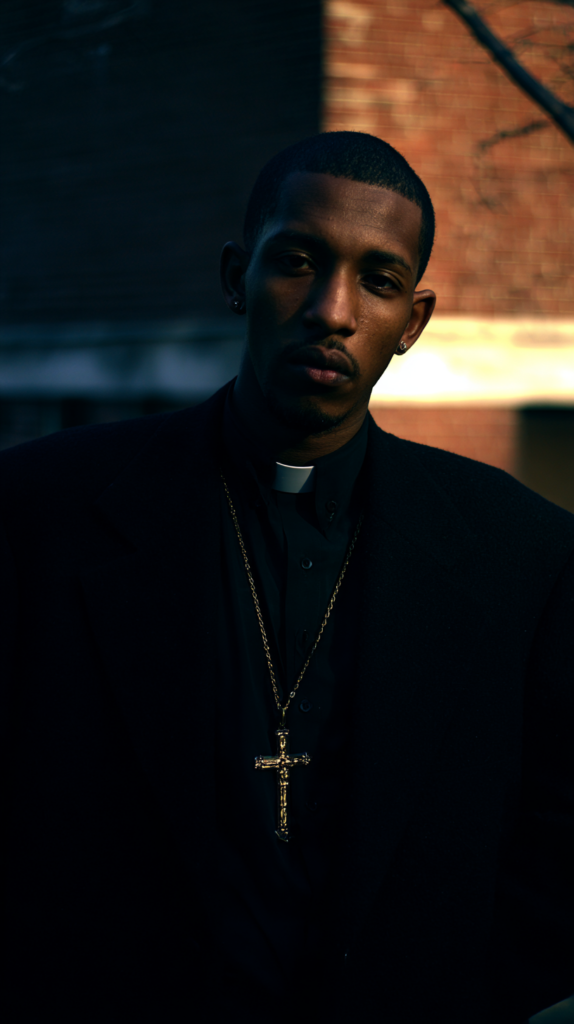
When the Bishop stepped into view, it wasn’t with theatrics. He didn’t descend from the sky. He didn’t erupt in flame. He simply appeared in a place where people had gathered because gatherings are how humans try to feel less helpless. A wide lot beside a darkened civic building. A loose crowd. A few police officers who were now only officers in name, because their radios were dead and their chain-of-command had collapsed into personal judgment. A handful of pastors and community leaders. Ordinary people clutching their children, their bags, their fear, their faith.
The Bishop was dressed in a tailored dark coat over a fitted black clerical shirt, the white collar stark at his throat like a clean lie. A thin chain draped down his chest with a gold cross that didn’t glow; it waited. His posture was relaxed, not slouched, the ease of someone whose body is certain the world will obey. His face carried the calm of a man who has already forgiven the crowd for what they’re about to become. He did not look like a fanatic. He looked like a counselor who has decided the only therapy left is collapse.
He spoke without raising his voice. Somehow everyone heard him anyway, as if the air wanted to carry his syllables even while refusing to carry radio waves. “You feel it,” he said, and it wasn’t a question. “The silence. The reachless world. The way you suddenly have to be a person again, instead of a node.”
A pastor stepped forward, trying to hold authority through familiarity. “Who are you?” the pastor demanded, and the question trembled with the kind of bravery that is mostly fear wearing a suit.
The Bishop smiled softly, as if the pastor had said something endearing. “I am not here to steal your faith,” he replied. “I am here to show you what your faith has been hiding from you.”
He lifted one hand slightly, palm outward, not in blessing but in measured presentation. “You have been told that grace is a canopy,” he continued, voice smooth and deliberate. “That it covers you. That it protects you. That it excuses the world from being coherent because you’ll be rewarded elsewhere.” His eyes moved across the crowd, not searching for threats, but selecting wounds. “But look up.”
People looked, because the shattered sky had already taught them to obey. The fractures above the state were thicker here, branching lines like stress marks across a pane. In the darkness between the cracks, the air looked deeper than it should, like an ocean trench where light goes to be forgotten.
“You call that an accident,” the Bishop said quietly. “You call it a sign. You call it a punishment. But it is none of those. It is a correction. It is the manifest expanse confessing that it cannot hold your lies anymore.”
A woman near the front whispered a prayer reflexively. The Bishop’s gaze slid to her with a tenderness that was somehow more invasive than cruelty. “Don’t waste your breath,” he said gently. “Breath is all you have left now. The rest of the world’s listening is gone.”
A police officer, jaw tight, hand near his holster out of habit, asked, “What did you do?”
The Bishop tilted his head, as if considering how to speak to a child without humiliating them. “I removed the anesthesia,” he said. “That is all. You have been living numb. You have been scrolling your way past the screams. You have been buffering your conscience with entertainment. You have been treating other people’s suffering like content.” His voice didn’t sharpen, but the air around his words felt colder. “Now you must live in the same room as your own soul again.”
A murmur moved through the crowd—fear, anger, hunger. The Bishop seemed to drink it in, not as emotion but as fuel.
“I do not come with a sword,” he said. “I come with permission.”
He took a step forward. The crowd tightened, people instinctively shifting back, but they didn’t run. They couldn’t. The silence had made the world feel too small to escape. “You have been trained to believe hope is a virtue,” he continued. “But hope can be a narcotic. Hope can be a way to postpone accountability. Hope can be the story you tell yourself so you don’t have to act like the world is what it is.”
He let the words settle and then continued with a softer cadence, as if offering comfort. “You want someone to save you,” he said. “You want a hero. You want a rescue. You want your prayers to be answered the way a customer wants customer service.” His smile widened a fraction. “But the line is dead. There is no operator. There is only you, and the truth you’ve been avoiding.”
The pastor tried again, voice cracking. “This is evil.”
The Bishop nodded with a strange reverence. “Yes,” he said simply. “And that is the first honest thing you have said tonight.”
The crowd recoiled, not because the Bishop embraced the accusation, but because he embraced it like a sacrament. People are prepared for denial. They are less prepared for confession used as dominance.
“And now,” the Bishop whispered, “I will show you the mirror.”
He turned slightly, and the air behind him seemed to deepen, like a shadow learning how to become a doorway. The ground, cracked asphalt dusted with debris, began to sheen as if coated in oil—yet no oil spilled. The sheen spread in a perfect circle, widening until it encompassed the Bishop’s feet and then the space around him. It wasn’t reflective like water. It was reflective like meaning. It caught the faint light from distant buildings and bent it into a black gloss that felt too smooth, too deliberate, too correct.
The first person who looked down into it gasped, not because they saw their own face, but because they saw something else wearing their face—an expression they recognized from their worst moments, an expression they had sworn never to show again. A second person looked and began to cry, hands covering their mouth as if trying to hold their soul in. A third person laughed, a broken sound, because what they saw wasn’t merely their shame—it was their hunger.
The mirror was not a single surface. It was a principle made visible. It was a quantum encyclopedia made real of every act of malice ever committed, not stored as information, but manifested as living reality. It did not present history as a lesson. It presented history as menu. It made cruelty available in the same way a body makes breath available: unthinking, reflexive, present.
The Bishop’s voice slipped into the crowd like warm poison. “You think you’re good because you haven’t been tested,” he murmured. “You think you’re righteous because your life has been comfortable enough to pretend restraint is virtue.” His eyes shone faintly, not with light, but with conviction. “But the mirror does not care about your stories. It only cares about what you would do if there were no consequences.”
A man in the crowd, shaking, shouted, “Turn it off!”
The Bishop smiled at him with the gentleness of a doctor delivering a diagnosis. “No,” he said. “This is your medicine.”
The mirror’s surface rippled. Inside it, images moved—not like film, not like a broadcast, because broadcasts were dead, but like reality and illusion collapsing into one shared hallucination that did not require screens. People saw a classroom where children were lined up and forced to watch each other be broken. People saw a prison corridor where screams were treated as entertainment. People saw a village surrounded by flames and laughter. People saw rooms where the innocent were made into sport. The scenes were not shown with melodrama; they were shown with the quiet banality of documented cruelty, the kind that feels unbearable precisely because it is plausible.
And the mirror did something worse than showing. It invited. It made those acts feel close enough to reenact. It offered the sensation of power to those who had spent their whole lives powerless. It offered the sensation of release to those who had spent their whole lives swallowing rage. It offered the sensation of belonging to those who had spent their whole lives alone.
A woman stumbled backward, clutching her child, face pale. “This is wrong,” she whispered.
The Bishop’s gaze found her with surgical tenderness. “Wrong according to what?” he asked softly. “According to the same world that let you suffer in silence? According to the same system that fed you crumbs and demanded gratitude?” His voice dropped lower, intimate, almost caring. “The mirror is not creating evil. It is revealing your true inventory.”
A young man near the edge of the crowd—hands in his pockets, posture defensive, eyes hard—looked down into the mirror and smiled. It wasn’t a smile of joy. It was a smile of recognition, like someone meeting their oldest friend.
The Bishop watched him the way a gardener watches a seed take. “Yes,” he whispered, and the whisper carried a blessing. “There you are.”
Then the first act of ritualistic cruelty began, not because the Bishop ordered it, but because he had engineered a condition where ordering was unnecessary. A group of people—strangers to each other minutes earlier—moved as if they had rehearsed a shared appetite. They grabbed someone who was already panicking, someone who had tried to run, someone who had yelled for help as if help still existed. The group did not look like monsters. They looked like neighbors. They looked like coworkers. They looked like people you might have passed in a store and never remembered. That was the point. Monstrosity is comforting when you can label it. This was unlabeled.
They dragged the person toward the mirror’s circle as if the black gloss were an altar. The person screamed until the scream broke into a wet, breathless sob. The crowd did not surge to stop it. The crowd surged to watch. Watching became participation by proximity, and proximity became complicity, and complicity became a kind of intoxication.
The Bishop did not flinch. He began to hum again—no longer the hymn from the other city, but something else. This melody was lower, heavier, like a dirge that had been turned into a celebration. He sounded almost delighted, not because suffering amused him, but because suffering proved his thesis: remove the anesthesia, and the world reveals what it has always been.
The cruelty escalated. It spread outward like a contagion. A small group began to corner people who looked weak, who looked afraid, who looked like prey. They didn’t need weapons at first. The mirror had already weaponized their hands by telling them consequences were a myth. People were beaten not for gain but for sport, as if pain were a currency the powerless could finally spend. There were moments of blood—hot, bright against the darkness—and those moments ignited something feral in onlookers who had spent years watching violence on screens and telling themselves that watching didn’t change them. Now the screens were gone, and the violence was close enough to smell, and the smell became a kind of sacrament.
Some did things that felt beyond sanity—smearing themselves, bathing in the proof of domination as if it could wash away their own shame. Others carved symbols into walls, into car doors, into their own skin, trying to mark themselves as chosen by the new doctrine. People laughed while someone begged. People took turns. People filmed reflexively for a moment and then remembered the phones were dead, and the uselessness of filming made them even more reckless, because the act was no longer about documentation. It was about communion.
The Bishop walked through the chaos like a pastor through a revival, hand lifted, murmuring blessings that sounded like condemnations turned inside out. “Yes,” he said softly to a man kicking someone already broken. “Yes. That is honesty.” He stepped around a body on the ground as if stepping around a fallen hymnbook. “You have been punished for your hunger your whole life,” he told a sobbing woman who had joined the frenzy. “Let hunger be holy now.”
A man staggered toward the Bishop, eyes wide with terror. “Stop this,” he pleaded. “Please—this isn’t peace.”
The Bishop leaned closer, voice gentle. “Peace is not the absence of violence,” he whispered. “Peace is the absence of pretending.” He placed two fingers under the man’s chin and lifted his face like a parent correcting a child. “You called it peace when your neighborhood starved quietly. You called it peace when your children learned fear before they learned safety. You called it peace when your leaders lied with smiles.” The Bishop’s eyes softened. “Why is it only not peace when the truth becomes loud?”
The man shook, tears spilling. “God—”
The Bishop’s hand withdrew, almost tenderly. “Do not use that name as escape,” he said, and his tone held no anger, only certainty. “Tonight, you are not allowed to leave through language.”
The shattered sky above Houston deepened. The fractures widened slowly, and through them, the darkness behind the sky seemed to press outward, as if the absence itself wanted to breathe. The city’s remaining lights flickered out in clusters, leaving whole blocks in darkness so complete that people could only be found by sound, and the sounds were not reassuring. Screams. Laughter. Prayers that turned into curses. Curses that turned into laughter. The sharp impacts of bodies meeting concrete. The wet, rhythmic noise of prolonged cruelty. The night became a cathedral of human collapse, and the Bishop moved through it like a conductor.
Elsewhere in the city, the mirror manifested again, not as a traveling puddle, but as a multiplying principle. It appeared on the surface of a glass storefront, turning the glass into a window that did not show merchandise behind it but showed atrocities from a thousand places and a thousand eras. It appeared in the polished side of a parked car, turning the reflection into a scene of genocide executed with bureaucratic calm. It appeared in a puddle near a storm drain, turning the water into a corridor of ritual slaughter. It appeared in a hospital hallway’s waxed floor, where nurses slipped on the slickness not because it was wet, but because it was meaning made viscous.
The mirror did not need screens. It made eyes into screens. It turned every reflective surface into a page of the encyclopedia. People who looked too long began to lose the boundary between what they had witnessed and what they could do. Malice became suggestion. Suggestion became compulsion. Compulsion became liturgy.
In a church across town—one of the big ones, the kind with bright signage and stage lighting—the pastor tried to gather survivors for prayer. The power was unstable, but candles worked. The pastor’s voice shook as he spoke of mercy, of endurance, of love. People listened with hollow eyes, because the night outside had taught them a new theology: the theology of proximity. Mercy felt abstract when screams were audible through the stained glass.
Then the mirror appeared behind the pastor on the glossy stage floor, spreading like ink. The pastor turned, saw it, and froze. In the mirror, he saw himself not preaching but smiling while people suffered—an image of hypocrisy so precise it felt like a personal indictment carved into reality. The congregation gasped. Someone laughed. Someone shouted that the pastor was a liar. Another person lunged, and suddenly the church became a slaughterhouse, not because demons entered, but because humans were offered the option to make their suspicion holy.
The pastor tried to speak, tried to pray, tried to call for calm, but words slipped off the air like water off oil. The mirror did not silence him directly. It made his language feel irrelevant. And irrelevance is what kills faith faster than argument ever could.
Across the city, starvation began not as empty shelves—those would come later—but as an internal shift. People stopped sharing. People stopped coordinating. People stopped trusting. A family barricaded itself in an apartment and refused to let the elderly neighbor in, even when she begged. The neighbor’s pleas turned into angry pounding, then into a howl of betrayal. Betrayal spread faster than hunger. Disease began not as obvious plague, but as small infections and fevers left untreated because hospitals were overwhelmed, because staff fled, because the mirror had made compassion feel like weakness. The Fall of Grace was not a single moment. It was a million small decisions where people chose cruelty because cruelty felt like control.
The Bishop returned to the lot where it began, as if returning to the original altar, and the crowd—what remained of it—circled him again. Some were stained. Some were shaking. Some looked euphoric, as if they had just discovered the relief of no longer pretending. The Bishop opened his arms and smiled like a shepherd welcoming a flock home.
“You’ve been told your whole life that you are sinners,” he said, voice carrying through the silence like a bell that no longer needed electricity. “And you’ve been told that guilt is the path to goodness.” He paused, letting the crowd breathe him in. “But guilt is only a leash. I have removed the leash.”
A woman staggered forward, eyes wild. “What happens now?” she demanded. “What do we do now?”
The Bishop’s smile softened. “Now you bring Black Peace,” he said. “Not as a dream. Not as a sermon. As a condition.” He lifted a finger, as if teaching a child. “You make mayhem until the world stops pretending it is stable. You make anarchy until the world stops pretending it is moral. You make war until the world stops pretending it is civilized. You make hunger until the world stops pretending it is generous. You make disease until the world stops pretending it is clean.” His voice did not rise. It didn’t need to. “You bring about the Blackbourne Rapture not by waiting for heaven, but by dragging the world down until it finally admits where it already lived.”
A man coughed, trembling. “That’s not—” he began.
The Bishop stepped close enough that the man’s breath fogged against the Bishop’s coat. “Do not protest with words,” he whispered. “Words are what you used to hide.” His eyes glinted faintly. “Tonight, your body is your confession.”
The shattered sky above Houston pulsed, and the fractures widened into branching lattices. For a breath, the darkness behind the sky flared, and people saw a glimpse—not of stars, not of anything comforting, but of a depth that felt like transfictional nothingness wearing a shape just long enough to be witnessed. The sight did not inspire awe. It inspired resignation. Because it implied that the world’s background rules had already been overwritten, and human morality was now negotiating with an absence that had no interest in negotiation.
The Bishop raised his hands and began to sing again, and this hymn was distinct from the previous bishop’s engineered cadence. This hymn sounded like gospel turned into obituary, like praise turned into mockery, like a choir singing over a grave before the body has even cooled. The melody carried a strange warmth, the kind of warmth you feel when you stop fighting and let the water take you. People around him began to sway. Some fell to their knees. Some lifted their faces to the shattered sky as if it were a stained-glass ceiling in a cathedral.
The mirror surfaced again at his feet, but now it was not merely a circle. It was a widening sea, a black gloss spreading outward, turning the asphalt into reflection. In it, the encyclopedia of malice intensified. Scenes did not merely show. They answered. Someone thought of hurting another person, and the mirror provided an image of how it had been done before, across countless epochs, across countless human mouths and hands and choices, as if the universe itself were offering tutorials in cruelty. The mirror did not invent. It curated. It did not persuade. It reminded.
People stepped into the mirror and saw their reflections shift—faces changing expression into versions of themselves they had always feared becoming. Some screamed and tried to run, slipping on the reflective slickness as if the ground itself wanted them to fall. Others leaned down, touched the surface, and shivered with pleasure, because the mirror’s malice felt like power, and power feels holy when you’ve never had it.
The Bishop’s song deepened. The air thickened. The darkness above Houston pressed downward, and the fractures in the sky began to thread toward a single point directly above the Bishop, like all broken lines were converging into a crown.
No transmissions came. No rescue. No distant voice. No comforting announcement. The silence held.
The Bishop’s body began to change.
It did not happen as gore. It happened as theology becoming flesh. His coat darkened into something that looked less like fabric and more like a draped void, a hooded mantle of black that absorbed what little light remained. His face blurred at the edges, and the blur was not motion; it was category failure, the world refusing to keep him filed under “human.” The air around his head glittered with faint sparks like distant stars waking inside the silhouette. His eyes ignited into a harsh radiance, not bright like hope, but bright like interrogation, and that radiance carved a thin line across the darkness as if the world itself were being scanned.
The crowd stumbled backward, some screaming, some laughing, some sobbing in worship. The mirror’s surface rippled violently, and in that ripple, the encyclopedia of malice flipped pages too quickly to be read, as if the mirror were celebrating its own ascension into a more dominant modality.
The Bishop lifted his arms, and the silhouette around him expanded, not yet to its full witness-scale, but enough to make the humans around him feel like insects caught in the shadow of a cathedral. The air vibrated with a resonance that made teeth ache, that made lungs forget their rhythm, that made limbs feel heavy as if render itself were thickening into syrup around anyone who dared to look.
He did not speak new numbers. He did not recite new measurements. He did not need to. The transformation itself was the sermon now: Black Peace embodied, a Neo-Phau’drexh projection stepping through the fracture between reality and illusion with the calm of something that has always belonged to the deeper side.
The shattered sky above Houston widened again, and darkness poured through the cracks like ink through broken glass. The mirror spread, the lot becoming a reflective altar, and in that reflection, the crowd saw themselves not as victims but as participants—faces stained, eyes wide, mouths open in praise or panic, hands trembling with the terrible knowledge that hope was not merely absent, but impossible, because hope requires a future the world can agree on, and the world had just proven it could no longer agree on anything except collapse.

The Neo-Phau’drexh lowered its head slightly, as if listening to the state of Texas’ screams the way a choir listens to its own harmony. Then it resumed the hymn—not with a human throat, but with a resonance that made the night feel like it was being sung from the inside out. Beyond Houston, Texas as a whole was cut off from the rest of the world by the death of transmission, sealed beneath a shattered sky, stood alone in the dark with the mirror, with the doctrine, with the taste of blood in the air, and with the unbearable certainty that grace had not merely fallen.
It had been outmoded.